To get a clear picture on higher education moves by the state government (during the last 5 years) outside of the capital area (Khurda, Cuttack and Puri districts) we try to list the moves. Many fully centrally funded institutes are mentioned as the state contributes by free land and in making the location decision. (Note that Odisha has 30 districts.)
What has been done so far (including under construction):
- Central University of Orissa, Dist – Koraput
- Upgradation of UCE Burla to VSSUT, Dist – Sambalpur
- Private University status to Centurion, Dist – Gajapati
- Government Engieering College, Bhawanipatna, Dist – Kalahandi
- College of Agriculture, Bhawanipatna, Dist – Kalahandi
- WODC funds and free land for Private Medical College, Jaring, near Bhawanipatna, Dist – Kalahandi (significant part of the construction is complete)
- Pushed Vedanta to establish Vedanta Science College in Lanjigarh, Dist – Kalahandi
- Parla Maharaj Engineering College, Berhampur, Dist-Ganjam
- Special SUIIT institute as part of Sambalpur University, Dist – Sambalpur
- WODC funds for Hi-Tech Medical College, Rourkela, Dist – Sundergarh (under construction)
- Indian Institute of Handloom Technology, Baragarh
- College of Horticulture, Chipilima, Dist – Sambalpur
The districts involved above and the number of items for them are: Baragarh (1), Gajapati (1), Ganjam (1), Kalahandi (4), Koraput (1), Sambalpur (3), Sundergarh (1). If one takes the funding amount as the criteria then Koraput comes at the top.
Some of the announcements that are most likely to happen in 1-3 years as reported in the news:
- Pushed MCL to agree to make a medical college in Talcher
- Pushed NTPC to agree to make a medical college (location not announced)
- Pushed NTPC to agree to make a Power Institute (location not announced)
- Announced that all three medical colleges (includes Berhampur, Sambalpur) will be autonomous starting with the one in Sambalpur.
- Announced that Khallikote College Berhampur will be made to a university
- Proposed that one of the 20 IIIT should be in Berhampur.
- Pushing to upgrade FCI Balangir to an Institute of Hotel Management
- Grants to XIMB to open a campus in Balangir
- Grants to XIMB to open a campus in Sambalpur
- Support for a CIPET campus in Balasore
- Upgradation of GM College, Sambalpur to a university (announed by Higher Education Minister)
The districts involved in the above two lists and their number of items are: Angul (1), Balasore (1), Balangir (2), Baragarh (1), Gajapati (1), Ganjam (4), Kalahandi (4), Koraput (1), Sambalpur (6), Sundergarh (1).
The districts that are left out are: Bhadrak, Bouda, Deogarh, Dhenkanal, Jagatsinghpur, Jajpur, Jharsuguda, Kandhamala, Kendrapada, Keonjhar, Malkangiri, Mayurbhanj, Nabarangpur, Nayagarh, Nuapada, Rayagada and Sonepur.
Besides the above there have been reports about government willing to give grants to several private medical colleges in various places and the WODC has tried (but failed) to entice (through grants and free land) a private party to establish a medical college in Balangir.
Also, I think the government will implement some of the recommendations made by the higher education task force.
Please suggest missing items in the comments section. Any capital-bashing comments will be deleted as the purpose of this post is to get a clear picture of what is happenning and not happening in the higher education side outside of the capital districts of Khurda, Cuttack and Puri.
Again, this list is to get a clear picture of what has happened in the non-capital area districts so that one can make an informed decision if the government is biased towards some non-capital districts over other non-capital districts. (There is no argument that the bulk of the moves have been made favoring the capital area. So no discussion on that.)
In regards to my personal view on what the government ought to do, it is listed in details in the site http://orissa2020.org.
The above list should not be interpreted in isolation. For example, one should not conclude that Kalahandi got too much. It got several institutions because it started from very little and the education conscious people of Kalahandi have been rightly demanding for higher education institutions for a long time. But at the same token, arguing that Kalahandi has been neglected by this government with respect to higher education just goes against the facts above and I worry that the well-meaning people who are making such arguments may be harming their cause. I guess the argument comes from losing the central university to Koraput. But then every district other than Koraput (and the capital districts) can use that argument. [If there is interest I will explain more on my take on this in the comments section.]
As an analogy, in 2005 we could rightly argue that the central government neglected Odisha with respect to centrally funded higher education institutions. But if we now say that the UPA government neglected Odisha with respect to centrally funded higher education institutions, we will be laughed at, and our efforts will have negative impact. So we plan to use finer arguments and location specific arguments to push for central institutions in Odisha for the 12th plan.
Kalahandi people wanting more institutions in Kalahandi should think of other ways to make their case and irritating the state government and its bureaucrats with arguments that go against the facts (see list above) may help some politicians but has a higher potential to harm Kalahandi’s case than help its case.
March 29th, 2011
Update:
Following is from a report in sify.com.
Kolkata, Feb 17 (IANS) The central government has approved the plan to set up an Indian Institute of Information Technology (IIIT) in West Bengal, the state’s Information Technology Minister Debesh Das said here Thursday.
Following is from a report in dnaindia.com.
The Himachal Pradesh government today said an Indian Institute of Information Technology will soon be set up in the state.
"We have been demanding an IIIT for last one year and are satisfied with the Centre’s response. The union government had asked whether the state could provide the land and funding for the project, and we gave an affirmative reply."
"I will meet HRD minister Kapil Sibal on February 17 in Delhi and put forth our claim for the allotment," state technical education minister Narendra Bragta said.
Following is from a report in prlog.com.
The Indian government has decided to set up an advanced institute to combat cybercrime. The proposed Indian Institute of Information Technology (IIIT) will groom IT professionals. The proposed institute will also develop advanced technologies to tackle cybercrime. The institute will be set up at a cost of INR100 crore on a Public-Private Partnership (PPP) model. The cost will be jointly borne by the Central government, concerned state government depending upon the location of the institute and the industry The Indian Institute of Information Technology, Allahabad (IIIT-A) will finalize the concept and details of the proposed institute.
So far there is no recent news on the proposed IIIT in Berhampur, Odisha.
February 18th, 2011
Following is an excerpt from a report in Deccan Chronicle about efforts in Andhra Pradesh.
The Union HRD ministry has written to the state government, expressing its willingness to allot one IIIT to the state. It has asked for proposals to be submitted immediately.
In response to this, Mr Damodara Rajanarasimha, minister for higher and technical education, said: “We have convened a meeting with officials of higher and technical education departments to discuss the Centre’s proposal this week. Initially, we will identify the suitable cities and about 50 acres required for the purpose of setting up the institute. Based on this, we will submit a report to the UMHRD after shortlisting the location.”
January 4th, 2011
Somehow we missed this news earlier. Following is from the PIB release http://www.pib.nic.in/release/release.asp?relid=68209.
| The Union Cabinet today approved the setting up of 20 new Indian Institutes of Information Technology (IIITs) with a Public Private Partnership (PPP) model with an outlay of ` 2808.71 crore (` 2558.71 crore for non recurring, ` 200 crore for recurring expenditure and ` 50.00 crore for faculty development expenditure). The proposal includes:
• The capital cost of each IIIT will be ` 128.00 crore to be contributed in the ratio of 50: 35: 15 by the Central Govt, the State Govt, and the industry respectively (57.5 : 35: 7.5 in case of North-Eastern region). In addition, ` 50.00 crore will be provided by the Central Government for faculty development programme for the faculty of new IIITs as well as existing IIlTs and IISERs. During the first four years of setting up each IIIT, the Central Government will provide partial support towards the recurring expenditure upto ` 10 crore to each IIIT depending upon actual requirement of IIIT.
• The project shall start from the financial year 2011-12 with setting up 5-10 IIITs depending upon the response of the State Governments and private partners.
• Each IIIT shall meet its operating expenditure on its own within 5 years of commencement out of students fees, research and other internal accruals.
• The concerned State Government will provide 50-100 acres of land, free of cost.
• The Governing Board of IIIT will be empowered in the matters relating to student intake, fee structure, faculty/non faculty salaries, creation of faculty and non faculty positions, recruitment norms etc
• In principle approval for introducing the Indian Institutes of Information Technology Act, 2010 for setting up new IIITs and declaring them as Institutes of National Importance. Since this process is time consuming, the IIITs may, initially, be registered as Societies under the Societies Registration Act 1860.
• To put in place a tripartite MoU document spelling out the role and responsibilities of private partners vis-a-vis that of the Government. • To work out the modalities and detailed plan for the faculty development for new IIITs as well as existing IIITs and IISERs in consultation with the Ministry of Finance.
The Indian Institutes of Information Technology (IITs) will be world-class Institutes and will be set up as autonomous institutes based on Public Private Partnership (PPP) model. Each Institute is meant to specialize in application of IT skills in one or more domain areas. One of the important criteria for setting up IIIT in a State will be availability of 50-100 acres of contiguous land or a minimum of 50 acres of land, with additional land available at another site in the State, which shall be made available, free of cost, for the establishment of the Institute. Initial capital for establishment of the Institute shall be contributed by the Central, State Governments concerned and industry.
The new IIITs will produce world-class high quality technical personnel, which will generate manpower for emerging industries, science departments and laboratories. This will, in turn contribute to the development of industries and finally boost the economic growth of the country. IIITs will develop professional expertise and skilled manpower in IT and its applications to certain domain areas.
****
VBA/SH/LV |
January 4th, 2011
Following is from a report in expressbuzz.com.
In order to set up 20 new Indian Institutes of Information Technology (IIITs) with a public private partnership (PPP) model, the Centre has decided to introduce the Institutes of Information Technology Bill 2010 in the Budget session of the Parliament.
The Human Resource Development Ministry has prepared the draft Bill to allow the setting up of institutes in PPP mode which can function with complete autonomy and at the same time with professionalism and integrity. The Bill also proposes to declare the IIIT, Kancheepuram, Pandit Dwarka Prasad Mishra IIIT, Jabalpur, Atal Bihari Vajpayee IIIT, Gwalior and IIIT, Allahabad as institutions of national importance, retaining the individuality and autonomy of each institute.
The new IIITs would offer under-graduate, masters and PhD programmes.
Each institute will have an intake capacity of about 1,000 students within a period of six to seven years of their functioning.
The capital cost of each IIIT would be `128 crore to be contributed in the ratio of 50:35:15 by the central government, the state government and the industry respectively. Land for the institutes would be provided by the states, for a completely integrated campus with science and technology parks.
Each institute will specialise on specific area of Information Technology and each IIIT would be a centre of excellence in that domain. The project would start from the financial year 2011-12 with setting up five to 10 IIITs depending upon the response of the state governments and private partners, according to sources.
The draft bill mentioned above is available at http://www.education.nic.in/Acts/IIITBill-2010.pdf.
January 2nd, 2011
(Thanks to Biswa for the pointer.)
Update: It looks like IGIT Sarang was the only one in the 25 government colleges that are eligible (under sub component 1.1) to submit an Institutional Developmental Proposal (IDP). VSSUT and CET are in the list of Ineligible (under sub componnet 1.1) Govt. funded/aided institutions (for which the state is ready to co-sponsor) that can submit again for compliance of eligibility conditions & then submit IDPs. There are no private institutions from Odisha under sub component 1.1.
There are no eleigible institutions from Odisha under sub-component 1.2. NIT Rourkela is in the list of Non-Eligible Institutions (for which State is ready to co-sponsor) shortlisted for compliance of eligibility conditions for participation in the Project under Sub-Component 1.2.
The following table lists the institutions that applied from Oidsha, their over all scores and the problems they had (if any).
| Institution |
Score (sub-component)
|
Problems |
| IGIT Sarang |
66 (1.1) |
None (found eligible) |
| VSSUT Burla |
73 (1.1) |
Faculty less than 50%; BOG not as per UGC |
| CET Bhubaneswar |
63 (1.1) |
Faculty less than 50%; BOG not as per UGC |
| NIT Rourkela |
57 (1.2) |
BOG not as per UGC |
| OSME Keonjhar |
25 (1.1) |
Number of courses less than 4 |
| Synergy, Dhenaknal |
39 (1.1) |
BOG not as per UGC |
| NIST, Berhampur |
35 (1.1) |
BOG not as per UGC |
| CEB, Bhubaneswar |
34 (1.1) |
BOG not as per UGC |
| DRIEMS, Cuttack |
36 (1.1) |
BOG not as per UGC |
| OEC, Bhubaneswar |
33 (1.1) |
BOG not as per UGC |
| KISD, Bhubaneswar |
37 (1.1) |
BOG not as per UGC |
| CV Raman, Bhubaneswar |
46 (1.2) |
BOG not as per UGC |
As per http://www.npiu.nic.in/faq.htm sub component 1.1 is about Strengthening institutions to improve learning outcomes and employability of graduates and Sub-component 1.2 is about Scaling-up postgraduate education and demand driven R&D and innovation.
One of the requirement for the BOG is that it be headed by an eminent industrialist/engineering academician with adequate representation from other stakeholders.
So it is not clear what the Telegraph article below is talking about.
As per the report in http://telegraphindia.com/1101207/jsp/orissa/story_13265662.jsp the five Colleges are:
- DRIEMS, Tangi, Cuttack
- NIST, Berhampur
- CEB, Bhubaneswar
- VSSUT, Burla
- IGIT, Sarang
The details of the program is at http://www.npiu.nic.in/faqi.htm. From a quick reading it seems that the government institutions will get about 10 crores each and the private ones about 4 crores each.
December 7th, 2010
Following is an excerpt from a report in Expressbuzz.com.
The State Government has decided to elevate Khallikote Autonomous College here and Gangadhar Meher College at Sambalpur to unitary university status, said Higher Education Minister Debi Prasad Mishra here today.
A government appointed task force on higher education reforms had suggested upgrading these two premier autonomous colleges to university status, the Minister said while addressing a function of the Students’ Union of Khallikote College.
Mishra however stressed the need to develop necessary infrastructure facilities before the second oldest college of the State was declared a unitary university.
While at least 50 acre was required, Khallikote Autonomous College had only 16.74 acres of land in its possession.
“There is a proposal to get another 2.50 acres from transport departments garage adjoining the college”, he said.
The Minister asked the local MLAs to locate another 50 acres in the town for the college’s expansion. He also assured the students to fill up the vacant posts soon. Around 50 out of 90 posts of teaching staff are vacant in the 132-yearold college, where over 3,600 students are pursuing studies in 19 different departments, 15 of them having post-graduate departments.
November 20th, 2010
Following is from http://pib.nic.in/newsite/PrintRelease.aspx?relid=67316.
Press Information Bureau
Government of India
Ministry of Human Resource Development
19-November-2010 17:27 IST
Setting up of New IIITs
The Government of India has a proposal to set up 20 new Indian Institutes of Information Technology (IITs) in Public Private Partnership (PPP) mode. The proposal has been approved by the Expenditure Finance Committee (EFC). The locations and other details of new IIITs will depend upon the response of the State Governments & Industry partners.
This information was given by the Minister of State for Human Resource Development, Smt. D. Purandeswari, in written reply to a question, in the Rajya Sabha today.
MV/SKS/Hb
November 19th, 2010
Following is an excerpt from a report in Indian Express.
… Sibal had written to the PM seeking his intervention on three stuck schemes including the proposal to set up 20 new IIITs (Indian Institutes of Information Technology) on PPP basis, which was shot down by the Finance Ministry earlier this month. Of the other two stuck projects, one is meant to finance state universities and colleges, and the second is a Rs 2,000-crore scheme to set up 2,500 vocational schools across the country.
The PMO has now asked the Planning Commission to re-examine the projects.
Sibal is learnt to have brought to the PM’s notice how these projects were key to increasing the Gross Enrolment Ratio (GER) in higher education. India is looking at a GER target of 20 per cent by 2020 against a dismal 12 per cent at present.
… the ministry’s proposal — shared with all state governments last year — to incentivise states for setting up new universities and colleges has also hit a roadblock. The proposal is to provide Central assistance to state governments to the tune of 1/3rd of the capital cost for setting up of new universities and colleges and also for expansion of existing institutes. The state governments will be required to bear 2/3rd of the capital cost and recurring expenditure. In fact, states have already been asked to identify land and suitable locations for these new institutions and also prepare detailed project reports.
July 21st, 2010
Following three ads are from Samaja.
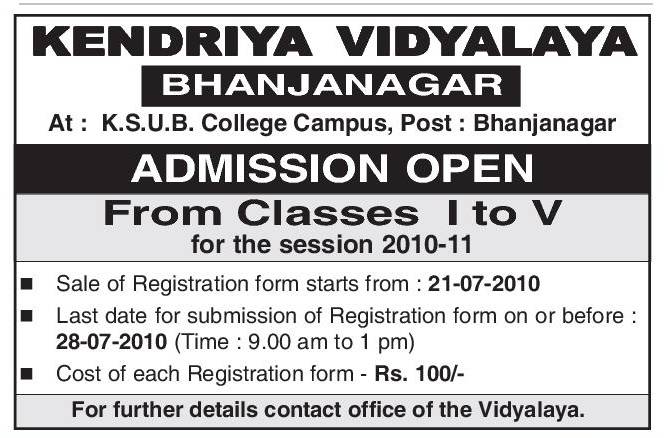
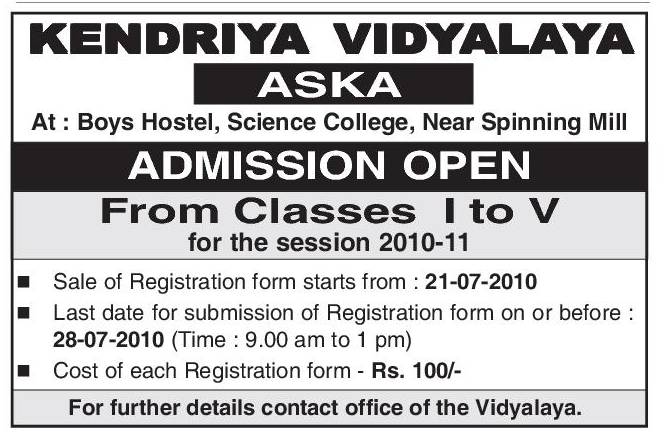
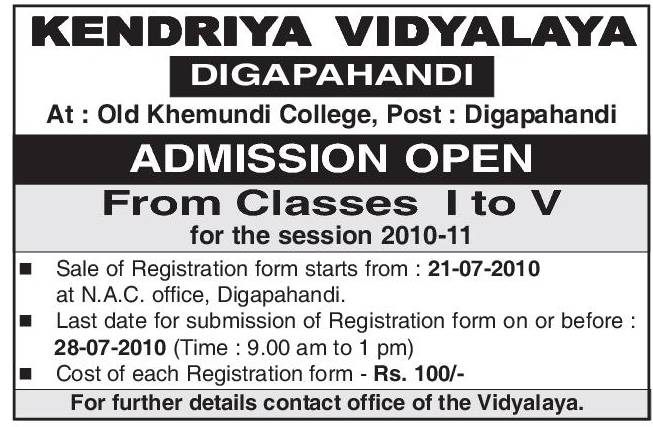
Following is an excerpt from a report in Telegraph.
… two have already started functioning from the Millennium City in Cuttack.
The admission process in the two schools will commence from the current academic session, the notification for which has already been published by the Kendriya Vidyalaya Sangathan (KVS).
The two schools will be operating from Munduli and Nuapatana.
The state government has allotted land for the construction of the two campuses, the work for which has already started.
Before the construction work is completed, the two schools will be operating from the CRPF campus, and from the Government Press.
“Students starting from standard I to V will be admitted now and soon the schools will be upgraded to standard X. Currently, both the schools will have 45 students each,”…
… the remaining nine schools at Kutra in Sundargarh, Bhanjanagar, Digapahandi and Aska in Ganjam, Murgabadi in Mayurbhanj, and one each at Sonepur, Deogarh, Jajpur and Nuapada will be set up soon.
Based on our bookkeeping in https://www.orissalinks.com/archives/4222 after the above schools are established the only two districts in Odisha that will lack a Central School will be: Kendrapada and Nayagarh.
July 19th, 2010
Following is extracted from multiple sources including http://www.aicte-india.org/excel/29jun/ORISSA.html.
| College |
M.Tech branch |
Number of Seats |
| Mahavir Institute of Engineering & Technology, Bhubaneswar (36) |
Computer Science & Engg |
18 |
| |
Electrical & Communication |
18 |
| DRIEMS, Cuttack (90) |
Computer Science |
18 |
| |
ECE |
18 |
| |
EE (Power) |
18 |
| |
Electronis & Instr |
18 |
| |
IT |
18 |
| Synergy, Dhenkanal (72) |
Computer Science & Engg |
36 |
| |
Electrical & Comm. (VLSI & Embeded System) |
18 |
| |
Electrical & Electronics (Power Electronics & Drives) |
18 |
| Majhighariani, Rayagada (36) |
BioTechnology |
18 |
| |
Mechanical Engineering |
18 |
| East, Bhubaneswar (36) |
Computer Science & Engineering |
18 |
| |
Electronics & Telecommunication |
18 |
| CIPET, Bhubaneswar (54) |
Material Sc & Technology (M.SC) |
18 |
| |
Plastic Engineering (M.Tech) |
18 |
| |
Polymer Nano Technology |
18 |
| Orissa Engineering College, Bhubaneswar (36) |
Computer Science & Engineering |
18 |
| |
Mechanical System Design |
18 |
| IIIT, Bhubaneswar (25) |
Computer Science & Engineering |
25 |
| Krupajal, Bhubaneswar (72) |
Computer Science & Engineering |
18 |
| |
Power Electronics & Drives |
18 |
| |
Communication Engineering |
18 |
| |
Heat Power Engineering |
18 |
| CEB, Bhubaneswar (54) |
Computer Science & Engineering |
18 |
| |
Electrical & Communication |
18 |
| |
Thermal Engineering |
18 |
| C V Raman, Bhubaneswar (180) |
Industrial Engineering |
18 |
| |
Chemical Engineering |
18 |
| |
Computer Science & Engineering |
36 |
| |
Electrical (Power System) Engg |
18 |
| |
Electronics and Communication |
36 |
| |
Heat Power Engineering |
18 |
| |
IT |
18 |
| |
Mechatronics |
18 |
| Konark Institute, Bhubaneswar (36) |
Computer Science & Engineering |
18 |
| |
Electrical & Communication |
18 |
| NM Institute, Bhubaneswar (36) |
Power Electronics & Devices |
18 |
| |
Mechanical Engineering |
18 |
| Techno, Bhubaneswar (36) |
ECE |
18 |
| |
EEE |
18 |
| Gandhi Engineering College, Bhubaneswar (36) |
Computer Science & Engineering |
18 |
| |
Electrical & Communication |
18 |
| GITA, Bhubaneswar (36) |
Electrical / Electrical & Elex |
18 |
| |
Mechanical Engineering |
18 |
| Silicon, Bhubaneswar (72) |
Computer Sc & Engineering |
18 |
| |
Electrical / Electrical & Elex |
18 |
| |
Electronics &Telecommunication |
36 |
| GIET, Gunupur (144) |
Applied Elex & Instrumentation |
18 |
| |
Computer Science & Engineering |
18 |
| |
Machine Design |
18 |
| |
Thermal Engineering / Heat Power Engg. |
18 |
| |
CAD/CAM |
18 |
| |
Electronics & Comm. Engg. |
18 |
| |
Industrial Engineering |
18 |
| |
Power Electronics Engg. |
18 |
| IMIT, Cuttack (18) |
IT |
18 |
| NIST, Berhampur (54) |
VLSI & Embedded System Design |
18 |
| |
Wireless Communication Technology |
18 |
| |
Electronics & Communication Engineering |
18 |
IIPM, Kansbahal (0)
|
Production Management |
|
IMMT Bhubaneswar (10)
|
Material Research Engineering |
10 |
| IIT Kharagpur, Bhubaneswar Center (50) |
Electrical Engineering (3yr weekend and after hrs M.Tech) |
25 |
| |
Electronics & Communication Engineering (3yr weekend & after hrs M.Tech) |
25 |
| Utkal University, Bhubaneswar (30*) |
Computer Science |
30 |
| |
M.E in Computer Sc and Eng with specialization in Knowledge Engineering |
* |
| KIIT University, Bhubaneswar (144*) |
Water Resource Engineering – Civil |
18* |
| |
Construction Engineering & Management |
18* |
| |
Electrical |
18* |
| |
Mechanical |
18* |
| |
Computer Science |
18* |
| |
Electronics & Telecommunication |
18* |
SOA University, Bhubaneswar (144*)
|
Computer Science & Eng. |
18* |
| |
Applied Electronics & Instrumentation Engg. – VLSI Design & Embedded System) |
18* |
| |
Mechanical Engg. – Thermal Engineering |
18* |
| |
Electrical Engg. — Power Electronics & Drives |
18* |
| |
Electronics & Telecommunication Engg. – Telecommunication System Engineering |
18* |
| |
IT |
18* |
CET, Bhubaneswar (107)
|
Computer Science & Engg |
13 |
| |
IT |
18 |
| |
Industrial Engineering & Management |
18 |
| |
Structural Engineering |
18 |
| |
VLSI & Embedded Systems |
10 |
| |
Mechanical System Design & Dynamics |
10 |
| |
M.Architecture |
20 |
ABIT, Cuttack (20)
|
M.Architecture |
20 |
NIT Rourkela (288)
|
Biotechnology & Medical Engineering |
18 |
| |
Ceramic Engineering |
18 |
| |
Chemical Engineering |
18 |
| |
Civil Engineering – Soil Mechanics & Foundation Engg |
18 |
| |
Civil Engineering – Structural Engineering |
18 |
| |
Computer Science & Engineering- Computer Sc |
18 |
| |
Computer Science & Engineering- Info. Security |
18 |
| |
Electrical Engineering – Electronics Systems & Communication |
18 |
| |
Electrical Engineering – Power control & Drives |
18 |
| |
Electronics & Communication Engineering – Telematics & Signal Processing |
18 |
| |
Electronics & Communication Engineering – VLSI Design & Embedded Systems |
18 |
| |
Mechanical Engineering – Machine Design & Analysis |
18 |
| |
Mechanical Engineering – Production Engineering |
18 |
| |
Mechanical Engineering – Thermal Engineering |
18 |
| |
Metallurgical & Materials Engineering |
18 |
| |
Mining Engineering |
18 |
VSSUT, Burla (152)
|
Communication System |
18 |
| |
Heat Power Engineering |
12 |
| |
Hydraulic & Irrigation Engineering |
18 |
| |
Machine Design & Analysis |
12 |
| |
Power system Engineering |
18 |
| |
Production Engineering |
12 |
| |
Structural Engineering |
13 |
| |
Transportation Engineering |
13 |
| |
Computer Science & Engg |
18 |
| |
Manufacturing Systems |
18 |
IGIT Sarang (54*)
|
Electrical – Power Electronics & Drives |
18* |
| |
Civil – Environmental Science & Engineering |
18* |
| |
Mechanical – Mechanical System Design |
18* |
| OUAT, Bhubaneswar (*) |
Agricultural Engineering |
* |
| Sambalpur University (20) |
Food Science & Technology |
20 |
| SUIIT, Sambalpur (24) |
Computer Science |
24 |
The * implies that I am not sure of the number. The number I have in that case may be a few years old. The above adds up to 1830+372* seats total. Out of which 1112+318* seats are in the greater Bhubaneswar (including Dhenkanal) area.
My guess is that majority of these M.Tech’s (at least 50-60%) would go into teaching. This should definitely help the faculty quality of the engineering colleges and programs in Odisha. In a few years IIT Bhubaneswar is going to start M.Tech. That would help the situation further.
July 16th, 2010
Earlier in https://www.orissalinks.com/archives/4700 we reported about 8 companies signing MOU with Odisha government to establish ITCs. Those companies were: Orissa Power Generation Corporation (Hemagiri), Tata Power Ltd (Banki), Emami Paper Mills (Balgopalpur), RSB Metaltech (P) Ltd (Kalyansinghpur), Surrendra Mining Industries Ltd (Bonei), Monnet Ispat and Energy Ltd (Teleibani), Uttam Utkal Steels (Jhumpura), Ind-Barath Energy (Utkal) Ltd (Lakhanpur).
New reports mention 13 additional companies signing similar MOUs. Following is an excerpt from a report in Economic Times.
The companies which signed MoUs on Friday include Action Ispat and Power Private Limited, Adhunik Metaliks Limited, Crackers India (Alloys) Limited, MGM Steels Limited, Posco India Limited, Rungta Mines Limited, SSL Energy Limited, CESC Limited, KVK Nilachal Power Limited, GMR Kamalanga Energy Limited, VISA Power Limited, Essar Steel Orissa Limited and Mahanadi Aban Power Co Limited.
Action Ispat will set up an ITC at Kirimira block of Jharsuguda district while Adhunik Metaliks will have its centre at Koida in Sundergarh district.
Similarly, Crackers India will establish its two ITCs at Kalampur in Kalahandi districts and Champua block in Keonjhar district.
MGM Steels has proposed to set up its ITC at Odapada in Dhenkanal district while Posco’s centre will come up at Erasama block of Jagatsinghpur district.
The Rungta Mines ITC will be set up at Dhenkanala, SSL ITC at Kholikote in Ganjam district, CESC ITC at Dampara in Cuttack district, KVK Nilachal ITC at Krushnaprasad in Puri district, GMR Kamalanga ITC at Bheden in Bargarh district, VISA Power ITC at Bhapur in Nayagarh district and ESSAR Steel at Telkoi in Keonjhar district.
Mahanadi Aban Power Co Limited would set up two ITCs at Binika in Sonepur district and Banarpal in Angul district.
July 10th, 2010
Following is an excerpt from a report in Economic Times.
Plans for setting up 20 new Indian Institutes of Information Technology (IIITs) is likely to be shelved with the finance ministry suggesting that the proposal could be considered for the Twelfth Five-Year Plan period.
The HRD ministry had suggested that the institutes be set up in the private-public partnership mode during the current five year plan.
The Eleventh Five Year Plan comes to a close in 2012. The ministry had outlined its proposal for consideration by the Expenditure Finance Committee. The Planning Commission had already given an in-principle approval to the proposal.
“The finance ministry did not agree to the proposal of setting up of 20 IIITs in the Eleventh Plan. It has said the scheme can be considered during the Twelfth Plan,” an official said.
June 28th, 2010
Following are excerpts from a report in tathya.in. (The website of the Centurion group is http://www.cgi.ac.in/.)
… Proposal to establish the Centurion University of Technology and Management (CUTM) by the Department of Higher Education (DHE) has received green signal of the Chief Minister Naveen Patnaik.
… And latest is Centurion University of Technology and Management (CUTM) in Gajapati will go a long way in serving the state in general and KBK in particular, said a senior official.
Once the proposal receives clearance of the State Cabinet, a bill will be presented in the Odisha House to enact a law to establish the university by JITM Trust.
This is a great move by the Odisha government. In recent years JITM of Parlakhemundi has had many innovative programs. Making it a university is a just reward and a big boon to the backward Gajapati area.
I hope other areas of Odisha take note of this and try to learn from this. It is easier for a government to help, if people take their own initiatives.
Another institution that deserves similar reward is the Gandhi group of institutions, with its initial (and the best) college GIET in Gunupur, also in a backward district (Rayagada). I hope the Odisha government also upgrades the GIET in Gunupur, the largest engineering college in Odisha, to a university.
NIST Berhampur also deserves similar reward as it is located in Ganjam (also considered a backward district and part of the backward South Odisha) and is among the top engineering colleges in Odisha.
Based on quality, Silicon Bhubaneswar also deserves to become a university. Similarly, Hi-tech because of its medical college also deserves to become a university. (Note: The two other private medical coleges of Odisha are part of deemed universities.)
In general, the government should make universities out of any engineering college that is in a backward district but yet is among the top 20 (with respect to student preferences), groups with private medical and engineering colleges in any location, and top 5 private engineering colleges in any location. This should be done every 4-5 years so that every college does not become a university.
Following are excerpts from a report in tathya.in on IIIT Bhubaneswar.
State Government has decided to accord the Unitary University status to IIIT-Bh so that it will enjoy academic, administrative and financial autonomy.
Chief Minister Naveen Patnaik has given consent to the proposal of Ramesh Chandra Majhi, Minister IT in this regard.
… State Cabinet will take a call on the issue on 9 June, said sources.
June 8th, 2010
Following is an excerpt from a PTI report.
Plans are afoot to develop Orissa’s second flying training institute at Rangeilunda airstrip near here.
The ministry of Civil Aviation wants to use Rangeilunda airstrip as a flying training institute. Binodini Devi, a senior captain from the ministry, visited the airstrip recently and discussed the project with engineers of the works department here, Ganjam district collector V K Pandian said.
… A senior pilot of the ministry also visited the site last week and asked the works engineer to develop it as a Visual Flight Rule (VFR) airstrip and to provide at least two rooms to conduct the pilot training institute.
"We have agreed to provide all necessary infrastructure facilities to the ministry to use Rangeilunda airstrip as a flying training institute," K Pandian said.
May 30th, 2010
India has several DAV Colleges and Schools. A listing of them can be obtained from http://www.davcmcdircol.org/index2.aspx. Some of their top colleges in India are DAV College Chandigarh and Hansraj College Delhi. They currently have 4 colleges in Odisha.
| 44. |
DAV School of Business Management |
Unit 8, Bhubneshwar, Orissa – 769004 |
0672-560539(O) |
dsbmbbsr@gmail.com
http://dsbm8.org
|
Mr. D.N. Mishra |
| 45. |
DAV College |
Titlagarh, P.O. Bhatipara, Bolangir, Orissa – 767042 |
06655-220523(O), 220344(R), 9437153529(M) |
bsnpsar@gmail.com |
Shri Bhawani Shankar Negi |
| 46. |
Khetrabasi DAV College |
Khurda, Nirakarpur, Orissa – 752019 |
06756-222024(O), 9437010336(M) |
principal_bkdav@yahoo.com |
Shri S. Maharana |
| 47. |
DAV Centre for Management Development in Agriculture & Environment |
N-4/16, Civil Township, Rourkela, Sundergarh, Orissa – 769004 |
0661-266405(O), 2664724(PP), 9437022010(M) |
himansukm@hotmail.com |
Dr. H. K. Mohanty |
Based on the claims in their web page, the DAV School of Business Management seems to be doing very well.
Currently there are four DAV Public Schools in the Bhubaneswar area.
There are many DAV Schools in rest of Odisha. This includes
- DAV School Berhampur
- Four DAV Schools in Cuttack city (Raja Bagicha, CDA, Gandharpur, Alisa Bazaar)
- DAV School, Basanti Colony Rourkela
- DAV School Sovarampur Balasore
- DAV School Paradeep
- DAV Talcher Thermal
- DAV MCL
- DAV Jharsuguda
- DAV Burla
- DAV Badambagarh, Cuttack
- DAV Brajarajnagar
- DAV Sundergarh
See http://www.adhyapak.com/schools/orissa/orissa_schools2.html for a bigger list.
May 3rd, 2010
Next Posts
Previous Posts