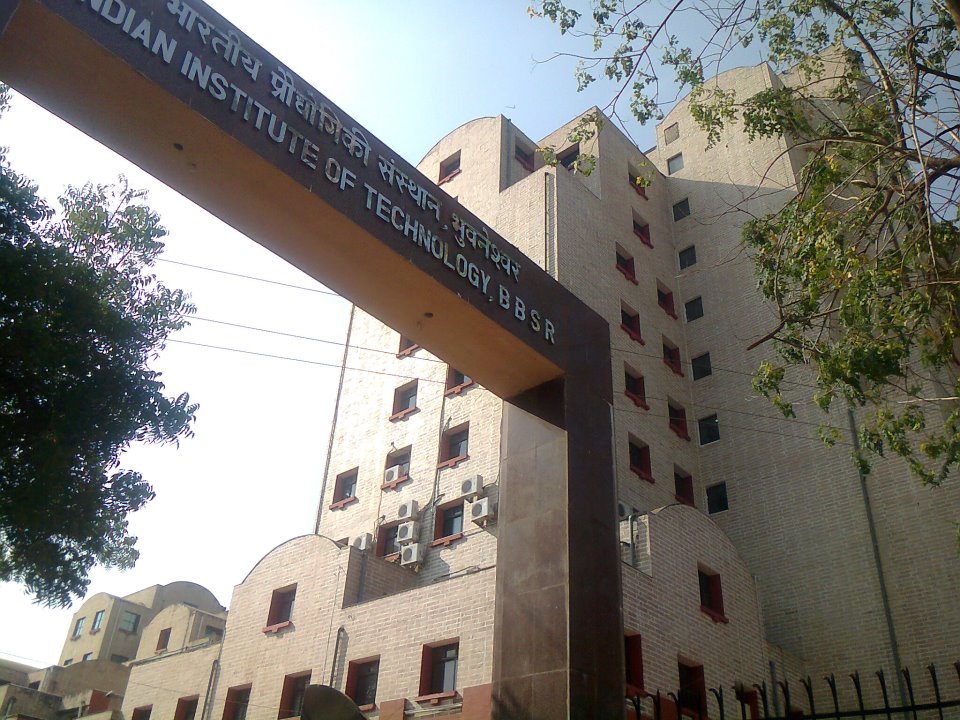
So far IIT Bhubaneswar only offered B.Tech and Ph.D programs. It has now advertised its new M.Tech programs which are actually joint M.Tech-Ph.D programs that allow one with GPA greater than 8 (after doing the M.Tech coursework) to seamlessly transition to a Ph.D program or just get an M.Tech degree. The details of the program is given at http://www.iitbbs.ac.in/applicationforms/advt/Information-for-Admission-to-Joint-M.Tech.-Ph.D.Programme.pdf.
Following are some excerpts from that.
INDIAN INSTITUTE OF TECHNOLOGY BHUBANESWAR
INFORMATION FOR JOINT M. TECH. – PH.D. PROGRAMME Joint M. Tech. – Ph. D. Programme in:
* Applied Geosciences
* Civil Engineering
* Climate Science & Technology
* Electronics & Communication Engineering
* Materials Science and Engineering
* Mechanical Engineering
Selection: Valid GATE score followed by Written Test and/or Interview. Opting for Ph. D. Programme:
Desirous students with CGPA greater than equal to 8 after the 3rd semester of the M. Tech. programme with an aptitude towards research can opt for Ph. D. Those students with CGPA less than 8 will exit with M. Tech. degree after successfully completing the fourth semester and the credit requirements.
… Number of Seats: 18 in each programme. (Reservation as per GOI norms applicable).
In addition to the above mentioned joint M.Tech/Ph.D program IIT Bhubaneswar has also advertised for direct admission to its Ph.D programs in each of its seven schools .
See http://www.iitbbs.ac.in/applicationforms/advt/Information-for-Admission-to-Ph.D.Programme.pdf for details.
With these programs added and currently with only 120 B.Tech students admitted per year, IIT Bhubaneswar will have more graduate students (M.Tech and Ph.D) admitted per year than undergraduate students (B.Tech). This is a good direction and IIT Bhubaneswar should strive to have more graduate students than undergraduate students thus putting emphasis on research.
April 14th, 2012
Following are recent news snippets on this.
From http://www.igovernment.in/site/14-world-class-varsities-now-12th-plan dated 30th March 2012.
The proposal for setting up of world class universities in 14 states is awaiting clearance by the Law Ministry, Minister of State for Human Resource Development D Purandeswari said.
Replying to questions in the Rajya Sabha, Purandeswari said the government is also planning to set up higher educational institutions in the 374 educationally backward blocks in the country.
The National Development Council had approved setting up of 14 world-class universities for innovation across the 11th and 12th plan periods on the public private partnership model.
The innovation universities are part of the Ministry of Human Resource Development’s (MHRD) "brain gain" policy to attract global.
The proposed universities will be set up in Bhubaneswar, Kochi, Amritsar, Greater Noida, Patna, Guwahati, Kolkata, Bhopal, Gandhinagar, Coimbatore, Mysore, Pune, Visakhapatnam and Jaipur.
From http://twocircles.net/2012apr10/14_innovation_universities_be_set_india.html dated April 10th 2012.
Fourteen innovation universities would be set up in the country during the 12th Five Year Plan, Union Minister of State for Planning, Science and Technology and Earth Sciences Ashwani Kumar said here Tuesday.
From http://ibnlive.in.com/generalnewsfeed/news/govt-to-set-up-14-innovation-universities/984605.html dated April 10th 2012.
Chandigarh, Apr 10 (PTI) The government today said it will set up 14 innovation universities during the 12th five- year plan. "We are going to open 14 innovation universities," Union Minister of State for Planning Ashwani Kumar told reporters here. Kumar was in the city to review the flagship programmes of the state. The innovation universities are aimed at making India a global knowledge hub. Each one to be built around a theme or subject, these unique universities will enjoy total autonomy with regard to appointments, collaborations, resource generation and nomenclature of degrees awarded by it.
From http://www.deccanchronicle.com/channels/cities/chennai/innovation-varsity-kovai-soon-066 dated April 2nd 2012.
The Union government has added another feather to Tamil Nadu’s cap by proposing to set up a university of innovation at Coimbatore.
This will be one of the 14 universities to be set up in the country.
The Centre will table Universities for Innovations Bill, 2011, in Parliament soon.
The Bill will provide an in-principle approval for establishing universities for innovation. Some of the innovation universities will be in partnership with private players also and they will be made eligible for the government’s funding for research activities and student scholarships.
The Union HRD minister will discuss the proposal with education secretaries of all state governments on April 13 in New Delhi.
April 10th, 2012
Following are excerpts from a report in tathya.in.
Chief Minister Naveen Patnaik has cleared the proposal of the MEF, which is eyeing to expand its footprint all over the country in general and eastern India in particular.
This will be a State University, for which a bill will be presented in the Odisha Legislative Assembly (OLA), said a senior official in the Department of Higher Education (DHE).
The proposed university will be fourth of its kind and will come up with an investment of Rs.200 crore.
… The proposed University will provide high quality education at the level of under Graduation, Post Graduation, post-PG and Research in Engineering, management, Hospitality, Law, Paramedics, Pharmacy, Education Technology, Media & Journalism, Planning & Architecture, Medicine and general subjects also.
Total student strength of about 10,000 is estimated by the end of five years to achieve the target of 20,000 in 7-8 years as the University is expecting normative growth by 5 per cent per annum.
20 percent seat will be reserved for Person of Indian Origin (PIO), Foreign/NRI/NRI sponsored students as this will be a World Class University.
The proposed University will come up in the outskirts of the Capital City, for which 70 acres of Government land will be provided at a premium of market rate to the promoters of the institution, said sources in Government.
Recently the Chief Secretary headed committee has approved the proposal, which has been green signalled by the Chief Minister, said sources.
March 30th, 2012
Following is an excerpt from a report in Orissadiary.
Odisha Chief Minister, Naveen Patnaik today met the Union Minister for Health & Family Welfare, Ghulam Nabi Azad in New Delhi. Chief Minister informed the Union Minister for Health & Family Welfare that the proposal to raise the number of seats for admission to MBBS Course from 150 to 250, would necessitate significant increase in the infrastructure of the Medical Colleges in the State.
He requested that the three Medical Colleges of the State may be approved for upgradation to AIIMS like Institutions under the Pradhan Mantri Swasthya Suraksha Yojana (PMSSY) along with sanction of Rs.432 crore for the purpose. He added that the State has identified an alternative site for establishment of a Regional Institute of Paramedical Sciences at Bhubaneswar for which Government of India may sanction the funds forming part of Central Share component.
… Chief Minister urged upon the Union Minister to appreciate the just needs of the State for augmenting medical infrastructure and creating new specialized medical institutions. He requested the Union Minister to establish a National Cancer Institute at Bhubaneswar and a Regional Geriatric Centre at SCB Medical College, Cuttack. He further informed that State has already identified 20 acres of land for setting up of the Central Research Institute of Yoga and Naturopathy. Accordingly, Government of India may sanction the required funds to enable early establishment of the Institute along with 100 bedded Hospital, at the earliest.
… The Union Minister assured the Chief Minister that the issues raised by him will receive priority attention of the Ministry. He agreed to provide necessary funds for upgrading the infrastructure of the three Medical Colleges in the State.
… Union Minister promised to take urgent steps for establishing the Regional Institute of Para Medical Sciences at Bhubaneswar.
He assured that the Central Share for the Odisha State Treatment Fund shall be released very shortly and that additional funds will be provided for strengthening the Regional Cancer Centre at Cuttack. Further, the request of Odisha for a stand-alone Cancer Institute will be considered as and when adequate funds are available for the purpose in the Central Budget.
Union Minister agreed to establish a Regional Geriatric Centre at SCB Medical College, Cuttack and requested that Government of Odisha may handover the identified 20 acres of land for setting up of Central Research Institute of Yoga and Naturopathy.
We have been writing the CMO and others about approaching the Health ministry regarding the upgradation of the state medical colleges. See:
It took a long time, but its good that he finally did it.
I hope he also pursues a Central Agricultural University in Odisha. More on this in a separate post.
March 7th, 2012
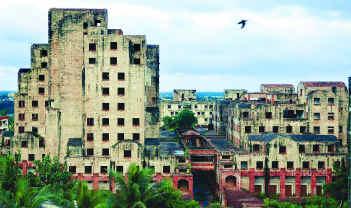
Earlier as per https://www.orissalinks.com/archives/4845 Toshali Plaza looked like the following:
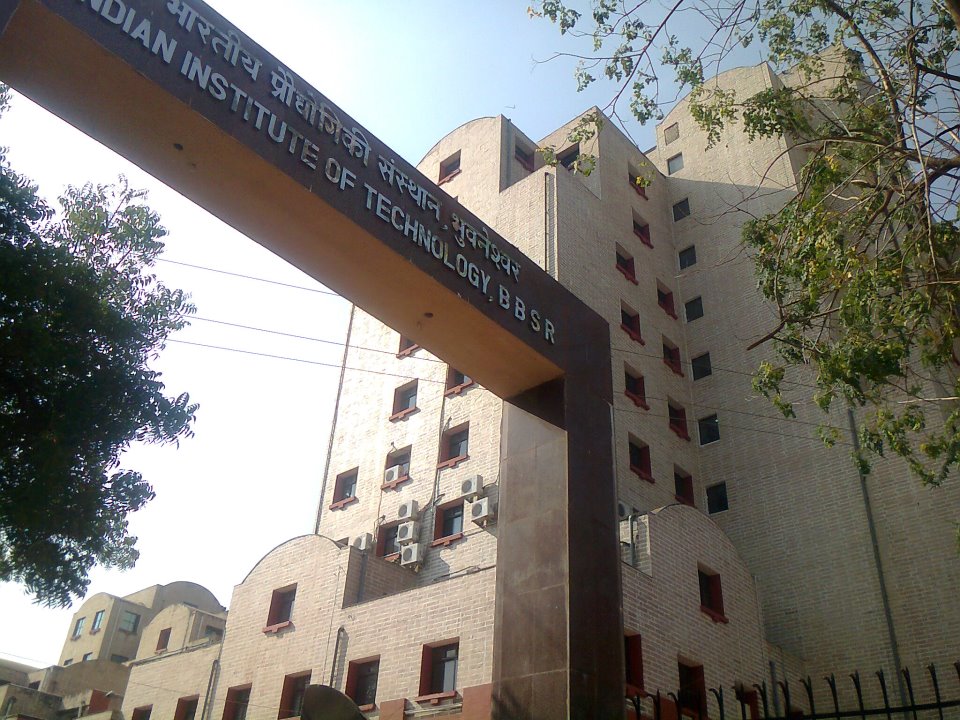
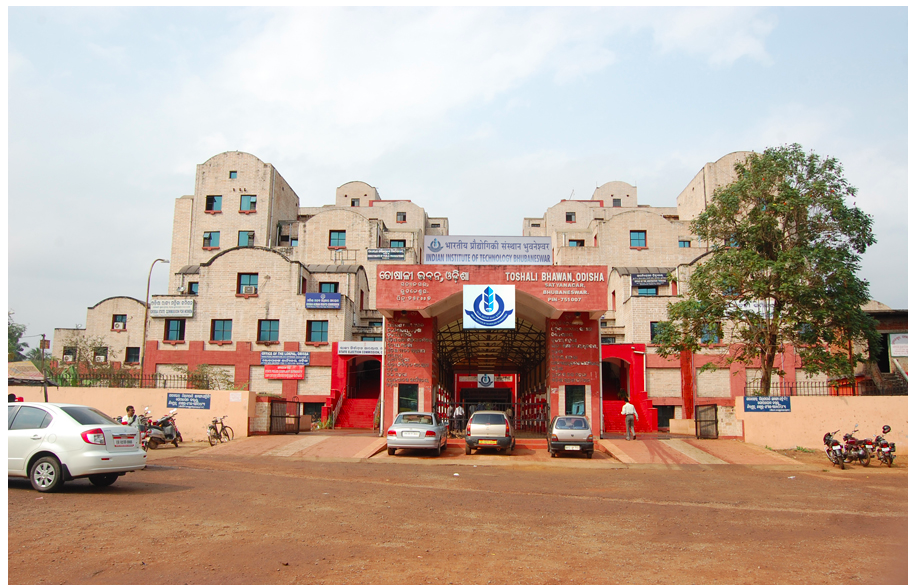
 Now it looks as follows. (Obtained from wikipedia.)
 While its main campus gets built IIT Bhubaneswar has built some new facilities in its Samantapuri campus. Following is how one of the new facilities (a hostel) look. (From wikipedia.)
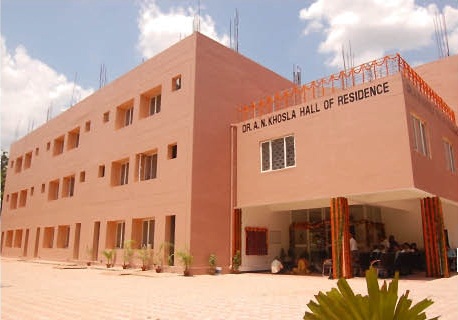
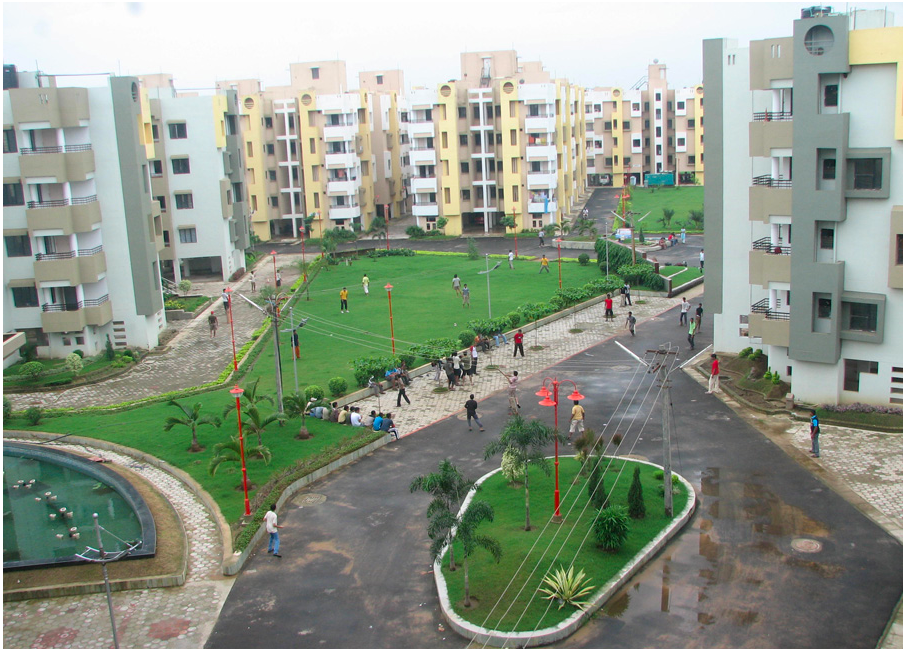
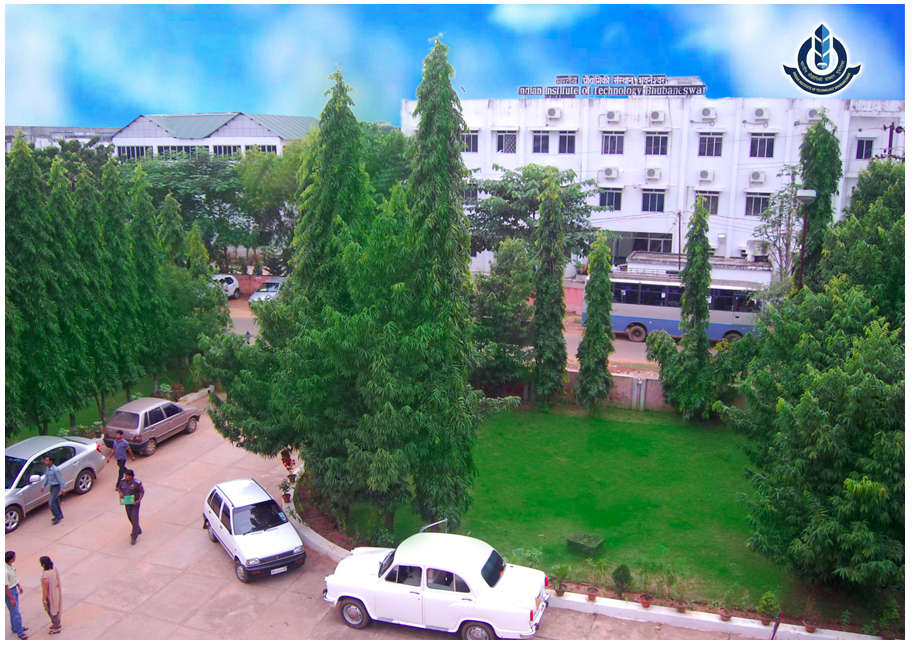
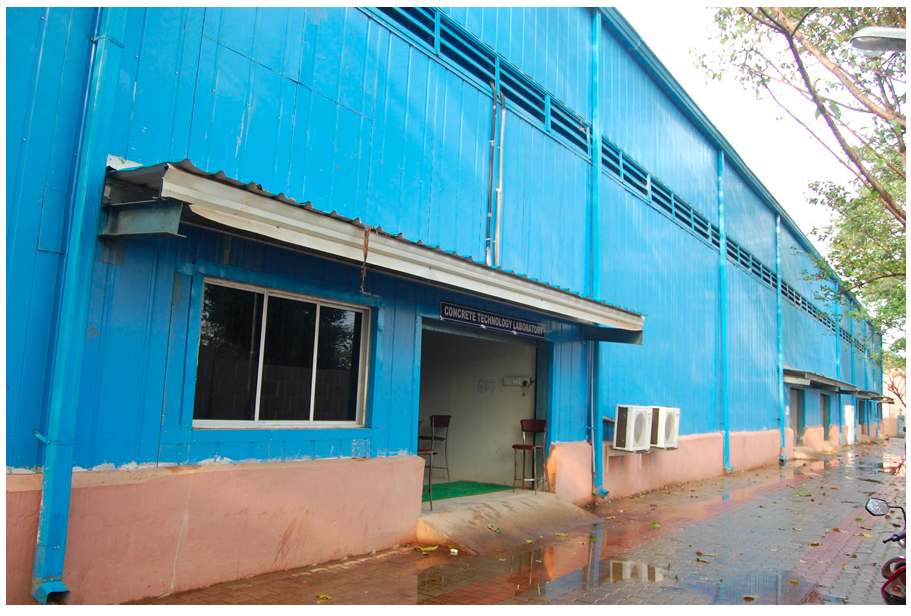
Following are pictures of some of the other building being temporarily used by IIT Bhubaneswar.
SBI Colonly in Kesura: 50-60 apartments are taken on rent here for student accommodation.
IIT Kharagpur extension center in Samantapuri (back of Swosti Premium)
 Workshop Building
March 4th, 2012
The ad is at http://www.aiimsexams.org/pdf/ADMISSION-NOTICE-MBBS-2012.pdf. The prospectus is at http://www.aiimsexams.org/pdf/MBBS_Prospectus_2012.pdf. Following is the admission notice.
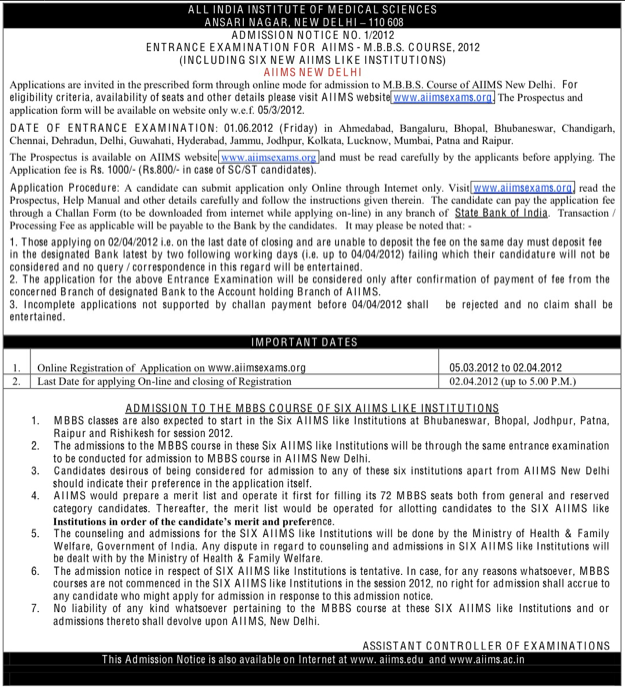
Following are excerpts from the prospectus.
Other AIIMS like Institutes Under the Pradhan Mantri Swasthya Suraksha Yojana
6 New All India Institutes of Medical Sciences are being established similar to AIIMS, New Delhi. Government of India has decided that the Academic Session in six New AIIMS at Bhopal, Patna, Jodhpur, Rishikesh, Raipur and Bhubaneswar starts in August 2012. The proposal is for an intake of 50 students for each of the institutions. The Ministry after deliberation took the view that for the first academic session (2012-2013), selection for admission should be done through the same entrance examination through which candidates are selected for AIIMS New Delhi. The counselling and admission in Six New AIIMS will be done by the Ministry of Health & Family Welfare, Government of India. Any dispute in regard to counseling and admission to six new AIIMS will be dealt with by Ministry of Health and Family Welfare, Nirman Bhavan, New Delhi.
1:0 NUMBER OF SEATS & RESERVATION
AIIMS NEW DELHI
A. Each year 77 (seventy seven) seats are available for admission to the graduate medical course, leading to the award of the degree of M.B.B.S. by the All India Institute of Medical Sciences,Delhi. Out of these, 11 (eleven) seats are reserved for the Scheduled Castes, 5 (five) seats are reserved for the Scheduled Tribes, 19 (nineteen) seats are reserved for Other Backward Classes and 5 (five) seats are reserved for the Foreign Nationals nominated by the Government of India and 37 (thirty seven) seats for General Category. For Indian Nationals, 3% reservation for orthopaedic physically handicapped shall be provided on horizontal basis, in the seats available. If requisite number of suitable candidates are not available to fill the seats reserved for the Scheduled Castes, the same are filled out of the candidates belonging to the Scheduled Tribes and vice versa. In case suitable candidates are not available from the above two reserved categories, Orthopaedically handicapped and OBCs, the vacant seats will be filled by the candidates from the general category.
SIX AIIMS LIKE INSTITUTIONS
B. From August 2012, Six New AIIMS like Institutions (viz: Bhopal, Patna, Jodhpur, Rishikesh, Raipur and Bhubaneswar) will start with an intake of 50 students each. The reservation policy followed will be 7.5% ST, 15% SC and 27% OBC. For Indian Nationals, 3% reservation for Orthopaedic physically handicapped shall be provided on horizontal basis, in the seats available.
… The candidate is required to go through the prospectus carefully and acquaint himself/herself with all requirements with regard to filling in of the online application form. Candidates are advised to give order of preference for the Six New AIIMS, apart from AIIMS New Delhi in the Application Form.
… For enquiries relating to Counseling and Admission to Six new AIIMS,please contact from 1st July, 2012 onwards:
PMSSY Section, Room No.22 ‘A’ Wing, Ministry of Health and Family Welfare, Nirman Bhawan , Maulana Azad Road, New Delhi-110 011 Tel Fax: No- 011-2306187, Website: www.mohfw.nic.in & Email : admissionpmssy@gmail.com
March 3rd, 2012
Following is from Dharitri.
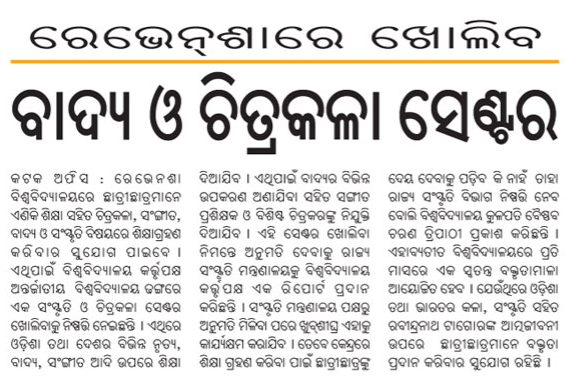
February 28th, 2012
Following is from Samaja:
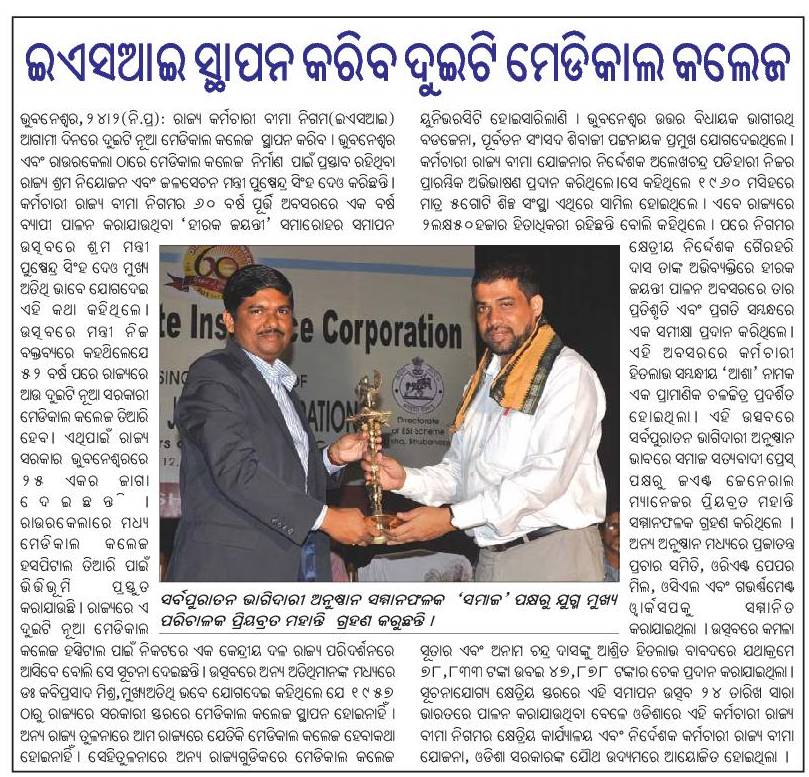
Following is from Sambada: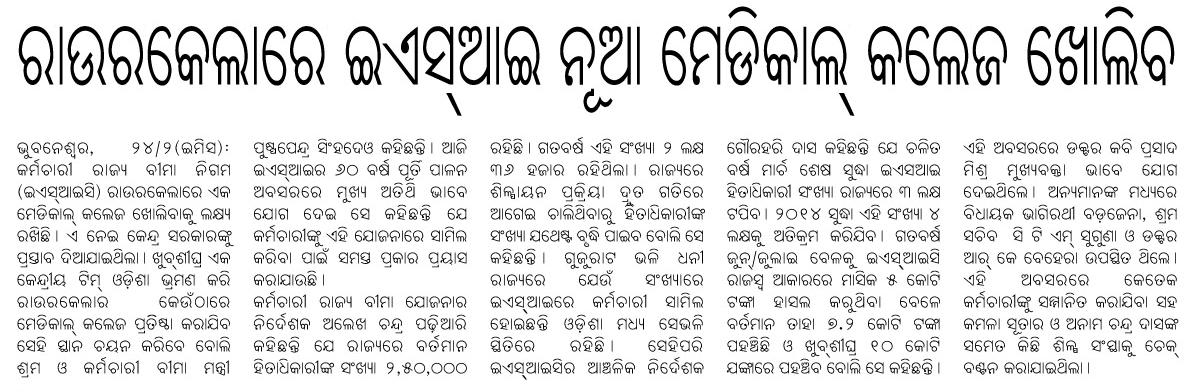
Following is from Dharitri: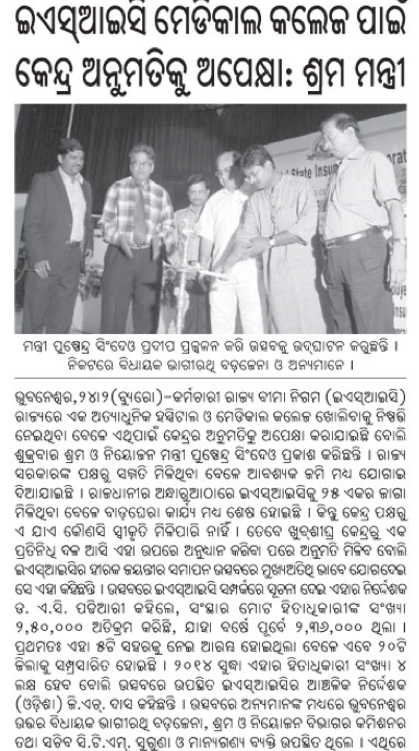
February 25th, 2012
Following is an excerpt from a report in Business Standard.
The fist academic session of the city centre of All India Institute of Medical Sciences (AIIMS) medical college is set to begin from August this year. The 500-bed multi-speciality hospital is expected to start functioning from December 2012.
“The session for the first batch of students for AIIMS medical college will begin from August 2012 with an intake of 50 seats. We expect the hospital to be operational from December this year. Work on the AIIMS campus is 65 per cent complete,” said P K Pradhan, Union health secretary. On the state government’s demand for funds for seat hike in three government run medical colleges, Pradhan said, “The Chief Secretary has said that the state government intends to raise intake of each of three medical colleges from 150 to 250. This requires an investment of Rs 100-150 crore per college for infrastructure upgrade. We are coming up with a scheme wherein we can provide funds to the state government for upgradation of infrastructure at medical colleges.”
Various Odia papers report that as of today 65% of the Hospital building construction and 70% of the college building construction are completed.
January 31st, 2012
Following is an excerpt from a report in Daily Pioneer.
Initially proposed to be completed by December 2011 with 100 UG seats each, medical colleges are now expected to complete by March 2012. “For this academic session, test will be conducted for 50 MBBS seats. A lot of nitty-gritty is left before the colleges which can take up the target capacity of 100 seats,” a senior health official said.
However, in what could cause trouble to the students, those getting admission in AIIMS at Bhubaneswar and Raipur will be asked to head to the other four medical colleges for their study this academic session while Directors of Patna and Bhopal have been given additional charge of AIIMS in Rishikesh and Jodhpur respectively, informed the official.
January 8th, 2012
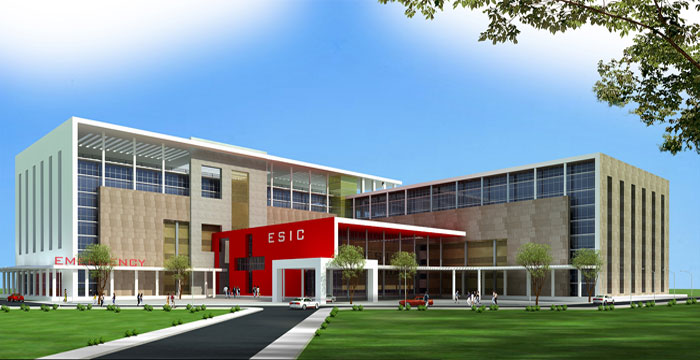
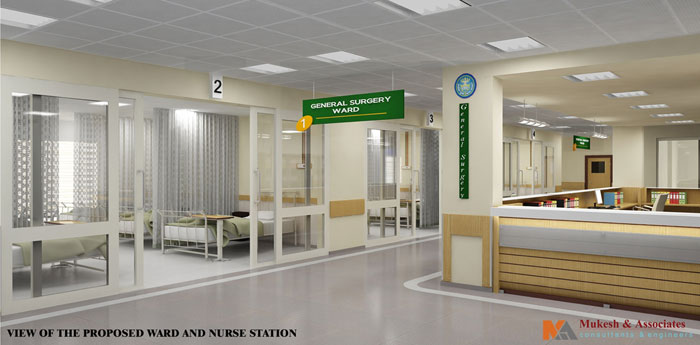
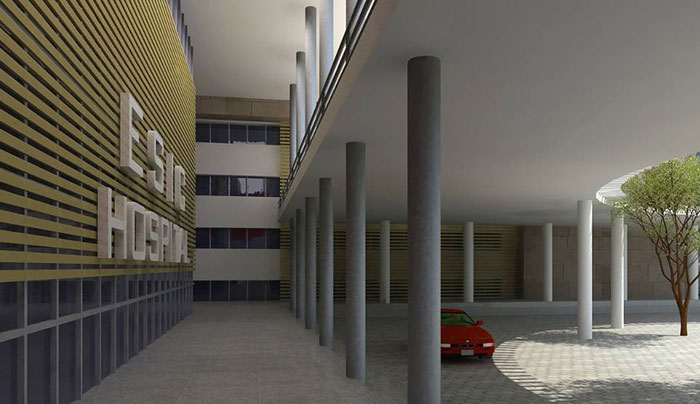
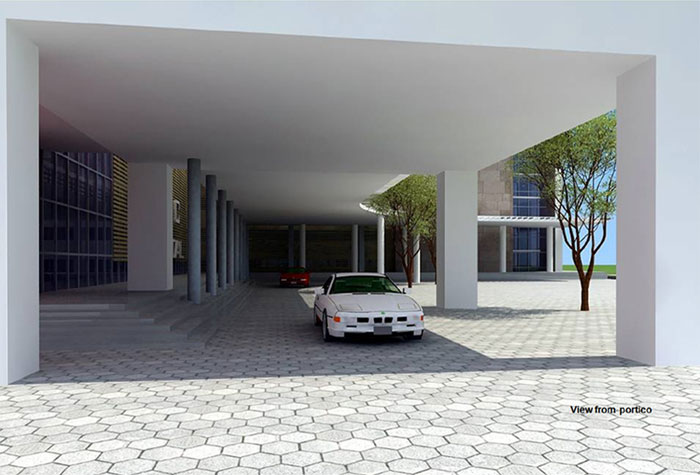
The following pictures are from http://mukeshassociates.com/bhubaneswar-hospital.html.
Front View
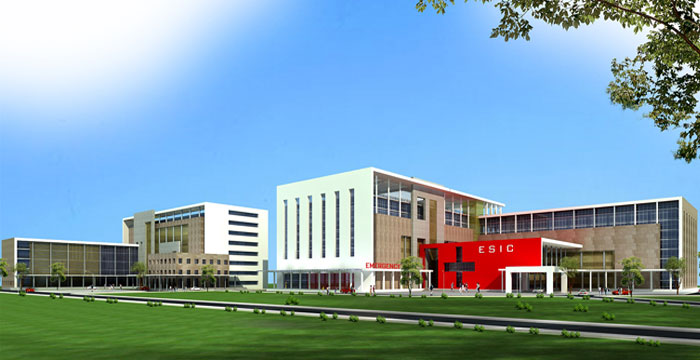
Close up of the main building
A ward with nurse station
Administration Block
View from portico
January 5th, 2012
Following is from a report in Times of India.
The report of the steering committee on health for the 12th five year plan (incorporating reports of all working groups and deliberations in Committee meetings) has suggested opening of four new prototypes of premiere All India Institute of Medical Sciences ( AIIMS) in addition to the eight already approved.
… Union health ministry is in the process of constructing six AIIMS-like institutes in Patna, Raipur, Bhopal, Bhubaneswar, Jodhpur and Rishikesh at a cost of Rs 847 crore each, up from Rs 332 crore that was originally estimated. There are expected to be ready by July, 2012.
The Planning Commission has given approval to two more AIIMS-like institutes in Uttar Pradesh and West Bengal. …
With 26 medical institutions have been approved for upgrade, the panel has said an additional 30 medical colleges established at least 20 years ago be identified for support through Pradhan Mantri Swasthya Suraksha Yojna.
“Other medical colleges, in private or voluntary sector may also be considered for upgrade and strengthening for starting new postgraduate disciplines and increasing post-graduate seats,” the report says.
In Odisha, as per the timeline, SCB medical college in Cuttack was established in 1944, VSS in Burla was established in 1959 and MKCG in Berhampur was established in 1962. All three of them satisfy the above mentioned criteria of being established 20 years ago. Considering that none of the 26 approved upgrades are from Odisha, and 4 states currently are approved for both new AIIMS-like institutes as well as upgrades (WB,Bihar, MP, UP) the Odisha government should push for all three of its existing government medical colleges to be upgraded during the 12th plan.
December 31st, 2011
Following are excerpts from a report in Times of India.
Union health minister Ghulam Nabi Azad on Friday asked the Medical Council of India (MCI) to prepare a series of medical reforms within a month. One of the crucial reforms is regarding land required to start medical colleges.
Now, the ministry allows a medical college to start on a 10-acre plot in nine cities – Mumbai, Chennai, Kolkata, Delhi, Bangalore, Hyderabad, Ahmedabad, Kanpur and Pune. It is planning to expand this list and include state capitals of Orissa, Uttar Pradesh, Bihar, Jharkhand, Chhattisgarh and Rajasthan, which are not only facing acute shortage of human resources, but also have poor health indicators.
The ministry will allow these states to have split campuses – hospital and medical college within 10km of each other. This facility is available only in north-eastern and hill states, which require 20 acres of plot to start a medical college.
… The high-power expert group (HLEG) of the Planning Commission working on universal health coverage has proposed a phased addition of 187 colleges. The HLEG said by 2015 under phase A, 59 new medical colleges will admit students in the 15 states of Assam, Bihar, Chhattisgarh, Gujarat, Haryana, Jammu and Kashmir, Jharkhand, Madhya Pradesh, Maharashtra, Meghalaya, Orissa, Punjab, Rajasthan, UP and West Bengal.
By 2017, 13 of these states will have an additional 70 medical colleges, and by 2022, 58 additional colleges will be built in two additional phases (2017-20 and 2020-22). By 2022, India will have one medical college per 25 lakhs in all states except Bihar, Uttar Pradesh and West Bengal.
"The implementation of HLEG’s recommendations will enable the additional availability of 1.2 lakh doctors by 2017 and another 1.9 lakh doctors between 2017 and 2022. With this rate of growth, it is expected that the HLEG target of one doctor per 1,000 will be achieved by 2028," the report said.
These easing of norms would indeed help. In particular, the plan to expand Capital Hospital in Bhubaneswar to a medical college is stuck because of the land requirements. With the ease of the norms many large hospitals, which already have or are close to having the required number of beds, can have an associated medical college.
The ease of the norms should be such that many district hospitals can also have medical colleges. That will spread the medical colleges to other districts.
December 24th, 2011
Following is an excerpt from an Indian Express report in ibnlive.com.
The 10 proposed agro-polytechnics by the Odisha University of Agriculture & Technology (OUAT) in the agro-climatic zones of the State would come up by the next academic session beginning July-August. These polytechnics would offer two-year diploma course for Plus-II pass-outs in the disciplines of agriculture, fisheries, animal science and horticulture. While one each polytechnic will be dedicated for horticulture, fisheries, animal science, the remaining seven will impart training on agriculture.
The polytechnics will also provide certificate courses for school dropouts in various disciplines.
… The OUAT had last year proposed to set up the polytechnics aiming to help the grassroots-level people in the field of technology transfer and guiding farmers in improving their economy.
These polytechnics would churn out agro-technicians, who can earn a living by doing agricultural jobs for the farmers on payment basis or just establishing their own ventures such as seed production, nursery management, food processing and preservation and bio-fertiliser production.
There is a great need for such intermediate-level technicians who can convince the local farmers about low-risk technologies and their applications for better yield.
V-C Ray said the agro-polytechnics would function close to agriculture research stations and Krishi Vigyan Kendras as there will be optimum utilisation of teachers, support staff, equipment and appliances and other existing facilities. “If required, additional infrastructure would be set up for the purpose,” Ray said.
December 20th, 2011
An article in Telegraph mentions that Sainik School Bhubaneswar occupies an area of 220 acres. It is located next to Utkal University in a prime location. At present the Bhubaneswar Sainik School has a capacity of 525 students. Its current faculty strength is 28 and it has an adminsitrative staff of 14. It probably has some more maintenance staff.
While the achievement of Sainik School Bhubaneswar has been very good (see excerpt below)
Achievements: So far approximately 600 cadets have become officers in the defence forces through NDA alone. In addition many cadets have got commission through other entries. This school also has been honoured by the achievements of its cadets through various civil services like IAS-14, IPS-07 and allied services – 09. Several have become ministers in the State of Orissa and Nagaland. The cadets making foray in the fields of medical, engineering, merchant navy are plenty and doing the school proud. The highest ranking officers are two major generals and one Air Vice Marshal.
I think the 220 acres in a prime location in a capital city is a gross under utilization of the land for a residential school of 525 students, 28 teachers and 14 academic staffs, unless one explains it away as a green cover.
Following excerpts tell the story of how the Sainik Schools were set up.
Salient Features of Sainik Schools
(a) The entire capital expenditure on land and buildings is met by the respective State Govts who are also required to provide funds for maintenance of infrastructure and for new infrastructural projects. The State Govts also award scholarships on merit cum means basis.
…
Role of Ministry of Defence in Sainik Schools
(a) Ministry of Defence provides scholarships to wards of defence personnel including ex-servicemen. In addition Ministry of Defence provides central assistance to those students who are awarded state scholarships. The sharing of expenditure on fees/scholarships among Central Govt, State Govt and parents is decided by the BOG from time to time.
(b) With effect from financial year 2003-04, the Ministry of Defence has implemented a scheme under which burden of fee and dietary charges are being shared between the Ministry of Defence and the parents in the ratio 3 : 1. Under this scheme all boys studying in Sainik Schools get financial assistance of about Rs.9,000 – 10,000 every year. The scheme also provides incentive to boys who join the NDA by refunding.
Achievements of Sainik Schools a) Aims – So far these schools have contributed about 7,000 officers to the three services. Its students today occupy important positions in all spheres of national activities. Since the schools were founded in early 60s, its cadets have now reached the level of Generals in the Army and equivalent Ranks in the Navy and Air Force.
b) Results – These schools send about 130-160 cadets to the NDA every year. As far as CBSE results are concerned the schools are performing creditably. All efforts are on to improve the results qualitatively.
c) Quality Education – In most of the States Sainik Schools are the only residential institutions and that too located in isolated areas. Thus these schools have been able to contribute significantly to development of education in backward areas and also in carrying out backward area educational integration.
Considering that the state government gave the land and buildings to the school and in most states these schools are in isolated areas, I think it may be worth pondering if the:
(a) Sainik School Bhubaneswar should be relocated to a backward area where it can contribute positively to the area and the existing 220 acres be used more productively; perhaps by turning it to a small Knowledge City, say similar to the 381 acres Knowledeg City in Mohali.
OR
(b) augment the current use by using part of the 220 acres of Sainik School Bhubaneswar to establish a military academy or an armed forces medical school or a DRDO lab, etc. to have better land utilization.
There are many examples similar to (b). For example, IISER Pune is established on NCL (National Chemical Laboratory) land.
This may be a good time to ponder about options (a) and (b) as it is reported that:
The 220-acres of land given by the government for the existing Sainik School in Bhubaneswar established in 1962 continues to be under the general administration department of the government.
December 16th, 2011
Next Posts
Previous Posts