The following is an excerpt from http://ibnlive.in.com/news/coming-up-innovation-centre-for-climate-change/251002-60-117.html.
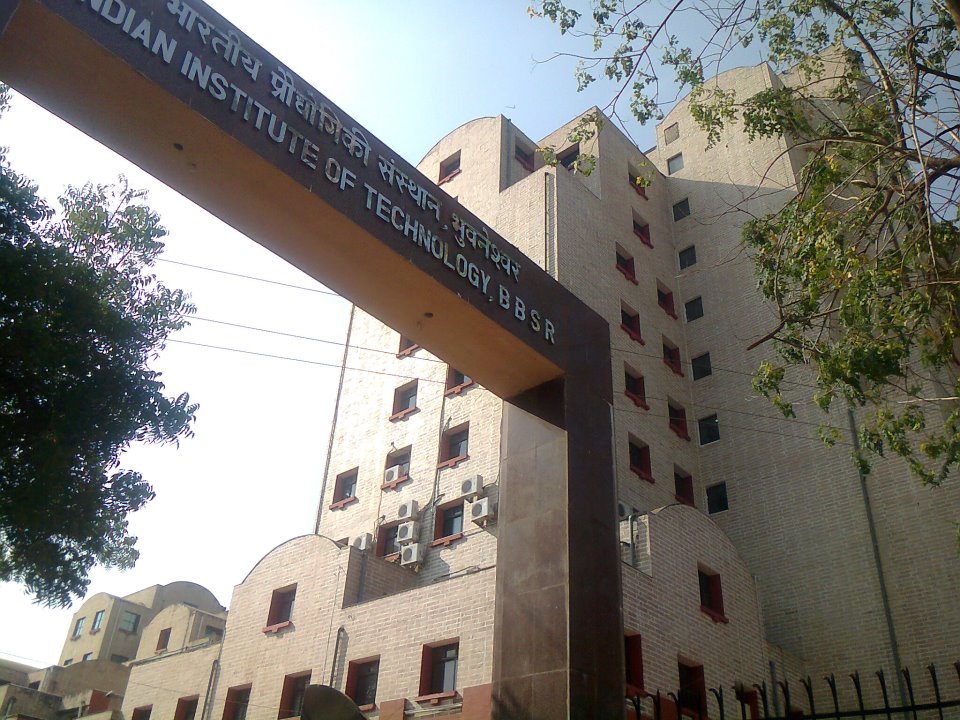
India will very soon have the first-ever Innovation Centre for Climate Change (ICCC) to cover the Bay of Bengal. It will come up on the Konark-Puri road. The Centre will function under the Indian Institute of Technology, Bhubaneswar (IITB).
The Bay of Bengal Coastal Observatory (BOBCO) as it has been named will study the behaviour of the Bay of Bengal. With the completion of the observatory, the country will be able to forecast extreme weather conditions and collect data about the ocean behaviour and numerous other details like the physical, chemical, biological and Geo-scientific data. “All this information will be instrumental in preparing a model for understanding cyclone. We would have understood the 1999 cyclone better if we had this observatory back then,” said Earth, Ocean and Climate Sciences Prof Prem Chand Pandey.
Its working will be different from the Meteorological Department (MET) as the ICCC will look into the causes behind the occurrences in the ocean while MET department records the ocean behaviour and gives continuous information.
The ICCC will come up along with the School of Earth, Ocean and Climate Science (SEOCS) under IITB. The SEOCS, which will come up at Arugul, will be headed by Prof Subhashish Tripathy. The State Government had allotted around 936 acre land for the construction of the SEOCS. It also recently allotted around 75 acres for setting up of the observatory.
… For the setting up of the observatory, IITB is working closely with University of Massachusetts and University of South Hampton. They will also conduct the Ocean Instrumentation Training Programme to train people with the advanced instruments that will be used in the ICCC. “There will be around 12 faculties initially, but with the gradual growth of the school, more and more experienced faculties will be brought in,” said Tripathy. The recruitment process has already begun. The institute also has ambitious plans to conduct research in the field of land, ocean and atmosphere, added Pandey.
April 23rd, 2012
Following is rearranged from http://pib.nic.in/newsite/erelease.aspx?relid=82396. The sub-headings are added by me.
On 14 Innovation Universities
Recognizing the need for leveraging on the creative knowledge, we are also planning to set up 14 Innovation Universities, to begin with, aiming at world class standards which will set benchmarks for excellence for the Central and State Universities. Each of the Innovation University shall consistently aspire for attainment of pinnacle of knowledge and will provide the knowledge manpower of the country in training professionals, specialists, scientists and researchers needed by the supporting national innovation system. Government has already framed a legislation for Universities of Research and Innovation which will provide a facilitating framework for creation of these institutions. These universities would be embedded in ecosystems developed for promoting synergies among education, research and incubation centres or industry
In order to be truly innovative, these Innovation Universities will not be clones of each other, but will focus on one deep theme of innovation and will focus on one area or problem of global significance in general and India in particular, by building an ecosystem of research and teaching around related discipline and fields and will search for solutions that are globally valid. For example, such areas may focus on urbanization public health, water security, environmental sustainability, digital literacy etc. The proposed universities will be autonomous in true sense, designing their own knowledge disciplines, admission criteria, academic programmes, credit systems etc. The programmes shall also facilitate horizontal mobility across disciplines.
…
We have realized that traditional models of public funded universities are not enough as the investment required is too high. We do acknowledge the need for policies to encourage private investment in higher education and the Foreign Education Providers’ Bill, now under consideration of the Parliament, is a decisive step in that direction. Although Government will be prime facilitator of the new innovation universities and innovation clusters, it is also proposed to focus on Public Private Partnerships (PPP) mode. It is also proposed to collaborate with Universities elsewhere in the world and they may be invited to set up similar such institutions in India and Government will support its research and establishment needs and teaching including scholarships may be funded by the promoting university. New Greenfield Innovation Universities supporting an already existing University/Institution of repute to attain world class standards through innovation in chosen areas of knowledge as well as Identification of some educational hubs in the country, where a few institutions of excellence are located and create an architecture of Innovation University by promoting synergy for teaching and research among such institutions are the models that we are aiming at promoting.
Cluster Innovation Centers
We have also planned creation of Cluster Innovation Centres in our Higher Education Institutions for promoting linkages for innovations, and R&D for solving the real problems and creation of products and processes for which systemic reforms have already been initiated for facilitating the linkages with industry and society. The Cluster Innovation Centres will provide a platform for the University and its partners to forge linkages between various stakeholders from industry and academia and to act as catalysts and facilitators. We have prepared a blueprint for setting up about 50 innovation centres of excellence in different frontier areas. Cambridge Cluster in UK as well as Trinity College founded by Cambridge Science Park are two prominent examples from UK which have promoted the growth of enterprise and innovation and created thriving innovation ecosystems. Such examples also exists in US (MIT, Silicon Valley – Stanford University), Israel, Germany, Sweden, Japan, China and Korea. Biggest strength of these clusters has been the cooperation and collaboration, where all actors are connected in symbiotic relationships. We are also aiming to scale up such National Innovation Clusters. We already have a few such schemes in the form of Technology Business Incubators and Technology Entrepreneur Promotion.
Collaboration with UK
The Cluster Innovation Centers and Innovation Universities are the specific areas in which we seek further collaboration with UK Institutions who have already innovated and scaled up by creating appropriate framework and institutionalized the same successfully.
Meta Universities
Seizing the new opportunities and leveraging the National Knowledge Network, the National Innovation Council has also proposed to create the first Global Meta University. With a network of Universities coming together offering courses cutting across disciplines, the Meta University will reinterpret the concept of a University as not just a traditional, physical space of learning, but as a repository of knowledge and information that can be delivered in multiple ways, and can be accessed from anywhere and anytime. It will seek to enhance the learning experience through new and innovative delivery models of education that allow students and institutions to collaborate in unprecedented ways. Thus the 21st century meta-university would be a network and an ecosystem rather than a single brick and mortar space – a Facebook of Institutions. A few central institutions located at Delhi, like Jawaharlal Nehru University, University of Delhi, Jamia-Millia Islamia and IIT-Delhi have already initiated steps to constitute a meta-university. Here also, we are looking forward to collaborate with Institutions from the United Kingdom in the next step for creation of global meta alliances. Though the internet and technology are fundamental to this conception of the Meta University, at the crux is not a new technology but a ‘new pedagogy’ that is more in tune with the requirements of the knowledge society of the 21st century. In such an environment there is a greater focus on a learner centric, collaborative model that allows continuous learning from the environment.
April 20th, 2012
So far IIT Bhubaneswar only offered B.Tech and Ph.D programs. It has now advertised its new M.Tech programs which are actually joint M.Tech-Ph.D programs that allow one with GPA greater than 8 (after doing the M.Tech coursework) to seamlessly transition to a Ph.D program or just get an M.Tech degree. The details of the program is given at http://www.iitbbs.ac.in/applicationforms/advt/Information-for-Admission-to-Joint-M.Tech.-Ph.D.Programme.pdf.
Following are some excerpts from that.
INDIAN INSTITUTE OF TECHNOLOGY BHUBANESWAR
INFORMATION FOR JOINT M. TECH. – PH.D. PROGRAMME Joint M. Tech. – Ph. D. Programme in:
* Applied Geosciences
* Civil Engineering
* Climate Science & Technology
* Electronics & Communication Engineering
* Materials Science and Engineering
* Mechanical Engineering
Selection: Valid GATE score followed by Written Test and/or Interview. Opting for Ph. D. Programme:
Desirous students with CGPA greater than equal to 8 after the 3rd semester of the M. Tech. programme with an aptitude towards research can opt for Ph. D. Those students with CGPA less than 8 will exit with M. Tech. degree after successfully completing the fourth semester and the credit requirements.
… Number of Seats: 18 in each programme. (Reservation as per GOI norms applicable).
In addition to the above mentioned joint M.Tech/Ph.D program IIT Bhubaneswar has also advertised for direct admission to its Ph.D programs in each of its seven schools .
See http://www.iitbbs.ac.in/applicationforms/advt/Information-for-Admission-to-Ph.D.Programme.pdf for details.
With these programs added and currently with only 120 B.Tech students admitted per year, IIT Bhubaneswar will have more graduate students (M.Tech and Ph.D) admitted per year than undergraduate students (B.Tech). This is a good direction and IIT Bhubaneswar should strive to have more graduate students than undergraduate students thus putting emphasis on research.
April 14th, 2012
Following are recent news snippets on this.
From http://www.igovernment.in/site/14-world-class-varsities-now-12th-plan dated 30th March 2012.
The proposal for setting up of world class universities in 14 states is awaiting clearance by the Law Ministry, Minister of State for Human Resource Development D Purandeswari said.
Replying to questions in the Rajya Sabha, Purandeswari said the government is also planning to set up higher educational institutions in the 374 educationally backward blocks in the country.
The National Development Council had approved setting up of 14 world-class universities for innovation across the 11th and 12th plan periods on the public private partnership model.
The innovation universities are part of the Ministry of Human Resource Development’s (MHRD) "brain gain" policy to attract global.
The proposed universities will be set up in Bhubaneswar, Kochi, Amritsar, Greater Noida, Patna, Guwahati, Kolkata, Bhopal, Gandhinagar, Coimbatore, Mysore, Pune, Visakhapatnam and Jaipur.
From http://twocircles.net/2012apr10/14_innovation_universities_be_set_india.html dated April 10th 2012.
Fourteen innovation universities would be set up in the country during the 12th Five Year Plan, Union Minister of State for Planning, Science and Technology and Earth Sciences Ashwani Kumar said here Tuesday.
From http://ibnlive.in.com/generalnewsfeed/news/govt-to-set-up-14-innovation-universities/984605.html dated April 10th 2012.
Chandigarh, Apr 10 (PTI) The government today said it will set up 14 innovation universities during the 12th five- year plan. "We are going to open 14 innovation universities," Union Minister of State for Planning Ashwani Kumar told reporters here. Kumar was in the city to review the flagship programmes of the state. The innovation universities are aimed at making India a global knowledge hub. Each one to be built around a theme or subject, these unique universities will enjoy total autonomy with regard to appointments, collaborations, resource generation and nomenclature of degrees awarded by it.
From http://www.deccanchronicle.com/channels/cities/chennai/innovation-varsity-kovai-soon-066 dated April 2nd 2012.
The Union government has added another feather to Tamil Nadu’s cap by proposing to set up a university of innovation at Coimbatore.
This will be one of the 14 universities to be set up in the country.
The Centre will table Universities for Innovations Bill, 2011, in Parliament soon.
The Bill will provide an in-principle approval for establishing universities for innovation. Some of the innovation universities will be in partnership with private players also and they will be made eligible for the government’s funding for research activities and student scholarships.
The Union HRD minister will discuss the proposal with education secretaries of all state governments on April 13 in New Delhi.
April 10th, 2012
Following are excerpts from a report in tathya.in.
Chief Minister Naveen Patnaik has cleared the proposal of the MEF, which is eyeing to expand its footprint all over the country in general and eastern India in particular.
This will be a State University, for which a bill will be presented in the Odisha Legislative Assembly (OLA), said a senior official in the Department of Higher Education (DHE).
The proposed university will be fourth of its kind and will come up with an investment of Rs.200 crore.
… The proposed University will provide high quality education at the level of under Graduation, Post Graduation, post-PG and Research in Engineering, management, Hospitality, Law, Paramedics, Pharmacy, Education Technology, Media & Journalism, Planning & Architecture, Medicine and general subjects also.
Total student strength of about 10,000 is estimated by the end of five years to achieve the target of 20,000 in 7-8 years as the University is expecting normative growth by 5 per cent per annum.
20 percent seat will be reserved for Person of Indian Origin (PIO), Foreign/NRI/NRI sponsored students as this will be a World Class University.
The proposed University will come up in the outskirts of the Capital City, for which 70 acres of Government land will be provided at a premium of market rate to the promoters of the institution, said sources in Government.
Recently the Chief Secretary headed committee has approved the proposal, which has been green signalled by the Chief Minister, said sources.
March 30th, 2012
Following is an excerpt from a report in Orissadiary.
Odisha Chief Minister, Naveen Patnaik today met the Union Minister for Health & Family Welfare, Ghulam Nabi Azad in New Delhi. Chief Minister informed the Union Minister for Health & Family Welfare that the proposal to raise the number of seats for admission to MBBS Course from 150 to 250, would necessitate significant increase in the infrastructure of the Medical Colleges in the State.
He requested that the three Medical Colleges of the State may be approved for upgradation to AIIMS like Institutions under the Pradhan Mantri Swasthya Suraksha Yojana (PMSSY) along with sanction of Rs.432 crore for the purpose. He added that the State has identified an alternative site for establishment of a Regional Institute of Paramedical Sciences at Bhubaneswar for which Government of India may sanction the funds forming part of Central Share component.
… Chief Minister urged upon the Union Minister to appreciate the just needs of the State for augmenting medical infrastructure and creating new specialized medical institutions. He requested the Union Minister to establish a National Cancer Institute at Bhubaneswar and a Regional Geriatric Centre at SCB Medical College, Cuttack. He further informed that State has already identified 20 acres of land for setting up of the Central Research Institute of Yoga and Naturopathy. Accordingly, Government of India may sanction the required funds to enable early establishment of the Institute along with 100 bedded Hospital, at the earliest.
… The Union Minister assured the Chief Minister that the issues raised by him will receive priority attention of the Ministry. He agreed to provide necessary funds for upgrading the infrastructure of the three Medical Colleges in the State.
… Union Minister promised to take urgent steps for establishing the Regional Institute of Para Medical Sciences at Bhubaneswar.
He assured that the Central Share for the Odisha State Treatment Fund shall be released very shortly and that additional funds will be provided for strengthening the Regional Cancer Centre at Cuttack. Further, the request of Odisha for a stand-alone Cancer Institute will be considered as and when adequate funds are available for the purpose in the Central Budget.
Union Minister agreed to establish a Regional Geriatric Centre at SCB Medical College, Cuttack and requested that Government of Odisha may handover the identified 20 acres of land for setting up of Central Research Institute of Yoga and Naturopathy.
We have been writing the CMO and others about approaching the Health ministry regarding the upgradation of the state medical colleges. See:
It took a long time, but its good that he finally did it.
I hope he also pursues a Central Agricultural University in Odisha. More on this in a separate post.
March 7th, 2012
Following is from a report in Pioneer.
The State Government in the Department of Health and Family Welfare on Saturday asked the district authorities of Kalahandi, Kandhamal, Sundargarh and Dhenkanal to start preliminary work for construction of four General Nursing and Midwifery Training Schools in those districts at a cost of Rs 10 crore each.
Out of the required Rs 40 crore, the Central Government has agreed to release 85 per cent and the State would have to bear 15 per cent. …
Besides, the Government has also directed the departmental authorities in Nabarangpur, Boudh and Subarnpur to accelerate the process of completing the GNM Training School and two ANM Training Schools under construction in the districts, respectively. The Centre has released Rs 4.75 crore out of a total of Rs 17 crore. The State Government has also released Rs 1 crore while another Rs 3. 33 crore has been laid out in the current year towards the State’s share.
March 4th, 2012
Earlier as per https://www.orissalinks.com/archives/4845 Toshali Plaza looked like the following:
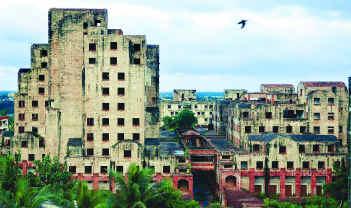 Now it looks as follows. (Obtained from wikipedia.)
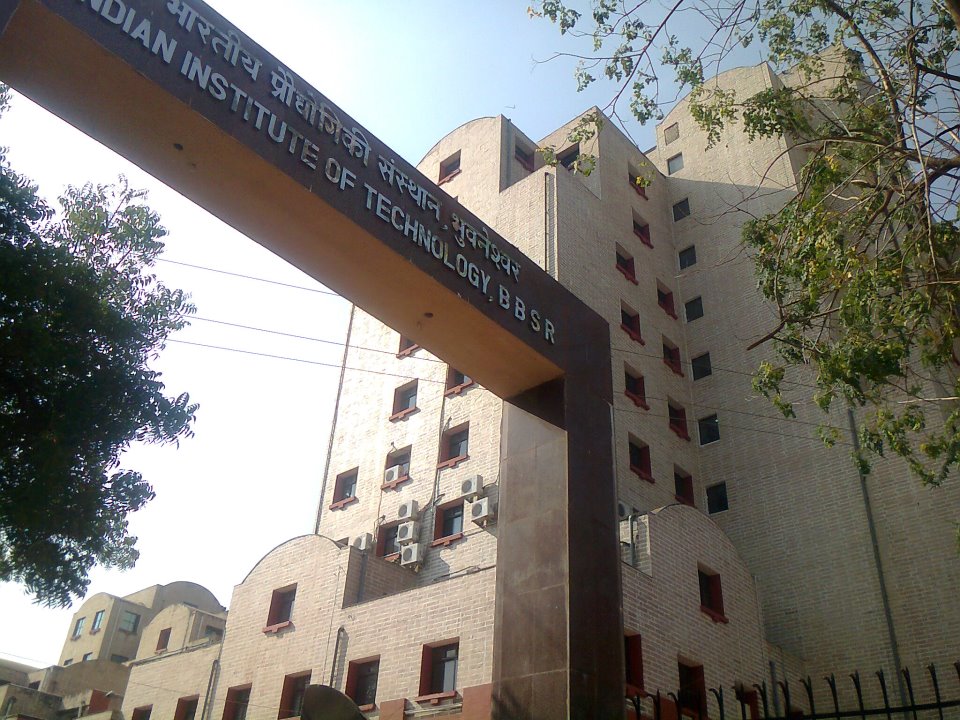
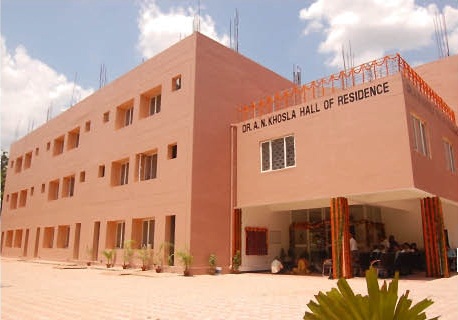
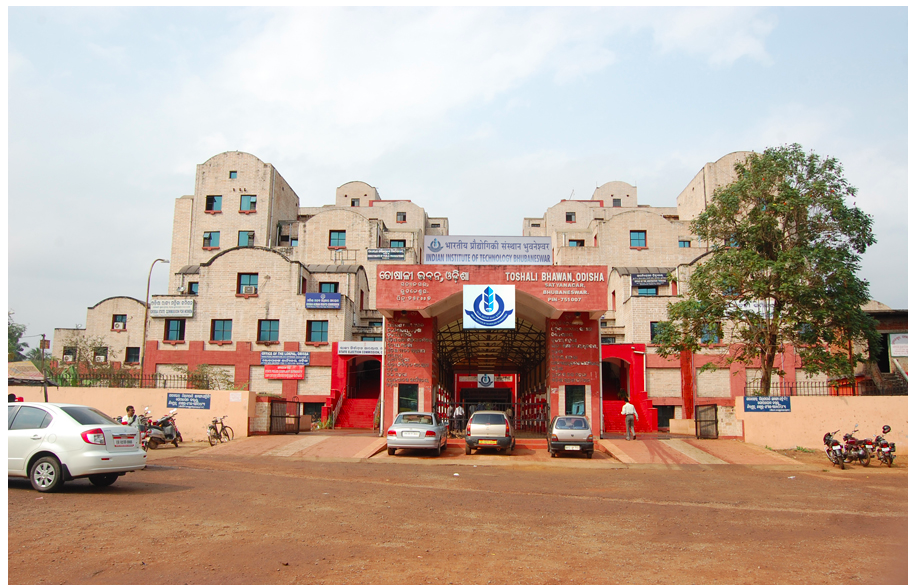 While its main campus gets built IIT Bhubaneswar has built some new facilities in its Samantapuri campus. Following is how one of the new facilities (a hostel) look. (From wikipedia.)
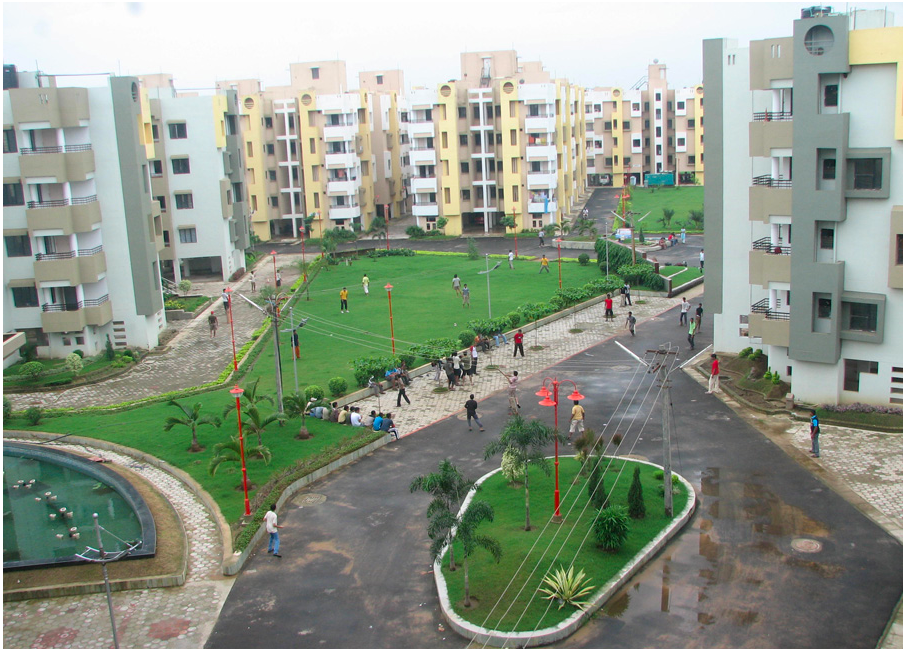
Following are pictures of some of the other building being temporarily used by IIT Bhubaneswar.
SBI Colonly in Kesura: 50-60 apartments are taken on rent here for student accommodation.
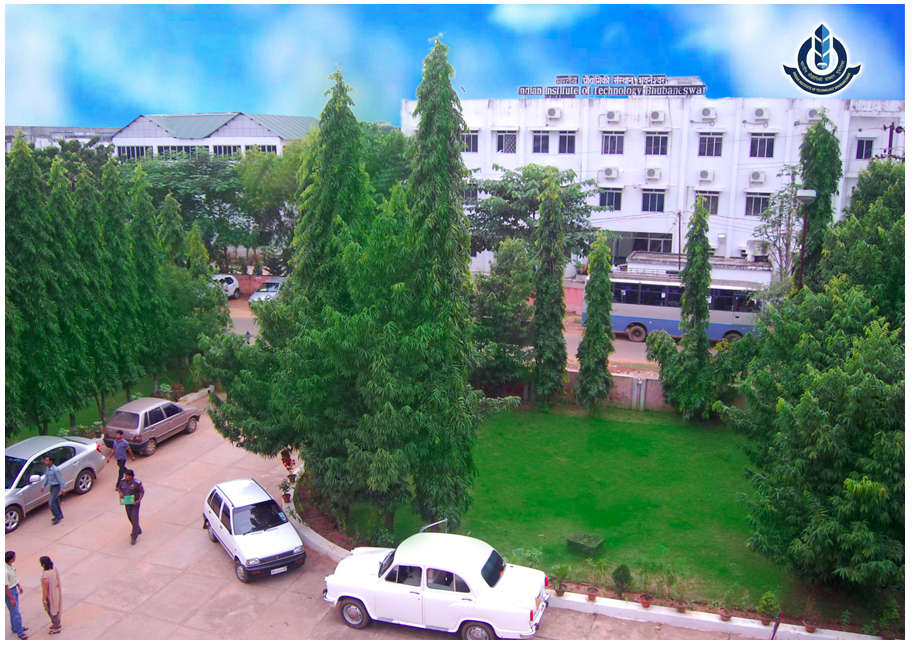
IIT Kharagpur extension center in Samantapuri (back of Swosti Premium)
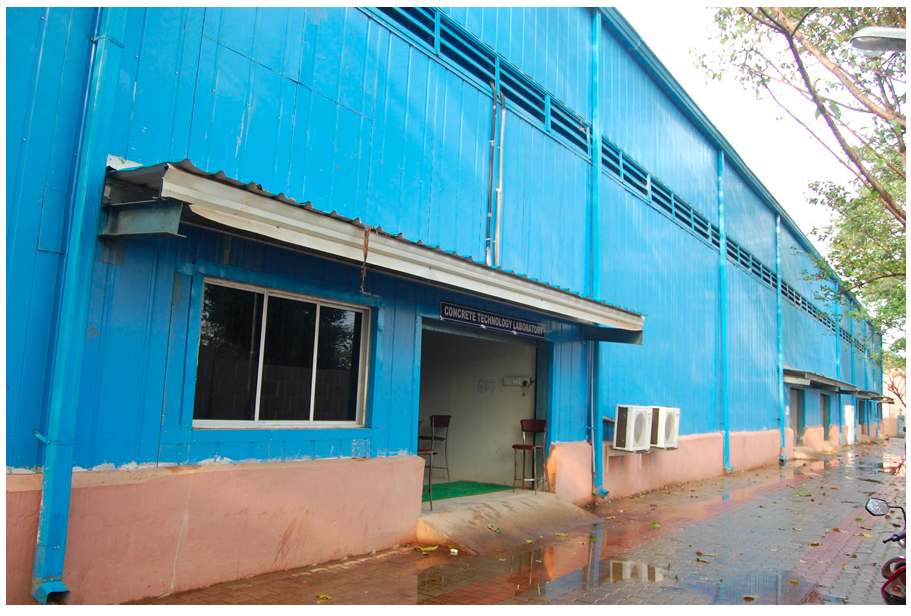
 Workshop Building
March 4th, 2012
The ad is at http://www.aiimsexams.org/pdf/ADMISSION-NOTICE-MBBS-2012.pdf. The prospectus is at http://www.aiimsexams.org/pdf/MBBS_Prospectus_2012.pdf. Following is the admission notice.
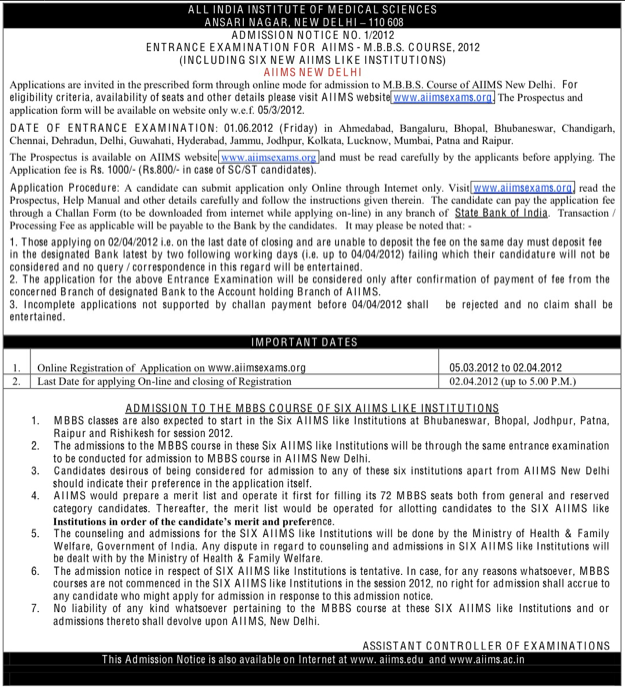
Following are excerpts from the prospectus.
Other AIIMS like Institutes Under the Pradhan Mantri Swasthya Suraksha Yojana
6 New All India Institutes of Medical Sciences are being established similar to AIIMS, New Delhi. Government of India has decided that the Academic Session in six New AIIMS at Bhopal, Patna, Jodhpur, Rishikesh, Raipur and Bhubaneswar starts in August 2012. The proposal is for an intake of 50 students for each of the institutions. The Ministry after deliberation took the view that for the first academic session (2012-2013), selection for admission should be done through the same entrance examination through which candidates are selected for AIIMS New Delhi. The counselling and admission in Six New AIIMS will be done by the Ministry of Health & Family Welfare, Government of India. Any dispute in regard to counseling and admission to six new AIIMS will be dealt with by Ministry of Health and Family Welfare, Nirman Bhavan, New Delhi.
1:0 NUMBER OF SEATS & RESERVATION
AIIMS NEW DELHI
A. Each year 77 (seventy seven) seats are available for admission to the graduate medical course, leading to the award of the degree of M.B.B.S. by the All India Institute of Medical Sciences,Delhi. Out of these, 11 (eleven) seats are reserved for the Scheduled Castes, 5 (five) seats are reserved for the Scheduled Tribes, 19 (nineteen) seats are reserved for Other Backward Classes and 5 (five) seats are reserved for the Foreign Nationals nominated by the Government of India and 37 (thirty seven) seats for General Category. For Indian Nationals, 3% reservation for orthopaedic physically handicapped shall be provided on horizontal basis, in the seats available. If requisite number of suitable candidates are not available to fill the seats reserved for the Scheduled Castes, the same are filled out of the candidates belonging to the Scheduled Tribes and vice versa. In case suitable candidates are not available from the above two reserved categories, Orthopaedically handicapped and OBCs, the vacant seats will be filled by the candidates from the general category.
SIX AIIMS LIKE INSTITUTIONS
B. From August 2012, Six New AIIMS like Institutions (viz: Bhopal, Patna, Jodhpur, Rishikesh, Raipur and Bhubaneswar) will start with an intake of 50 students each. The reservation policy followed will be 7.5% ST, 15% SC and 27% OBC. For Indian Nationals, 3% reservation for Orthopaedic physically handicapped shall be provided on horizontal basis, in the seats available.
… The candidate is required to go through the prospectus carefully and acquaint himself/herself with all requirements with regard to filling in of the online application form. Candidates are advised to give order of preference for the Six New AIIMS, apart from AIIMS New Delhi in the Application Form.
… For enquiries relating to Counseling and Admission to Six new AIIMS,please contact from 1st July, 2012 onwards:
PMSSY Section, Room No.22 ‘A’ Wing, Ministry of Health and Family Welfare, Nirman Bhawan , Maulana Azad Road, New Delhi-110 011 Tel Fax: No- 011-2306187, Website: www.mohfw.nic.in & Email : admissionpmssy@gmail.com
March 3rd, 2012
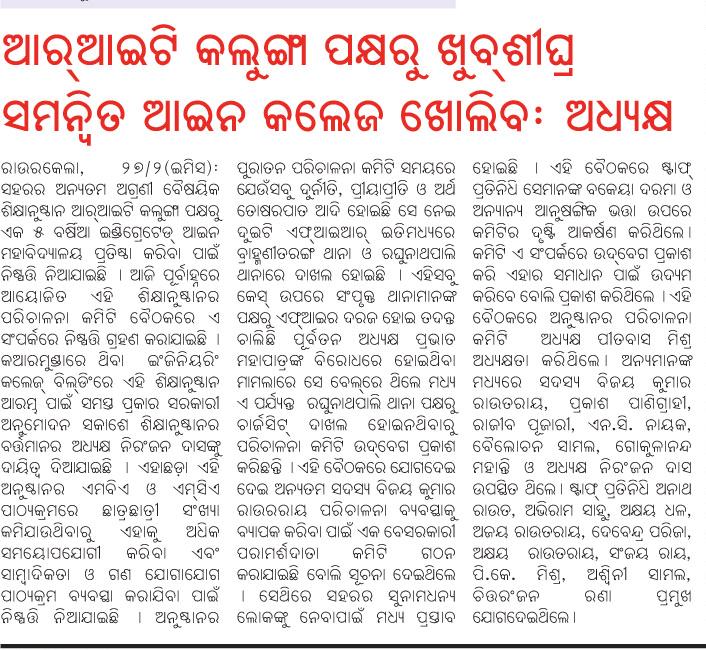
RIT (Rourkela Institute of Technology) is planning to open a 5-yr integrated law school. This is a good development. (Thanks to Siddhant for his pointer in rourkelacity.com) Following is from Sambada.
February 28th, 2012
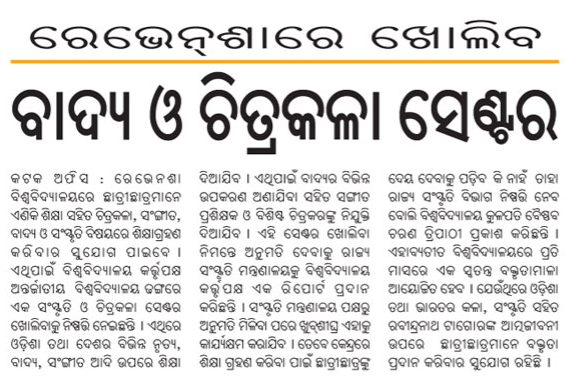
Following is from Dharitri.
February 28th, 2012
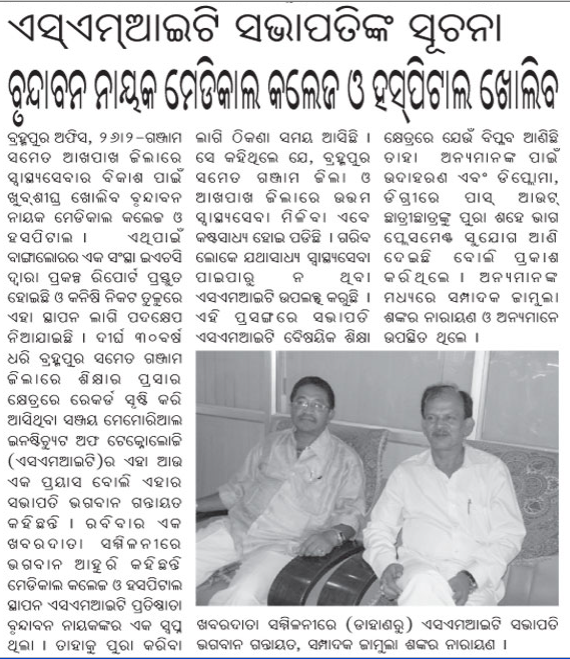
This trust already has several educational institutions in the Berhampur area; the main one being the SMIT Degree Engineering College. Following is an article from Dharitri about their intention to start a medical college.
February 27th, 2012
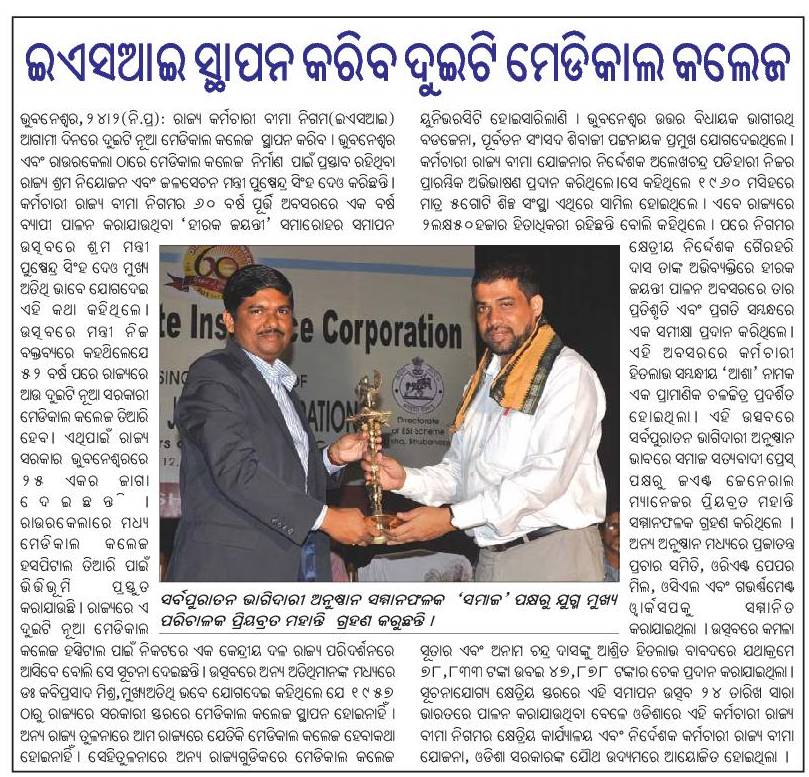
Following is from Samaja:
Following is from Sambada: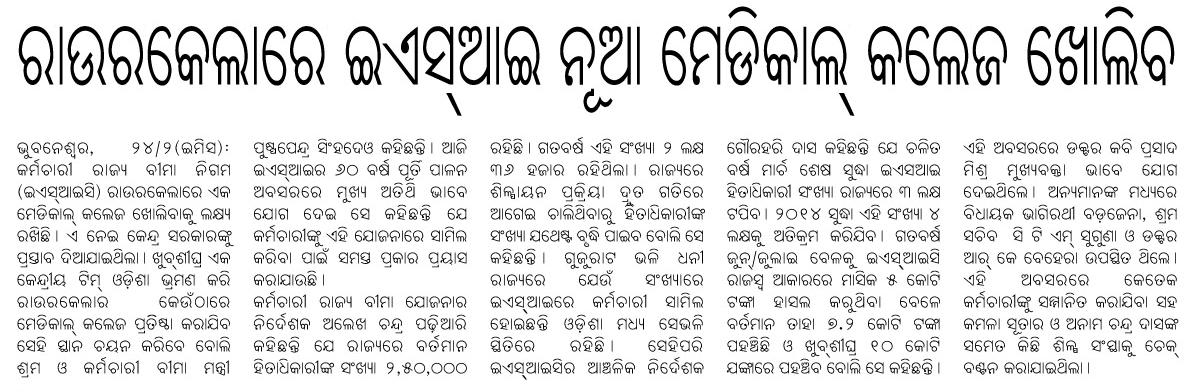
Following is from Dharitri: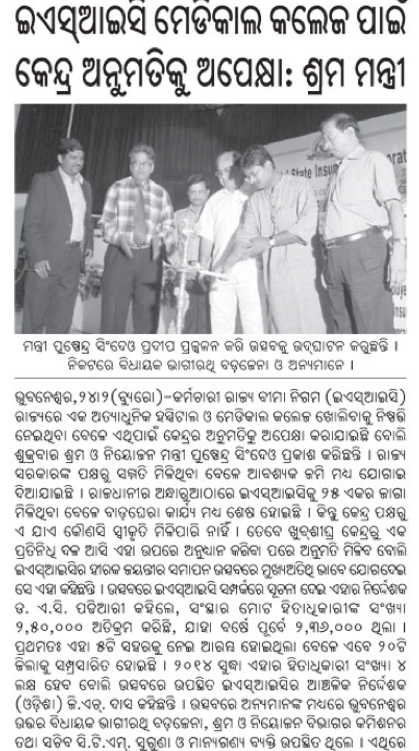
February 25th, 2012
Following is an excerpt from Priya Abraham’s report in Telegraph.
The Biju Patnaik University of Technology (BPUT) plans to collaborate with the Pune-based Centre for Development of Advanced Computing (C-DAC) to work on various key areas of high performance computing, the use of supercomputers and computer clusters to solve advanced computing problems.
The university is working on setting up five advanced centres of computing in various institutions in the state and intends to set up a high performance computing cluster in their upcoming campus in Rourkela.
February 22nd, 2012
Following is an excerpt from a report in Hindu Business Line.
The first of the global schools to be set up in Bhopal is likely to be operational by the end of this year. “We are in talks with investors for setting up schools in Kolkata, Bengaluru and Rourkela,” Mr Kumar said. The school will have classes from kindergarten to XII.
According to Mr Kumar, the primary differentiating factor between FIITJEE’s World School and Global School would be in terms of the infrastructure and curriculum.
“The world school in Hyderabad is not a residential school and is based primarily on the State board syllabus. The global school, on the other hand, will have both day scholar and boarding facilities, the infrastructure will also be of higher standards and it will offer three curriculum options (CBSE, ICSE and State board) to students to choose from,” Mr Kumar said.
The average cost of setting up the infrastructure for the Global School would be close to Rs 150 crore, he said.
February 15th, 2012
Following is from Samaja.
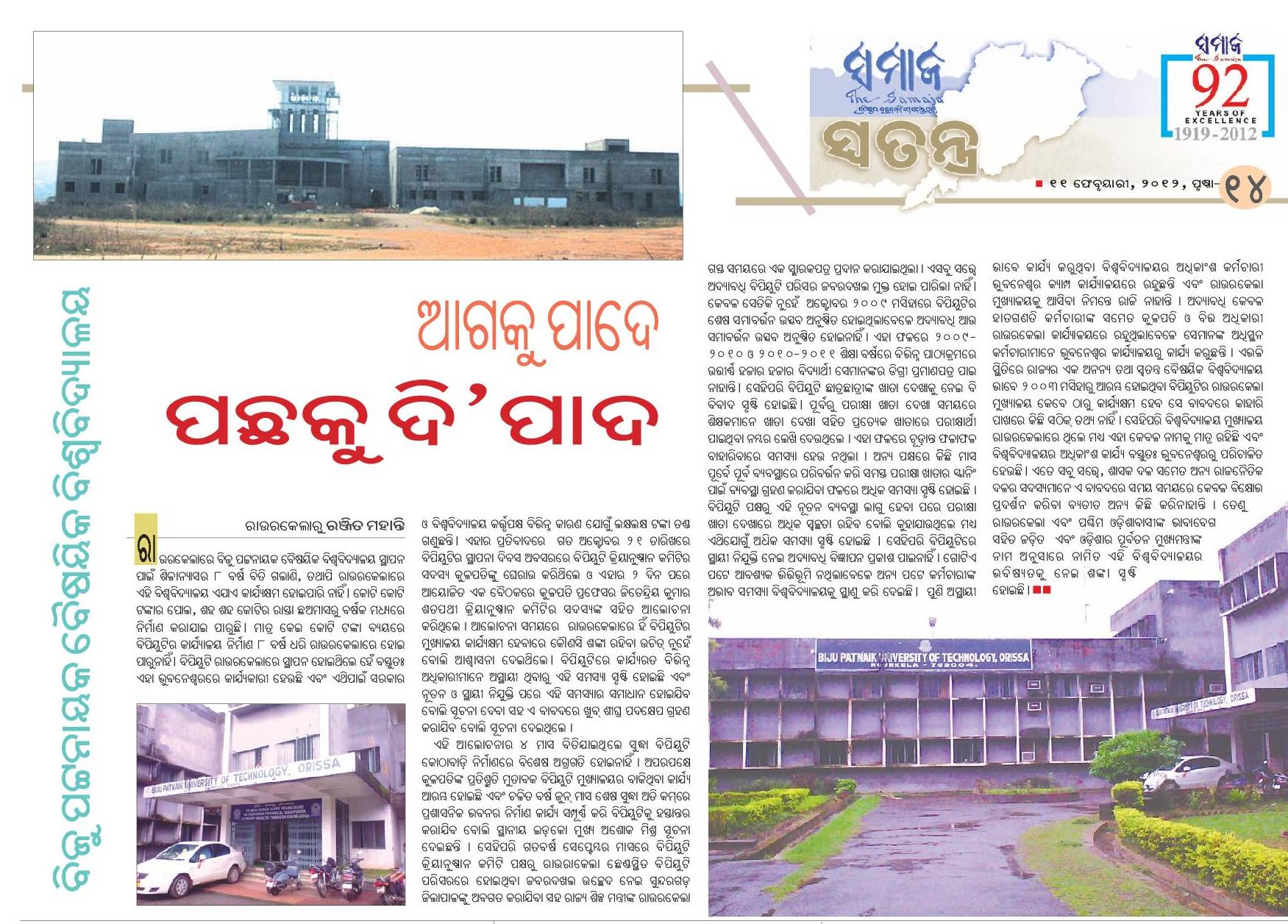
February 11th, 2012
Next Posts
Previous Posts