To get a clear picture on higher education moves by the state government (during the last 5 years) outside of the capital area (Khurda, Cuttack and Puri districts) we try to list the moves. Many fully centrally funded institutes are mentioned as the state contributes by free land and in making the location decision. (Note that Odisha has 30 districts.)
What has been done so far (including under construction):
- Central University of Orissa, Dist – Koraput
- Upgradation of UCE Burla to VSSUT, Dist – Sambalpur
- Private University status to Centurion, Dist – Gajapati
- Government Engieering College, Bhawanipatna, Dist – Kalahandi
- College of Agriculture, Bhawanipatna, Dist – Kalahandi
- WODC funds and free land for Private Medical College, Jaring, near Bhawanipatna, Dist – Kalahandi (significant part of the construction is complete)
- Pushed Vedanta to establish Vedanta Science College in Lanjigarh, Dist – Kalahandi
- Parla Maharaj Engineering College, Berhampur, Dist-Ganjam
- Special SUIIT institute as part of Sambalpur University, Dist – Sambalpur
- WODC funds for Hi-Tech Medical College, Rourkela, Dist – Sundergarh (under construction)
- Indian Institute of Handloom Technology, Baragarh
- College of Horticulture, Chipilima, Dist – Sambalpur
The districts involved above and the number of items for them are: Baragarh (1), Gajapati (1), Ganjam (1), Kalahandi (4), Koraput (1), Sambalpur (3), Sundergarh (1). If one takes the funding amount as the criteria then Koraput comes at the top.
Some of the announcements that are most likely to happen in 1-3 years as reported in the news:
- Pushed MCL to agree to make a medical college in Talcher
- Pushed NTPC to agree to make a medical college (location not announced)
- Pushed NTPC to agree to make a Power Institute (location not announced)
- Announced that all three medical colleges (includes Berhampur, Sambalpur) will be autonomous starting with the one in Sambalpur.
- Announced that Khallikote College Berhampur will be made to a university
- Proposed that one of the 20 IIIT should be in Berhampur.
- Pushing to upgrade FCI Balangir to an Institute of Hotel Management
- Grants to XIMB to open a campus in Balangir
- Grants to XIMB to open a campus in Sambalpur
- Support for a CIPET campus in Balasore
- Upgradation of GM College, Sambalpur to a university (announed by Higher Education Minister)
The districts involved in the above two lists and their number of items are: Angul (1), Balasore (1), Balangir (2), Baragarh (1), Gajapati (1), Ganjam (4), Kalahandi (4), Koraput (1), Sambalpur (6), Sundergarh (1).
The districts that are left out are: Bhadrak, Bouda, Deogarh, Dhenkanal, Jagatsinghpur, Jajpur, Jharsuguda, Kandhamala, Kendrapada, Keonjhar, Malkangiri, Mayurbhanj, Nabarangpur, Nayagarh, Nuapada, Rayagada and Sonepur.
Besides the above there have been reports about government willing to give grants to several private medical colleges in various places and the WODC has tried (but failed) to entice (through grants and free land) a private party to establish a medical college in Balangir.
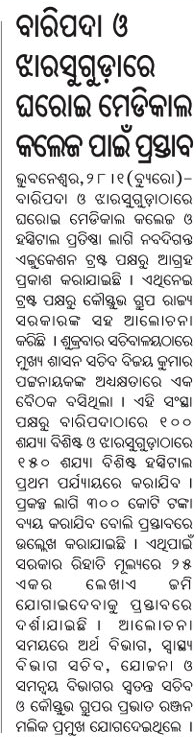
Also, I think the government will implement some of the recommendations made by the higher education task force.
Please suggest missing items in the comments section. Any capital-bashing comments will be deleted as the purpose of this post is to get a clear picture of what is happenning and not happening in the higher education side outside of the capital districts of Khurda, Cuttack and Puri.
Again, this list is to get a clear picture of what has happened in the non-capital area districts so that one can make an informed decision if the government is biased towards some non-capital districts over other non-capital districts. (There is no argument that the bulk of the moves have been made favoring the capital area. So no discussion on that.)
In regards to my personal view on what the government ought to do, it is listed in details in the site http://orissa2020.org.
The above list should not be interpreted in isolation. For example, one should not conclude that Kalahandi got too much. It got several institutions because it started from very little and the education conscious people of Kalahandi have been rightly demanding for higher education institutions for a long time. But at the same token, arguing that Kalahandi has been neglected by this government with respect to higher education just goes against the facts above and I worry that the well-meaning people who are making such arguments may be harming their cause. I guess the argument comes from losing the central university to Koraput. But then every district other than Koraput (and the capital districts) can use that argument. [If there is interest I will explain more on my take on this in the comments section.]
As an analogy, in 2005 we could rightly argue that the central government neglected Odisha with respect to centrally funded higher education institutions. But if we now say that the UPA government neglected Odisha with respect to centrally funded higher education institutions, we will be laughed at, and our efforts will have negative impact. So we plan to use finer arguments and location specific arguments to push for central institutions in Odisha for the 12th plan.
Kalahandi people wanting more institutions in Kalahandi should think of other ways to make their case and irritating the state government and its bureaucrats with arguments that go against the facts (see list above) may help some politicians but has a higher potential to harm Kalahandi’s case than help its case.
March 29th, 2011
Following is from the tathya.in report at http://www.tathya.in/news/story.asp?sno=4965.
It seems that the long awaited proposal for the Xavier University will take a concrete shape, thanks to the initiative of B K Patnaik, Chief Secretary.
Mr.Patnaik is pursuing the proposed private university initiated by the Xavier Institute of Management, Bhubaneswar (XIMB), said sources.
Chief Minister Naveen Patnaik cleared the proposal of the XIMB for an university after A U Singh Deo, Minister Planning & Coordination brought to his notice about the long pending case
Once the Chief Minister cleared it, Debi Prasad Mishra, Minister Higher Education asked the authorities in DOHE to frame the bill.
In the meantime XIMB authorities have identified the place near Pipili in Puri district to set up the University Campus.
However the Xavier varsity bill got delayed because of the proposed Umbrella Act for all universities.
With the Supreme Court of India rejecting the idea, the State Government in the Department of Law (DOL) has favoured the proposal for that each private University shall be established by a separate State Act and shall conform to the relevant provisions of the UGC Act, 1956.
So Chandra Sekhar Kumar, Commissioner-cum-Secretary, DOHE has sent the draft Xavier University bill to the Department of Law for vetting the same.
Debabrata Dash, Principal Secretary DOL has discussed the issue with his officers and they are busy in finalizing the provision of the bill, said sources.
Once cleared by the DOL, the proposed bill will be presented to the State Cabinet.
With the approval of the Cabinet, bill will be placed in the Odisha Legislative Assembly (OLA) to be cleared.
Sources said that Xavier University bill will be placed in the OLA in the coming Budget Session.
I hope this really happens. A lot of expansion plan is dependent on this. In particular there have been reports about plan for a Rural Management school in Balangir, a campus in Sambalpur that will offer Business program as well as general courses (arts, commerce, etc.), a campus in Bhubaneswar that will offer general courses (arts, commerce, etc.), a new institute run together with XLRI that will offer courses on HR, etc. There was earlier plans to offer B.Ed courses. All these will become easy to implement once the university happens.
February 8th, 2011
Update: From a report in DNA.
Sources from the ministry of human resource development said that under the 12th plan, the Centre would announce 10 more IITs.
Following is an excerpt from a report in Deccan Herald.
The Bangalore University will submit a memorandum to the Union Law Minister on January 2 urging him to upgrade University Visvesvaraya College of Engineering (UVCE) to an Indian Institute of Technology.
"The HRD ministry has announced that it would set up ten more IITs soon. UVCE has the necessary infrastructure, expertise, faculty and students. This can be converted into an IIT with a campus at Muddenahalli," Vice-chancellor N Prabhu Dev told reporters on Friday. The memorandum will be submitted at the mega reunion event of UVCE alumni, which will be held from January 1 to 3 on the occasion of Sir Visvesvaraya’s 150th anniversary. "UVCE might remain a constituent college of BU. Even if we have to let go of the administration of UVCE, we will not mind," he added.
VSSUT Burla must be watchful and take appropriate steps at the right time.
January 1st, 2011
Thanks to reader Jitu for the pointer. Following are excerpts from an interview in pagalguy.com.
Bhubhaneswar-based Xavier’s Institute of Management (XIMB) is in the process of turning into a university soon, its Director Fr PT Joseph, SJ tells PaGaLGuY. In this interview, he also speaks about the curriculum changes the institute is planning for its Post Graduate Diploma in Management (PGDM) and the PGDM Rural Management courses.
What changes can the incoming batch of 2013 look forward to benefitting from at XIMB?
From the point of view of the fulltime programme students, we will be revising the curriculum a little bit next year. Apart from that, although it doesn’t directly affect PGDM or PGDM(RM) students, but we have started a 1-year advanced management programme on Resettlement and Rehabilitation and Corporate Social Responsibility for 15 executives of Uttarakhand’s Tehri Hydro Development Corporation. This along with our other initiatives in the rural management and social sector will continue to be under focus in the coming year.
Are you looking at an increase in intake for any of the the two-year programmes?
We were looking at expansion in the number of seats but the proposal hasn’t gone past AICTE’s regulations. But we may become a university soon and therefore increase intake from a university perspective. That process might take one or two months to finalize, but we are in the process of becoming a university.
Would that mean that the PGDM degrees would be offered as full-fledged MBA degrees under the XIMB University?
The PGDM will still remain as an AICTE-approved course, it may not become a university degree for now. But after we get university status we may start some other type of programmes under the university. Right now we have gotten the government sanction of Rs 10 crores and are involved with acquiring the necessary land for the University in Sambalpur. Until land is acquired, which is priority for now, we aren’t in a position to share more details.
What is XIMB’s faculty strength now and how are you thinking about expanding it?
As of now we are 55 in total. One more is joining in December and another two may join in January 2011. We hire faculty whenever we come across somebody good. For example, one of the faculty joining next is a Cornell University PhD with lots of experience. Another person in the recruitment process has worked in Netherlands and has a PhD from Korea.
What kind of curriculum changes are you going to make in the PGDM and PGDM(RM) courses before the next batch joins?
We have already started a new course on Environment and Sustainability which is mandatory for all the 180 PGDM students. There’s another mandatory course on Emotional quotient and Leadership. Next, we are planning a meeting of all the faculty on the January 12, 2011. Before that meeting, a committee is preparing the background papers by looking at changes in the global and Indian economy. Only after the January 12 meeting will a clear picture emerge about the exact changes.
But speaking in general, we’ve been teaching management that is too bifurcated by specialization in our view. As you know, students choose to go for either marketing or finance or other specializations during the course. We are having a feeling that there should be some integration between these specializations by changing their content and give each course a holistic approach. For example, we know that there is a good market for inkjet printer cartridges. But inkjet cartridge production also generates a large amount of waste and affects the environment. So when we teach either of marketing or production management, we need to also bring awareness of sustainability in and show how both marketing and production are linked. If we can do this, we will not only make better managers but also better human beings. Apart from that, we would like to increase our connection with the bottom of the pyramid. We have a very strong programme in which all 180 PGDM students went and stayed in villages for 3 days. We want to increase their exposure to bottom of the pyramid and to leadership. We would also like to focus on ways to increase mentoring from faculty and senior students.
January 1st, 2011
Update: Odisha must push for a second campus of Indian School of Mines. See https://www.orissalinks.com/archives/6076 for the reasoning that can be used for this.
The twelfth five year plan starts from 2012. It is only two years away. The eleventh plan fetched us a NISER (Bhubaneswar), IIT (Bhubaneswar), Central University of Orissa (Koraput), and plans for an innovation university (Bhubaneswar) and a centrally funded IIIT (Berhampur). Since all of these are in their earlier stages and there were 5+1 IISER/NISERs, 8 new IITs, 16 new/upgraded central universities, plan for 14 innovation universities and plan for 20 IIITs across the country I do not think there will be new ones of them in the 12th plan.
However, there are other kinds of centrally funded institutes and universities that were not much covered in the 11th plan, but yet there were instances of them in some parts of the country. I think if we focus on them from now it is possible that we can influence the inclusion of their establishment across the country in the 12th plan with some locations in Odisha. It is important to push these ideas as pan-Indian ideas rather than Odisha specific. Within Odisha by focusing on "backward districts" we can achieve a good distribution.
Following are some pan-Indian ideas that come to mind.
- Several Central Agricultural Universities in backward areas of the country, including one in Kalahandi: Currently there is a Central Agricultural University HQed in Imphal. (http://www.cau.org.in/). I came across the news item in http://bundelkhand.in/portal/NEWS/Centre-clears-an-AIIMS-like-institute-for-Jhansi-Bundelkhand that says "the Union agriculture ministry had given the go-ahead to develop a central agriculture university in Jhansi". I think a good case can be made that instead of just Jhansi (in the backward Bundelkhand district) such universities should be made in several backward district clusters in India. In Odisha at one time Kalahandi was known as the Rice Bowl of Odisha. Also, with the central government’s role in harming the industrialization of Kalahandi they may be sympathetic to establish a CAU there.
- Several Central Institutions of Technology in backward areas of the country, including one in Balangir: Currently, a Central Institute of Technology exist in Kokrajhar, Assam. Similar ones exist in Longowal Punjab (SLIET), and one being made in Malda (GKCIET). These are all centrally funded institutions, have rural focus and are aimed at 3-tiers: workers, technicians and engineers. See https://www.orissalinks.com/orissagrowth/archives/3911 for some more details on these colleges. I think a good case can be made that such institutions be made across India in the various backward district clusters. In Odisha, Balangir may be suggested as the location as the third district cluster of the famed backward KBK region. With CUO in Koraput and and a CAU in Kalahandi, Balangir is the right place for a CIT.
- Upgradation of several engineering colleges to IIESTs, including the upgradation of VSSUT, Burla: Now that go ahead has been given to upgrade BESU (Bengal Engineering and Science University) to an IIEST (Indian Institute of Engineering, Science and Technology), this idea should be expanded to another dozen or so colleges across India. In Odisha, VSSUT is the one most suitable for this upgrade. In this regard one may note that as per the evaluation in http://www.npiu.nic.in/PDF/Govt-25-1.1.zip and http://www.npiu.nic.in/PDF/Govt-58-1.1.zip only two government colleges (one in Pondicherry (75) and one in Hubli (77)) in India have a higher score than VSSUT’s score of 73. Even among the colleges listed in http://www.npiu.nic.in/PDF/Govt-71-1.2.zip only BITS-Mesra (76), Sri Jayachamarajendra College of Engineering, Mysore (82), Institute of Chemical Technology, Mumbai (80) and NIT Surathkal (77) have a higher score than VSSUT’s 73. [I am not sure if the colleges in the last list were scored on the same parameters as VSSUT.]
- Several National Sports Institutions/Universities, including one HQed in Rourkela: Currently there are two such institutes: Lakshmibai National University of Physical Education (LNUPE), Gwalior and Netaji Subhash National Institute of Sports (NSNIS), Patiala. Recently, a proposal was received by GOI from the Ministry of Youth Affairs & Sports to convert Rajiv Gandhi National Institute for Youth Development, an institution deemed to be university, at Sriperumbudur into Rajiv Gandhi Central University/National Institute of Youth and Sports. I think a good case can be made that such institutions be made across India in districts and locations that are catchment areas for various sports. In Odisha Rourkela would be the right choice with a possible branch campus around Kendrapada (women’s soccer) and Jagatpur (Rowing).
- Additional branches of IGNTU (Indira Gandhi National Tribal University) including one in Kandhamala: Indira Gandhi National Tribal University is HQed in Amarkantak, MP. Its act mentions that the university will have branch campuses in various locations across India. The government of Odisha has proposed Kandhamala as the location of one such branch campus. This should be pushed and perhaps another campus may be proposed for the tribal areas cluster of Keonjhar and Mayurbhanj.
In addition we need to continue to push for a medical college and an engineering college as part of the Central University of Orissa, Koraput. The state government and the CUO Koraput authorities are already doing it.
December 15th, 2010
(Thanks to Biswa for the pointer.)
Update: It looks like IGIT Sarang was the only one in the 25 government colleges that are eligible (under sub component 1.1) to submit an Institutional Developmental Proposal (IDP). VSSUT and CET are in the list of Ineligible (under sub componnet 1.1) Govt. funded/aided institutions (for which the state is ready to co-sponsor) that can submit again for compliance of eligibility conditions & then submit IDPs. There are no private institutions from Odisha under sub component 1.1.
There are no eleigible institutions from Odisha under sub-component 1.2. NIT Rourkela is in the list of Non-Eligible Institutions (for which State is ready to co-sponsor) shortlisted for compliance of eligibility conditions for participation in the Project under Sub-Component 1.2.
The following table lists the institutions that applied from Oidsha, their over all scores and the problems they had (if any).
| Institution |
Score (sub-component)
|
Problems |
| IGIT Sarang |
66 (1.1) |
None (found eligible) |
| VSSUT Burla |
73 (1.1) |
Faculty less than 50%; BOG not as per UGC |
| CET Bhubaneswar |
63 (1.1) |
Faculty less than 50%; BOG not as per UGC |
| NIT Rourkela |
57 (1.2) |
BOG not as per UGC |
| OSME Keonjhar |
25 (1.1) |
Number of courses less than 4 |
| Synergy, Dhenaknal |
39 (1.1) |
BOG not as per UGC |
| NIST, Berhampur |
35 (1.1) |
BOG not as per UGC |
| CEB, Bhubaneswar |
34 (1.1) |
BOG not as per UGC |
| DRIEMS, Cuttack |
36 (1.1) |
BOG not as per UGC |
| OEC, Bhubaneswar |
33 (1.1) |
BOG not as per UGC |
| KISD, Bhubaneswar |
37 (1.1) |
BOG not as per UGC |
| CV Raman, Bhubaneswar |
46 (1.2) |
BOG not as per UGC |
As per http://www.npiu.nic.in/faq.htm sub component 1.1 is about Strengthening institutions to improve learning outcomes and employability of graduates and Sub-component 1.2 is about Scaling-up postgraduate education and demand driven R&D and innovation.
One of the requirement for the BOG is that it be headed by an eminent industrialist/engineering academician with adequate representation from other stakeholders.
So it is not clear what the Telegraph article below is talking about.
As per the report in http://telegraphindia.com/1101207/jsp/orissa/story_13265662.jsp the five Colleges are:
- DRIEMS, Tangi, Cuttack
- NIST, Berhampur
- CEB, Bhubaneswar
- VSSUT, Burla
- IGIT, Sarang
The details of the program is at http://www.npiu.nic.in/faqi.htm. From a quick reading it seems that the government institutions will get about 10 crores each and the private ones about 4 crores each.
December 7th, 2010
Following is an excerpt from a report in Expressbuzz.com.
The State Government has decided to elevate Khallikote Autonomous College here and Gangadhar Meher College at Sambalpur to unitary university status, said Higher Education Minister Debi Prasad Mishra here today.
A government appointed task force on higher education reforms had suggested upgrading these two premier autonomous colleges to university status, the Minister said while addressing a function of the Students’ Union of Khallikote College.
Mishra however stressed the need to develop necessary infrastructure facilities before the second oldest college of the State was declared a unitary university.
While at least 50 acre was required, Khallikote Autonomous College had only 16.74 acres of land in its possession.
“There is a proposal to get another 2.50 acres from transport departments garage adjoining the college”, he said.
The Minister asked the local MLAs to locate another 50 acres in the town for the college’s expansion. He also assured the students to fill up the vacant posts soon. Around 50 out of 90 posts of teaching staff are vacant in the 132-yearold college, where over 3,600 students are pursuing studies in 19 different departments, 15 of them having post-graduate departments.
November 20th, 2010
Following is an excerpt from a report in Indian Express.
“To boost innovation in basic sciences, the government is keen on funding and establishing world class institutes. We have recently established more IITs, IISERs and institutes in pharmaceutical science. On the same lines, the Cabinet has decided to establish IIESTs across the country,” said Prithviraj Chavan, Union Minister for State for Science and Technology.
He was inaugurating a seminar on Nano Technology: Materials and Composites for Frontier Applications, organised by Bharati Vidyapeeth University. Chavan did not commit that CoEP would feature on the list of five colleges to be converted into IIESTs, but said there was a possibility because the college has been trying to get deemed university status.
Odisha should remind the central government regarding its earlier request to upgrade VSSUT, Burla to an IIEST.
November 2nd, 2010
Recall from https://www.orissalinks.com/archives/5524 where we reported the following:
… The NIC will also have innovation centres in universities and innovation clusters to create regional hubs….
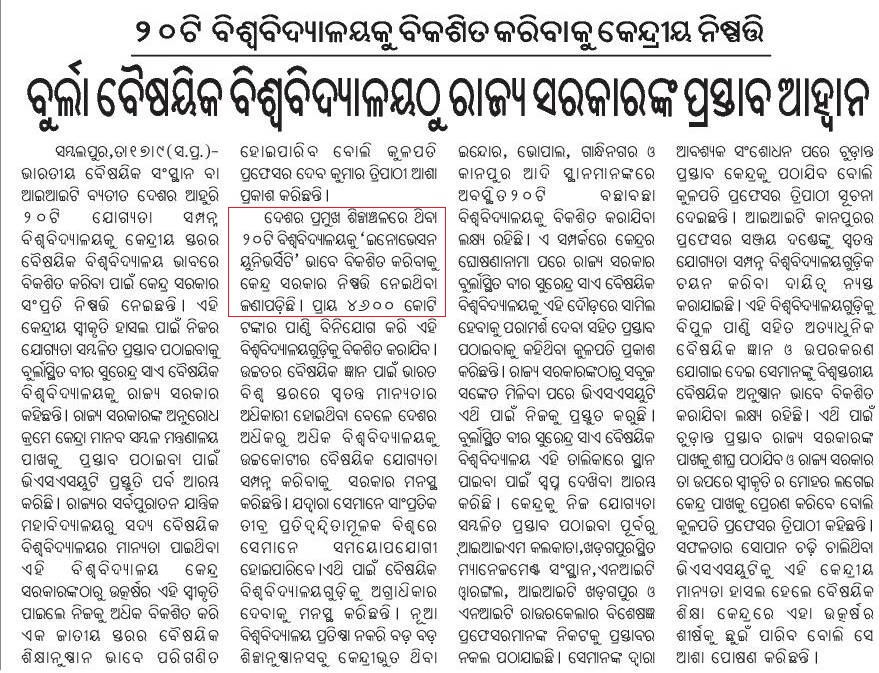
“Those clusters will be selected where there is a minimum critical mass of industries of some kind and then we will give them an innovation toolkit. The toolkit will be a set of guidelines on how to innovate. Moreover, we are also selecting 20 universities, besides the Indian Institutes of Technology (IIT) where we can do seed innovation,” he said.
Prof Sanjay Dhande, IIT Kanpur director, who is a member of the Council, is in the process of identifying the universities which will then be given the innovation toolkit to be able to connect with industry.
We had contacted the Govt. of Odisha as well as the VCs of VSSUT and Sambalpur University about it. (I think some other people and groups may have done something similar too.)
The Government of Odisha has now asked VSSUT Burla to prepare a proposal in response to it. This is a good move. However, I think a joint proposal from VSSUT and Sambalpur University may be stronger and this is important if Prof. Dhande goes strictly by merit (without taking state representation – one from each major state — into account). Following is from Samaja. (The part in red is confusing. The reporter did not understand the difference between "Innovation University" and "universities where GOI will seed innovation".)
September 18th, 2010
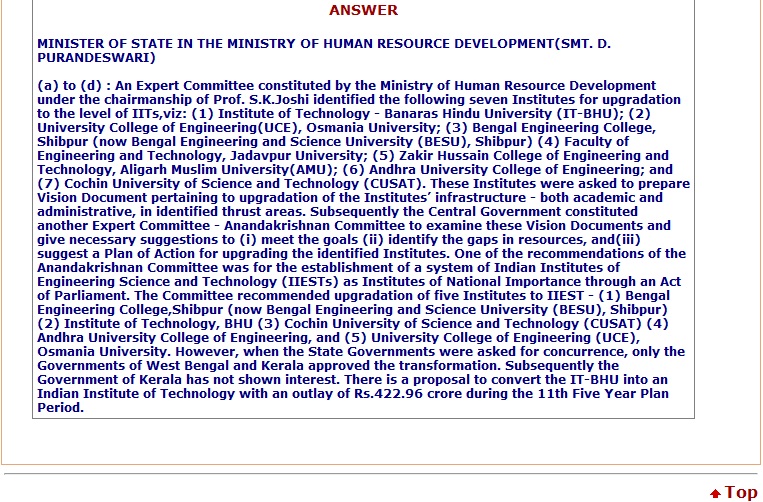
I think the best possibility is to work on upgrading VSSUT, Burla (formerly, UCE Burla) to an IIEST. UCE Burla alumni is fully supportive of this. In general, such a proposal has and will continue to have support from all circles of Odisha. Also, the CM has in the past written to Delhi about upgrading this.
To do this first the state government needs to be pushed to give a one time allocation of a significant amount (say 100 crores) to improve the infrastructure. In addition the faculty size needs to be increased to be at the level of the colleges mentioned below. Simultaneously there should be a campaign to convince the central government to upgrade it to an IIEST.
The Congress MP from Sambalpur should do all he can for this.
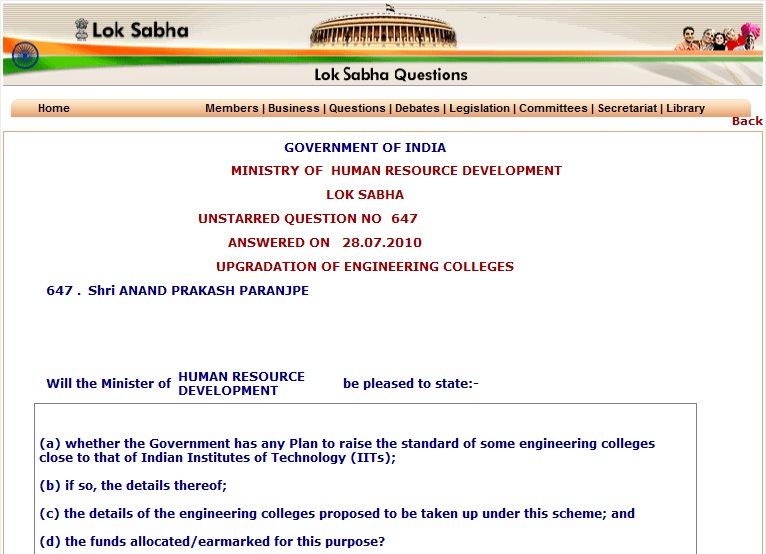
For some background on IIESTs see http://164.100.47.132/LssNew/psearch/QResult15.aspx?qref=89897. Following are screen capture of that page.
August 18th, 2010
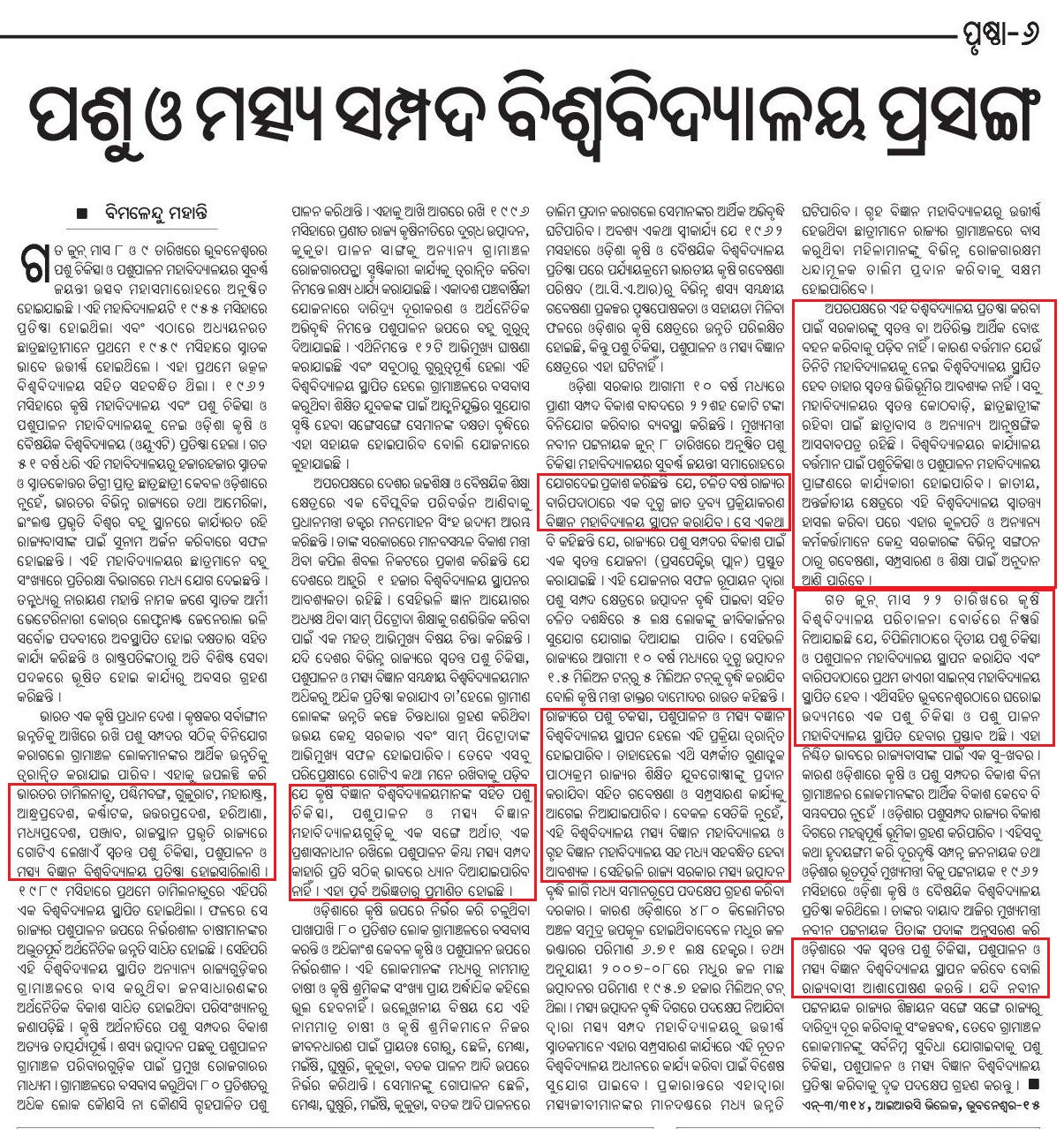
The op-ed below advocates carving out a Veterinary, Animal Husbandry and Fishering University out of OUAT. It also mentions the following:
- A private organization is also planning a Veterinary University.
- OUAT management board has decided to establish the states second Veterinary and Animal husbandry college at Chipilima, near Sambalpur.
- It also has decided to establish a Diary Science College in Baripada.
Related postings from the past:
August 9th, 2010
Following is an excerpt from a report in tathya.in.
Minister said to provide qualitative education on Management, XIMB has been roped in to set up its campus at Balangir to start a Post Graduate Program in General Management with specialization in Banking and Finance Service.
Intake will be 60 students in this discipline and equal number of students in Rural Management Program, for which XIMB will be given Rs.10 crore grant.
Similarly XIMB will open another branch at Sambalpur for General Management with specialization in Human Resource Development Program with intake capacity of 120 students, said the Minister.
July 18th, 2010
Following is extracted from multiple sources including http://www.aicte-india.org/excel/29jun/ORISSA.html.
| College |
M.Tech branch |
Number of Seats |
| Mahavir Institute of Engineering & Technology, Bhubaneswar (36) |
Computer Science & Engg |
18 |
| |
Electrical & Communication |
18 |
| DRIEMS, Cuttack (90) |
Computer Science |
18 |
| |
ECE |
18 |
| |
EE (Power) |
18 |
| |
Electronis & Instr |
18 |
| |
IT |
18 |
| Synergy, Dhenkanal (72) |
Computer Science & Engg |
36 |
| |
Electrical & Comm. (VLSI & Embeded System) |
18 |
| |
Electrical & Electronics (Power Electronics & Drives) |
18 |
| Majhighariani, Rayagada (36) |
BioTechnology |
18 |
| |
Mechanical Engineering |
18 |
| East, Bhubaneswar (36) |
Computer Science & Engineering |
18 |
| |
Electronics & Telecommunication |
18 |
| CIPET, Bhubaneswar (54) |
Material Sc & Technology (M.SC) |
18 |
| |
Plastic Engineering (M.Tech) |
18 |
| |
Polymer Nano Technology |
18 |
| Orissa Engineering College, Bhubaneswar (36) |
Computer Science & Engineering |
18 |
| |
Mechanical System Design |
18 |
| IIIT, Bhubaneswar (25) |
Computer Science & Engineering |
25 |
| Krupajal, Bhubaneswar (72) |
Computer Science & Engineering |
18 |
| |
Power Electronics & Drives |
18 |
| |
Communication Engineering |
18 |
| |
Heat Power Engineering |
18 |
| CEB, Bhubaneswar (54) |
Computer Science & Engineering |
18 |
| |
Electrical & Communication |
18 |
| |
Thermal Engineering |
18 |
| C V Raman, Bhubaneswar (180) |
Industrial Engineering |
18 |
| |
Chemical Engineering |
18 |
| |
Computer Science & Engineering |
36 |
| |
Electrical (Power System) Engg |
18 |
| |
Electronics and Communication |
36 |
| |
Heat Power Engineering |
18 |
| |
IT |
18 |
| |
Mechatronics |
18 |
| Konark Institute, Bhubaneswar (36) |
Computer Science & Engineering |
18 |
| |
Electrical & Communication |
18 |
| NM Institute, Bhubaneswar (36) |
Power Electronics & Devices |
18 |
| |
Mechanical Engineering |
18 |
| Techno, Bhubaneswar (36) |
ECE |
18 |
| |
EEE |
18 |
| Gandhi Engineering College, Bhubaneswar (36) |
Computer Science & Engineering |
18 |
| |
Electrical & Communication |
18 |
| GITA, Bhubaneswar (36) |
Electrical / Electrical & Elex |
18 |
| |
Mechanical Engineering |
18 |
| Silicon, Bhubaneswar (72) |
Computer Sc & Engineering |
18 |
| |
Electrical / Electrical & Elex |
18 |
| |
Electronics &Telecommunication |
36 |
| GIET, Gunupur (144) |
Applied Elex & Instrumentation |
18 |
| |
Computer Science & Engineering |
18 |
| |
Machine Design |
18 |
| |
Thermal Engineering / Heat Power Engg. |
18 |
| |
CAD/CAM |
18 |
| |
Electronics & Comm. Engg. |
18 |
| |
Industrial Engineering |
18 |
| |
Power Electronics Engg. |
18 |
| IMIT, Cuttack (18) |
IT |
18 |
| NIST, Berhampur (54) |
VLSI & Embedded System Design |
18 |
| |
Wireless Communication Technology |
18 |
| |
Electronics & Communication Engineering |
18 |
IIPM, Kansbahal (0)
|
Production Management |
|
IMMT Bhubaneswar (10)
|
Material Research Engineering |
10 |
| IIT Kharagpur, Bhubaneswar Center (50) |
Electrical Engineering (3yr weekend and after hrs M.Tech) |
25 |
| |
Electronics & Communication Engineering (3yr weekend & after hrs M.Tech) |
25 |
| Utkal University, Bhubaneswar (30*) |
Computer Science |
30 |
| |
M.E in Computer Sc and Eng with specialization in Knowledge Engineering |
* |
| KIIT University, Bhubaneswar (144*) |
Water Resource Engineering – Civil |
18* |
| |
Construction Engineering & Management |
18* |
| |
Electrical |
18* |
| |
Mechanical |
18* |
| |
Computer Science |
18* |
| |
Electronics & Telecommunication |
18* |
SOA University, Bhubaneswar (144*)
|
Computer Science & Eng. |
18* |
| |
Applied Electronics & Instrumentation Engg. – VLSI Design & Embedded System) |
18* |
| |
Mechanical Engg. – Thermal Engineering |
18* |
| |
Electrical Engg. — Power Electronics & Drives |
18* |
| |
Electronics & Telecommunication Engg. – Telecommunication System Engineering |
18* |
| |
IT |
18* |
CET, Bhubaneswar (107)
|
Computer Science & Engg |
13 |
| |
IT |
18 |
| |
Industrial Engineering & Management |
18 |
| |
Structural Engineering |
18 |
| |
VLSI & Embedded Systems |
10 |
| |
Mechanical System Design & Dynamics |
10 |
| |
M.Architecture |
20 |
ABIT, Cuttack (20)
|
M.Architecture |
20 |
NIT Rourkela (288)
|
Biotechnology & Medical Engineering |
18 |
| |
Ceramic Engineering |
18 |
| |
Chemical Engineering |
18 |
| |
Civil Engineering – Soil Mechanics & Foundation Engg |
18 |
| |
Civil Engineering – Structural Engineering |
18 |
| |
Computer Science & Engineering- Computer Sc |
18 |
| |
Computer Science & Engineering- Info. Security |
18 |
| |
Electrical Engineering – Electronics Systems & Communication |
18 |
| |
Electrical Engineering – Power control & Drives |
18 |
| |
Electronics & Communication Engineering – Telematics & Signal Processing |
18 |
| |
Electronics & Communication Engineering – VLSI Design & Embedded Systems |
18 |
| |
Mechanical Engineering – Machine Design & Analysis |
18 |
| |
Mechanical Engineering – Production Engineering |
18 |
| |
Mechanical Engineering – Thermal Engineering |
18 |
| |
Metallurgical & Materials Engineering |
18 |
| |
Mining Engineering |
18 |
VSSUT, Burla (152)
|
Communication System |
18 |
| |
Heat Power Engineering |
12 |
| |
Hydraulic & Irrigation Engineering |
18 |
| |
Machine Design & Analysis |
12 |
| |
Power system Engineering |
18 |
| |
Production Engineering |
12 |
| |
Structural Engineering |
13 |
| |
Transportation Engineering |
13 |
| |
Computer Science & Engg |
18 |
| |
Manufacturing Systems |
18 |
IGIT Sarang (54*)
|
Electrical – Power Electronics & Drives |
18* |
| |
Civil – Environmental Science & Engineering |
18* |
| |
Mechanical – Mechanical System Design |
18* |
| OUAT, Bhubaneswar (*) |
Agricultural Engineering |
* |
| Sambalpur University (20) |
Food Science & Technology |
20 |
| SUIIT, Sambalpur (24) |
Computer Science |
24 |
The * implies that I am not sure of the number. The number I have in that case may be a few years old. The above adds up to 1830+372* seats total. Out of which 1112+318* seats are in the greater Bhubaneswar (including Dhenkanal) area.
My guess is that majority of these M.Tech’s (at least 50-60%) would go into teaching. This should definitely help the faculty quality of the engineering colleges and programs in Odisha. In a few years IIT Bhubaneswar is going to start M.Tech. That would help the situation further.
July 16th, 2010
July 14th, 2010
Earlier in https://www.orissalinks.com/archives/4700 we reported about 8 companies signing MOU with Odisha government to establish ITCs. Those companies were: Orissa Power Generation Corporation (Hemagiri), Tata Power Ltd (Banki), Emami Paper Mills (Balgopalpur), RSB Metaltech (P) Ltd (Kalyansinghpur), Surrendra Mining Industries Ltd (Bonei), Monnet Ispat and Energy Ltd (Teleibani), Uttam Utkal Steels (Jhumpura), Ind-Barath Energy (Utkal) Ltd (Lakhanpur).
New reports mention 13 additional companies signing similar MOUs. Following is an excerpt from a report in Economic Times.
The companies which signed MoUs on Friday include Action Ispat and Power Private Limited, Adhunik Metaliks Limited, Crackers India (Alloys) Limited, MGM Steels Limited, Posco India Limited, Rungta Mines Limited, SSL Energy Limited, CESC Limited, KVK Nilachal Power Limited, GMR Kamalanga Energy Limited, VISA Power Limited, Essar Steel Orissa Limited and Mahanadi Aban Power Co Limited.
Action Ispat will set up an ITC at Kirimira block of Jharsuguda district while Adhunik Metaliks will have its centre at Koida in Sundergarh district.
Similarly, Crackers India will establish its two ITCs at Kalampur in Kalahandi districts and Champua block in Keonjhar district.
MGM Steels has proposed to set up its ITC at Odapada in Dhenkanal district while Posco’s centre will come up at Erasama block of Jagatsinghpur district.
The Rungta Mines ITC will be set up at Dhenkanala, SSL ITC at Kholikote in Ganjam district, CESC ITC at Dampara in Cuttack district, KVK Nilachal ITC at Krushnaprasad in Puri district, GMR Kamalanga ITC at Bheden in Bargarh district, VISA Power ITC at Bhapur in Nayagarh district and ESSAR Steel at Telkoi in Keonjhar district.
Mahanadi Aban Power Co Limited would set up two ITCs at Binika in Sonepur district and Banarpal in Angul district.
July 10th, 2010
Next Posts
Previous Posts