NOTE: Please note that I am in the board of advisors of BIT. I agreed to join the board because I believe in the people who are making it. Nevertheless I am obviously biased.
The above statement is made in a report about Bhubaneswar Institute of Technology in Pioneer. Some excerpts from that report are:
A group of likeminded eminent NRO academicians have come together to start the Bhubaneswar Institute of Technology (BIT) and offer students of the State the opportunity for technical education and research of international standard and style. The institute promises its students education by experienced faculty from the US, innovative teaching methods and much more within the framework of the BPUT curriculum.
… There would also be opportunities for students to “Earn while Learn,” “Learn While You Teach” and the top five students would be provided opportunities in the US for higher studies and research, he said. The BIT hopes to achieve all this through its experienced faculty, both visiting and permanent, from places like the US, Canada and Singapore.
I beleive that the above promise would be honored. That is because:
- The BIT founders include several professors in the USA, two of whom (Prof. Laxmi Bhuyan and Prof. Prasant Mohapatra) are Chairmen of their departments at University of Califoirnia at Riversive and University of California at Davis respectively.
- The top students from Orissa are as good as from any other state in India and thus many US universities would love to take them as graduate students and they will believe the quality of these students when these students submit recommendation letters written by professors in the US who know the students closely because of their association with BIT.
BIT’s initial faculty recruitment is also showing their commitment to quality. Its current faculty of thirteen has four Ph.Ds, two doing their Ph.Ds, four with M.Tech/ME/M.Phil degrees and only three with simple B.E/B.Tech degrees.
Even at this early stage of BIT’s recruiting, one may compare BIT with the following institute faculty to get an idea of where BIT is heading.
- Computer Science and Engineering faculty at CET Bhubaneswar (1 B.Tech, 1 M.Tech and 1 Ph.d)
- Computer Science and application at CET Bhubaneswar (1 B.Tech, 1 M.Tech and 1 Ph.d)
- Information Technology at CET Bhubaneswar (1 Ph.D, 2 B.E/B.Tech)
- Electrical Engineering at CET Bhubaneswar (2 Ph.D, 2 M.Tech)
- Instrumentation and Electronics Engineering at CET Bhubaneswar (2 Ph.D, 1 doing Ph.D, # M.E/M.Tech)
- Computer Science at UCE Burla (1 Ph.D, 1 doing Ph.D, 4 M.E/M.Tech)
- Electronics and Telecommunication at UCE Burla (5 Ph.D, 4. M.E/M.Tech)
- IIIT Bhubaneswar (2 Ph.D, 1 submitted Ph.D, 2 doing Ph.D, 1 M.Tech)
- CSE Department at Silicon Bhubaneswar (1 Ph.D, 9 M.Tech, 4 B.E/B.Tech)
- IT Department at Silicon Bhubaneswar (9 M.Tech, 2 B.E/B.Tech )
July 14th, 2009
The following is extracted from http://jee.iitd.ac.in/openclose09.htm.
| Institute |
Open EE (11) |
Close EE (11) |
Open ME (24) |
Close ME (24) |
Last rank |
| IIT Bombay (B) |
8 |
109 |
72 |
494 |
3884 (Chemistry) |
| IIT Delhi (D) |
108 |
241 |
237 |
634 |
2981 (Biochem & Biotech) |
| IIT Madras (M) |
32 |
310 |
275 |
820 |
3500 (Biotechnology) |
| IIT Kanpur (K) |
39 |
416 |
497 |
806 |
4684 (Chemistry) |
| IIT Kharagpur (G) |
596 |
920 |
830 |
1191 |
6327 (Architecture) |
| IIT Roorkee (R) |
848 |
1821 |
927 |
1909 |
5467 (Chemistry) |
| IIT Guwahati (W) |
W16-2043 |
W-16 2489 |
1693 |
2608 |
5748 (Design) |
| IIT Hyderabad (H) |
985 |
2645 |
1812 |
2876 |
2876 (Mech) |
| IIT Gandhinagar (N) |
1939 |
3038 |
1736 |
3317 |
3741 (Chemical Engg) |
| IIT Rajasthan (J) |
2830 |
3555 |
2947 |
3792 |
3792 (Mech) |
| IIT Bhubaneswar (A) |
2585 |
3704 |
3147 |
4025 |
4272 (Civil) |
| IIT Indore (E) |
2502 |
3916 |
3133 |
4060 |
4060 (Mech) |
| IIT Punjab (U) |
3293 |
3847 |
3336 |
4001 |
4001 (Mech) |
| IIT Mandi (C) |
3547 |
4146 |
3185 |
4288 |
4288 (Mech) |
| IIT Patna (P) |
3439 |
4313 |
4097 |
4410 |
4410 (Mech) |
| IT BHU (V) |
2073 |
3782 |
2389 |
4014 |
7117 (Pharmaceutics) |
| ISMU Dhanbad (S) |
4229 |
5611 |
4571 |
5680 |
7063 (Chemistry)
|
(The 2008 open-close ranks are here.)
July 14th, 2009
Following is from http://www.jeeorissa.com/newsfiles/news_10.htm.
JOINT ENTRANCE EXAMINATION -2009, ORISSA
JEE/09/AIPMT05 Dated:08.07.2009
Registration of AIPMT (AIPMEE/AIPDEE) candidates to participate in the counseling- cum –admission against 15% all India Quota seats in private medical colleges.
As per provision of “The Orissa Professional Educational ( Regulation of Admission and Fixation of Fee) Act ,2007” 15% of the seats in MBBS and BDS programmes in all private medical colleges to be filled up by valid AIPMT rank holders. To participate the counselling, these candidates are required to register on line in our website www.jeeorissa.com from 10.07.2009 to 12.07.2009. Candidates are advised to take the print out after the registration. The candidates are allowed to enter the counselling hall with production of this printout. Only registered candidates will be allowed to participate in counseling. The schedule and venue for counseling for these candidates are at 8.15 AM on 14.07.2009 at Conference Hall , Hotel Kharavela, Khandagiri Chhak,Bhubaneswar-30. No separate letter will be given to candidates for attending Counselling.
Chairman , JEE-2009
Following is from http://www.jeeorissa.com/newsfiles/news_11.htm.
JOINT ENTRANCE EXAMINATION -2009, ORISSA
Registration of AIEEE candidates to participate in the counselling– cum –admission against 15% all India Quota seats in private Engineering colleges.
As per provision of “The Orissa Professional Educational ( Regulation of Admission and Fixation of Fee) Act ,2007” 15% of the seats in all private Engineering colleges are to be filled up by AIEEE rank holders. To participate the counselling, these candidates are required to register on line in our website www.jeeorissa.com from 11.07.2009 to 15.07.2009, 2P.M as per their all India rank. Candidates are advised to take the print out after the registration. The candidates are allowed to enter the counselling hall with production of this printout. Only registered candidates will be allowed to participate in counselling. The schedule and venue for counselling for these candidates will be published on 16.07.2009 in our web site. Candidates are advised to check their Date, Time and Venue from our web site after 16.07.2009 along with documents required for the counsellng. No separate letter will be given to candidates for attending counselling. The counselling will be held from 19.07.2009.
Chairman , JEE-2009
July 10th, 2009
NOTE: Please note that I am in the board of advisors of BIT. I agreed to join the board because I believe in the people who are making it. Nevertheless I am obviously biased.
Update: Expressbuzz.com has a nice report on Bhubaneswar Institute of Technology.
This year IIIT Bhubaneswar is starting B.Tech courses. See http://www.iiit-bh.in/ It could be a good alternative to CET and UCE.
Similarly, BIT, although private, could be a good alternative to CET and UCE as BIT is being made by several top professors in the USA. See http://www.bit.edu.in/. Just to elaborate on the later, following is the promoting body of BIT, as obtained from their web site http://www.bit.edu.in/promoting.htm. I know several of the professors in the BIT promoting body and they are very well respected internationally. I strongly believe that they will make BIT a top engineering college in Orissa.
|
|
Prof. Rabi N. Mahapatra, Chairman
Department of Computer Science, Texas A&M University, USA

Dr. Rabi Mahapatra is currently an Associate Professor in the Department of Computer Science at Texas A&M University. He was a faculty at Indian Institute of Technology, Kharagpur prior to his joining at Texas A&M University in 1995. He has also held visiting faculty position at IBM T.J Watson Research Center during 2001. Dr. Mahapatra received his PhD in Computer Engineering from Indian Institute of Technology in 1992. He directs the Embedded System Research Group at Texas A&M University since 2002. He was editor of the special Issue on Codesign of Embedded Systems for International Journal on Microelectronics in 2003. He is a cofounder of Orissa Information Technology Society (OITS) and International Conference on Information Technology in 1998. Dr. Mahapatra was the Steering Committee Chair of ICIT during 2004 – 2005, and the Program Chair of IEEE Workshop on Embedded System Codesign. He served in the technical program committee of ACM/IEEE Design Automation Conference (DAC) during 2005-2007; IEEE Intl Workshop on Large-scale Real-time Embedded Systems (2005, 2006), International Conference on Parallel & Distributed Systems (ICPADS) in 2004; International Conference on Parallel Processing (2004), Intl Workshop on System on Chip, and many other International events. He served as the Chairman of IEEE Kharagpur Section during 1994-95. Currently, he is serving as a Faculty Senator from College of Engineering at Texas A&M University for two years and also Associate Editor of ACM transaction of embedded computing.
Dr. Mahapatra’s principal areas of research are Embedded Systems, System on Chip, Network Router Architectures, Low-power Designs, and Cyber Physical Systems. He has published more than 100 research articles in the refereed international journals and conference proceedings. His research has been supported by several federal agencies such as National Science Foundation, NASA, Department of Federal Aviation Agency (DoT), and industries like IBM, Boeing, BAE, Lockheed Martin and Xilinx Corp. Dr. Rabi Mahapatra is Ford Fellow, BOYS-CAST Fellow, Senior-Member IEEE Computer Society, and a Distinguished Visitor of IEEE Computer Society. Dr. Mahapatra is currently serving as ABET coordinator for Computer Science, Faculty Senator of Texas A&M University, and Graduate Admission Committee Member in Computer Science.
|
|
|
Mrs. Sumita Panda, Managing Trustee
Bhubaneswar, India

Mrs. Sumita Panda with a Masters degree in Arts from the Sambalpur University in 1984 has been directly and indirectly engaged in a number of social projects relating to poverty alleviation, adult education and awareness creation on environmental issues. She takes active interest in woman empowerment by inspiring and helping formation of Self Help Groups among rural and semi urban women from lower economic strata. She is a yoga exponent and an active member of the movement for vegetarianism. Mrs. Panda hails from a reputed Oriya family of freedom fighters and social workers." She is married with two children.
|
|
|
Prof. Laxmi N. Bhuyan, Trustee
Professor and Chairman, Department of Computer Science, University of California, Riverside, USA

Dr. Laxmi Narayan Bhuyan is a professor of Computer Science and Engineering at the University of California, Riverside since January 2001. Prior to that, he was a professor of Computer Science at Texas A&M University (1989-2000) and Program Director of the Computer System Architecture Program at the National Science Foundation (1998-2000). He has also worked as a consultant to Intel and HP labs.
Dr. Bhuyan received his Ph.D. degree in Computer Engineering from Wayne State University in 1982. His current research interests are in the areas of network computing, multiprocessor architectures, router and web server architectures, parallel and distributed processing, and performance evaluation. He has published more than 150 papers in these areas in IEEE Transactions on Computers (TC), IEEE Transactions on Parallel and Distributed Systems (TPDS), Journal of Parallel and Distributed Computing (JPDC), and many refereed conference proceedings. Dr. Bhuyan currently serves as the Editor-in-Chief of the IEEE Transactions on Parallel and Distributed Systems (TPDS). He is a past Editor of the IEEE TC, JPDC, and Parallel Computing Journal. He was the founding Program Committee Chairman of the HPCA in 1995, Program Chair of the IPDPS in 1996, General Chair of ADCOM-2001, and General Chair of HPCA-9 (2003). He was elected Chair of the IEEE Computer Society Technical Committee on Computer Architecture (1995-1998).
Dr. Bhuyan is a Fellow of the IEEE, the ACM, the AAAS (American Association for the Advancement of Science), and the WIF (World Innovation Foundation). He has also been named as an ISI Highly Cited Researcher in Computer Science. He has received other awards such as Halliburton Professorship at Texas A&M University, and Senior Fellow of the Texas Engineering Experiment Station. He was also awarded the IEEE CS Outstanding Contribution Award in 1997.
|
|
|
Mr. Binoy K. Dash, Trustee
Software Engineer, Cisco Systems, California, USA

Mr. Binoy Dash is currently a Software Engineer in Cisco Systems at San Jose, USA. He graduated with a Master’s degree in Computer Science from Texas A&M University in 2006. Before joining Cisco Systems, he worked as an Engineering Intern in wireless technology giant Qualcomm Inc. for several months, where he worked in WCDMA Physical layer Software, specifically the Cell Searcher algorithm implementation on the wireless chipset. In academics, he was the scholarship recipient from Foundation for Excellence Inc., USA and Industrial Affiliates Program (IAP) in Texas A&M University.
In his role as a Software Engineer in Cisco Systems, he is involved in the Design and Development of different applications and protocols that provides routing and switching infrastructure in IOS-XR Microkernel operating system, which drives the high end routers.
|
|
|
Major General P Pinak Das (Retd.), Trustee
Defense Research Development Organization, New Delhi, India
Maj Gen P.P. Das was commissioned into the Indian Army in June 1969 having been trained at The National Defense Academy (NDA). In the early stages of his career he took part in the 1971 INDO-PAK operations, in the state of Sikkim. He later went on to complete the Post Graduate program in Maintenance and Industrial Tribology at Indian Institute of Technology, Delhi.
After a decade of service in the Army he was selected by the then Scientific Advisor to the Raksha Mantri to be part of the Defense Research and Development Organization (DRDO). During his tenure in the DRDO he worked in the specialized areas of satellites, electronic warfare, missiles and corporate governance. He spearheaded some projects to successful completion in the capacity of Project Director. He served as the interface of DRDO to promote Services’ interaction with a view to develop and design precision equipment to augment the actual requirements of Armed Forces under the Ministry of Defense and Corporate India as an Industry partner.
|
|
|
Mr. Rabindra Gaan, Trustee
Satellite Radio Broadband Consultant, Bell Labs, New Jersey, USA

Mr. Rabindra Gaan graduated from IIT-BHU with B.Tech degree in Electronics & Communication during 1985 and obtained his Master Degree from PII, Eindhoven, The Netherlands in 1990. During 1985-89, Mr. Gaan worked with Bharat Electronics, at Bangalore on design, development and testing of VHF wireless .equipment for Indian Defense Forces. He was also responsible for development of encryption equipments for Indian Army on wireless communications. Subsequently, he joined with Punwire Wireless Communications and worked on Digital Multi Access Radio Telephone (DMART) for Indian Defense Forces (Army) as Principal Engineer during 1990 to 1992. Mr. Gaan was working with Shyam Telecom during 1992-1998 where he was a General Manager (R&D). He was instrumental in success of projects like MART (Multi Access Rural Telephony wireless), Optical Multiplexer, ATE (Automatic Test Equipment) and SCADA (Supervisory Control and Data Acquisition) technologies.
Since 1999, Mr. Gaan has been working with Bell Labs at Murray Hill, New Jersey as a consultant with expertise on Satellite Radio Broadcast Systems. He has more than 21 years of experience in field of Communication Engineering and Technology that includes several innovations to his credits.
|
|
|
Mr. Neelamadhaba Mahapatro, Trustee
General Manager and Partner, Microsoft Corp. USA
Neelamadhaba Mahapatro is a General Manager and Partner at Microsoft Corporation. Since 1988, he has played key roles at Microsoft in different product groups in the company such as tools, system and office. He has envisioned several new products providing vision, strategy, and architecture roadmap and foreseeing the successful development of several key new products. To his credit, he has built up strong teams from scratch, working closely with senior executives at Microsoft. He is also a key investor in several technology start ups engaged in development of enterprise software, application servers, and user software development. Neel holds a bachelor’s degree in electronics and electrical engineering from IIT Kharagpur and owns several patents to his credit.
|
|
|
Dr. Gopal K. Mohapatra, Trustee
Geophysical Advisor, Hess Corp., Houston
Dr. Gopal Mohapatra is a business/planning advisor at Hess Corporation, an integrated oil and gas company in the U.S. Prior to joining Hess, he worked in Exxon Mobil, the largest public oil and gas company, for 10 years. His expertise is in oil and gas exploration and development. Dr. Mohapatra holds a Ph.D. in Geophysics from University of Arizona, Tucson, an MBA from University of Houston and a BS/MS degree in Geophysics from Indian Institute of Technology, Kharagpur.
|
|
|
Prof. Prasant Mohapatra, Trustee
Professor and Chairman, Department of Computer Science, University of California, Davis, USA

Dr. Prasant Mohapatra is currently a Professor in the Department of Computer Science at the University of California, Davis. In the past, he was on the faculty at Iowa State University and Michigan State University. He has also held Visiting Scientist positions at Intel Corporation, Panasonic Technologies, Institute of Infocomm Research (I2R), Singapore, and National ICT Australia (NICTA). Dr. Mohapatra received his Ph.D. in Computer Engineering from the Pennsylvania State University in 1993. He was/is on the editorial board of the IEEE Transactions on computers, ACM WINET, and Ad Hoc Networks. He has been on the program/organizational committees of several international conferences. He was the Program Vice-Chair of INFOCOM 2004, and the Program Co-Chair of the First IEEE International Conference on Sensor and Ad Hoc Communications and Networks (SECON 2004), Program Chair of QSHINE International Conference (2006), and a Guest Editor for IEEE Network, IEEE Communications, IEEE Transactions on Mobile Computing and the IEEE Computer.
Dr. Mohapatra’s research interests are in the areas of wireless networks, sensor networks, Internet protocols and QoS. Dr. Mohapatra’s research has been funded through grants from the National Science Foundation, Intel Corporation, Siemens, Panasonic Technologies, Hewlett Packard, and EMC Corporation. On the administrative side, Dr. Mohapatra served as the CTO of Polyphasic Corporation from 2001-2003, and has been serving the Chair of Graduate Group in Computer Science at UC Davis since 2003.
|
|
|
Dr. Sujata Mishra, M.B.B.S, M.D, Trustee
Consulting Physician, Bangalore, India |
July 10th, 2009
Finally some details of the 2009 BPUT JEE Counseling are available from the BPUT/Orissa JEE Page. Following are some links.
* Registration of AIPMT (AIPMEE/AIPDEE) candidates
* Prioritization process for Ex-Serviceman candidates
* COUNSELLING SCHEDULE FOR MBA, MCA COURSES
* COUNSELLING SCHEDULE FOR LATERAL ENTRY (ENGINEERING / PHARMACY) COURSES
* COUNSELLING SCHEDULE FOR ENGINEERING, MEDICAL(MBBS &BDS) & PHARMACY COURSES
* JEE 2009 Counseling-cum-admission instructions.
The last document has open close ranks, which we give below.
Continue Reading July 9th, 2009
Following is excerpted from a report in expressbuzz.com.
- This year 5,552 had applied for MCA courses in the JEE and 4,946 are on the merit list. Last year 6,422 candidates were on the chart.
- Last year, there were about 2,900 seats in both the government and private institutes that offered MCA programmes. This time around, the number is set to remain same.
- MBA: Last time there were 10,957 candidates on the merit list and this time it has dropped marginally to 10,652. The number of seats is likely to rise though – from about 3,200 in 2008 to 3,500.
- Pharmacy: In 2005, about 700 had taken admission but last year just 180 turned up. This time, 9,788 students are on the merit list but colleges are unsure.
- Engineering: There are at least 57,352 candidates put on the rank list of JEE even as the seat strength of colleges is on the rise. From about 20,650 seats in 63 colleges in 2008, it is expected to rise by another 6,500.“We expect 15 more institutes getting affiliation by the time counselling starts which will add about 3,600 seats. Besides, some existing institutes have sought a raise in seat strength too,’’
- Counselling by JEE Committee is likely to start from July 12.
June 13th, 2009
Following is from http://nest.niser.ac.in/nest09impnotice.html.
IMPORTANT NOTICE FOR THE SHORT LISTED CANDIDATES
OF
NEST 2009 EXAMINATION
All the short listed candidates whose names appear in the list have been sent an email asking for the preference to join NISER on or before 30th June, 2009. Alternatively, candidates whose name appears in the list can also download attached consent form and fill it up and send it to NISER on or before 30th June, 2009. If we do not receive the filled consent form from the short listed candidates before 30th June, 2009 it will be assumed that they are not interested in joining NISER or CBS.
The list of selected candidates based on the rank will be announced on the website of NISER on 2nd July, 2009. Selected candidates are requested to deposit the fee (Rs 19650 for General & OBC candidates and Rs 12150 for SC/ST candidates) in terms of a demand draft drawn in favor of "Director NISER" payable at Bhubaneswar before 10th July, 2009. If we do not receive the demand draft before 10th July, 2009, the admission stands cancelled and seat will be allotted to the lower rank candidates in the merit list.
Students claiming admission under reservation (OBC, SC, ST) should produce authentic certificates at the time of admission. Candidates without authentic certificates will not be admitted.
Please note that NISER has only 52 seats (Gen – 31, OBC – 9, SC – 8, ST – 4)
The consent form can be sent by any of the 3 methods given below.
1. direcly fill the online consent form. (will be available shortly)
2. download, fill and send it as mail-attachment to admissions@niser.ac.in or director@niser.ac.in
3. download, fill and FAX it to 0674-2302436
Choose whichever suits you. No need to send repeatedly.
Sd/-
DIRECTOR
June 12th, 2009
By checking randomly I have found that people have gotton ranks beyond 39,000. No official word yet about the total number of qualified candidates for B.Engg and total number of seats.
In 2007, there were 43 colleges that took students based on Orissa JEE and ranks were initially given till 34835 and after the initial counseling there was another JEE to fill leftover seats and in two additional colleges (Indus and Templecity). In 2008 there were 18 more colleges and ITER became a deemed university, taking the total number of colleges taking students from JEE to 43+2+18-1=62. This year (2009) 25-30 new coleges are expected. We will post the details as they become available.
For students wanting to know what they can get based on their, a very very rough idea can be obtained by looking at the 2007 data at https://www.orissalinks.com/archives/1185. However, there were several new colleges in 2008 which were much better than the earlier colleges. Some of those are:
- Apex (run by the same people who run NIST Berhampur)
- Centurion (run by the same people who run JITM, Parlakhemundi)
(By the way, JITM Parlakhemundi is a good college and run by good people. Check their web page. The location is also beautiful. I visited it. For some reason students overlook it. Later this year or early next year there will be direct train to Parlakhemundi.)
Also, Templecity (two of its cofounders were the cofounders of KIIT) and Indus (its founder, an IIT Kharagur graduate and with a Ph.D from Houston USA, was instrumental in making NIST Berhampur a top college) that were established in 2007 but were not in the initial list are both good colleges.
This year couple of new colleges that are expected to be very good are:
June 10th, 2009
I had heard that many of the Kota coaching institutes hire IIT graduates to teach, but did not know how much they paid. The following excerpt from an Indian Express report mentions that even high schools in Delhi hire IIT graduates to coach their students.
Not only did 30 of its students make it to the IITs, Modern Vidya Niketan, Faridabad, has also produced the all-India IIT-JEE topper, Nitin Jain. Nearly 430 students appeared for the examination and 141 were able to make it to the merit list. In 2008 too, the school had an impressive number of students cracking the IIT-JEE, but this year’s results surpassed all expectations, managing director Varun Sharma said. “For the last 15 years, we have been sending students to the IITs. At least 15 have made it every year,” he said. The school employs around 25 former IITians and pays them a package of up to Rs 15 lakh per annum each, according to Sharma.
May 29th, 2009
Following is an excerpt from a report in expressbuzz.com.
A preliminary estimate puts the number of successful candidates from the State at about 200 – including those who secured All India Ranks (AIR) and those who figured in the extended merit list announced on Monday.
While 150 students are believed to have cleared the test from Bhubaneswar alone, 11 students of Jawahar Navodaya Vidyalaya, Mundali, in Cuttack notched up good ranks.
Initial reports said approximately 10 students from Berhampur and another 20 from Rourkela made it to the extended merit list.
This IIT success rate is probably the best ever in the State with one student, …
JNV, Mundali, where about 39 students were given special coaching for IIT, saw its student Abhisek Rai getting AIR 1,948 (placed 258th in OBC category list).
Another student, Pratapbandhu Solanki, has secured 12th rank in Scheduled Tribe (ST) category, whereas Sourav Ginnore got 232nd rank in Scheduled Caste category.
Similarly, Ravindra Chourase (324), Saroj Nayak (437), Ranu Choudhury (543), Rakesh Malick (692), Soumya Ranjan Sahoo (731), Nitesh Patra (831) and Kamlesh Ahirwar (953) are among the successful candidates in the SC list, school principal S B Rao said.
The private IIT tutorial institutions were ecstatic about the results. Akash Institute claimed at least 91 of its students cleared the all-India entrance.
Director A B Singh said 24 of its students were on the merit list, while the rest were on extended list.
Similarly, Vidwan claimed 56 students followed by Naidu with 11 and Kalinga Bharati with about 20 students.
… From Kharagpur zone, of 52,176 students, only 928 students qualified. The result percentage in Kharagpur zone is below 2 per cent.
May 26th, 2009
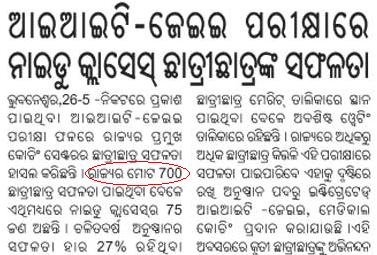
Orissatv.com reports in http://orissatv.com/NewsDetail.asp?newsId=NS3601 that 300 Orissa students cracked the IIT entrance. If that means they qualify for the IIT then it is a great improvement over previous years. If the 300 includes the exttended merit list then one needs the data regarding how many are in the EML and how many qualified for the IITs. If even half of the 300 qualified for IIT then also it is an improvement over the previous years. The article goes on to say:
The state students performed well only after the establishment of an IIT in Bhubaneswar recently.
However, Orissa is still far behind other states. For example, 2000+ qualified from Andhra Pradesh. Comparable to Orissa is Gujarat from where 167 qualified to the IITs and 175 are in the extended merit list.
Update: Dharitri says 700 qualified from Orissa.
May 26th, 2009
May 14th, 2009
After the problems with wrong evaluations with respect to IIT JEE question papers, NEST, the entrance examination for NISER and UM-DAE, plans to take a cautious approach. Following is from NISER-NEST 2009 web page:
NEST question papers and correct answers to the questions of NEST examination conducted on May 10 2009 will be available HERE on May 12 at 4 pm is available HERE Since May 12, 4:00 pm.
Candidates or any other persons may send their comments to feedback [at] niser.ac.in
Comments received till May 20 will be put before the NEST Examination Committee. These comments will be reviewed by the committee and the final correct answers will be announced.
The decision of the Paper Setter’s Committee regarding the correct answers will be final.
This show of humility by the NEST question setters is refreshing.
May 12th, 2009
Following are from postings in the NISER orkut community about the NEST exam in the previous two years.
The pattern of NEST is somewhat as follows : The paper consists of 5 parts –
1. General, 2. Physics, 3. Chemistry , 4. Biology, 5. Mathematics
The General section is mandatory for all. Amongst the other 4, you are supposed to attend ANY 3. All sections carry equal weightage. Regarding the query about scientists and contributions, such kind of questions needn’t be expected in the NEST exam. It basically checks your analytical skill, reasoning and application of concepts. Hence, direct formulae, simple numericals etc. are less probable in NEST.
There will be questions with only one correct answer as well as more than one right alternative. As with the case of SPECIAL textbooks for NEST, your thorough knowledge of basic concepts will be your best guide in the exam, as it evaluates your ability to reason properly, apply your knowledge and arrive at the answer.
!sh@n
abt question types ,
hi ,
The previous year’s paper are not released in public domain yet . however i can assure u it is not like any engineering or medical competitive exam papers. The questions require more analysis and are more thought-provoking. n about books , i think ncert books plus some books with sound theoretical concept would help .
!sh@n
>>henry
analytical questions like, u might be given some graphs or a trend of any sort n u l need to answer based on wht u deduce frm it ( eg bacterial population growth , nuclei decay kind of ). i do not trhink u l need to hurry as in other exams but time management of course helps .
Aaram
The question pattern ‘s a bit different from IIT-JEE, AIEEE or AIPMT. Here, you have a compulsory general section + 3/4 subjects(Phy,chem,bio,math) , & in each section you wil be having ten 3 mark questions n five (or was it six?) 5 mark questions, or atleast thats the way it used to be! The 3 mark qns wil hav only one right answer out of the given choices while the 5 mark ones wil hav more than one correct alternatives. Remember that the 3 mark qns wil fetch you a -1 if you get that wrong, but Heard that there wil b no -ve marking for the 5 mark ones. Heard that this time , the general section ‘s got as equal weightage as the other sections. And regarding some exact qns askd in previous xam, my poor memory doesnt help. Sid , Ishan – May be you can help ém out wid a qn or two.
Aaram
Well, I dont think it’d be necessary for you to be a master of ‘history of science’ to answer d qns in general section successfully. There wont be any qn demanding the answer for "In which year did Roentgen invent the X-ray?" or "Who was the only woman to win the Nobel prize twice?". But for the general section, you need to hav a good ability to ‘think out of the box’ as Sid has mentioned, to be logical, to reason well, n here too, to be clear with your basic concepts. ‘Cos, tho d qns wont be about d years or names, it ‘d definitely help you if you know what ‘s d idea/concept/principle behind different famous classical experiments in science(like Millikan’s oil drop expt, Luria-Delbrook’s expt etc.)
VED
nest 2007 questions.
i remember one or two questions.
1. given that hydrogen gas is at some volume V & pressure P. if the volume is tripled what would be its final pressure. the gas is kept in athermos flask.
2. place the order in which the following occured in time scale.
* darwin proposed his theory.
*kepler proposed his theory on planetary motion.
*there were two more, i dont remember.
3. there was also a question related to the topic critical temperature of real gases. how does the gas behave when it undergoes free expansion. helium gets heated up as its critical temperature for cooling is higher than the room temperature. a whole paragraph was given on this topic & 4 questions were asked in this in the general(compulsory ) section. this question was similar to unseen passage,.
Vaisakh
About General Section
I got some questions of the general section from some of the present 1st year students of NISER. Last year there where 3 or 4 questions from the History of Science part like the year in which Einstein gave the concept of stimulated emission of light, and what Fermat’s last theorem states and what is the main observation in proof for the expanding nature of light.
In last 2 years NEST papers there where questions asking you to arrange the given events in the chronological order. Also as Ved have already said, there were 3-4 question which you should answer based on the paragraphs given above. Last year the paragraphs were about Fresnel and Young’s wave theory of light. And in the year before the paragraphs were about the critical temperature of gases.
Altogether there were 10 questions in the General Section.
Vaisakh
@Şűќѓĩŧĩ
ya it was a mistake, i mean the expanding nature of Universe
To know abt the no: n type of qns,pls refer to previous posts.
For Biology, the biology questions of NEST-2007 were more of ‘checking the concept type’ than ‘checking the information type’. For e.g., there was a question in which a diseased condition called anhydrotic dyplasia was described and questions were asked based on the info provided( like"what if it was like this?". However, this may not be the case always. You are supposed to know the classical experiments, the key concepts, and the basic information, if which ‘s included in your syllabus (ie, informative knowledge of things in syllabus is also important. For e.g., if somebody asks you "How can you possibly reduce the risk of cardiac diseases?" to answer,you must know WHAT all factors lead to cardiac diseases).
However, cramming up lots of data aint gonna help you either. The concepts behind the experiments and the data are more important. So, in the li’l time left now, try to brush up the different concepts in biology ( I mean, for e.g, try to understand what leads to evolution more thoroughly than what are the different kinds of evolutionary evidences, or When you rewind Lederberg’s replica plating expt., try to figure out what they meant to prove by the expt, what was the reasoning etc. When you say Dihybrid ratio ‘s 9:3:3:1, think what did Mendel infer frm that ratio. ) . Such a kind of thinking can really help solve the biology questions n all NEST qns in general.
May 9th, 2009
Number of students registered for NEST 2009, the entrance examination for NISER and UM-DAE
As per http://nest.niser.ac.in/choosecentre.php the number of students registered for NEST and their centers are:
- Ahmedabad: 168
- Allahabad: 285
- Bengaluru: 174
- Bhopal: 577
- Bhubaneswar: 3303
- Chandigarh: 413
- Chennai: 418
- Dehradun: 165
- Delhi: 1458
- Guwahati: 159
- Hyderabad:727
- Jaipur: 653
- Jammu: 61
- Kochi: 539
- Kolkata: 1192
- Lucknow: 841
- Mumbai: 837
- Nagpur: 270
- Panaji: 25
- Patna: 830
- Raipur: 262
- Ranchi: 526
- Sambalpur: 248
- Shillong: 17
- Simla: 38
- Srinagar: 14
The total is 14,200. (Last year 8,000 appeared NEST.) The total number of seats that are available this year are 52 in NISER and 30 in UM-DAE.
May 2nd, 2009
Last year people got into an IIT by scoring 45% in the IIT JEE
(Thanks to Jagmohan Swain for suggesting to write about this.)
See the data at https://www.orissalinks.com/archives/1303.
Aggregate Total for every 500th rank in Common Merit List
|
Rank in Common Merit List
|
Aggregate Marks
|
|
1
|
433
|
|
501
|
287
|
|
1001
|
263
|
|
1501
|
248
|
|
2001
|
236
|
|
2501
|
227
|
|
3001
|
219
|
|
3501
|
212
|
|
4001
|
206
|
|
4501
|
200
|
|
5001
|
195
|
|
5501
|
191
|
|
6001
|
186
|
|
6501
|
182
|
|
7001
|
179
|
|
7501
|
175
|
|
7903
|
172
|
… first paper of IIT JEE 2008 consisted of 69 objective question with 246 marks. Second paper was also of same marks. So the full marks of IIT-JEE 2008 examination was 492. All questions were of objective type with negative marking. The duration of each paper was three hour.
… For OBC quota cutoff will be around 170 marks for rank 4000.
Based on the above and the open-close numbers given at https://www.orissalinks.com/archives/1303 one can see that one can get into an IIT by scoring 45% in the IIT JEE.
March 1st, 2009
Next Posts
Previous Posts

