(Thanks to Prof. Moshe Vardi of Rice University for this pointer.)
This is based on the data made available at http://acarem.hse.ru/data where the faculty compensations (both salaries and perks such as housing) are compared on a PPP (purchasing power parity) basis in 26 countries. Following are some bullet points based on that data.
- In terms of academic salaries of entry level faculty at public universities the list with the per month salary in PPP US Dollars is: Canada (5733), Italy (5029), US (4950), Germany (4885), Norway (4491), UK (4077), India (3954), Australia (3930), South Africa (3927), Israel (3525), Netherlands (3472), Saudi Arabia (3457), Argentina (3151), Japan (2897), Malaysia (2824), Nigeria (2758), Czech Republic (2562?), Turkey (2027), France (1973), Columbia (1965), Brazil (1858), Mexico (1336), Latvia (1087), Kazakhstan (1037), Ethiopia (864), Russia (433), Armenia (405), China (259).
- In terms of academic salaries of top level faculty at public universities the list with the per month salary in PPP US Dollars is: Canada (9485), South Africa (9330), Italy (9118), Saudi Arabia (8524), UK (8369), Malaysia (7864), Australia (7499), India (7433), US (7358), Netherlands (7123), Germany (6383), Israel (6377), Nigeria (6229), Norway (5847), France (4775), Japan (4604), Brazil (4550), Argentina (4385), Columbia (4058), Czech Republic (3967), Turkey (3898), Mexico (2730), Latvia (2654), Kazakhstan (2304), Ethiopia (1580), China (1107), Russia (910), Armenia (665).
- In terms of ratio of monthly salaries to GDP per capita per month for entry level faculty at public universities: Ethiopia (130%), Nigeria (116%), India (110%), South Africa (45%), Argentina (23%), Columbia (23%), Malaysia (20%), Turkey (19%), Brazil (18%), Italy (16%), Canada (13%), Germany (12%), Israel (12%), Saudi Arabia (12%), UK (11%), US (11%), Czech Republic, Mexico (10%), Australia (8%), Japan (8%), Netherlands (8%), Armenia (7%), Kazakhstan (7%), Norway (7%), France (6%), Latvia (6%), China (4%), Russia (2%).
- In terms of ratio of monthly salaries to GDP per capita per month for top level faculty at public universities: Nigeria (262%), Ethiopia (238%), India (207%), South Africa (107%), Malaysia (56%), Columbia (47%), Brazil (43%), Turkey (36%), Argentina (32%), Italy (30%), Saudi Arabia (29%), Canada (22%), Israel (22%), UK (22%), Mexico (21%), Germany (17%), Australia (16%), Kazakhstan (16%), Latvia (16%), US (16%), China (15%), Czech Republic (15%), Netherlands (15%), France (14%), Japan (13%), Armenia (12%), Norway (9%), Russia (5%).
- Housing:
- Provided to all by law: India, Latvia, Nigeria
- Widely used to attract best faculty: China, Saudi Arabia
- Important part of contract negotiations: Kazhakstan, Turkey
- Not influential in contract negotiations: Canada, Ethiopia, Japan, South Africa, UK
- Not offered: Rest
- Retirement funds
- Not offered: Kazakhstan
- Widely used to attract best faculty: UK, China, Canada
- Provided to all by law: Rest (includes India)
One can also use the numbers in http://www.bbc.co.uk/news/magazine-17543356 to do further comparison. For example, the average income in India is $295/month in PPP dollars. So an entry level faculty in a public university in India earns $3954/295=13.4 times of an average Indian. In contrast, an entry level faculty in a public university in US earns $4950/3263= 1.52 times of an average American.
June 21st, 2012
Following is from a PTI report in zeenews.
The proposed innovation universities in the country would be supported by research councils, which would not only identify potential areas of research but also extend advisory services in other areas.
Every university for research and innovation will have such a council headed by a director. These varsities shall present its report annually highlighting its achievements on their website.
The proposed innovation universities, a Bill of which was introduced in Parliament last week, are to be set up during the 12th Plan Period.
The hallmark of the legislation is that each university would focus on one area or problem of significance to India and build an eco-system of research and training around different related disciplines.
In keeping with this objective, each of the council of the university concerned shall interface with research funding organisations, industry and civil society to identify potential areas for research in areas of enterprise.
Besides, the council will assist the teachers in obtaining funding from external sources for research projects prepared by them, according to the provisions of the Universities for Research and Innovation Bill, 2012.
The Bill seeks to set up the universities both in the public as well as the private sectors.
As per the provisions, each of these universities would offer exposure to an international classroom environment, with a minimum of 50 per cent of the students from India.
Each of the research council will be headed by a director and members, the strength of which would be specified by the board of governors of the university concerned.
The council will also provide for incubation of applications emerging from research undertaken in such university.
Importantly, it shall make provisions for research and advisory service for which it would enter into agreement with other institutes, industry, civil society and other organisations and enable the results and benefits of research to be disseminated to the public.
According to the Bill, the research council shall present its annual output on its website three years after the establishment of the university and each year thereafter.
Each of the university would have autonomy in matters of academics, faculty, personnel and finances administration.
May 28th, 2012
Update: Following is an excerpt from a PTI report in Zeenews.
A bill which seeks to provide for establishment of universities focussed on innovation and research was introduced in Parliament on Monday.
The Universities for Research and Innovation Bill, 2012 was tabled in the Lok Sabha by HRD Minister Kapil Sibal.
The Bill seeks to set up the universities both in the public as well as the private sectors.
Each university on research and innovation would provide for the knowledge and economic needs of the country by creating professionals, specialists, scientists and researchers and generate new knowledge to support the national innovation system.
According to the provisions of the Bill, each of these universities would offer exposure to an international classroom environment, with a minimum of 50 per cent of the students being Indian.
The hallmark of the legislation is that each university would focus on one area or problem of significance to India and build an eco-system of research and training around different related disciplines.
These universities would have autonomy in matters of academics, faculty, personnel and finances administration.
The President would be the visitor of the publicly funded universities.
The Bill, which was cleared by the Union Cabinet early this month, does not specify the target of 14 such universities as was proposed earlier.
Following is from a report by Basant Kumar Mohanty in Telegraph.
The Union cabinet today cleared a proposed “omnibus law” under which central or private theme-based universities can be set up with Parliament’s approval without enacting a separate law for each institution as is the rule now.
The Universities for Research and Innovation Bill, 2012, does not apply to general universities but only to “innovation universities” — those where teaching and research will focus on specific areas such as environment, astrophysics, urban planning or the liberal arts.
Universities are now set up individually through legislation by Parliament or a state’s Assembly. Once Parliament passes the new bill, which could be introduced in the current budget session, innovation universities can be established through an executive order followed by parliamentary approval, which will make the process faster.
It will also allow the establishment of as many theme-based universities as the Centre wants as long as they fulfil the set requirements. They can be set up in the public, private or public-private partnership (PPP) mode.
The government plans to set up a few such universities on its own. The bill allows internationally acclaimed foreign universities with at least 50 years of standing in their countries to collaborate with Indian entities to set up innovation universities.
Private bodies such as registered societies, trusts or companies registered under Section 25 of the Companies Act and foreign institutions will be termed “promoters” and will have to sign a memorandum of agreement (MoA) with the government to set up innovation universities, either through collaboration or independently.
The promoter will apply to the government and send a detailed project proposal carrying information such as the vision plan, areas of focus, and how the land and funds will be mobilised.
If the proposal is found acceptable, the government will sign an MoA with the promoter, notify it and place it before Parliament, which will have the right to reject or amend it. The promoter cannot take away the profits from education activities but must plough them back into the institution for its development.
These universities can appoint by invitation anyone with academic distinction and professional achievements as professor or assistant professor. They can also appoint by invitation, as assistant professor, any graduate student with academic distinction and exceptional talent for research.
May 11th, 2012
Following is rearranged from http://pib.nic.in/newsite/erelease.aspx?relid=82396. The sub-headings are added by me.
On 14 Innovation Universities
Recognizing the need for leveraging on the creative knowledge, we are also planning to set up 14 Innovation Universities, to begin with, aiming at world class standards which will set benchmarks for excellence for the Central and State Universities. Each of the Innovation University shall consistently aspire for attainment of pinnacle of knowledge and will provide the knowledge manpower of the country in training professionals, specialists, scientists and researchers needed by the supporting national innovation system. Government has already framed a legislation for Universities of Research and Innovation which will provide a facilitating framework for creation of these institutions. These universities would be embedded in ecosystems developed for promoting synergies among education, research and incubation centres or industry
In order to be truly innovative, these Innovation Universities will not be clones of each other, but will focus on one deep theme of innovation and will focus on one area or problem of global significance in general and India in particular, by building an ecosystem of research and teaching around related discipline and fields and will search for solutions that are globally valid. For example, such areas may focus on urbanization public health, water security, environmental sustainability, digital literacy etc. The proposed universities will be autonomous in true sense, designing their own knowledge disciplines, admission criteria, academic programmes, credit systems etc. The programmes shall also facilitate horizontal mobility across disciplines.
…
We have realized that traditional models of public funded universities are not enough as the investment required is too high. We do acknowledge the need for policies to encourage private investment in higher education and the Foreign Education Providers’ Bill, now under consideration of the Parliament, is a decisive step in that direction. Although Government will be prime facilitator of the new innovation universities and innovation clusters, it is also proposed to focus on Public Private Partnerships (PPP) mode. It is also proposed to collaborate with Universities elsewhere in the world and they may be invited to set up similar such institutions in India and Government will support its research and establishment needs and teaching including scholarships may be funded by the promoting university. New Greenfield Innovation Universities supporting an already existing University/Institution of repute to attain world class standards through innovation in chosen areas of knowledge as well as Identification of some educational hubs in the country, where a few institutions of excellence are located and create an architecture of Innovation University by promoting synergy for teaching and research among such institutions are the models that we are aiming at promoting.
Cluster Innovation Centers
We have also planned creation of Cluster Innovation Centres in our Higher Education Institutions for promoting linkages for innovations, and R&D for solving the real problems and creation of products and processes for which systemic reforms have already been initiated for facilitating the linkages with industry and society. The Cluster Innovation Centres will provide a platform for the University and its partners to forge linkages between various stakeholders from industry and academia and to act as catalysts and facilitators. We have prepared a blueprint for setting up about 50 innovation centres of excellence in different frontier areas. Cambridge Cluster in UK as well as Trinity College founded by Cambridge Science Park are two prominent examples from UK which have promoted the growth of enterprise and innovation and created thriving innovation ecosystems. Such examples also exists in US (MIT, Silicon Valley – Stanford University), Israel, Germany, Sweden, Japan, China and Korea. Biggest strength of these clusters has been the cooperation and collaboration, where all actors are connected in symbiotic relationships. We are also aiming to scale up such National Innovation Clusters. We already have a few such schemes in the form of Technology Business Incubators and Technology Entrepreneur Promotion.
Collaboration with UK
The Cluster Innovation Centers and Innovation Universities are the specific areas in which we seek further collaboration with UK Institutions who have already innovated and scaled up by creating appropriate framework and institutionalized the same successfully.
Meta Universities
Seizing the new opportunities and leveraging the National Knowledge Network, the National Innovation Council has also proposed to create the first Global Meta University. With a network of Universities coming together offering courses cutting across disciplines, the Meta University will reinterpret the concept of a University as not just a traditional, physical space of learning, but as a repository of knowledge and information that can be delivered in multiple ways, and can be accessed from anywhere and anytime. It will seek to enhance the learning experience through new and innovative delivery models of education that allow students and institutions to collaborate in unprecedented ways. Thus the 21st century meta-university would be a network and an ecosystem rather than a single brick and mortar space – a Facebook of Institutions. A few central institutions located at Delhi, like Jawaharlal Nehru University, University of Delhi, Jamia-Millia Islamia and IIT-Delhi have already initiated steps to constitute a meta-university. Here also, we are looking forward to collaborate with Institutions from the United Kingdom in the next step for creation of global meta alliances. Though the internet and technology are fundamental to this conception of the Meta University, at the crux is not a new technology but a ‘new pedagogy’ that is more in tune with the requirements of the knowledge society of the 21st century. In such an environment there is a greater focus on a learner centric, collaborative model that allows continuous learning from the environment.
April 20th, 2012
Following is an excerpt from a report in Hindu.
The Tagore University for the Liberal Arts, first institution to be established under the Human Resource Development Ministry’s once ambitious Universities for Innovation programme, will be set up in Pune. But, ironically, the word ‘innovation’ will be missing from the nomenclature of the institution. For, the group of experts, which was asked to draft a concept for such institutions, fears that such an emphasis is likely to inhibit its creative potential.
The task of such an “institution should be, not to presume an elite status for itself, but to create excellence by drawing freely upon the best talent from all sections of the populace, and fostering it to the furthest extent possible in a climate of international exchange and awareness. Ultimately, such an institution might be the first of many, and it might also provide a model for other existing universities,” the group said in its report submitted to the Ministry.
On its part, the Ministry is finalising the concept paper so that it can send the toned down version of the Universities for Innovation Bill, 2011 for Cabinet clearance.
The proposal to set up 14 such world-class universities was made during the tenure of the former HRD Minister, Arjun Singh, and even the locations were finalised with the Planning Commission. Under the new regime, it was decided to convert these universities into institutions of innovation in different areas of societal concerns. They were then named Universities for Innovation, each expected to focus on its theme in an interdisciplinary manner. However, the revised draft Bill does not give any number for such universities.
… The experts include theatre personality Girish Karnad, academics Supriya Chaudhuri and Sunil Khilnani, and writer Ramachandra Guha.
According to the group’s note, the task of the Tagore University for the Liberal Arts should be to promote both arts and science under the rubric of liberal arts, in an interdisciplinary environment which allows creative interchange of scholars from different fields. The university will have five schools: School of Humanities for teaching languages, literature, philosophy, cultural studies and creative writing; School of Social Sciences for teaching history, politics, sociology, economics and human sciences; School of Sciences for mathematical studies, biological sciences, physical sciences and environmental science; School of Performing Arts for dance, theatre, music, film and sports; and School of Visual and Applied Arts for painting, sculpture, graphic, arts, textile arts, crafts, design and photography.
The experts group has recommended that the university should have a Research Fund with an annual corpus of Rs 200 crore, administered by a Research Council with both internal and external members. ….
The university can invite applications for a proportion of its posts from non-Indian citizens who are outstanding scholars, artists, writers and scientists so as to promote international cooperation and exchange of ideas. The guests will be entitled to special salary provisions, in excess of the pay scales stipulated by the University Grants Commission or other such regulatory body.
March 12th, 2012
The website of this summit is http://www.ficci.com/past-Events-page.asp?evid=20665. Following are excerpts from the press release on Dr. Montek Ahluwalia’s speech.
Inaugurating FICCI Higher Education Summit 2011: Strategies for Expansion in Higher Education in India’, Mr. Ahluwalia said, “The challenge before planners, policy makers and educationists, both in the public and private sector, was of producing world class Indian universities that could be counted in the top 200 rating list.” In the next 20 years we must see a significant number of educational institutions in that category, he declared.
Mr. Ahulwalia also underlined the need to lend an international flavour to Indian universities by inducting international faculty. This would not happen unless the government removes the restriction on employment of international faculty, he said.
For higher education, the 12th Plan objective was expansion, equality of access and excellence. The aim was to raise the gross enrolment ration from the current level of 15 per cent to 30 per cent over the next 15 years. “Expansion of higher education has to be balanced with equality of access, especially for those living in areas where educational institutes did not exist,” he said.
Following are excerpts from the press release on Sam Pitroda’s speech.
Addressing the FICCI Higher Education Summit 2011, Mr. Pitroda said, “Higher education reforms are essential if the nation is to meet the serious challenge of skill shortage that will not allow the economy to grow at 8-10 per cent annually. While many of the recommendations of the National Knowledge Commission are in the process of being implemented, we are waiting for the government to act on the recommendations retailing to reform of higher education.”
“The debate on what needs to be done ought to be over, the time now is to focus on action,” he said and added that “the Bills have already been drafted but none of them have been tabled in or passed by Parliament.”
Mr. Pitroda’s concern found an echo in FICCI President, Mr. Harsh Mariwala’s suggestion that although education continues to be a priority sector during the Twelfth Plan, unless the reform agenda initiated by the Ministry of Human Resource Development in the 11th Plan is carried forward within a stringent timeframe, the demographic dividend of a young population could become a demographic disaster for India as well as the world.
Mr. Mariwala hoped that the Foreign Education Providers’ Bill; Unfair Practices Bill; Tribunal Bill and the Accreditation Bill will be passed in the coming winter session of the Parliament and the National Commission for Higher Education and Research (NCHER) Bill 2010 and Innovation University Bill will be introduced in the winter session of the Parliament. The delay in implementation of the reforms is a serious impediment for the economic development of the country, he said and added that FICCI earnestly urges the political leadership to take cognizance of this fact.
Mr. Pitroda said that the government was creating a US$ 5 billion National Knowledge Network (NKN) which is expected to be ready in about nine months. The network would be a state-of-the-art multi- gigabit pan-India network for providing a unified high speed network backbone for all knowledge related institutions in the country. It would facilitate the building of quality institutions with requisite research facilities and creating a pool of highly trained professionals. The NKN will enable scientists, researchers and students from different backgrounds and diverse geographies to work closely for advancing human development in critical and emerging areas.
Following are excerpts from a report in Chronicle of Higher Education.
Mr. Sibal has said that private participation in higher education must be encouraged, and conference attendees agreed that if the government hopes to reach its goal of sending 30 percent of young people to college, both private and public participation are needed. The challenge, as always, is in weeding out the low-quality operators.
"The public perception of private higher education is in a range," said Montek Singh Ahluwalia, head of India’s Planning Commission, a top government policy-making body. "Many are good, but there is a problem of those not-very-good ones."
Mr. Ahluwalia argued that supply and demand will eventually eliminate the bad actors, but others disagreed.
"It will be difficult to weed them out," said M. Anandakrishnan, head of the Indian Institute of Technology’s Kanpur branch. Because there is more demand than supply, he said, it will take time for stakeholders to make discerning choices.
Another delegate, Sachi Hatakenaka, a British-based education researcher, argued that "private sector growth is good for quantity but not for quality."
… Still, said Mr. Agarwal, the next round of government higher-education planning will focus more on expanding capacity at existing institutions rather than adding new universities.
Some private players were hopeful that the government will look to the private sector more as an ally than an adversary in coming years.
November 16th, 2011
Following are excerpts from the Economic Times article.
The IITs have completed 50 years and have helped build India. They were set up for producing high quality technical human capital for India and have met their objectives. But, as is the character with such institutions, they have not changed with the times and are not providing India with what she now needs.
… The IIT boards and the directors are unable to take any financial decision which they deem fit without the approval of the government . Even for an overseas travel of the director or the faculty, permission is needed. They are subject to austerity measures of the government, a perfect situation to emasculate an educational institution.
The demand for an IIT seat is enormous and has spawned a tutorial industry that earns more revenues than the IITs themselves. This has resulted in large number of students spending up to two years of their youth going to cramming schools learning pattern recognition, forgetting the art of thinking and problem solving knowing that their lives are made once they get entry into the hallowed portals. Today about 60% or more of the intake is from the coaching mandis. This has also resulted in many bright young Indians deciding not to undergo the ordeal and go overseas for higher education. 250,000 of them study overseas, over 110,000 in the United States, about 45,000 in the UK spending about $ 6bn on fees and costs annually …
Overall , the 15 IITs graduate 7000 undergraduates, 6000 post graduates and about 1700 PhDs annually . Sadly only about 2% of the undergraduates go on to their masters and PhD in the IIT system. The IITs hold fast to the idea that by squeezing input they can get a quality output, an idea that has been consigned to the dustbin of history. Increasing the scale and size can give them the diversity of talent, the resources, the ability to have more quality faculty and the depth and width needed for an elite educational institution.
… the IITs will live in their ivory tower and possibly become less and less relevant to India’s need as neither are they meeting India’s need for more human capital nor producing the kind of PhDs India needs.
… The best solution is to open up the education system and allow competition, the dreaded word in academics, to come forth. India should revise her educational policies and allow the private sector to set up "innovation universities" granting them all that they need. Full autonomy, academic, administrative and financial to chart their own future. Some safeguards are needed, as this is a public good. A large corpus of say Rs 100 crore, an open merit based admission policy, a faculty compensation policy based on minimum UGC scales and an assurance that they will aim to be amongst the top 100 in the world over the next 25 years. To ensure access to the merited we need a national scholarship scheme which will fund students. India needs to trust the genius of her citizens to create institutions that are world class and not look at them through myopic eyes with suspicion.
… Today there is a flight to quality. The bad colleges are dying since students have a choice, they are voting with their feet. The good ones are expanding and seeing greater demand. The market mechanism has worked, not by design but by serendipity. So there is hope. Look at various other sectors today. Bharti has made BSNL redundant and has given us a choice, Jet has overtaken Air India and given us a choice, the power system in Mumbai is still the best, and in education the Indian School of Business has turned our IIMs inside out. The IIMs actually want reform, expansion and are concerned about their future .
Competition and an open liberal environment for higher education will work .
I agree with most of the points made in the article and its arguments buttress the need for early approval of universities like the proposed Vedanta University.
One point where I disagree is the suggestion that 100 crores is a large corpus. If the goal is to be in the top 100 in the world, a corpus of 100 crores is very little. That is only 20-25 million USD. In comparison the corpus of Harvard and Stanford are of the order of 25+ Billion USD.
June 16th, 2011
(Thanks to Devasis Sarangi for the pointers.)
Following is from a report in Financial Express.
The ministry of human resource development has zeroed down on 5 of the 14 proposed universities of innovation that would offer students one deep theme of innovation by focussing on one particular area each. The five areas are health, urban planning, energy, liberal arts and power around which an ecosystem of research and teaching would be built.
"These themes are at preliminary stages and the universities can come up only after the overarching body in higher education is in place,” said a ministry official.
The ministry has already started work on the University for Innovation in Liberal Arts but the varsity will be completely publicly funded as not much interest was generated among the private players on this subject.
"The university will be built in the memory of Rabindranath Tagore. It will teach music, physics and maths of music and its relation with the society and arts. Liberal arts will be looked at in an inter-disciplinary manner and not only as psychology or sociology,” said another official privy to the development. The National Development Council of the Planning Commission had approved the setting up of the 14 universities aiming at world class standards and dedicated to innovation across the 11th and 12th Plan period.
The universities are proposed to be located in Orissa, Kerala, Punjab, Uttar Pradesh and Gujarat, among others. Each university will focus on one area, such as urbanisation, environmental sustainability and public health. The Innovation Universities can be established through multiple modes that is publicly funded, privately funded, public-private partnership or by eminent foreign universities.
"Of the foreign universities who have evinced interest are the Massachusetts Institute of Technology, Yale University, Virginia Tech, Columbia University, University of Southern California and the University of Alabama," the official added.
While MIT has expressed interest in mentoring the university that is focused on the energy sector, Columbia University has already started a centre in Mumbai.
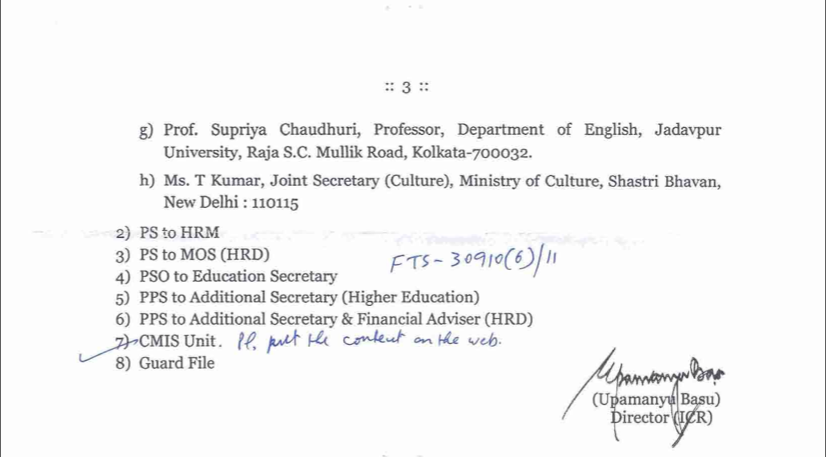
Following is an MHRD memorandum on the university for innovation in liberal arts.
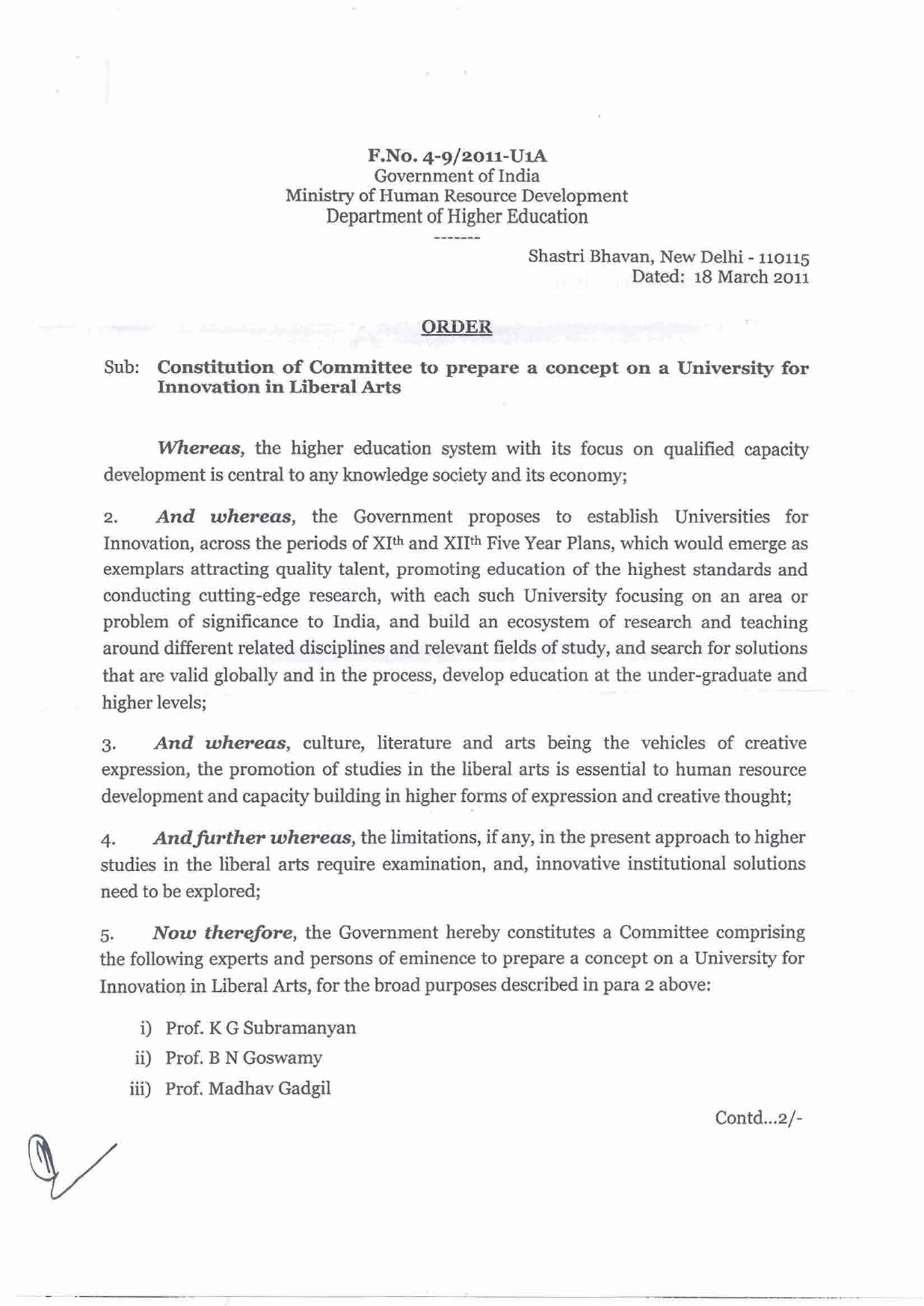
.jpg)
April 4th, 2011
Following are excerpts from the interview at http://www.livemint.com/richardlevin.htm.
Leading Indian institutes are good at teaching but they are not research-oriented. What should be the focus now?
The IITs and IIMs are basically good teaching institutions… The biggest contribution made by research universities is that they have advanced knowledge as well as educate quality students. The requisite for making that happen is, one, opening up the structure of faculty compensation so that you can actually attract world-class individuals.
The strong Indian nationals go to graduate schools in the US and they will not come back if they don’t get compensation close to what they get aboard. And right now, they would not unless there is some change in legislation.
The second is the state support—the need for quality laboratory, infrastructure and competitive research grant to advance their work. While there have been some advances in research grants in India, there is still by and large not the quality of the facility that you can have access to in the US, parts of Europe or indeed recently in China.
…
You had an interaction with Ratan Tata (chairman of Tata group). Is he sponsoring a chair?
There is nothing particular to announce now. We are talking to lots of leading Indian families who are interested in Yale getting more involved in India. I hope there will be some support for our relationship. There is a lot of philanthropic interest in higher education of India. I hope Parliament will open the market up to those philanthropists to build universities. They can give some money to Yale, but that will not have the impact.
India is very brand conscious and it seems it wants foreign universities to set up shop here. That will help, but that is not the answer. The answer is great Indian universities and Indian brands. You have done it with companies—you got Tata, Reliance (Reliance Industries Ltd and Reliance-Anil Dhirubhai Ambani Group), Infosys (Technologies Ltd), you got Wipro (Ltd). These are great global brands now. You can do the same with Indian universities rather than co-branding like Yale-India Campus or Harvard-India Campus.
The impression here is Yale is interested in partnering one or more of the proposed innovation universities. Is that true?
We can have partnership in more than one area (but) not as co-brands. There will be some exchanges.
We may have some advisory role, having some of our faculty helping establish these universities. No joint investment. I think the real hope (for innovation university) is private sector support.
How do you see the growth of education in India vis-à-vis China?
… To compete successfully 20 years from now, India and China will need much stronger research universities. China is very aware of this and politically committed to it.
China is making big investments in research laboratories. They are putting lots of money in top universities to make them competitive with Harvard, Yale and Stanford. They are focusing more on a small number of top universities. Politically, that is very hard for India to do because of India’s democracy. It is very hard for America to do so. Solution is to allow the private sector to have a big role in higher education.
I believe you will succeed because India has built great companies in (the) last 20 years. I think a lot of people responsible for that want to give back to the Indian society. They are eager to do what Leland Stanford (founder of Stanford University) and John D. Rockefeller (founder of Chicago University and Rockefeller University) did in America over 100 years ago. If I am not mistaken, all Parliament needs to do is not to give the money away but pass legislation so that will happen.
The term Ivy League seems to have caught on. After China branded some of its university as C-9 or the Chinese Ivy League, India is set to designate at least nine top universities the Indian Ivy League. Does this help?
It reflected something really in China. Those are the universities that China is making disproportionate investment (in). In fact the government made those investments before naming them as Ivy League of China. I don’t know much about the Indian Ivy League. Unless there are much resources, I don’t think it will have that much of impact.
… prashant.n@livemint.com
I have underlined the part that I thought are important. President (of Yale) Levin is right in his answers. Under the current system Indian government can not pay large enough compensations that will attract a large number of top-quality Ph.Ds and faculty from abroad to populate proposed world class research and innovations universities in India. Only private universities backed by Billion dollar level endowment as well as a viable plan to have global level annual funding year after year (note: My university, Arizona State U, has an annual budget of $1.7 Billion plus; Harvard and Stanford annual budgets are about $3 Billion) have a chance to become world class. Fortunately Vedanta University is exactly such a plan. But unfortunately, the Indian government, instead of helping it and showcasing it such that other billionaires from India follow it, is creating hurdles.
November 13th, 2010
Following is from http://pib.nic.in/release/release.asp?relid=66896.
The National Development Council has approved the setting up of fourteen Universities aiming at world class standards and dedicated to innovation. These universities are proposed to be located at Bhubaneswar in Orissa, Kochi in Kerala, Amritsar in Punjab, Greater Noida in Uttar Prdesh, Patna in Bihar, Guwahati in Assam, Kolkata in West Bengal, Bhopal in Madhya Pradesh, Gandhinagar in Gujarat, Coimbatore in Tamilnadu, Mysore in Karnataka, Pune in Maharashtra, Vishakhapatnam in Andhra Pradesh and Jaipur in Rajasthan respectively.
A concept paper finalized by the government is available on website www.education.nic.in and includes the scope for public private partnership.
The proposed universities for innovation are to be established across two plan periods of XIth and XIIth Plan.
This information was given by the Minister of Human Resource Development Shri Kapil Sibal, in a written reply to a question in the Lok Sabha today.
It was not clear to be what the National Development Council is. Searching in the web I came across the following:
The Planning Commission works under the overall guidance of the National Development Council, India’s prime policy-making body, which guides the nation on the development process.
The planning commission page http://planningcommission.nic.in/plans/planbody.html has the speeches of the PM and CM of various states in various National Development Council meetings. In the most recent meeting the PM addresses his cabinet colleagues, the CM and ministers from various state delegations, and the planning commission members.
November 10th, 2010
Following is an excerpt from a interview in http://chronicle.com/article/Yales-President-Talks-About/125273/.
Q. By "innovation," what do you mean? Could you give me some examples?
A. The biggest one is this: If India is going to build some truly high-quality institutions, it is going to have competitive compensation on a global scale. One of the things the Chinese have done, … they have essentially decided to break their salary scales to recruit back Chinese expats working in the U.S. and U.K. to be leaders and senior professors at their top institutions. And India has an extraordinary expat academic population. But it is very hard to get those people back in the public universities [here], because they are not attractive-enough jobs. So "innovation universities" offer hope that they’ll be able to provide competitive compensation and merit-based compensation.
Q. Did you talk with Kapil Sibal, India’s minister in charge of higher education, about this?
A. Yes, with the minister and many other people here. … The whole point of innovation universities is that both public and private innovation universities in the legislation [to allow for their creation] will have the possibility of not paying [faculty salaries] according to the standard scale.
Q. Why is that issue here in India important to you at Yale?
A. If the question posed to us is, Help us build world-class institutions, my first piece of advice is you can’t do it and pay people 20 percent of what they earn in the U.S. [He laughs.]
The last point is a very important one. While there are many top world class researchers in India, who are only paid 20% of what they would earn in the US, it is not possible to have a university full of such top (in terms of research) faculty by paying them only 20%; let alone have 14 such universities.
That is why there is a need of deep pocketed private benefactors of such universities.
November 9th, 2010
Following is an excerpt from a report in expressindia.com.
Yale president Richard Levin on Thursday said that while China had worked on a “dramatic scale of advancement” in the education sector in the last decade, India has only now begun to work on that path. Speaking to The Indian Express after signing an MoU to launch the “India-Yale University Leadership Programme” with IIT Kanpur and IIM Kozhikode, Levin said India’s answer to China’s investment in high quality education was innovation.
“Making the advancement that China has made…that’s expensive. China has put in a lot of money in higher education… China has singled out 10 per cent of its national universities towards disproportionate investment in order to make them globally competitive,” Levin said. He added that India being a very democratic nation could not, on the other hand, single out certain institutes and provide them with funds in order to make them compete with the Ivy League. China has developed nine of its top universities in a way that they can compete with the US Ivy league.
“Whereas for India, which is a much more democratic country, it is harder to make those kinds of distinctions with government funds and say …we are going to take these five institutions and make them competitive with Yale, China is doing it and getting away with it. India’s answer is innovation universities and have the private sector raise extra resources to get really high quality institutions. That I think for India is a very adaptive strategy,” he said.
… The combination of opening to foreign universities, creating innovation varsities, reforming the accreditation — all of these I think will help for talent advance in higher education sector in India. I am very supportive of Mr Sibal’s vision and hope he is successful in his legislative agenda,” he said.
He, however, admitted that there were misgivings about ‘bureaucratic barriers” in India and that to attract foreign universities to India they would have to be allowed to set their own pay scales, promote/ advance people on their own criteria and bring students they approve by their own process.
October 30th, 2010
Vizag is getting antsy about the delay in the establishment of one of the aiming to be "world class" universities in that city. Deccan Chronicle reports on this issue. Following is an excerpt.
The much-touted “world-class university” in Visakhapatnam has failed to take off though it has been more than two years since the Centre announced the project.
In 2008, the Union HRD ministry had announced plans of 14 “world-class universities” across the country, of which one was allotted to Andhra Pradesh. The state government had also come forward and offered around 800 acre in Visakhapatnam to set up the varsity.
Though the university was later renamed by the Centre as “Innovation University”, officials of the higher education department are clueless about when the actual works will begin.
The state government had identified four sites in Vizag for the purpose and submitted a proposal to UMHRD for clearance. However, there has been no response from the Centre till now.
Sources in the department of higher education said the Centre’s stand about setting up the “Innovation Universities” has changed and that’s the reason for the delay.
… However, the Union minister of state for HRD, Ms D. Purandeswari said the world-class university would be a reality in Vizag in a year. “It is still being discussed how a world-class university should be. So, there is some delay. I cannot give an exact time-frame but in a year a world-class university would definitely be a reality in Visakhapatnam,’’ she said.
Note that Purandeswari is the sitting MP from Vizag.
It should be noted that a draft bill of the Universities for Innovation was circulated and discussed recently. It is expected that a revised version of it may be introduced in the parliament in the winter session. I guess following that starting from August 2011 at least a few of these universities will start operation. The 14 locations that were announced were: Amritsar, Bhopal, Bhubaneswar, Coimbatore, Gandhinagar, Guwahati, Jaipur, Kochi, Kolkata, Mysore, NOIDA-Delhi, Patna, Pune and Vizag. There will be minor funding for these universities during this five year plan. The major funding will come during the 12th plan that starts from 2012.
September 14th, 2010
Following is an excerpt from a report in Times of India.
Facing a massive shortage of well-qualified teachers, the prestigious Indian Institutes of Technology (IIT) have mooted a proposal for hiring foreign nationals as permanent faculty members.
With one-third teaching positions lying vacant, the proposal as a solution to meet the unprecedented staff crunch is expected to be deliberated at the next IIT council meeting on Friday, IIT officials said.
The move, if accepted, would enable the premier engineering and technology institutes to appoint foreign teachers on permanent positions, up to 10 per cent of the faculty strength.
I hope this proposal by the IITs is approved and the limit is increased from the proposed 10%.
Most universities in US, Europe, Australia, Hong Kong, Singapore etc. are able to hire foreign faculty in permanent positions. The inability of IITs and other Indian institutions to do that hurts them. This will also serve as an experiment to see how attractive the salary offered by the IITs is to foreign faculty that are not of Indian origin. The data and experience gathered from this experiment will be useful for the universities of innovation which are supposed to be unconstrained by the government in terms of salary offered to its faculty. The concept note of these universities already talked about allowing hiring of foreign faculty.
September 9th, 2010
Following are excerpts from a report in University World News.
… "These universities will focus a lot on research and development and industry-academia collaboration. Besides the conventional streams of knowledge, research and development in emerging areas like global warming, food security, agriculture and community health will get prime focus," Sibal said after the consultation on 28 August with vice-chancellors, academics and business and industry organisations.
Universities themselves will decide their area of focus. However, Sibal said, they "should essentially identify areas having a direct bearing on the community."
Apart from the 14 public universities to be set up under the bill, private players could set up more institutions within the prescribed framework.
The new universities will be allowed to admit half their students from abroad, teach foreign curricula and hire teachers and even vice-chancellors who are foreign nationals, according to a draft law circulated by the government.
"Every university of innovation shall provide an ambience of learning that has an international flavour," states the Universities for Innovation Bill 2010, though "not less than half" the students should be Indian nationals".
The universities will not come under the purview of the University Grants Commission, which regulates most universities in India. The UGC caps the enrolment of foreign nationals at 15%.
Instead they will be set up with private help and be self-regulated, with half their board members being independent experts of academic eminence. They will also be free to set up more than one campus, including outside India.
Some of the universities will be set up in collaboration with leading American and British universities. Yale University, for instance, is already in talks with the education ministry and wants to develop leadership programmes for the new universities.
Innovation universities will be allowed to teach both Indian and foreign curricula simultaneously, and issue degrees that need not comply with established Indian norms.
The bill allows each innovation university to frame its own policy to attract faculty members from India and abroad and hire them directly, offering wages and perks that it deems fit. Currently, the government clears all faculty appointments and decides the salary structure of teachers in government and government-aided institutions.
There was overwhelming support for more flexibility in appointing faculty members. "The heart of this bill is innovation. We want to give the required freedom for innovation and not stifle promoters with regulations like appointing vice-chancellors through collegiums," said Sibal, referring to the current system of selection university heads.
Lifting an existing 20% cap on appointing professors by invitation was also discussed. In the meeting "stakeholders asked to do away with the rule", Sibal said. A senior academic argued: "Why limit it to 20%? Let the innovation universities decide."
A key suggestion during the consultation was that since the universities will be innovative in nature, the bill should clearly define the outcomes it plans to achieve. Administrative structure, too, figured prominently in the discussion.
Sibal said most of the suggestions that came up in the consultation were likely to be incorporated in the final draft of the bill, which will probably be introduced into parliament during the winter session.
Most of the points above have been covered in earlier articles. The only new point here is that these universities will be free to have multiple campuses. This is significant. For the one in Bhubaneswar, the government should allocate land in multiple locations inside Odisha (some far from Bhubaneswar), perhaps from the beginning itself.
September 6th, 2010
The following were obtained from various sources. I don’t vouch for their 100% correctness. Please use them at your own risk.
September 2nd, 2010
Previous Posts