The following is extracted from the Odisha JEE 2011 brochure. Thanks to a post in rourkelacity.com for the pointer.
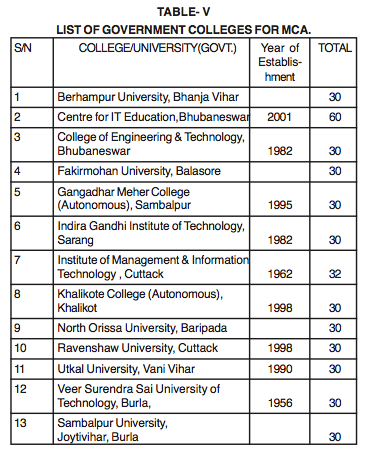
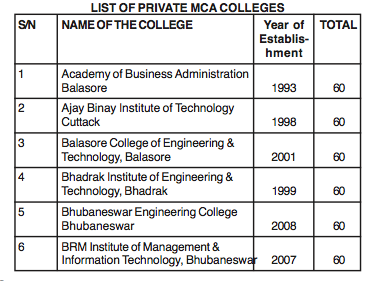
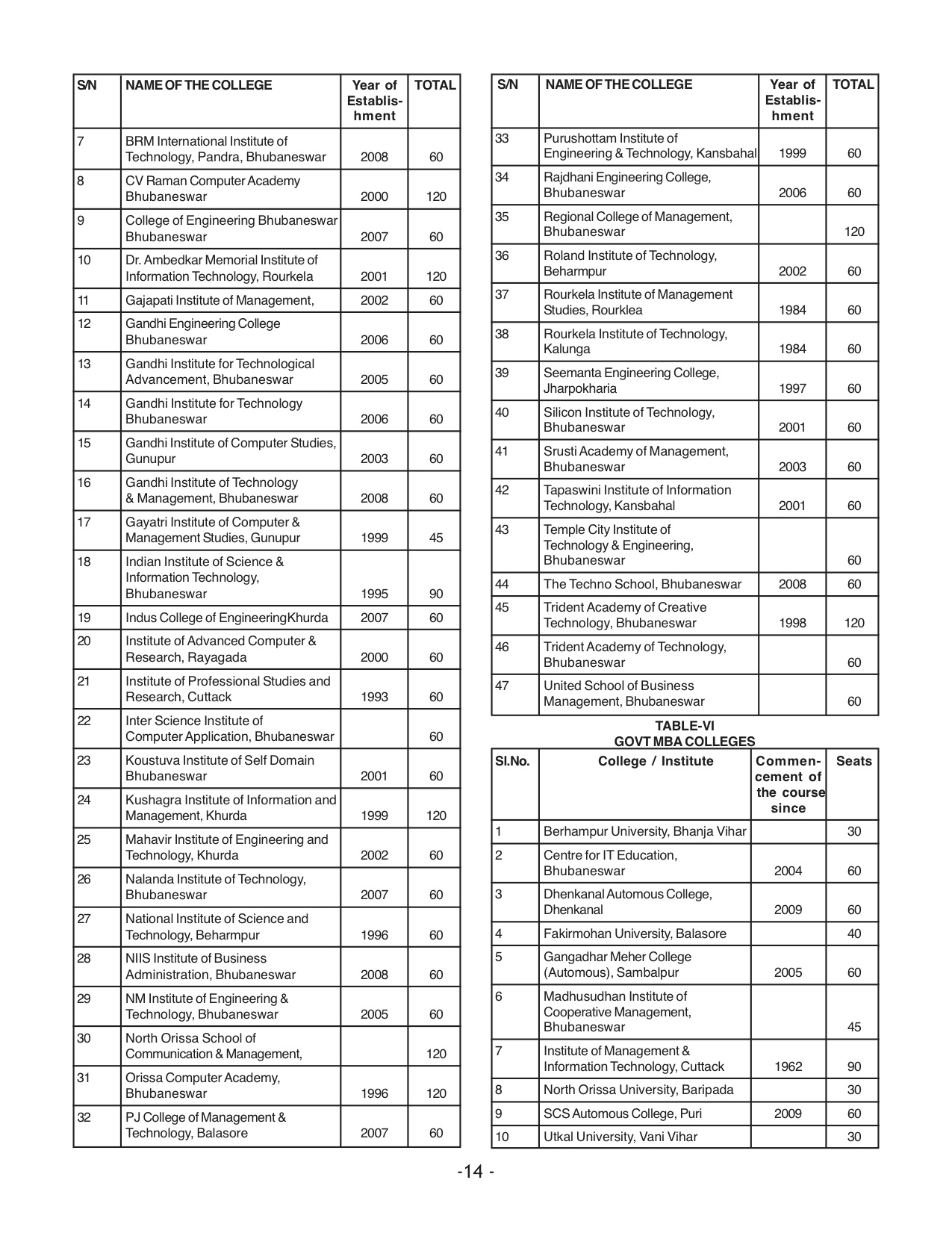
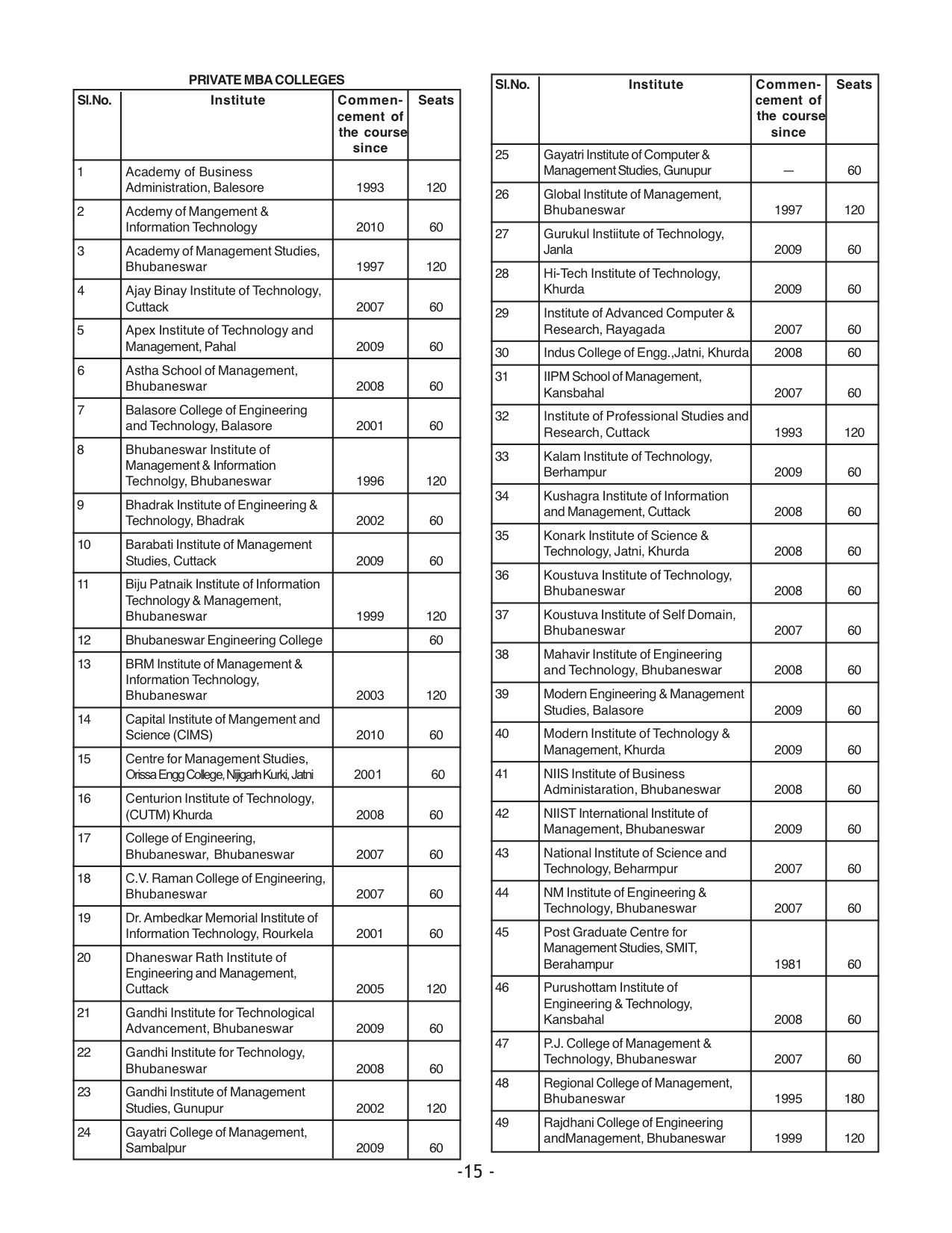
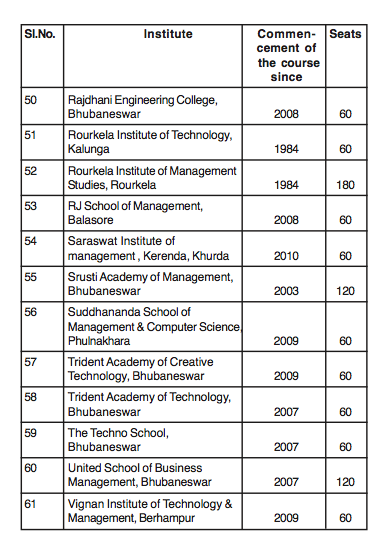 Note that one can study PG Diploma in Business Management and similar subjects (such as Rural Management) in several other institutions. Those are not listed above. Some of these institutions are: XIM Bhubaneswar, IMI Bhubaneswar, HDF Business School Bhubaneswar, IITTM Bhubaneswar, etc.
One can also pursue B.Sc (Hons) in Computer Science and M.Sc Computer Science in several institutions. SUIIT (Sambalpur University Institute of Information Technology) also offers courses in IT that are not listed above.
May 9th, 2011
The following is from http://www.aicte-india.org/downloads/expertsch/Expert%20Visit%20Schedule%20as%20on%2028.05.10.htm.
| 20-MAY-10 |
Deficiencies noted by EVC |
SRI KRISHNA CHAITANYA ENGINEERING COLLEGE |
| 20-MAY-10 |
Deficiencies noted by EVC |
Bhubaneswar Institute of Industrial Technology |
| 21-MAY-10 |
Deficiencies noted by EVC |
Shibani Institute of Business and Management |
| 21-MAY-10 |
Deficiencies noted by EVC |
Saraswat Institute of Management |
| 22-MAY-10 |
Deficiencies noted by EVC |
BHADRAK ACADEMY OF TECHNOLOGY |
| 22-MAY-10 |
Forwarded to RC |
Mahendra Institute of Management and Technical Studies |
| 22-MAY-10 |
Deficiencies noted by EVC |
Pentagon School of Management |
| 22-MAY-10 |
Deficiencies noted by EVC |
UDAYANATH COLLEGE OF SCIENCE AND TECHNOLOGY |
| 22-MAY-10 |
Deficiencies noted by EVC |
DRIEMS BUSINESS SCHOOL |
| 22-MAY-10 |
Appeal Requsted |
INTERNATIONAL INSTITUTE OF ENGINEERING & TECHNOLOGY |
| 22-MAY-10 |
Deficiencies noted by EVC |
CAPITAL ENGINEERING COLLEGE |
| 22-MAY-10 |
Deficiencies noted by EVC |
KRUTTIKA INSTITUTE OF TECHNICAL EDUCATION |
| 24-MAY-10 |
Deficiencies noted by EVC |
CAPITAL INSTITUTE OF MANAGEMENT AND SCIENCE |
| 24-MAY-10 |
Deficiencies noted by EVC |
ACADEMY OF MANAGEMENT & INFORMATION TECHNOLOGY |
| 25-MAY-10 |
Deficiencies noted by EVC |
Government College (Autonomous), Angul |
| 25-MAY-10 |
Deficiencies noted by EVC |
Fakir Mohan Autonomous College |
| 25-MAY-10 |
Part B – Submitted |
Radhakrishna Institute of Engineering and Technology (RITE) |
| 25-MAY-10 |
Part B – Submitted |
RAYAGADA INSTITUTE OF TECHNOLOGY AND MANAGEMENT |
| 26-MAY-10 |
Deficiencies noted by EVC |
Hirakud Institute Of Engineering And Technology |
Following is the list of Colleges and Programs that are in the pipeline. It is obtained from http://www.aicte-india.org/excel/30april/Orissa_300410.htm.
| AADARSH Institute of Management and Science, Bhubaneswar (Management) |
| ACADEMY OF MANAGEMENT & INFORMATION TECHNOLOGY, Bhubaneswar (Management) |
| BHADRAK ACADEMY OF TECHNOLOGY, Bhubaneswar (Engineering) |
| Bhubaneswar Institute of Industrial Technology, Bhubaneswar (Engineering) |
| BRM International Institute of Management, Bhubaneswar (Management) |
| CAPITAL ENGINEERING COLLEGE, Bhubaneswar (Engineering) |
| CAPITAL INSTITUTE OF MANAGEMENT AND SCIENCE, Bhubaneswar (Management) |
| Dadhichi College of Engineering, Cuttack (Engineering) |
| Dadhichi Institute of Management & Science, Cuttack (Management) |
| DAV SCHOOL OF BUSINESS MANAGEMENT, Bhubaneswar (Management) |
| DRIEMS BUSINESS SCHOOL, Cuttack (Management) |
| Fakir Mohan Autonomous College, Balasore (Management) |
| Government College (Autonomous), Angul (Management) |
| Hirakud Institute of Engineering & Technology, Baragarh (Engineering) |
| IMB BUSINESS SCHOOL, Bhubaneswar (Management) |
| INTERNATIONAL INSTITUTE OF ENGINEERING & TECHNOLOGY, Bhubaneswar (Engineering) |
| INTERNATIONAL MANAGEMENT INSTITUTE – BHUBANESWAR (Management) |
| KRUTTIKA INSTITUTE OF TECHNICAL EDUCATION, Bhubaneswar (Engineering) |
| M.P.C. (AUTONOMOUS) COLLEGE, Baripada |
| Maa Manasha Institute of Engineering and Technology (MMIET), Bhubaneswar (Engineering) |
| Mahendra Institute of Management and Technical Studies, Bhubaneswar (Management) |
| Pentagon School of Management, Bhubaneswar (Management) |
| Radhakrishna Institute of Engineering and Technology (RITE), Bhubaneswar (Engineering) |
| RAYAGADA INSTITUTE OF TECHNOLOGY AND MANAGEMENT, Rayagada (Engineering) |
| Saraswat Institute of Management, Bhubaneswar (Management) |
| Satyananda Institute of Engineering & Technology, Bhubaneswar (Engineering) |
| SATYANANDA INSTITUTE OF MANAGEMENT & INFORMATION TECHNOLOGY (SIMIT), Bhubaneswar (Management) |
| Shibani Institute of Business and Management, Bhubaneswar (Management) |
| SRI KRISHNA CHAITANYA ENGINEERING COLLEGE, Bhubaneswar (Engineering) |
| UDAYANATH COLLEGE OF SCIENCE AND TECHNOLOGY, Adaspur (Management) |
May 23rd, 2010
Following is from a report in tathya.in.
… Mr.Patnaik (the CM) has asked Country’s one of the topmost B-School, Xavier Institute of Management Bhubaneswar(XIMB) to open another campus in Sambalpur.
A U Singhdeo, Minister Planning & Coordination and Public Enterprises also urged XIMB authorities to expand their empire.
So with the blessings of the Chief Minister and his government XIMB soon will open another campus in Sambalpur district of Western Orissa.
On being invited by Government of Orissa, XIMB opened its first Institute here in 1987.
That time 20 acres of land and Rs.5 crores were given to the institution to open a campus in Orissa.
During these 22 years, XIMB brought Bhubaneswar on the national B-School map and earned a good name for being in list of top ten Management Institute of the country.
It is run by Jesuit Society on no profit, no loss basis.
In fact XIMB has the most reasonable fee structure among the top institutes.
It has also produced about 1500 students in the last 20 years who have reached to the top post of private sector in the various parts of the country.
Many of them have returned back to the state and started their own enterprise.
Many successful entrepreneurs of the state can trace back their relation with XIM one way or other.
Vijay Arora, Secretary PPP, known for his dynamism and original thinking knowing the strength of the XIMB, conceived the idea of opening another campus in the state preferably in Samblapur.
He discussed the concept with P T Joseph SJ, Director XIMB who agreed to the idea in case the Government provides the necessary support.
This was to allow the Western Orissa benefit of quality educational Institution.
Matter was discussed with the Government in the Department of Planning & Coordination.
Satya Prakash Nanda, Development Commissioner is favorably disposed off towards a new campus of XIMB in Sambalpur, said sources.
After arriving at a mutual understanding, a report was submitted by the Director XIM Professor Joseph to the Government outlining the project and the support required.
Along with Management XIMB proposes to run courses in Agri-Business Management and Rural Management etc.
This is a great move from all aspects.
October 17th, 2009
Following is from http://www.jeeorissa.com/newsfiles/news_10.htm.
JOINT ENTRANCE EXAMINATION -2009, ORISSA
JEE/09/AIPMT05 Dated:08.07.2009
Registration of AIPMT (AIPMEE/AIPDEE) candidates to participate in the counseling- cum –admission against 15% all India Quota seats in private medical colleges.
As per provision of “The Orissa Professional Educational ( Regulation of Admission and Fixation of Fee) Act ,2007” 15% of the seats in MBBS and BDS programmes in all private medical colleges to be filled up by valid AIPMT rank holders. To participate the counselling, these candidates are required to register on line in our website www.jeeorissa.com from 10.07.2009 to 12.07.2009. Candidates are advised to take the print out after the registration. The candidates are allowed to enter the counselling hall with production of this printout. Only registered candidates will be allowed to participate in counseling. The schedule and venue for counseling for these candidates are at 8.15 AM on 14.07.2009 at Conference Hall , Hotel Kharavela, Khandagiri Chhak,Bhubaneswar-30. No separate letter will be given to candidates for attending Counselling.
Chairman , JEE-2009
Following is from http://www.jeeorissa.com/newsfiles/news_11.htm.
JOINT ENTRANCE EXAMINATION -2009, ORISSA
Registration of AIEEE candidates to participate in the counselling– cum –admission against 15% all India Quota seats in private Engineering colleges.
As per provision of “The Orissa Professional Educational ( Regulation of Admission and Fixation of Fee) Act ,2007” 15% of the seats in all private Engineering colleges are to be filled up by AIEEE rank holders. To participate the counselling, these candidates are required to register on line in our website www.jeeorissa.com from 11.07.2009 to 15.07.2009, 2P.M as per their all India rank. Candidates are advised to take the print out after the registration. The candidates are allowed to enter the counselling hall with production of this printout. Only registered candidates will be allowed to participate in counselling. The schedule and venue for counselling for these candidates will be published on 16.07.2009 in our web site. Candidates are advised to check their Date, Time and Venue from our web site after 16.07.2009 along with documents required for the counsellng. No separate letter will be given to candidates for attending counselling. The counselling will be held from 19.07.2009.
Chairman , JEE-2009
July 10th, 2009
Following is an excerpt from a report in Indiaeducationdiary.
The Chief Minister of Orissa, Shri. Naveen Patnaik inaugurated the new academic block of the Xavier Institute of Management, Bhubaneswar (XIMB) this morning. XIMB which has been consistently ranked as one of the finest business schools in India has achieved yet another milestone with this new infrastructural development keeping in mind the future demands of management education. …
Speaking to a gathering of more than 800 people, Shri.Patnaik felt that XIMB as an Institute has a lot to offer and congratulated the leadership at XIMB for ensuring continued success and development for the society through the social developmental activities carried out by XIMB.
This new academic block is a seven storied beautiful building and is adjacent to the Fortune Towers which houses major companies operating in Orissa. Standing tall along side the Fortune Towers, the XIMB’s new academic block also provides a glimpse of the changing industrial scenario of Orissa and points to the development that the state is making with regard to business education, commerce and industry. The new academic block has a built up area of 45,875 square feet and has been constructed at an estimated cost of 6.5 crores. It has 23 Faculty rooms, 6 lecture halls with a seating capacity for 60 students each, 4 lecture halls with a seating capacity for 70 students each and two lecture halls with a seating capacity for 120 students each. Besides these facilities, the new academic block also has a board room, a conference room and an examination hall with a seating capacity for 250 students. …
June 22nd, 2009
May 9th, 2009
This status report is as off 12/31/2008 and is from here. The earlier status report is at https://www.orissalinks.com/archives/1197.
1. Krupajal Engineering College, Pubasasan, Kausalya Ganga, Bhubaneshwar – 2, Orissa.
De-novo
F. 9-17/2007-U.3 (A) dated 15th March, 2007 withdrawn. Fresh proposal received under De-Novo No. F.9-27/2008 dt. 15.4.08
View/NOC of the State government is awaited. UGC No. F. 35-1/2007 (CPP-I).
2. College of Engineering Bhubaneswar, Under Nabadigant Educational Trust, Plot No. 1, Sector – 3, Chandaka Nucleus Industrial
Complex, Patia, Bhubaneswar – 751 024, Orissa.
De-novo
F.9-30/2007-U.3 (A) dated 15th May, 2007
The Institute has been asked to comply with the deficiencies vide UGC Letter No. F. 35-3/2007 (CPP-I) dated 27th August, 2007
3 Asian School of Business Management Bhubaneswar, Orissa.
De-novo
F.9-45/2007-U.3 (A) dated 18th September, 2007
Views/NOC from State Government is awaited. UGC letter No. F. 35-5/2007 (CPP-I)
4. Vidya Bharti University, Gunupur Distt. Rayagarh, Orissa
F.9-60/2007- U.3(A) dated 28.11.2007
Views/NOC from State Government is awaited. F.35-6/2007 (CPP-I).
5. Koustav Institute of Self Domain Patia, Bhubaneswar, Orissa.
De-novo
F. 9-68/2007- U.3(A) dated 9th January, 2008
Information has been called in checklist proforma vide UGC Letter F. 35-1/2008 (CPP-I) dt. 4.2.2008.
6. HI-TECH University Plot No. A-170, Saheed Nagar, Bhubaneswar, Orissa.
F. 9-4/2008-U.3(A) dated 15th January, 2008
Information has been called in checklist proforma vide UGC Letter F. 35-2/2008 (CPP-I) dt. 6.2.2008.
7. C.V. Raman University Bhubaneswar, Orissa.
F. 9-67/2007-U.3(A) dated 9th January, 2008
The Institute has been asked to comply with the deficiencies vide F. 35-4/2008 (CPP-I) dt. 8.8.2008.
8. Orissa Institute of Technology P.O.-Burla, Distt-Sambalpur – 758018 Orissa
F. 9-41/2008-U.3(A) dated 9th July, 2008
Institute has been requested to submit the information in the prescribed proforma & checklist vide letter No.F.35-5/2008 (CPP-I) dated 29.7.2008
March 5th, 2009
Following is from the annexure at http://pib.nic.in/release/release.asp?relid=47598.
.jpg)
.jpg)
February 18th, 2009
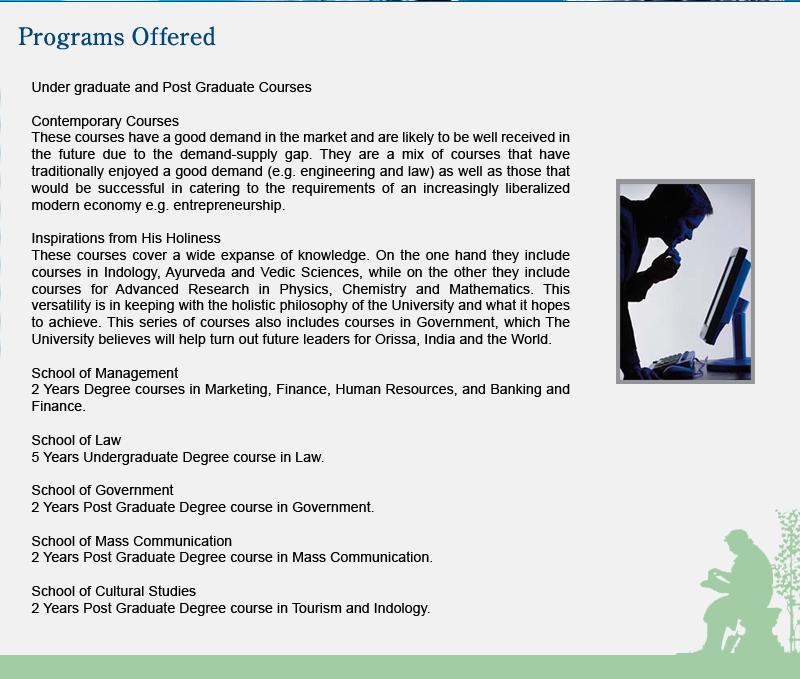
The website of the university is http://www.srisriuniversity.org. The courses that are on offer now (hope they start working on the engineering and medical school soon) are as follows:

Following is an excerpt of the news item from the Statesman about the foundation laying .
The foundation stone for the Sri Sri University was laid at Naraj in Cuttack district today. The University is going to be set up by Sri Sri Ravisankar Vidya Mandir Trust.
Speaking at the occasion, chief minister Mr Naveen Patnaik said the world-class research-based University will have streams in basic science, arts, engineering, business management, law, art and culture, ayurveda and others.
… The government has provided 186 acres of land for the Sri Sri University and will bring a special law for it.
Spiritual guru Sri Sri Ravisankar said the whole world looks to India for guidance in the present turbulence across the glove.
“The human values are the best gifts of our country to the world”, he said.
On the university he said that that this will be a common man’s university. “There is an urgent need to change the educational system and the prime necessity is the teaching of human values”, he added.
September 25th, 2008
Following is an excerpt from a report in Business Standard by Jayjit Dash.
Hi-Tech Group of Institutions has planned to set up two management institutes, one at Khurda and the other at Jatni, both located within 25 km radius of the city, at a combined investment of about Rs 12 crore.
These management institutes are set to be built on surplus land available at the two technological institutes run by the organisation – Konark Institute of Science and Technology (KIST) located at Jatni and the Hi-Tech Institute of Technology (HIT) in Khurda.
While the B-school in Khurda will come up on 15 acres of surplus land on HIT campus, the other B-school will be developed on 10 acres of surplus land within the KIST campus at Jatni.
“Construction work for our two proposed management institutes has already begun and we expect these two institutes to be functional next year. …
Each of these management institutes will have an intake of 60 seats and will offer two-year, full-time MBA programmes from the 2009-10 academic session.
The Hi-Tech Group will also invest Rs 30 crore for introducing new super-specialities, namely, cardiology, cardio-thoracic surgery, neurology, nephrology and trauma care in the Hi-Tech hospital. Hi-Tech Group of Institutions has also got the approval of AICTE to introduce post-graduate courses in engineering at the KIST campus.
The KIST campus will offer MTech in computer science and engineering as well as electronics and telecommunications engineering from the next academic session.
At present, KIST is offering BTech in five streams of engineering with the institute’s total intake being 420 seats. Meanwhile, the group expects to take possession of land for its proposed medical college and hospital in Rourkela within a month.
“We expect to get 25 acres of land for our proposed medical college cum hospital in Rourkela within a month and then inaugurate the hospital six months after acquiring land. Our medical college in Rourkela is expected to be operational a year after the inauguration of the hospital”, Panigrahi claimed.
September 13th, 2008
LOCATION FOR THE PROPOSED UNIVERSITY:
The proposed university will be developed at Banki, near Cuttack, Orissa, in multiple stages. Kripaluji Maharaj has lakhs of followers in Orissa. In the first stage, 110 acres of land has been finalised, and a Memorandum of Understanding (MoU) has been signed by the Trust and the Govt. of Orissa.
PROPOSED COURSES AT THE UNIVERSITY:
1. B. Nat (Ayu) – Bachelors of Ayurved in Naturopathy.
2. B. Nat (Yogic Sciences) – Bachelor of Naturopathy and Yogic Sciences
3. Rural Economics
4. Rural development on Health, Hygiene, Homes, Human Values and harmony in diversity
5. Rural Management
6. B.A – Bachelor of Arts
7. B.B.A, M.B.A – Bachelor and Master of Business Administration
8. B.C.A – Bachelor of Computer Application
9. Bachelor and Master of Oriental Learning
10. Bachelor of Professional Studies
11. Bachelor and Master of Social Work
12. B.Sc – Bachelor of Science
13. B.E – Bachelor of Engineering
14. Yog Therapy
Continue Reading August 6th, 2008
Recent news in Tathya and earlier news in Samaja mention that the IIT in Bhubaneswar may be located in Argul near (3kms away) Khurda Rd/Jatni station. If that happens with NISER also 2 km away (in a different direction) from Khurda Rd, the Knowledge SEZ near Khurda, multiple private engineering colleges in the vicinity, and with the possibility of a campus of the highly rated management institute IMI near the IIT, this area will become a major knowledge hub. The govt. of Orissa plans to join all these together as an ITIR. The proposed Vedanta University will only be 40kms or only 30minutes from this area.
August 6th, 2008
The Chairman of HDF is Dr. Dhanada Mishra, Ph.D in Civil Engineering from University of Michigan, Ann Arbor. Among other credentials, Dhanada is the state coordinator of Pratham, an AID Saathi, SEEDs board member and a decent human being. He is the Chairman of the Human Development Foundation (HDF), which is in the process of establishing a business school with difference. With him at the helm of the HDF School of management, HDF’s vision of "an empowered and proactive community enriched by quality human resources" and mission of "facilitating a participatory movement to strengthen development initiatives by promotion of quality human resources and encouragement of shared leadership", and with Dhanada as the chairman of the board of trustees of HDF, I think this B-School will not only be a top-notch B-School in the country but will also be a B-School with difference. To understand what I mean by a B-school with difference, let me copy and past the Chairman’s message below.
Dear prospective students;
Welcome to HDF School of Management!
As you consider your choices for higher education in Management Studies, I would like you ponder for a moment about the kind of institution that you would like to spend two precious years of your life in. As you look at the options I am sure you will realise that you are faced with two very stark choices. On one hand you have public sector institutions offering programs at affordable costs to students selected in highly competitive admission process. It is no doubt that some of these institutions are world-class. Unfortunately, most of the public sector institutions provide poor environment for overall growth of the individual in the sense that they lack the entrepreneurial spirit which is reflected in weak placement effort, lack of up-to-date curriculum, weak industry linkage and so on. These aspects are more pro-actively addressed by the second group of growing number of institutions promoted by edupreneurs in the last one and half decade. However, it may not be an exaggeration to say that most of these second set of institutions are characterised by high fees, unethical commercialisation, lack of transparency and poor quality.
In the above scenario, Human Development Foundation (HDF) is making an attempt to create a third alternative where the best characteristics of public and self-financed education can be offered to the students. The Foundation itself is based on the deep concern of a set of individuals for the over-all development of the society through creation of high quality and ethical human resource to tackle our myriad problems. The School of Management is but one of the several ventures to offer students high quality education at a modest fee. It is driven by highly qualified and motivated faculty. It provides opportunity to students for exposure to social sector development projects for hands-on feel for one’s responsibility towards society beyond career aspirations. Thus, it aims to create a balanced, competent and wholesome individual equipped with the best tools of the trade, ready to engage with the society be it through the corporate sector or through the development sector.
The vision of the foundation, ‘an empowered and pro-active community’, can only be achieved by creation of high quality human resource on a scale matching the enormity of our future needs. We believe that through our passion for this vision, hard work, team effort and dedication we will create an environment where you can achieve your true potential as a management professional of highest caliber ready to take on the world.
I look forward to meeting you in near future.
Dhanada Kanta Mishra, Ph. D. (University of Michigan, Ann Arbor)
April 5th, 2008
Following is an excerpt from a report in New Indian Express.
Leading business weekly ‘Dalal Street Investment Journal’ (DSIJ) has zeroed in on city-based Asian School of Business Management to launch a post-graduate programme in investment portfolio management, the first of its kind in the country.
The journal, owned by Ramdeo Media Enterprises, will provide the course content and other expertise. ASBM … Both the organisations signed an MoU on Thursday to launch the course. It would first be offered in ASBM’s upcoming Hyderabad campus and later on here.
… the magazine had approached ASBM to leverage on its core strength and run the programme which would eventually meet the increasing demand for qualified professionals in the expanding equity market. A recent report by the journal had, in fact, highlighted the acute shortage of managers in handling the swelling base of investment portfolio.
Signing the agreement, director (marketing) Deepak Jhangiani too highlighted the manifold growth of the investment community in the country which has expanded to the tune of 3.2 million within a short period.
As per prediction, about 1,000 mutual fund companies are expected to come up in the subcontinent. The course will stretch over 18 months and have six months of internship programme in investment firms.
April 4th, 2008
Following is an excerpt from http://www.pagalguy.com/index.php?categoryid=51&p2_articleid=1224.
What are the top 3 advantages of XIMB’s MBA programme that no other business school in the same league offers?
The top 3 advantages are:
a) Higher Industry Interaction and Corporate Linkages for the XIMB students by using platforms such as Immersion Courses, CEO Talks, etc. The Immersion Courses are specific course modules which are delivered by top Industry experts within a short span of 1-2 days while CEO talks are a series of seminars with top CEOs of the country and beyond.
b) Rigorous and intensive course curriculum which is highly adaptive and consistently upgraded and is extremely compatible with the industry needs and therefore provides the highest degree of relevance for study of the students and turns them into industry ready management professionals. Further, Technology intensive facilities like VSAT and Video Conferencing Platforms are used in order to augment learning process of the students.
c) Thrust and focus on establishing and maintaining high ethical standards in business and professional life and ensuring social sensitivity for the underdeveloped sections of the society and being a professional manager with a “Human Face”.
…
What were the XAT cutoffs at XIMB for the 2005 and 2006 PGP and PGPRM admissions? How does XIMB use sectional cutoffs for short listing candidates?
The XAT cutoffs at XIMB for PGP programme in 2005 and 2006 were 87.45 and 91.74 percentile respectively. PGPRM admissions are conducted through IRMA Entrance Test. For the year 2005 and 2006, IRMA has not released the cutoff marks. XIMB has an Admissions Committee comprising of Senior Faculty Members which every year scrutinizes analyses and then sets sectional cutoffs for short listing candidates as it relevant and necessary for that year.
…
How much is the quota for Orissa domicile students at XIMB and what is the XAT cutoff for this category?
The Institute gives some preference to domicile candidates to fulfill its social contract with the State of Orissa. The XAT cut off was close to 90 percentile for the domicile candidates for this year.
How would you address the concerns of a non-Orissa candidate with an admission offer about the dilution in batch quality due to the quota?
There is no dilution in standards of intake. The learning process imparts very high value and outcome is evident when 100 pc placements are achieved on Day-1 itself. Some domicile students who graduate from here do secure top 10 positions in the merit list.
…
How many full time faculty members does XIMB have? How does XIMB retain its best faculty?
XIMB has 47 full time faculty members. XIMB retains them by providing them the best compensation packages seen in India today, providing financial incentives for publications, paper presentations and other research work. Apart from that XIMB provides an excellent Quality of Life for them and their families on campus as well as supports them financially and institutionally for their PhD work, Research, and Consultancy as well as for undertaking Training and Development Programmes.
What are the pros and cons of being located in a relatively less-developed state like Orissa?
XIMB is located in Bhubaneswar, the capital city of Orissa. Bhubaneswar is extremely well connected by airlines, railways and Highways. Apart from that many IT majors like Infosys, Satyam, etc. as well as manufacturing entities like POSCO, Vedanta, NALCO, etc. are based out of Bhubaneswar. Bhubaneswar is considered to be one of the most rapidly developing cities in India. Therefore, there is no negatives but rather the presence of such high concentration of corporates makes Bhubaneswar and extremely viable and beneficial place for an institution like XIMB to grow.
What are the top 3 value propositions of studying Rural Management in XIMB as opposed to dedicated rural management schools like IRMA?
The top 3 value propositions are:
a) In Orissa, where more than 47 pc of people live Below the Poverty Line, the value of a Rural Management programme is highly relevant and necessary.
b) The practical and experiential aspect conducted in the PGPRM programme which is known as RLLE (Rural Living and Learning Experience) is extremely productive and highly acclaimed in the social sector.
c) CENDERET (Centre for Development Research & Training) is the social wing of XIMB which has pioneered and implemented successfully hundreds of social development programmes in the state of Orissa over the past decade. This on-campus exposure for the Rural Management students with CENDERET provides a practical basis for their learning which is unparalleled in any other organization across India.
How have the placement patterns evolved in PGPRM over the last two years?
Placements have evolved in PGPRM over the last two years in the following manner;
a) Number of placement offers has gone up from 68 in 2007 to 75 in 2008.
b) The mean salary has risen from 5.10 lakhs per annum in 2007 to 6.01 lakhs per annum in 2008.
c) The median salary has risen from 4.60 lakhs per annum in 2007 to 5.85 lakhs per annum in 2008.
d) The minimum salary has risen from 2.40 lakhs per annum in 2007 to 4.50 lakhs per annum in 2008.
e) The maximum salary has risen from 8.00 lakhs per annum in 2007 to 8.50 lakhs per annum in 2008.
Comments (1)
avatar byzantine – March 23, 2008 Its ironical how XIMB’s standards with reference to the domicile quota system get questioned time and again while other institutes which consistently get ranked above XIMB get away with even more reservation for local candidates (think delhi). And for the record, there are 5 students in the top-10 from the PGP class of 2008 who are Orissa domiciled (That includes the topper). Some of the best jobs on campus have gone to Oriyas as well. As a student who is about to graduate out of this wonderful place, I am yet to meet someone who I think doesn’t deserve to belong here. In a nutshell, although there is a small quota here, the gap in quality between the general candidates and the so called "reservation" candidates is next to negligible.
And by the way, I am not an Orissa domiciled student, so rest assured, this is an impartial view.
March 23rd, 2008
The following is from http://www.aicte.ernet.in/download/NewCollege/list.doc downloaded on January 26th 2008. These are colleges that have applied to AICTE for an LOI and AICTE has listed them for some clarifications. There may be other colleges which are also in progress and AICTE has already issued LOI to them.
Continue Reading January 27th, 2008
Previous Posts