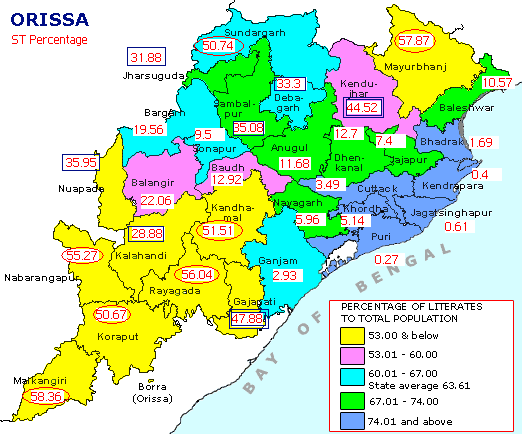
Following up on our earlier article, Odisha must push for an ISMU branch. The logic behind Assam getting an RGIPT branch is that Assam has a lot of petroleum related oil wells and refineries. By the same logic, Odisha tops the states in India with respect to its mineral output. Following is from a report in Business Standard.
With minerals produced in the state in 2009-10 valued at Rs 15,317 crore, Orissa has 13.10 percent share of the total value of minerals produced by major states in the country, followed by Madhya Pradesh (7.70 percent), Andhra Pradesh (7.21 percent), Maharashtra (4.92 percent), Gujarat (4.65 percent), Karnataka (3.96 percent), Tamil Nadu (3.21 percent), Rajasthan (2.99 percent), Assam (2.96 percent), West Bengal (2.78 percent).
According to the Economic Survey report (2010-11), the value of minerals extracted in Orissa has gone up by more than four times from Rs 3694 crore to Rs 15,317 crore between 2002-03 and 2009-10 coinciding with the boom in the mineral market during this period.
Orissa boasts of 95 percent of country’s chromite deposit, 92 percent of nickel ore, 55 percent of bauxite and 33 percent of iron ore. Besides, the state has substantial quantity of other minerals and ores like coal, manganese, dolomite, graphite and limestone.
With the iron ore prices spiraling, this commodity naturally leads the pack of minerals in terms of production and value. The state produced 79.7 million tonnes of iron ore in 2009-10 valued at Rs 7976 crore. This is followed by coal (105.5 million tonnes valued at Rs 5548 crore and chromite (3.4 million tonne valued at Rs 1167 crore).
Similarly, iron ore constituted 95.4 percent of the total exports of minerals from the state. About 15 million tonnes of iron ore was exported in 2009-10 valued at Rs 4224 core compared to exports of 0.46 million tonnes of chrome ore valued at Rs 464 crore and 0.25 million tonnes of mineral sand valued at Rs 72.32 crore.
One of the disturbing factors highlighted by the report is that with mining and quarrying sector gradually shifting to labour saving and capital-intensive technology, the total employment in the sector has been decreasing over the years. As a result, the number of direct employment in the mineral sector in Orissa has come down from 55764 in 2005-06 to 43705 in 2009-10.
It may be noted, with mineral deposits mostly occurring in the tribal belt of the state, this sector employs substantial number of tribals.
When ISM was made in Dhanbad, that region was perhaps the leader in mineral output (mainly coal) in the country. Odisha with a variety of minerals needs an ISM branch and we must push for it hard.
Related to that recently the Chief Minister has been concerned about the coal block allocation in Odisha. Following is an excerpt from a report in Economic Times on that.
Orissa government has taken strong exception to the coal ministry’s unilateral decision to allot coal blocks without consulting the state.
Chief minister Naveen Patnaik has shot off a letter to Prime Minister Dr Manmohan Singh urging him to review the allocation of coal blocks in Orissa. The coal ministry has allotted 32 coal blocks with an estimated reserve of about 15,000 million tons to 56 private and government agencies.
Mr Patnaik made it clear that a comprehensive regional master plan should have been prepared prior to allotment of huge number of coal mines in inhabited and environmentally sensitive areas in the state. Focus has to be given for infrastructure development, logistic planning, land requirements, rehabilitation and resettlement, environment impact studies and mitigation measures, the letter said.
Expressing serious concerns over the adverse environmental impact in post operationalisation of such a large number of coal blocks, Mr Patnaik pointed out that coal mining would cause deforestation and air pollution. Sources close to CM’s officer said, the letter also had pointed out that it might not be possible for the state to accommodate new coal mines by jeopardizing its environmental stability. The coal ministry needs to be advised to take a pragmatic and planned approach, keeping the interests and concerns of all stake holders including the state government in mind, the letter said.
For making the 32 coal blocks functional, 325 sq km shall have to be acquired within few years and another equivalent amount of land would be needed for allied activities like coal handling plants, siding, workshop, and residential colonies for project affected people, compensatory afforestation and other infrastructural facilities including roads.
This would lead to massive displacement and consequent socio-economic and environmental crisis, the chief minister is understood to have stated in his missive to the PM. However, such large-scale land acquisition and displacement could be avoided if coal blocks are allotted and developed in a planned and phased manner, Naveen added.
Incidentally, Orissa is already on the throes of severe climate change due to setting up of huge number of coal fired power plants threatening the livelihood of farmers and fishermen who form 70 % of the state’s population shall be severely hit due to irregular monsoons and erratic rainfall patterns.
Most of the power produced shall be transmitted to other states while the people of the state shall be the unwilling victims of the effects on climate change and pollution caused by the huge quantities of green house gases (GHGs) and fly ash generated.
“Coal mining is done either underground or open cast. In Orissa mostly open cast mining is done. When coal surfaces are exposed, pyrite (iron sulfide), comes in contact with water and air forming sulfuric acid. As water drains from the mine, the acid moves into the waterways, and as long as rain falls on the mine tailings the sulfuric acid production continues, whether the mine is still operating or not. Proper and holistic environmental protection measures are not taken by the owners of coal mines”, former director general of Council of Scientific and Industrial Research [CSIR] and currently, chairman, Institute of Advance Technology and Environmental Studies (IATES), P. K. Jena on Thursday told “The ET”.
This reinforces our thought that the civil society andthe government of Odisha must together push for an ISMU campus in Odisha that will specialize in all the issues mentioned above.
Please add aditional pointers in the comment section. As soon as the Malkangiri sutiation gets resolved we will start a movement to get an ISMU campus to Odisha.
February 21st, 2011
Going back to April 2010, there are several news regarding establishment of a tribal university in Andhra Pradesh. The early news reports talked about it being a state initiative. However, the recent news reports mention experts from outside being involved in evaluating locations and in reporting to the center, which suggests that the center may also be involved in the making of this university. We now give several excerpts.
From Hindu (April 26, 2010):
Dogged by the question of a dismal State of higher learning among tribals in the State, the government is ‘seriously’ contemplating establishment of a Tribal University. “A strong demand from tribal groups and other concerned sections of society in the recent past has made the government to sit up and think on the ways and means to establish a university,” divulges a top-level source in the Tribal Welfare Department.
“The government had initially explored the possibility of converting Srikakulam’s MG University into a Tribal University. This idea was dropped due to certain practical difficulties,” recalls the officer about the efforts made by the government so far.
The government has also rejected an offer from the Tribal University at Amarkantak in Madhya Pradesh for affiliating some of the colleges here with it.
From Hindu (Jan 23, 2011):
Andhra Pradesh Tribal University is all set to come up on a 300-acre site in Chintapalle.
A study team of senior professors led by Samaresh Bandopadhyay (Kolkata) with Sudarshan Nadu (Bhubaneswar), Joseph Bara (JNU) and Registrar of Indira Gandhi National Tribal University from Amarkantak in Madhya Pradesh, Ashok Singh, which inspected the site on Friday, will be submitting feasibility report to the Centre.
“We are absolutely happy that a lot of land is available with facilities like power, water and connectivity. In fact, this place is more accessible than Amarkantak where there is already a university,” Prof. Bandopadhyay told The Hindu at the Visakhapatnam airport after returning from Chintapalle on Saturday noon. The tribal university would provide avenues of education, particularly higher education and research facilities primarily for the tribal population of the country, he said. If everything went on well, the new university at Chintapalle could be started by June, he added.
From TOI (Feb 3, 2011):
While the Centre is mulling to set up the campus at Chintapalle in Visakhapatnam Agency, …
IGNTU, located in the small pilgrim town of Amarkantak in Anuppur district in Madhya Pradesh, became functional some time ago and has already established its regional campus in Manipur after the state government handed over 370 acres of land for establishment of a permanent campus. Sources said IGNTU was also approached by Andhra Pradesh, Orissa, Kerala and Gujarat to open its regional campuses in the respective states.
The government had initially explored the possibility of converting Srikakulam’s Mahatma Gandhi University into a tribal university.
"But the idea was dropped due to practical difficulties and logistical problems. Visakhapatnam became a potential site for the campus as it has basic amenities like power, water and better connectivity," a senior official said.
… After visiting some sites here, the team of senior professors led by registrar of IGNTU Ashok Singh said they would be submitting a report to the Centre soon.
Note that the idea for a central tribal university was suggested by Orissa CM, on 24th October 2005, which the HRD minister had appreciated. See our earlier posting at https://www.orissalinks.com/archives/1087 for more details.
February 3rd, 2011
Following is a letter that Dr. Karmee has sent to many people. This is an excellent work. It is well researched and based on something unique to the location, the Gandhamardan Hills of Baragarh and Balangir. (Considering that many in Orissa may not be aware of Gandhamardan Hills being in Orissa and/or its medicinal values, I have a companion piece on it at https://www.orissalinks.com/orissagrowth/archives/2776.)
I hope others will also focus on unique aspects and attributes of other parts of orissa and write to the higher education task force (HETF) about it.
Respected Mr. Patnaik, CM of Odisha and Members of the Higher Education Task force,
I appreciate the formation of higher education task force by the state government. Also, I am hopeful that such innovative steps will definitely sharpen the higher education of Odisha.
Sirs,
I would like to request the higher education task force to recommend the establishment of a “National Institute of Ayurveda” in Gandhamardan area in western Odisha. I am sure many of us are aware of the potential of Gandhamardan mountain and medicinal plants in it.
In this document, I am presenting the details about the “Gamdhamardan mountain as a reservoir of medicinal plants” with scientific references; thereby, making a case for the establishment of a National Institute of Ayurveda.
I am sure our respected CM, who is the author of the “Garden of Life: An introduction to the Healing Plants of India” will take this matter seriously. Also, I am hopeful that the higher education task force will take the necessary steps; so that, “the medicinal plants in Gamdhamardan mountain” will not get lost with time.
Please have a look on the following write-up for further details.
Thanking you with best regards,
Sanjib
1. “National Institute of Ayurveda” is a must in Gandhamardan area: Introduction and Analysis:
Gandhamardan mountain range is known world wide as a reservoir for medicinal plants. It is located in the western Odisha. More specifically, it is located in between Balangir and Bargarh district (Figure 1).
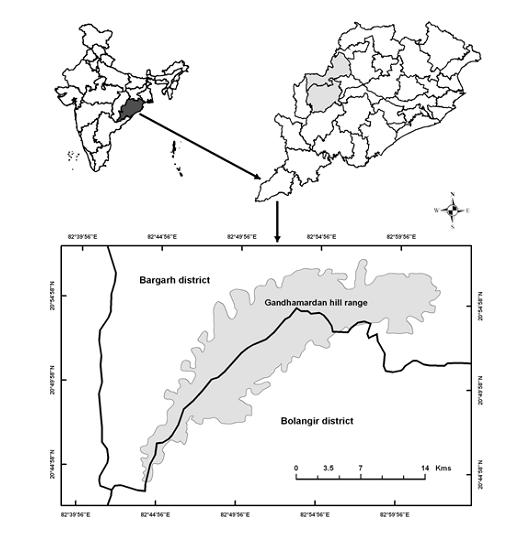
Figure 1 Map showing location of Gandgmardan mountain in between Balangir and Bargarh district
Many eminent scholars of life sciences have done a lot of research on the medicinal plants available in this mountain range. In fact, this hill range is legendary. It has found a place in folklore and mythology -of how Hanuman plucked Bisalyakarani, a medicinal plant, from this hill to save the life of Laxman in the battle of Lanka in “The Ramayana”. In addition, it is known to the whole world how this hill range was at the centre of one of the most prominent ecological movements, that is, the battle between environmentalists keen on protecting aryurvedic plants and the then state-owned Bharat Aluminium Corporation.
Apart from this, there are many scientific journals and books that are mentioning about the potential of medicinal plants available in Gandhamardan mountain (see the reference list)1-5. The state/central govt must establish a “National Institute of Ayurveda” in this place. Right now, both Balangir and Bargarh (Paikmal) each have one Ayurvedic College. Establishing a national level institute on Ayurvedic Medicine will help to a great extent to these colleges by carrying out research in emerging areas. Recently, research on ayurvedic medicine is attracting considerable attention in India and abroad.
It is important to note that, significant developments have boosted systematic research on different aspects of ayurveda and traditional medicine in India. They include the Golden Triangle project jointly managed by CSIR, ICMR and AYUSH; the New Millennium Indian Technology Leadership Initiative (NMITLI) of CSIR and various schemes of DST and DBT.
Additionally, ayurveda is also entering to the mainstream “Drug Discovery”. Following graph show the growing demand of research on Ayurvedic medicine.
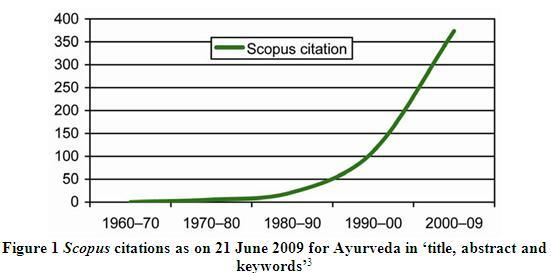
In addition to this, a paper by “Reddy and Pattnaik” from the Forestry and Ecology Division, National Remote Sensing Centre, Hyderabad 500 037, Andhra Pradesh, India points out many interesting facts about “Gandhamardan hill” 4.
It states that, after analyzing and studying the plant resources of Gandhamardan hill range a total of 912 vascular species belonging to 556 genera under 142 families were found. Herbs dominate the flora followed by trees, climbers and shrubs.
Therefore, proper conservation and management plans are needed to save the natural resources, especially medicinal plants, of this sacred hill range. Many botanists fear that this reserve of medicinal plants could be lost in the next few years if proper care is not taken and the indiscriminate collection and smuggling of herbs by local villagers is not stopped. The state forest department which is supposed to guard this botanical wealth is not able to do enough to stop all these developments because they lack of the knowledge and expertise about these plants. In fact, they have no clue which are useful medicinal plants and which are not.
In addition, in these places there is no organized way of farming of the medicinal plants. They just grow in the wild. Therefore, it is very difficult to guard these species. Taking the advantage of this situation any villages or smugglers can walk into the forest and collect the herbs. It is very important that the government should takes steps to grow these plants, harvest these properly, and finally do the marketing of these medicinal plants and herbs in a well organized manner. It should take care of the cultivation and preservation of these plants like it is doing for other forest products like sal seeds or kendu leaves etc.
However, intellectually this problem can be solved by establishment of a National Institute of Ayurveda. The above discussion/ description/ scientific observation strongly suggests the establishment of a National Institute of Ayurveda near Gandhamardan mountain.
2. Following are some of my points in support of establishing a National Institute of Ayurveda in Gandhamardan area:
* West is very much keen on establishing institute on ayurveda. One such successful institution is the National Institute of Ayurvedic Medicine established by Dr. Scott Gerson, USA, (http://niam.com/corp-web/index.htm). This is an example of an institute that has carried out research into Ayurvedic practices to a great extent. In this context, we must use our native expertise. In addition, the National Institute of Ayurvedic Medicine, USA can be a collaborative partner for establishing an institute Gandhamardan area.
* This mountain is very important to all of us and to the world. We should use our natural medicinal resources very judiciously. It is also very surprising that no steps have been taken for the preservation of these high-valued plants. It is the right time to establish a National Institute of Ayurveda in this area.
* As we know this mountain range is a reserve for medicinal plants. Therefore, it will provide adequate environment for cutting edge research/studies in different areas of ayurvedic medicine per international standard.
* Establishment of a National Institute of Ayurveda will help for organized way of farming the medicinal plants; which just grow in the wild. This will also help in preserving different rare species of plants.
* This Institute will provide a boost to the ongoing research/academic activities by Ayurvedic College Balangir and Shri Nrusinghanath Ayurved College Paikmal, Bargarh on this area. Along this line, establishing a National Institute of Ayurveda will make this place a leader in this area of science in national/international level.
* This step will attract companies like Dabur, Ayur, and others to set-up labs/companies in this area.
* From the above discussion it is very clear that research fundings are already available from the leading agencies of India like CSIR (Council for Scientific and Industrial Research), DST (Department of Science & Technology), and DBT (Department of Biotechnology). So, there will be no problem in setting up labs and developing infrastructure.
* There is a lot of synergistic research going on between Ayurvedic, Homeopathic and Allopathic branches of medicine. This is very clear from our day-to-day life as Allopathic doctors often prescribe medicines of Dabur, Neem, etc. Therefore, establishment of such an institute will further enhance the research between this National Institute of Ayurveda with other institutes viz. VSS Medical College, SCB Medical College etc. of the state.
3. The following steps need to be taken to establish a National Institute of Ayurveda in Gandhamardan
* It is important to look in to the web-site of these model Institutes viz. National Institute of Ayurvedic Medicine, USA (http://niam.com/corp-web/index.htm); Gujarat Ayurved University Jamnagar, Gujrat, India (www.ayurveduniversity.com); Rajasthan Ayurved University, Jodhpur Rajasthan (http://www.raujodhpur.org/aboutus.html); National Institute of Ayurved, Jaipur, Rajasthan (http://nia.nic.in/); Ayurvedic university, Hoshiarpur, Punjab; (http://www.financialexpress.com/news/punjab-clears-first-ayurvedic-university-in-hoshiarpur/517911/; This seems to be a new Institute).
* Immediately, the state govt. should present a proposal to the HRD Ministry for establishing National Institute of Ayurveda in Gandhmardan area.
* Along the line of the above institutes, the state govt. in collaboration with govt. of India must establish a National Institute of Ayurveda in Gandhamardan area.
References:
1. Netra Bhanu Pradhan, Gandhamardan – A treasure House of Medical Plants, Navaratna Journal, Jan-Feb, 2008, 41-44.
2. Ayurveda: scientific research and publications, Current Science, 2009, 97( 8), 1117-1122
3. C. Sudhakar Reddy and Chiranjibi Pattanaik, An Assessment of Floristic Diversity of Gandhamardan Hill range, Orissa, India. Bangladesh J. Plant Taxon. 16(1): 29-36, 2009
4. Following are some of the research papers taken from the reference list of the paper 3 (Papers only with the name Gandhamardan are taken)
Brahmam, M. and Saxena, H.O. 1990. Ethnobotany of Gandhamardan hills – Some noteworthy folk medicinal uses. Ethnobotany 2: 71-79.
Brahmam, M. and Saxena, H.O.1990. Phyto-chemical screening of the plants of Gandhamardan hills of Orissa (India) for tannins, saponins, flavonoids and alkaloids. Asian J. Plant Sci. 1: 71-79.
Misra, R.C. 2004. Therapeutic uses of some seeds among the tribals of Gandhamardan hill range, Orissa.Indian J. Traditional Knowledge 3: 105-115.
Misra, R.C. and Behera, G. 1998. Ecological status of Gandhamardan forests using remote sensing techniques. In: Biodiversity Conservation: Problems and Prospects. Proc. National Seminar on Biodiversity Conservation, Bhubaneswar, India, pp. 75-80.
Misra, R.C. and Das, P. 1998. Vegetation status of Nrusinghanath – Harishankar complex, Orissa. J. Econ.Taxon. Bot. 22: 547-554.
Mishra, R.C. and Das, P. 2003. Wild poisonous seeds: Some notable species from Gandhamardan Hill ranges of Orissa. J. Econ. Bot. 27: 513-518.
Misra, R.C. and Das, P. 2004. Vegetation stratification of Gandhamardan hill range, Orissa using remote sensing techniques. J. Econ. Taxon. Bot. 28: 429-438.
Mishra, R.C., Panda, P.C. and Das, P. 1994. Lesser known medicinal uses of plants among the tribals of Gandhamardan hill ranges, Orissa. In: Gupta, B.K. (ed.), Higher Plants of Indian Subcontinent, Vol. III, Bishen Singh Mahendra Pal Singh Publications, Dehra Dun, India, pp. 135-142.
Mishra, R.C., Panda, P.C. and Das, P. 2001. A taxonomic study of the ferns and fern allies of Gandhamardan hills, Orissa. J. Econ. Taxon. Bot. 25: 577-590.
Panigrahi, G. 1963. Gandhamardan Parbat, Orissa – A potential source of important indigenous drugs. Bull. Reg. Res. Lab. 1: 111-116.
Pattanaik, C. and Reddy, C.S. 2007. Medicinal plant resources of Gandhamardan hill range, Orissa: An urgent need for conservation. Natl. Acad. Sci. Lett. 30: 35-38.
Raju, D.C.S. 1960. Vegetation pattern of Gandhamardan hills. Bull. Int. Soc. Trop. Ecol. 1: 21-22.
Saxena, H.O. and Brahmam, M. 1995. Vascular flora of Gandhamardan hills. J. Econ. Taxon. Bot. 19: 113-132.
5. NOTE: This is not the complete list of references. Because of time limitation I have collected as much as I can.
November 4th, 2009