Today we removed the scrolling text about Vedanta University. We still have some hope on its happenning, but all depends on the Supreme Court and we have no idea how long that will take. The scrolling text that we removed was as follows:
Vedanta University, as envisioned, could have been a game changer for Odisha and India. However, its parameters (Rs 15K crores initial budget, 10K faculty, 6K+ acres, etc.) were so audacious that many well-meaning people were skeptical about it, opposed it and criticized the Odisha government for standing behind it. But precisely those audacious parameters made it a once-in-a-millennium type opportunity for Odisha and India. Ex-CM of Andhra, Rosaiah, a Congressman recognized it and wrote to the chairman of Anil Agarwal Foundation (AAF): "I request you to choose Andhra Pradesh as the state has a unique capacity and culture to nurture the institute of your dreams that will put Indian education back on the global map. I depute the chief executive officer of AP Invest, the state government’s nodal agency, to make a detailed presentation to you in this regard. I assure you that the state government will extend every possible support to this endeavour. Your vision of building a research university of the stature of Stanford in India, your dream of providing higher education of global standards to over one lakh students is all the more heartening." So most of the political opposition to Vedanta University was opportunistic and political parties that opposed it in Odisha had their governments in Andhra (Congress) and Karnataka (BJP) wooing it. Any way, the land acquisition for Vedanta University case is in the Supreme court for a year and half now, and who knows when it will be decided. Meanwhile the Vedanta University website is gone. So this whole thing may be dead. However, being a born optimist, I still have a very slim hope that some day this may all be revived. I am keeping these pages so that even if it does not happen people will one day realize the folly by exploring the pages here and in facebook. The facebook pages have support statements from many Odisha origin academics from Odisha and abroad. Please read what they say.
September 2nd, 2012
The following bullet points about the guidelines are from this article in tathya.in.
- The committee that will examine the proposals based on the guidelines will be headed by the Chief Secretary and Secretary of the Higher Education will be the Member Convener.
- Each private university shall be established by a separate Act, which will be passed by Odisha Legislative Assembly.
- Private university shall fulfill the minimum criteria in terms of programs, faculty, infrastructural facilities and financial viability.
- Any college opting to establish a private university should have been in existence for at least 15 years in the state, however in deserving cases the State Government may relax the condition of 15 years for
institutes of national and international repute.
- In ‘De Novo’ university category, where no such institution belonging to the promoter exists within Odisha as on date of commencement of the university will be devoted to unique and emerging areas of knowledge. These institutions should be promoted by persons/institutions of proven merit and reputation. Selection of universities in this category will be made by a committee of experts comprising eminent academicians and the Secretary of the department concerned dealing with the subject.
- Infrastructure requirement: At least 15 acres of land in urban area and 30 acres of land in non-urban area will be needed. For administrative building 1000 square meter and academic building 10,000 square meter will be required for a private university. Residential accommodation for teachers and hostel accommodation for students will be required.
- Corpus Fund: For institutions conducting professional program such as Engineering & Technology and Medicine it will be Rs.8 crore, where as for Management and Law it will be Rs.5 crore and for other programs Rs.4 crore kitty will be needed. For institutions conducting both professional and other programs will have Rs.10 as Corpus Fund, while for the ‘De Novo’ category of university; the Corpus Fund will be Rs.25 crore.
- Financial viability of the institution will be verified by the audited statements of accounts of the institutions for the previous 5 years.
- The Chancellor of the university will be an eminent educationist or a distinguished public figure and there will be no Pro-Chancellor.
- The Board of Management will be headed by the Vice Chancellor with the body consisting a minimum of 10 and maximum of 12 Members.
In the link https://www.orissalinks.com/archives/7127 we have the list of applicants as of 8/20/2011. Let us analyze some of those application in terms of the above criteria. (In that we will use the link https://www.orissalinks.com/archives/6243 which includes the dates when various professional colleges were started.)
- Centurion: Established on 12/23/2010. Its main constituent JITM started in 1997.
- Sri Sri: Act passed by GOO on 12/26/09. Classes to start in Fall 2012. Would have been considered in the de-novo category.
- ICFAI: Act passed by GOO on 3/9/10. No progress since then. Would have been considered in the de-novo category.
- Vedanta University: Bill passed by OLA in December 2009. Awaiting governor’s assent. Also awaiting supreme court verdict on land acquisition.
- Jagadguru Kripalu University: Would be considered in de-novo category.
- Xavier University: XIMB was started in 1987.
- Techno Global University: Techno started in 2005. It will have 15 years experience in 2020.
- Amrita Viswa Vidyapeetham University: Would be considered in de-novo category.
- Synergy University: Synergy started in 1999. It will have 15 years experience in 2014.
- Women’s university of Technology: Not sure about the foundation that is behind this. Could be KISD. KISD was started in 2001.
- Private University by Rai foundation: Would be considered in de-novo category.
- Amity University: Would be considered in de-novo category.
- University of Corporate Excellence: Would be considered in de-novo category.
- Silicon University: Silicon was started in 2001.
- ASBM University: Not sure when ASBM was started.
- Divine Global University by Divine Education Trust, Delhi: No idea about the trust behind it.
- GIET University, Gunupur: GIET was started in 1997.
- C. V. Raman International University Bhubaneswar: C. V. Raman was started in 1997.
- JPM University by Shree Chandulal Minda Memorial Trust: Do not know about this trust.
- Krupajal National University: Krupajal was started in 1999.
- Manipal: Would be considered in de-novo category.
- Odia University: Would be considered in de-novo category.
- Edu City in Rourkela by Knowledge Foundation, Jail Road, Jharpada, Bhubaneswar: Do not know about this trust.
So among the above XIMB, GIET and CVRaman have the required 15 years experience; Synergy and Krupajal will have that in 2014.
July 28th, 2012
| |
Name of the University |
Official status on 8/20/2011 (my comments)
|
| 1 |
Centurion University of Technology and Management |
Established on 12/23/2010 |
| 2 |
Sri Sri University |
Act passed by GOO on 12/26/09. No request has been received for visit of H.P.C (My comments: Expected to commence in Fall 2012) |
| 3 |
ICFAI University |
Act passed by GOO on 3/9/10. No request has been received for visit of H.P.C. |
| 4 |
Vedanta University |
Bill passed by OLA in December 2009, awaiting Governor’s assent. |
| 5 |
Jagadguru Kripalu University |
Draft Bill, land, project report etc. are being examined as per the guidelines. |
| 6 |
Xavier University |
Steps are being taken for finalization of the Draft bill/cabinet memorandum |
| 7 |
Techno Global University |
Land, project report etc. are being examined as per guidelines. |
| 8 |
Amrita Viswa Vidyapeetham University |
Draft bill from the proposed university has not yet been received. Collector, Khurda/Cuttack has been requested for identification of 150 acres of land for establishment of the university. |
| 9 |
Synergy University |
Land, project report etc. are being examined as per the guidelines. |
| 10 |
Women’s university of Technology |
Land, project report etc. are being examined as per the guidelines. |
| 11 |
Private University by Rai foundation |
Land, project report etc. are being examined as per the guidelines. |
| 12 |
Amity University |
Land, project report etc. are being examined as per the guidelines. |
| 13 |
University of Corporate Excellence |
Land, project report etc. are being examined as per the guidelines. |
| 14 |
Silicon University |
Land, project report etc. are being examined as per the guidelines. |
| 15 |
ASBM University |
Land, project report etc. are being examined as per the guidelines. |
| 16 |
Divine Global University by Divine Education Trust, Delhi |
Draft bill, land, project report etc. are being examined as per the guidelines. |
| 17 |
GIET University, Gunupur |
Land, project report etc. are being examined as per the guidelines. |
| 18 |
C. V. Raman International University Bhubaneswar |
Land, project report etc. are being examined as per the guidelines. |
| 19 |
JPM University by Shree Chandulal Minda Memorial Trust |
Land, project report etc. are being examined as per the guidelines. |
| 20 |
Krupajal National University |
Land, project report etc. are being examined as per the guidelines. |
| 21 |
Manipal Education and Medical Group (to set up a world class university at Bhubaneswar) |
DPR has not been received. |
| 22 |
Oriya University |
DPR has not been received. |
| 23 |
Edu City in Rourkela by Knowledge Foundation, Jail Road, Jharpada, Bhubaneswar |
The foundation has been requested to furnish audited profit and loss account, balance sheet of the preceding 5 years as filed before the income tax authorities and the copy of the trust deed. |
| * |
BIMTECH |
Expressed interest to be a university after the above were listed. (Note: This is an update.) |
December 23rd, 2011
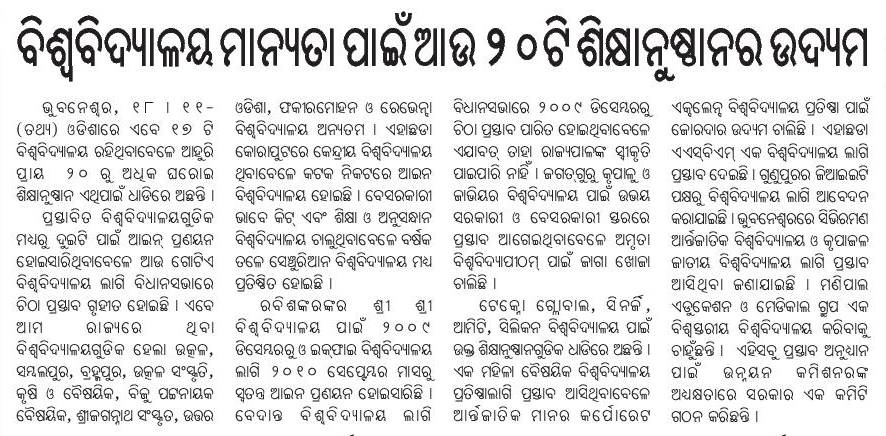
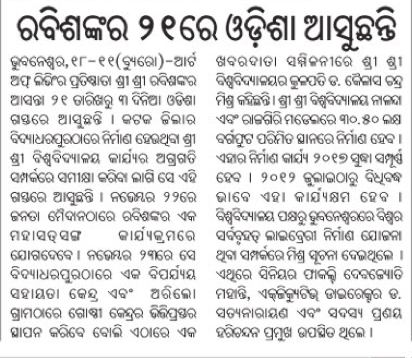
The 30.5 lakh sq feet is equivalent to 2,83,355.4066 sq meters and is equivalent to 70.0158 acres. As a comparison:
November 20th, 2011
Following are excerpts from the Economic Times article.
The IITs have completed 50 years and have helped build India. They were set up for producing high quality technical human capital for India and have met their objectives. But, as is the character with such institutions, they have not changed with the times and are not providing India with what she now needs.
… The IIT boards and the directors are unable to take any financial decision which they deem fit without the approval of the government . Even for an overseas travel of the director or the faculty, permission is needed. They are subject to austerity measures of the government, a perfect situation to emasculate an educational institution.
The demand for an IIT seat is enormous and has spawned a tutorial industry that earns more revenues than the IITs themselves. This has resulted in large number of students spending up to two years of their youth going to cramming schools learning pattern recognition, forgetting the art of thinking and problem solving knowing that their lives are made once they get entry into the hallowed portals. Today about 60% or more of the intake is from the coaching mandis. This has also resulted in many bright young Indians deciding not to undergo the ordeal and go overseas for higher education. 250,000 of them study overseas, over 110,000 in the United States, about 45,000 in the UK spending about $ 6bn on fees and costs annually …
Overall , the 15 IITs graduate 7000 undergraduates, 6000 post graduates and about 1700 PhDs annually . Sadly only about 2% of the undergraduates go on to their masters and PhD in the IIT system. The IITs hold fast to the idea that by squeezing input they can get a quality output, an idea that has been consigned to the dustbin of history. Increasing the scale and size can give them the diversity of talent, the resources, the ability to have more quality faculty and the depth and width needed for an elite educational institution.
… the IITs will live in their ivory tower and possibly become less and less relevant to India’s need as neither are they meeting India’s need for more human capital nor producing the kind of PhDs India needs.
… The best solution is to open up the education system and allow competition, the dreaded word in academics, to come forth. India should revise her educational policies and allow the private sector to set up "innovation universities" granting them all that they need. Full autonomy, academic, administrative and financial to chart their own future. Some safeguards are needed, as this is a public good. A large corpus of say Rs 100 crore, an open merit based admission policy, a faculty compensation policy based on minimum UGC scales and an assurance that they will aim to be amongst the top 100 in the world over the next 25 years. To ensure access to the merited we need a national scholarship scheme which will fund students. India needs to trust the genius of her citizens to create institutions that are world class and not look at them through myopic eyes with suspicion.
… Today there is a flight to quality. The bad colleges are dying since students have a choice, they are voting with their feet. The good ones are expanding and seeing greater demand. The market mechanism has worked, not by design but by serendipity. So there is hope. Look at various other sectors today. Bharti has made BSNL redundant and has given us a choice, Jet has overtaken Air India and given us a choice, the power system in Mumbai is still the best, and in education the Indian School of Business has turned our IIMs inside out. The IIMs actually want reform, expansion and are concerned about their future .
Competition and an open liberal environment for higher education will work .
I agree with most of the points made in the article and its arguments buttress the need for early approval of universities like the proposed Vedanta University.
One point where I disagree is the suggestion that 100 crores is a large corpus. If the goal is to be in the top 100 in the world, a corpus of 100 crores is very little. That is only 20-25 million USD. In comparison the corpus of Harvard and Stanford are of the order of 25+ Billion USD.
June 16th, 2011
Following is an excerpt from a report in tathya.in.
Prof. Gopabandhu Behera and Dr. A. K. Nanda, who are also the Governing Body member of Vedanta Science College were also present.
Mr.C Joseph, in-charge of the Vedanta Science College, Nabakrushna Panda, Principal, Government Autonomous College, Bhawanipatna, S P Nanda, Principal, Government, Women’s College, Bhawanipatna, Sudershan Rath, Principal, Bisamcuttack College and Bharat Rath, Principal Rayagada Government College also graced the conference.
The objective of the conference was to make the people conscious about the value of science education at degree level as well as to discuss about the proposed Vedanta Science College at Lanjigarh.
Dr. Kumar, President and COO, VAL, said, “Vedanta Science College was a long pending demand of the people of Western Ordisha.
He said that Vedanta is committed to create a state of art Science College that will promote quality science education in Western Odisha.
Quality Science education can help in developing technical manpower for industrialization in the state, he added.
The proposed Vedanta Science College will start its academic session from 2011.
The institution will provide education in subjects of Physics, Chemistry, Botany, Mathematics, Zoology, and Environmental Science.
It should be noted that there are very few (could be zero) fully private (i.e., without depending on state grants) science colleges in Odisha. Even the government ones and private ones that depend on state grants do not have good infrastructure and do not have adequate quality faculty. The more well known private higher education institutions of the state focus on trade oriented disciplines like engineering, management, medicine, pharmacy, biotechnology etc. so that they can charge adequate amount of student tuition. This includes deemed universities like KIIT and SOA and the private state university Centurion. None have science programs at the Bachelors level.
So if the Vedanta Science college in Lanjigarh becomes a good quality science college, then it would be a big boon to Kalahandi and Rayagada districts and hopefully it will also encourage other private groups to establish similar colleges.
January 31st, 2011
The report is at http://bit.ly/vu-report .
Current Members of “Odisha World-Class Universities Support Group” that are listed in that report are:
Academics
- Dr. Abani Patra, Professor, University at Buffalo, State University of New York, USA
- Dr. Amiya Kumar Rath, Professor and Director, College of Engineering (CEB), Bhubaneswar
- Dr. Arun Pujari, Professor, University of Hyderabad (Currently Vice Chancellor, Sambalpur University, Odisha)
- Dr. Chitta Baral, Professor, Arizona State University, USA
- Dr. Chitta Ray, Professor, University of Hawaii, USA
- Dr. Dhanada Mishra, Chairman, Human Development Foundation, Bhubaneswar
- Dr. Durga Mishra, Professor, New Jersey Institute of Technology, USA
- Dr. Gautam Das, Professor, University of Texas at Arlington, USA
- Dr. Manmohan Mohanti, Retired Professor (Emeritus), Geology, Utkal University (Currently at Nimapara near Bhubaneswar)
- Dr. Nihar Ranjan Das, Research Fellow at the Indian Council of World Affairs, New Delhi
- Nitai Dhal, Trustee, Silicon Institute of Technology, Bhubaneswar
- Dr. Pranay Swain, UNICEF-OPEPA, ex-faculty IIM Calcutta (Currently at Bhubaneswar)
- Dr. Prasant Mohapatra, Professor, University of California at Davis, USA
- Dr. Rabi Mahapatra, Professor, Texas A & M University, USA
- Dr. Rabi Nayak, Professor, Indian Institute of Science Bangalore (retired), Currently at NISER Bhubaneswar
- Dr. Ramakrushna Pradhan, Research Scholar, School of International Studies, JNU, New Delhi
- Sahadeva Sahoo, Ex-Vice Chancellor OUAT, Ex-Chief Secretary Government of Odisha (Currently at Bhubaneswar)
- Sanjeev Nayak, Trustee, Silicon Institute of Technology, Bhubaneswar
- Dr. Sumanta Swain, Senior Research Officer, International Institute of Health Management Research New Delhi
- Dr. Siba P. Misra, Retired Professor and Director, Institute of Physics Bhubaneswar, Ex-President Orissa Bigyan Academy, Ex-President Orissa Information Technology Society (Resides in Bhubaneswar)
- Dr. Sunil Sarangi, Professor, IIT Kharagpur, Ex-Director, NIT Rourkela, Odisha
- Dr. Supriti Mishra, Fullbright Scholar, Professor, HDF Business School, Bhubaneswar
- Dr. Trailokya Nath Naik, Ex-Deputy Director, National Institute of Cholera & Enteric Diseases, Kolkata, Currently at Bhubaneswar after a stint at NISER, Bhubaneswar.
Others (some associated with academia)
- Basant Barik, Credit Suisse, Singapore
- Devasis Sarangi, Invest Bhubaneswar and the upcoming TIE Odisha Chapter, Bhubaneswar
- Dhirendra Kar, Entrepreneur, North Carolina USA and Bhubaneswar
- Nirakar Sahoo, NRO in Maryland, USA (VSSUT Graduate)
- Pradosh Sahoo, Student at an IIT, Bhubaneswar
- Priyadarshi Mishra, Chairperson, Skill Odisha Initiative, Bhubaneswar
- Purna Mohanty, Technology Entrepreneur and SEED Investor, Silicon Valley, CA, USA, Member, TiE Silicon Valley, Member, Invest Bhubaneswar Silicon Valley
- Sujeet Jena, Financial Controller, University of New South Wales Foundation, Australia
- Surya Rath, Editor of Artfair, Bhubaneswar/Puri
- Tejeswar Parida, President, Delhi Odisha Students Association (DOSA), Delhi
- Umashankar Das, Entrepreneur Hyderabad/Bangalore
(Note: A facebook site in support of Vedanta University has about 1200 “likes” and its companion facebook account has about 500 “friends”; about 300 of them are common. The site is http://www.facebook.com/vedantau and the account is http://www.facebook.com/vedantauniv.)
January 29th, 2011
Following is an excerpt from a report in Economic Times.
The Supreme Court on Friday admitted petitions of Anil Agarwal Foundation and the Orissa government challenging the Orissa High Court , which ruled acquisition of over 6,000 hectares for an international university in Puri was illegal. …
The state government and Anil Agarwal Foundation, in separate special leave petitions told the apex court that the appellant foundation is a public limited company under the Companies Act.
The state government argued that the land acquired for the mega university was not illegal. The high court had held that land acquisition was not permissible under Section 40(1)( a) of the Land Acquisition Act. Earlier, two different benches of the apex court refused to hear the case as one judge, each, was linked to the adjudication of the issue earlier. The petitions were admitted by a bench comprising Justice DK Jain and Justice HL Dattu.
… Chief minister Naveen Patnaik had made a statement in the assembly denying that an ordinance was passed to build the university. "The reference to the ordinance is baffling. The fact is that no ordinance has ever been promulgated by the government for establishing the proposed Vedanta University. Under the UGC Regulations , 2003, a university can be set up by an Act of Parliament or state legislature by a Section 25 company or a trust or a registered society. The promoter of the proposed university, the foundation is a "not for profit" company registered under Section 25 of the Companies Act" .
Following is an excerpt from a report in Indian Express.
The Supreme Court on Friday ordered the Orissa government to maintain status quo on acquisition of 6,000 hectares of land for setting up an international university by UK-based Vedanta group in the holy city of Puri.
A Bench of Justices D K Jain and H L Dattu passed the order on appeals filed by the Orissa government and the Anil Agarwal Foundation against an Orissa High Court decision that land acquisition procedures for the proposed university project was illegal.
This has been widely reported in various media but most have not analysed the ruling properly. The best analysis is done in the Odia paper Sambada. Following are screen copies from its site.
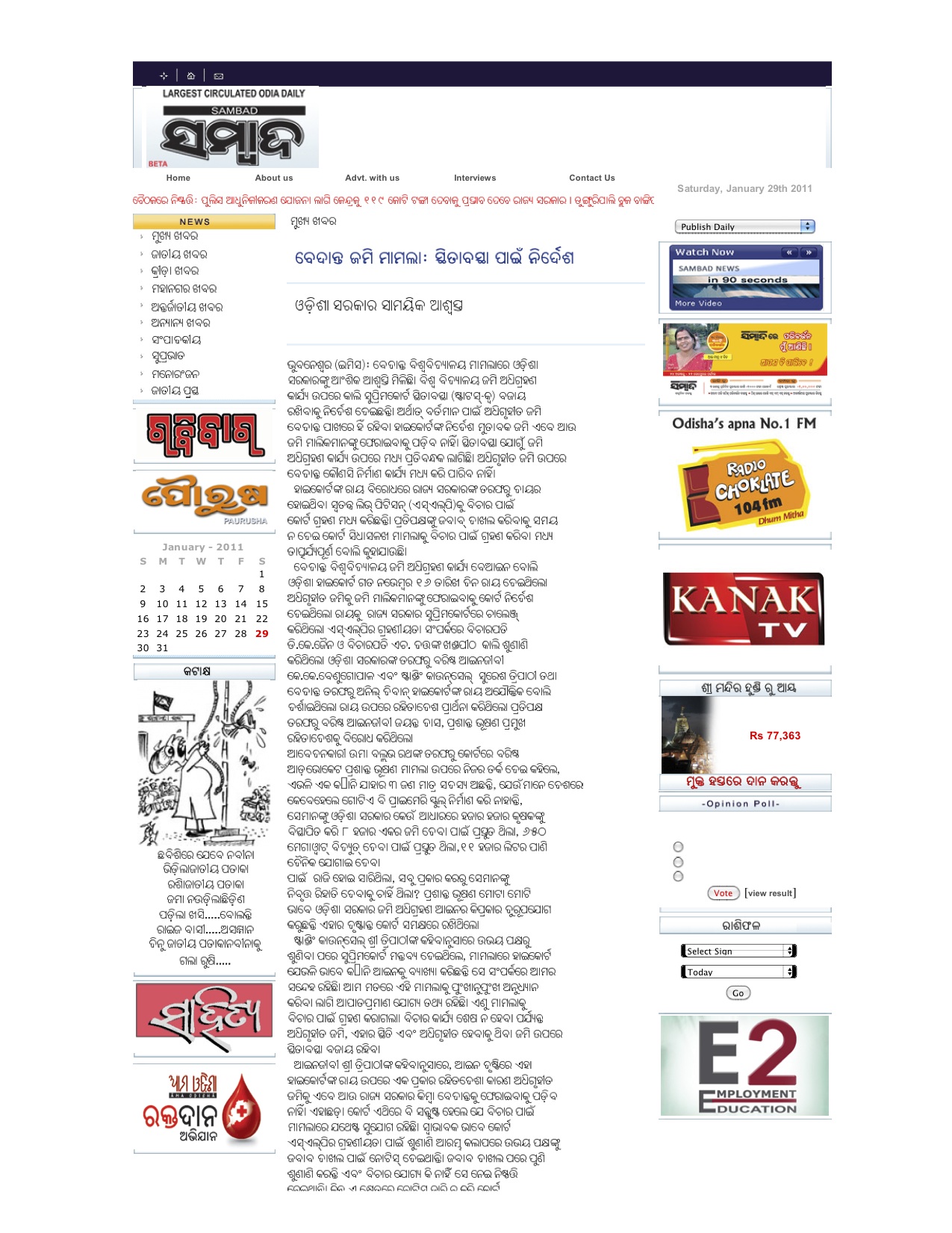
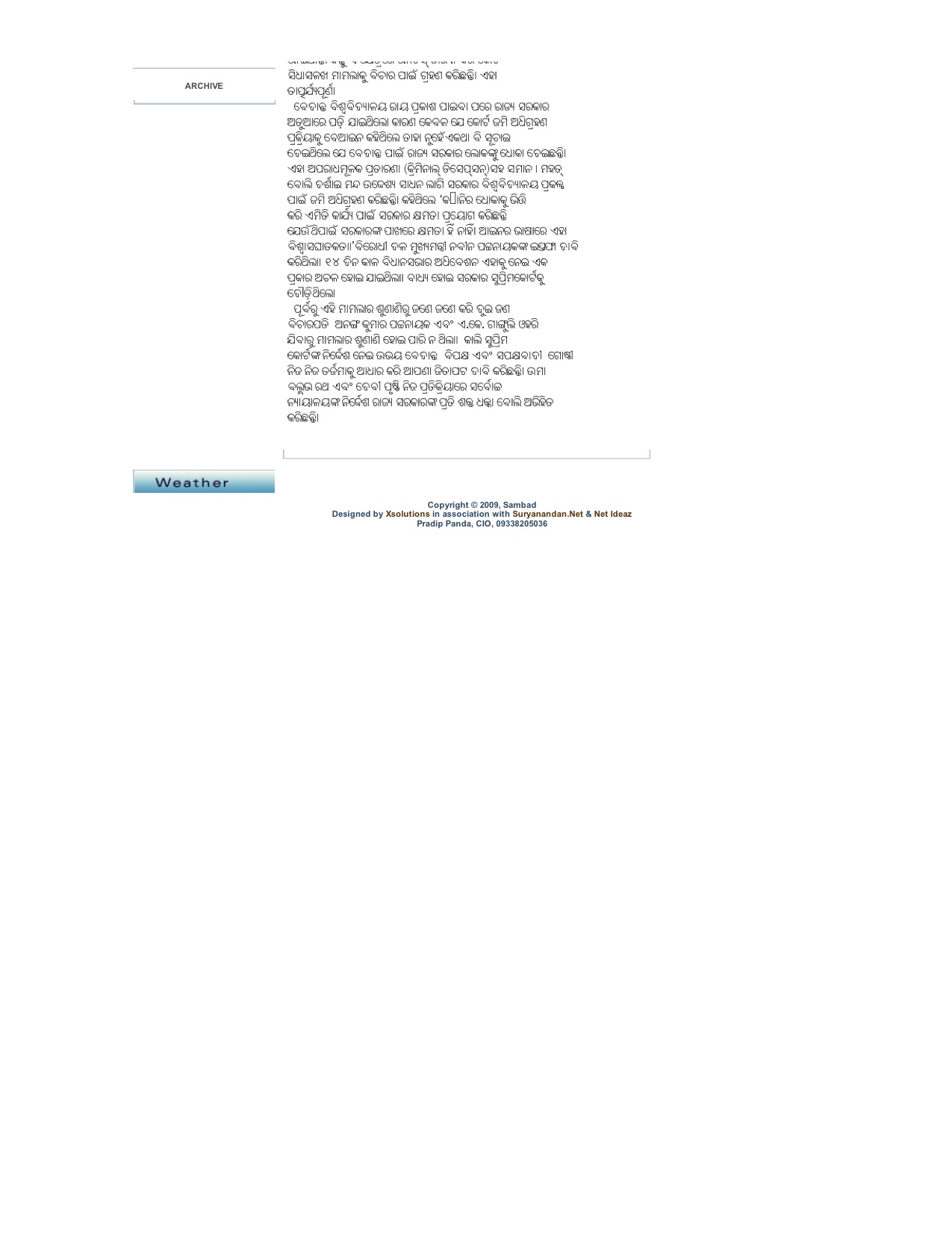
January 29th, 2011
Following is from a report in Pioneer.
Vedanta is going to open a science college at Lanjigarh in Kalahandi to spread higher education among tribals. The Vedanta Science College will commence classes from the academic year 2011-12.
The company has identified five acres of land at Lanjigarh for the purpose. The architectural design of the college has been completed and construction activity will begin soon. The bhoomi puja for construction of the building was performed last month.
“The science college will fill the gap of quality science education in western Odisha. Besides education, it will also improve the human development index and leadership quality among youth,” said Prof Gopabandhu Behera, retired Professor of Chemistry of the Sambalpur University.
Most towns in interior western Odisha mostly have arts and commerce colleges, where job opportunities for students passing out are limited. The proposed college is expected to address the need for quality science education in the district of Kalahandi and will make the youth qualified enough to get ample job opportunities.
The first batch of students will be admitted on merit basis, with preference to local students. In the first batch, the college will enroll 64 students. “Vedanta Science College will integrate teaching, learning, and research for a holistic development of the students,” said President and Chief Operating Officer of Vedanta Aluminium Ltd, Lanjigarh Dr Mukesh Kumar.
The college will impart graduate level studies in Physics, Chemistry, Mathematics, Zoology, Botany and Environment Science. The college will be managed by the DAV College Trust and Management Society, which is a premier education society and has already set up more than 100 colleges across the country. With the latest infrastructure, the college will provide facilities for sports, games and cultural facilities.
In Lanjigarh, the DAV College Trust and Management Society has set up an international school jointly with VAL which is giving access to quality English medium education to tribal students from Lanjigarh and around.
January 4th, 2011
Update: Following is the PIB release on it.
Shri Kapil Sibal, Union Minister for Human Resource Development, announced revised norms for the approval process, for 2011-2012, of institutes that are regulated by the All Indian Council for Technical Education (AICTE), here today.
The AICTE has been making an effort to facilitate stake holders in establishing good technical institutions in the Country. In order that a planned and coordinated development is ensured in technical education, AICTE for the coming year 2011 -12 has taken the following facilitative measures for Institutions, Faculty and students and others.
1. Introduction of Section 25 of Company’s Act to allow good corporates to setup Technical Institutions. However no Joint ventures can apply for this.
PPP and BOT model
2. Extended to 241 Districts where currently no AICTE Institution exists. This will facilitate spread of Technical education to all under represented areas.
3. Benefits of MEGA Cities extended to Metros and MRDA regions. Now there shall be two classifications of Rural and Other areas where the land requirement is: Rural area 10 acres, Other areas 2.5 acres.
4. FSI / FAR shall be considered for vertical Expansion where Management Programs will be allowed on FSI / FAR basis
5. Social Responsibility
5pm to 8 pm Courses for skill development that are based on the expertise areas possessed by the respective Institutions in the areas of Engineering / Technology / Architecture / Town Planning / Hospitality / Pharmacy etc are being allowed to be conducted by AICTE approved Institutions. This will facilitate the community around the Institutions to benefit by acquiring the skills provided by these Institutes. These Institutions are expected to form clusters with other institutions in the neighbourhood and collaborate with the Industries in the area in running these skill based programs.
6. Upto year 2010, Architecture had 40 students / division. This has been raised to 60 Seats / division. to provide for larger no. of seats and optimisation of resources without having to set up new institutions in the area.
7. Upto year 2010, different Programs like Engineering / Architecture / Pharmacy / Management / Hotel management and catering Technology, one each were allowed to be integrated into a single campus so that resources can be shared and optimised. Now this facility has been extended to more than one program to be integrated. Ie, 2 or more Engineering colleges, 2 or more management colleges and so on can be integrated as Technical / integrated campus to optimise resources
8. Upto year 2010, Tuition fee waiver scheme operated by AICTE allows for providing 10% supernumerary seats that are given to students of economically backward category. These seats were provided for Instituitions who may apply for such a scheme. Now these seats are made manadatory for every Institute upto 5%.
9. Security Money Deposit that takes care of contingencies in case of Institutions defaulting on their obligations, shall be replaced as money deposit in AICTE account. All existing FDR’s shall be converted to money deposit. This is necessitated because of
• Earlier FDR’s being encashed without AICTE knowledge or permission
• Custody and logistics of maintaining FDR’s being a source of problems.
10. The interest accrued shall be used to facilitate more stake holders like faculty, students, funding Institutions through schemes, and enhanced scholarships. AICTE has recently taken a decision to include all Government and Government aided Institutions as QIP centres in order to promote more research amongst faculty and produce more Ph. D’s. Hence a lot more faculty would be needed to be provided with QIP scholarships. This is also expected to be met from the money so generated.
11. All institutions completing more than one batch shall be eligible to get 2 Courses / program / level / shift on self disclosure if facilities and infrastructure are available. One Course would mean an addition of 60 students or one division. The ceiling which was there earlier like no increase after an intake of 540 students has been removed.
12. Institutions not completing one batch of passed out students shall get 1 Courses / program / level / shift on self disclosure if facilities are available.
13. If institutions have accreditation a further 1 Courses / program / level / shift shall be given additional in the course accredited.
14. 2nd Shift Courses and Women to Co-Ed Institutions shall be processed only after expert visits confirm that the infrastructure required exists with the Institutions.
15. Stand alone PG Institutes can be started which was not the case earlier.
16. Indian Degrees can be given in Campuses of Indian Institutions abroad subject to local laws.
17. Overseas campus can be setup subject to local laws and Indian Government clearance.
18. PGDM courses to be regulated as per several representations made.
• Date of admissions and Model curriculum to be given by AICTE
• Admissions to be effected by States and Fee to be regulated by State fee committee.
19. All approvals for Polytechnics shall be processed by AICTE.
20. Students of XII Vocational / Technical of the State Boards or any other to be admitted to 2nd Year lateral entry of a Diploma Program
21. Students of B. Sc to be admitted to 2nd Year lateral entry onto a Degree Program provided they have passed Mathematics at XII or B Sc level and would be required to pass Engineering Graphics and Engineering Mechanics along with the second year subjects.
22. 10% lateral entry setas increased to 20% in all states except Andaman Nicobar, Lakshadweep and Diu Daman where it is 30%
23. A separate division of 60 students / course can be started from 2nd year onwards in all AICTE approved Institutions subject to availability of infrastructure, exclusively for Polytechnic students for lateral entry.
24. All approval process to be completed by May 31st 2011 to enable coordinated planning.
MV/Hb
Following are excerpts from a report in India Today.
The new norms, allowing for an increase in the number of institutes and seats in various courses, will come into effect immediately.
(1) … all institutions completing more than one batch will be eligible to get two courses and programmes.
One course would mean the addition of 60 students.
(2) The earlier ceiling, which did not permit any increase after an intake of 540 students, has now been removed.
(3) All these steps envisage an increase in the number of total available seats by 50 per cent and a sharp increase in the workload of the faculty members. …
(4) The reforms also include relaxing land requirement for setting up institutions from 3.5 acres to 2.5 acres in urban areas and introducing section 25 of the Companies Act to allow ‘ good corporates’ to set up technical institutions. No joint ventures can apply for this.
(5) Until recently, postgraduate programmes could be started only where an undergraduate programme existed. But now, the AICTE will permit standalone postgraduate institutions to be started.
In regards to point (4) above one may note that one of the controversy regarding Vedanta University is regarding its status as a Section 25 company.
Following are excerpts from a report in expressbuzz.com.
Human Resource Development Minister Kapil Sibal on Thursday announced the revised norms for the approval process for 2011-2012 of institutes that are regulated by All Indian Council for Technical Education (AICTE). …
… From now onwards, technical institutes approved by the AICTE, have to reserve up to 5 percent of their seats for students from economically backward sections of society.
“Till now, tuition fee waiver scheme, operated by the AICTE, allowed providing up to 10 percent supernumerary seats that are given to students of economically backward category. It was the discretion on the part of the institution to apply for such a scheme. Now, these seats are made mandatory for every institute up to 5 percent,” Sibal said. The minister said, “These measures are aimed at easing pressure on the education sector and providing relief to the students in matters of admission.”
January 1st, 2011
Following is the content from http://on.fb.me/vedantau.
In less than three months we have created a sizable compendium on Vedanta University, mostly based on information collected from the web. They are available in the page http://www.facebook.com/vedantau . Given below are the links to important parts of that collection.
Please share this with your friends in FB or otherwise and urge them to explore it. We need to spread this information so that more and more people (especially from Odisha and India) are aware of the benefits of this university and its importance to Odisha and India and are not swayed by misinformation spread by some vested interests. This is an opportunity of a millennium for Odisha and we must not miss this.
1. http://bit.ly/vedantau-radio : A radio interview of the main architect of Vedanta University. It was done by a radio station in the US in 2007. It will tell you everything about the university and the motivation behind it.
2. http://bit.ly/vedantau-video2 : A video interview of Anil Agarwal by Charlie Rose of the Public Broadcasting Service (PBS) of USA. He talks about the Vedanta University and how it came about.
3. http://bit.ly/vedantau1 : A 43 page pdf document by me titled "Vedanta University: Its importance to Odisha and India." This document address the significance and importance of Vedanta University for Odisha and India through the following points.
In addition it addresses the following frequently asked questions (FAQs):
4. http://on.fb.me/vedantau-s1 : Why Vedanta University is important for Odisha? A statement by Dr. Dhanada Mishra, Bhubaneswar.
5. http://on.fb.me/vedantau-s2 : Vedanta University – Will You Gain? A slide presentation by Devasis Sarangi, Bhubaneswar
6. http://on.fb.me/vedantau-s4 : Vedanta University is an academic question. An appeal to Odisha academics by Professor S P Misra, Bhubaneswar.
7. http://on.fb.me/vedantau-s5 : Why we need Vedanta University in Odisha? A statement by Manmohan Dash, currently at Bhubaneswar.
8. http://on.fb.me/vedantau-s6 : Why Vedanta University is important for Odisha? A statement by Sujeet Jena, originally from Puri, Currently in Sydney, Australia.
9. http://on.fb.me/vedantau-s7 : I am propagating the project. What will I get? Umashankar Das (currently at Bangalore) answers questions posed to him on his support for Vedanta University.
December 23rd, 2010
Dear all:
By now most of you must be aware that the Odisha government as well as the Vedanta University authorities have gone to Supreme Court. One can draw two inferences from that.
(i) The Odisha government is standing behind its decision. [Some may consider that it did not have a choice. Perhaps. On the other hand, in the past, the CM had disassociated himself from people (ministers and officers) linked to controversies so that he does not get tainted. He could have done that here. But he seems to be standing behind the project and believe in it and its importance to Odisha. He seems to have taken a personal risk to his reputation by standing behind the project.]
(ii) The fact that the Vedanta University people also went to the supreme court means that they are still interested in having it in Odisha.
Now Supreme Court will take its time in giving a verdict. I am not sure if we can write to the supreme court or not. I am trying to find out as we do not want to take any missteps.
While hoping that the Supreme Court gives a favorable (towards Vedanta Univ) verdict, we should not just wait and do nothing. From past experience we know that the opponents will still try to create problems even after a favorable (towards Vedanta Univ) supreme court verdict.
So we must continue our efforts to spread the positives and virtues of Vedanta University and its impact on Odisha and India. We are doing that in facebook. Please help us there as well as through other channels of your choice.
The point is that the parameters of this project is unprecedented in India. Thus there is misunderstanding and opposition. The government is not doing that good a job in countering the misinformation. Nevertheless, the people who understand the project and its unprecedented implications to Odisha (that is we) must do our part. In the west when there is a controversial project, people from both sides speak. In Odisha the opponents are often small but make a lot of noise and drama while the supporters mostly keep quiet. With that happening repeatedly no wonder Odisha despite being resource rich it is at the bottom of most human development parameters. We need to break that pattern starting from this project.
We need to come out in the open and speak up.
To help in that we have consolidated various information on the issue at http://on.fb.me/vedantau . I am giving them below. Please read some of the statements in that list. It is very encouraging. If you have not done so, please write your statement and send them to me. I would still like to make a collection of those statements and give it to various people in Odisha.
Links to some of the statements:
4. http://on.fb.me/vedantau-s1 : Why Vedanta University is important for Odisha? A statement by Dr. Dhanada Mishra, Bhubaneswar.
5. http://on.fb.me/vedantau-s2 : Vedanta University – Will You Gain? A slide presentation by Devasis Sarangi, Bhubaneswar
6. http://on.fb.me/vedantau-s4 : Vedanta University is an academic question. An appeal to Odisha academics by Professor S P Misra, Bhubaneswar.
7. http://on.fb.me/vedantau-s5 : Why we need Vedanta University in Odisha? A statement by Manmohan Dash, currently at Bhubaneswar.
8. http://on.fb.me/vedantau-s6 : Why Vedanta University is important for Odisha? A statement by Sujeet Jena, originally from Puri, Currently in Sydney, Australia.
9. http://on.fb.me/vedantau-s7 : I am propagating the project. What will I get? Umashankar Das (currently at Bangalore) answers questions posed to him on his support for Vedanta University.
Action Items:
(a) Please spread the word.
(b) Send me your statements (if you have not done so)
(c) Show support in face book: Click on "like" in http://www.facebook.com/vedantau
We now have more than 1200 well educated people (mostly Odias) openly showing their support in Facebook through likes and friends links. More than 70% of them are from India. So this is not an NRI thing. On purpose we focused on India.
(d) In general, lets not sit quiet; lets do our part as a well-wisher of Odisha.
best regards
Chitta Baral
December 23rd, 2010
Following is an excerpt from a report in Business Standard.
The Andhra Pradesh government has rolled out a red carpet for the Anil Agarwal Foundation’s proposed Rs 15,000-crore Vedanta University project, after the Orissa High Court termed the land acquisition process illegal for the multi-disciplinary university in Puri.
In a letter to Anil Agarwal, chairman and founder of Vedanta Resources, K Rosaiah, then chief minister of the state, said, “Andhra Pradesh strongly believes in nurturing great institutions of learning to empower youth, realise demographic dividend in full measure and to truly make the state a global center of learning.”
Despite Rosaiah resigning last month, state government officials say the state is keen on Vedanta considering their proposal. “Even if Rosaiah resigned, we still have a Congress government in the state and we are keen to have Vedanta University on board. The ball is in Anil Agarwal’s court now,” said a senior state government official.
The official said Vedanta University officials were shown three different sites in September. These lands, however, are private ones and would be sold to Vedanta at reasonable rates.
It was suggested to Vedanta officials to have the university’s head office in Hyderabad, with campuses in other cities, including Bangalore and Chennai.
“Instead of setting up a campus in one city, they can spread it over to other cities too. We have shown them land, which is at a reasonable distance from Bangalore and Chennai, and would be connected through the golden quadrilateral,” the official added.
… Vedanta University is modelled on Stanford University and aims to be a world-class, multi-disciplinary university, with students from around the world. However, the varsity, which was to begin operations by mid-2011, has not even started the basic infrastructure work on the land due to stiff opposition from locals and lack of political support.
… A director of a local institute told Business Standard: “The university concept is a good one and if Vedanta opts out, it would be an opportunity loss for Orissa.”
It is really unfortunate that the Congress party in Odisha is vehemently opposing this university and creating all kinds of troubles while its government in Andhra is rolling out red carpet for them. It is becoming obvious that the Congress leaders of Odisha do not work for the people of Odisha but work for their masters in Delhi and elsewhere. [Recently, their prince visited Odisha but would not even give an audience to Odisha congress leaders. But our congress leaders have no self respect. They are used to being humiliated by the prince and his family and the leadership in Delhi. One of them even accepted a demotion and became a state minister without independent charge after being cabinet minister twice.
I wonder when they will realize that a self-defeating strategy, subservient attitude and lack of self-respect will take them nowhere.
I wish Congress had some real leaders and strategists who instead of creating trouble to stop growth oriented projects would do the opposite; i.e., focus on Odisha’s growth and point out the current government’s mistakes in making a mess in achieving that growth after signing tons of MOUs.
I wish the Odisha Congress took some lessons from their Bihar debacle under the leadership of their prince; the people want growth and development; not partisan politics, anti-development chaos, and prince worship.]
Note: The portion inside [ ] was added after, but not in response to, Comment 1.
December 10th, 2010
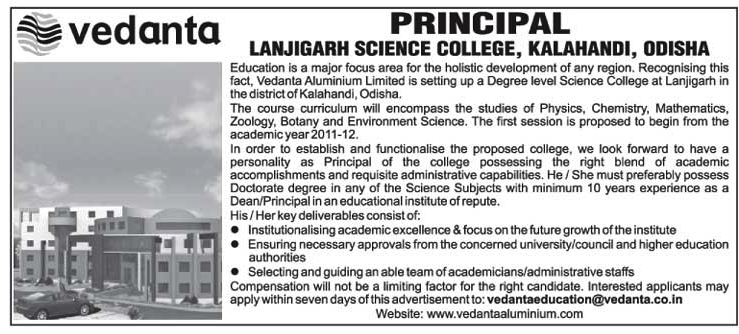
Although this may not become part of Vedanta University, such feeder and/or associated colleges in Vedanta Company’s operational areas will hopefully bring more goodwill to Vedanta University. This is a good start. More is needed though. Colleges that can take in mostly local students and produce graduates that can find jobs, such as Nursing and B.Ed Colleges in Kalahandi and Jharsuguda, would be appreciated.
December 4th, 2010
Following is an excerpt from a NDTV report.
The London School of Economics will collaborate with Reliance Foundation, run by the promoters of India’s largest corporate house, for setting up world-class universities in the South-Asian nation.
Reliance Foundation is the philanthropy arm of Indian billionaire industrialist Mukesh Ambani-led Reliance Industries group, while the LSE is one of the world’s most reputed business schools.
The LSE would collaborate with the Reliance Foundation in setting up world class Universities in India, LSE’s Professor Lord Nicholas Stern said here last night.
December 3rd, 2010
Update 5: The companies act of 1956 is at http://www.vakilno1.com/bareacts/companiesact/companiesacts.htm.
Update 4: The land acquisition act is given at http://dolr.nic.in/hyperlink/acq.htm. Following are the excerpts on the whole section on land acquisition for companies, including Section 40 referred below.
PART VII
Acquisition of Land for Companies
38. [Company may be authorized to enter and survey]. Rep. by the Land Acquisition (Amendment) Act, 1984 (68 of 1984), s.21.
[38A. Industrial concern to be deemed Company for certain purposes. – An industrial concern, ordinarily employing not less than one hundred workmen owned by an individual or by an association of individuals and not being a Company, desiring to acquire land for the erection of dwelling houses for workmen employed by the concern or for the provision of amenities directly connected therewith shall, so far as concerns the acquisition of such land, be deemed to be a Company for the purposes of this Part, and the references to Company in [selections 4, 5A, 6, 7 and 50] shall be interpreted as references also to such concern]
39. Previous consent of appropriate Government and execution of agreement necessary. – The provisions of [sections 6 to 16 (both inclusive) and sections 18 to 37 (both inclusive)] shall not be put in force in order to acquire land for any company [under this Part], unless with the previous consent of the [appropriate Government], not unless the Company shall have executed the agreement hereinafter mentioned.
40. Previous enquiry. – (1) Such consent shall not be given unless the [appropriate Government] be satisfied. [either on the report of the Collector under section 5A, sub-section (2), or] by an enquiry held as hereinafter provided, –
[(a) that the purpose of the acquisition is to obtain land for the erection of dwelling houses for workmen employed by the Company or for the provision of amenities directly connected therewith, or
[(aa) that such acquisition is needed for the construction of some building or work for a Company which is engaged or is taking steps for engaging itself in any industry or work which is for a public purpose, or]
(b) that such acquisition is needed for the construction of some work, and that such work is likely to prove useful to the public].
(2) Such enquiry shall be held by such officer and at such time and place as the [appropriate Government] shall appoint.
(3) Such officer may summon and enforce the attendance of witnesses and compel the production of documents by the same means and, as far as possible, in the same manner as is provided by the [Code of Civil Procedure, 1908 (5 of 1908)] in the case of a Civil Court.
41. Agreement with appropriate Government. – If the [appropriate Government] is satisfied [after considering the report, if any, of the Collector under section 5A, sub-section (2), or on the report of the officer making an inquiry under section 40] that [the proposed acquisition is for any of the purposes referred to in clause (a) or clause (aa) or clause (b) of sub-section (1) of section 40], it shall require the Company to enter into an agreement [with the [appropriate Government]], providing to the satisfaction of the [appropriate Government] for the following matters, namely :-
(1) the – [payment to the [appropriate Government]] of the cost of the acquisition;
(2) the transfer, on such payment, of the land to the Company.
(3) the terms on which the land shall be held by the Company,
[(4) where the acquisition is for the purpose of erecting dwelling houses or the provision of amenities connected therewith, the time within which, the conditions on which and the manner in which the dwelling houses or amenities shall be erected or provided;
[(4A) where the acquisition is for the construction of any building or work for a Company which is engaged or is taking steps for engaging itself in any industry or work which is for a public purpose, the time within which, and the conditions on which, the building or work shall be constructed or executed; and]
(5) where the acquisition is for the construction of any other work, the time within which and the conditions on which the work shall be executed and maintained and the terms on which the public shall be entitled to use the work.]
42. Publication of agreement. – Every such agreement shall, as soon as may be after its execution, be published in the official Gazette, and shall thereupon (so far as regards the terms on which the public shall be entitled to use the work) have the same effect as if it had formed part of this Act.
43. Section 39 to 42 not to apply where Government bound by agreement to provide land for Companies. – The provisions of sections 39 to 42, both inclusive, shall not apply and the corresponding sections of Land Acquisition Act, 1870 (10 of 1870), shall be deemed never to have applied, to the acquisition of land for any Railway or other Company, for the purposes of which, [under any agreement with such Company, the secretary of State for India in Council, the Secretary of State, [the Central Government or any State Government] is or was bound to provide land].
44. How agreement with Railway Company may be proved. – In the case of the acquisition of land for the purpose of a Railway Company, the existence of such an agreement as is mentioned in section 43 may be proved by the production of a printed copy thereof purporting to be printed by order of Government.
[44A. Restriction on transfer, etc. – No Company for which any land is acquired under this Part shall be entitled to transfer the said land or any part thereof by sale, mortgage, gift, lease or otherwise except with the previous sanction of the appropriate Government.
44B. Land not to be acquired under this Part except for certain purpose for private companies other than Government companies. – Notwithstanding anything contained in this Act, no land shall be acquired under this Part, except for the purpose mentioned in clause (a) of sub-section (1) of section 40, for a private company, which is not a Government company.
Explanation. – "Private company" and "Government company" shall have the meaning respectively assigned to them in the Companies Act, 1956 (1 of 1956).]
Update 3: Following are excerpts from a report in Pioneer.
The dispute was over whether the Anil Agarwal Foundation is a private company or a public company in terms of the provisions of the Companies Act, 1956. The Court held that the acquisition of land in favour of the Foundation is not permissible, except for some limited purposes enumerated under Section 40(1)(a) of the Land Acquisition Act, since it is a private company.
The Chief Minister, however, countered the Court’s stand by stating, “In this connection I may point out that acquisition was never made under this aforesaid provision but under Section 40(1) (aa) or 40 (l) (b) for a public purpose, the acquisition being for the purpose of setting up a university… As the Government has accepted, based on the records, that the Foundation is a Public Company, land acquisition for an educational purpose like for the proposed world class university would be permissible under the Land Acquisition Act, 1894.”
Replying to the court’s observation that the Ordinance promulgated by the State Government in favour of the Foundation cannot give the legal status to the university proposed to be established in the acquired land by the Foundation, Patnaik observed, “The reference to the Ordinance is baffling and is an error apparent on the face of record. The fact is that no Ordinance has ever been promulgated by the Government for establishing the proposed Vedanta University. Under the UGC Regulations, 2003 a university can be set up by an Act of Parliament or State Legislature by a Section 25 Company or a Trust or a Registered Society. The promoter of the proposed University, the Foundation is a “not for profit” Company registered under Section 25 of the Companies Act”.
The Chief Minister further clarified that the Assembly has already passed a Bill in July, 2009 for setting up the Vedanta University with an aim to provide education of global standards in the State. The Bill is presently awaiting the assent of the Governor.
The High Court had also observed that acquiring land in which two rivers are flowing, and requiring the company to maintain the flow of these rivers, would affect the residents of the area. The Chief Minister contended that no land comprising the rivers, channels or embankment would be transferred to the university.
“There is also no proposal to alienate the water channels in favour of the proposed university and the ownership, possession and right of use of channel will continue with Water Resources Department, and hence will serve the interest of the public at large”, he claimed.
Update 2: Following are excerpts from an IANS report in sify.com.
‘The setting up a world class university in Orissa is most certainly in the larger public interest and his government had acted in a bonafide manner throughout the process,’ Patnaik told the assembly in response to an adjournment motion.
… Responding to the questions raised by some opposition members during the debate, Patnaik also reiterated that as per the records available with the government, the foundation had satisfied all the norms for converting itself from a private to public company.
Update 1: Following are excerpts from a report in Business Standard.
Chief Minister Naveen Patnaik has shot back at the Opposition, refuting all allegations regarding land acquisition for the proposed Vedanta University Project.
Responding to the adjournment motion on the issue moved by the Congress MLA Prasad Harichandan, Patnaik clarified that land acquisition for the project was not illegal.
… Giving his initial response to the motion, the chief minister said,"After receipt of intimation of the Anil Agarwal Foundation about the change of its status from a private to a public limited company, notification was issued under Sub-Section 1 of Section 4 of the Land Acquisition Act in respect of 7184.37 acres of land which was subsequently reduced to 6137.90 acres. Acquisition has since been made in respect of 3495.21 acres of private land while government land to the extent of 509.27 acres has also been leased out to the Foundation”.
Referring to the High Court verdict on the issue, he said, “The High Court has held that the Anil Agarwal Foundation is a private company and not a public company in terms of provisions of the Companies Act, 1956. Therefore, it has held that the acquisition of land in favour of the Foundation is not permissible except for some limited purposes enumerated under Section 40 (1) (a) of the Land Acquisition Act. In this connection, I may point out that acquisition was never made under this aforesaid provision but under Section 40 (1) (a) (a) or 40 (1(b) for a public purpose, the acquisition being for the purpose of setting up a university.”
He further clarified that the Anil Agarwal Foundation had confirmed to the state government regarding the change of its status from a private to a public company with effect from November 23, 2006 by a resolution of the Extraordinary General Meeting pursuant to the approval of the regional director, Department of Company Affairs.
"The company subsequently produced a letter dated February 21, 2007 from D K Gupta, Registrar of Companies to its address stating that the company has complied with the provisions of requirements of Section 25 of the Companies’ Act and accordingly, the status of the company has been changed from a private company to a public limited company. A copy of this letter has also been filed before the High Court by the Foundation on June 20, 2008”, he added.
Patnaik also clarified that there has been no violation of Section 16 (2) of the Shri Jagannath Temple Act.
"So far as the acquisition of land from the Lord Jagannath Temple is concerned, about 606 acres spread over nine villages has been acquired under the Land Acquisition Act. There is no violation of Section 16 (2) of the Shri Jagannath Temple Act by such acquisition as the above section mentions about previous sanction of the state government for lease, mortgage, sale and alienation of land belonging to Lord Jagannath and would not, therefore, apply to the acquisition of land under the provisions of the Land Acquisition Act”, he added. …
Following is an excerpt from a report in DNA.
Indicating that the Orissa government might challenge the high court judgement on Vedanta University in the Supreme Court, chief minister Naveen Patnaik today claimed that there was no violation of law during land acquisition for the proposed project in Puri district.
"The period of challenging the order of the high court has not yet expired. The advocate general has been requested to advise the government on the subject, after which appropriate steps will be taken in accordance with the law," he said in a statement on an adjournment motion moved by Congress chief whip Prasad Harichandan on the issue.
… The court, in its November 16 judgement, stated that the acquisition process by the state government for a private limited company was not legal.
The chief minister, however, said, "We started land acquisition process after receipt of intimation from Anil Agarwal Foundation about the change of its status from a private to a public limited company."
Claiming that the state government had not violated law of the land, Patnaik said that land was acquired for public purpose.
"I would like to point out that the Foundation had submitted a letter dated 22, November, 2006 issued by VS Rao, regional director, ministry of company affairs, Mumbai to its address, stating that their request for permission under section 25(8) of the Companies’ Act has been considered for conversion of status of the company from private company, and that the provision of section 23, 31, 189 (2) and 192 of the Companies Act are required to be compiled with," Patnaik said.
However, a representative of the Registrar of Companies, Mumbai in its affidavit before the high court on October 15, 2008 stated that though the Registrar considered the change of status from private to public limited company, it did not furnish a certified true copy of the altered memorandum and articles of association.
The company affidavit also stated that the company had less than 7 members, the minimum requirement of a public company.
"This stand is at variance from the contents of the letter dated 21-2-2007 reportedly issued by the Registrar of the company. In view of the apparent contradiction, this matter will be examined further and appropriate steps will be taken as per law," Patnaik said.
Patnaik also rejected other factors that the varsity project would affect the Konark-Balukhand Sanctuary, violation of environment act, forest act and others.
Admitting that about 600 acre of land belonging to Jagannath Temple was acquired for the purpose, the chief minister said: "The high court has not passed any order with regard to the acquisition of the Jagannath Temple land."
Patnaik also cited recommendation of a House Committee that had earlier recommended for disposal of temple land to augment the resources of the temple. "By present acquisition for the proposed university, Rs8.80 crore have been received by the temple administration," he said.
Stating that a world-class university was required for the state, Patnaik said Vedanta Group had selected Puri after looking for different places in Rajasthan, Gujarat, Andhra Pradesh and West Bengal.
It is great to read that the CM understands the importance of Vedanta University. He has taken a huge risk to his political career in supporting this. It is time we take action in support of this. Stay tuned for our action plan.
November 25th, 2010
Previous Posts