Following are some excerpts from that report by Shailaja Neelakantan.
… Agarwal’s proposed Vedanta University is expected to be different. Undergraduates will study diverse subjects on the way to earning degrees, rather than focus exclusively on one discipline, as is typical at Indian universities. "An engineering student will be able to study literature or economics if he wants to, like in the US," says C.V. Krishnan, chief executive of the university project. Vedanta University plans to offer undergraduate, graduate and doctoral programmes in a huge variety of disciplines. The first phase of the university’s growth, to about 3,000 students, is scheduled to begin next year. In 2023, when it is destined for completion, Vedanta University will house 100,000 students, as well as 40,000 faculty and staff members.
…Nevertheless, he has huge ambitions for Vedanta University. According to promotional materials, Vedanta will boast faculty members and students from all over the world and will produce "tomorrow’s Nobel laureates, Olympic champions and community leaders." Agarwal and his public relations staff talk a good game – he has even likened himself to Leland Stanford, an American who made his fortune building railways in the US and founded Stanford University.
…Still, for Vedanta University’s supporters, its sheer scope is what makes it worth backing. "It could set a new revolutionary benchmark in higher education – and just the force of that argument should allow this project to go ahead," insists Pratap Bhanu Mehta, chief executive of New Delhi’s Centre for Policy Research.
As it is, the country’s 350 public universities serve only seven per cent of its 18- to 24-year-olds, a rate that is half that of other Asian countries. If Vedanta University succeeds, it could stem the rising tide of Indian students seeking an education overseas.
…
The campus
Is being designed by an American architect in Baltimore who has developed Duke, Carnegie-Mellon and Johns Hopkins universities in the US. It will be built on 8000 acres of land near the Puri-Konark marine drive in Orissa state and the buildings will be arranged in the form of two overlapping circles. The Orissa government has begun to build a four-lane expressway from the new campus to the international airport which is being constructed near the state capital, Bhubaneswar, 70km away. A railway station will also be located on campus. The area will be developed into a large university township that will house a permanent population of 500,000 in addition to the 100,000 students.
Any more?
Yes, there will also be a research and development park serving as an incubator for spin-off companies. Eventually, it is hoped that this will evolve into a large research-cum-education complex resembling Silicon Valley, the economic hub that surrounds Stanford.
Will it work?
The university system in India is under financial strain and is not known for its research strength, except in one or two areas, or for the quality of its academics. Although it has large numbers of keen and well-prepared students, India is not a global player and, unlike China, is not making super-human efforts to build up a stellar university system by recruiting retired or semi-retired university presidents and other staff from the US. That is why Indians spend large sums on getting a good higher education overseas. And it is why India’s Prime Minister, Manmohan Singh, announced that he wanted to set up 25 new universities funded by the centre to augment the handful of centrally funded universities already in existence. It is also why he supports Vedanta University.
Whether Vedanta will succeed is debatable, according to Lord Parekh, the British peer who was educated in Bombay and the London School of Economics, and was later vice chancellor of the University of Baroda. First, he wonders where the quality staff will come from for a new university containing 100,000 students. Second, he asks who is going to manage a 40,000-strong faculty.
"Three Chinese universities have invited retired or semi-retired American professors and executive officers to staff their universities," he says. "Singapore is doing the same. These countries are paying well. They have the confidence to hire foreigners."
October 11th, 2007
Tathya.in has a coherent argument on making UCE Burla a state university. Following is the article.
While students of the University College of Engineering (UCE) Burla are on war path to turn the institution as a Deemed University, educationists have suggested the state government to declare it as a State University.
“It is easier for the Government of Orissa to declare UCE Burla as an Engineering and Science University”, suggested an educationist who belongs to Western Orissa.
An alumnus of UCE, Burla has also echoed the view on this line.
“Instead of pleading with the Ministry of Human Resource Development (MHRD), it is easier for the state government to pass a Bill in this regard in the Orissa Legislative Assembly (OLA)”, said he.
Initially it will cost Rs.1.5 crore per annum at the most, said a Financial Advisor of the state government.
Later the state government by appointing a hyper active Vice Chancellor like Devdas Chhottaray will be able to rope in huge funds from University Grants Commission (UGC).
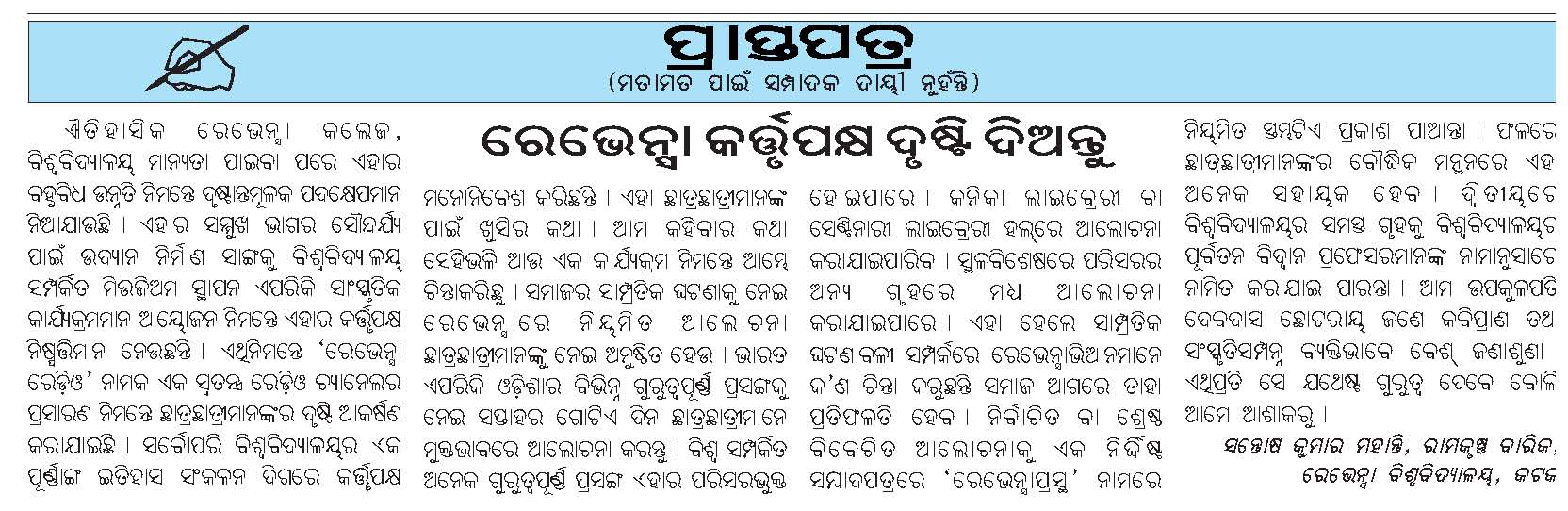
Mr.Chhottaray, VC of the newly formed Ravenshaw Unitary University (RUU) has been successful to convert the RUU as an UGC aided University in a period of one year.
When the 50 year old institution will be celebrating its Golden Jubilee, it is the right time for the state government to declare it as another State University, said another alumnus.
The UCE, Burla alumni have a major role to play, said a mandarin in the state secretariat.
Most of the alumni are in the top level of the state administration and their influence in this regard will play a major role to transform the institution as a State University of Science and engineering, said he.
While the students are demanding for a Deemed University status they are ignorant about the fact that most of the DUs are not funded by the UGC.
So it is better that at the first place UCE, Burla to be declared as a State University and later a pro-active VC will rope in funds from the UGC.
It may be pointed out that various states have followed this path earlier and have been successful like West Bengal and Kerala.
The Bengal Engineering and Science University (BESU) and the Cochin University of Science and Technology (CUSAT) are state universities, and both were selected to become Indian Institute of Education, Science and Technology (IIEST).
“Better late than never, Orissa must take a cue from West Bengal and Kerala”, said Sandip Das Verma, a leading Non Resident Odiya (NRO).
October 9th, 2007
NaxatraNews (NN): Orissa is poised for a major industrial boom, as the Vice- Chancellor of the nodal technical University of the state what do you think about the synergy between the industry and academics?
Omkarnath Mohanty (OM): In a mature economy, the synergy between industry and academia is spontaneous. However, in a situation such as India’s and Orissa’s, this is not so; one has to make an effort to bring about a serious interaction between the two. An attempt has already been made in the IT sector to have a serious collaboration by identifying common projects at the Post-Graduate level. Further, in many colleges, the Knowledge Center concept will become operational attracting some of the industries to participate. However, this is going to be a slow process for some time as the industry does not necessarily feel that the academia can assist its progress. In the steel sector we are about to witness a quantum jump in production in Orissa and the Post-Graduate Centre in Steel Research has been contemplated at Rourkela for awarding M.Tech. and Ph.D. degrees. It is expected that a number of steel companies will participate in this exercise.
NN: The number of engineering students passing out from colleges each year from the state is far short of the present requirements. Besides, many students go out of the state for greener pastures. How would you address this issue given the projected industrialization in the state?
OM: Yes, it is true that the number of graduates coming out of the forty–plus engineering colleges (close to 15000 each year) may not be sufficient to take care of all the industries in Orissa, particularly in the near future. However it will be difficult to see the number of colleges growing overnight. Further even with the current number of colleges, the quality of faculty is far from satisfactory and is a serious issue. Therefore, we would like to see a balanced growth in the number of colleges in Orissa.
NN: After assuming charge you have brought about many changes in the University administration as well as education system in spite of protests from many quarters. Which one you would rate as the greatest success and why?
OM: We have attempted to introduce several practices both in the administration as well as in the academic system of BPUT. In the University administration system the most important step that has been taken is the e-Registration process. This has just been introduced after a considerable amount of thought and efforts. It is expected that this process will get around several instances of "wrong" registration of students. The Semester Registration must be in consonance with the permissible group of subjects that a student can opt for and at the same time scrutinize the performance of the student in earlier examinations (clearance of subject). The new system has developed an algorithm that has embedded the stipulations of academic regulations.
In the area of Academics, I guess one of the most important steps is the starting of Question Bank in each subject. The Question Bank part has just begun; it needs to be strengthened so that every question paper has a semblance of quality and is strictly within the syllabus that is prescribed. In the absence of such a practice, numerous problems with regard to the standard of a Question Paper and its coverage have arisen in the past.
NN: What’s your opinion on the present controversy over capitation fee and separate entrance examination for engineering students of the privately owned engineering colleges?
OM: I do not intend to get into the capitation fees controversy – probably there is no real controversy. For instance, there was never a "declared" capitation fee. The current rationalization of fee structure has attempted to take into consideration all parameters that go into the financial structure of an academic institution. It has also provided for a generous expenditure on developmental activities. Most importantly there is also a handsome annual rate of return for the investment that has been provided for in the fee structure. If it is sincerely and ethically practaised by the owners of colleges, there should be very little scope for any disenchantment among the public.
As regards the separate entrance examination issue, everyone must be aware that the Supreme Court has decreed that the admission to the unaided, private professional institutions be based on:factors including transparency of the method of admission, merit being the only criterion of selection and no financial exploitation of the students
When the above criteria are employed, the merit of a separate entrance examination, to my mind, does not exist. One single entrance examination, today designated as the Orissa JEE, takes care of all the three above attributes.
NN: Keeping the booming steel industry of the state in mind you have planned a steel research institute at Rourkela. What precisely is this institute about?
OM: The Steel Research Institute in Rourkela has just only been born. It is meant for awarding M.Tech. and Ph. D. degree in the area of steel research. The world of steel, over the past decade, has witnessed radical developments both in the production techniques as well as in the application of steel. For instance, the FINEX process (recently adopted by POSCO in their plant in Korea), can use fine ore and has multiple products; this process is going to be watched with a lot of interest. Another example could be the Thin Strip Casting (primarily developed by an Oriya Metallurgist from IIT-Kharagpur, at BHP Australia) is currently in commercial production at the NUCOR plant in USA, involves direct casting from liquid state to 1mm and below strip. Thereby, the cost of steel strips is appreciably, reduced. Similarly, in the application areas extremely high strength (>1000Mpa) combined with reasonable ductility and more importantly high formability steel sheets have now been developed; these are important for automobile body manufacturing. Their use can reduce weight of a car without sacrificing safety.
Our centre at Rourkela is expected to get into some of above areas. This would require a multi-disciplinary approach, quite different from the conventional metallurgy of the earlier period. We have made a modest beginning with advertisement for 5 faculty that have been granted by the government of Orissa. Our plan is to involve the major steel companies operating in India both for support in the faculty and in procuring the sophisticated research equipment. This will however take time.
NN: Safeguarding intellectual property rights has become an important issue in academic world. Do you think research institutes and researchers of the state are giving due regard to the matter?
OM: Yes, the IPR items relating to the University are very important. For one thing, awareness about IPR motivates people to be engaged in innovative and creative research. On the other, the knowledge of IPR can also be utilized for commercial gain through introducing new products or processes. This can engage the attention of creative faculty as well as students.
NN: Better pay package in IT industry has attracted most of the engineering students from core subjects like civil and mechanical trades to IT resulting in non-availability of sufficient number of quality manpower in the core sector. How do you think this trend could be arrested?
OM: It is true that better pay package in the IT industry has been attracting brighter people into the IT sector, apparently making the core sector impoverished in terms of quality manpower. However, it must also be borne in mind that all engineering subjects require an IT-enabled approach. For instance, the Civil / Mechanical / Electrical Engineers of today have to be very well acquainted with many soft computing techniques and optimization techniques. Therefore, there is no real unhealthy competition between these streams. We are attempting to make the core sector more IT-savvy. The new upward trend in the market place for core engineering sector during the past two years has confirmed that IT-assisted core sector will also find excellent employment opportunities in the near future.
NN: Similarly the exodus of good students to IT industry in last few years has also resulted in shortage of good faculties. Do you have any plan to create a faculty pool or any special measures to upgrade their skills?
OM: There are several measures that we have contemplated in order to build a pool of good faculty. These include: Collaborating with IITs in order to get their course-content that are web-based or DVD-based which in turn will also involve training of BPUT faculty by IIT teachers at regular intervals. Besides we are in the process of creating an Academic Staff College under the aegis of BPUT using our own experienced faculty spread over several colleges. Moreover there are training programmes for engineering faculty undertaken at advanced centres, both at IITs and other central universities such as Jadavpur University. We would be taking advantages of each of the above channels open to us.
NN: As private engineering colleges keep mushrooming in the state are you happy with the quality of students coming out under the BPUT banner? Do you think measures like abolition of year-back system you had initiated have yielded desired results?
OM: The first batch of the students under the BPUT banner has come out this year. Some of these students, I am sure, are bright judging by their quality of placement and their grade points. As far as "abolition" of year-back system is concerned there seems to be a misinformation. BPUT has never abolished the system of promoting students to next higher year based on their performance; indeed, many students were not promoted last year. There has, however, been only some modification in the criteria / stipulation.
Incidentally it must be understood that the University does not have a "year-back" system as such; what has been stipulated is the fact that weaker students will take longer than 4 years to complete a B.Tech. programme, that is ideally of 4-year duration.
NN: What else is in store for BPUT in the coming days?
OM: The coming years would witness a greater emphasis on Ph D. and M.Tech. programmes of the University. It is now realized across the globe that in order to run a quality B.Tech. programme, M.Tech. and Ph.D programmes are necessary supports. Research publications by faculty is another area which is going to be stressed upon in the coming years. Another item of importance would be the quality text books, primarily written by BPUT faculty for its own syllabus. This is going to be financially supported by the University in order to provide the necessary incentive to our faculty for engaging themselves in this area; that of text-book creation.
October 6th, 2007
(Request to readers associate with Orissa: Please send a request to cmo@ori.nic.in with cc to hedsec@ori.nic.in, "indsec@ori.nic.in" <indsec@ori.nic.in>)
The last paragraph of the New Indian Express report says the following:
Fatmi said that the Central Government proposed to set up a Central University in Bihar as part of its plans for 30 new Universities. Though the University Grants Commission (UGC) suggested the upgradition of Patna University, the Government wanted to set up Central University, besides upgrading Patna University.
However, although we have sent several communications to the Orissa government on making a similar effort for a second central university for Orissa — beyond the automatic one presumably in the KBK region, the Orissa government has been silent. Tathya.in reports on our efforts and the resulting frustration.
Following are mails that we have sent to the CMO.
Dear Esteemed Chief Minister:
On August 15th the PM announced that there will be 30 new central universities, with 16 of them in states that do not have any. (That means Orissa will get one and since Orissa has been asking for a central university in KBK, it should go to KBK.)
As per the PM’s address to the planning commission few weeks back, the remaining 14 central universities will be decided on the basis of competition. See https://www.orissalinks.com/?p=634 and https://www.orissalinks.com/?p=652.
Since India already has 23 central universities (none among them is in Orissa) and the new 30 ones will take the total to 53, Orissa deserves not just one but two central universities. (Note: Orissa is the 11th largest state of India in terms of population and 9th largest in terms of area.)
But as the PM clearly said, the 14 (30-16) central universities will be decided on a competitive basis. THUS, Orissa govt. must send a proposal on this to the HRD ministry and the PM. This needs to be done as soon as possible as the PM gave 2 months time to the planning commission for deciding on the locations and close to 3 weeks has already gone by.
I would like to propose that the Orissa govt., send a proposal immediately to upgrade Ravenshaw University as a central university.
This is because Ravenshaw matches the best with respect to all the conditions that the PM mentioned in his address to the planning commission. In particular:
-
Ravenshaw is a unitary university. i.e., Like world class universities such as most universities in the United States, and like most of the existing central universities in India (such as JNU, BHU etc.) Ravenshaw does not have any affiliated colleges.
-
Ravenshaw‘s location at the heart the millennium city of Cuttack and also in the middle of the Bhubaneswar-Cuttack metropolitan area makes it easy to access and the presence of top-notch educational and research institutions near it makes Ravenshaw a good candidate for becoming a world-class knowledge hub; i.e., a world class central university. (The PM mentioned this criteria explicitly.)
-
Ravenshaw had made plans for its expansion in directions that are in unison with the goal of a world class university that the PM talked about.
- Among all universities in India that may be considered for an upgrade, Ravenshaw is in a unique position by virtue of its recent designation as a university. The existing faculty of Ravenshaw are Government of Orissa faculty and are not automatically entitled to be Ravenshaw faculty. So Ravenhsaw can be choosy in retaining only the ones that are qualified to be a faculty in a world class university. The others may revert back to the Government of Orissa to be posted to other colleges in Orissa.
- Finally, Ravenshaw is one of the oldest higher education institutions of India with a glorious past. Its alumni is almost who’s who of Orissa.
In closing, I would urge you to not miss this opportunity for making a case for a second central university in Orissa. Otherwise we will continue to remain behind, while other states will have 2, 3 or more central universities.
sincerely,
Chitta Baral
October 6th, 2007
Following is an excerpt on it from Pioneer. (My understanding is that it is not yet an engineering college, but is on its way to become one.)
… former Union Minister Devendra Pradhan.
Inaugurating the first session of the Pabitra Mohan Institute of Technology (PMIT) at Talcher on Tuesday, he said local people are not getting proper employment opportunities as they do not have the required technical education. Pabitra Mohan Institute of Technology, which is named after the great freedom fighter and former Deputy Chief Minister, would solve this problem, he said.
Local MLA Mahesh Sahu also emphasised the need of technical education in the area. He criticised the vested interests who are opposing the establishment of the only private engineering college at Talcher.
Among others, the meeting was addressed by Atul Ku Sahu, Principal, Orissa School of Engineering, Bichhand Pradhan, freedom fighter, LD Nayak, Principal, PMIT, …
October 3rd, 2007
Following is the press release.
Chief Minister Naveen Patnaik met the Union Health Minister Shri A. Ramdoss today and impressed upon him to start work on the AIIMS Bhubaneswar campus without further delay. The Government of Orissa has already made available land to Government of India for this purpose. The Union Health Minister assured the CM that work would begin latest by January 2008.
Discussion was also held on wide ranging issues in the Health Sector. The Chief Minister requested the Union Health Minister for opening of a Paediatric Centre at Berhampur for treatment of children affected by HIV/ AIDS. He also pursued the request made by the State Government for installation of CD-4 machines in the 3 Medical Colleges at Cuttack, Berhampur and Sambalpur for detection of HIV/ AIDS. The Chief Minister, Orissa requested the Union Health Minister to sanction state-of-the art machines such as Linear Accelerator for the Cancer Hospital at Cuttack. The Union Health Minister assured the CM that all support will be extended for this purpose.
The CM, Orissa pleaded for increase of intake capacity in Dental Surgery (BDS) from 20 to 50. He further suggested opening of MDS course for which necessary posts of doctors have been sanctioned by Government of Orissa. The Union Health Minister promised to consider the proposal favourably.
Discussions were also held for opening new Nursing Colleges in different parts of Orissa in PPP mode. Government of Orissa will take steps to open such colleges shortly.
In related news a Times of India report outlines the progress with respect to the AIIMS clone in Patna. The time line described in that report will most likely also hold for the one in Bhubaneswar.
The bidding for selection of consultant would be opened on October 3, 2007. "The project management committee had approved the expression of interest (EOI) for selection of project management consultants for construction of six AIIMS-like medical college and hospitals in the country," the affidavit stated.
The project management consultants would be selected by December, 2007, and detailed project report would be submitted by April-May, 2008. Civil construction of the hospital and medical college building may be started by early 2008 and completed by 2010. Simultaneously, the manpower requirement for the AIIMS-like institution is being assessed by a separate committee, the affidavit added.
September 29th, 2007
.jpg)