PM’s remarks in the full planning commission meeting

Following is from a PIB report.

The Prime Minister, Dr. Manmohan Singh, chaired the full Planning Commission meeting here today. Following is the text of the Prime Minister’s closing remarks on the occasion:

            “We have had a wide ranging discussion on a subject which is vital for the continued progress of our country. We have covered all the critical areas in education, although I believe that more work needs to be done to give a final shape to the Skill Development area.

            The approach presented by the note of the Planning Commission has received broad support. The proposed scale of Central Government funding for education in the 11th Plan amounts to almost Rs.2.5 lakh crores in constant prices, which is a four-fold increase over the 10th Plan. The share of education in the total Plan will correspondingly increase from 7.7% to 19.4%.  This reflects the high priority being given to education by our Government and represents credible progress towards the objective of raising public spending of the Centre and the States combined to 6% of our GDP.

            The proposals discussed today are at varying degrees of conceptualisation. While some are ready to be operationalised in a few weeks, others will take longer to take final shape. The Planning Commission, the Ministry of Human Resource Development and other Ministries concerned with Skill Development must now move quickly to operationalise the approach agreed to today by preparing detailed programmes for each of the major new initiatives.

I wish to emphasise a few points in particular:

1. Focus on Quality Education in Elementary Education

The Sarva Siksha Abhiyan has made breakthroughs in providing universal access in most parts of the country even though I recognise that the quality and quantity of high incidence of drop-out rates I think constitute, I think serious drawbacks. It must now move to a phase where the goal would be to extract the maximum value for the money being spent. It should rapidly move its focus to quality improvement. It should even be called the Second Phase of SSA. The Ministry of HRD should work out minimum standards which must be met by all schools, whether public or private, and also chalk out the details of how to ensure that the objective is actually achieved. Special attention needs to be paid to districts with concentrations of SC, ST and minority populations. The Mid Day Meals (MDM) scheme has to be rapidly expanded to cover 60 million additional children at the upper primary level by the end of year 2008-09 and I am glad to report that the Cabinet had today approved this ambitious proposal.

2. Secondary and Higher Secondary Education

            We are setting out a goal of universalising secondary education. This is clearly the next step after universalising elementary education. While the goal is laudable, much work needs to be done before we are in a position to launch the Scheme for Universalisation of Access for Secondary Education (SUCCESS). Its details need to be quickly spelt out and discussed with States so that we are fully ready to launch it from the year 2008-09. We must not underestimate the complexity of this task as the principles for universalising elementary education cannot be easily transferred to secondary education. The physical, financial, pedagogical and human resource needs are quite different. We also need to recognize the role currently being played by the private sector and the policy design must factor this in. Detailed strategies and plans would need to be worked out rapidly for each state. Special attention would need to be paid to Districts with SC/ST/OBC/Minority concentration. The points that are made by Shri Sharad Pawar when we are dealing with children from disadvantaged background I think their special needs need to be kept in mind. The recommendations of the Sachar Committee need to be seriously considered and factored into our planning processes while planning for this programme.

To kick start the initiative, the proposal for setting up 6000 high quality model schools with costs to be shared by the Centre and the States needs to be finalised within the next few weeks. The mechanism for setting up and managing these schools – whether in the government sector or through private participation in some aspects – should be worked out by the Ministry of HRD, in consultation with the Planning Commission. It must be recognised that about 60% of secondary schools are under private management and the Ministry and the Planning Commission should focus on incorporating the role of the private sector wherever possible. An outline of the proposal should be available within two months.

Expanding secondary education would run into capacity constraints on many fronts – in getting an adequate number of mathematics and science teachers, in ensuring better attendance of teachers, in ensuring a high quality of education and in ensuring accountability of schools. This would require attention to be paid to teacher training and  managerial control aspects. The Ministry of HRD, there is no doubt that  elaborate specific proposals for meeting this need.

3. Higher Education

The Higher Education System has been relatively neglected in the past decade. It was the investment made in this system in the 50s and 60s which has given us a strong knowledge base in many fields. We are committed to rapidly expanding this sector as well.

There is now general agreement on setting up 16 Central Universities in States which do not have a university, 14 Central Universities in other States, 8 IITs, 7 IIMs and 5 Indian Institute of Science, Education & Researches. I am already getting requests from a large number of states for locating these institutions in their states. I am sure that with the large number of institutions we are considering, we would be able to satisfy every state to some extent.

Some of these universities/institutions should, ab initio, be targeted to achieve world class standards. For the Central Universities aimed at world class standards it will be necessary to be more ambitious in terms of infrastructure, especially if they are to include departments of science, medicine and engineering. This involves higher costs. The scope for private participation in these universities should therefore be systematically explored. The location of these institutions should be determined in a manner which balances the desire for achieving a greater geographical spread with the potential synergies arising from co-location. Location decisions should not be purely based on land availability. We should encourage States to compete for the location of these prized Central Institutions.

These are decisions which would define the educational growth trajectory of states for many decades to come and must be taken with utmost care.  The details and the roll-out of this high visibility programme should be worked out by an Inter-Ministerial Group consisting of the Ministry of HRD, the University Grants Commission and the Planning Commission and outside experts which the Planning Commission can appoint within a fortnight. Locational decisions should be taken within the next two months.

Once the broad policy framework is clear, we should make a start with detailed planning for the proposed Central Universities aiming at world class standards. The proposal in the Planning Commission note to set up distinct teams, to go into details of the structure and operationally relevant issues for each university is a good idea. We should have a creative approach to the design of these new centres of learning. Ideas such as common entrance tests, the semester system, flexible syllabi, student body diversity, inter-institutional student transferability, faculty recruitment and transferability, autonomy and governance reform should all be well thought out in this design. The final approval of funding for these universities should be given on the basis of the reports of these teams.

We should also seriously look at the proposal for fee increases to reasonable levels in a graduated manner accompanied by a scheme of extensive scholarships and loans which would ensure that no student is denied education because of his or her financial constraints This is a reasonable approach and the Planning Commission should work out these proposals in greater detail.

We must also seriously examine the role of private initiative in supplementing public funding for higher education. We obviously cannot rely on the private response alone but we should welcome it as a supplement. I believe that there is a role for private initiative in this area. Many states have developed good quality private institutions. We should carefully examine the policy issues that need to be addressed to promote growth of such institutions in the future.

Finally I would like to draw attention to an aspect of quality education that has been touched upon but not adequately elaborated. The IITs and IIMs have acquired a “star status” globally and we have ambitious plans of expanding the number of such institutions. However, there are large potential capacities within existing institutions which can be easily captured. Some of the existing IITs and IIMs are well endowed with land and have the capacity to expand the size of the student population by three fold. We are currently planning an expansion of 54% for providing reservation to students from other backward classes (OBCs). In fact I feel we should set up a committee to go into the optimum capacity of the existing IITs and IIMs. The Planning Commission and the Ministry of HRD should set up a group for this purpose.

The role and functions of apex institutions like UGC, All India Council of Technical Education, Medical Council of India, etc, need to be reviewed in the context of the large number of changes that have taken place in higher, professional and technical education in the last many years and the demands of a new knowledge economy.  The Planning Commission in consultation with the Ministry of Human Resource Development and other concerned Ministries should set up a Working Group to suggest a specific reforms agenda in this area.

4. Vocational Education

One area where I believe that we have slipped a lot in our commitments is in vocational education and skill development. I had mentioned on 15th August that we will develop the capacity for enrolling one crore children under this stream. The proposals, however, are too sketchy – both in vocational education and skill development. I would like to Planning Commission, in consultation with all concerned Ministries to finalise this proposal before 2nd October so that we see some real action on the ground this year.

Conclusion

            In conclusion, I compliment the Planning Commission and the Ministry of HRD for having put in sustained effort in giving shape to our commitment to improve the quantity and quality of our education system. However, what I would like to emphasise is that we cannot discuss options endlessly. We need to work with a sense of urgency and work to fixed timelines if we have to see action on the ground. Otherwise, we will continue with a theoretical exercise within these four walls for some more years. We need to work hard to ensure that all that we have agreed today takes off in a reasonably short time frame. Proposals for setting up 6000 schools covering all blocks, having 30 Central Universities and providing large capacities in vocational education must be finalised within the next two months. Locational decisions must be taken fast. It is only then that the common man will have faith in our ability to deliver on our promises.”

2 comments September 14th, 2007
UGC’s thrust and priorities in the 11th plan

The document at http://www.ugc.ac.in/notices/xiplanthrust_priorities.pdf discusses UGC’s thrusts and priorities for the 11th plan. I hope Orissa Universities are taking appropriate steps in this direction. I urge anyone with expertise and ideas on how universities in Orissa can take advantage of the UGC thrust areas to make suggestions in the comments section. Furthermore, if they have contacts in Orissa Universities (such as, they know the VC, the registrar or infleuntial faculty), then they can directly suggest ideas to them.

August 31st, 2007

Proposal for six new NIPERs gets cabinet approval

Following is from a PIB release. (To go through this proposal the original NIPER bill was amended.)

The Union Cabinet today gave its approval to the following proposals:

i) Setting up of six National Institutes of Pharmaceutical Education and Research (NIPER) at Hyderabad (Andhra pradesh), Ahmedabad (Gujarat), Hajipur (Bihar) Guwahati (Assam), Raibareilly (U.P.) and Kolkata (West Bengal).

ii) Commencing some courses at four locations of New NIPERs from the current academic session i.e. September, 2007 with the assistance of Mentor Institutes.

iii) Continuation of courses under the present arrangements from the plan budget for two years i.e. 2007-08 and 2008-09 and preparation and preparation and approval of the Detailed Project Reports (DPRs) by the Competent Authority.

iv) Appointment of a Consultant of repute to prepare the DPR for each NIPER wherever possible on the Public Private Partnership model.

v) Pending the constitution of board of Governors under the NIPER Act 1998, an Apex Steering Committee under the Chairmanship of Secretary (C&PC) to oversee the functioning of these NIPERs may be set up.

This decision will facilitate training of high caliber pharmaceutical experts and award of Masters degrees to cater to the demand of pharmaceuticals industry, academic institutes and the pharmacy profession.

My comments: In a few years, Orissa should try for a NIPER around Paradip which will become a mega petro-chemicals hub.

1 comment August 23rd, 2007

Worker’s national technical university in Hyderabad

Following is from a PIB.


The Committee constituted by this Ministry under the Chairmanship of Dr. G. Sanjeeva Reddy has since submitted its report in December, 2006. The report recommended establishment of a Workers Technical University for inter-alia training the students from workers family and those belonging to economically poor sections of the society particularly form rural areas to make them more relevant to the needs of today’s technology intensive and knowledge driven industrial society.

The Committee recommended the industry to contribute a small percentage of their gross profit ( ranging from 0.5% to 2%) as the education cess for the proposed university.

The Committee recommended that the jurisdiction of the proposed National Workers Technical University shall be the whole of the country, having the main campus at Hyderabad with regional centres at different major cities in the country. The Ministry has constituted a Core Committee to work out the details of establishment of the National Workers Technical University. The XIth plan has not been finalized.

This was stated by the Minister of State for Human Resource Development Smt. D. Purandeswari in a reply to a question by Shri Ravi Prakash Verma in Lok Sabha today.

My comments: Orissa should persue campus of such a university in Berhampur or Keonjhar.

August 21st, 2007

NIPM (National Institute of Intellectual Property Management) in Nagpur

The PIB mentions minister Kamal Nath laying its foundation. The details of the PIB is as follows:

Continue Reading 3 comments August 17th, 2007

India produces 40 PhDs in Computer Science/yr to US’s 1400/yr and China’s 3000/yr

Dr. R. K. Ghosh pointed us to a Forbes article by the Editor in Chief of JACM. Following is an excerpt from it.

The U.S. produces about 1,400 Ph.D.s in computer science annually and China about 3,000. By stark comparison, India’s annual computer science Ph.D. production languishes at roughly 40. That number is about the same as that for Israel, a nation with roughly 5% of India’s population size.

While India needs all the new IITs, IIITs and Central Universities that the PM announced during his Aug 15 speech, one wonders where from these institutions will get Ph.Ds for their faculty. The government and the IT industry must brainstorm together and come up with a strategy to tackle this. Following are some initial un-coordinated half-baked thoughts.

  • Start motivating good students from an early age about the value of research. This can be done through science magnet schools.
  • In IITs and IISc and may be a few other selected institutions have a track similar to MD/PH.D tracks in US medical schools. Students in this track would pursue a B.Tech-P.hD program (no need for MS) and would be given a generous stipends.
  • To allow more time for IIT/IISc faculty to pursue research and guide Ph.D students these institutions (especially their CS depts.) should take in more M.Tech students and let them do most of the teaching.
  • Government should open special graduate centers in IT/Computer Science (may be as branches of exisiting IITs) that only focus on research. For example, the IIT Kharagpur center in Bhubaneswar may house a faculty of 5-10 CS  professors and offer *only* a Ph.D program in computer science. Such centers may have affiliated faculty (who have Ph.Ds) from nearby engineering colleges. Such centers should be slowly opened in every metropolitan area with 15+ engineering colleges.  (The IIITs could have served this purpose but it seems most IIITs are focusing on undergraduate education. Exceptions are IIIT Hyderabad, which has a good research program; IIIT Bangalore which only offers M.Tech and Ph.D and the nascent IIIT Bhubaneswar which will also only have M.Tech and Ph.D program, at least in the beginning. )
  • Government needs to offer better salary and perks to professors so that more students are attracted to a career in academia.

82 comments August 17th, 2007

Rajiv Gandhi Fellowship for tribal students

Earlier we gave pointers to the UGC ad for this scholarship. Following is the latest PIB release on this.

The Ministry of Tribal Affairs provided Rs. 15.90 crores as fellowship to more than 600 Tribal students during 2006-07 for taking up higher studies. The fellowship provided under Rajiv Gandhi National Fellowship Scheme for pursuing higher studies such as M.Phil and Ph.D at universities, institutions recognized by UGC.

Each year more than 600 students are provided the fellowship for the maximum duration of five years. The scheme is implemented through UGC on behalf of the Ministry of Tribal Affairs. Financial assistance of Rs. 8000/- per month is provided for initial two years to Junior Research Fellow and Rs. 9000/- per month for remaining period of the fellowship.

Beside this fellowship amount, contingency fund for humanities and social sciences is also provided at the rate of Rs. 10,000/- per annum for initial two years of the fellowship and Rs. 20,500/- per annum for remaining period of the research work. In the case of sciences the Contingency fund is provided Rs. 12,000/- per annum for initial two years and Rs. 25,000/- per annum for remaining tenure of the fellowship. The Government also provides assistance to the host institute for providing infrastructure. Amount of the departmental assistance is Rs. 3000/- per annum per student. An additional assistance of Rs. 1000/- per month is provided for escorts or reader assistance in cases of physically and visually handicapped candidates.

259 comments August 7th, 2007

More details on UGC’s support to Ravenshaw University

Indiaedunews.net has more details on UGC’ s support to Ravenshaw. Following are some excerpts.

Cuttack: The newly-formed Ravenshaw University (RU) has become eligible to receive Central financial assistance under section 12 (B) of UGC Act 1956. The university authorities recently received a letter from UGC undersecretary Urmila Gulati.

The communique states that: "The University shall abide by the instructions, guidelines, notifications, rules and regulations as issued by the UGC from time to time". It may be noted here that a team of members from UGC had visited the campus earlier this month to verify the facilities available at the university that was last year upgraded to its present status from an autonomous college.

As per the UGC norms, the varsity would now get an immediate assistance of Rs.1 crore for development under "Young University" scheme. "The Government is now going to abolish all existing posts of the erstwhile college and in their place, fresh recruitments will be made soon for the newly formed university," said Satyakam Mishra Registrar of RU.

Ravenshaw University is a state University which came in to existence on 15th November, 2006. The university has been upgraded from the erstwhile Ravenshaw College established in 1868 which was one of the oldest and largest autonomous colleges in India.

August 1st, 2007

From the UGC pages – financial support links

With an eye to help Orissa universities take advantage of the opportunities provided by UGC we will dig through UGC pages and find out and highlight programs, opportunities and initiatives.

We start with the page “http://www.ugc.ac.in/financialsupport/guideline.html.” It has the following links:

Continue Reading 1 comment July 28th, 2007

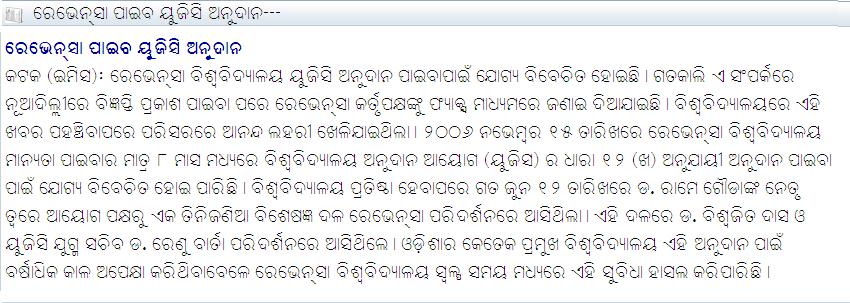
Ravenshaw becomes eligible to get UGC funding

Devdas babu has done it! While universities like Fakir Mohan University, North Orissa University, BPUT and Utkal University of Culture are yet to get "funded by UGC" tag, Ravenshaw which was made a university on November 15 2006 has received UGC approval to get into the "funded by UGC tag." Mega kudos to Devdas Chhotray, the VC of Ravenshaw University, who made this possible within so short a time. Following is Sambada’s report on this.

The document has many details on what kind of funding UGC provides to state universities.

ravenshaw.JPG

1 comment July 28th, 2007

Classrooms are humming again: Sarva Sikhya Abhiyan in Orissa still not showing progress

Financial Express probes the efficacy of big spending of UPA in last three years in primary education in the hinterland of the country. 

It says the Orissa state government has created an online database of all the 98 lakh children between the 1-14 years age group.

It continues on saying that the Orissa state government wants to use Sarva Sikhya Abhiyan to enroll all children between 6-14 years of age in schools but this attempt, many say, has failed. But nothing is hunky dory. To make matters worse, students enroll and drop out after obtaining scholarships, a problem which is acute in districts like Kalahandi. Moreover, attendance is as low as 30 to 50% in most schools and the school dropout rate is as high as 50%, according to various estimates.

The government must choose alternative way like establishing primary school in every village which has more than 250 populations in hinterland such as KBK (where many villages are located in deep forest). 

May 30th, 2007

Education in the 11th Plan (2007-2012)

The planning commission’s web pages on Education related working groups and steering committees are given at http://planningcommission.nic.in/plans/planrel/11thf.htm and we copy and paste them below.

Some of the links that are of immediate interest to me are: (a) the constitution of the technical education working group (their report is not out yet) (b) the constitution and report of the higher education working group and (c) the constitution and report of the science and technology working group. I will post excerpts from them in the coming days.

Continue Reading 1 comment April 2nd, 2007

TIFR e-booklet on various scientific research institutes in India

TIFR has a nice e-booklet on various scientific research institutes in India.

March 31st, 2007

Vedanta University is courting some top-notch people

I am told that Vedanta University is after some top-notch people. Until their names are formally announced we can not name them here. All we can say at this point is that the people whose names are doing the round have top-notch credentials and one of them is known Inida wide.

February 18th, 2007

Six new National Schools of Drama are in the offing: Orissa should ask for one

Pioneer reports that six new National Schools of Drama-NSD (or similar institutes) will be established in the coming years. Orissa should make efforts to have one of these new NSDs in Orissa. Currently the only NSD is in New Delhi.

February 18th, 2007

Dharitri and Odisha.com have hard hitting articles on the Center’s indifference to Orissa

Dharitri (pdf: page1, page2, page3) covers the main story on “Center Does not Need Orissa” where it exposes how Orissa is being sidelined with respect to the national institutes being proposed in 11th five year plan. Odisha.com reports on Government of India’s betrayal towards Orissa and its people while establishing new IIT across India.  (Based on Dr. Digambara Patra’s sentences.)

1 comment February 6th, 2007

Next Posts Previous Posts


Calendar

March 2026
M T W T F S S
 1
2345678
9101112131415
16171819202122
23242526272829
3031  

Posts by Month

Links

Posts by Category