Archive for 2011
Following is from http://www.e-architect.co.uk/india/imi_campus_bhubaneswar.htm.
Architects : ADS Designs Pvt. Ltd.
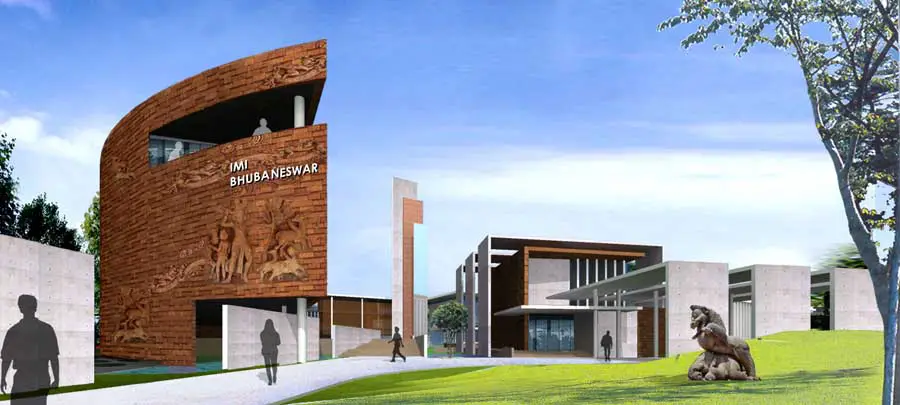
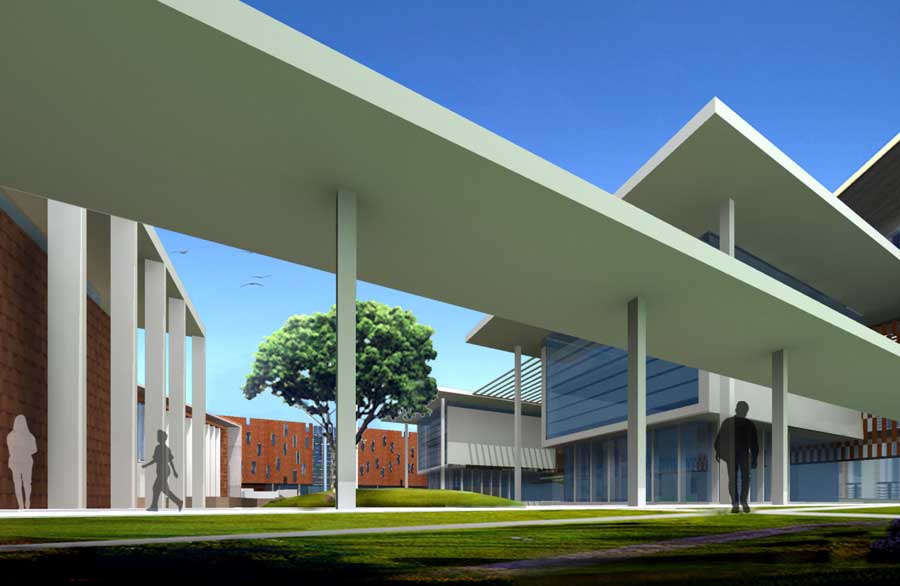
When asked to design the IMI campus at Bhubaneswar, Orissa, we decided at first to learn the ‘City of Temples’, to let it speak to us. And….. it spoke like never before!
The temples with their rich architecture, atypical to any other in India, and sanctity had us overwhelmed.
The primitive rock cut cave architecture took us back in time.
The sculptural motifs left us breathless with their majesty, beauty and attention to detail.
The gardens, statues and fountains beckoned to us invitingly.
We took solace from the heat under extended roofs and traditional courtyards.
We found an architecture which had risen from the native soil – sacred and pure.
We found one of those rare places where tradition matches its steps with modernity, where culture and technology flourish together, where the glorious past is preserved and an illustrious future is in the making.
We finally understood what the city was trying to tell us.
The challenge lay in fusing the rich heritage and traditional elements in a modern setting.
For the purpose
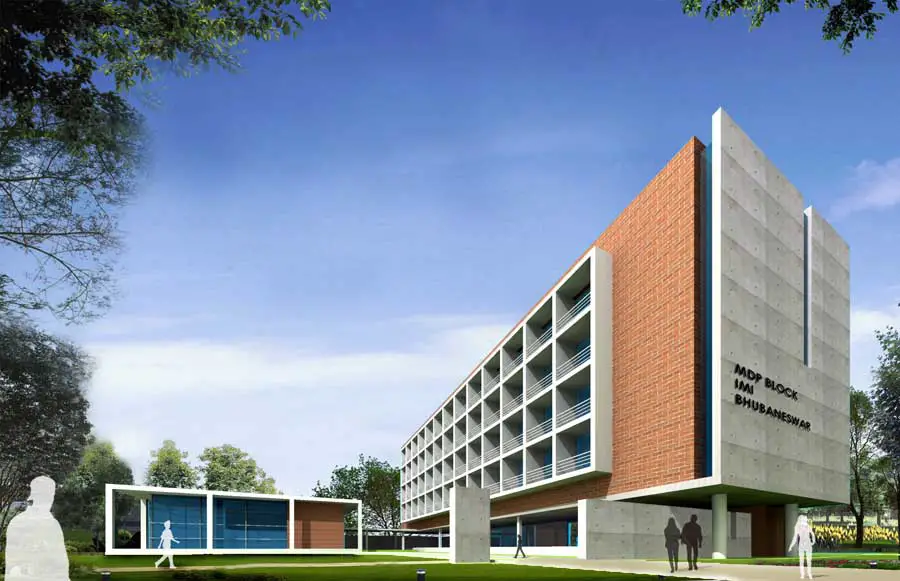
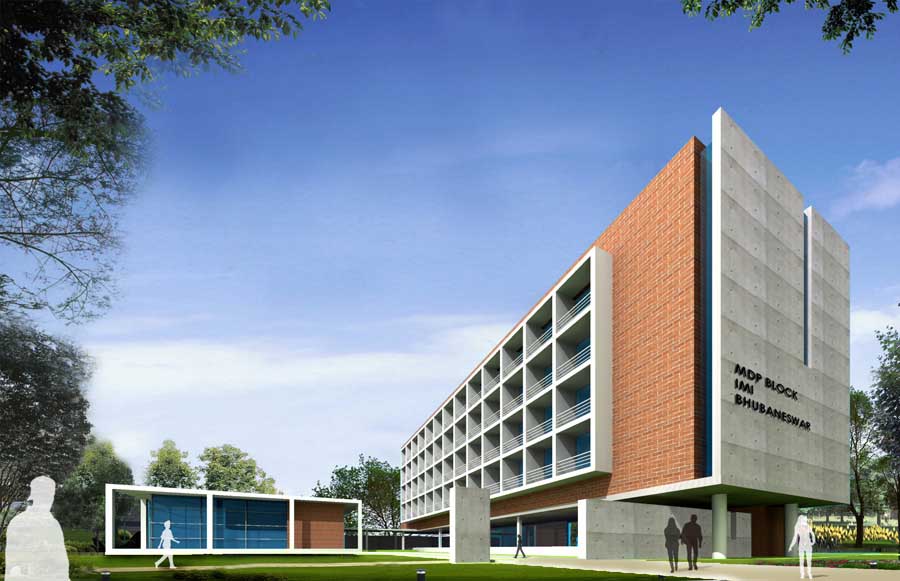
The site is located in an extreme tropical climate on the outskirts of Bhubaneswar, about 14 kms from the city centre. The campus is to be built in three phases. The planning is done such that phase II & III construction, will not interfere with the daily happenings of the institute or residential facilities.
The site was broadly zoned according to site constraints and function, allowing for easy vehicular movement and short distance pedestrian movement. The academic block is placed between the student hostels and faculty residences acting as a buffer between them as well as making it easily accessible to both areas.
Keeping in mind the extreme summer conditions, the structures have been designed and oriented on site to minimize heat gain and reduce the use of electromechanical energy.
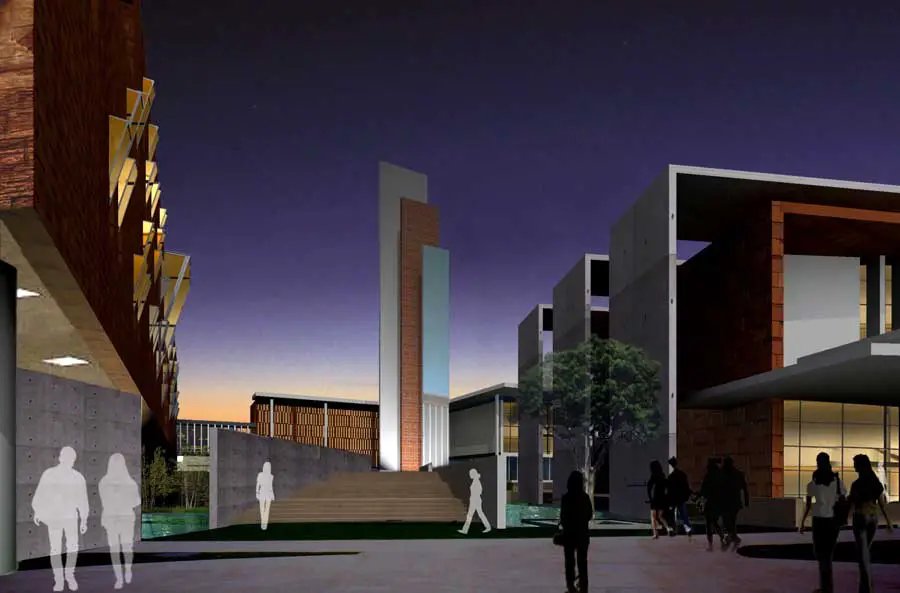
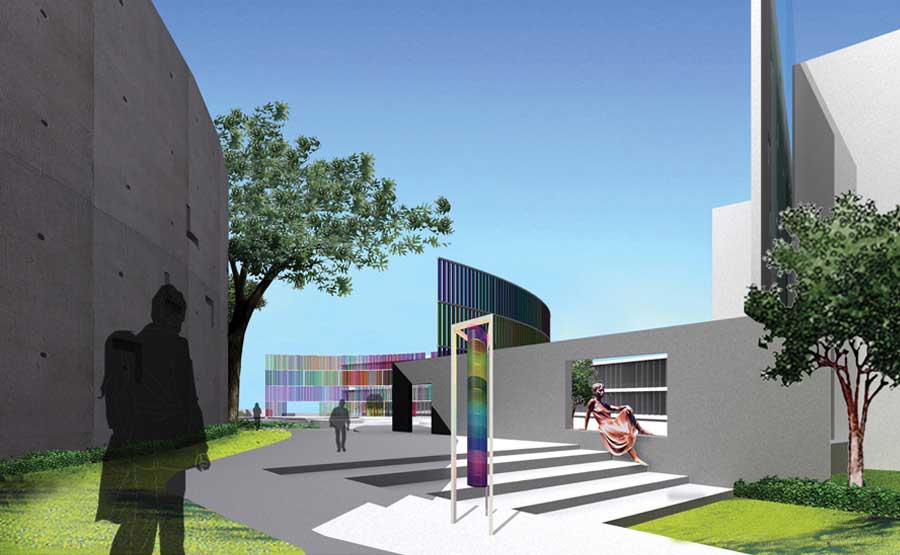
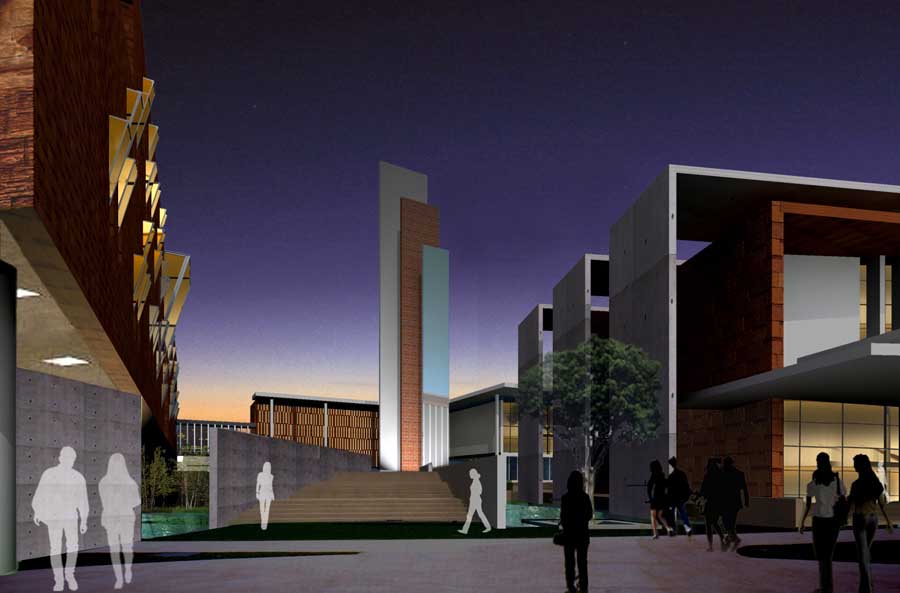
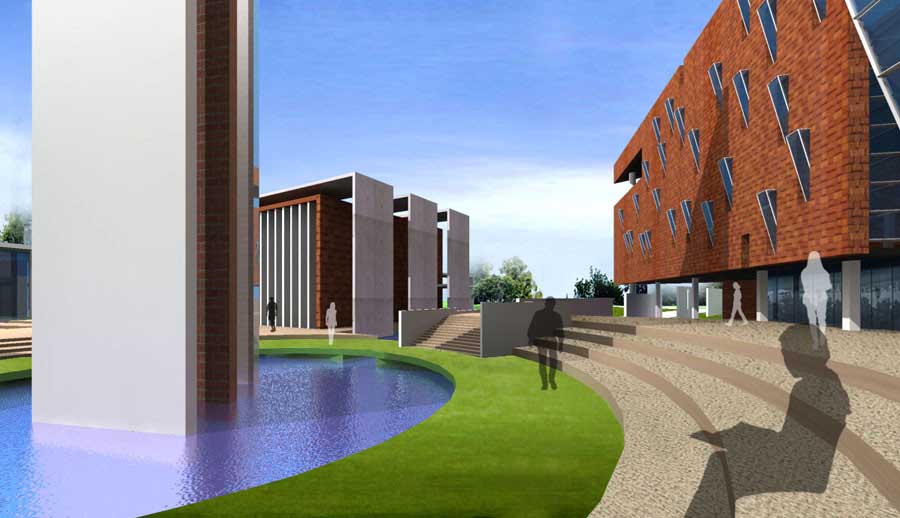
Interactive zones where students can spill out, unwind, celebrate or just be inspired are a very essential part of campus design. The main interactive zone has been designed as a central plaza of the academic block. A shaded walkway connects the plaza to the hostels, creating a strong visual link between the two. Other smaller zones have been designed at nodal points.

For the city
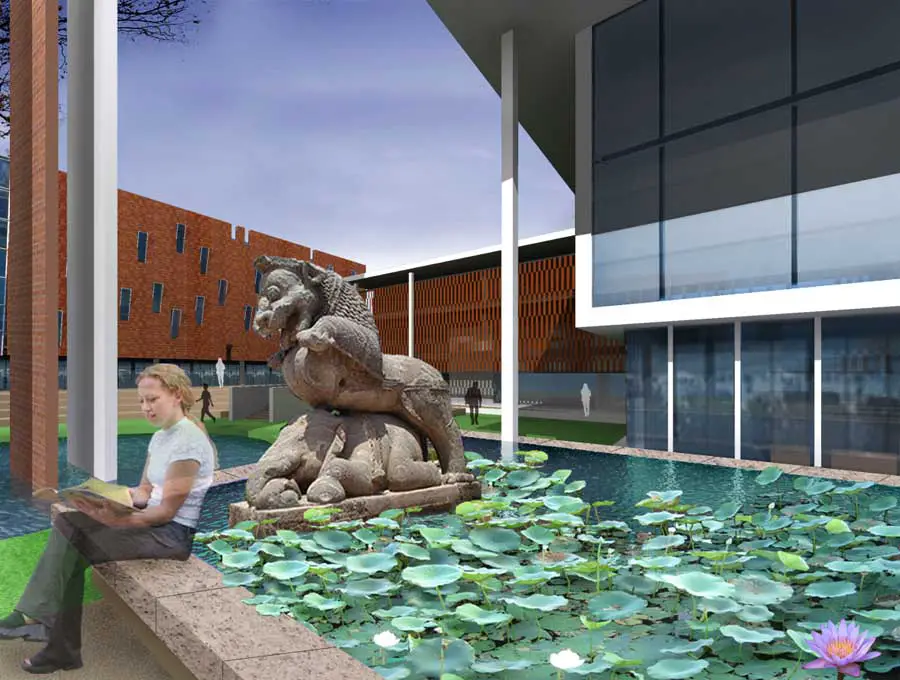
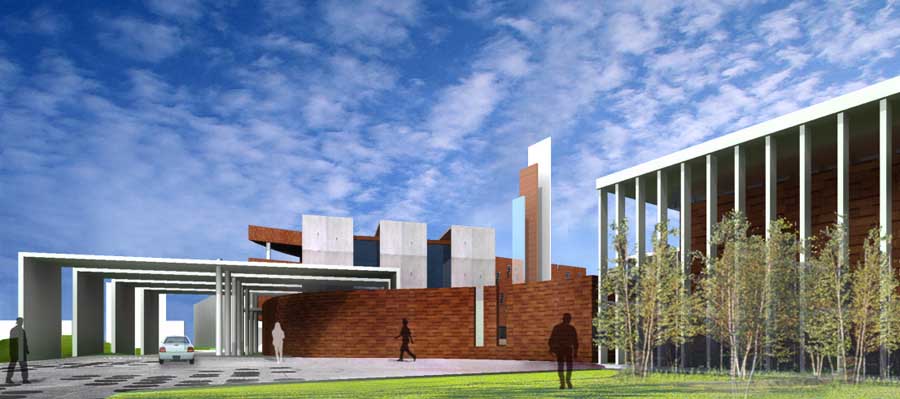
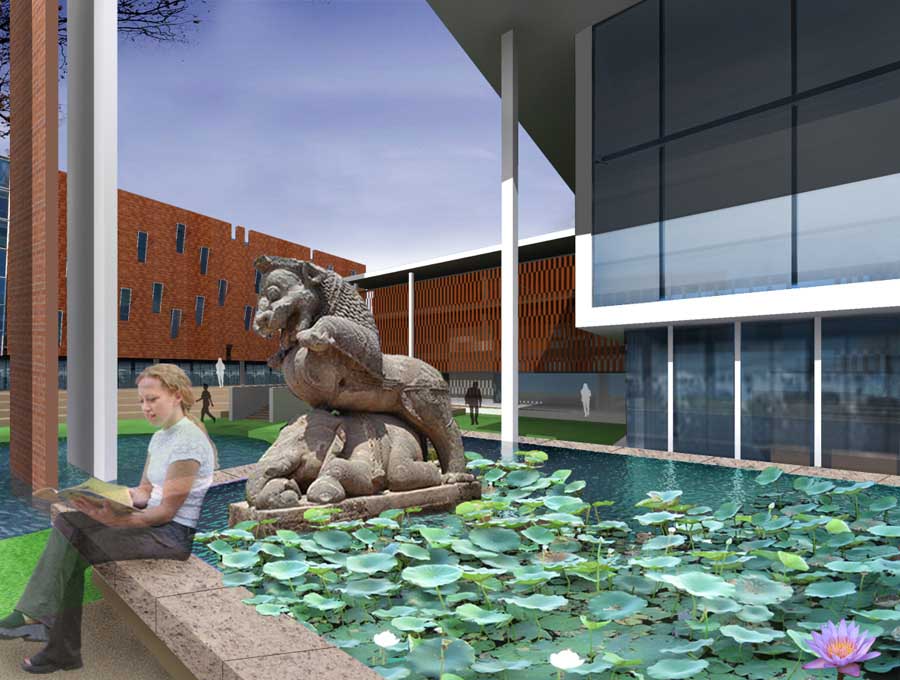
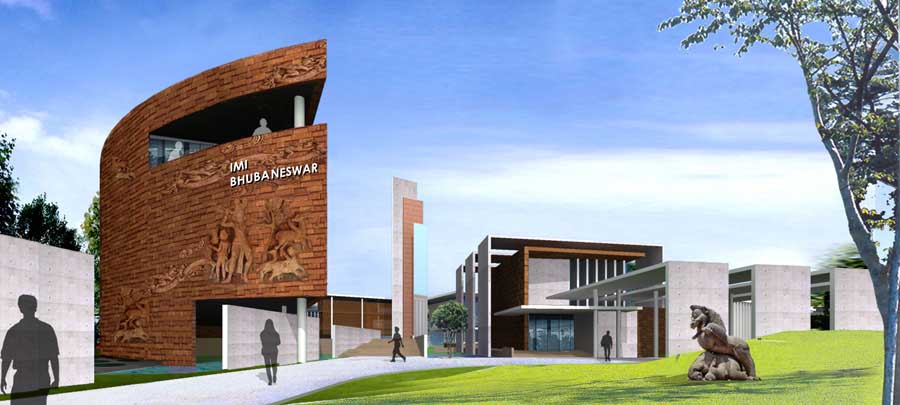
Although the design of the institute is very modern a conscious effort has been made to fuse into the concept some of the local influences. The curved façade of the library building in the academic block will have sculptures, replicated from Khandagiri caves, in stone embedded into the façade. As one views the academic block, one sees a modern design reinforced with the traditional. The beauty of the sculptures will leave the viewer speechless as one is reminded of the rich culture and history of the state.
The traditional courtyard here is in the form of a central stepped plaza, designed using solid laterite blocks, locally available in Orissa, which leads to a water body. Keeping the climatic factors in mind, the central water court acts as a natural exhaust cooling the air passing over it making the middle court a solace in the hot summer.
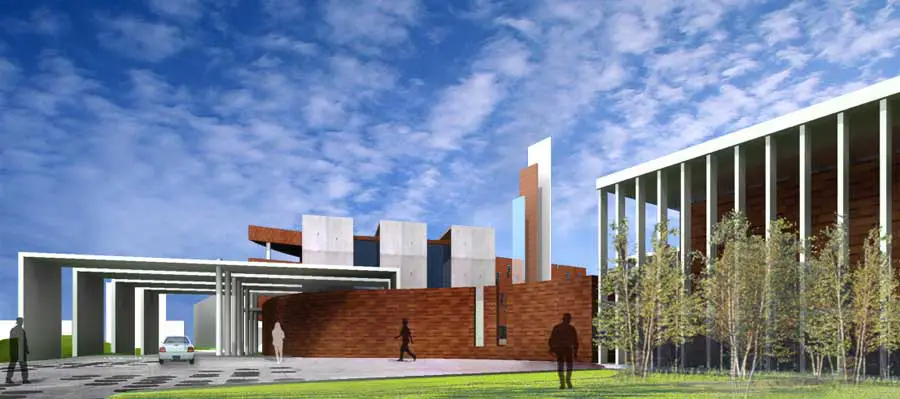
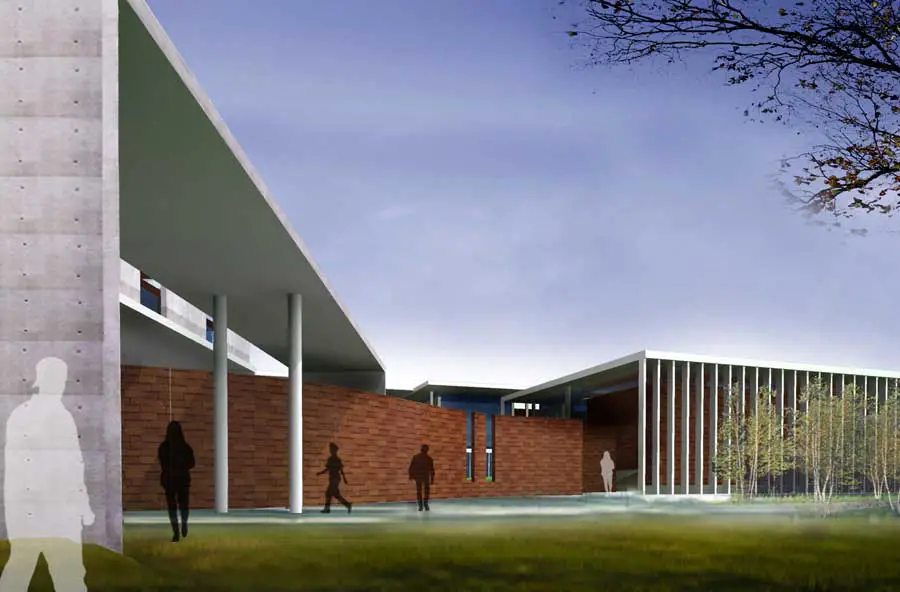
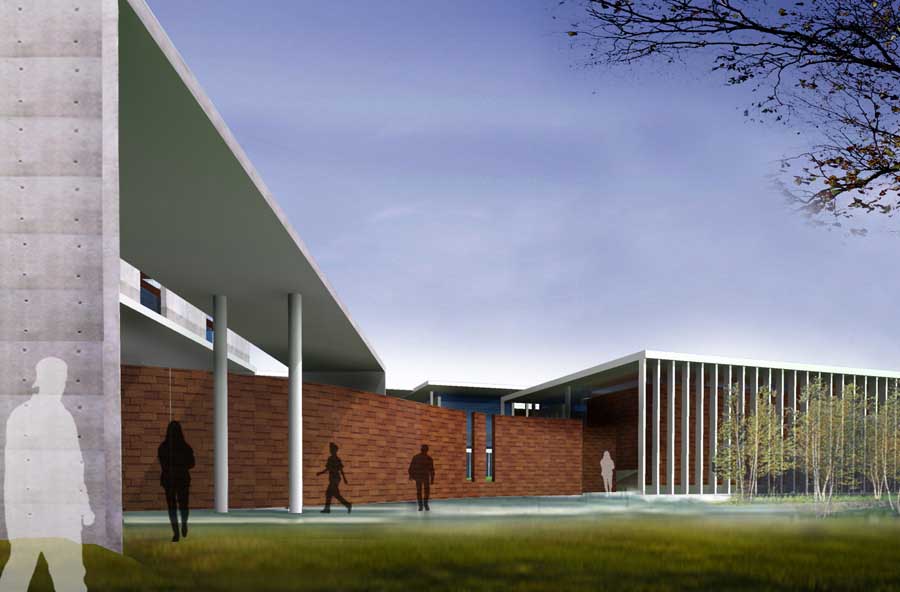
Large overhanging roofs, pergolas, colonnades are some of the traditional elements which have been used in the design.
A combination of brick cladding and painted surfaces have been used throughout the campus, giving it a very earthy and sobering feel especially in the summer.
A strong vertical axis is created in the form of a tower as a feature element, with a visibility from 3kms away, making the campus a landmark in the surrounding areas.
This design is a confluence of the traditional with the modern, where we allow the past to catch up with us, remind us where we come from, while taking a leap into the future.
As famous architect Frank O. Gehry said ‘Architecture should speak for its time and place, but yearn for timelessness’, we attempt to do just that.
IMI Campus Bhubaneswar images / information from ADS Designs Pvt. Ltd.
March 15th, 2011
Following is from http://www.e-architect.co.uk/india/nift_campus_bhubaneswar.htm.
‘Fashion is architecture: it is a matter of proportions’ said Coco Chanel, and rightly so. So why not let each be the inspiration for the other!
Orissa, a state widely known for its opulent cultural heritage and rich architecture has a history atypical from that of the northern plains. Unlike other parts of India, tribal customs and traditions have played a significant role in shaping the heritage of the state.
The unique and beautiful appliqué artwork of Pipili; silver filigree ornamental works and patta chitras; and tie and dye and Sambalpuri textiles in all its artistic grandeur awakens the imagination of creative minds.
An institute designed for budding designers and then the maestro, are the inner soul of the complex in very much the same way as the rich culture of Orissa is its inner soul.
The inner soul needs a shell. Shell and soul are interdependent and independent, belonging to each other and to themselves.
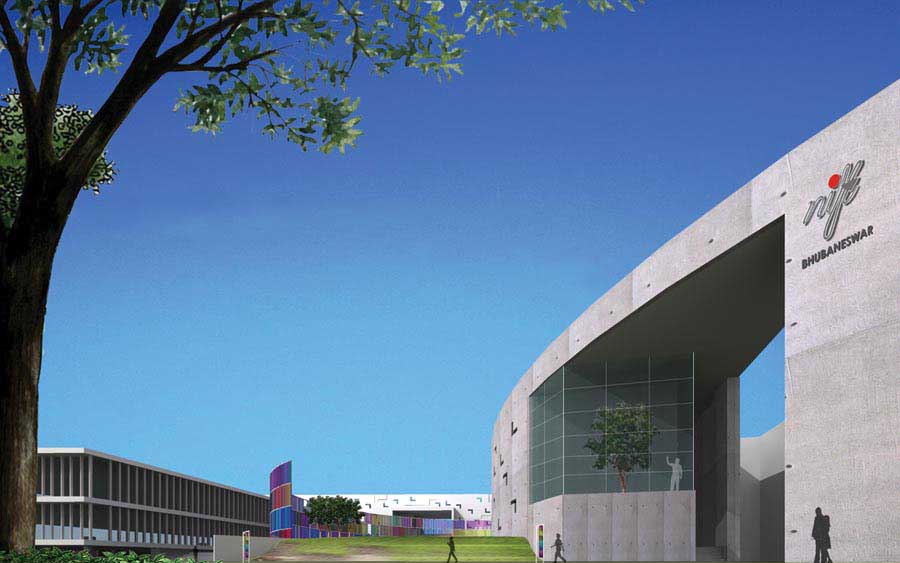
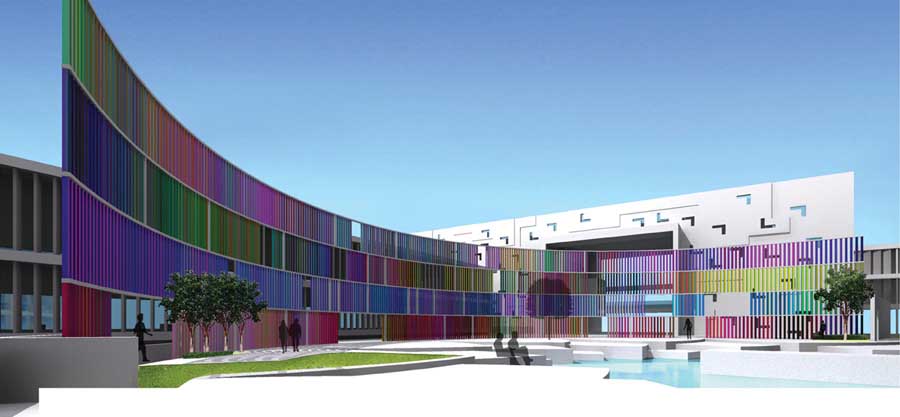
Here, the built form developed from climatic factors and conceptualized by elements of the crafts and nature, forms a shell for its soul providing them with spaces to imagine and innovate or simply to inspire.
REALITY
The site is located an uncongested area of Bhubaneswar. The architecture of Bhubaneswar is one of indoor and outdoor spaces merging into each other, the use of which is influenced by climate and season. It is an architecture which has risen from native soil-sacred and pure.
A simple yet modern architecture vocabulary has been adopted. The traditional courtyard here is in the form of a central stepped plaza, interspersed with trees and green patches, which leads to a water body. Keeping all climatic factors in mind, the central lotus water court acts as a natural exhaust, cooling the air passing over it, making the middle court a solace in the hot summer.
Designers dare to dream, to imagine, innovate and create that which is used, seen and felt by all. Someone once said “its not what you look at that matters, its what you see” and feel.
Dieter Rams rightly said:
“Good design is innovative.
Good design makes a product useful.
Good design is aesthetic.
Good design makes a product understandable.
Good design is unobtrusive.
Good design is honest.
Good design is long-lasting.
Good design is thorough down to the last detail.
Good design is environmentally friendly.
Good design is as little design as possible.”
We dream big and beyond the realms of imagination to create the unique. When soul and shell unite the destiny is ‘creation’.
Let us all dare to dream…
National Institute of Fashion Technology Campus Bhubaneswar images / information from Abin Design Studio
March 15th, 2011
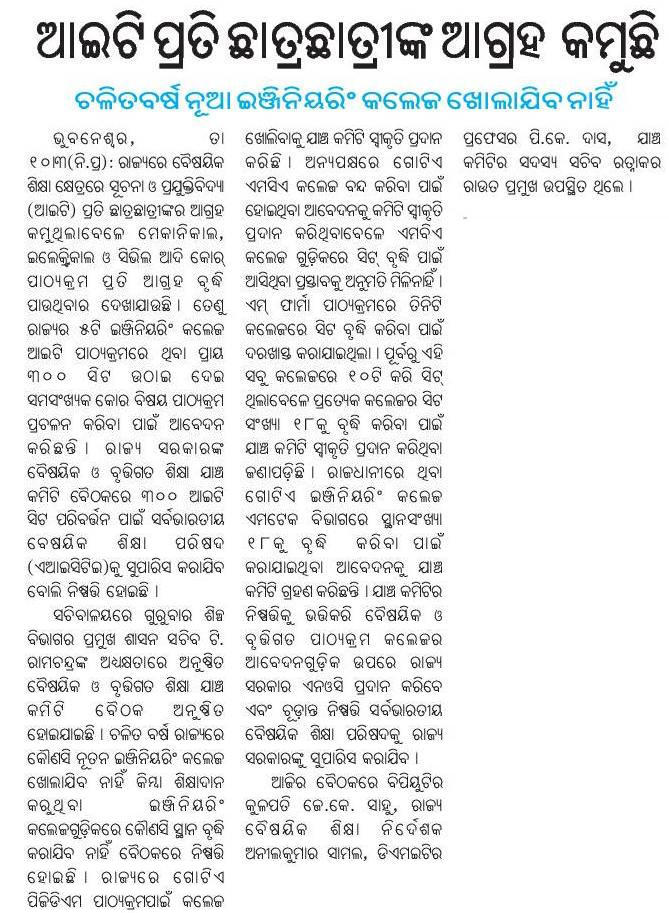
With large number of seats falling vacant in the last two years, this is a good decision. Although, they have decided not to approve any new engineering colleges this year, there may be a handful (5-6) that were approved by the Odisha government last year but did not get AICTE approval in time, which may be able to go forward this year. (I am not sure, if they will need a fresh No Objection certificate from the state.)
March 11th, 2011
The following is from a PIB dated 9th March 2011.
In order to bring more and more workers under coverage of ESI Scheme in the country, the ESI Corporation has taken the following steps;
The Corporation prepares a phased programme for implementing the scheme in new areas every year in consultation with the State Governments. The position of implementation/extension of ESI Scheme in new areas during the last 3 years is given below:-
|
Year
|
New areas where scheme implemented
|
No. of employees covered
|
|
2007-2008
|
37
|
97,739
|
|
2008-2009
|
46
|
70,427
|
|
2009-2010
|
53
|
1.23 lakh
|
|
2010-2011
|
68*
|
1.14 lakh *
(upto 03-03-2011)
|
The wage ceiling for coverage of employees under the Act has been enhanced from Rs.10,000/- p.m. to Rs.15,000/- p.m. w.e.f. 01-05-2010.
A uniform threshold of 10 or more persons for coverage of factories has been prescribed vide ESI (Amendment) Act, 2010.
State Governments have been requested to lower the threshold for coverage of shops and other establishments from 20 persons to 10 or more persons under the powers conferred upon them under Section.1(5) of the Act. Already the State Governments of Bihar, Punjab, Rajasthan and West Bengal have issued notifications in this regard.
The steps taken by the Corporation to make the scheme more favourable are as follows:
* Improving work environment and facilities for Insured Persons (IPs) visiting ESIC Offices.
* Payment of Long term benefits through Electronic Clearing Scheme (ECS).
* Rates of cash benefits have been enhanced and entitlements have been enlarged.
* Cashless provision of super specialty services through network hospitals.
* Modernisation and up gradation of medical infrastructure.
* Issue of smart cards called ‘Pehchan’ and networking of all ESI institutions for easy access.
To overcome the shortage of doctors in hospitals, filling up of vacant posts is being done on an ongoing basis. To overcome the shortage of doctors, including specialists in the long run and to improve the quality of medical care, the ESI Corporation has started various Medical Education Projects.
The ESI Corporation proposes to set up 18 Medical Colleges in the country in phases. The details are as under.
|
Sl.
No.
|
State
|
Location of Project
|
Project
|
|
| |
|
1
|
Andhra Pradesh
|
Hyderabad
|
Medical College
|
|
|
2
|
Bihar
|
Patna
|
Medical College
|
|
|
3
|
Gujarat
|
Naroda
|
Medical College
|
|
|
4
|
Haryana
|
Faridabad
|
Medical College
|
|
|
5
|
Himachal Pradesh
|
Mandi
|
Medical College
|
|
|
6
|
Karnataka
|
Gulbarga
|
Medical College
|
|
|
Bangalore
|
Medical College
|
|
|
7
|
Kerala
|
Kollam
|
Medical College
|
|
|
8
|
Maharashtra
|
Mulund
|
Medical college
|
|
|
9
|
Madhya Pradesh
|
Indore
|
Medical College
|
|
|
10
|
New Delhi
|
Basaidarapur
|
Medical College
|
|
|
11
|
Orissa
|
Bhubaneswar
|
Medical College
|
|
|
12
|
Rajasthan
|
Alwar
|
Medical College
|
|
|
13
|
Tamil Nadu
|
Chennai
|
Medical College
|
|
|
Coimbatore
|
Medical College
|
|
|
14
|
Uttarakhand
|
Haridwar
|
Medical College
|
|
|
15
|
West Bengal
|
Kolkata
|
Medical College
|
|
|
Baltikuri
|
Medical College
|
|
This information was given by Shri Mallikarjun Kharge, Minister for Labour and Employment in a written reply to a question in the Rajya Sabha today/
YSK: PM
March 9th, 2011
The following is from http://www.centraluniversityorissa.ac.in/Faculty_Details.asp?pgid=4 with the information in blue added via web searching.
| 1. Dr. Kanhu Charan Satapathy (Centre for Anthropological Studies) Ph.D in Anthropology, 2007, Utkal University. Previously faculty at SM Govt. Women’s College, Phulbani. Successfully completed the UGC Refresher Course training program in Anthropology at UGC Academic Staff College, Utkal University, Bhubaneswar, Orissa. Published a book on "Refugees’ Health" by Athena Books, 2010. Presented a research paper entitled ‘Tibetans in India and Their Coping Strategies from a Bio-Cultural Perspective" at the National Seminar on Bio-Cultural Anthropology: Prospects and Challenges, organized by Post-Graduate Department of Anthropology, Utkal University, Bhubaneswar in Collaboration with Anthropological Survey of India, Kolkata from 27-28 March, 2010. |
|

|
| 2. Dr. Meera Swain (Centre for Anthropological Studies) Previously faculty at NISWASS Bhubaneswar. Presented a research paper entitled "Social Responsibility, Awareness and Participation of Local Communities in Conserving the Coastal Environment: A Study in Orissa, East Coast of India" at the National Seminar on Bio-Cultural Anthropology: Prospects and Challenges, organized by Post-Graduate Department of Anthropology, Utkal University, Bhubaneswar in Collaboration with Anthropological Survey of India, Kolkata from 27-28 March, 2010. |
|

|
| 3. Dr. Debendra Biswal (Centre for Anthropological Studies) Ph.D in Anthropology, Delhi University. Thesis title: Ecology and Health : A Comparative Study of Kutia Kondhs and Gonds in Orrisa. Presented a research paper entitled “Ecosystem approach in health: Is it holistic or partial?” at the National Seminar on Bio-Cultural Anthropology: Prospects and Challenges, organized by Post-Graduate Department of Anthropology, Utkal University, Bhubaneswar in Collaboration with Anthropological Survey of India, Kolkatafrom 27-28 March, 2010. |
|

|
| 4. Dr. Kailash Bantha (Centre of Odia Language & Literature) Publication of D Litt.Thesis titled "Fakir Mohanka Katha Sahitya re Karma Fala". Edited "Ratnakar Chaininka Charoti Chhoto Natak and Amurta Manara Murta Bhaskar". Publication of Ph.D thesis titled "Oriya Upanyasre Shaitan Charitra". Felicitation by "Dakhin Orissa Sanskrutik Sansad, Malkangiri". |
|

|
| 5. Dr. Rudrani Mohanty (Centre of Odia Language & Literature) Words fail to express my heartfelt feelings when I boarded Hirakhand Express to join as a faculty in the noscent Central University at the bosom of nature in Koraput. Lush green hills, the beautiful bounties of nature, the offectionate studentant teacher relationship in campus added a lively chapter in my life under the caring and guiding umbrella of our dynamic University authority. It makes my life poetic as well as practical and engrossing. |
|

|
| 6. Dr. Ganesh Prased Sahu (Centre of Odia Language & Literature) The Central University of Orissa, Koraput has created educational revolution in Orissa. Basically the Tribal Students of southern Orissa will be involved in that progress. The University has focused on Humanities Study like School of Languages (Oriya & English) and School of Social Sciences (Anthropology & Sociology). The students are really lucky as the first batch of this University. They are keenly interested to attend class programmes at Koraput and try to prove their potentialities through examinations. Being a lecturer I always trying to inculcate inclinations of subjects with deep root of knowledge to my students. Every part towards development of this University is going on smoothly with a proper guidance and good ideology. I wish all betterment and a prosperous future to this new Central University. |
|

|
| 7. Dr. Kapila Khemundu (Centre for Sociology Studies), Ph.D in 2008-09 from JNU. Thesis: Indian Sociology and its Engagement with Values: A Comparative Study of Select Discourses. It is encouraging that the newly established Journalism and Mass Communication, Anthropology, Sociology, Oriya and English Departments in the Central University of Orissa, Koraput are shaping up under the dynamic leadership of University authority along with newly recruited young energetic faculty. Their commitment towards teaching and learning activities is positive indication to establish a vibrant academic tradition to achieve the aims and objectives of the higher education in the country. I firmly believe despite having its location in remote area this university will be recognized in near future as a centre for excellence in education. |
|

|
| 8. Aditya K. Mishra has joined as a Lecturer in the Centre for Sociological Studies on 8th February, 2010. He has done his M.A., M.Phil & Ph.D (TBA) from the prestigious University of Hyderabad. He has published various research papers and reviews in leading peer-reviewed journals. He has also presented several research papers in national and international conferences. His research interests include Sociology of Development, Sociology of Health, Environmental Sociology and Contemporary Socio Economic issues. He can be reached at adityamishra80@gmail.com
Presented a research paper (co-authored by Prof. E. Haribabu [University of Hyderabad]) entitled ‘Interrogating Participatory Biodiversity Conservation: Social Capital, CBCDCs and Conservation Outcomes’ at the National Seminar on Bio-Cultural Anthropology: Prospects and Challenges, organized by Post-Graduate Department of Anthropology, Utkal University, Bhubaneswar in Collaboration with Anthropological Survey of India, Kolkata from 27-28 March, 2010.
|
|

|
| 9. Sujit Kumar Mohanty has joined as a Lecturer in the Centre for Media Studies on 8th February, 2010. He has done his M.A. (Communication) from the prestigious University of Hyderabad. He is currently pursuing his M. Phil in the Centre for Regional Studies, University of Hyderabad. He was worked with a leading English newspaper of the Southern India – Deccan Chronicle and also undertaken a project with UNICEF. He was also associated with CNN – IBN (New Delhi) for a short while and then moved to TV9 – English as an assignment editor. His research interests include Media and Development, Film Studies & Religion and Politics in Media. He can be reached at sujitadm@gmail.com |
|

|
| 10. Talat Jahan Begum has joined as a Lecturer in the Centre for Media Studies on 8th February, 2010. She has done her M.A in Journalism and Mass Communication from Utkal University. With a teaching experience of 20 years, she has taught Journalism and Mass Communication at the prestigious BJB Autonomous College at Bhubaneswar. She was worked as Project Coordinator for UNICEF sponsored Project on "Children Reporting Children Issues". She has participated in International Visitor Leadership Program on "Community Approaches to Social Issues" in USA in 2008. She has also worked with ETV. She is actively involved with the NSS. Her research interests include Mass Communication Research, Community Media &TV Journalism. She can be reached at talattjb@yahoo.co.in |
|

|
| 11. Sony Parhi (Centre for Journalism and Mass Communication Studies) The Central University of Orissa, Koraput is the outcome of long cherished dreams. Hard work, initiative, collaboration and readiness to face challenges are hallmarks of Journalism and Mass Communication faculty and students. The remoteness of the place and challenges in communicating effectively with a varied audience give ample avenues to our entire team. Rich cultural heritage of this region and the task of disseminating the same through agencies of mass media for holistic progress is our goal. This University also teaches me to pursue knowledge and research while maintaining empathy and harmony towards my environment. |
|

|
| 12. Sanjeet Kumar Das (Centre of English) Having joined in the Department of English, Central University of Orissa, Koraput, I am overwhelmed to disseminate my experiences to young and energetic students in the field of language and literature. The leitmotif of our ‘School of Languages’ is to import education and research in new vistas such as Women writings in the Post modern era, Ecocriticism, literature on Diaspora writings etc. In the domain of linguistics, we focus our research on applied areas such as Computational linguistics, Evolutionary linguistics, Biolinguistics, Cognitive linguistics, Neuro-linguistics, Ethno linguistics, and Geolinguistics etc. Nevertheless, theoretical linguistics like Phonology and phonetics, morphology, syntax, semantics and pragmatics are also emphasized for the development of communicative competence among the students. I am pursuing my Ph. D in the Department of Humanities & Social Sciences, IIT Kanpur. |
|

|
| 13. Himani Mishra (Centre for Sociology Studies) The Central University of Orissa, Koraput is now in the stage of infancy and has a long way to go ahead. Still it is constructing the good architects for our future and one day it will definitely achieve this goal where it will be among the best Universities giving proper shapes to the students. Being a part of this newly built institute, I feel glad. |
|

|
March 8th, 2011
The following is compiled from http://www.iiit-bh.ac.in/faculty/faculty-list and http://www.iiit-bh.ac.in/downloads/AdmissionBrochure2011.pdf?attredirects=0&d=1.
Computer Science:
- Dr. Gopal Krishna Nayak, B. Tech (IIT Kharagpur), PGDM (IIM Bangalore), Ph.D. (IIT Kharagpur), Professor & Director
- Mr. Ajit Kumar Das, B. Tech (IIT Kharagpur), M. Tech (UU), Ph.D. Continuing (UU), Professor & Dean
- Dr. Rakesh Chandra Balabantaray, M. Tech (UU), Ph. D. (UU), Assistant Professor
- Dr. Anjali Mohapatra, M. Tech. (UU), Ph. D. (UU), Assistant Professor
- Ms Puspanjali Mohapatra, M. Tech.(UU), Lecturer
- Mr. Muktikanta Sahu, M. Tech. (BPUT), Lecturer
- Dr. Debasish Jena, BE, M.Tech.(UU),Ph.D.(NIT, Rourkela), Assistant Professor
- Mr. Alok Chakrabarty , Ph.D. thesis submitted (Assam Univerisity), Lecturer
- Dr. Hemanta Kumar Pati , Ph.D. (IIT Kharagpur), Assistant Professor
- Mr. Suvendu Rup ,B.E(UU) , M.Tech.(Jadavpur University), Ph.D. continuing (NIT Rourkela), Lecturer
- Dr. Sudarsan Padhy, Ph.D, Emeritus Professor (Retired from Utkal University)
- Dr. Shakti Ranjan Mohapatra, Ph.D, Visiting Faculty, from CITE Bhubaneswar
- Dr. Ajit Nayak, Ph.D, Visiting Faculty, from ITER, SOA University Bhubaneswar
Electrical Engineering:
- Ms. Usharani Rout, M. Tech.(BIT, Mesra), Lecturer
- Mr. Tapas Kumar Panigrahi , M. Tech.(Bengal Engineering College), Senior Lecturer
- Ms. Umamani Subudhi , M.Tech.(UCE, Burla), Lecturer
Electronics:
- Mr. Harish Kumar Sahoo ,M.Tech.(NIT,Rourkela),Ph.D. continuing (Sambalpur University), Senior Lecturer
- Mr. Ratnakar Dash , M. Tech.(UCE, Burla), Ph.D.continuing (NIT, Rourkela), Lecturer
- Mr. Tapas Patra, Visiting Faculty, From CET Bhubaneswar
Mechanical Engineering:
- Mr. Bamadev Sahoo, M. Tech. (IIT Kharagpur), Senior Lecturer
- Mr. Biranchi Narayan Padhi , M. Tech.(UCE, Burla), Ph.D. continuing (NIT Rourkela), Senior Lecturer
- Dr. L. N. Panda, Ph.D, Visiting Faculty, From CET Bhubaneswar
- Dr. P. K. Satapathy, Ph.D, Visiting Faculty, From CET Bhubaneswar
Physics:
- Dr. Monalisa Ray, M.Phil., Ph.D.(UU), Senior Lecturer
- Dr. Biswajit Pradhan, Ph.D.(IIT Bombay), Lecturer
- Mr. R. K. Parida, Visiting Faculty, From ITER, SOA University
Chemistry:
- Dr. Satyanarayan Pal, Ph.D.(CU, Hyderabad), Senior Lecturer
- Dr. Hiranmayee Satapathy, Ph.D.(IIT Kharagpur), Lecturer
Mathematics:
- Dr. Rupaj Kumar Nayak, Ph.D.(UU), Assistant Professor
- Dr. Manas Ranjan Tripathy , Ph.D .(IIT Kharagpur), Lecturer
Humanities:
- Ms. Lipika Das, Lecturer, M. A., M.Phil., Ph.D.continuing (UU) – Communicative English, Lecturer
- Dr. Tanutrushna Panigrahi, Ph. D. (Berhampur University) – Communicative English, Senior Lecturer
March 5th, 2011
(Thanks to Kalahandia for the pointer.)
Following is from http://expressbuzz.com/states/orissa/medical-college-to-see-light-of-the-day/253254.html.
The last one year has rekindled hopes for Kalahandi waiting since long for a medical college as promised by the State Government. Sardar Raja Medical College at Jaring is expected to start functioning from 2012 academic year, the chief executive officer of the college Tarun Mishra announced at a press meet here.
The project got clearance from the State Government in 2004 after an MoU was signed with a private educational institute Salvam Educational and Charitable Trust, Tamil Nadu. The Revenue Department provided 25 acres at Jaring and Western Orissa Development Council released Rs10 crore for infrastructure development. Work soon picked up on the 300-bed hospital, college and hostel buildings.
However, the project suffered a setback with the chairman of the trust entangled in a legal battle in Tamil Nadu. The long court battle had raised doubts about the future of the project. Last year, the college also failed to get a nod from the Medical Council of India mostly due to lack of adequate number of doctors, staff and some basic infrastructure. This had led to resentment among the locals.
With the charges against the chairman of the trust dropped, the project witnessed some positive development this year.
Mishra said that the infrastructure as pointed out by MCI has been put in place. The Health and Family Welfare Department has already issued essentiality certificate and Sambalpur University given consent for affiliation. MCI permission has already been sought and the team is expected to be here soon. Pending works have been taken up on a war-footing to meet the MCI stipulations, he added.
The chairman of the Salvam Educational and Charitable Trust SA Raja, in a press release, said that the commitment for establishment of a medical college and super speciality hospital will be fulfilled and he thanked people for their cooperation for success of the project despite undue delay.
It would be interesting to see whether this one becomes operational first or the AIIMS-like institute in Bhubaneswar gets operational first. Looks like both are scheduled to take in students in 2012. The foundation stone of the AIIMS-like institution was laid in 2003, a year earlier than the medical college in Kalahandi.
March 4th, 2011
Following is from http://www.pib.nic.in/newsite/erelease.aspx?relid=70461.
The scheme of ‘Centres of Excellence in Polymer Technology’ aims at setting up of Centers of Excellence (COE) in existing educational and research institutions working in the field of polymers. It is expected that each Centre of Excellence (COE) will emerge as an internationally recognized Centre for the analysis and dissemination of existing global knowledge in the chosen fields. Detailed proposals received from the Institutions have been evaluated by an expert Panel for finalizing the names of institutions as Centres of Excellence during the 11th Plan period. Two fully functional Centres of Excellences (COEs) are to be established over a period of three years.
The campaign against plastic is restricted to plastic carry bags and their indiscriminate littering. The aim of setting up Centres of Excellence, inter alia, includes developing bio-polymers and bio-degradable polymers and innovative recycling process technology which may ultimately result in developing strategies to address such issues.
This information was given by the Minister of State for Chemicals and Fertilizers Shri Srikant Kumar Jena in a written reply in the Lok Sabha today.
DNM/PKM/SB
Perhaps one of these centers of excellence will be in Odisha as the CIPET campuses in Odisha have good research programs in polymer technology and it has the LARPM (Laboratory for advanced research in polymeric materials).
March 4th, 2011
Following is compiled from a report in India Today, a report in Telegraph and a report in Hindu.
- Rs 200 crore one-time grant to IIT-Kharagpur (West Bengal)
- Rs 50 crore for Aligarh Muslim University centre at Murshidabad (West Bengal)
- Rs 20 crore for IIM-Calcutta to set up its Financial Research and Trading Laboratory (West Bengal)
- Rs 10 crore for the Kolkata centre of the Mahatma Gandhi Antarrashtriya Hindi Vishwavidyalaya (West Bengal)
- Rs 10 crore for the Allahabad centre of the Mahatma Gandhi Antarrashtriya Hindi Vishwavidyalaya (UP)
- Rs 100 crore one-time grant to Kerala Veterinary and Animal Sciences University at Pookode (Kerala)
- Rs 50 crore for Aligarh Muslim University centre at Malappuram (Kerala)
- Rs.15 crore has been allocated for the Lakshmibai National College of Physical Education (LNCPE) at Karyavattom. (Kerala)
- Rs 20 crore for Rajiv Gandhi National Institute of Youth Development (Tamil Nadu)
- Rs 10 crore for Madras School of Economics (Tamil Nadu)
- Rs 10 crore for Delhi School of Economics (Delhi)
March 2nd, 2011
The 2011-12 budget is available at http://indiabudget.nic.in/ebmain.asp. The HRD budget page is http://indiabudget.nic.in/ub2011-12/eb/sbe59.pdf. Following is from those pages.
MHRD: Higher Education:
- Total budget for Higher Education: 21912 crores. (2010-11: 18206 crores)
- UGC: Total budget is 8675.66 crores. (2010-11: 7530.19 crores) [Includes the budget of the old and new central universities.]**CUO Koraput**
- Educational Loan interest subsidy: 640 crores (2010-11: 500 crores; this program was introduced in 2010-11.)
- 7 old IITs: 2081.68 crores (2010-11: 1771.71 crores)
- Setting up of 8 new IITs: 500 crores (2010-11: 250 crores)**IIT Bhubaneswar**
- IISc Bangalore: 290.41 crores (2010-11: 267.65 crores)
- ISMU Dhanbad: 138.68 crores (2010-11: 122.47 crores)
- 5 IISERs: 580 crores (2010-11: 450 crores)
- 20 NITs: 1378.58 crores (2010-11: 1292.51 crores)**NIT Rourkela**
- Setting up of new NITs: 40 crores (2010-11: 16.81 crores)
- IIEST: 25 crores
- 7 old IIMs (Ahmedabad, Bangalore, Kolkata, Lucknow, Kozhikode, Indore, Shillong): 148.93 crores (2010-11: 108.8 crores)
- Setting up of new IIMs: 60 crores (2010-11: 13 crores)
- IIITs: Gwalior – 39.38 crores; Allahabad – 52.35 crores; Jabalpur – 40 crores; Kanchipuram – 70 crores.
- New IIITs: 29 crores **IIIT Berhampur ??**
- SLIET: 39.03 crores (2010-11: 27 crores)
- NERIST: 39.66 crores (2010-11: 36.34 crores)
Ministry of Health and Family Welfare:
- Total: 26897 crores (2010-11: 23300 crores)
- Safdarjang Hospital, New Delhi: 345 crores (2010-11: 330.69 crores)
- Dr. Ram Manohar Lohia Hospital, New Delhi: 283 crores (2010-11: 257.54 crores)
- Central Institute of Psychiatry, Ranchi: 67 crores (2010-11: 52.03 crores)
- All India Institute of Physical Medicine and Rehabilitation, Mumbai: 14.5 crores (2010-11: 11.6 crores)
- Kalawati Saran Children’s Hospital, New Delhi: 56.22 crores (2010-11: 53.91 crores)
- Vallabh Bhai Patel Chest Institute, Delhi University: 33.4 crores (2010-11: 30.72 crores)
- Lady Hardinge Medical College & Smt. Sucheta Kripalani Hospital New Delhi: 194 crores (2010-11: 174.72 crores)
- NIMHANS Bangalore: 166.23 crores (2010-11: 140.46 crores)
- All India Institute of Speech & Hearing, Mysore: 41 crores (2010-11: 34.35 crores)
- PGIMER, Chandigarh: 470 crores (2010-11: 407 crores)
- JIPGMER, Puducherry: 250 crores (2010-11: 266 crores)
- AIIMS New Delhi: 1022.35 crores (2010-11: 985 crores)
- 6 New AIIIMS-like institutions and upgrading of state govt. hospitals: 1616.57 crores (2010-11: 747 crores)**AIIMS-like Bhubaneswar**
Department of Atomic Energy:
- Total: 7602.41 crores (2010-11: 6535.29 crores)
- BARC, Mumbai: 2554 crores (2010-11: 2338.20 crores)
- IGCAR, Kalpakkam: 711.70 crores (2010-11: 454 crores)
- RRCAT, Indore: 248.15 crores (2010-11: 226.25 crores)
- VECC, Kolkata: 155.69 crores (2010-11: 106.54 crores)
- TIFR, Mumbai: 510.38 crores (2010-11: 417.30 crores)
- Tata Memorial Center, Mumbai: 289.78 crores (2010-11: 286.60 crores)
- Saha Institute, Kolkata: 117.05 crores (2010-11: 116.9 crores)
- Institute Of Physics (IOP), Bhubaneswar: 239.6 crores (2010-11: 76.86 crores)
- Harish-Chandra Institute, Allahabad: 25.8 crores (2010-11: 19.74 crores)
- Institute of Mathematical Sciences, Chennai: 28 crores (2010-11: 27.5 crores)
- Institute of Plasma Research, Gandhinagar: 564.48 crores (2010-11: 384.63 crores)
(IOP’s budget used to be around 20-25 crores, close to the budget of HCI Allahabad and IMS Chennai. The substantially higher amount is because it includes the budget of NISER, Bhubaneswar. I wonder why NISER does not have a line item budget.)
Ministry of Statistics and programme Implementation
- Indian Statistical Institute: 141 Crores (2010-11: 131.76 crores)
Ministry of Textiles
- National Institute of Fashion Technology: 167 crores (2010-11: 108 crores) [Several campuses, including one in Bhubaneswar]
Ministry of Environment and Forests
- Indian Institute of Forest Management: 12.5 crores (2010-11: 12.5 crores)
Department of Space
- Vikram Sarabhai Space Center: 686.03 crores (2010-11: 603.05 crores)
- ISRO-Inertial Systems Unit: 39.74 crores (2010-11: 29.63 crores)
- Liquid propulsions systems center: 314.33 crores (2010-11: 271.32 crores)
- Indian Institute of Space Science & Technology: 100 crores (2010-11: 100 crores)
- ISRO Satellite Center (ISAC): 320.69 crores (2010-11: 348.10 crores)
- Laboratory for Electro-Optics System: 42.85 crores (2010-11: 36.71 crores)
- Semi-Conductor Laboratory: 80 crores (2010-11: 58 crores)
- Satish Dhawan Space Center: 434.77 crores (2010-11: 364.41 crores)
- Space Application Center: 420.75 crores (2010-11: 300.86 crores)
- National Remote Sensing Center: 223.80 crores (2010-11: 222.2 crores)
- Physical Research Laboratory: 80.7 crores (2010-11: 47.13 crores)
- National Atmospheric Research Laboratory: 19.34 crores (2010-11: 9.1 crores
Ministry of Petroleum and Natural Gas
- Rajiv Gandhi Institute of Petroleum Technology: 39 crores (2010-11: 36 crores)
Ministry of Chemical and Fertlizers
- NIPER (old and several new ones): 132.31 crores (2010-11: 71.22 crores)
- CIPET: 44.32 crores (2010-11: 74.55 crores) [*Several campuses including one in Bhubaneswar*]
- Institute of Pesticides Formulation Technology: 4 crores (2010-11: 3.19 crores)
Ministry of Agriculture
- National Institute of Biotic Stress Management: 20 crores (new)
- Indian Institute of Agricultural Biotechnology: 30 crores (new)
- Central Agricultural University, Bundelkhand: 30 crores (new)
Ministry of Youth Affairs and Sports
- Rajiv Gandhi National Institute of Youth Development: 10.8 crores (2010-11: 9.9 crores)
- Laxmi Bai National Institute of Physical Education: 24.63 crores (2010-11: 36.63 crores)
- Laxmi Bai National Institute of Physical Education – NE area and Sikkim Initiative: 15 crores (2010-11: 3 crores)
Ministry of Science & Technology
- 23 autonomous S & T institutions and professional bodies: 713 crores (2010-11: 589 crores)
- 14 autonomous Biotechnology R & D institutions: 378.35 crores (2010-11: 330.1 crores) **Institute of Life Sciences, Bhubaneswar**
- 37 CSIR National Laboratories and 38 field centers: 2312.68 crores (2010-11: 2083.84 crores)
- Institute of Translational Research (Innovation Complexes): 10 crores (new) [To be created at strategic locations.]
Ministry of Culture
- National School of Drama: 21.2 crores (2010-11: 21.95 crores)
Ministry of Shipping
- Indian Maritime University: 41 crores (2010-11: 26 crores)
Ministry of Tourism
- Training (22 institutes of Hotel Management; 5 Food Craft Institutes; IITTM; National Institute of Water Sports): 123 crores (2010-11: 109.22 crores)
Department of Information Technology
- National Informatic Centers: 679 crores (2010-11: 628 crores)
- C-DAC: 185.4 crores (2010-11: 163 crores)
Ministry of Corporate Affairs
- Indian Institute of Corporate Affairs: 28 crores (2010-11: 87.36 crores)
Ministry of Commerce
- National Institute of Design: 9.5 crores (2010-11: 11.49 crores)
- National Institute of Intellectual Property Management: 8.4 crores (2010-11: 10.3 crores)
- Central Manufacturing Technology Institutes: 5.5 crores (2010-11: 4.24 crores)
I have not been able to figure out which ministry funds the Indian Institute of Foreign Trade. Also, if I am missing some institutes which I should include, please let me know.
March 1st, 2011
The web page of the university is http://www.southasianuniversity.org/. Following is an excerpt from a report in Times of India that talks about faculty salary at this university.
Faculty positions in SAU are the highest paid (tax-free) academic jobs in the government sector in South Asia. The to-be-appointed president of the university would get $80,000 salary per year, while a professor gets between $30,000 and $45,000 a year.
Their application period for faculty positions just ended in Feb 21, 2011. However, this ad gives an idea of the salary ranges. We give some excerpts.
For the second academic session commencing in July 2011, the University has the following openings for faculty positions at the level of Professor, Associate Professor and Assistant Professor:
- Faculty of Economics (5 positions)
- Faculty of Mathematics and Computer Science (5 positions)
- Faculty of Life Sciences and Biotechnology (6 positions)
- Faculty of Legal Studies (6 positions)
- Department of Sociology, Faculty of Social Sciences (6 positions)
- Department of International Relations, Faculty of Social Sciences (6 positions)
Salary, Benefits and Incentives:
- Professor: – US$ 30,000 to 45,000 PA
- Associate Professor: – US$ 20,000 to 35,000 PA
- Assistant Professor: – US$ 15,000 to 25,000 PA
In terms of Indian Rupees, at today’s rate of $1 = 45.47 rupees, the amounts are:
- Professor: 13.64 lakhs p.a. to 20.46 lakhs p.a.
- Associate Professor: 9.09 lakhs p.a. to 15.91 laks p.a.
- Assistant Professor: 6.82 lakhs p.a. to 11.37 lakhs p.a.
February 25th, 2011
We earlier wrote about this proposal in https://www.orissalinks.com/archives/4781. There is a new article about it in tathya.in. Nothing much new in this article except it gives the name of the institute. Nevertheless, the new article suggests that that authorities are thinking about its implementation. Following is from this tathya article.
With 40 000 Mega Watt (MW) power production being lined up, the Government of Odisha is mulling to set up a Power Technology Management Institute in the state.
So the Government of Odisha has decided to set up the Odisha Power Technology and management Institute(OPTMI), which will be of international standard, said official sources.
More than 30 Independent Power Producers (IPP)s are setting up their plants in the state, major share of such capacity addition is expected within Twelfth Plan Period(2012-17), foresee officials in Department of Energy(DOE).
In fact increase in power generation capacities also requires commensurate development of transmission capabilities as well as enhanced techno-commercial and management skills as well as modern Grid management and Energy metering, said Pradip Kumar Jena, Secretary DOE.
Mr.Jena said that it would increasingly become necessary to adopt highly efficient technologies, commercial and management practices to handle such high volume of power generation, transmission and distribution.
Needless to say that this would also require a vast pool of human resources having skillsets and competency of a nature not widely available today, said an expert in Power Sector.
So the Power Administrators have felt the necessity to simultenously plan an accelerated growth of human resources having right competence .
Moreover, in order to utilize newly emerging frontier technology and management concepts it would be necessary to develop an advanced facility to undertake research in such high technology and management sectors with continuous focus on Power Sector of Odisha.
Keeping this in view OPTMI is being planned to be set up on the Public Private Partnership (PPP) mode, said an official.
This institute will be set up with active participation of the upcoming power projects in the state and the Public Sector Undertakings (PSU)s of the Power Sector, said the official.
February 23rd, 2011
Following are excerpts from an article in Frontline.
THE Siksha ‘O’ Anusandhan University in Bhubaneswar, a deemed university under Section 3 of the University Grants Commission Act, 1956, is fast developing as one of Orissa’s foremost educational hub. It started as a small venture in 1996 when the visionary educationist Dr Manojranjan Nayak set up the Institute of Technical Education and Research (ITER) with 118 students. Gradually, institutes offering courses such as management, medicine, dental sciences, nursing, pharmaceutical science, biotechnology, hotel management and law were set up.
With over 7,000 students, the ITER is today one of the highly-ranked engineering colleges in the eastern region. The university has been awarded ‘A’ grade by the National Assessment and Accreditation Council (NAAC) for five years from September 2009. All its institutes are housed on four campuses spread across 120-odd acres.
… The Institute of Medical Sciences has a 750-bed state-of-the-art hospital attached to it, which does not charge any consultation fee and has been endeavouring to provide quality health care facilities.
The latest addition to the university is the SOA National Institute of Law. The institute will start functioning from the academic year 2011-12 and offer a five-year integrated course in law in three different streams: BA LLB; BSc LLB; and BBA LLB. There will also be LLM and PhD programmes….
I am appreciative of SOA University’s contribution to education in Odisha, but the above article sounds too much like an ad and for that reason may not impress its readers.
February 22nd, 2011
See http://www.tathya.in/news/story.asp?sno=5021 for the details. I hope it is established in Berhampur. That would bring the first centrally funded institute to Berhampur. Following is from Samaja.
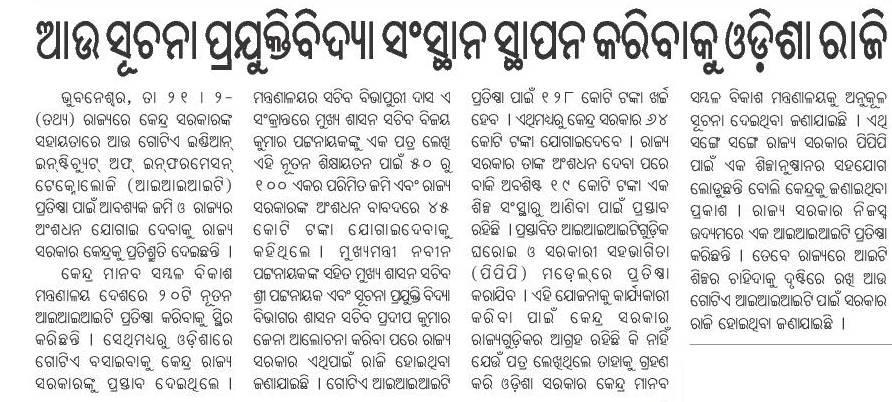
We take this opportunity to review the existing IIIT type institutes that are centrally funded. They are:
The "M" in IIITM Gwalior stands for "management", but the "M" in IIITDM Jabalpur and Kancheepuram stands for "manufacturing". The "D" stands for "design". I hope the above mentioned IIIT in Odisha has programs in management, design and manufacturing.
Besides the above there are several IIITs that are part state government funded. Those are: IIIT Hyderabad, IIIT Bangalore, IIIT Bhubaneswar and IIIT Delhi. There are several other IIITs that are privately funded.
February 22nd, 2011
Following up on our earlier article, Odisha must push for an ISMU branch. The logic behind Assam getting an RGIPT branch is that Assam has a lot of petroleum related oil wells and refineries. By the same logic, Odisha tops the states in India with respect to its mineral output. Following is from a report in Business Standard.
With minerals produced in the state in 2009-10 valued at Rs 15,317 crore, Orissa has 13.10 percent share of the total value of minerals produced by major states in the country, followed by Madhya Pradesh (7.70 percent), Andhra Pradesh (7.21 percent), Maharashtra (4.92 percent), Gujarat (4.65 percent), Karnataka (3.96 percent), Tamil Nadu (3.21 percent), Rajasthan (2.99 percent), Assam (2.96 percent), West Bengal (2.78 percent).
According to the Economic Survey report (2010-11), the value of minerals extracted in Orissa has gone up by more than four times from Rs 3694 crore to Rs 15,317 crore between 2002-03 and 2009-10 coinciding with the boom in the mineral market during this period.
Orissa boasts of 95 percent of country’s chromite deposit, 92 percent of nickel ore, 55 percent of bauxite and 33 percent of iron ore. Besides, the state has substantial quantity of other minerals and ores like coal, manganese, dolomite, graphite and limestone.
With the iron ore prices spiraling, this commodity naturally leads the pack of minerals in terms of production and value. The state produced 79.7 million tonnes of iron ore in 2009-10 valued at Rs 7976 crore. This is followed by coal (105.5 million tonnes valued at Rs 5548 crore and chromite (3.4 million tonne valued at Rs 1167 crore).
Similarly, iron ore constituted 95.4 percent of the total exports of minerals from the state. About 15 million tonnes of iron ore was exported in 2009-10 valued at Rs 4224 core compared to exports of 0.46 million tonnes of chrome ore valued at Rs 464 crore and 0.25 million tonnes of mineral sand valued at Rs 72.32 crore.
One of the disturbing factors highlighted by the report is that with mining and quarrying sector gradually shifting to labour saving and capital-intensive technology, the total employment in the sector has been decreasing over the years. As a result, the number of direct employment in the mineral sector in Orissa has come down from 55764 in 2005-06 to 43705 in 2009-10.
It may be noted, with mineral deposits mostly occurring in the tribal belt of the state, this sector employs substantial number of tribals.
When ISM was made in Dhanbad, that region was perhaps the leader in mineral output (mainly coal) in the country. Odisha with a variety of minerals needs an ISM branch and we must push for it hard.
Related to that recently the Chief Minister has been concerned about the coal block allocation in Odisha. Following is an excerpt from a report in Economic Times on that.
Orissa government has taken strong exception to the coal ministry’s unilateral decision to allot coal blocks without consulting the state.
Chief minister Naveen Patnaik has shot off a letter to Prime Minister Dr Manmohan Singh urging him to review the allocation of coal blocks in Orissa. The coal ministry has allotted 32 coal blocks with an estimated reserve of about 15,000 million tons to 56 private and government agencies.
Mr Patnaik made it clear that a comprehensive regional master plan should have been prepared prior to allotment of huge number of coal mines in inhabited and environmentally sensitive areas in the state. Focus has to be given for infrastructure development, logistic planning, land requirements, rehabilitation and resettlement, environment impact studies and mitigation measures, the letter said.
Expressing serious concerns over the adverse environmental impact in post operationalisation of such a large number of coal blocks, Mr Patnaik pointed out that coal mining would cause deforestation and air pollution. Sources close to CM’s officer said, the letter also had pointed out that it might not be possible for the state to accommodate new coal mines by jeopardizing its environmental stability. The coal ministry needs to be advised to take a pragmatic and planned approach, keeping the interests and concerns of all stake holders including the state government in mind, the letter said.
For making the 32 coal blocks functional, 325 sq km shall have to be acquired within few years and another equivalent amount of land would be needed for allied activities like coal handling plants, siding, workshop, and residential colonies for project affected people, compensatory afforestation and other infrastructural facilities including roads.
This would lead to massive displacement and consequent socio-economic and environmental crisis, the chief minister is understood to have stated in his missive to the PM. However, such large-scale land acquisition and displacement could be avoided if coal blocks are allotted and developed in a planned and phased manner, Naveen added.
Incidentally, Orissa is already on the throes of severe climate change due to setting up of huge number of coal fired power plants threatening the livelihood of farmers and fishermen who form 70 % of the state’s population shall be severely hit due to irregular monsoons and erratic rainfall patterns.
Most of the power produced shall be transmitted to other states while the people of the state shall be the unwilling victims of the effects on climate change and pollution caused by the huge quantities of green house gases (GHGs) and fly ash generated.
“Coal mining is done either underground or open cast. In Orissa mostly open cast mining is done. When coal surfaces are exposed, pyrite (iron sulfide), comes in contact with water and air forming sulfuric acid. As water drains from the mine, the acid moves into the waterways, and as long as rain falls on the mine tailings the sulfuric acid production continues, whether the mine is still operating or not. Proper and holistic environmental protection measures are not taken by the owners of coal mines”, former director general of Council of Scientific and Industrial Research [CSIR] and currently, chairman, Institute of Advance Technology and Environmental Studies (IATES), P. K. Jena on Thursday told “The ET”.
This reinforces our thought that the civil society andthe government of Odisha must together push for an ISMU campus in Odisha that will specialize in all the issues mentioned above.
Please add aditional pointers in the comment section. As soon as the Malkangiri sutiation gets resolved we will start a movement to get an ISMU campus to Odisha.
February 21st, 2011
Next Posts
Previous Posts