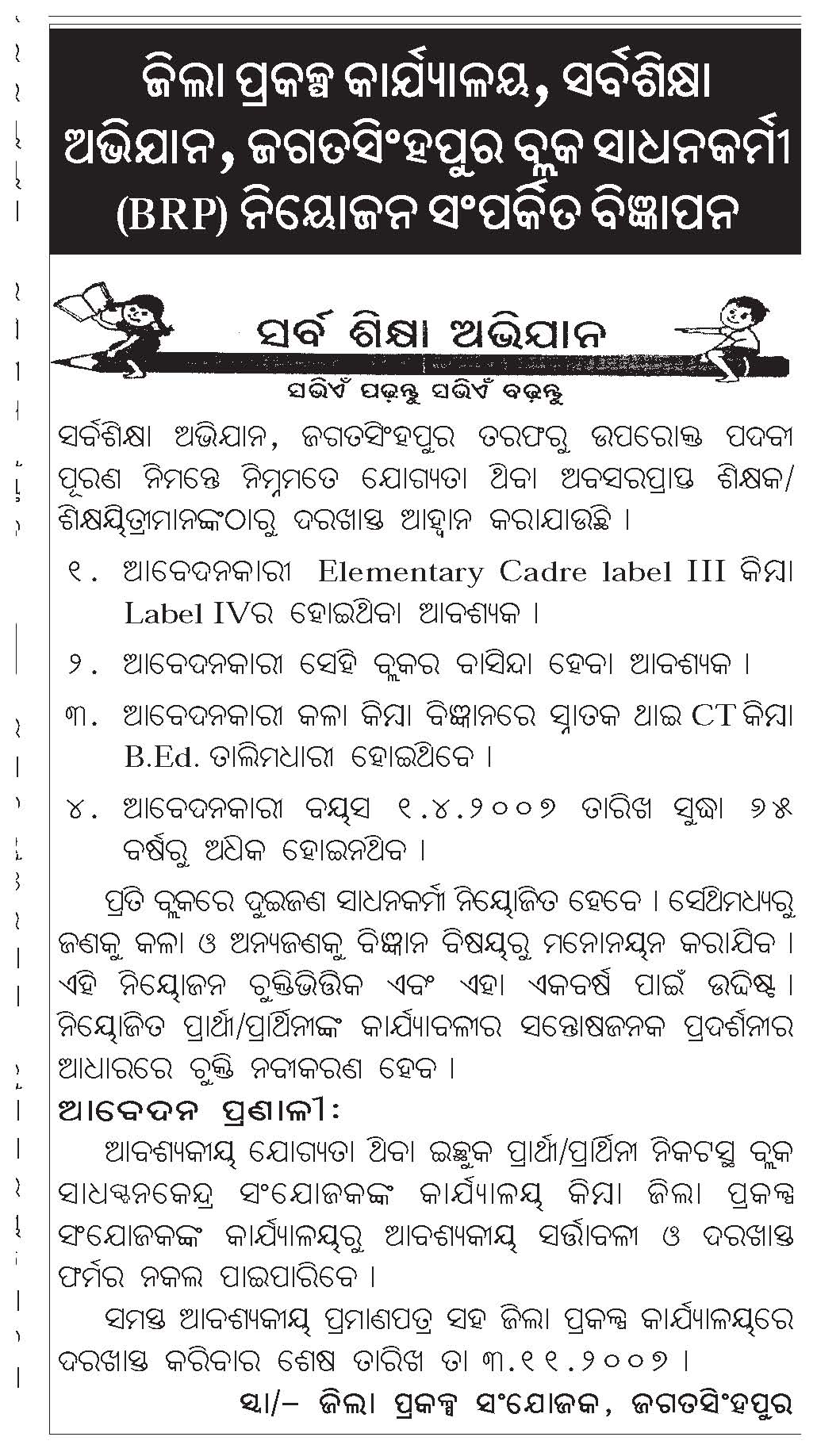
Sarba Siksha Abhijan related positions in Jagatsinghpur district: Ad in Samaja
1 comment October 28th, 2007 Author : Chitta Baral
1 comment October 28th, 2007 Author : Chitta Baral
Following is from Tathya.in. Please go there for details.
The Indira Gandhi National Open University (IGNOU) will begin its first phase admission process for B.Ed. program from 30 October.
… The admission to the B.Ed. Program will be done for the 10 Program Study Centers of Bhubaneswar Region.
… The first phase admission shall be concluded on 5 November for all centers.
The list of successful candidates has been placed on the Regional Centre website www.ignoubbsr.org.
37 comments October 27th, 2007 Author : Chitta Baral
Following is from Tathya.in.
Accordingly it was decided that each student will have to receive 6 Cumulative Grade Point Average (CGPA) out of 10 to be eligible to pass the B.Tech degree.
However in the first year itself the student has to receive 4.5 CGPA, so that he/she can be promoted.
But by the end of the course he will have to get 6 CGPA to receive the degree.
Though B.Tech program is for 4 years but a student will be allowed 7 years time for clearance of the degree.
The student, who will be enrolled in 2008-09, if fails consecutively in 3 semesters will be out of the university, said a spokesman of BPUT.
It was decided to set up a Faculty Training Institute to train the faculty members of the constituent colleges.
The proposed system is probably similar to the system followed at IITs. The year back system is what is followed at most colleges in the rest of the country. In the US universities there is no year back system. However there are pre-requsites for classes. So if subject A is a prerequisite for subject B then one can not normally take B before he/she has passed A. However, the courses that are prerequisites for other courses and are in the critical path to graduation are offered every semester.
One question to the readers: If a student fails in a course in a semetser and takes the exam for that course the next semester, what happens to the internal marks. Does he/she have a chance to improve them? How?
5 comments October 27th, 2007 Author : Chitta Baral
October 27th, 2007 Author : Chitta Baral
Following is an excerpt from a report on this in topnews.in.
At least 56 children with various mental-disabilities are taking vocational training at a special centre in Orissa’s Koraput to be self-reliant and prove wrong those who doubted their potential.
At the Manas Education and Vocational Training Centre for the Mentally Challenged, operated under the aegis of Koraput district administration since 2001, training is imparted to children between 6 to 18 years of age. …
The institute provides an opportunity to students to develop their hobbies besides attending the inmates for their mental and physical disorders. Student can learn stitching, candle making, spices packing, book-binding and other similar works.
Fourteen of the students at Manas, who had a harrowing time in their immediate society, now are earning a handsome amount of money.
"Here we stitch mosquito nets and sell them in markets. I will take it as a vocation. If I was in my village my life would have been ruined," said Dinesh Sarika, a student.
According to Bidyadhar Paramanik, Principal of Manas Education and Vocational Training Centre for the Mentally Challenged, the centre is facing financial constraint.
"We have started this school with the objective of looking after such mentally challenged children who are not usually accepted by the society. We gather these children from different villages and provide them with right health treatment and vocational training so as to make them self-sufficient,” Paramanik said.
“Although much is being done by this institution, it is facing financial constraints. The Centre provides 75 per cent funds for this school. The rest is borne by the district administration. We need at least Rs. 65,000 a year, but we get much less," he said.
October 26th, 2007 Author : Chitta Baral
Following is an excerpt from an Economic Times report on this.
If you figure in the list of meritorious 1 lakh students, you will get Rs 1 lakh annually for pursuing university education in science stream and the amount may continue up to five years. The government is planning to institute scholarships to encourage education in science and technology. While modalities of selecting meritorious students are yet to be worked out, it is proposed that the future scientists would be caught young in the 12th class itself.
The financial assistance would be given to such students while pursuing BSc and MSc courses. “We have proposed to give adequate financial support to sufficient number of students to foster talent in scientific research. The government is considering to award 1 lakh scholarships of Rs 1 lakh each.
Meritorious students pursuing university education in science stream would be eligible for the award. The proposal is expected to be incorporated in the 11th Five-Year Plan, and expected to be announced in the forthcoming National Development Council (NDC) meeting,” a source in the government said.
It is understood that the proposed scholarship would be modelled on the line of INSPIRE programme mooted by the department of science & technology (DST).
INSPIRE stands for innovations in science pursuit for inspired research. The programme aims at reaching out to the young talent and help them to pursue their interest in science.
“It is also an intervention devised to redress low entry of students into science and technology streams,” a DST source said. After the programme would get a formal approval, the selection procedure for the meritorious students would be announced.
… It is expected that the budget allocation of scientific departments would be enhanced significantly in the 11th Plan. The plan allocation has been doubled from about Rs 12,000 crore in the 9th Plan to about Rs 25,000 crore in the 10 Plan and it is planned to increased it approximately four fold in the 11th Plan, official sources said.
10 comments October 26th, 2007 Author : Chitta Baral
October 26th, 2007 Author : Chitta Baral
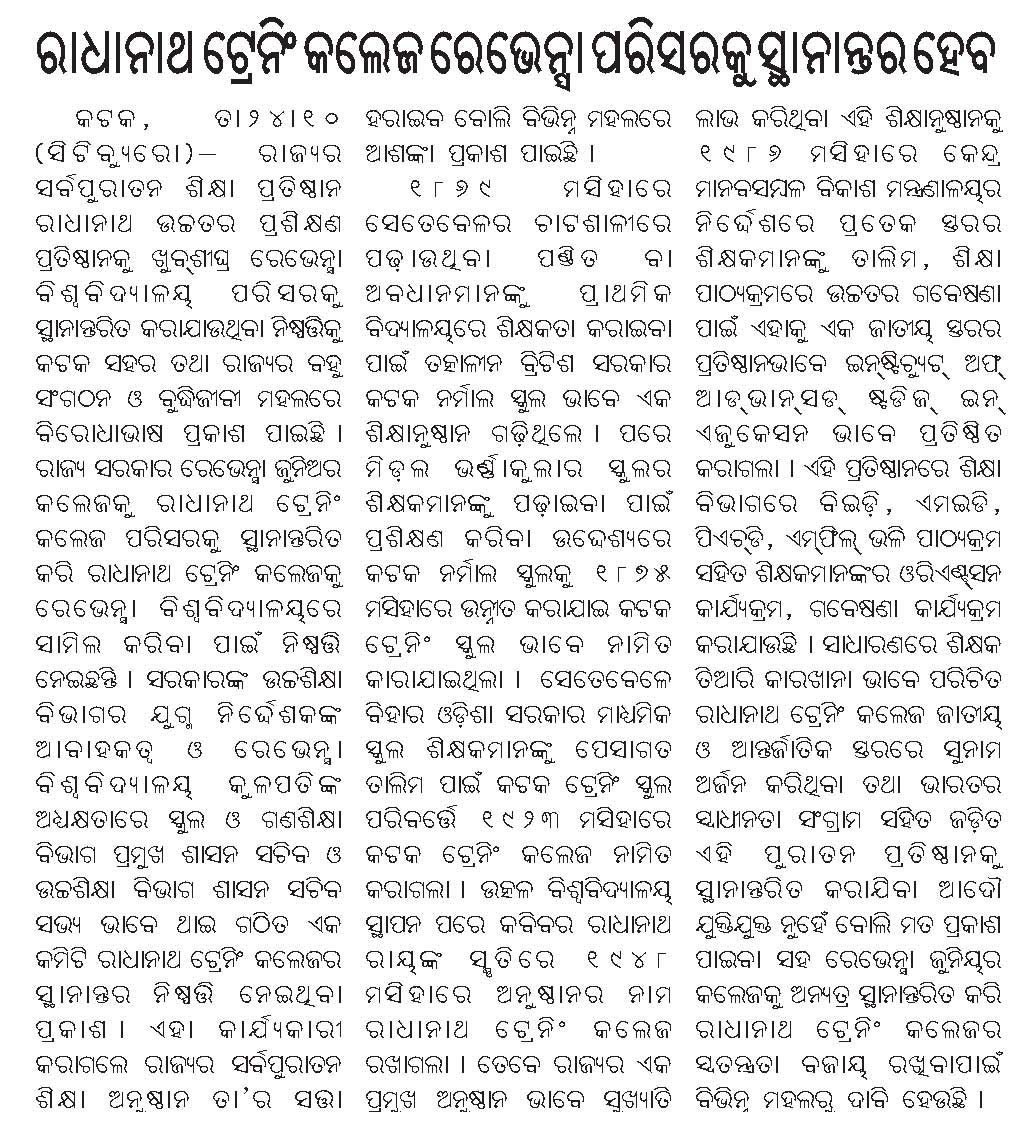
Samaja writes about the plan to shift the Radhanatha Institute of Advanced Study in Education to Ravenshaw University campus. (Note: The site http://www.nuepa.org/libdoc/addresses/iase.pdf lists other institutes of advanced study in education in India. Its a old list though as it does not list the other IASEs in Orissa. See https://www.orissalinks.com/?p=238.)
October 25th, 2007 Author : Chitta Baral
Following is the PIB release on that.
The Union Cabinet today gave its approval for setting up of two Indian Institutes of Science Education and Research (IISERs) at Bhopal and Thiruvananthapuram, at a total cost of Rs. 1000 crores ( Rs. 500 crore per Institute).
Indian Institutes of Science Education and Research (IISERs), Bhopal and Thiruvananthapuram are the fourth and fifth in the chain of IISERs to be set up in the country by the Ministry of Human Resource Development. The Government of India has decided to create the IISERs with the unique objective of integrating undergraduate education, postgraduate education and research under the same umbrella.
The basic idea of IISER is to create research universities of the highest caliber in which teaching and education will be totally integrated with the state of the art research. These universities will be devoted to undergraduate and postgraduate teaching in sciences in an intellectually vibrant atmosphere of research. One of the important goals of creating these universities is to make education and careers in basic sciences more attractive by providing opportunities in integrative teaching and learning of sciences and breaking the barriers of traditional disciplines. One other significant concept of the proposed IISER is to actively forge strong relationship with existing universities and colleges and network with laboratories and institutions, in order to share and complement faculty resources as well as research, library and computational facilities.
The IISER shall have programmes of study called Schools in various interdisciplinary areas of Biological Sciences, Mathematical and Computer Sciences, Physical Sciences, Chemical Sciences and Materials Sciences. Each Institute is expected to have about 2000 undergraduate students, postgraduate students and research scholars, and about 200 faculty members, across disciplines.
Our earlier article at https://www.orissalinks.com/?p=630 gives numbers related to NISER and some IITs.
October 25th, 2007 Author : Chitta Baral
Stanford Daily has an article on Vedanta university with the title "Indian College to be modeled after Stanford." It talks about the vision behind Vedanta University and asks Indian students in Stanford if they would prefer Vedanta University over Stanford. Most students say they would prefer Stanford; this is understandable as Vedanta University does not exist yet. Here is an excerpt from that article:
Revti Gupta ‘09 was impressed by Vedanta’s high expectations.
“It is high time someone took action to establish a world class institute in India that is not just IIT and IIM,” she said, referring to the top technology and management schools in the South Asian country, home to nearly one-sixth of the world’s people.
However, like Mehra and Forbes, Gupta said she would still prefer to travel to California to study.
“I would still come to Stanford because it provides a new perspective and an immersion in a cultural experience for me that I would not have been exposed to in India.”
Despite the lack of enthusiasm from students, Linda Hess, co-director of the Center for South Asia at Stanford, emphasized the positive impact of the initiative in the long-run.
“While Indian students who are at Stanford today may not be tempted to go to a university that’s ‘like Stanford’ in India,” she said in an email to The Daily, “the creation of a place like Vedanta University is part of a much bigger picture — the picture called ‘globalization.’
“The assumptions that used to be made about the sources of economic and intellectual power, about who is ‘ahead’ and who is ‘behind,’ are being turned around,” Hess added. “If the vision of its founders is realized, Vedanta University will attract top students from across the globe to India for the same reasons that Stanford is able to do that now.”.
October 24th, 2007 Author : Chitta Baral
We mentioned this earlier in https://www.orissalinks.com/?p=746. Following is an excerpt from a PTI report in Hindu. (New Indian Express also reports on this.)
In an effort to ensure spread of higher education avenues in an even manner, Prime Minister Manmohan Singh has advised the HRD Ministry not to decide on locations of proposed establishment of new central universities and other elite institutions in the country till a mechanism was evolved for the purpose.
Prime Minister Manmohan Singh has indicated that the Ministry should await the finalization of the XI Plan before deciding on locations for the new central Universities, IITs, IIMs, IIITs and IISERs, the PMO said in a recent communication to the HRD Ministry.
"He (the Prime Minister) has also desired that the Ministry put in abeyance all further locational decisions till a formal mechanism is evolved for this purpose," it said.
The communication from the PMO was in response to a letter of HRD Minister Arjun Singh had written last month to the Prime Minister regarding establishment of these institutions.
1 comment October 23rd, 2007 Author : Chitta Baral
1 comment October 23rd, 2007 Author : Chitta Baral
Following is from an article in Rediff/Business Standard.
The route to the cockpit starts with a Student Pilot License (SPL). This can be attained at the age of sixteen years only. The cost of such courses is almost Rs 1 lakh. Once you have your SPL, you can go for Private Pilot License (PPL) or Commercial Pilot License (CPL). But the former does not allow you to fly commercially and is generally taken up by those who have a passion for flying.
A CPL allows you to fly for airlines, corporate private planes or even cargo airlines. To obtain a CPL, 200 hours of flying is necessary. The cost is as high as Rs 11 to 12 lakh. Then, you also require to have knowledge of handling multi-engine aircraft which is another three weeks of training and comes with an extra price tag of Rs 2.5 lakh. Similar courses done abroad come for almost Rs 25 to 30 lakh.
As the training costs are really steep, many banks offer loans for them. Student education loans of Rs 10 to 20 lakh are available for pursuing pilot training courses in India and abroad. Interest rates charged are between 12 to 13 per cent. Banks approve such loans easily, if the chosen training school is one from their own list of approved flight training schools.
The salaries start from Rs 10,000-20,000 (stipend) till the pilot successfully undergoes the initial training of six months to one year to become eligible for sharing the cockpit with the flying team. Going forward in the career, there are two other levels — first officer and commander. A first officer (junior and senior) can earn in the range of Rs 1.2 lakh to 1.8 lakh per month. The commander commands anywhere between Rs 2.5 to Rs 4 lakh a month.
As in any other field, your remuneration will rise with your years of experience. The best bait airlines use is to lure trained pilots by flashing huge salaries. That’s one good reason for aspirants to reach for the skies.
Salaries of professionals
* Trainee pilot – Rs 15,000-20,000
* First officer (junior) – Rs 1 lakh and up
* First officer (senior) – Rs 1.8 lakh and up
* Commander – Rs 2.5 lakh and up
8 comments October 23rd, 2007 Author : Chitta Baral
Following is an excerpt from http://cordis.europa.eu/fetch?CALLER=EN_NEWS&ACTION=D&SESSION=&RCN=28553.
The societal dimension of information and communication technology (ICT) was the centre of attention at the Information Technology for European Advancement (ITEA 2) Symposium 2007. At the annual event on 18 and 19 October in Berlin, stakeholders from industry, politics and academia discussed what ICT can contribute to global challenges such as the ageing society, the digital divide, climate change, security and healthcare.
‘ICT is not an end in itself, but helps meet major societal challenges,’ says Rudolf Haggenmüller, chairman of ITEA 2. However, decision-makers seem to be losing interest in ICT, he adds. …
An increased investment in research and development in ICTs is essential to boost innovation, growth and jobs creation, agrees Rosalie Zobel, Director of the ICT Components & Systems unit of the European Commission’s Directorate General for Information Society and Media. ‘Half of the productivity growth over the last 20 years has been shown by the OECD and others to be due to the use of ICT in all sectors of society and also through the development of ICT industries themselves. So, it is a major contributing factor to the competitiveness of Europe.’
Under the Seventh Framework Programme (FP7), the EU will invest just over €2 billion in ICT themes in the first two years of the programme alone, making ICT one of FP7’s key areas for research and technological development. But be it at EU or national level, there is currently more money available than good ideas for projects, Mr Haggenmüller thinks.
However, every funding programme has its weakness, he says. In the case of EU research grants, for instance, ‘the problem is that administrators instead of scientists define research topics’.
ITEA 2 is a EUREKA cluster. EUREKA is an intergovernmental initiative and its clusters, like those funded by the EU, involve research institutes and companies from various countries. Under EUREKA, every project partner must apply for funding at national level, having to abide by different rules and meet different deadlines, Mr Haggenmüller points out. …
Generally speaking, Europe is too hesitant to pick up new trends and developments. ‘Europeans always want proof that an idea is going to be a success,’ says Mr Haggenmüller. As a result, they lag behind the US and India. In order for Europe to be able to compete with them, he feels that an effective instrument is needed to counterbalance the Massachusetts Institute of Technology (MIT) and the Indian Institute of Technology (IIT).
Mr Haggenmüller therefore welcomes the idea of a European Institute of Technology (EIT), which – from his point of view – should incorporate a ‘faculty’ exclusively dedicated to ICT. ‘IT-specific architectures and standards are not created by chance,’ he says. ‘Considering the fact that ICT is responsible for 80% to 90% of innovations in some areas, I do indeed think that we need a Knowledge and Innovation Community (KIC) devoted to ICT.’ …
October 23rd, 2007 Author : Chitta Baral
The Massachusetts Institute of Technology and the Institute for Financial Management and Research are jointly organizing an international competition for the best research paper on innovative responses to India’s urban challenges. The purpose of this competition is to highlight usually overlooked cases of innovation and success in response to rapid urbanization. Additional support for this competition is provided by the MIT-India Program.
Deadlines:
ABSTRACT: October 30, 2007
FINAL PAPER: December 01, 2007
For more information: http://hidden-successes.mit
October 23rd, 2007 Author : Chitta Baral
Following is an excerpt on this from Business Standard. An earlier article on this appeared in Times of India.
The Uttar Pradesh government has started the process for setting up Manyawar Sri Kanshiram Uttar Pradesh Institute of Technology on the lines of the Indian Institutes of Technology (IITs) and an Indian Institute of Science (IISc) on the pattern of the prestigious Bangalore institute.
The Kanshiram institute is proposed to be set up in Lucknow while the IISc will be set up in Greater Noida. An eleven-member committee has been set up under the chairmanship of the chief secretary for the projects.
For the Kanshiram institute, the Lucknow Development Authority would provide 200 acres, while the Greater Noida Authority would give 200 acres for IISc. Both these institutes would be set up by the Rajkiya Nirman Nigam.
In a recent meeting presided over by Principal Secretary to the chief minister Shailesh Krishna, it was decided that the proposed institutes would be centres of excellence and set up under the Acts passed by the state legislatures.
With the help of TCS, Maharashtra has made a plan (3 MB file) to upgrade couple of its state engineering colleges to "IIT level." (See this 3 MB presentation for what is meant by "IIT level.") The initial colleges they have shortlisted for this are VJTI Mumbai, College of Engineering, Pune and Guru Govind Singh College of Engineering, Nanded.
Orissa should follow Maharashtra’s example and take a PPP approach to upgrade UCE Burla and CET Bhubaneswar to IIT level. (Orissa did initiate a plan to upgrade the Keonjhar School of Mines to the ISM level; but that plan has not progressed much.)
4 comments October 22nd, 2007 Author : Chitta Baral