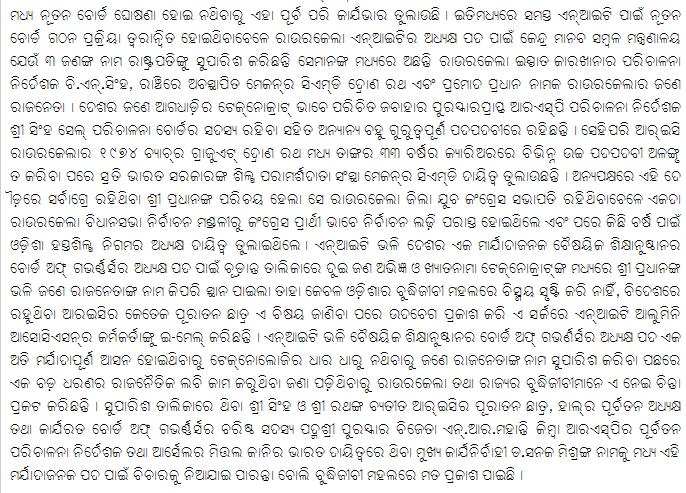
Samaja Ad: NDA and Naval Academy entrance examination details
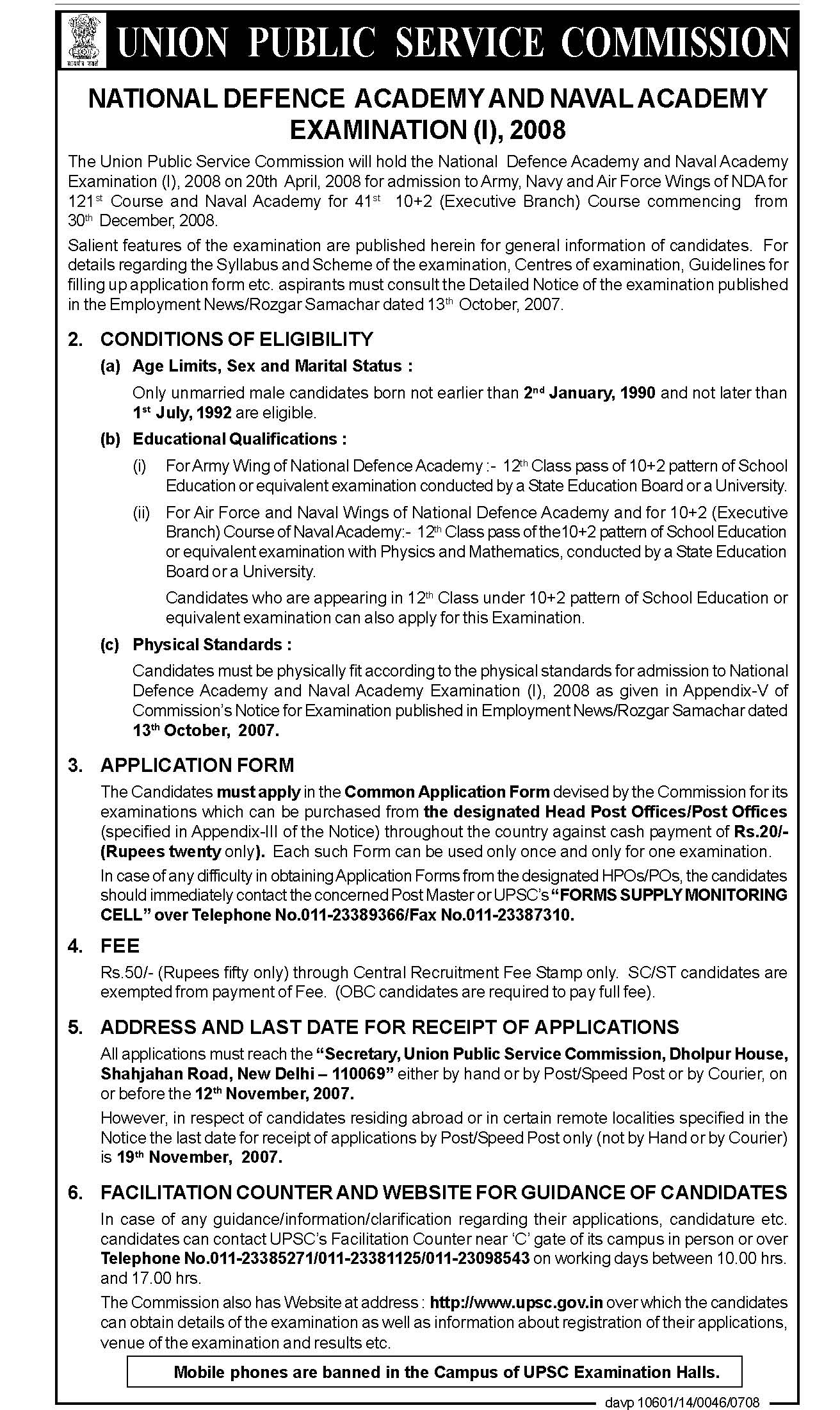
October 13th, 2007 Author : Chitta Baral
October 13th, 2007 Author : Chitta Baral
Following is an excerpt from a report in Hindustan Times.
Planning Commission Member, B Mungekar, suggested a differential fee structure for higher education at a conference of vice-chancellors on Wednesday.
Mungekar, who had drafted the new expansion and reform plan, asked vice-chancellors to consider differential fee structure with the poor paying less and those who can afford paying higher fee.
“It is not justified that a person paying Rs 5,000 for nursery classes pays Rs 50 for a MA course. Students from private schools should pay same amount of fees as they pay in schools,” he said.
He also said the commission and University Grants Commission will soon come up with a formula on a new “sustainable” fee structure for higher education. “We are talking of charging fee up to 20 per cent of university expenditure and not 20 per cent as National Knowledge Commission had recommended,” he said.
October 13th, 2007 Author : Chitta Baral
Following is an excerpt on this from a report in Hindu by Anita Joshua:
The Union Human Resource Development (HRD) Ministry will soon be approaching the Cabinet Committee on Economic Affairs with a proposal to offer loan subsidies to students below the “creamy layer” in a bid to ensure access for all to professional education.
As per estimates, this subsidy will cost the exchequer Rs. 3,250 crore over the XI Five Year Plan. All students hailing from families with an annual income below Rs. 2.5 lakh will be eligible for the loan subsidy irrespective of whether they hail from the general category or the reserved categories.
The interest rate on education loans now runs into double digits; upwards of 12 per cent for amounts up to Rs. 4 lakh and it increases as the loan amount goes up. The Ministry proposes to allow students to avail themselves of loans at around 4 per cent irrespective of the market rate. The difference will be subsidised from the Ministry’s budget.
This facility will be allowed only to students seeking admission to professional courses offered by recognised institutions; both government and private. …
Students will have to begin repaying the loan only after one year of completion of the course or on getting a job; whichever is earlier. The pay back schedule can be worked out as per the paying capacity of the borrower, although Ministry officials said details were yet to be finalised with banks.
The government will facilitate the loans by standing guarantor so that the students will not have to provide any collateral. … The Ministry’s position is that it is necessary to move to a system where banks will lend freely to students who have got admission to certified institutions against a loan guarantee given by the government.
The Ministry is also working on a proposal to set up a National Student Loan Guarantee Corporation to facilitate university financing via the students. The Prime Minister’s Office is also understood to have evinced an interest in this scheme.
3 comments October 13th, 2007 Author : Chitta Baral
Following is an excerpt from a report in Pioneer.
A ministerial delegation from the State would meet Satya Sai Baba at his Puttaparti Ashram on November 7, sources said. They would seek the support of Satya Sai Baba for setting up a state-of-the-art medical college and hospital in the State. Sources said the delegation would urge Baba to set up a medical college in a remote part of the State. They would also try to convince Baba how his help was needed to provide good heath care to the poor.
The delegation would include Health Minister Duryodhan Majhi, Industry and Rural Development Minister BB Harichandan, Finance Minister Prafulla Ghadai, Revenue Minister Manmohan Samal and Speaker of the Orissa Assembly Maheswar Mohanty.
… The ministerial delegation would urge Satya Sai Baba to open a cancer, heart and kidney centre in the State. …
1 comment October 13th, 2007 Author : Chitta Baral
Following are excerpts from a report in indiaedunews.com.
With plans to transform itself into a global educational centre in the coming years, the Banaras Hindu University (BHU) has submitted a Rs.3100 crore plan to the Union Human Resource Development (HRD) Ministry.
The proposal for the 11th Five Year Plan includes Rs.2800 crore for the main campus and Rs.300 crore for the South Campus of the varsity located at Barkachha in Mirzapur.
The university has also gone ahead with developing an Ayurveda faculty along with a 125-bed hospital, said BHU Vice Chancellor Professor Panjab Singh.
The institute’s Rs.100 crore proposal to establish an Institute of Science is also under the consideration of the Central Government.
The process of setting up an Institute of Law, Management and Social Sciences was also in progress, the V-C added.
I think Ravenshaw University, if it hopes to become a central university, should send such a plan. (One may note that of the 30 new proposed central universities, 14 are supposed to be world class universities.)
October 12th, 2007 Author : Chitta Baral
Following is an excerpt from a report in Pragativadi on this.
Tata Steel, in collaboration with Pathani Samanta Planetarium, will organise a Young Astronomer Talent Search (YATS). According to a Tata Steel release, all students from Class 8 to 10 from any school in Orissa are eligible to participate in the programme.
The YATS will be conducted in three stages. In the first phase, the students have to prepare an abstract within 500 words on any subject related to astronomy and space science and submit it with the concurrence of the heads of their respective institutions, either to Tata Steel or the Pathani Samanta Planetarium before October 15. In the second stage, the short-listed students will be called for the zonal camps and those selected in these camps will be invited to participate in the state-level camp.
The zonal camps will be held at Keonjhar, Jharsuguda, Jajpur, Bhubaneswar , Koraput and Berhampur and the State-level camp in Bhuibaneswar. The students participating in the zonal and state-level camps will be reimbursed for their actual expenses. About 100 students will be invited to each zonal camp.
Out of the 600 students participating in the six zonal camps, 150 will be invited to State-level camp. The best 10 models of the state-level camp will be awarded on the occasion of the 173rd birth anniversary of Mahamahopadhyay Chandrasekhar Singhsamant Harichandan Mahapatra, popularly known as Pathani Samanta, on December 13.
October 12th, 2007 Author : Chitta Baral
Following is an excerpt from a Kalinga Times report on this.
The Apeejay Surrendra Group has also expressed its willingness to set up a research and design centre and a Knowledge Park at Bhubaneswar, the government said.
The Knowledge Park would have a school as well as higher education on subjects such as business management, hotel management, fashion designing, food technology, and nutrition science and nautical science.
October 12th, 2007 Author : Chitta Baral
Via Abi and Ram Mohan following is an excerpt from a Financial Times report.
India’s shortage of computer science PhDs is so dire that it threatens the country’s role as the world’s information technology services outsourcing hub, according to the chairman of Microsoft India.
Although many Indians pursue post-graduate studies overseas, India’s universities now produce only about 35 computer science PhDs a year compared with about 1,000 in the US.
October 11th, 2007 Author : Chitta Baral
Following is from the PIB release http://pib.nic.in/release/release.asp?relid=31853.
The University Grants Commission organised a two day National Conference on Development of Higher Education on 10th and 11th October,2007 at New Delhi. The two day National Conference was attended by Vice Chancellors of Central, State, Deemed Universities and other eminent educationists. Six technical sessions were held on the themes of (i) Access and Expansion (ii)Equity & Inclusion (iii) Quality & Excellence (iv) Private Participation in Higher Education and Internationalization (v) Academic and Administrative Reforms (vi) Financing and Funding Mechanism. Following is a summary of the recommendations made by the participants of the National Conference.
1. There was a consensus that the triple objective of Expansion, Inclusion and Excellence are integral and complementary to one another and must be seen as three dimensions of the same problem and issues related to them will have to be addressed simultaneously and with due deference to one another.
2. It was agreed that access to higher education has to be increased to 20-25 percent and that the target GER of 15 by the end of the 11th plan appears reasonable. The participants agreed with the two-pronged strategy of establishment of new institutions and also capacity enhancement of existing institutions. They however emphasised that this should be done with due regard to the social and market relevance and changing preference of students and that the focus of expansion should be on inclusion and excellence and an approach that is expedient.
a. Capacity addition in existing instituions
b. Focus on smaller towns, rural and remote areas and backward regions where GER is lower than the national average;
c. A women university in each state
d. Established universities to set up rural campuses
e. Priority to professional and technical courses in public institutions;
f. Restructuring conventional courses
g. Focus on professional, technical and market-oriented courses must not be at the cost of humanities and social sciences.
h. Universities should not be reduced to skill-development centre; their focus should be intense engagements in intellectual activities;
i. Enrolment at the PG level across all disciplines need to be enhanced;
j. Universities and colleges to be of optimal size; conduct a study to decide;
3. Rationalise the affiliating system: reduce the number of colleges per university; make affiliation more effective; autonomy to bigger and better colleges; UG examination board within the university;
4. It was insisted upon that the strategies for expansion as outlined in these conference must not rely upon the private sector alone for this will adversely impinge upon the goal of equity and inclusion. Thus public investment in higher education has to be increased substantially;
5. It was reiterated time and again that mere expansion in institutions and intake capacity shall not necessarily make higher education inclusive. This will require an proactive approach and strategies for removing the regional and social imbalances. The participants agreed with the approach and strategies suggested by the UGC and also with the recommendations of the regional conferences:
a. New universities and colleges in areas that have GER lower than the national average;
b. Strengthen and expand existing universities and colleges that are located in areas that have GER lower than the national average;
c. Special assistance to institutions located in under-privileged regions/areas and also to those that have higher proportion of such social groups as SCs, STs, OBCs, Minorities, Girls, Physically Challenged in their student and staff population;
d. Establishment of equal opportunity office in each university;
e. Capacity building centres for students from the deprived social groups;
6. It was emphasised that the strategies for inclusion must also include the physically challenged – departments of disability studies;
7. Focus will also be on school education;
8. Better endowed and privileged universities and colleges need to network with under-privileged institutions located in rural and remote areas and thus offer the opportunity of providing the best talents and technology to the rural, backward and deprived institutions;
9. Regarding excellence in higher education will have to focus on Infrastructure, physical facilities and human resources particularly teachers;
10. The national conference is in agreement with the strategies suggested by the UGC and the recommendations of the regional conferences;
a. Bring the non-12b colleges & universities under the ugc fold – on matching grant basis;
b. Priority funding for bringing B and C band universities at the level of A band universities;
c. Faculty development through fellowships and FIP
11. Much depends upon the availability of quality teaching faculty but for which quality of higher education shall not improve;
12. State governments to accord priority to higher education – Remove ban on creation of faculty positions and appointment
a. Nurturing Talents and Promoting Quality Faculty: Teaching Staff: Special and urgent efforts are needed in attracting and retaining the best available talents as faculty members in higher education. Autonomy with responsibility, performance based incentives, revisit the compensation and rewards;
b. Rigour in faculty selection, PhD admission on merit and through rigorus selection process; faculty development;
c. Student evaluation and feedback of courses and faculty should be introduced and these should be used for incentivising faculty members;
d. Financial assistance to universities and colleges for International faculty exchange, Inter-institutional faculty exchange within the country and also for faculty exchange between industry and academic institutions;
13. On the issue of academic and administrative reforms the conference is in agreement with the recommendations of the regional conferences on updating of curricula, examination and evaluation system, semester and credit based courses, inter-institutional mobility of students;
14. The process of reforms has already been delayed for long and every possible efforts should be made to put them into practice. The leadership of the university should take the initiative and must exert their authority to ensure that these are implemented urgently;
15. It was indicated that Infrastructural constraints particularly inadequate faculty is the biggest constraint in the implementation of these reforms;
16. Higher education must protect its autonomy and the most effective way of doing the same lies in behaving with responsibility. Autonomy with accountability, therefore, has to be the guiding principle. The higher education fraternity must work hard and excel in their pursuits to command respect. The higher education system needs to protect its autonomy and in no circumstances the universities should allow the external forces to control the contents of higher education.
17. Multiplicity of regulatory authorities is a concerns encroaching upon the university autonomy and creates confusion. It is suggested that:
§ The UGC should be the sole regulatory authority for universities and that other regulatory authorities should respect the autonomy of these institutions and should play only an advisory role.
§ The mandates of other regulatory authorities – the AICTE, NCTE, etc should be confined to colleges offering professional and technical courses and private and self financed non-affiliated institutions only;
§ As medical and agricultural universities and colleges are funded by separate administrative Ministries, the MCI and ICAR should continue to regulate the medical and agricultural education in universities and colleges;
§ Other regulatory authorities should consult and involve the university concerned in their approval and accreditation process of affiliated institutions;
§ Governance and Decision making process:
o size and composition of decision making bodies.
o Decentralisation
o Departmental autonomy
o Leadership in universities plays vital role in promoting quality and excellence in higher education. Thus The Vice Chancellors should be appointed
§ on merit proven administrative administrative capabilities;
§ by search committee comprising of people of repute and other external forces should not be allowed to play part in the selection of vice chancellors’
As regards internationalisation, participants agreed with the recommendations of the regional conference. Watchword has been that it must not adversely impinge on the goal of equity and quality. Strongly regulatory mechanism for the foreign universities was suggested;
So was the case with the issues concerning private participation in higher education. Even the private and self financed universities were in agreement that these universities should be guided by the principles of equity and justice and commitment for providing quality higher education; A strong regulatory framework was suggested for the purpose;
The crisis in higher education is not as much due to lack of resources as it is of priorities. Unless higher education appears high on the priority of the union and state governments, the resource constraints shall continue to remain;
Cost recovery from students is already very high in the range of 40 – 50% and the scope of raising fees may be limited.
1 comment October 11th, 2007 Author : Chitta Baral
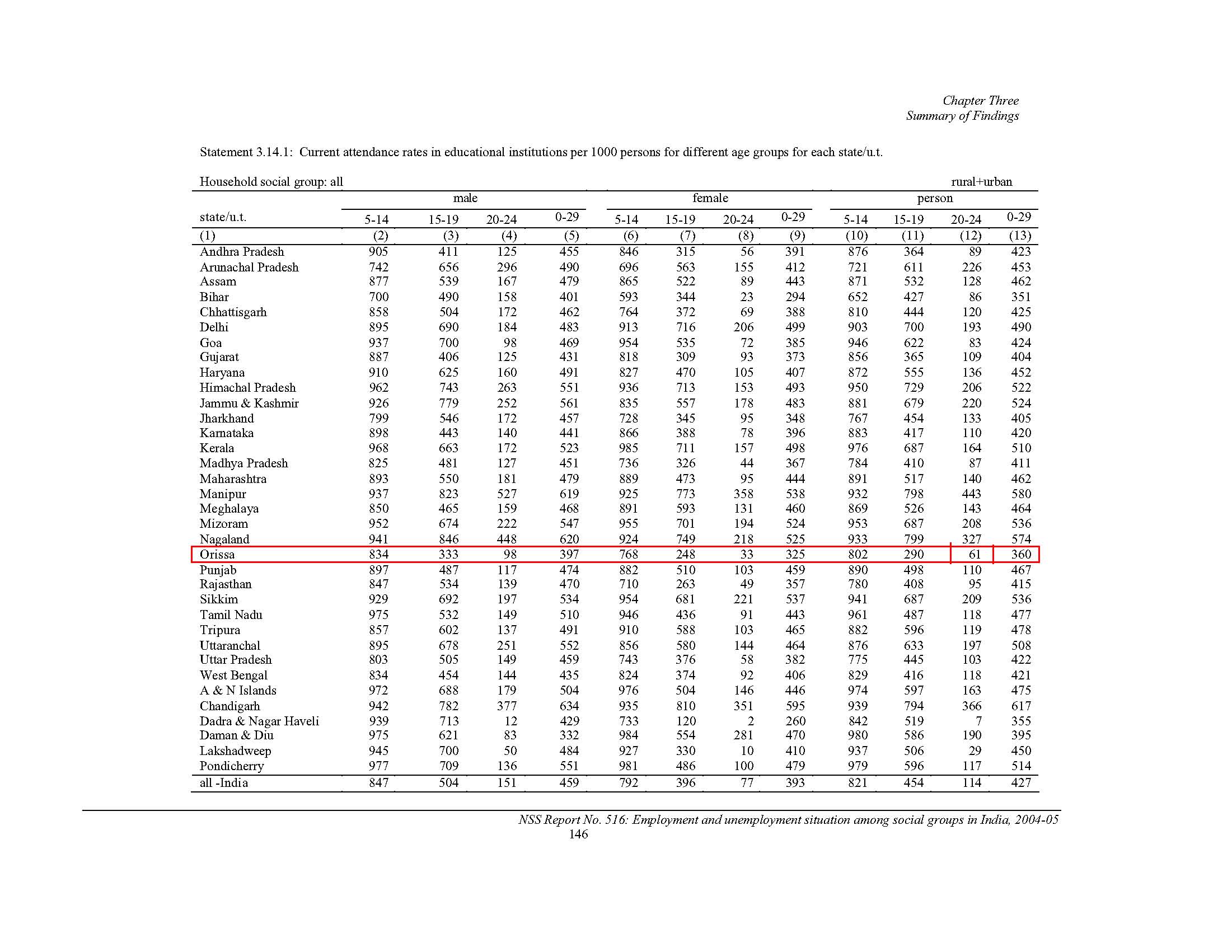
As per the NSSO study of 2004-2005 (released in October 2006), Table 3.14.1 (of Report 516) shows that in the 15-19 age group 29% people in Orissa are attending school/college and in the 20-24 age group this number for Orissa is 6.1%. (Both numbers are lowest among all but the small states/UTs of Dadra and Nagar Haveli, Daman & Diu and Lakshadweep.) Our focus in this posting being higher education, one may note that higher education corresponds to the 20-24 age group.
Now the PIB http://pib.nic.in/release/release.asp?relid=31735 says that:
The 11th Plan objectives are aimed at increasing the Gross Enrolment Ratio(GER) (access rate) in higher education from the present 10% to 15% by 2012, while ensuring improvement in quality and enhancement of equity.
Now if one looks at the data below it is a no brainer that one of the 14 world class central universities (30 total – 16 to states that do not have any) must be established in Orissa.
October 11th, 2007 Author : Chitta Baral
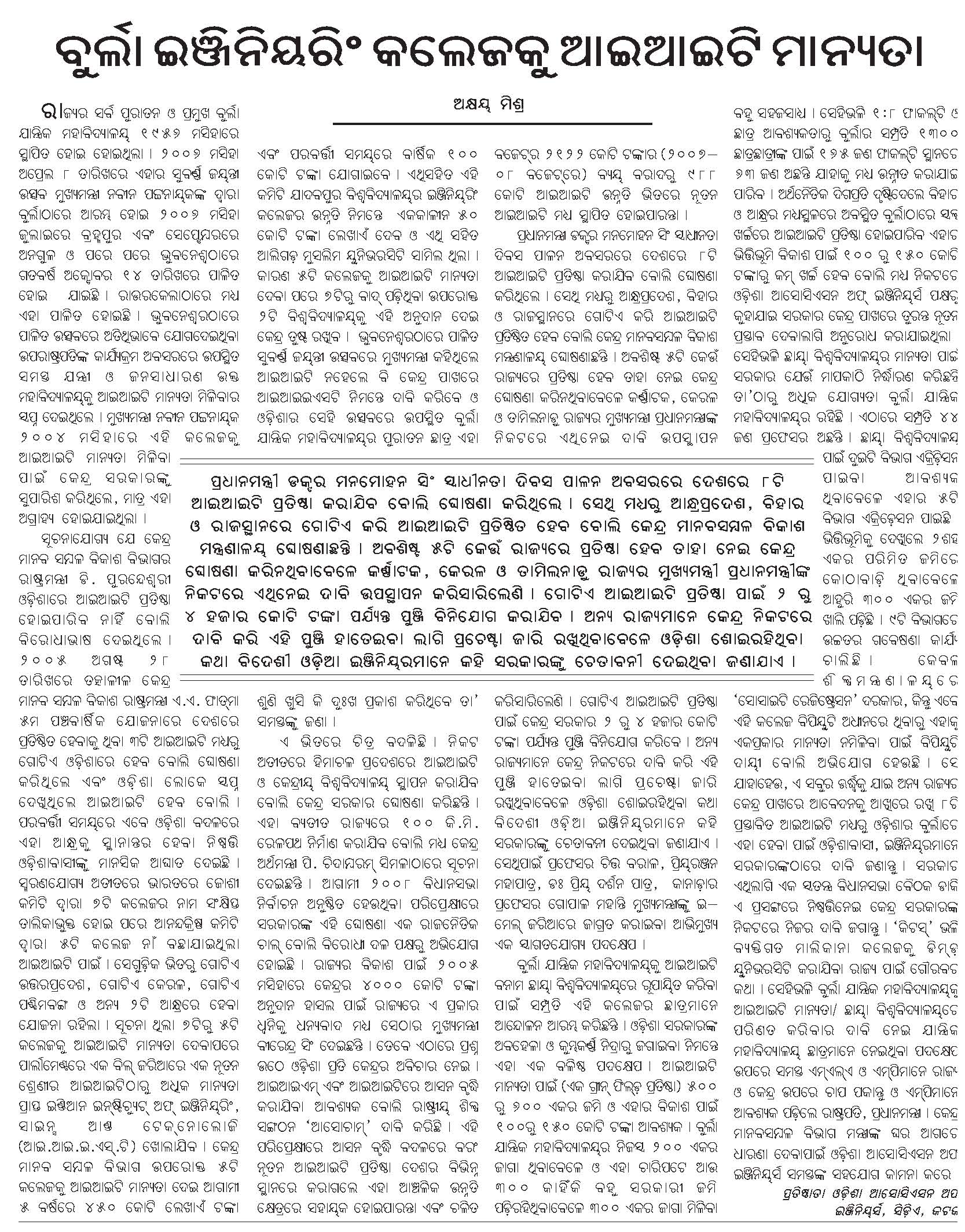
This article is mostly well argued and has a lot of information regarding recent announcements. My only issue is that it is a bit short-sighted at the end: If Andhra Pradesh can upgrade two of its existing colleges to IIESTs and still get a greenfield IIT, why should Orissa just ask for one upgradation; Orissa should ask for upgradation of UCE Burla to an IIEST and the establishment of a greenfield IIT. Also, just asking for UCE Burla to an upgradation to an IIT is a bit dangerous as the central govt. may say that they are not upgrading any institution to an IIT. If that happens we become double losers. So, Orissa govt should ask that UCE Burla be upgraded to an IIEST and Orissa should get one of the proposed 5 new IITs. Furthermore, as we have argued earlier Orissa govt, should immediately make UCE Burla a state university.
3 comments October 11th, 2007 Author : Chitta Baral
Various news reports mention this. Following is an excerpt from a report in Economic Times.
… prominent alumni of the seven Indian Institutes of Technology are drawing up a blueprint to set up a new IIT.
Last month, Rajat Gupta, founding member and chairman of the board of directors of PAN-IIT , an alumni group of heavyweights, floated the idea among members, sparking off a flurry of email exchanges at the highest levels of corporatedom. In a communication with TOI, Gupta — who headed worldwide operations for consultancy major McKinsey until recently — confirmed the plan.
Speaking to TOI, Ashank Desai, president of the alumni group and chief of software firm Mastek, said, ‘‘We had some discussions and thought exchanges among some members. A lot of us have shown interest in the idea of setting up an IIT.’’ But, he emphasised, it was at a nascent stage.
Work has already begun though. A concept note has been prepared and a couple of PAN-IIT members have broached the subject with the Union HRD ministry. Details regarding the location of the proposed institute and the funding model it would follow remain to be worked out.
October 11th, 2007 Author : Chitta Baral
The following is from http://www.jeeorissa.com/newsfiles/news_36.htm.
JOINT ENTRANCE EXAMINATION-2007, ORISSA
COUNSELLING-CUM-ADMISSION FOR VACANT/ENHANCED SEATS OF MCA/ENGINEERING/MBA/ARCH/HMCT COURSES
Some seats of different Engineering/MCA/MBA/ARCH./HMCT courses in private colleges are lying vacant after 3rd phase of counselling, for which the 4th phase of counselling will be held as per schedule given below.
Venue: OUAT Conference Hall (Swaminathan Hall)
Schedule of Counselling-cum-admission
|
DATE |
COURSE |
TEST |
SESSION |
RANK |
|||
|
FROM |
TO |
||||||
|
13.10.07 |
MCA |
JEE |
1 |
1 |
2000 |
||
|
MCA |
JEE |
2 |
2001 |
4000 |
|||
|
MCA |
JEE |
3 |
4001 |
5767 |
|||
|
14.10.07 |
MBA |
JEE |
1 |
1 |
2000 |
||
|
MBA |
JEE |
2 |
2001 |
3500 |
|||
|
MBA |
JEE |
3 |
3501 |
5000 |
|||
|
15.10.07 |
MBA |
JEE |
1 |
5001 |
7000 |
||
|
MBA |
JEE |
2 |
7001 |
8481 |
|||
|
ARCH |
JEE |
3 |
1 |
1208 |
|||
|
HMCT |
JEE |
3 |
1 |
47 |
|||
|
16.10.07 |
ENGG |
JEE |
1 |
1 |
8000 |
||
|
ENGG |
JEE |
2 |
8001 |
10000 |
|||
|
ENGG |
JEE |
3 |
10001 |
12000 |
|||
|
17.10.07 |
ENGG |
JEE |
1 |
12001 |
15000 |
||
|
ENGG |
JEE |
2 |
15001 |
18000 |
|||
|
ENGG |
JEE |
3 |
18001 |
19000 |
|||
|
18.10.07 |
ENGG |
JEE |
1 |
19001 |
21545 |
||
|
ENGG |
JEE |
2 |
21545 |
24000 |
|||
|
ENGG |
JEE |
3 |
24001 |
25306 |
|||
|
19.10.07 |
ENGG |
JEE |
1 |
25307 |
26500 |
||
|
ENGG |
JEE |
2 |
26501 |
28000 |
|||
|
ENGG |
JEE |
3 |
28001 |
29500 |
|||
|
20.10.07 |
ENGG |
JEE |
1 |
29501 |
31000 |
||
|
ENGG |
JEE |
2 |
31001 |
33000 |
|||
|
ENGG |
JEE |
3 |
33001 |
34835 |
|||
Session Timing- Reporting Time: Session 1-
All Candidates are required to bring the following documents to the counselling: (i) Print out of the On-line registration (ii) Original JEE rank card or Original University registration card for JEE admitted candidates or downloaded rank card for JEE extended merit-list candidates, (ii) All certificates and mark-sheets starting from 10th standard with one set of Xerox copies of each, (iii) SLC/CLC in original (iv) Certificate from the head of the Institution last attended (Appendix V in JEE Counselling-cum-admission Instructions available in our website: www.jeeorissa.com,) (v) Draft: Rs.200/- in favor of “JEE-2007 (for admitted candidates on production of Original Registration Card of BPUT) or Two Bank drafts of Rs.16,000/- and Rs.200/-) in favour of “JEE-2007” payable at Bhubaneswar (for fresh admission).
Chairman JEE-2007, Orissa
4 comments October 11th, 2007 Author : Chitta Baral
Following are some excerpts from that report by Shailaja Neelakantan.
… Agarwal’s proposed Vedanta University is expected to be different. Undergraduates will study diverse subjects on the way to earning degrees, rather than focus exclusively on one discipline, as is typical at Indian universities. "An engineering student will be able to study literature or economics if he wants to, like in the US," says C.V. Krishnan, chief executive of the university project. Vedanta University plans to offer undergraduate, graduate and doctoral programmes in a huge variety of disciplines. The first phase of the university’s growth, to about 3,000 students, is scheduled to begin next year. In 2023, when it is destined for completion, Vedanta University will house 100,000 students, as well as 40,000 faculty and staff members.
…Nevertheless, he has huge ambitions for Vedanta University. According to promotional materials, Vedanta will boast faculty members and students from all over the world and will produce "tomorrow’s Nobel laureates, Olympic champions and community leaders." Agarwal and his public relations staff talk a good game – he has even likened himself to Leland Stanford, an American who made his fortune building railways in the US and founded Stanford University.
…Still, for Vedanta University’s supporters, its sheer scope is what makes it worth backing. "It could set a new revolutionary benchmark in higher education – and just the force of that argument should allow this project to go ahead," insists Pratap Bhanu Mehta, chief executive of New Delhi’s Centre for Policy Research.
As it is, the country’s 350 public universities serve only seven per cent of its 18- to 24-year-olds, a rate that is half that of other Asian countries. If Vedanta University succeeds, it could stem the rising tide of Indian students seeking an education overseas.
…
The campus
Is being designed by an American architect in Baltimore who has developed Duke, Carnegie-Mellon and Johns Hopkins universities in the US. It will be built on 8000 acres of land near the Puri-Konark marine drive in Orissa state and the buildings will be arranged in the form of two overlapping circles. The Orissa government has begun to build a four-lane expressway from the new campus to the international airport which is being constructed near the state capital, Bhubaneswar, 70km away. A railway station will also be located on campus. The area will be developed into a large university township that will house a permanent population of 500,000 in addition to the 100,000 students.
Any more?
Yes, there will also be a research and development park serving as an incubator for spin-off companies. Eventually, it is hoped that this will evolve into a large research-cum-education complex resembling Silicon Valley, the economic hub that surrounds Stanford.
Will it work?
The university system in India is under financial strain and is not known for its research strength, except in one or two areas, or for the quality of its academics. Although it has large numbers of keen and well-prepared students, India is not a global player and, unlike China, is not making super-human efforts to build up a stellar university system by recruiting retired or semi-retired university presidents and other staff from the US. That is why Indians spend large sums on getting a good higher education overseas. And it is why India’s Prime Minister, Manmohan Singh, announced that he wanted to set up 25 new universities funded by the centre to augment the handful of centrally funded universities already in existence. It is also why he supports Vedanta University.
Whether Vedanta will succeed is debatable, according to Lord Parekh, the British peer who was educated in Bombay and the London School of Economics, and was later vice chancellor of the University of Baroda. First, he wonders where the quality staff will come from for a new university containing 100,000 students. Second, he asks who is going to manage a 40,000-strong faculty.
"Three Chinese universities have invited retired or semi-retired American professors and executive officers to staff their universities," he says. "Singapore is doing the same. These countries are paying well. They have the confidence to hire foreigners."
October 11th, 2007 Author : Chitta Baral
October 10th, 2007 Author : Chitta Baral
Institute of Mathematics and Applications in Bhubaneswar has extended the last date of application for RMTS 2007 to 25th of October. The test date is not changed and stays on Nov 11.
Update: The application form is available at http://www.rmtsorissa.org/text/aplication.zip.
3 comments October 10th, 2007 Author : Chitta Baral

.jpg)