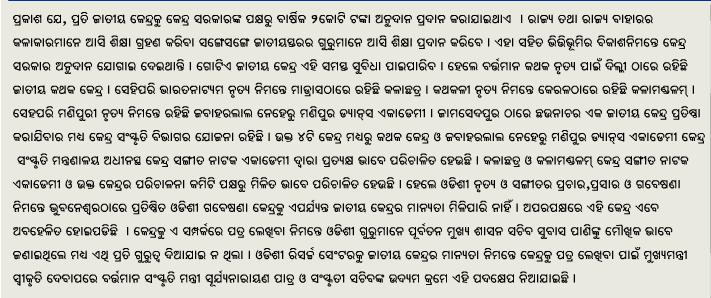
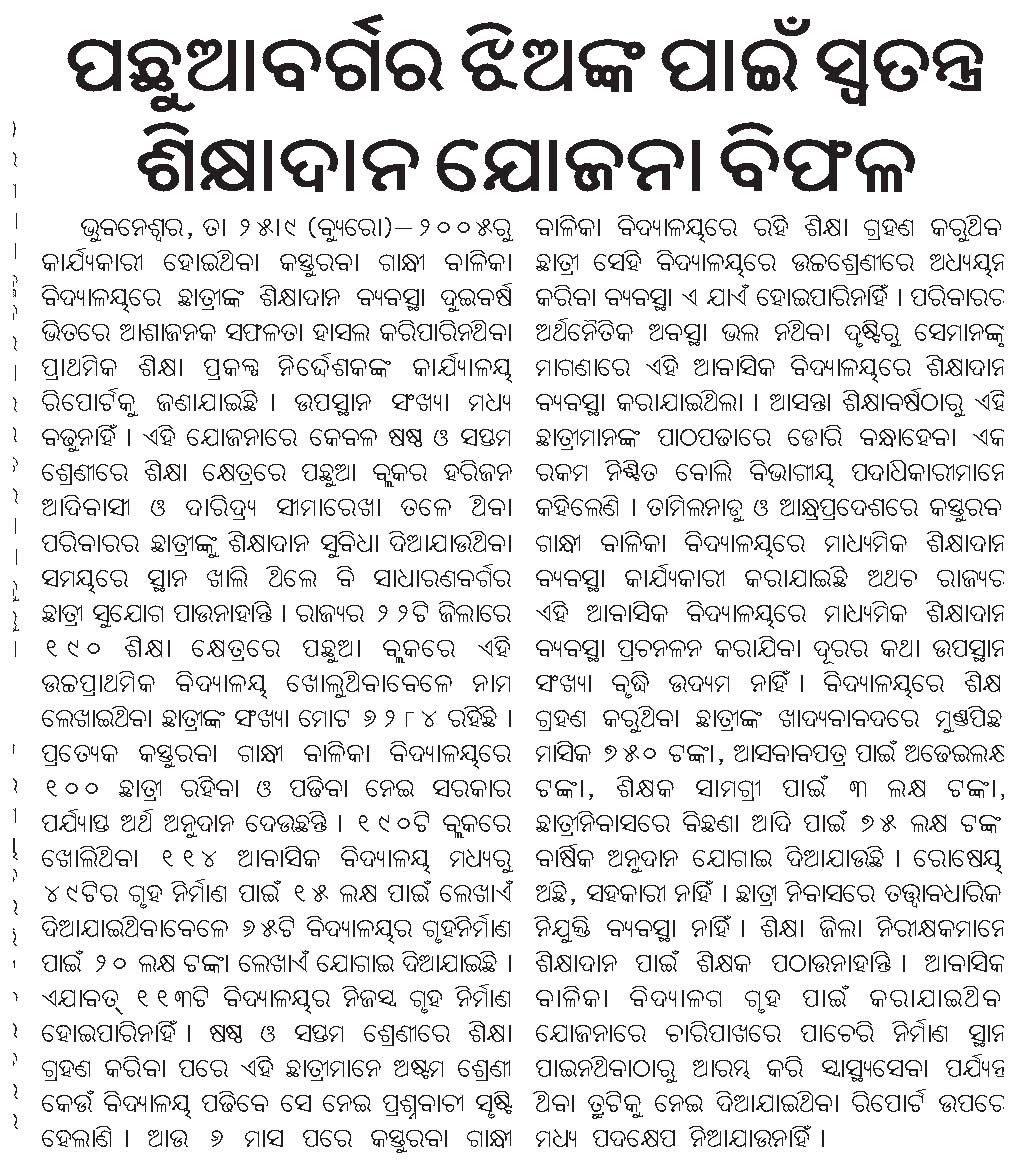
Problems faced by the Kastuaba Gandhi Balika Vidyalaya Scheme in Orissa: Samaja
September 27th, 2007 Author : Chitta Baral
September 27th, 2007 Author : Chitta Baral
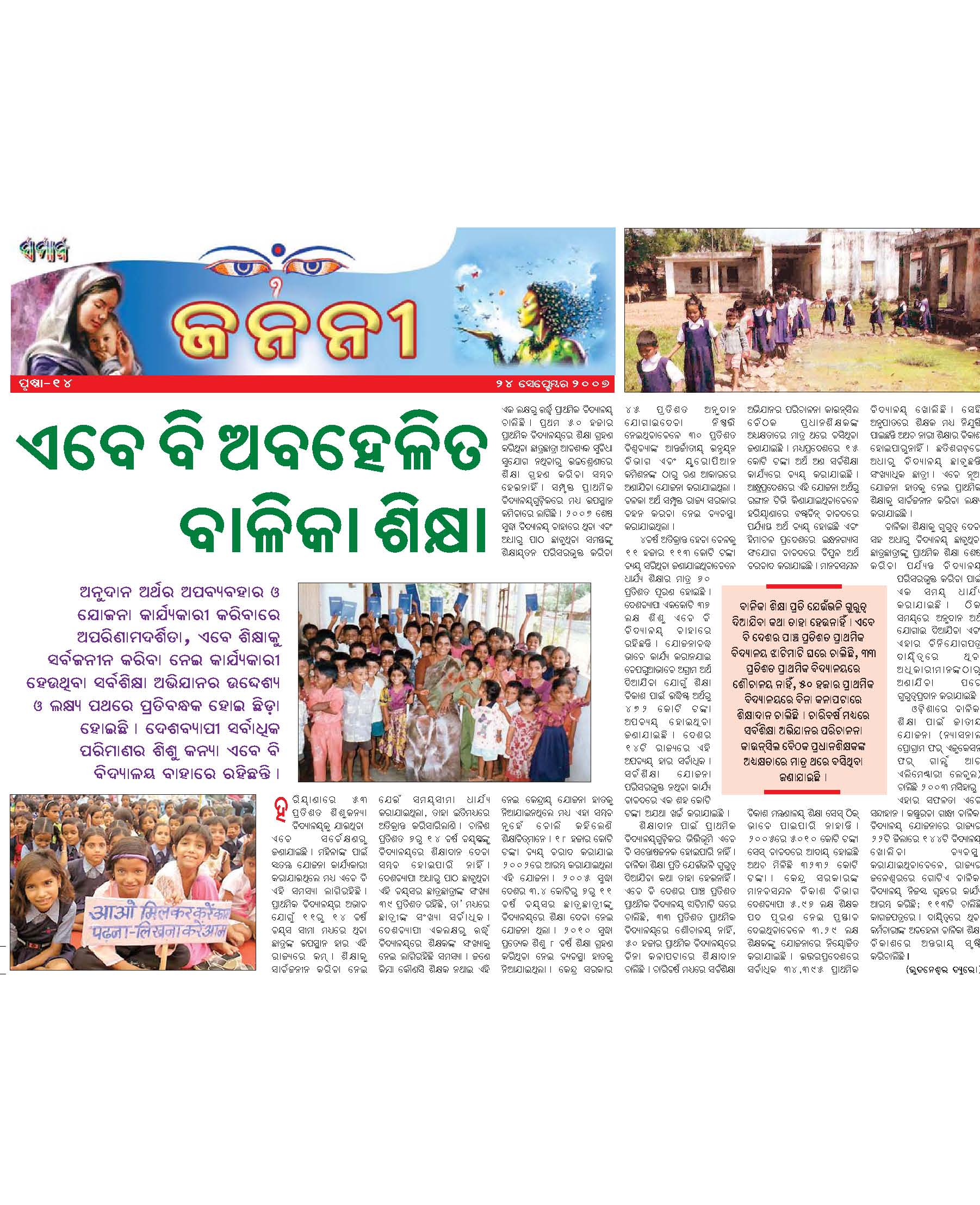
The Kasturaba Gandhi Balika Vidyalaya scheme is aimed at girls belonging primarily to SC, ST, OBC and minorities in difficult areas. The guidelines for their implementation as given in their web site is as follows:
1. Background
1.1 The Government of India has approved a new scheme called Kasturba Gandhi Balika Vidyalaya (KGBV) for setting up upto 750 residential schools with boarding facilities at elementary level for girls belonging predominantly to the SC, ST, OBC and minorities in difficult areas. The scheme will be coordinated with the existing schemes of Department of Elementary Education & Literacy viz. Sarva Shiksha Abhiyan (SSA), National Programme for Education of Girls at Elementary Level (NPEGEL) and Mahila Samakhya (MS).
2. Scope/ Coverage of the scheme
2.1 The scheme would be applicable only in those identified Educationally Backward Blocks (EBBs) where, as per census data of 2001, the rural female literacy is below the national average and gender gap in literacy is more than the national average. Among these blocks, schools may be set up in areas with:
¨ concentration of tribal population, with low female literacy and/or a large number of girls out of school;
¨ concentration of SC, OBC and minority populations, with low female literacy and/or a large number of girls out of school;
¨ areas with low female literacy; or
¨ areas with a large number of small, scattered habitations that do not qualify for a school
The criteria for eligible EBB will be the same as in the NPEGEL scheme of SSA.
3. Objective
3.1 Gender disparities still persist in rural areas and among disadvantaged communities. Looking at enrolment trends, there remain significant gaps in the enrolment of girls at the elementary level as compared to boys, especially at the upper primary levels. The objective of KGBV is to ensure access and quality education to the girls of disadvantaged groups of society by setting up residential schools with boarding facilities at elementary level.
4. Strategies
4.1 Between 500 to 750 residential schools will be opened in a phased manner over the Xth Plan period at an estimated cost of Rs. 19.05 lakh as recurring cost and Rs. 26.25 lakh as non-recurring cost, per school. Initially, the proposed schools shall be opened in rented or other available Government buildings after deciding the location.
4.2 Such residential schools will be set up only in those backward blocks that do not have residential schools for elementary education of girls under any other scheme of Ministry of Social Justice & Empowerment and Ministry of Tribal Affairs. This shall be ensured by the district level authority of SSA at the time of actual district level planning of KGBV initiatives by co-ordinating with the other Departments/Ministries. A list of educational complex being run by Ministry of Tribal Affairs is enclosed for facilitating selection of KGBV.
5. The components of the scheme will be as follows:
(i) Setting up of residential schools where there are a minimum of 50 girls predominantly from the SC, ST and minority communities available to study in the school at the elementary level. The number can be more than 50 depending on the number of eligible girls. Three possible models for such school have been identified and given at Annex.I(a) to I(c).
(ii) To provide necessary infrastructure for these schools
(iii) To prepare and procure necessary teaching learning material and aids for the schools
(iv) To put in place appropriate systems to provide necessary academic support and for evaluation and monitoring
(v) To motivate and prepare the girls and their families to send them to residential school
(vi) At the primary level the emphasis will be on the slightly older girls who are out of school and were unable to complete primary schools (10+). However, in difficult areas (migratory populations, scattered habitations that do not qualify for primary/ upper primary schools) younger girls can also be targeted
(vii) At the upper primary level, emphasis will be on girls, especially, adolescent girls who are unable to go to regular schools
(viii) In view of the targeted nature of the scheme, 75% girls from SC, ST, OBC or minority communities would be accorded priority for enrolment in such residential schools and only thereafter, 25% girls from families below poverty line.
(ix) Established NGOs and other non-profit making bodies will be involved in the running of the schools, wherever possible. These residential schools can also be adopted by the corporate groups. Separate guidelines are being issued in the matter.
6. Implementation, monitoring and evaluation
6.1 The scheme will be implemented by State Governments through the Mahila Samakhya (MS) Society in MS states and through the SSA society in case of other states. Funds will be released as per SSA pattern to the State SSA societies. The monitoring and evaluation at the State and district level will be undertaken by the MS State Resource Centers and in non-MS states, through the committee created for the National Programme for Education of Girls at the Elementary Level in the SSA society.
6.2 Training for teachers and staff at the residential schools will be coordinated by the District Institutes of Educational Training, Block Resource Centres and the Mahila Samakhya Resource Groups.
7. State Support Group
7.1 An Advisory State level coordination committee as approved under the NPEGEL scheme, shall provide direction and support to the programme. This group will consist of nominees from relevant State Government Departments, Government of India, experts in the field of girls education, educationists etc. The selection of an appropriate model of the school and its location would be done by this Committee based on the recommendation of the district committee implementing the NPEGEL and the new proposed scheme.
8. National Support Group
8.1 The National Resource Group (NRG) created under the Mahila Samakhya programme at the National level shall provide inputs on conceptual issues and concerns arising in the programme, and advice GOI on policy matters concerning the education of girls. This group will provide the interface with research and training institutions, women’s movement, educationists and non-Governmental institutions and also bring in other experiences of educating girls.
8.2 Since the NRG, consists of a small number of persons and meets only two to three times in a year, smaller sub committees of the NRG created for specific inputs, like gender training of teachers, development of gender based teaching learning material, development of audio visual programmes etc. will co- opt additional persons from relevant institutions or experts for the purpose.
9. Methodology
9.1 Based on the number of girls and the type of residential school to be provided, the selection of the model of the school to be selected would be done by a State Level Committee based on the recommendation of the District Committee for the purpose. The proposal shall be forwarded to the Cell at the National level who shall appraise them with the help of external agencies/consultants, where necessary. Finally, the Project Approval Board of SSA will approve these plans.
10. Financial Norms under KGBV
10.1 The SSA pattern of financing with a 75:25 ratio of sharing between the Centre and the States during the Tenth Five Year Plan, and 50:50 thereafter, will be adopted for KGBV as well. Commitments regarding sharing of cost would be taken from the State Governments in writing.
10.2 The provisions for KGBV will be in addition to the provisions already made under SSA and for NPEGEL. The SSA Society shall ensure convergence of KGBV with NPEGEL and Mahila Samakhya programme. It shall also ensure that funds allocated are appropriately invested and there is no duplication of activities.
10.3 The Government of India would directly release funds to the SSA State Implementation Society. The State Government will also release its share to the State Implementation Society. Funds will be released thereafter to the Mahila Samakhya Society wherever applicable. In States where MS is not being implemented, the implementation of this scheme will be through the ‘Gender Unit’ of SSA Society and existing mechanism used for implementation of SSA will be followed.
10.4 The State Society should open a separate Savings Bank Account for operating the funds of KGBV. State Government should also release its matching share to the State SSA Society through a separate budget head. Separate accounts will have to be maintained at district and sub-district structures, accordingly.
Annex I(a)
FINANCIAL ESTIMATES- I
(Scenario I: Cost estimates for 100 girls)
NON RECURRING:
Rs in lakhs
SN
ITEM OF EXPENDITURE
AMOUNT PER SCHOOL*
1
Building
20.00
2
Furniture/ Equipment including kitchen equipment
2.50
3
Teaching learning material and equipment including library books
3.00
4
Bedding
0.75
TOTAL
26.25
RECURRING COSTS PER ANNUM:
Rs in lakhs
SN
ITEM OF EXPENDITURE
AMOUNT PER SCHOOL*
1
Maintenance per girl student per month @ Rs. 750
9.00
2
Stipend for girl student per month @ Rs. 50
0.60
3
Course books, stationery and other Educational material @ Rs 50/ month
0.60
4
Examination fee
0.01
5
Salaries:
1 Warden cum teacher
4 Full time teachers
3 Part time teachers
2 Support staff – (Accountant/Assistant, Peon
Chowkidar and Cook)
6.49
6
Vocational training/specific skill training
0.40
7
Electricity/ water charges
0.50
8
Medical care/contingencies @ Rs 750/ child
0.75
9
Miscellaneous including maintenance
0.40
10
Preparatory camps
0.15
11
PTAs/ school functions
0.15
TOTAL
19.05
* Based on calculations for 100 girls. The number of girls can, however, increase.
Annex I(b)
FINANCIAL ESTIMATES- II
(Scenario II: Cost estimates for 50 girls)
NON RECURRING:
Rs in lakhs
SN
ITEM OF EXPENDITURE
AMOUNT PER SCHOOL
1
Building
15.00
2
Furniture/ Equipment including kitchen equipment
2.50
3
Teaching learning material and equipment including library books
3.00
4
Bedding
0.75
TOTAL
21.25
RECURRING COSTS PER ANNUM:
Rs in lakhs
SN
ITEM OF EXPENDITURE
AMOUNT PER SCHOOL*
1
Maintenance per girl student per month @ Rs 750
4.5
2
Stipend for girl student per month @ Rs 50
0.3
3
Course books, stationery and other Educational material @ Rs 50/ month
0.3
4
Examination fee
5
Salaries:
6.49
1 Warden
4 Full time teachers
3 Part time teachers
2 Support staff –
(Accountant/Assistant, Peon, Chowkidar and Cook)
Vocational training/specific skill training
0.3
Electricity/ water charges
Medical care/contingencies @ Rs 750/ child
0.375
Miscellaneous including maintenance
0.35
Preparatory camps
0.1
PTAs/ school functions
0.1
TOTAL
12.815
* Based on calculations for 50 girls. The number of girls can, however, increase.
Annex I(c)
FINANCIAL ESTIMATES- III
(Scenario III: In an existing Girls upper primary school)
NON RECURRING:
Rs in lakhs
SN
ITEM OF EXPENDITURE
AMOUNT PER SCHOOL*
1
Building
15.00
2
Furniture/ Equipment including kitchen equipment
2.50
3
Teaching learning material and equipment including library books
3.00
4
Bedding
0.75
TOTAL
21.25
RECURRING COSTS PER ANNUM:
Rs in lakhs
SN
ITEM OF EXPENDITURE
AMOUNT PER SCHOOL*
1
Maintenance per girl student per month @ Rs 750
4.5
2
Stipend for girl student per month @ Rs 50
0.3
3
Course books, stationery and other Educational material @ Rs 50/ month
0.3
4
Examination fee
.01
5
Salaries:
3.6
1 Warden
3 Part time teachers
2 Support staff –
(Accountant/Assistant, Peon, Chowkidar and Cook)
Vocational training/specific skill training
0.3
Electricity/ water charges
Medical care/contingencies @ Rs 750/ child
0.375
Miscellaneous including maintenance
0.35
Preparatory camps
0.1
PTAs/ school functions
0.1
TOTAL
9.925
* Based on calculations for 50 girls. The number of girls can, however, increase.
September 27th, 2007 Author : Chitta Baral
Following are excerpts from a Hindustan Times report on this.
The government on Thursday said it was formulating a law to empower the premium Indian Institutes of Management (IIMs) to offer degrees like universities without curtailing their autonomy.
"The government has been examining the issue of bringing the IIMs in the country under an umbrella legislation like the Institutes of Technology Act. It will empower the IIMs to award degrees to students, which they are not competent to do at present," the human resource development (HRD) ministry said in a statement.
"It may be clarified that bringing the IIMs under the ambit of a central law will in no way alter their accountability to parliament or their status of being public institutions," it said.
India has six IIMs at Ahmedabad, Kolkata, Bangalore, Lucknow, Khozhikode and Indore, providing industry-oriented postgraduate diplomas and executive certificate programmes.
…Though the IIMs at Ahmedabad, Kolkata and Bangalore are not dependent on government funds for their day-to-day operational expenses, it does not compromise their status of being public institutions. However, it is being proposed that funds be given to them for future expansion.
September 27th, 2007 Author : Chitta Baral
Following are excerpts from a Business Standard report.
Birla Institute of Technology and Science(BITS) based in Pilani(Rajasthan) has announced plans to set up elite management institutes on par with the IIMs in the next five years. "As of now, we have not given any concrete shape to our plan but we are targeting to set up full-fledged management institutes in the league of IIMs in another five years. Hyderabad and Bhubaneswar can be the possible locations for these management institutes as the chief ministers of Andhra Pradesh and Orissa have evinced a keen interest for these institutes", LK Maheshwari, vice-chancellor of BITS, Pilani told mediapersons.
3 comments September 27th, 2007 Author : Chitta Baral
3 comments September 26th, 2007 Author : Chitta Baral
Following is from a PIB release about JIPMER Puducherry.
The Ministry of Health & Family Welfare, Government of India, in the public interest, decided to increase the number of MBBS seats in JIPMER, Puducherry from 75 to 100.
However, due to administrative reasons, the enhanced admissions in this Institute will take effect from the Academic Year 2008-09 onwards.
September 25th, 2007 Author : Chitta Baral
Update: Tathya.in has more details on this.
The following is from http://www.jeeorissa.com/newsfiles/news_33.htm.
COUNSELLING-CUM-ADMISSION FOR VACANT SEATS OF MCA/ENGINEERING COURSES
Some seats of different Engineering and MCA courses in private colleges are lying vacant after second phase of counselling, for which the 3rd phase of counselling will be held as per schedule and venue given below. The extended merit list of candidates for Engineering and MCA courses are available on our web site: www.jeeorissa.com . The venue and schedule of counselling-cum-admission are as follows:
Venue: OUAT Conference Hall (Swaminathan Hall)
Schedule of Counselling-cum-admission
DATE
COURSE
TEST
SESSION
RANK
FROM
TO
26.9.07
MCA
JEE
1
3241
4500
MCA
JEE
2
4501
5767
ENGG
JEE
3
1
7000
27.9.07
ENGG
JEE
1
7001
16000
ENGG
JEE
2
16001
21545
ENGG
JEE
3
21546
22600
28.9.07
ENGG
JEE
1
22601
23800
ENGG
JEE
2
23801
25306
ENGG
JEE
3
25307
26500
29.09.07
ENGG
JEE
1
26501
28000
ENGG
JEE
2
28001
29500
ENGG
JEE
3
29501
31000
30.09.07
ENGG
JEE
1
31001
33000
ENGG
JEE
2
33001
34835
Session Timing- Reporting Time: Session 1- 8.15am; Session 2 – 11.30am; session 3 – 3pm.
All Candidates are required to bring the following documents to the counselling: (i) Original JEE rank card or registration card for JEE admitted candidates(for Engineering only) or downloaded rank card for JEE extended merit-list candidates, (ii) All their certificates and mark-sheets starting from 10th standard with one set of Xerox copies of each, (iii) SLC/CLC in original (iv) Certificate from the head of the Institution last attended (Appendix V in JEE Counselling-cum-admission Instructions available in our website: www.jeeorissa.com, (v) Two Bank drafts of Rs.16,000/- and Rs.200/- in favour of “JEE-2007" payable at Bhubaneswar.
Chairman, JEE-2007, Orissa
1 comment September 24th, 2007 Author : Chitta Baral
Following is from an Indian Oil notice. More details on this scholarship is available in another Indian Oil site and on-line application forms are available at another site.
450 Scholarships awarded on merit-cum-means basis under IndianOil Scholarships Scheme
Indian Oil Corporation Limited – India’s largest commercial enterprise and the No.1 Indian Company in Fortune ‘Global 500’ listing – awards 450 Scholarships for meritorious students all over India, under the IndianOil Scholarships Scheme for each academic year.
As part of IndianOil’s social responsibility programme, the scheme provides for attractive scholarships to bright students selected on ‘merit-cum-means’ basis for each academic year covering the first year students of 10+ / ITI, Engineering, MBBS and MBA, will is formally announced through newspaper advertisements inviting applications under the Scholarship Scheme on September 1, every year, coinciding with IndianOil day. A period of one month is given to students for submission of their applications forms & relevant documents.
Out of the total 450 scholarships, 250 scholarships for 10+/ ITI students will be on zonal basis @ Rs. 1000/- per month for two years. Engineering (100) and MBBS (40) students will be awarded scholarships @ Rs. 2000/- per month for four years, while MBA (60) students shall be entitled to a scholarship amount of Rs.2000/- per month for a duration of two years.
As part of the scheme, special encouragement is being given to girl students, physically challenged students, and students from J&K as well as the Northeast States.
17 comments September 24th, 2007 Author : Chitta Baral
Following are excerpts from a report in New Indian Express on this.
The Integrated Test Range (ITR), ‘dream child’ of former President Dr A P J Abdul Kalam, will soon achieve the status of an Air Borne Range (ABR).
This was announced by Dr V K Saraswat, chief controller research and development (R&D), DRDO, on Saturday evening. Saraswat was here to attend the silver jubilee function of ITR.
The status will mean there will be an instrumented station in space. A Floating and Tracking System will be set up in space to track missile systems.
28 comments September 24th, 2007 Author : Chitta Baral
Following is an excerpt from a news report in Economic Times.
Orissa Government on Saturday decided to allot nearly 200 acres of land at a concessional rate to Sri Sri Ravishankar Vidyamandir (SSRV) for setting up its proposed multi-disciplinary university in the state.
This was decided at the state cabinet’s meeting today, presided over by Chief Minister Naveen Patnaik.
According to the government’s decision, the Bangalore-based trust will pay Rs 6 crore for 185.970 acre of land near Naraj barrage over river Mahanadi in Cuttack district.
Officials said while the actual price of the land sanctioned in favour of the trust would be Rs 30 crore, the government, on the basis of its Industrial Resolution Policy, decided to offer the land at a cheaper price.
"The government is prompted to give land on concessional price as the trust would be setting up a university of international standard in the state," said Chief Secretary Ajit Tripathy. …
Sources said that the government has demarcated land for the purpose in three villages in Cuttack sadar tehsil. "While 105.57 acres are demarcated in Vidyadharpur village, 48.21 acres in Arilo village and 32.19 acres in Govindpur village," he said.
The SSRV had signed MOU with the state government on December 12, 2006 for the university.
The decision came close on the heels of the government’s decision to allot nearly 6,200 acre of land to Vedanta group for setting up its university near Puri.
2 comments September 23rd, 2007 Author : Chitta Baral
Following are excerpts from a Pragativadi report.
The state government has decided to accord heritage status to the 140-year-old historic hall at the Ravenshaw College soon.
Announcing this, culture secretary Gopinath Mohanty said that the College Hall of Ravenshaw …, was constructed during the tenure of Thomas Eric Ravenshaw who was then the commissioner of Orissa in the British Raj.
The hall with a capacity of 300 people plus another 200 people in its gallery, had housed the first historic session of the Orissa Legislative Assembly in 1936, he added.
The authorities of the Ravenshaw
DeemedUniversity have drafted a plan for conservation and promotion of the heritage building at a cost of about Rs 1crore to attract tourists and heritage lovers to the site.As decided, the state government would provide Rs 40 lakh for conservation of the hall and installation of a light and sound system for the visitors in the first phase.
The walls of the hall will be decorated with paintings and photographs depicting the 140 years history of the famous educational institution to give it an apt ambience.
2 comments September 22nd, 2007 Author : Chitta Baral
September 20th, 2007 Author : Chitta Baral