Following are excerpts from a report in The Hindu:
… Surmounting heavy odds, the well-trained rugby team of the Bhubaneswar-based Kalinga Institute of Social Sciences (KISS) was now ready to take on the world, representing India at an under-14 international school rugby tournament in London.
For the products of the country’s largest school for tribal communities, rugby was just the right tool to unleash their collective talent. Hitherto dismissed to their miserable tribal hinterland, the students had a mission: to prove their mettle to a world cynically ignorant of the tribal life, their dreams and ambitions.
KISS, a sister concern of the KIIT Deemed University, had picked them out of their poverty-stricken families to offer an education, to get them a slice of mainstream life. Nurtured in the residential campus since age six, the team members were now prepared to announce their arrival. London beckoned, so did recognition and fame.
The training
Behind their collective exuberance was a well-tuned method. Thirty students had been selected from a first list of 56, who underwent rigorous training by a World Rugby Association coach.
The 30 proved their worth at a tournament in Kolkata on July 16, watched closely by their sponsors, the Kolkata Jungle Crows.
The final 12 now await the flight for the big fight on September 24, but not before some fine-tuning by an English coach, Paul Walsh, and two coaches from the Kolkata Rugby Association.
“We are confident of beating the other teams.” This remark by the KISS Rugby team captain to a visiting media team from Bangalore, had a solidity built on months of disciplined training. “From 6 a.m. to 7.30 a.m., 4 p.m. to 6.30 p.m., we are at it every day,” explained the team’s school coach, Manash Jena.
The team
Tag Rugby was the team’s first brush with the game, 18 months ago. Graduating to full rugby in quick time, the team captained by Bikash Chandra Murmu practised hard. Any tribe-based differences forgotten, the students were now part of one team. It had Chitta Ranjan Mumu and Babula Malka, Raj Kishore Murmu and Bukai Hansda, Niranjan Biswal, Hadi Dhangada Majhi, Sahadev Majhi, Gauranga Jamuda, Narsingh Kerai, Barial Beshra and Ganesh Hembram. Represented were the tribes Banda, Santal, Bathudi, Kandha and Kolha, whose people were otherwise dismissed to the poor rural backyard of Orissa.
The vision
Tribal people make up 23.13 per cent of Orissa’s population. It needed a body as systematic as KISS to pull them out of obscurity and neglect.
It was eventually left to philanthropist and Kalinga Institute of Industrial Technology (KIIT) founder Achyutananda Samanta to make that critical difference through KISS. …
Asian School of Business Management (ASBM), one of the premier business schools of Orissa today a Post-graduate Programme in Banking, Insurance and Financial Services Management (PGPBIFSM).
The programmed is tailored to meet manpower requirement in these sectors. …
The director of ASBM Biswajit Patnaik said the PGPBIFSM course aims to bring appropriate balancing of banking, insurance and financial services. It is the only B-school focussing on the sectoral programmes, he claimed.
The school had launched the retail programme management earlier.
The new course contents 90 hours of elective study and 150 hours of soft skill development along with the foundation courses, specialisation and super specialisation programmes.
Post-Graduate Merit Scholarship Scheme for University Rank Holders at Undergraduate Level for the academic session 2006-07.
The University Grants Commission, on the basis of a initiative of MHRD, had introduced Post-Graduate Merit Scholarship Scheme for University rank holders (in General and Honours Courses at Undergraduate levels) with the objective of attracting talents for pursuing post-graduate studies in basic subjects. The scheme is for non-professional courses only. The selection will be purely on merit basis. The awardees under this scheme can pursue their Post-Graduate programme in any area of specialization as also in any institution of higher learning in the country recognized by UGC under Section 2(f) and 12(B) of UGC Act.
Subjects identified at undergraduate level for the award of Scholarships
S.No.
Subjects
1
B.Sc. (General)
2
B.A. (General)
3
B.Com. (General)
4
B.Sc. (Botany) (Hons.)
5
B.Sc. (Chemistry) (Hons.)
6
B.Sc. (Mathematics) (Hons.)
7
B.Sc. (Physics) (Hons.)
8
B.Sc. (Statistics) (Hons.)
9
B.Sc. (Zoology) (Hons.)
10
B.A. (Economics) (Hons.)
11
B.A. (English) (Hons.)
12
B.A. (Geography) (Hons.)
13
B.A. (Hindi) (Hons.)
14
B.A. (History) (Hons.)
15
B.A. (Philosophy) (Hons.)
16
B.A. (Political Science) (Hons.)
17
B.A. (Psychology) (Hons.)
18
B.A. (Sanskrit) (Hons.)
19
B.A. (Sociology) (Hons.)
20
B.A. (Urdu) (Hons.)
21
B.Com. (Hons.)
Eligibility
While in General Courses the First & Second Rank holders at under-graduate level in the above mentioned courses only admitted in any Post-Graduate courses would be awarded the scholarship
In Honours Courses scholarship will be awarded only to the First Rank Holder.
These awardees will have to submit the proofs of their merit position at undergraduate level as well as their admission in first year of Post-Graduate courses during 2006-07.
The scholarship would however, be subject to securing a minimum of sixty percent marks at undergraduate level.
Duration of Scholarships: 2 Years
Number of Scholarships per year:
General Course
1800
Honours Course
575
Total
2375
Rate of Scholarship: Rs. 2000/- p.m.(10 months in a year)
Other Conditions:
A student who is awarded the Post-Graduate Scholarship will not be debarred from accepting any other Scholarship. But candidate is entitled for only one scholarship either PG Merit Scholarship for University rank holding or Indira Gandhi PG Scholarship for Single Girl Child.
Students desirous of leaving the studies mid-way without completing the PG degree will have to take prior approval from the UGC by submitting an application along with justification through the concerned university.
The University/College institution will have to submit a certificate of completion of the PG Course in respect of each student availing this scholarship.
Documents to be submitted at the time of application:
Proof of admission to Master�s degree course in a recognized Indian University.
Matriculation Certificate.
Verification certificate from the institution where the candidate has taken admission (Annexture-II)
University Rank Certificate at U.G. level (Annexure-III)
Procedure for application:
Eligible students who are pursuing postgraduate 1st year course in any of the above mentioned subjects in the current year, i.e. 2005-2006 may submit their application for the above scholarship (Annexure I) giving full details like name, father�s name, date of birth, permanent and postal address, name of the undergraduate course, percentage of marks obtained along with merit certificate, postgraduate, course being pursued etc. (with all relevant attested copies of documents).
The application may be submitted to Joint Secretary (NIC), University Grants Commission, Bahadurshah Zafar Marg, New Delhi 110002 within 15 days from the date of publication of this advertisement.
Application received after the due date will not be considered. Those who have applied earlier need to apply fresh in response to this advertisement.
Candidates are advised before submitting application should read guidelines for the scheme which is available on UGC website www.ugc.ac.in.
Envelops containing application should be marked as APPLICATION FOR PG MERIT SCHOLARSHIP FOR UNIVERSITY RANK HOLDER.
Government of India in consultation with Reserve Bank of India (RBI) and Indian Banker’s Association (IBA) has framed a Comprehensive Educational Loan Scheme to ensure that no deserving student in the Country is deprived of higher education for want of finances. The new scheme covers all type of courses including professional courses in schools and colleges in India and abroad.
The Salient features of the scheme are as under:
The scheme envisages loans up to Rs.7.5 lakh for studies in India and up to Rs. 15 lakh for studies abroad.
For loans up to Rs. 4 lakh no collateral or margin is required and the interest rate is not to exceed the Prime Lending Rates (PLR). For loans above Rs. 4 lakh the interest rate will not exceed PLR plus 1 percent.
The loans are to be repaid over a period of 5 to 7 years with provision of grace period of one year after completion of studies
Tax Benefit
Repayment of an education loan is deductible under section 80E of the Income Tax Act. The yearly limit for deduction is Rs. 40,000 (for both the principal and the interest). Only loans taken for higher education – fulltime studies in any graduate or post-graduate, professional, and pure and applied science courses – may claim deduction. The deduction will be available for a maximum of eight years starting from the day you start repaying.
Equitable Access to quality higher education has been a concern of the University Grants Commission. To this purpose the Commission, besides encouraging colleges and universities to provide for liberal financial support to the meritorious but needy students, has also been instrumental in educational loan scheme. The Reserve Bank of India (RBI) has issued guidelines in this regard to all commercial banks. A large number of banks have already launched educational loan schemes. Provided below are links to the respective website of individual banks offering such facilities.
Disclaimer: Since the rules, regulations, eligibility conditions, repayments and interests rates etc are revised by the banks from time to time in keeping pace with the changing capital market conditions, students and parents are advised to thoroughly check the terms and conditions of educational loan scheme on offer at the time of application.
The NIT (National Institutes of Technology) act becomes effective Aug 15 2007. There is a similar act for the IITs; but the NITs did not have one earlier. By virtue of this act NITs now become "Institutes of National Importance (INI)." Thus the proposed IIESTs, which will also be accorded INI status will not necessarily have a higher status than NITs.
Following are excerpts from a report in Pioneer on this.
Thirteen students belonging to B Tech, +2 Science and ITI of JITM, Paralkhemundi, have been chosen by the LBW Trust, which is based in Sydney, Australia, having the website http://www.lbwtrust.com.au.
The scholarships will cover the respective tuition fees in different programmes. The support is initially for a year and would be continued based on the academic performance of the students.
The awardees also include three female students. It is expected that this support will assist the selected students greatly, who are from weak financial background though being meritorious. It is also expected to encourage other students to perform well academically in order to avail similar opportunities in the future.
…
The LBW Trust was established last year with the purpose of providing education and training to impoverished and underprivileged people overseas and within Australia.
Candidates for assistance by the trust would be chosen from cricket playing nations among developing countries as well as from Australia.
The trust hopes that these young men and women, who are sponsored by it, would in their turn play their part in the upliftment of their countries.
Interested students should go to the Contact Us pages of the trust and send a mail to them to find out more about this scholarship and how to apply for it.
A proposal for setting up of 16 Central Universities – one each in such States as have no Central University – is in the process of being finalized. Orissa being one of such States, its request for establishment of a Central University in the tribal dominated KBK region shall receive due consideration. Further, a Bill for setting up a Central Tribal University is in the process of being introduced in the current session of the Parliament. The proposed University shall have power to establish its Regional Centres in the areas inhabited by tribal population, which could include KBK region of Orissa.
This was stated by the Minister of State for Human Resource Development Smt. D. Purandeswari in a written reply in the Rajya Sabha today.
It is proposed to establish 30 Central Universities during the XIth Plan and the first two years of the XIIth Plan period, subject to the Plan being finalized.
While a common entrance test would be desirable, in keeping with the NCMP commitment of the autonomy, any such decision would be taken by the concerned Universities after they come into existence.
An estimated 20% of the budgeted expenditure on higher education is met currently by the Central Government.
Action for establishment, in the first phase, of one Central University in each of the 16 States which do not have a Central University so far has already been initiated. The financial requirement of these Universities is estimated at Rs.4,800 crore during the 11th Plan period at an average of Rs.300 crore per University. This was stated by the Minister of State for Human Resource Development Smt. D. Purandeswari in a written reply in the Rajya Sabha today.
It is proposed to establish during the XIth Plan, one Central University in each State with no such University and provide assistance for establishing one college in each district with low Gross Enrolment Ratio in higher education.
As at present, 23 Central Universities in 14 States/Union Territories have been functioning under the purview of Ministry of Human Resource Development. Action for establishment of a Central University in each of the remaining 16 States, namely Bihar, Chhattisgarh, Goa, Gujarat, Haryana, Himachal Pradesh, Jammu and Kashmir, Jharkhand, Karnataka, Kerala, Madhya Pradesh, Orissa, Punjab, Rajasthan, Tamil Nadu and Uttarakhand, has already been initiated.
This was stated by the Minister of State for Human Resource Development Smt. D. Purandeswari in a written reply in the Rajya Sabha today.
Subject to availability of resources, it is proposed to establish new Central Universities and to develop existing Universities to world standards. The XIth Plan is yet to be finalized.
This was stated by the Minister of State for Human Resource Development Smt. D. Purandeswari in a written reply in the Rajya Sabha today.
One of the above PIB mentions that there are 23 existing central universities. From our list it seems the 23 are in the following 14 states: Andhra Pradesh (2), Arunachal Pradesh (1), Assam (2), Delhi (4), Maharastra (1), Manipur (2), Meghalaya (1), Mizoram (1), Nagaland (1), Pondicherry (1), Sikkim (1), Tripura (1), Uttar Pradesh (4), and West Bengal (1).
Thousands of tribals in Orissa’s poverty ridden Kalahandi, Bolangir and Koraput (KBK) districts may soon have access to better higher education with a central university being planned there.
The human resource development (HRD) ministry Monday said it was weighing a state government proposal to set up such a university in the region.
‘Orissa being one of such states (without a central university), its request for establishment of a central university in the tribal-dominated KBK region shall receive due consideration,’ Minister of State for HRD D. Purandeswari said.
‘Further, a bill for setting up a central tribal university is in the process of being introduced in the current session of parliament,’ Purandeswari informed the Rajya Sabha.
The proposed university shall have power to establish its regional centres in areas inhabited by tribals.
The HRD ministry had earlier said there was a proposal for setting up 16 central universities in states where there was no such university.
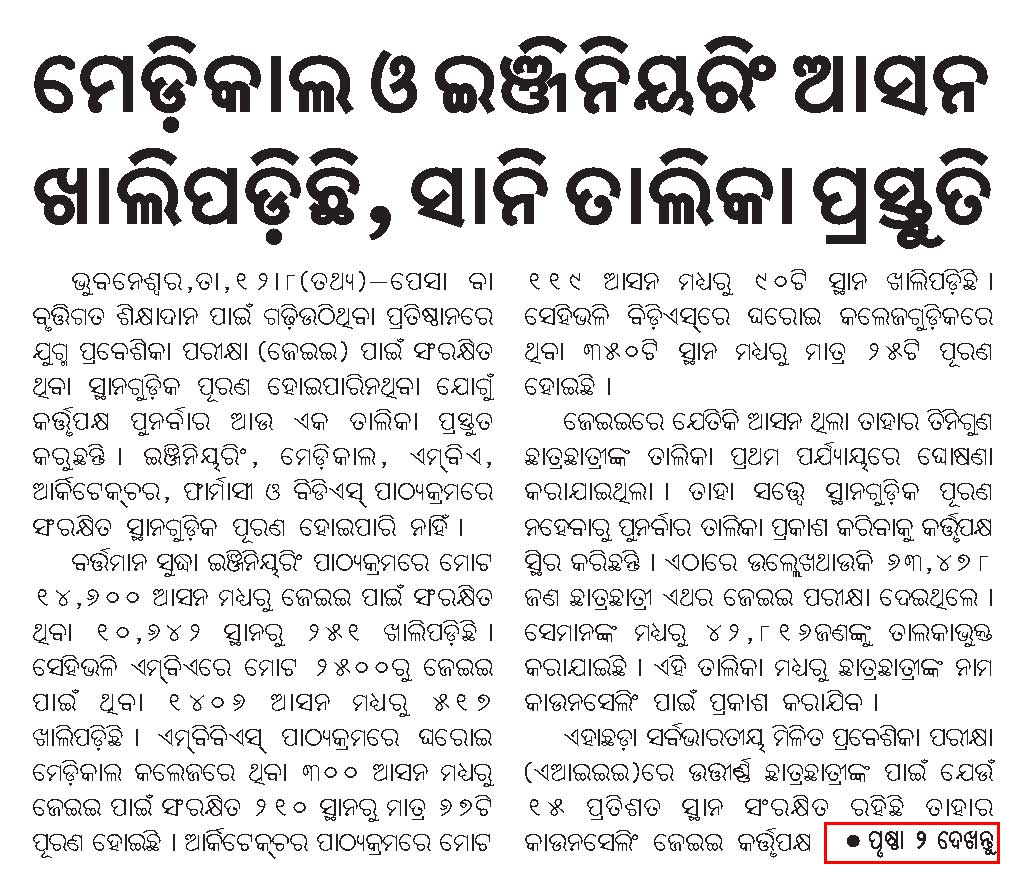
Samaja reports that BPUT will soon come up with an additional list and do additional round of counseling for that list to fill-up the left-over seats in Engineering, MBA etc. It says that out of a total 14,600 seats in engineering, of the 10,642 seats earmarked for JEE, 251 seats are left. Similarly, for MBA, out of 2500 seats, 1406 are earmarked for JEE and out of that 517 seats are left. In MBBS among the 300 seats in the private medical colleges, 210 are earmarked for JEE, and 143 seats are left. In architecture out of 119 seats 90 are left over. In BDS (dental) out of 350 seats 325 are left.
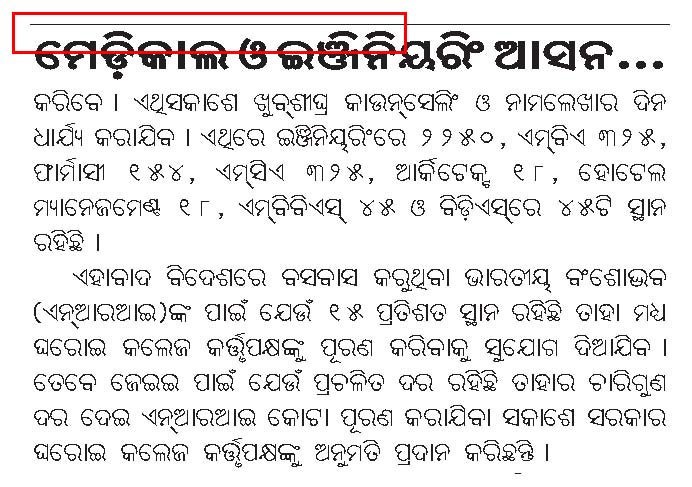
On AIEEE it mentions that the government will soon come up with the schedule. For AIEEE there are 2250 engineering seats, 325 MBA seats, 154 pharmacy seats, 325 MCA seats, 18 architect seats, 18 hotel management seats, 45 MBBS seats and 45 BDS seats.
In addition 15% seats are reserved for NRIs and they will be charged 4 times the amount charged for regular seats.
Often various sundry organizations oppose various industries that are coming up just for the heck of it. A better approach would be to make sure the industry does not adversely affect them and then convince the industry to do positive things for the area. The later includes setting up of engineering colleges and necessary infrastructure like township, roads, parks, playgrounds, schools, medical facilities etc. Finally such an approach is being taken by the Koshali Ekta manch vis-a-vis Vedanta and Kalahandi. Despite the fact that Vedanta is in the process of making a world class university near Puri, they should listen to this demand, if only to give value to this general approach. Moreover, making an engineering college, of the kind made by most private trusts in Orissa, does not cost much. One can start it with an initial budget of 10 crores and then it can become self -sustaining through student fees. So Vedanta should seriously consider this. Also, people in other areas where industries are coming up, or have come up should take a similar approach. For example, the people in Paradip and Kujanga, rather than being hostile to POSCO should negotiate with POSCO to establish a medical college & hospital and a top-notch engineering college like POSTECH in Korea, that was established by POSCO. Same with respect to the Tatas in Kalinganagar; people in Kalinganagar should negotiate with the TATAs to establish an engineering college and a medical college in Kalinganagar. The Mittals should be asked for the same in Patana, Keonjhar area; RSP/SAIL should be asked for the same in Rourkela; MCL+NTPC should be asked for the same in Talcher area and NALCO for the same in Anugul and Damanjodi.
Following is an excerpt of a Pioneer report that triggered the above thoughts.
Bhawanipatna: A meeting of the Koshali Ekta Manch has decided that a memorandum would be submitted on August 24 to Vedanta Alumina limited in order to establish an engineering college in Kalahandi. … Manch leaders Jagannath Mund, Govind Chandra Rath and Padma Kishore Pujari were present at the meeting.
BJB Junior College is the premier junior college of Orissa. Earlier we listed its arts and science merit lists. In the science merit list there are about 418 students who have secured more than 90% in their class X exam. Although I have not seen Ravenshaw Junior College’s list, my guess is the situation will be almost similar (may be a little bit less) percentage wise. BJB Junior College currently has 512 seats in plus two science and Ravenshaw (after the recent seat increase) has 384 seats.
I am an alumnus of BJB (when it had 384 seats) and have close friends from Ravenshaw. Based on my experience in BJB, and my subsequent experience in IIT Kharagpur Computer Sc and University of Maryland (where I had JEE number 1 of a year in one of my classes) I can say that at least 200 of BJB Jr plus two science students and 150 of Ravenshaw Jr plus two science students have the ability to make it to an IIT and do well in them.
Yet, as I am told, these days annually only about 10-12 fresh plus two pass outs from BJB Jr make it to IITs and may be another 10-12 older pass outs also make it. The result for Ravenshaw Jr is similar. Considering the quality of students that get into BJB Jr and Ravenshaw Jr, this result is dismal and is a shame.
One should just compare how similar colleges from others states do. Many of them send more than 100 students to IITs. An example is Little Flower Junior College of Hyderabad. (It was true in my time and as Partyusa confirms, it was true in his time too.)
Now, it is not the case that Orissa students (as aptly represented by BJB and Ravenshaw) are inferior than students from other states. They are as good, and often they do better (than what their incoming ranks would suggest) once they get in to a national institute.
So why is it that their result in the IIT entrance exam is so dismal!
From my analysis, experience and talking to other friends following are some of my thoughts on this.
1. Lack of Confidence; not believing in oneself: Many students hear about the performance of the previous year and when they find out that only 10-12 from their college made it to IITs, they figure that they won’t be among the top 10-12 in their batch and hence give up before starting. Many others start preparing for IIT but because of lack of confidence, give up mid way.
2. Negative advice: I have heard that certain teachers/seniors/parents/guardians give negative advice. They say that IIT is too hard and if one focuses so much on the IIT preparation then he/she may do badly in other exams and as a result, neither will he/she get IIT, nor will he/she get into the easier options through AIEEE and Orissa JEE.
3. Over dependence on low quality tuitions: Many students take multiple tutions and coaching classes that leaves them little time to study on their own. They depend on their tuition master’s notes rather than reading the books themselves.
4. Satisfied with easier alternatives: Some students set a lower goal for themselves. They notice that graduates from various private colleges in and around Bhubaneswar get well-paying jobs in recognized companies and decide why work hard to prepare for IIT.
Some basic advice to plus 2 students regarding getting into IITs
1. Confidence issues and countering the negative advice: The students who get into BJB jr and Ravenshaw jr colleges with more than or close to 90% marks in their Class X need not doubt their abilities. They will be successful in no matter what they do, provided they put their mind to it. Now, not every one needs to aim or go to IITs. But whatever field they decide for their career they should aim for the best college/institute in that field. So if Engineering is their choice then IITs and BITS should be in the top of their list and if science and maths is their interest then they should aim for NISER and IISERs. If one prepares for these entrance exams in a proper way then even if they are not successful for IIT/BITS/NISER/IISER they will do well in AIEEE, Orissa JEE and Plus 2 examination. The students that get into BJB jr and Ravenshaw jr are among the top 1000 students of Orissa. So there is no reason they should not get within the top 1000 of Orissa JEE and get into a very good local engineering college. With that excellent fall back option, BJB jr and Ravenshaw jr plus two science students interested in engineering should prepare for IIT with their full heart, and without any fear, but in a proper way.
2. A proper way for preparing for IIT and other entrance exams: First, only reading notes dictated by ones tuition master is the worst way for preparing for entrance exams. When a tuition master dictates notes, at best what it implies is that he/she has read the material from one or more places, hopefully understood it, and has made a summary of it. When someone else (a student taking tuition) just reads those notes he/she does not develop the same level of understanding as he/she would have developed if he/she had read the original material in the books himself/herself. Similarly, by only reading examples of solved problems (or listening to a tuition master explaining a solved problem) one does not develop the skill to solve problems. Unfortunately, many plus two students take multiple tuitions where their tuition masters dictate notes, and go through solved examples; they do not have time or energy left to read the text book and develop their own understanding and solve problems on their own to develop the problem solving skill. Now that we have discussed what is the wrong way; let us discuss the right or proper way.
* One must read one of the text books and develop their own understanding of a topic. It is ok to ask a teacher, including a tuition master, to clarify certain aspects that the student could not understand on his/her own. One may (does not have to) make their own notes based on their reading and understanding for quick revisions of the material later.
* For each topic, one must solve many problems on their own. Some of the problems may not be solvable in one sitting. Sometimes one may have to think about the problem, and may be go to sleep; may be in their subconscious they will get some insight of how to solve the problems. In other words, for any topic, pick one source (say X) that has a few solved problems and several problems to be solved (but with final answers). One should then read the material in the book, then read the material in X, then read the solved examples in X, and then solve the exercise problems in X on their own. They should not look at another source Y which may have solved some of the exercise problems in X. One needs to do their best, and if necessary spend 2-3 days thinking about the exercise problems in X that they could not immediately solve. Only after one does this kind of routine with respect to a topic and a source X, and has time, one may take a stab at another source Y. After working with source X, when working with source Y, one should try to not read all the solved examples of Y, but read a few of them and do the solved example problems (without looking at the solution) as well as the exercise problems on their own. However, in general, most students won’t have time to work with more than one source.
* In summary, one must read a book to understand the material (and make their own notes if they desire so) and pick one source (may be the study material of a postal coaching class, or a preparing for IIT book, etc.), and solve all its exercise problem on their own.
Now how does the above fit in with classes at your Junior College and the tuition that many student seem to be taking. I worry that there is not enough hours in a day for most people to take multiple tuitions, attend classes at BJB/Ravenshaw and then prepare in a proper way as I suggest above. So one has to make decisions.
I personally attended my classes at BJB, and prepared in the above way with my source being study material of a postal coaching class. I never took tuition in my life, and never attended a face-to-face coaching class.
=
Many coaching classes do simulated tests. Taking simulated tests are useful, but only if you have prepared in the proper way described above. Otherwise, they are not much useful as you would not have developed the understanding and problem solving skills necessary to answer hard question in an exam.
This is all for now. In my next write up I will discuss some studying as well as test taking strategies. But let me sum up the main thoughts in the above write up.
Most students in BJB and Ravenshaw junior colleges are good enough to get into IIT as well as succeed in it. All they need is to believe in themselves, ignore negative advices and prepare in a proper way.
Proper preparation means reading the text book (not notes dictated by someone) to develop understanding of topics and solving problems (not reading solved examples) on your own to hone your problem solving skills.
The NISER (National Institute of Science Education and Research) web page has a list of candidates who have been called for interview in Bhubaneswar. The list for the candidates invited for interview in Mumbai in connection with UM-DAE is here. Following is the information for interview for the interviews in Bhubaneswar, as given in the NISER web page.
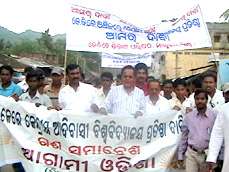
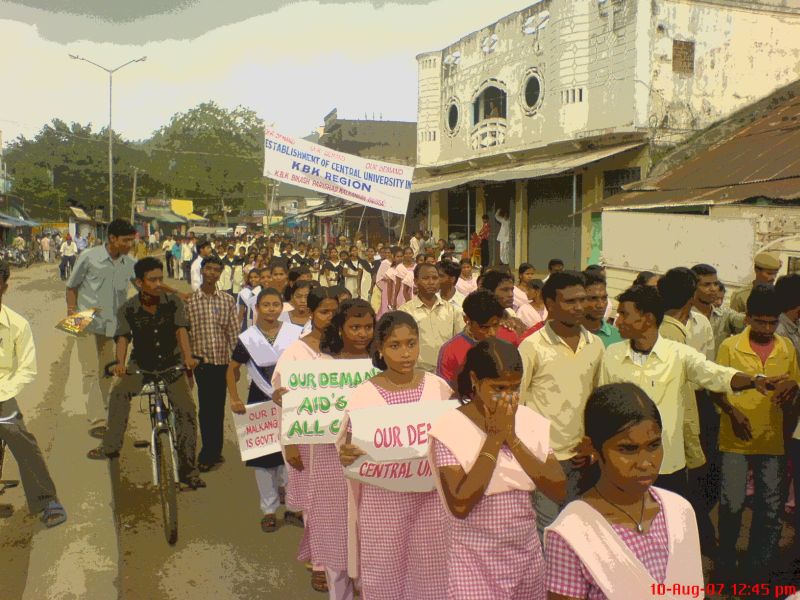
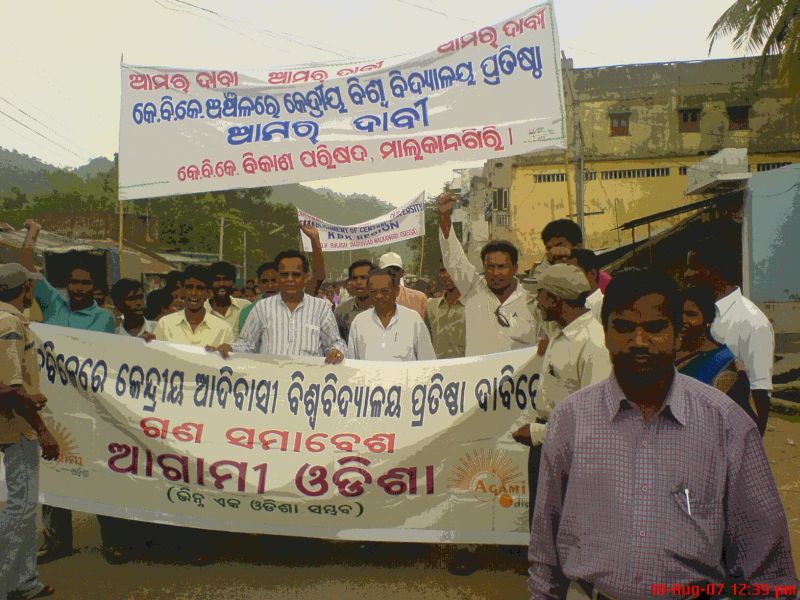
Following is Lalit Patnaik’s report and pictures on it.
Dear Friends,
On behalf of Agami Odisha, me and Dillip Sabat has been deputed to participate in the mass rally for demand of KBK university. Our President sri Dhiren Ray wished us good luck in the departing moment.
We have to travel 700 KM to reach Malkangiri from Bhubaneswar. 350 KM by Train up to Vizaynagaram, and subsequently by Bus another 225 Km through Ghat up to Jeypore and rest 125 Km through deep jungle to Malkangiri. We reached their in the early morning hours to be received by Malkangiri MLA Mr Nimai Sarkar and his associates. We proceeded to Dandakaranya Guest House and found Police in the nook and corner of Malkangiri town, the last one of Orissa before Chattishgarah. The town is Naxal infected and it needs courage to live there, for Police as well as for People.
Mr Sadan naik, MLA of Kodinga came along with his associate by 11 am and our rally started at 11.30 am from bus stand arena. I was really surprised to see the large gathering of students( Young men and women ) of not less than 1250 in number. There were around 250 Intellectuals, business men and retired old persons. The rally was led at three places, front one by Intellectuals, the middle one by the women students and the last one by Men students. the slogan of KBK University is our demand reverberated the high walls of Malkangiri Mountain and almost entire town was by the side road watching the marathon rally of nearly 1 Km long. The rally moved for 2 hours and culminated at Collector’s Office. Collector rushed to his office from a meeting some where else so as to receive our Memorandum to the President of India. Even after handing over of memorandum, the students were in no mood to disperse but went on giving slogans for their right to have a University around KBK. The people were aghast since long, because the nearest University of Berhampur is 500 Km away from their place.
Sincerity of their demand was well visible from the eyes of those boys as well as girl students. After wards, the president of their college walked close to me and expressed his thanks to Agamee odisha for taking up their cause. In return I assured him to carry their message to the Swabhimani odiya all over the world, to support in their endeavor to get an Central funded University at KBK.
They are struggling for their right to higher education, amidst the chaos of Naxalisim. They are not demanding their land to be annexed to Chattisgarah, a very close by State, nor are they demanding for more food or money but are only asking for a Central University, which we all should fight and get it for them, is not it. Are they not real swabhimani Odiya’s ?.
While staying 700 Km away from the capital, they are reciting the song of Mother Odiya, day in and day out.
MSS/NRTS (age below 15 for general, and below 16 for SC/ST)
NTS (Students studying in Class 10)
JBNSTS (Students who have passed 10 + 2 examination in this year and are studying Basic Sciences / Medical Sc. / Engineering in West Bengal are eligible)