(Thanks to http://www.rourkelacity.com/rdf/showthread.php?p=41#post41 for the pointer.) Following is an excerpt from a report in Ranchi Express.
State Health Minister Baithnath Ram on Monday informed the Assembly that approval letters have been sent to HEC, Ranchi and SAIL, Bokaro to start medical colleges at Ranchi and Bokaro respectively. About 250 students will be admitted in each medical college, Minister said.
Note that HEC Ranchi is a Government of India enterprise.
We have said this earlier but is worth repeating. Odisha must push the central public sectors that have large operations in Odisha, especially the ones that either use Odisha minerals, pollute Odisha or both to establish medical colleges in Odisha. So far they have pursued this strategy with MCL which has promised a medical college in Talcher.
Odisha government should immediately pursue with the other such public sectors.
- SAIL Rourkela should be pushed for a medical college in Rourkela.
- NALCO should be pushed for a medical college in one of the places it operates in Odisha.
- NTPC should be pushed for a medical college.
They should also do that with respect to some of the private sectors that have been using Odisha minerals. This includes:
- Tatas in the Kalinganagar area.
- Birlas in the Barbil area.
Some of our earlier articles on this topic:
March 17th, 2010
Following is an excerpt from a report in expressbuzz.com.
Koraput will soon be connected to the nationwide network of Council of Scientific and Industrial Research (CSIR) laboratories as it is chosen as an extension centre to have a pool of master trainers to train grassroots-level people in applied technologies in various fields.
The extension centre would be presently promoted by the State Government with an initial investment or Rs 30-40 lakh on a 25-acre land. However, it would soon have a full-fledged CSIR centre of Rs 40-50 crore investment with master trainers in agriculture, food and rural technologies, environment, biodiversity and food processing and for this a detailed proposal had already been submitted to the central authorities.
It would have active support from Institute of Minerals and Materials Technology (IMMT), Bhubaneswar, Central Foodcraft Technology Research Institute, Mysore, Central Institute of Medicinal and Aromatic Plants, Lucknow, North East Institute of Science and Technology, Jorhat, and Central Salt and Marine Research Institute, Bhavnagar.
According to IMMT Director Prof. Barada Kanta Mishra, the centre, to be built under `CSIR-800 Programme’ would also help in creating employment opportunity for the backward region in the southern part of Orissa which has seen a series of extremist activities recently.
It would also work as an interface to transfer laboratory-based knowledge to the rural people.
March 10th, 2010
Following is an excerpt from a report in Expressbuzz.com.
The Central University here will soon set up a medical college and hospital in Koraput. Vice-Chancellor Surobhi Benerjee announced this in a release today.
The university is now in the process of submitting the detailed project report (DPR) to the appropriate authorities.
She also said there would be a detailed discussion with Chief Minister Naveen Patnaik in this regard tomorrow.
Moreover, the university is going to start a school for bio-diversity and conservation of natural resources in collaboration with M.S. Swaminathan Research Foundation (MSSRF), Chennai.The authorities of the MSSRF have agreed to provide all support in establishing the school and run collaborative PG programmes. …
COMMUNITY RADIO: Besides, the university will set up a community radio station in Koraput for the development of the tribal community. A proposal for commissioning the radio station had been submitted to the Ministry of Information and Broadcasting. The university is also going to set up a centre for community welfare in Koraput.
SCHOOL OF HEALTH SCIENCE: Further, the university will sign an MoU with Jamia Hamdard University, New Delhi, in the area of nursing and public/ community health for its proposed school of health science (Nursing, public health and community health).
February 2nd, 2010
Following is from a report in Indiaedunews.
Proposed Central varsities in two remote areas of the country – Bihar and Kerala have received a denial from the Human Resource Development (HRD) ministry to host new Central universities for their states.
Far-flung Motihari and Kasargod in Bihar and Kerala respectively do not qualify up to the desirable standards for a site to be constructed for such universities as they lack the physical and social infrastructure to proceed.
The ministry is learnt to have asked the two states to come up with an alternative location for the set up.
The Central government clearly opposed the stand of the State governments, academics and development votaries who stood by the decision to host the new varsities in the remote areas of the country, which will boost its economy and help in creation of new and additional infrastructure.
The necessary conditions needed for the set up of a university in both Motihari nad Kasargod area are not feasible due to poor access, connectivity and lack in infrastructure in the form of good schools which are vital to attract quality faculty in the varsity.
While Kasargod, located in the northern part of Kerala suffers serious connectivity issues, Motihari in East Champaran in Bihar is considered a backward region.
The ministry felt that constructing such institutes in these areas will mar the whole criteria of establishment since they would not be able to provide quality education through qualified teachers, as they would not be interested to enter in such areas.
A similar problem has been faced by the Central University at Koraput in Orissa which is facing a serious faculty crunch in terms of quality.
Lack of adequate facilities, along with absence of good schools and hospitals are proving to be deterrents for the faculty who are unwilling to shift over to such areas.
In regards to Koraput, Orissa government needs to take some proactive steps quickly; before the problem becomes worse. Earlier we suggested the following.
- Start a daytime train between Bhubaneswar and Koraput. The distance between them is 679 kms. (Note that Koraput has daily overnight trains to Bhubaneswar and Howrah and a new daily train to Rourkela has been announced in this year’s budget.)
- Start an intercity between Visakhapatnam and Jeypore via Koraput. (Distance is 258 kms.)
- Open a knowledge park of 200 acres near the central university. This knowledge park should contain an STP, and other amenities. the state should invite trustees of some of the top private engineering colleges to establish educational institutions such as engineering colleges in this knowledge park.
In addition, the state should vigorously pursue the proposed airport in Jeypore.
December 31st, 2009
Following is from http://www.orissa.gov.in/health_portal/index.html.
Medical & Dental Colleges:
| Government Colleges |
| Sl.No. |
Name of the College |
Location |
Intake Capacity
|
| |
|
|
MBBS |
BDS |
| 1 |
S.C.B. Medical College |
Cuttack |
150 |
20 |
| 2. |
M.K.C.G. Medical College |
Berhampur |
150 |
– |
| 3. |
V.S.S. Medical College |
Sambalpur |
150 |
– |
Ayurvedic Colleges:
Government Institutions
|
Sl
|
Name of the Institute
|
Location
|
Courses Offered
|
Duration of The Course
|
Intake Capacity
|
|
1
|
Gopabandhu Ayurveda Mahavidyalaya
|
Puri
|
B.A.M.S.
|
5.5 years
|
30
|
|
2
|
Kaviraj Ananta Tripathy Sharma Ayurveda College, Akuspur
|
Akuspur, Berhampur
Ganjam
|
-do-
|
-do-
|
-do-
|
|
3
|
Government Ayurveda College
|
Bolangir
|
-do-
|
-do-
|
-do-
|
Private Institutions:
|
Sl
|
Name of the Institute
|
Location
|
Courses Offered
|
Duration of The Course
|
Intake Capacity
|
|
1
|
Mayurbhanj Ayurveda Mahavidyalaya
|
Baripada ,
Mayurbhanj
|
B.A.M.S.
|
5.5 years
|
30
|
|
2
|
Sri Sri Nrusingha Nath Ayurveda College & Research Institute
|
Paikmal , Baragarh
|
-do-
|
-do-
|
-do-
|
|
3
|
Indira Gandhi Memorial Ayurveda College & Hospital
|
Bhubaneswar
|
-do-
|
-do-
|
-do-
|
Homeopathic Colleges:
Government Institutions
|
Sl
|
Name of the Institute
|
Location
|
Courses Offered
|
Duration of The Course
|
Intake Capacity
|
|
1
|
Dr.Avirna Chandra Homeopathy Medical College & Hospital
|
Bhubaneswar
|
B.H.M.S.
|
5.5 Years
|
25
|
|
2
|
Orissa Medical College of Homeopathy & Research
|
Sambalpur
|
-do-
|
-do-
|
-do-
|
|
3
|
Utkalmani Homeopathy Medical College & Hospital
|
Rourkela
|
-do-
|
-do-
|
-do-
|
|
4
|
Biju Pattnaik Homeopathy Medical College & Hospital
|
Berhampur
|
-do-
|
-do-
|
-do-
|
Private Institutions:
|
Sl
|
Name of the Institute
|
Location
|
Courses Offered
|
Duration of The Course
|
Intake Capacity
|
|
1
|
Mayurbhanj Homeopathy Medical College & Hospital
|
Baripada
|
B.H.M.S.
|
5.5 Years
|
30
|
|
2
|
Cuttack Medical College of Homeopathy
|
Cuttack
|
-do-
|
-do-
|
-do-
|
Nursing Colleges:
|
BSc. Nursing Course in Government & Private College of Nursing
|
|
Sl. No.
|
Name of the College
|
Total Seats
|
|
1
|
College of Nursing, Berhampur
|
20
|
|
2
|
College of Nursing, Cuttack
|
20
|
|
3
|
SUM Nursing College, Bhubaneswar
|
20
|
|
4
|
Lord Jagannath Mission’s College of Nursing, Bhubaneswar
|
30
|
|
5
|
Neelachal Institute of Medical Science, Bhubaneswar
|
15
|
|
6
|
Manjari Devi College of Nursing, Bhubaneswar
|
20
|
|
7
|
Sushree Institute of Technical Education, CON, Bolangir
|
20
|
|
8
|
VISWAS College of Nursing, Bhubaneswar
|
25
|
|
9
|
Hi-Tech School of Nursing, Pandra, Rasulgarh, Bhubaneswar
|
30
|
|
10
|
Gajapati College of Nursing, Parala Khemundi, Gajapati
|
20
|
|
11
|
Jagannath Institute of Medical Scinece & Research, College of Nursing, Sahid Nagar, Bhubaneswar
|
25
|
|
12
|
Sri Vidya Niketan College of Medical Science & Research, Nayapalli, Bhubaeswar
|
20
|
| |
TOTAL
|
265
|
| Diploma Course in General Nursing and Midwifery Training |
|
Sl. No.
|
Name of the College
|
Total Seats
|
|
1
|
School of Nursing, SCB Medical College Hospital, Cuttack
|
100
|
|
2
|
School of Nursing, VSS Medical College Hospital, Burla
|
50
|
|
3
|
School of Nursing, MKCG Medical College Hospital, Berhampur
|
50
|
|
4
|
Nursing Training Institute (N.T.I.), I.G.H., SAIL, Rourkela
|
40
|
|
5
|
School of Nursing, N.S.C. Hospital, M.C.L., Talcher
|
10 + 10
|
|
6
|
SUM Nursing School, Bhubaneswar
|
20
|
|
7
|
Lord Jagannath Mission’s School of Nursing, Bhubaneswar
|
25
|
|
8
|
Kalinga Nursing School, Kalinga Hospital, Bhubaneswar
|
20
|
|
9
|
School of Nursing KIIT, Bhubaneswar
|
15
|
|
10
|
Sushree Institute of Technical Education, SON, Bolangir
|
20
|
|
11
|
Sushila Devi School of Nursing, Nuapada
|
20
|
|
12
|
Manjari Devi School of Nursing, Bhubaneswar
|
20
|
|
13
|
Hi-Tech School of Nursing, Bhubaneswar
|
20
|
|
14
|
Neelachal School of Nursing, Bhubaneswar
|
10
|
|
15
|
Mahavir School of Nursing, Cuttack
|
20
|
|
16
|
VISWASS School of Nursing, Bhubaneswar
|
20
|
|
17
|
New Hope Society School of Nursing, Berhampur
|
20
|
|
|
TOTAL
|
480
|
Pharmacy Colleges:
|
Government Colleges
|
|
Sl. No.
|
Name of the College
|
Total Seats |
|
1
|
Pharmacy Wing, SCB Medical College, Cuttack
|
60
|
|
Private College
|
|
Sl. No.
|
Name of the College
|
Total Seats
|
|
1
|
College of Pharmaceutical Sciences, Ballguall, Puri
|
60
|
|
2
|
College of Pharmaceutical Sciences, Mohuda, Berhampur
|
60
|
|
3
|
Gayatri College of Pharmacy, Jamadarapali, Sambalpur
|
60
|
|
4
|
Herbal Cross Institute of Pharmacy, Mahanadi Barrage Road, Nimpur, Jagatpur, Cuttack
|
40
|
|
5
|
Indira Gandhi Institute of Pharmaceutical Sciences, Bhubaneswar
|
60
|
|
6
|
Institute of Medical Technology, Gopalpur, Puri
|
60
|
|
7
|
Institute of Pharmacy & Technology, Salipur, Cuttack
|
60
|
|
8
|
Jeypore College of Pharmacy, Jeypore, Koraput
|
60
|
|
9
|
Kanaka Manjari Institute of Pharmaceutical Sciences, Rourkela, Sundargarh
|
60
|
|
10
|
Maa Mangala College of Pharmaceutical Sciences, Karanjia, Mayurbhanj
|
60
|
|
11
|
Mayurbhanj Medical Academy, Baripada, Mayurbhanj
|
60
|
|
12
|
Maruti Pharmacy College, Kalimandir Chowk, Bargarh
|
40
|
|
13
|
Orissa College of Pharmaceutical Sciences, Mahuli Pada, Dhenkanal
|
60
|
|
14
|
Om Sai College of Pharmacy and Health Sciences, Gopalpur on Sea, Ganjam
|
60
|
|
15
|
Pranabandhu Institute of Paramedical Sciences & Technology, Angul
|
60
|
|
16
|
Patitapabana Institute of Pharmaceutical Scineces % Tech. Gangapada, Bhubaneswar
|
60
|
|
17
|
Roland Institute of Pharmaceutical Sciences, Berhampur
|
60
|
|
18
|
Royal College of Pharmacy and Helath Sciences, Berhampur
|
60
|
|
19
|
Seemanta Institute of Pharmaceutical Sciences, Jharpokharia, Mayurbhanj
|
60
|
|
20
|
Sidheswar College of Pharmaceutical Sciences, Amarda Road, Balasore
|
60
|
|
21
|
Sri Jayadev College of Pharmaceutical Sciences, Naharkanta, Khurda
|
60
|
|
22
|
Sivananda College of Pharmaceutical Sciences, Near Engineering College Square, Panda Colony, Berhampur
|
60
|
|
23
|
The College of Pharmaceutical Sciences, Tamando, Khurda
|
60
|
|
24
|
The Institute of Pharmaceutical Sciences of Tech., Padmapur, Bahugram, Cuttack
|
60
|
|
25
|
The Pharmaceutical College, Barpali, Bargarh
|
60
|
|
26
|
Gayatri Institute of Pharmaceutical Sciences, Gunpur, Rayagada
|
40
|
|
27
|
Institute of Pharmaceutical Sciences, Balasore
|
60
|
|
28
|
Dadhichi College of Pharmacy, Vidya Vihar, Sundergram, Cuttack
|
60
|
|
29
|
Hi-Tech College of Pharmacy, Pandara, Rasulgarh, Bhubaneswar
|
40
|
|
30
|
Gajapati College of Pharmacy, Ranipendha, Paralakhemundi, Gajapati
|
40
|
|
31
|
Kalinga Institute of Pharmaceutical Sciences, Nuasahi, Balia, Balasore
|
40
|
|
32
|
Balakrushna College of Pharmacy, Nuapada
|
40
|
|
|
TOTAL
|
1840
|
December 10th, 2009

December 6th, 2009
Following is extracted from Swaha Sahoo’s report at http://in.news.yahoo.com/32/20091203/1053/tnl-makeshift-universities.html. It originally appeared in Hindustan Times. (The article has the first name of the CUO VC wrong. Her name is Surabhi Banerjee and not Saswati Banerjee.)
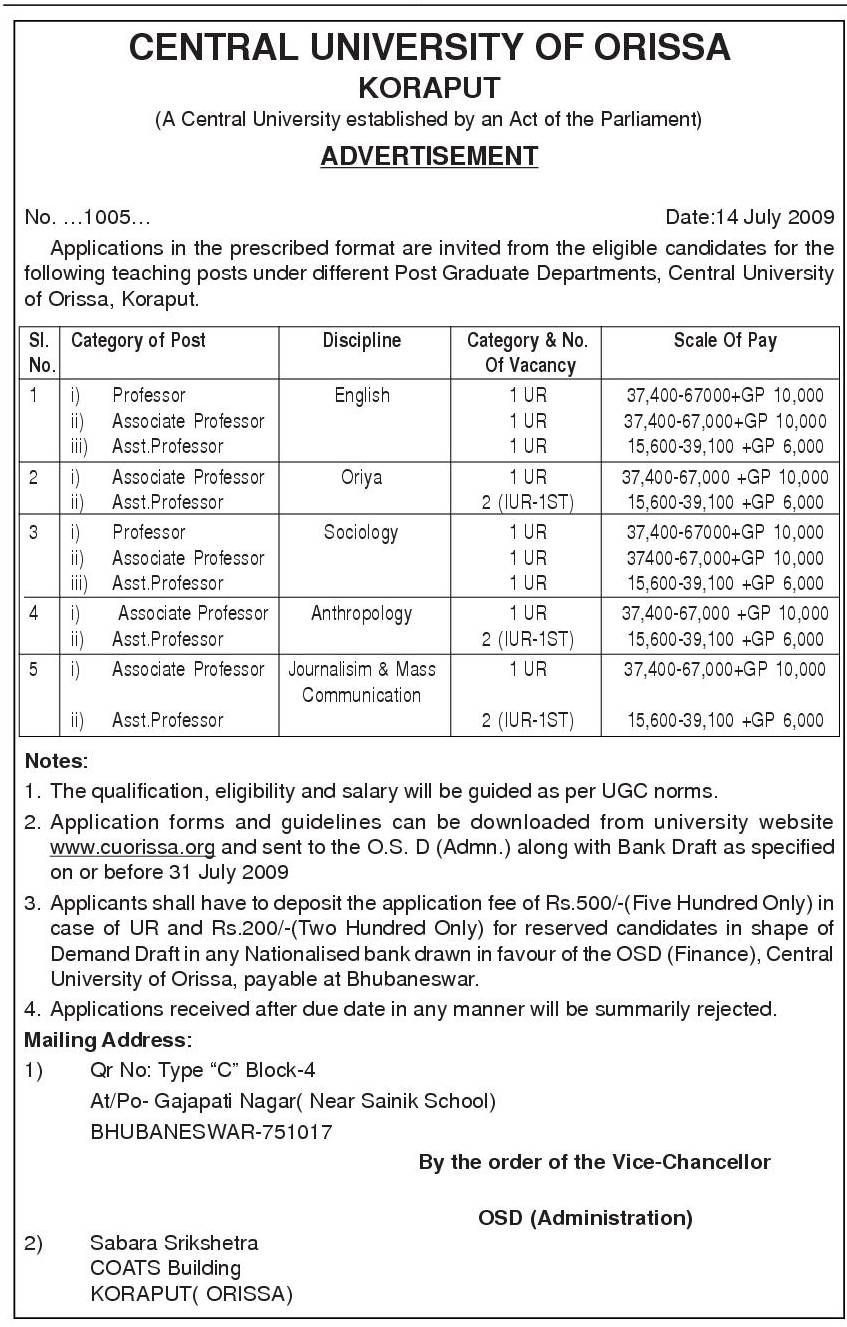
- Central University of Orissa, Koraput: Started with four teachers taking post-graduate courses in English, Oriya, sociology, anthropology and tribal studies, and journalism and mass communication. One lecturer left soon after joining."We are not short of faculty and have visiting teachers. The procedure to appoint regular faculty takes time," said vice-chancellor …. The university has plans to appoint 15 faculty members initially. With 150 post-graduate students … Guest lecturers are not too keen on visiting the Central University of Orissa because reaching Koraput, 450 km southwest of state capital Bhubaneswar, is difficult. A single passenger train a day runs from the state capital Bhubaneswar and takes 18 hours to reach Naxal-affected Koraput. The closest airport is in Vizag in Andhra Pradesh, a five-hour drive. "Unless some sort of infrastructure development happens in and around the central universities, attracting faculty and providing quality education will be difficult,” said … Banerjee.
- Central University of Haryana, Mahendragarh: Lord Krishna Central University of Haryana has been functioning temporarily from the Government Education College at Narnaul, the headquarters of Mahendergarh district, about 130 km west of Delhi. There is no place for teachers and students to stay at the college campus. There is a community health centre (CHC), only one cinema hall, a government school, and a few private schools in Mahendergarh. About 40 km from this place, about 500 acres of panchayat land for the university is under transfer. The process of admission for the M Phil and Ph D courses in English, Economics and Political Science is on. The temporary administrative office of the university is in Gurgaon, adjacent Delhi.
- Central University of Bihar: The state government wants to set up the central university in Motihari, 135 km north of Patna. Vice-Chancellor Janak Pandey has proposed for setting up a multi-centre campus, with Motihari as the main venue. Motihari does not have air connectivity. The university is functioning at a makeshift campus in Patna, mostly with teachers on contract from the Tata Institute of Social Sciences, Mumbai, and the Institute of Development Studies, Jaipur. … In Bihar, the HRD ministry has attached conditions to the state government’s proposal for a central university at Motihari, 135 km north of Patna. Sibal wrote to Bihar Chief Minister Nitish Kumar in October that the state government should develop infrastructure such as roads and air connectivity as soon as possible.
- Central University of Kerala: .. began two interdisciplinary courses – MA in Comparative Literature and Economic Theory and Global Governance – while only five of the 25 seats in Economics and 15 of the 25 seats in English filled. Teacher shortage …
- Central University of Gujarat: … 25 posts have been sanctioned, but since recruitment is yet to take place, the university has begun functioning with three teachers on contract, temporarily in Gandhinagar. Land is yet to be allotted.
- Central university of Karnataka: “We have constructed just a boundary wall on the 621 acres of land handed over to us and will soon begin construction,” said A.M. Pathan, vice-chancellor of the Central University of Karnataka.
- Most of the universities have come or are slated to do so in educationally backward areas such as Koraput (Orissa), Thiruvarur (332 km south of Chennai), Gulbarga (663 km north of Bangalore), Mahendragarh (in Haryana; 130 km from Delhi), Kasargod (650 km north of Thiruvananthapuram) and Bathinda (Punjab; 146 km west of Chandigarh). The following have temporary locations: Patna, Brambey (20 km west of Ranchi in Jharkhand), Jaipur, Gandhinagar and Kasrgod. The ones in Himachal Pradesh and Jammu & Kashmir have not started functioning.
- … only five central universities (Haryana, Karnataka, Orissa, Punjab and Tamil Nadu) have managed to find land for setting up permanent infrastructure.
- In Himachal Pradesh, for instance, the dispute between the state and Central governments has come in the way of setting up the campus.
The following table from http://www.orissa2020.org/appendix/location-of-new-central-universities gives a bit more information on the locations.
| City – Metropolitan area |
State |
Metro population |
| Gandhinagar – Ahmedabad (temporary?) |
Gujarat |
5,334,314 |
| Srinagar |
J & K |
1,104,489 |
| Khunti, Ranchi |
Jharkhand |
1,066,449 |
| Jammu |
J & K |
690,924 |
| Bikaner (Changed to near Ajmer, 80 kms from Jaipur) |
Rajasthan |
624,577 613,000 |
| Gulbarga |
Karnataka |
534,417 |
| Sagar |
Madhya Pradesh |
351,537 |
| Bilaspur |
Chhatisgarh |
319,129 |
| Bathinda |
Punjab |
269,520 |
| Koraput-Sunabeda-Jeypore |
Orissa |
200,000 |
| Motihari |
Bihar |
121,475 |
| Tiruvarar |
Tamil Nadu |
61,270 |
| Kasaragod |
Kerala |
52,683 |
| Tehri Garhwal |
Uttarakhand |
25,425 |
| Mahendragarh |
Harayana |
23,977 |
| Kangra |
Himachal Pradesh |
9,155 |
These are all teething problems and as the campuses get built things will change for the better. Despite these problems, it is wise that many of the states picked the backward areas for these universities.
Some of the things the Orissa government needs to do is:
- Start a daytime train between Bhubaneswar and Koraput. The distance between them is 679 kms. (Note that Koraput has a daily train to Howrah and a new daily train to Rourkela has been announced in this year’s budget.)
- Start an intercity between Visakhapatnam and Koraput. (Distance is 216 kms.)
- Open a knowledge park of 200 acres near the central university. This knowledge park should contain an STP, and other amenities. the state should invite trustees of some of the top private engineering colleges to establish educational institutions such as engineering colleges in this knowledge park.
Another point to note is that Central University of Bihar VC is planning a multi-center campus. CU Orissa should do the same and have multiple centers in the KBK region.
December 5th, 2009
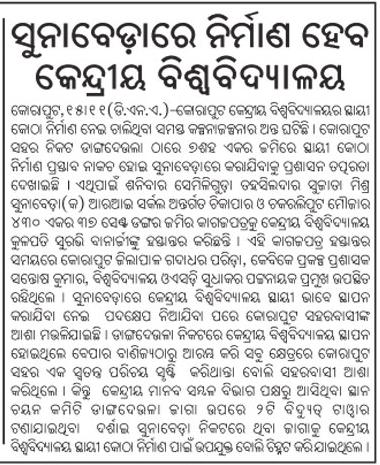
November 16th, 2009
Following is an excerpt from a report in Business Standard.
The newly established Central University of Orissa at Koraput aims to set up five new schools in the academic session of 2010.
The proposed new schools include the School of Basic Sciences, School of Health Sciences, School of Development Studies, School of Indigenous Studies and School of Biodiversity Studies.
… The new schools would offer courses in subjects like mathematics, economics, nursing, pharmacy and community health.”For starting the School of Health Sciences, the Central University of Orissa is mulling tie-ups with Jamia Hamdard, New Delhi and for School of Community and Public Health with the University of Minnesota, US.
The Central University of Orissa will set up a Centre for Peace and Sustainable Development next year. The University also intends to run joint research projects and programmes with the Mahatma Gandhi Institute of Education for Peace and Sustainable Development, New Delhi. The Central University plans to offer PHD in five subjects- English, Hindi, sociology, anthropology as well as journalism and mass communication from 2010.
“We are going to sign a MoU (Memorandum of Understanding) with the British Council for holding English language teaching workshops once in every three months. Our university will also enter into a MoU with the Chennai Mathematical Institute University (CMIU) and under this MoU, the faculty from CMIU will visit our campus from the 2010 academic session”, said Banerjee.
At present, the Central University of Orissa has two schools- School of Languages and School of Social Sciences. While the School of Languages offers post graduate programmes in English and Hindi; the School of Social Sciences offers post graduate courses in sociology, anthropology as well as journalism and mass communication.
Now the following is from Dharitri.
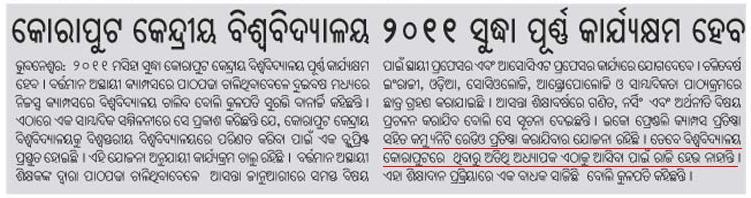
One needs to take note of the underlined sentence. I think in future when we have central institutions in "remote" areas, we should at least let it start for a year in a less remote location so that when they are depending on visiting faculty they are able to attract them. Once they hire permanent faculty the remoteness of the location will become less relevant.
October 23rd, 2009
The following list is based on the information in the page http://sctevtorissa.in/collegedetail.aspx?Cid=2 extracted today.
Bhubaneswar-Cuttack-Khurda-Puri area:
- BOSE, Cuttack
- DRIEMS, Tangi
- ITT, Choudwar
- Dhabaleswar Institute of Polytechnic, Athagarh
- Gurukrupa Technical School, Narsinghpur, Cuttack
- Kalinga Polytechnic, Bhubaneswar
- Nilachal Polytechnic, Bhubaneswar
- Women’s Polytechnic, Bhubaneswar
- Krupajal Engineering School, Bhubaneswar
- CV Raman Polytechnic, Bhubaneswar
- Koustav School of Engineering, Bhubaneswar
- CIPET, Bhubaneswar
- Bhubaneswar Polytechnic, Bhubaneswar
- Nalanda Institute of Technology, Bhubaneswar
- Suddhananda Residential Polytechnic, Phulnakhara
- Ganesh Institute of Engineering & Technology, Bhubaneswar
- Swami Vivekenanda School of Engineering & Technology, Bhubaneswar
- ARYAN INSTITUTE OF ENGINEERING TECH, Bhubaneswar
- Ideal School of Engineering, Retang, Khurdha
- Puri Engineering School, Puri
Berhampur area:
- SMIT, Ankuspur
- UCPES, Berhampur
- Women’s Polytechnic, Berhampur
- BSET, Berhampur
- Gandhi School of Engineering, Berhampur
- Aumasi Institute of Technical Education, Berhampur
- Kalam Institute of Technology, Berhampur
Koraput-Jeypore area:
- IEM, Jeypore
- Hi-Tech Institute of Information Technology, Jeypore
- Jeypore School of Engineering & Technology, Jeypore
- Siddhartha Institute of Engineering & Technology, Koraput
- SCSITM, Semiliguda
Rourkela area:
- Purusottam School of Engineering & Technology, Rourkela
- RIT, Kalunga
- SKDAV, Rourkela
- UGIE, Rourkela
Angul-Talcher-Dhenkanal area:
- IGIT, Saranga
- Pabitra Mohan Institute of Technology, Talcher
- KIMET, Chhendipada, Angul
- Women’s Polytechnic, Dhenkanal
- Orissa Institute of Engineering & technology, Dhenkanal
- Pathani Samanata Institute of Engineering & Technology, Dhenkanal
Jharsuguda-Sambalpur-Baragarh-Sundergarh area:
- JES, Jharsuguda
- BDSE, Brajarajnagar
- SES, Sundergarh
- PKAIET, Baragarh
Rayagada area:
- MITS INSTITUTE OF POLYTECHNIC, RAYAGADA
- UGMIT, Rayagada
Others:
- BSET, Barapada (Bhadrakh)
- BSE, Balasore
- MSE, Baripada
- SITE, Bolangir
- Kalahandi School of Engineering & Technology, Bhawanipatana (Kalahandi)
- Biju Patnaik Institute of Technology, Phulbani (Kandhamala)
- OSME, Keonjhar
- Sri Polytechnic, Komonda, Nayagarh
- Mahamaya Institute of Medical & Technology Science, Nuapada
October 11th, 2009
Update: The following was written before I saw this article in Pioneer.
Tathya.in has a report on Dr. Digamabara Patra’s request for a national or central university in Bhawanipatna, Kalahandi. A lot of the arguments made there make sense. Many of the recent central universities have been established in rural and semi-urban areas and indeed there is no reason why one should not be established in Bhawanipatna; especially since its citizens have been asking for one for more than 2 decades.
However, as mentioned in the article https://www.orissalinks.com/archives/3229 adequate infrastructure seems to have been an important factor in determining the locations of the new IITs, IIMs and National universities.
For Orissa to have them in locations ouside of Bhubaneswar, there are two ways to go about it.
- Argue that adequate infrastructure should not be a requirement or they will automatically come once the institutions are established.
- Develop areas outside Bhubaneswar to have adequate infrastructure.
To me pursuing (2) has a higher chance of success than pursuing (1) and even if (1) is successful the institutes/universities in locations without appropriate infrastructure will struggle until the infrastructure eventually catches up which may take a long time if just left to fate. (Such a struggle may result in Orissa not being given in appropriate numbers additional central/national institutes.)
[In India people sometime point out that IIT Kharagpur was established in a rural location. First, Kharagpur is only 116 kms from Howrah. Second it has been a major railway junction for a long time. Third it was the first IIT and for a long time only one of 5 IITs. Similarly Roorkee was the oldest engineering college and is close to Haridwar and Dehradun. There are a few top universities and institutions in the US that are in rural areas, but these are exceptions, and the infrastructure in rural areas of US are quite good compared to rural areas of India. For example, Univ of Illinois at Urbana Champaign and Penn State University in State College, PA are often mentioned in that context. But both do have small airports with commercial flights.]
Before we suggest what needs to be done regarding developing areas outside Bhubaneswar to have adequate infrastructure, let us address what may be coming in the future and why Orissa needs to do this urgently so as to not risk missing future allocations of national institutions.
The National Knowledge Commission (NKC) in its December 2006 note on higher education has explicitly suggested 50 national universities in India. It says:
We recommend the creation of up to 50 National Universities that can provide education of the highest standard. As exemplars for the rest of the nation, these universities shall train students in a variety of disciplines, including humanities, social sciences, basic sciences, commerce and professional subjects, at both the undergraduate and post-graduate levels. The number 50 is a long term objective. In the short run, it is important to begin with at least 10 such universities in the next 3 years. It is worth noting that the National Universities need not all be new universities. Some of the existing universities could also be converted into National Universities, on the basis of rigorous selection criteria, to act as exemplars. We recognise that there could be a human resource constraint if faculty members are not available in adequate numbers to establish these universities.
The current government has implemented most of the recommendations of the NKC and exceeded some of them. For example, instead of the recommendation of 10 national universities in the three years following the report (2007-2010), establishment of 14 have been announced. Moreover, the higher education budget has been increasing drastically from one five year plan to the next. The 12th five year plan starts in 2012 and it is expected that it will take up on the long range objectives of the knowledge commission. In other words there could and should be more central and national universities in the 12th plan.
[My impression is that how soon additional national universities are established will depend on the success of the first 14. It seems to me that the locations of the first 14 have been greatly influenced by the consideration of, where in each of the states selecetd, does it have the best chance to succeed.]
Unless Orissa is prepared for it, Orissa may lose out pieces of those plans on lack of infrastructure grounds. Other states with multiple locations with adequate infrastructure will get preference and Orissa may lose out.
However, 2012 is still 3 years away and if adequate steps are taken very soon, Orissa should be able to get its fair share.
The pity is there are areas in Orissa which are on the verge of having the necessary infrastructure, mostly through private investment, but because of non-constructive opposition, blind suspicion towards industrialization and the relcucatnce of many to speak out in favour of development and industrialization, the development and associated infrastructure building has been greatly hampered. The governments (state and center) are also at fault for their sluggishness on some aspects.
Following are some suggestions:
- The state government should push for the completion of the airport in Jharsuguda within a year.
- It should make an all-out effort to have commercial flights operating out of the existing airport in Rourkela. In general, the people of the area need to recognize the existing infrastructure and potential of Rourkela and take advantage of it. Currently, as a friend of mine would say, Rourkela is an orphan. This is a pity. It is a big asset to Orissa, especially to the western parts of Orissa; but is severely underutilized and undermined.
- Coming back to Jharsuguda, the people there should follow a smarter approach in not opposing and rather facilitating industries coming up there, and at the same time being vigilant about environmental and land acquisition related R & R issues. If these industries and investment are allowed to materialize there soon, then Sambalpur-Jharsuguda area would become a large metro with adequate infrastructure to have and support any and all kinds of institutes and universities. But will the people do that? Or will they continue to be controlled by or scared of the anti-industry activists.
- Similarly, both Bhawanipatna (Lanjigarh to be precise) and Rayagada areas have industrial investors who have been senselessly opposed. If the people would take a smarter approach that mixes development with being vigilant about environmental and land acquisition related R & R then both these areas would be able to get infrastructure where a central university (and possibly more) would flourish. But will the people do that? Or will they continue to be controlled by or scared of anti-industry activists. In Lanjigarh, Kalahandi, the local MP has recently taken a more sensible approach. I hope there is a quick resolution as this area desperately needs development and the resulting infrastructure.
- The state government should push for the rail infrastructure, particularly, the Khurda-Balangir line, the Talcher-Bimlagarh line and connectivity to Kalahandi, to be completed at the earliest.
The above is extremely important for the development of the western parts of Orissa where there is often a feeling of neglect. If the people there do not follow a smarter approach and only follow the strange approach that many (not all) seem to be following (such as opposing industrialization and thus infrastructure building but wanting things that need infrastructure) the places that follow a smarter approach (inside and outside Orissa) would be gainers. The same is happening in some other places in Orissa too – Paradeep and Kalinganagar come to mind, but these places are in closer proximity to Bhubaneswar and because of that they may be less harmed.
October 4th, 2009
Update on 27th April 2011: The Central University location has been changed to Bander Sindri near Ajmer and only 80 kms from Jaipur. The Innovation University (previsouly referred to as National University) aiming for world class is now pushed for Jaipur. [Times of India].
Tathya.in has a report that mentions some official saying that because of the lack of an airport in Rourkela central government will not agree to have ESIC medical college in Rourkela. I think this is a completely frivolous argument; I don’t see much connection between an ESIC medical college and an airport. (Often airport is a codeword for adequate infrastructure. If that is the case Rourkela indeed has the infrastructure for an ESIC medical college.)
However, in regards to certain centrally funded institutions, such a requirement is in the background and mentioned by journalists, even if they may not be spelled out explicitly. So while pushing for an ESIC medical college in Rourkela, we should set our target to push for more functioning airports as a next action item. Following is a more detailed analysis.
Given below are the locations of some national institutions and some related attributes. It is easy to see that for the locations of IITs, IIMs and National Universities being near (say within 120 kms or 2 hrs) an operational airport has been an important factor. For national universities, in addition being in a large (1 million plus metropolitan area) area with other research institutes has also been spelled out as an important criteria and it is reflected in the locations that are picked.
On the other hand, the newly established central universities are in towns of all sizes and the locations of the NITs are mixed. The next level centrally funded but locally focused technological institutes, SLIET, Longowal, ABAGKC IET, Malda and Central Institute of Technology, Kokrajhar are on purpose established in rural areas and smaller towns. Unlike the NITs these institutions take only local students and also have programs focused on local needs. Nevertheless, their quality need not be bad. For example, SLIET is considered quite good.
Looking to the future following are some points relevant to Orissa.
- For Orissa to have future central institutions like IIM, SPA, etc. to be in a location outside of Bhubaneswar, Orissa must push for the quick establishment of airports and other infrastructure in other parts of the state. For example, the airports in Jharsuguda and Rourkela are the closest to be operational and they should have scheduled flights at the earliest. Otherwise new centrally funded institutions may again be established near Bhubaneswar and crying hoarse after the fact may not be productive.
- Similarly the knowledge commission has proposed the establishment of 50 national universities in the long run. Considering that the education budget significantly increases from one 5 yr plan to the next, I would not be surprised if there is another set of them made during the 12th plan. Orissa must be prepared for that and by that time (there is a short window) have other areas in Orissa with adequate infrastructure that are being deemed necessary for a national university.
- Orissa must take advantage of the industrial and investment interests in Orissa, mostly due to its minerals, and develop metropolitan areas with larger population base. Currently the local people are creating roadblocks rather than helping in such development.
- In 2010 we should do our best to convince the planning commission, the PM and MHRD that the 12th plan (starting 2012) should include more centrally funded institutions of the kind that can be located in rural or semi-urban areas. In particular,
- A centrally funded but locally focused technological institute (like SLIET) in all states. The one in Orissa could be located in Kalahandi or Balangir, the other two KBK districts that lack centrally funded institutions.
- Two regional universities in each major states that are funded 50-50 by the state and the center. (This would be better than one centrally funded institute.)
- Multiple branches of Indira Gandhi National Tribal University in districts with high tribal population.
The NITs.
| City/Town |
State |
Population of city/town |
Population rank |
| Delhi |
Delhi |
18,639,762 |
2 |
| Surat |
Gujarat |
3,196,799 |
10 |
| Jaipur |
Rajasthan |
3,102,808 |
11 |
| Patna |
Bihar |
2,656,318 |
13 |
| Nagpur |
Maharashtra |
2,569,775 |
14 |
| Bhopal |
MP |
1,751,766 |
17 |
| Allahabad |
UP |
1,272,612 |
31 |
| Jamshedpur |
Jharkhand |
1,252,815 |
33 |
| Srinagar |
J & K |
1,104,489 |
41 |
| Calicut |
Kerala |
1,000,802 |
46 |
| Tiruchirapalli |
Tamil Nadu |
963,237 |
49 |
| Jalandhar |
Punjab |
958,854 |
50 |
| Raipur |
Chhatisgarh |
795,104 |
56 |
| Dehradun |
Uttarakhand |
738,889 |
57 |
| Warangal |
Andhra Pradesh |
656,298 |
61 |
| Surathkal, Mangalore |
Karnataka |
612,374 |
66 |
| Pudducherry |
Pudducherry |
575,027 |
71 |
| Rourkela |
Orissa |
550,668 |
75 |
| Durgapur |
West Bengal |
543,922 |
77 |
| Shillong |
Meghalaya |
304,596 |
136 |
| Aizawl |
Mizoram |
295,864 |
140 |
| Imphal |
Manipur |
279,679 |
147 |
| Agartala |
Tripura |
218,028 |
184 |
| Silchar |
Assam |
209,543 |
193 |
| Kurukshetra (Thaneswar) |
Punjab |
157,609 |
249 |
| Panaji |
Goa |
142,336 |
271 |
| Kohima |
Nagaland |
103,210 |
407 |
| Gangkot |
Sikkim |
32,483 |
|
| Hamirpur |
Himachal Pradesh |
17,219 |
|
The IITs.
| City – Metropolitan area |
State(s) |
Metro population |
Metro rank |
State or country Capital |
Rank in state |
Number 1 in the state |
Nearest airpot |
Preferred airport |
| Bombay |
Maharashtra |
21347412 |
1 |
Yes |
1 |
picked |
in area |
same |
| Delhi |
UP, Delhi, Haryana |
18639762 |
2 |
Yes |
1 |
picked |
in area |
same |
| Chennai |
Tamil Nadu |
7305169 |
4 |
Yes |
1 |
picked |
in area |
same |
| Hyderabad |
Andhra Pradesh |
6290397 |
6 |
Yes |
1 |
picked |
in area (60 kms away) |
same |
| Gandhinagar – Ahmedabad |
Gujarat |
5334314 |
7 |
Yes |
1 |
picked |
Ahmedabad (40 kms) |
same |
| Kanpur |
Uttar Pradesh |
3494275 |
9 |
No |
1 |
picked |
in area (only Air India) |
Lucknow (80 kms) |
| Patna |
Bihar |
2656318 |
13 |
Yes |
1 |
picked |
in area |
same |
| Indore |
Madhya Pradesh |
2049193 |
15 |
No |
1 |
picked |
in area |
same |
| Bhubaneswar |
Orissa |
1666429 |
22 |
Yes |
1 |
picked |
in area |
same |
| Guwahati |
Assam |
1038071 |
44 |
Yes |
1 |
picked |
in area |
same |
| Ropar – Chandigarh |
Punjab |
1033671 |
45 |
Yes |
3 |
Ludhiana (19) |
Chandigarh (60 kms away) |
same |
| Jodhpur |
Rajasthan |
987919 |
47 |
No |
2 |
Jaipur (11) |
in area |
same |
| Kharagapur |
West Bengal |
511303 |
82 |
No |
5 |
Kolkata (3) |
Kolkata (120 kms away) |
same |
| Roorkee – Haridwar |
Uttarakhand |
250645 |
166 |
No |
2 |
Dehradun (57) |
Dehradun (1 hr away) |
Delhi (180 kms) |
| Mandi |
Himachal Pradesh |
32014 |
|
No |
3 |
Shimla (194) |
Kullu-Manali airport (60 kms away) |
same |
National Universities
| City – Metropolitan area |
State(s) |
Metro population |
Metro rank |
State or country Capital |
Rank in state |
Number 1 in the state |
Airport with scheduled flights |
Other airport nearby |
| NOIDA – Delhi |
UP, Delhi, Haryana |
18639762 |
2 |
Yes |
1 |
picked |
yes |
|
| Kolkata |
West Bengal |
15414859 |
3 |
Yes |
1 |
picked |
yes |
|
| Gandhinagar – Ahmedabad |
Gujarat |
5334314 |
7 |
Yes |
1 |
picked |
yes |
|
| Pune |
Maharashtra |
5273211 |
8 |
No |
2 |
Mumbai (1) |
yes |
|
| Jaipur |
Rajasthan |
3102808 |
11 |
Yes |
1 |
picked |
Yes |
|
| Patna |
Bihar |
2656318 |
13 |
Yes |
1 |
picked |
yes |
|
| Bhopal |
Madhya Pradesh |
1751766 |
17 |
Yes |
2 |
Indore (15) |
yes |
|
| Bhubaneswar |
Orissa |
1666429 |
22 |
Yes |
1 |
picked |
yes |
|
| Coimbatore |
Tamil Nadu |
1644224 |
23 |
No |
2 |
Chennai (4) |
yes |
|
| Kochi |
Kerala |
1541175 |
24 |
No |
1 |
picked |
yes |
|
| Visakhapatnam |
Andhra Pradesh |
1511687 |
26 |
No |
2 |
Hyderabad (6) |
yes |
|
| Mysore |
Karnataka |
1230039 |
34 |
No |
2 |
Bangalore (5) |
New airport but no scheduled flights yet |
140 kms from Bangalore |
| Amritsar |
Punjab |
1206918 |
36 |
No |
2 |
Ludhiana (19) |
yes |
|
| Guwahati |
Assam |
1038071 |
44 |
Yes |
1 |
picked |
yes |
|
New Central Universities
| City – Metropolitan area |
State |
Metro population |
| Gandhinagar – Ahmedabad (temporary?) |
Gujarat |
5,334,314 |
| Srinagar |
J & K |
1,104,489 |
| Khunti, Ranchi |
Jharkhand |
1,066,449 |
| Jammu |
J & K |
690,924 |
| Bikaner (Changed to be in Bander Sindri, near Ajmer, 80 kms from Jaipur) |
Rajasthan |
624,577 613,293 |
| Gulbarga |
Karnataka |
534,417 |
| Sagar |
Madhya Pradesh |
351,537 |
| Bilaspur |
Chhatisgarh |
319,129 |
| Bathinda |
Punjab |
269,520 |
| Koraput-Sunabeda-Jeypore |
Orissa |
200,000 |
| Motihari |
Bihar |
121,475 |
| Tiruvarar |
Tamil Nadu |
61,270 |
| Kasaragod |
Kerala |
52,683 |
| Tehri Garhwal |
Uttarakhand |
25,425 |
| Mahendragarh |
Harayana |
23,977 |
| Kangra |
Himachal Pradesh |
9,155 |
IIMs
| City – Metropolitan area |
State |
Metro population |
Airport |
| Kolkata |
West Bengal |
15414859 |
in area |
| Bangalore |
Karnataka |
6466271 |
in area |
| Ahmedabad |
Gujarat |
5334314 |
in area |
| Lucknow |
Uttar Pradesh |
2991280 |
in area |
| Indore |
Madhya Pradesh |
2049193 |
in area |
| Ranchi |
Jharkhand |
1066449 |
in area |
| Kozhikode |
Kerala |
1000802 |
in area |
| Tiruchirapalli |
Tamil Nadu |
963237 |
in area |
| Raipur |
Chhatisgarh |
795104 |
in area |
|
Dehradun
Kashipur
|
Uttarakhand |
738889
92978
|
in area
72 km away in Pantnagar
|
| Udaipur |
Rajasthan |
456994 |
in area |
| Rohtak |
Haryana |
340319 |
71 kms from Delhi |
| Shillong |
Meghalaya |
304596 |
in area |
October 4th, 2009
Bhubaneswar-Cuttack-Puri area:
- Ajay Binay Institute of Technology Cuttack (ABT) Pvt.
- Aryan Institute of Engineering and Technology, Mouza: Barakuda, Post Panchagoan, Bhubaneswar-752 050
- Apex Institute of Technology & Management, Pahal Bhubaneshwar (APT) Pvt.
- Bhubaneswar Engineering College Khurda (BEC) Pvt.
- Bhubaneswar Institute of Technology, Plot No 4, Village Harapur, Khurda, Pin- 752 054
- BRM International Institute of Technology Bhubaneswar (BII) Pvt.
- C. V. Raman College of Engineering Bhubaneswar (CVR) Pvt.
- Central Institute of Plastics Engineering And Technology Bhubaneswar (CPT) Govt.
- Centurian Institute of Technology Khurda (CIK) Pvt.
- College of Engineering & Technology Bhubaneswar (CET) Govt.
- College of Engineering Bhubaneswar Bhubaneshwar (CEB) Pvt.
- Dhaneswar Rath Institute of Engineering and Management Studies Tangi, Cuttack (DRM) Pvt.
- Eastern Academy of Science & Technology Phulnakhara, Khurda (EAS) Pvt.
- Einstien Academy of Tech. & Management (EATAM) Bania Tangi Bhubaneswar
- Eklavya College of Tech., and Sci., At Kusumati PO Jatni Bhubaneswar Khurda
- Gandhi Engineering College Bhubaneswar (GEC) Pvt.
- Gandhi Institute for Education & Technology, At Banlatangi, P.O. Bajpur, Dist : Khurda-752060
- Gandhi Institute for Technology Bhubaneswar (GIF) Pvt.
- Gandhi Institute of Technological Advancement Badaraghunathpur, Bhubaneswar (GIB) Pvt.
- Gandhi Institute of Technology & Management Khurda (GIK) Pvt.
- Ghanashyama Hemalata Institute of Technology & Management Chhaitana Puri (GHT) Pvt.
- Gurukula College of Engineering for Women (GCEM) At- Jamuhari Chhatabar, Bhubaneshwar Dist- Khurda Odisha
- Gurukul Institute of Technology,Janla Bhubaneswar (GKT) Pvt.
- Hi-Tech College of Engineering, Rasulghar, Pandara Bhubaneswar
- Hi-Tech Institute of Technology Khurda (HIT) Pvt.
- Indic Institute of Design & Research Khurda (IID) Pvt.
- Indotech College of Engineering, Plot No. 144, AT/PO Mallipada, Via Pallahat(Khurda-2) Dist-khurda,Orissa-752056
- Indus College of Engg. Bhubaneswar (IDU) Pvt.
- Jagannath Institute of Engineering & Technology Cuttack (JIC) Pvt.
- KMBB College of Engineering and Technology AT-Daleiput, PO-Talahat Dist. Khurda,Orissa
- Konark Institute of Science & Technology Jatni,Bhubaneswar (KIS) Pvt.
- Koustav Institute of Technology Bhubaneswar (KIT) Pvt.
- Koustuva Institute of Self Domain (for Women) Bhubaneswar (KID) Pvt.
- Krupajala Engineering College Pubasasan, Bhubaneswar (KEC) Pvt.
- Maharaja Institute of Technology,Bhubaneswar Bhubaneswar (MIK) Pvt.
- Mahavir Institute of Engineering and Technology Paniora, Bhubaneswar (MIB) Pvt.
- Modern Institute of Technology & Management Khurda (MIM) Pvt.
- Nalanda Institute of Technology Bhubaneswar (NIT) Pvt.
- Nigam Institute of engineering and Technology, Barang,Cuttack
- NM Institute of Engineering & Technology Sijua, Bhubaneswar (NMI) Pvt.
- Orissa Engineering College Nijigarhkurki, Bhubaneswar (OEC) Pvt.
- Oxford College of Engineering and Management ,Ramachandrapur, Bhubaneswar (OCM) Pvt.
- Rajdhani Engineering College Bhubaneswar (REC) Pvt.
- Shibani Institute of Technical Education , At-PO-Chhatabar,Via, Hanla, Bhubaneswar – 752054, Khurda, Orissa
- Silicon Institute of Technology Bhubaneswar (SIT) Pvt.
- Sophitorium Engineering College, Baniatangi, Khurda
- Spintronic Tech. & Advance Resarch At.Po Taraboi P.S. Jatani Dist Khurda, Orissa
- Subas Institute of Technology Gyana Vihar, Barang, Bhubaneswar 754 005 Orissa
- Suddhananda Engg. & Research Centre, Phulnakhara Cuttack At Anchhipur P.O. Bhatapatna Orissa
- Synergy Institute of Technology, At : Bhimpur,P.O. Jagannathpur, P.S. Balianta, Dist:Khurda, Orissa
- TempleCity Institute of Technology & Engineering Khurda (TCT) Pvt.
- The Techno School Bhubaneswar (TTS) Pvt.
- Trident Academy of Technology Bhubaneswar (TAT) Pvt.
- Vedang Institute of Technology, Durga Prasad, P.O. Ramachandi, Dist. Khurda, Orissa
- VITS Engineering College, Tangi, Khurda (VTK) Pvt.
- Vivekananda Inst. Of Tech., at Chhatabar Dandi, Chaatabar, Orissa
- Xavier Institute of Tech., Princess Avencue Ghangapatna Bhubaneswar Dist Khurda Orissa
- Agricultural Engineering at OUAT, Bhubaneswar
- KIIT Bhubaneswar
- ITER Bhubaneswar
- IIIT Bhubaneswar
- IIT Bhubaneswar
Berhampur:
- Gandhi Academy of Tech. & Engineering At/PO Golonthara Konisi, Berhampur, Dist Ganjam Orissa
- Gandhi Institute of Industrial Technology Berhampur (GII) Pvt.
- Kalam Institute of Technology, Berhampur Berhampur (KIB) Pvt.
- National Institute of Science and Technology Palur Hills, Berhampur (NST) Pvt.
- Parla Maharaj Engineering College
- Rahul Institute of Engineering & Technology Thatadapalli Village, Kotharsing (P.O.) Konisi Tahasil, Berhampur, Ganjam (D. T.) Orissa
- Roland Institute of Technology Surya Vihar, Berhampur (RIT) Pvt.
- Sanjaya Memorial Institute of Technology Chandipadar, Berhampur (SMT) Pvt.
- Vignan Institute of Technology & Management Berhampur (VIT) Pvt.
- IIIT Berhampur (planned)
Balasore-Bhadrakh:
- Balasore College of Engineering & Technology Balasore (BCE) Pvt.
- Bhadrak Institute of Engineering & Technology Barapada, Bhadrak (BIT) Pvt.
- Modern Engineering & Management Studies Balasore (MEM) Pvt.
- Satyasai Engineering College Balasore (SAT) Pvt.
- Srinix College of Engineering College At-Ranipatna, Dist Balasore-750001 .
- Vijayanjali Institute of Technology At Gadabhanga No. 4 P.O. Khantapara, District : Balasore 756043 Orissa
Sambalpur-Baragarh-Jharsuguda-Sundergarh:
- Black Diamond College of Engineering & Technology Jharsuguda (BDC) Pvt.
- Padmashree Krutartha Acharya College of Engineering Bargarh (PKA) Pvt.
- Vikash College of Engineering for Women (VCEW) plot No. 2766, P.S. Dist- Baragarh, Odisha
- VSSUT Burla (UCE) Govt.
- Silicon Institute of Technology, Sason, Sambalpur -763 200, Orissa.
- Sundargarh Engineering College, Sundargarh (SUN) Pvt.
Rourkela:
- Padmanava College of Engineering Rourkela (PCE) Pvt.
- Purushottam Institute of Engineering & Technology Mandiakudar, Rourkela (PIE) Pvt.
- NIT Rourkela
- Rourkela Institute of Technology At P.O. Kuarmunda, District : Sundergarh Pin 770039 Orissa (planned)
Gunupur-Rayagada:
- Gandhi Institute of Engineering & Technology Gunupur (GIT) Pvt.
- Gandhi Institute of Science and Technology Rayagada (GIR) Pvt.
- Institute of Advanced Computer & Research Rayagada (IAC) Pvt.
- Majhighariani Institute of Technology and Science Rayagada (MIT) Pvt.
Angul-Talcher-Dhenkanal:
- Indira Gandhi Institute of Technology Sarang (IGT) Govt.
- Adarsha College of Engineering At Saradhapur, P.O. Kumurisingha Dist : Angul, Pin 759122 Orissa
- Synergy Institute of Engineering and Technology Dhenkanal (SYN) Pvt.
Koraput-Jeypore:
- Gopal Krushna College of Engineering & Technology Jeypore (GCE) Pvt.
- Samanta Chandra Sekhar Institute of Technology & Management Semiliguda, Koraput (SCS) Pvt.
Others:
- Jagannath Institute of Technology & Management Paralakhemundi (JIP) Pvt.
- Orissa School of Mining Engineering Keonjhar (OSM) Govt.
- Seemanta Engineering College Jharpokharia, Mayurbhanj (SEC) Pvt.
- Government Engineering College, Kalahandi
- Paradeep Port Engineering College (planned)
September 3rd, 2009
Our sister site in Twitter is http://twitter.com/orissalinks. (Often when we are busy or do not feel like writing a full posting here, we post a micro-blog in our Twitter sister site. The Twitter sister site also automatically adds the headline from this site and the orissagrowth site. Once in a while we will collect those headlines here. But readers wanting a broader and more immediate coverage should consider following our Twitter site at http://twitter.com/orissalinks.) Following are some selected items from that site since July 12th.
August 20th, 2009
Update: As one may notice one of the existing colleges that is missing from the list below is:
- Purushottam Institute of Technology, Rourkela.
It is missing because the Industries department of Orissa has barred it from admitting students from Orissa JEE in 2009-2010. Some details are reported at http://dailypioneer.com/191657/Industry-dept-bars-Purushottam-Institute.html. It was allowed to fill up seats based on AIEEE though.
The list below is based on the availability of seats pages of http://jeeorissa.com/availability_of_seats.asp.
- Ajay Binay Institute of Technology Cuttack (ABT) Pvt.
- Apex Institute of Technology & Management, Pahal Bhubaneshwar (APT) Pvt.
- ARYAN INSTITUTE OF ENGINEERING & TECHNOLOGY PANCHAGAON, KHURDA Bhubaneswar (AIE) Pvt.
- Balasore College of Engineering & Technology Balasore (BCE) Pvt.
- Bhadrak Institute of Engineering & Technology Barapada, Bhadrak (BIT) Pvt.
- Bhubaneswar Engineering College Khurda (BEC) Pvt.
- Bhubaneswar Institute of Technology JANLA, KHURDA (BIB) Pvt.
- Black Diamond College of Engineering & Technology Jharsuguda (BDC) Pvt.
- BRM International Institute of Technology Bhubaneswar (BII) Pvt.
- C. V. Raman College of Engineering Bhubaneswar (CVR) Pvt.
- Central Institute of Plastics Engineering And Technology Bhubaneswar (CPT) Govt.
- Centurian Institute of Technology Khurda (CIK) Pvt.
- College of Engineering & Technology Bhubaneswar (CET) Govt.
- College of Engineering Bhubaneswar Bhubaneshwar (CEB) Pvt.
- Dhaneswar Rath Institute of Engineering and Management Studies Tangi, Cuttack (DRM) Pvt.
- Eastern Academy of Science & Technology Phulnakhara, Khurda (EAS) Pvt.
- EINSTEIN ACADEMY OF TECHNOLOGY & MANAGEMENT BANIATANGI, KHURDA (EAT) Pvt.
- EKLAVYA COLLEGE OF TECHNOLOGY & SCIENCE Jatni, Bhubaneswar (ECT) Pvt.
- GANDHI ACADEMY OF TECHNOLOGY & ENGINEERING GOLONTHARA, BERHAMPUR (GAT) Pvt.
- Gandhi Engineering College Bhubaneswar (GEC) Pvt.
- GANDHI INSTITUTE FOR EDUCATION & TECHNOLOGY BANIATANGI,KHURDA (GIE) Pvt.
- Gandhi Institute for Technology Bhubaneswar (GIF) Pvt.
- Gandhi Institute of Engineering & Technology Gunupur (GIT) Pvt.
- Gandhi Institute of Industrial Technology Berhampur (GII) Pvt.
- Gandhi Institute of Science and Technology Rayagada (GIR) Pvt.
- Gandhi Institute of Technological Advancement Badaraghunathpur, Bhubaneswar (GIB) Pvt.
- Gandhi Institute of Technology & Management Khurda (GIK) Pvt.
- Ghanashyama Hemalata Institute of Technology & Management Chhaitana Puri (GHT) Pvt.
- Gopal Krushna College of Engineering & Technology Jeypore (GCE) Pvt.
- Government College of Engineering Kalahandi Bhawanipatna, Kalahandi (GCK) Govt.
- GURUKUL COLLEGE OF ENGINEERING(FOR WOMEN) JAMUJHARI, BHUBANESWAR (GCW) Pvt.
- Gurukul Institute of Technology,Janla Bhubaneswar (GKT) Pvt.
- HITECH COLLEGE OF ENGINEERING BHUBANESWAR (HCE) Pvt.
- Hi-Tech Institute of Technology Khurda (HIT) Pvt.
- Indic Institute of Design & Research Khurda (IID) Pvt.
- Indira Gandhi Institute of Technology Sarang (IGT) Govt.
- INDOTECH COLLEGE OF ENGINEERING MALLIPADA, KHURDA (ICE) Pvt.
- Indus College of Engg. Bhubaneswar (IDU) Pvt.
- Institute of Advanced Computer & Research Rayagada (IAC) Pvt.
- International Institute of Information Technology(Self Sustaining) Gothapatana, Bhubaneswar (III) Govt.
- Jagannath Institute of Engineering & Technology Cuttack (JIC) Pvt.
- Jagannath Institute of Technology & Management Paralakhemundi (JIP) Pvt.
- Kalam Institute of Technology, Berhampur Berhampur (KIB) Pvt.
- KMBB COLLEGE OF ENGINEERING & TECHNOLOGY DALEIPUT, KHURDA (KCE) Pvt.
- Konark Institute of Science & Technology Jatni,Bhubaneswar (KIS) Pvt.
- Koustav Institute of Technology Bhubaneswar (KIT) Pvt.
- Koustuva Institute of Self Domain(for Women) Bhubaneswar (KID) Pvt.
- Krupajala Engineering College Pubasasan, Bhubaneswar (KEC) Pvt.
- Maharaja Institute of Technology,Bhubaneswar Bhubaneswar (MIK) Pvt.
- Mahavir Institute of Engineering and Technology Paniora, Bhubaneswar (MIB) Pvt.
- Majhighariani Institute of Technology and Science Rayagada (MIT) Pvt.
- Modern Engineering & Management Studies Balasore (MEM) Pvt.
- Modern Institute of Technology & Management Khurda (MIM) Pvt.
- Nalanda Institute of Technology Bhubaneswar (NIT) Pvt.
- National Institute of Science and Technology Palur Hills, Berhampur (NST) Pvt.
- NM Institute of Engineering & Technology Sijua, Bhubaneswar (NMI) Pvt.
- Orissa Engineering College Nijigarhkurki, Bhubaneswar (OEC) Pvt.
- Orissa School of Mining Engineering Keonjhar (OSM) Govt.
- Padmanava College of Engineering Rourkela (PCE) Pvt.
- Padmashree Krutartha Acharya College of Engineering Bargarh (PKA) Pvt.
- Parala Maharaja Engineering College Berhampur (PMG) Govt.
- RAHUL INSTITUTE OF ENGINEERING & TECHNOLOGY GOVINDAPUR JN, BERHAMPUR (RIE) Pvt.
- Rajdhani Engineering College Bhubaneswar (REC) Pvt.
- Roland Institute of Technology Surya Vihar, Berhampur (RIT) Pvt.
- Samanta Chandra Sekhar Institute of Technology & Management Semiliguda, Koraput (SCS) Pvt.
- Sanjaya Memorial Institute of Technology Chandipadar, Berhampur (SMT) Pvt.
- Satyasai Engineering College Balasore (SAT) Pvt.
- Seemanta Engineering College Jharpokharia, Mayurbhanj (SEC) Pvt.
- SHIBANI INSTITUTE OF TECHNICAL EDUCATION JANLA, BHUBANESWAR (SIE) Pvt.
- Silicon Institute of Technology Bhubaneswar (SIT) Pvt.
- Silicon Institute of Technology Sasan, Sambalpur (SIS) Pvt.
- SOPHITORIUM ENGINEERING COLLEGE BANIATANGI, KHURDA (SEK) Pvt.
- SPINTRONIC TECHNOLOGY & ADVANCE RESEARCH TARABOI, KHURDA (STA) Pvt.
- SRINIX COLLEGE OF ENGINEERING RANIPATNA, BALASORE (SCE) Pvt.
- Subas Institute of Technology Barang,Bhubaneswar (SIB) Pvt.
- SUDDHANANDA ENGINEERING & RESEARH CENTRE PHULNAKHARA, CUTTACK (SER) Pvt.
- Sundargarh Engineering College sundargarh (SUN) Pvt.
- Synergy Institute of Engineering and Technology Dhenkanal (SYN) Pvt.
- SYNERGY INSTITUTE OF TECHNOLOGY BHIMPUR, KHURDA (SIK) Pvt.
- TempleCity Institute of Technology & Engineering Khurda (TCT) Pvt.
- The Techno School Bhubaneswar (TTS) Pvt.
- Trident Academy of Technology Bhubaneswar (TAT) Pvt.
- VEDANG INSTITUTE OF TECHNOLGY DURGA PRASAD,KHURDA (VIK) Pvt.
- Veera Surendra Sai University of Technology Burla (UCE) Govt.
- Vignan Institute of Technology & Management Berhampur (VIT) Pvt.
- VIKASH COLLEGE OF ENGINEERING(FOR WOMEN) BARGARH (VCE) Pvt.
- VIVEKANANDA INSTITUTE OF TECHNOLOGY BHUBANESWAR (VIB) Pvt.
- Xavier Institute of Technology Ghangapatna, Bhubaneswar (XIT) Pvt.
The Engineering Colleges, institutes and departments that do not take students via JEE are:
- IIT Bhubaneswar
- NIT Rourkela
- ITER, SOA University, Bhubaneswar
- KIIT Engineering College, Bhubaneswar
- Department of Agricultural Engineering, OUAT, Bhubaneswar
- ICFAI Tech, Bhubaneswar
July 25th, 2009
July 19th, 2009
Next Posts
Previous Posts