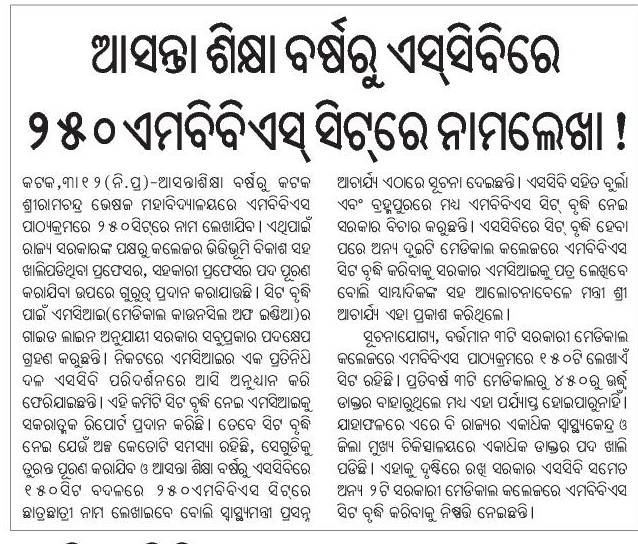
The report of the steering committee on health for the 12th five year plan (incorporating reports of all working groups and deliberations in Committee meetings) has suggested opening of four new prototypes of premiere All India Institute of Medical Sciences ( AIIMS) in addition to the eight already approved.
… Union health ministry is in the process of constructing six AIIMS-like institutes in Patna, Raipur, Bhopal, Bhubaneswar, Jodhpur and Rishikesh at a cost of Rs 847 crore each, up from Rs 332 crore that was originally estimated. There are expected to be ready by July, 2012.
The Planning Commission has given approval to two more AIIMS-like institutes in Uttar Pradesh and West Bengal. …
With 26 medical institutions have been approved for upgrade, the panel has said an additional 30 medical colleges established at least 20 years ago be identified for support through Pradhan Mantri Swasthya Suraksha Yojna.
“Other medical colleges, in private or voluntary sector may also be considered for upgrade and strengthening for starting new postgraduate disciplines and increasing post-graduate seats,” the report says.
Union health minister Ghulam Nabi Azad on Friday asked the Medical Council of India (MCI) to prepare a series of medical reforms within a month. One of the crucial reforms is regarding land required to start medical colleges.
Now, the ministry allows a medical college to start on a 10-acre plot in nine cities – Mumbai, Chennai, Kolkata, Delhi, Bangalore, Hyderabad, Ahmedabad, Kanpur and Pune. It is planning to expand this list and include state capitals of Orissa, Uttar Pradesh, Bihar, Jharkhand, Chhattisgarh and Rajasthan, which are not only facing acute shortage of human resources, but also have poor health indicators.
The ministry will allow these states to have split campuses – hospital and medical college within 10km of each other. This facility is available only in north-eastern and hill states, which require 20 acres of plot to start a medical college.
… The high-power expert group (HLEG) of the Planning Commission working on universal health coverage has proposed a phased addition of 187 colleges. The HLEG said by 2015 under phase A, 59 new medical colleges will admit students in the 15 states of Assam, Bihar, Chhattisgarh, Gujarat, Haryana, Jammu and Kashmir, Jharkhand, Madhya Pradesh, Maharashtra, Meghalaya, Orissa, Punjab, Rajasthan, UP and West Bengal.
By 2017, 13 of these states will have an additional 70 medical colleges, and by 2022, 58 additional colleges will be built in two additional phases (2017-20 and 2020-22). By 2022, India will have one medical college per 25 lakhs in all states except Bihar, Uttar Pradesh and West Bengal.
"The implementation of HLEG’s recommendations will enable the additional availability of 1.2 lakh doctors by 2017 and another 1.9 lakh doctors between 2017 and 2022. With this rate of growth, it is expected that the HLEG target of one doctor per 1,000 will be achieved by 2028," the report said.
These easing of norms would indeed help. In particular, the plan to expand Capital Hospital in Bhubaneswar to a medical college is stuck because of the land requirements. With the ease of the norms many large hospitals, which already have or are close to having the required number of beds, can have an associated medical college.
The ease of the norms should be such that many district hospitals can also have medical colleges. That will spread the medical colleges to other districts.
Act passed by GOO on 12/26/09. No request has been received for visit of H.P.C (My comments: Expected to commence in Fall 2012)
3
ICFAI University
Act passed by GOO on 3/9/10. No request has been received for visit of H.P.C.
4
Vedanta University
Bill passed by OLA in December 2009, awaiting Governor’s assent.
5
Jagadguru Kripalu University
Draft Bill, land, project report etc. are being examined as per the guidelines.
6
Xavier University
Steps are being taken for finalization of the Draft bill/cabinet memorandum
7
Techno Global University
Land, project report etc. are being examined as per guidelines.
8
Amrita Viswa Vidyapeetham University
Draft bill from the proposed university has not yet been received. Collector, Khurda/Cuttack has been requested for identification of 150 acres of land for establishment of the university.
9
Synergy University
Land, project report etc. are being examined as per the guidelines.
10
Women’s university of Technology
Land, project report etc. are being examined as per the guidelines.
11
Private University by Rai foundation
Land, project report etc. are being examined as per the guidelines.
12
Amity University
Land, project report etc. are being examined as per the guidelines.
13
University of Corporate Excellence
Land, project report etc. are being examined as per the guidelines.
14
Silicon University
Land, project report etc. are being examined as per the guidelines.
15
ASBM University
Land, project report etc. are being examined as per the guidelines.
16
Divine Global University by Divine Education Trust, Delhi
Draft bill, land, project report etc. are being examined as per the guidelines.
17
GIET University, Gunupur
Land, project report etc. are being examined as per the guidelines.
18
C. V. Raman International University Bhubaneswar
Land, project report etc. are being examined as per the guidelines.
19
JPM University by Shree Chandulal Minda Memorial Trust
Land, project report etc. are being examined as per the guidelines.
20
Krupajal National University
Land, project report etc. are being examined as per the guidelines.
21
Manipal Education and Medical Group (to set up a world class university at Bhubaneswar)
DPR has not been received.
22
Oriya University
DPR has not been received.
23
Edu City in Rourkela by Knowledge Foundation, Jail Road, Jharpada, Bhubaneswar
The foundation has been requested to furnish audited profit and loss account, balance sheet of the preceding 5 years as filed before the income tax authorities and the copy of the trust deed.
*
BIMTECH
Expressed interest to be a university after the above were listed. (Note: This is an update.)
The 10 proposed agro-polytechnics by the Odisha University of Agriculture & Technology (OUAT) in the agro-climatic zones of the State would come up by the next academic session beginning July-August. These polytechnics would offer two-year diploma course for Plus-II pass-outs in the disciplines of agriculture, fisheries, animal science and horticulture. While one each polytechnic will be dedicated for horticulture, fisheries, animal science, the remaining seven will impart training on agriculture.
The polytechnics will also provide certificate courses for school dropouts in various disciplines.
… The OUAT had last year proposed to set up the polytechnics aiming to help the grassroots-level people in the field of technology transfer and guiding farmers in improving their economy.
These polytechnics would churn out agro-technicians, who can earn a living by doing agricultural jobs for the farmers on payment basis or just establishing their own ventures such as seed production, nursery management, food processing and preservation and bio-fertiliser production.
There is a great need for such intermediate-level technicians who can convince the local farmers about low-risk technologies and their applications for better yield.
V-C Ray said the agro-polytechnics would function close to agriculture research stations and Krishi Vigyan Kendras as there will be optimum utilisation of teachers, support staff, equipment and appliances and other existing facilities. “If required, additional infrastructure would be set up for the purpose,” Ray said.
Achievements: So far approximately 600 cadets have become officers in the defence forces through NDA alone. In addition many cadets have got commission through other entries. This school also has been honoured by the achievements of its cadets through various civil services like IAS-14, IPS-07 and allied services – 09. Several have become ministers in the State of Orissa and Nagaland. The cadets making foray in the fields of medical, engineering, merchant navy are plenty and doing the school proud. The highest ranking officers are two major generals and one Air Vice Marshal.
I think the 220 acres in a prime location in a capital city is a gross under utilization of the land for a residential school of 525 students, 28 teachers and 14 academic staffs, unless one explains it away as a green cover.
(a) The entire capital expenditure on land and buildings is met by the respective State Govts who are also required to provide funds for maintenance of infrastructure and for new infrastructural projects. The State Govts also award scholarships on merit cum means basis.
…
Role of Ministry of Defence in Sainik Schools
(a) Ministry of Defence provides scholarships to wards of defence personnel including ex-servicemen. In addition Ministry of Defence provides central assistance to those students who are awarded state scholarships. The sharing of expenditure on fees/scholarships among Central Govt, State Govt and parents is decided by the BOG from time to time.
(b) With effect from financial year 2003-04, the Ministry of Defence has implemented a scheme under which burden of fee and dietary charges are being shared between the Ministry of Defence and the parents in the ratio 3 : 1. Under this scheme all boys studying in Sainik Schools get financial assistance of about Rs.9,000 – 10,000 every year. The scheme also provides incentive to boys who join the NDA by refunding.
Achievements of Sainik Schools a) Aims – So far these schools have contributed about 7,000 officers to the three services. Its students today occupy important positions in all spheres of national activities. Since the schools were founded in early 60s, its cadets have now reached the level of Generals in the Army and equivalent Ranks in the Navy and Air Force.
b) Results – These schools send about 130-160 cadets to the NDA every year. As far as CBSE results are concerned the schools are performing creditably. All efforts are on to improve the results qualitatively.
c) Quality Education – In most of the States Sainik Schools are the only residential institutions and that too located in isolated areas. Thus these schools have been able to contribute significantly to development of education in backward areas and also in carrying out backward area educational integration.
Considering that the state government gave the land and buildings to the school and in most states these schools are in isolated areas, I think it may be worth pondering if the:
(a) Sainik School Bhubaneswar should be relocated to a backward area where it can contribute positively to the area and the existing 220 acres be used more productively; perhaps by turning it to a small Knowledge City, say similar to the 381 acres Knowledeg City in Mohali.
OR
(b) augment the current use by using part of the 220 acres of Sainik School Bhubaneswar to establish a military academy or an armed forces medical school or a DRDO lab, etc. to have better land utilization.
There are many examples similar to (b). For example, IISER Pune is established on NCL (National Chemical Laboratory) land.
This may be a good time to ponder about options (a) and (b) as it is reported that:
The 220-acres of land given by the government for the existing Sainik School in Bhubaneswar established in 1962 continues to be under the general administration department of the government.
Private institutes in the state have started approaching the Odisha University Agriculture of Technology (OUAT) for affiliation, following passing of the OUAT bill.
The bill was passed on August 23 amending the Orissa University of Agriculture and Technology Act, 1965, to enable the university to accord affiliation to institutions in the private sector for imparting education in agriculture, veterinary, fisheries, forestry and allied sciences.
While two private colleges in the capital have approached the authorities, a former professor of the varsity is said to be considering the idea of setting up an agricultural college, sources said.
… While students are keen to take admission in the constituent colleges of the OUAT, the existing intake capacity of the varsity is limited.
This year, the university had received about 12,000 applications for admission in 608 seats in various courses in the colleges of agriculture, agricultural engineering, fisheries, veterinary science and home science.
The university is also working towards the establishment of two constituent colleges. There will be a college of veterinary science in Sambalpur and a college in dairy technology in Baripada.
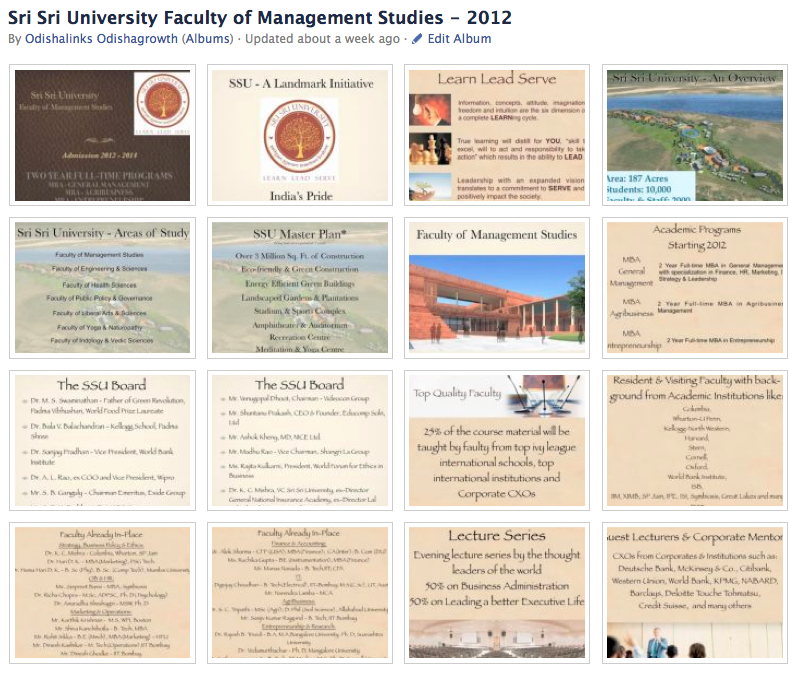
Sri Sri University at Naraj, Cuttack is starting its business school (Faculty of Management) from 2012-13 with three MBA programs:
General Management
Agribusiness
Enrepreneurship
It has assembled a good list of faculty (23 core faculty, adjunct faculty, and visiting faculty) and academic and industry mentors. Many of them have degrees from and/or other associations with top institutions in India (IIT, IIM) and abroad (Cornell, UT Austin, etc.). The following youtube video gives a quick introduction of Sri Sri University’s Faculty of Management.
A photo presentation based on screenshots of the above video is linked below.
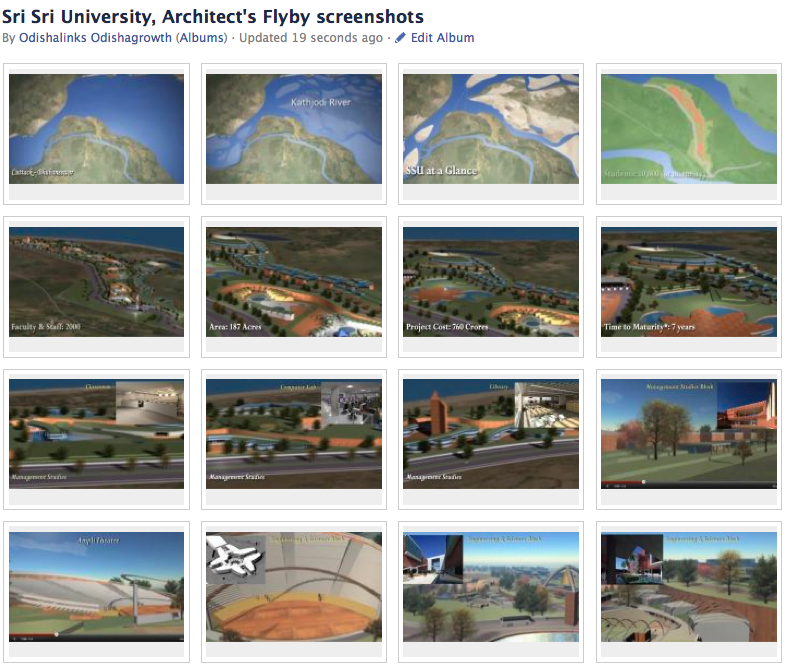
The campus design is impressive. See the youtube video of the Architect’s flyby below.
A photo presentation based on screenshots of the above video is linked below.
Note that the basic parameters of this university, as given in the above pictures, are as follows:
Note that many of the above numbers, especially the project cost, are comparable with that of IIT Bhubaneswar.
Based on the faculty it has already assembled for its business school, if they continue to hire at that level for the other disciplines, then, I think, at maturity (i.e., in 7 years) this university will be better than most central universities in India.
At that time with 10,000 students the tuition and housing income from students will be about 10,000 * 3 lakhs = Rs 300 crores per annum. (The 3 lakhs/year is based on the numbers here. The business school fees would have increased by that time. On the other hand other programs may have lesser tuition fees.) That is a good number to spend on the university.
Our first posting in this site was on November 28th, 2006. It is at https://www.orissalinks.com/archives/7. It was about a central university in KBK. We succeeded in our mission and a central university in KBK was announced in March 2008, and it has now been established in Koraput district.
Earlier this year (On May 22nd 2011) I wrote to the planning commission to establish a central agricultural university in Odisha as part of the 12th plan. Following are excerpts of my mail.
I propose that the 12thplan staring from 2012 include several CentralAgricultural Universities in backward district clusters of India that have potential for agriculture.
Sirs and and Madams: One of the biggest achievement of the 11th plan was that the new institutions (16 central universities, 8 new IITs, 7 new IIMs, proposed 20 new IIITs, proposed 14 innovation universities) were located across India, in states ruled by UPA, in states not ruled by UPA, and so on. It was an inclusive distribution and less driven by political connections.
I request that similar distribution be made with respect to the institutions that are proposed for the 12thplan, starting with several centralagricultural universities with various colleges (Agriculture, Horticulture, Veterinary, etc.).
The initial wave of creation of agricultural universities across India (in the 1960s) were an important factor in the initial Green revolution of India. However, as has been noted in the last two budgets (2010-11 and 2011-12) there is a need for another such revolution, especially taking into account factors such as (i) further mechanization (ii) urbanization (iii) looking east and (iv) developing backward and tribal areas.
44.The agriculture sector occupies centre-stage in our resolve to promote inclusive growth, enhance rural incomes and sustain food security. To spur the growth in this sector, the Government intends to follow afour-pronged strategy covering (a) agricultural production; (b) reduction in wastage of produce;
(c) credit support to farmers; and (d) a thrust to the food processing sector.
45.The first element of the strategy is to extend the green revolution to the eastern region of the country comprising Bihar, Chattisgarh, Jharkhand, Eastern UP, West Bengal and Orissa,…
52. The Green Revolution in Eastern Region is waiting to happen. To realize the potential of the region, last year’s initiative will be continued in 2011-12 with a further allocation of `400 crore. The program would target the improvement in the rice based cropping system of Assam, West Bengal, Orissa, Bihar, Jharkhand, Eastern Uttar Pradesh and Chhattisgarh
.
Both speech say the green revolution needs to be extended to the eastern region. The allocation of a total of 400 crores to 7 states is miniscule for the purpose and does very little.
Hence, I request that this aspect of extending the green revolution to the eastern region be taken seriously and in the 12thplanCentralAgricultural Universities be established in appropriate locations in these states and some of the other states of the country.
Somewhat of a start in this direction has been made via the allocation of 30 crores for aCentralAgriculturalUniversityin Bundelkhand in the 2011-12 budget.
It was reported by the press that Mr. Rahul Gandhi lobbied for this.
I would like to thank him for his vision and initiative and humbly request the planning commission that they need to also think of the other backward areas of the country.
Taking all the above into account, it would be a win-win to include the establishment of several CentralAgricultural Universities in the country located in backward districts with agriculture potential. The win-win aspects are:
(i) They will help higher education and GER, but will not stress the MHRD budget or its management. The majority of the funding could come from the Ministry of Agriculture with some required contributions from the state governments.
(ii) They will help bring ina new green revolution in some areas and extend the green revolution to the eastern region.
(iii) Since there have not been many new agricultural universities across the country, it will be comparatively easier to recruit faculty for these new institutions.
(iv) By locating them in the backward district clusters, they will bring Bharat and India closer.
I had sent copies of my mail to the MPs of Odisha as well as the Chief Minister’s officer. I talked to the secretary of agriculture Ranglal Jamunda by email at agrsec.or@nic.in as well as by phone and urged him that the Odisha government must push for a central agricultural university in Odisha, especially in the KBK regions (in particular, Kalahandi, as Kalahandi is known to be one of the rice bowl of Odisha; and Kalahandi was skipped over when deciding on the location of the central university in Koraput).
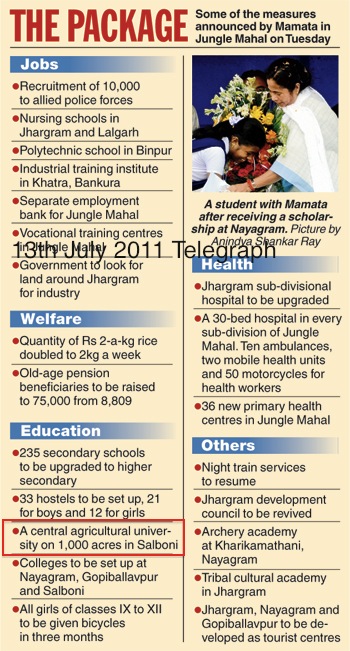
My emails and phone calls has had no visible impact on Odisha government, Odisha officials or Odisha MPs as so far I have not read any news regarding Odisha pursuing a central agricultural university. However, the news of the West Bengal government pursuing a central agricultural university came out after a few days of my writing to the planning commission. It is possible that may mail to the planning commission somehow got forwarded to the right people in West Bengal or it may just be a pure coincidence. Following is from a Telegraph article on 13th July 2011.
I think there is still time to pursue to get this included in the 12th plan. I request all readers to write to the Chief Minister’s office at cmo@ori.nic.in regarding this.
While for reason of pride it is important that BPUT buildings get completed soon in Rourkela and BPUT becomes fully operational from Rourkela asap, what is most important for Rourkela in terms of higher education is a general university with programs in all disciplines: arts, commerce, sciences, engineering, pharmacy, etc. etc.
Rourkela is one of the few metropolitan areas of the country with a population greater than 500,000 that does not have a general university. There are a few other outliers such as Asansol and Dhanbad. (Dhanbad has ISMU; but its not a general university.) I would say if one checks the cities with more than 500 K population anywhere in the world, most would have a general university. In US, most cities with a population greater than 200K have a general university. In Odisha itself, much smaller cities and towns (Berhampur, Sambalpur, Balasore, Baripada and Koraput) have general universities.
Last year the higher education taskforce, among many other items, recommended a general university in Rourkela. However, I am not sure if any action is being taken based on that report. Regardless, I think the resurgent residents of Rourkela need to put the establishment of a general university in Rourkela among the top of their demands. I would put it at number one. The first thing that a city needs to become a real city is a general university. If people have to go out of town to pursue masters degree in regular disciplines like Economics or Commerce then the city is severely lacking.
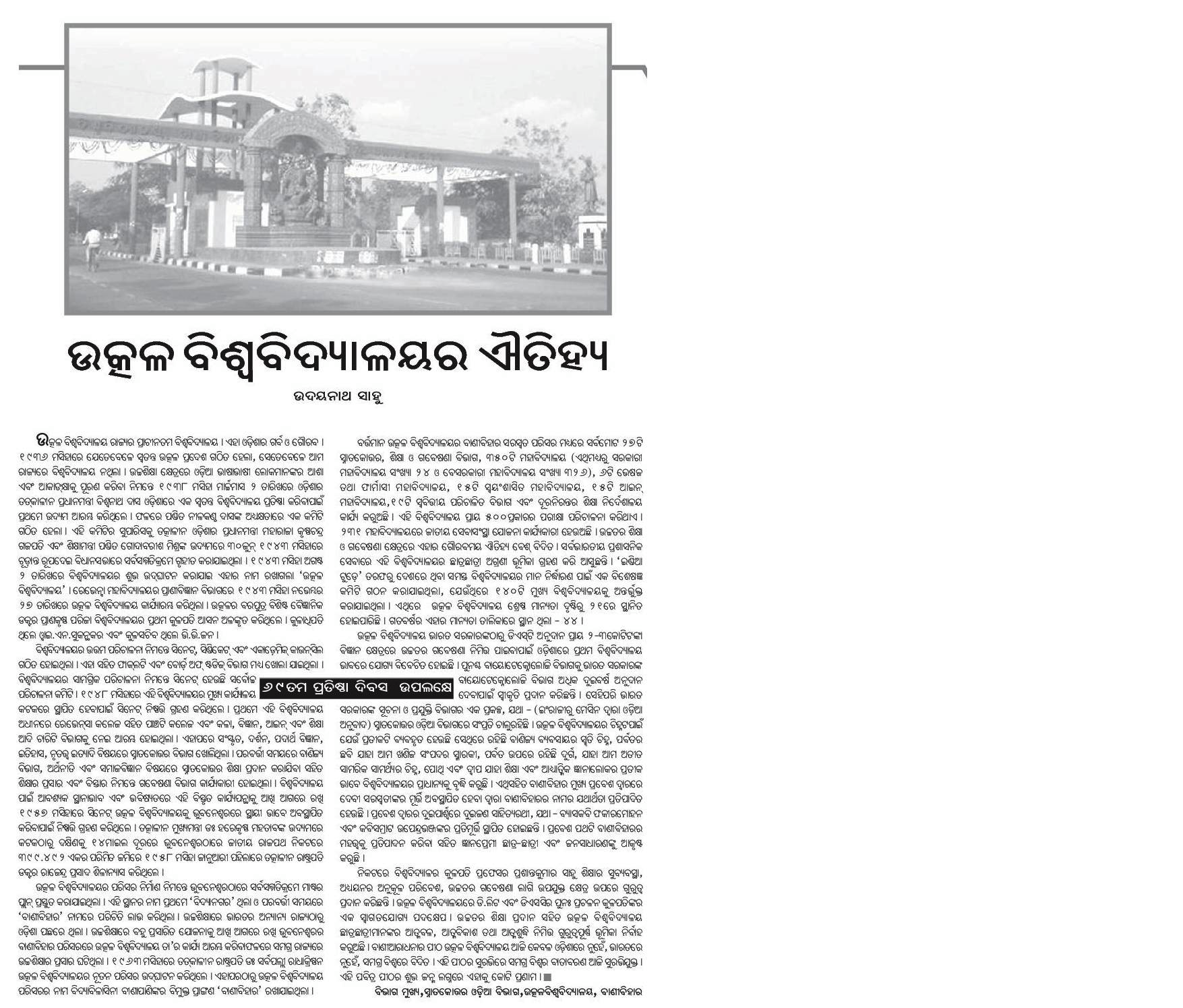
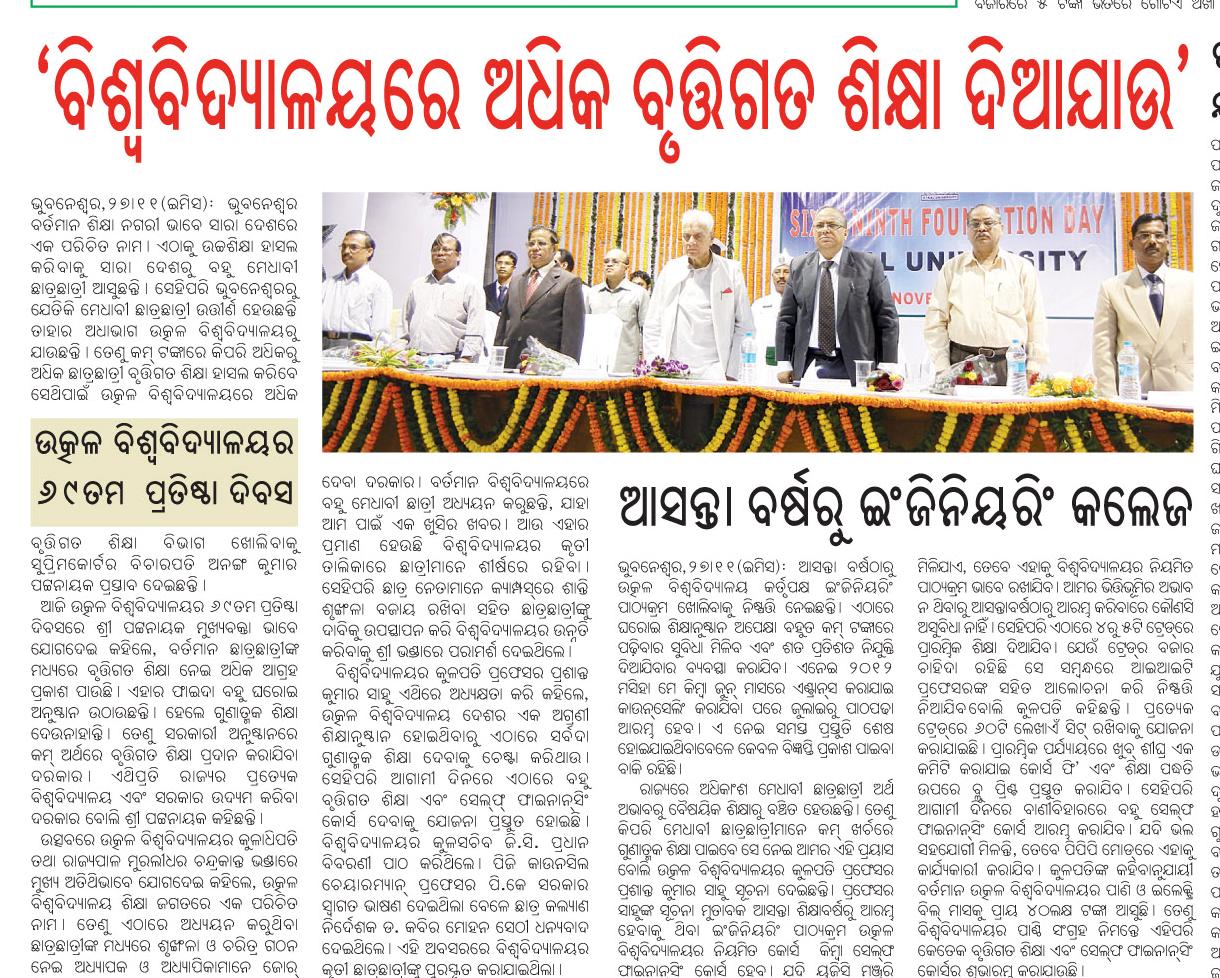
Following are some of the highlights mentioned in the above article.
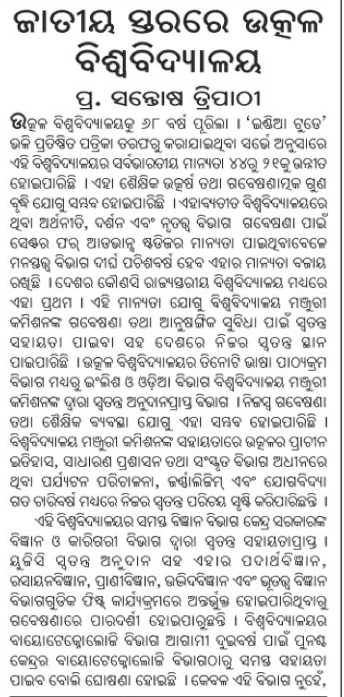
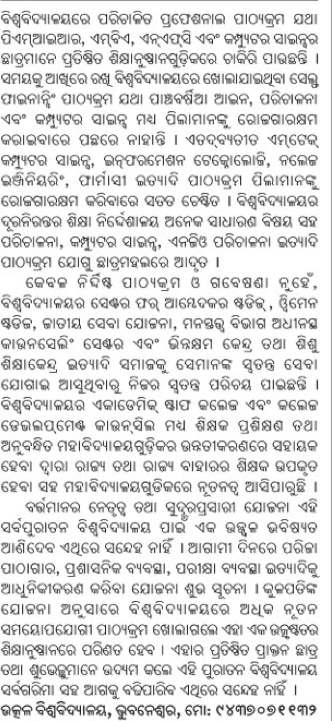
Utkal University’s rank increased from 44 to 21 in the latest India Today ranking.
The Economics, Philosophy and Anthropology departments have received the Center for Advanced Studies designation for its research.
The Psychology department has had the Center for Advanced Studies designation for the last 25 years. This is a first with respect to any state university in India.
English and Odia programs are specially funded by UGC.
With the help of UGC, the programs of Tourism management, Journalism and Yoga under the departments of Ancient history of Utkal, General administration and Sanskrit, respectively, have created their independent identity.
All the Science departments of the university get independent funding from Department of Science & Technology of the Central government.
The Physics, Chemistry, Botany, Zoology and Geology departments have UGC funding and are part of the FIST program.
It has been announced that the Biotechnology department will get full support from the Department of Biotechnology of the central government for the next two years.
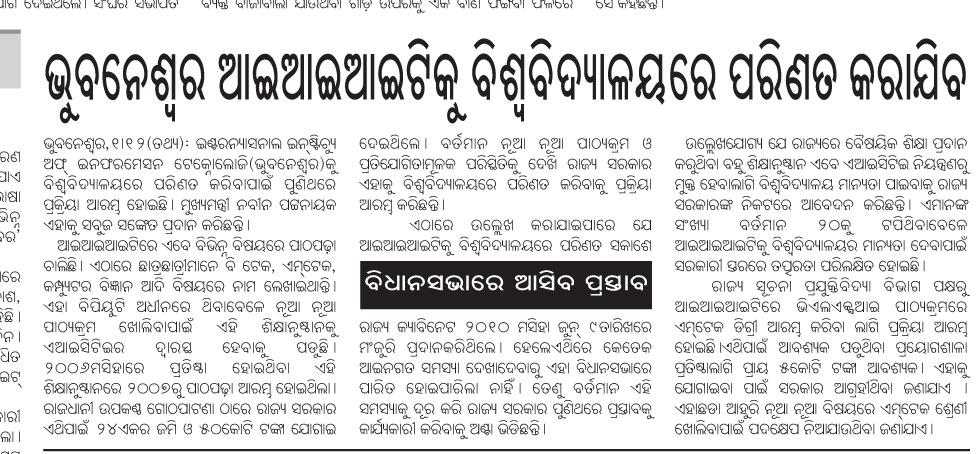

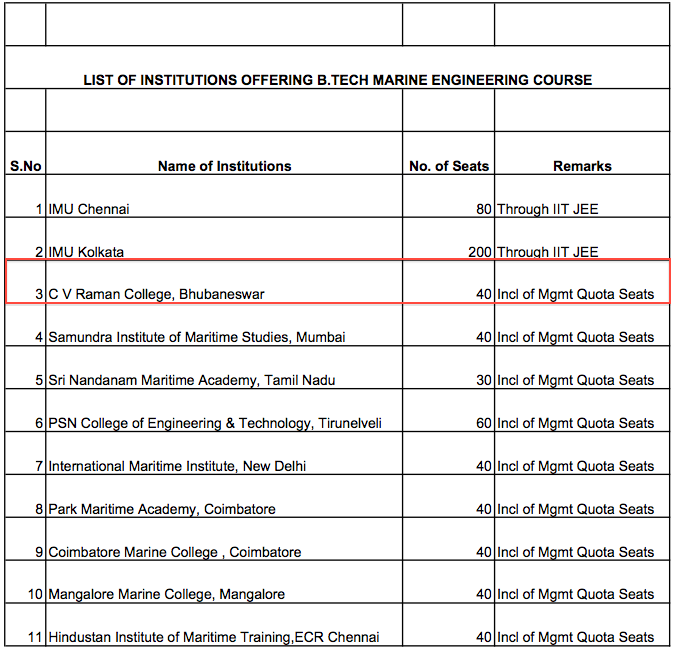
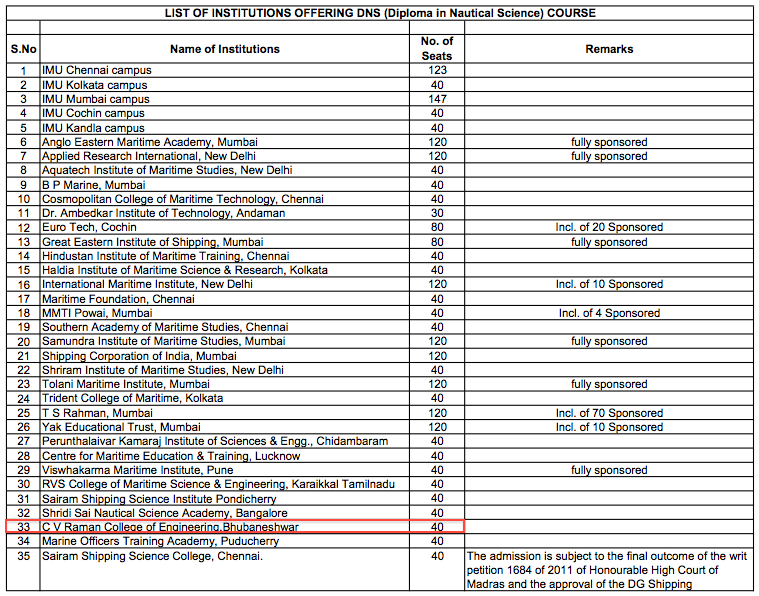
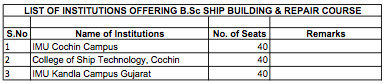 Note that the Indian Maritime University now has a new campus in Kandla, Gujarat.
.png)