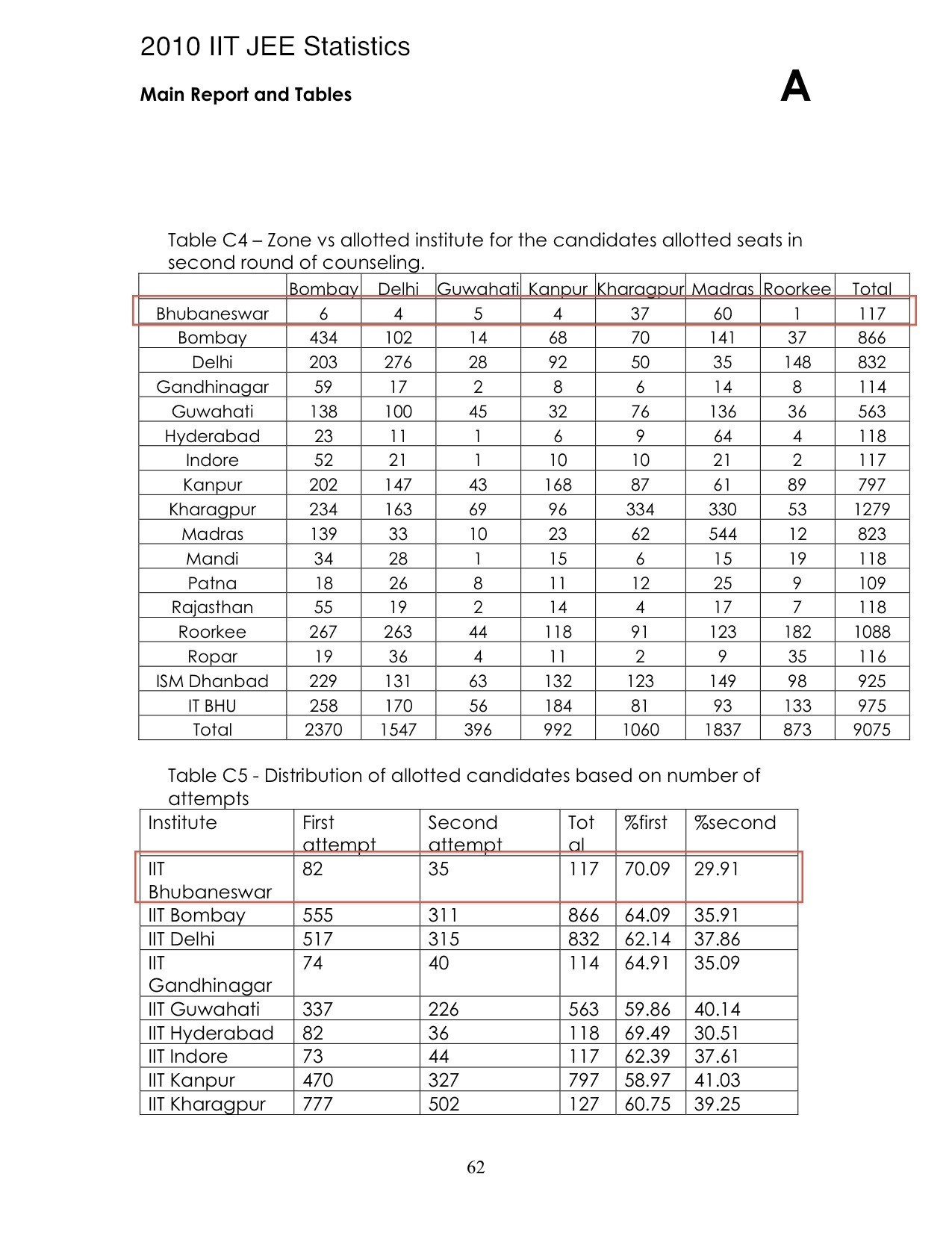
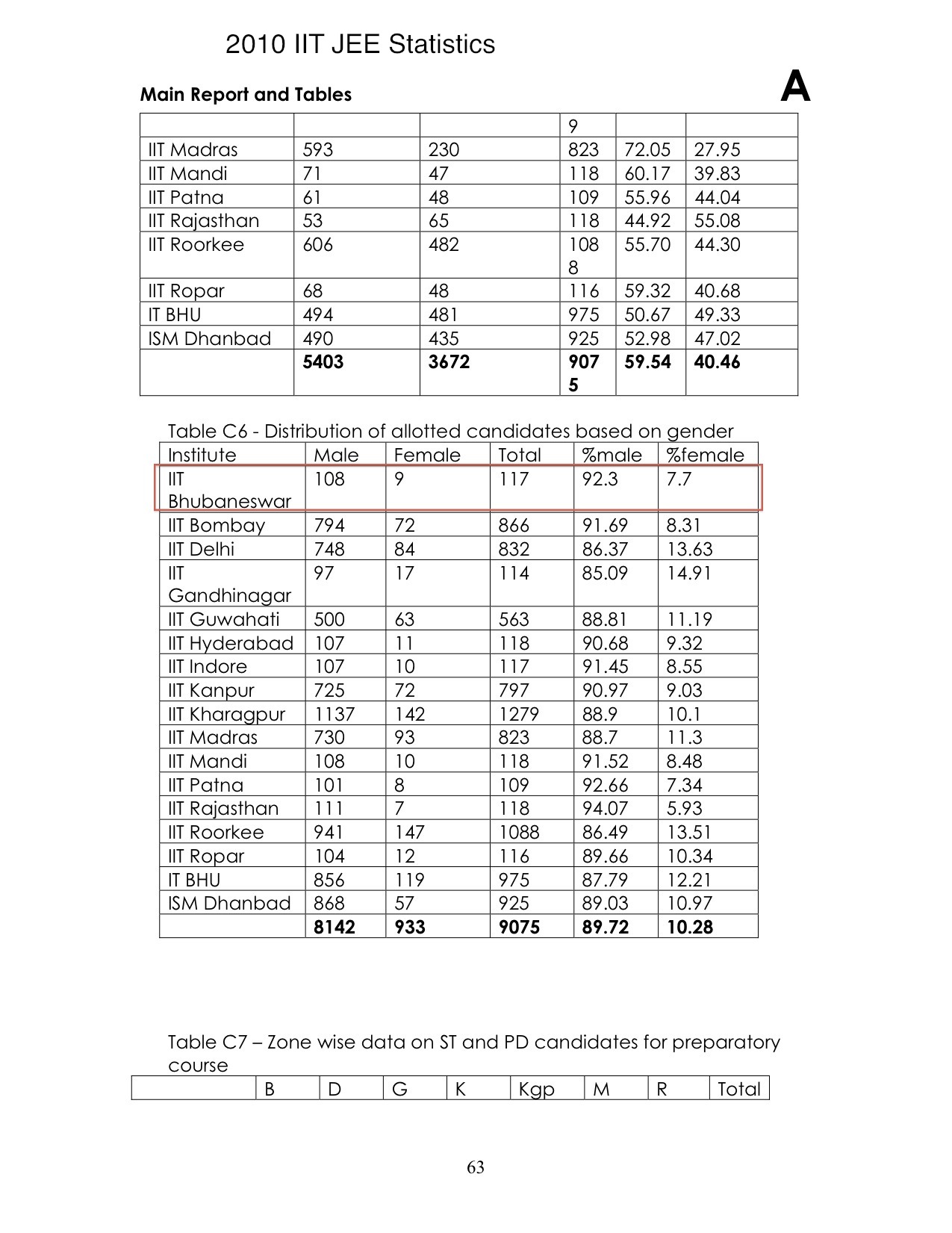
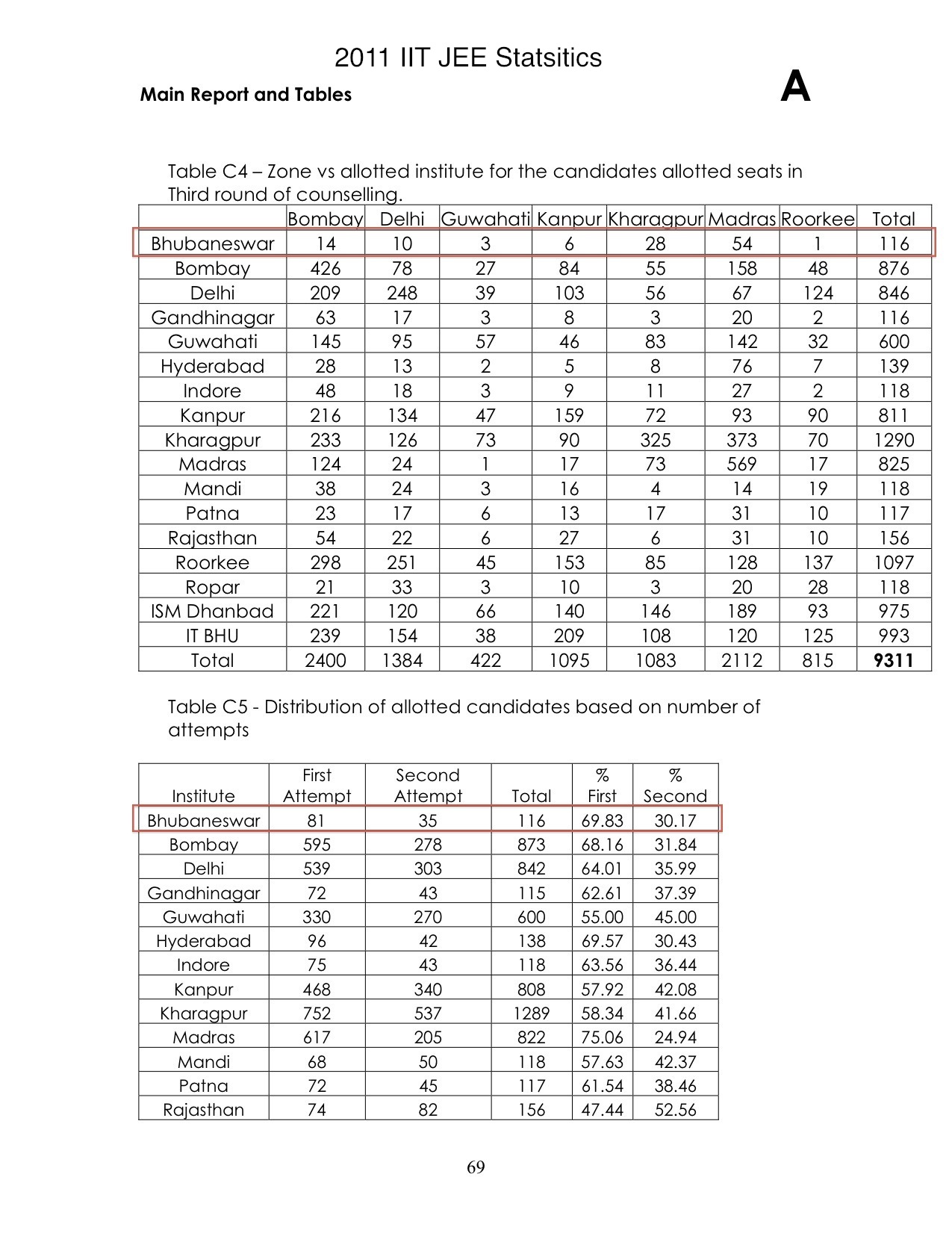
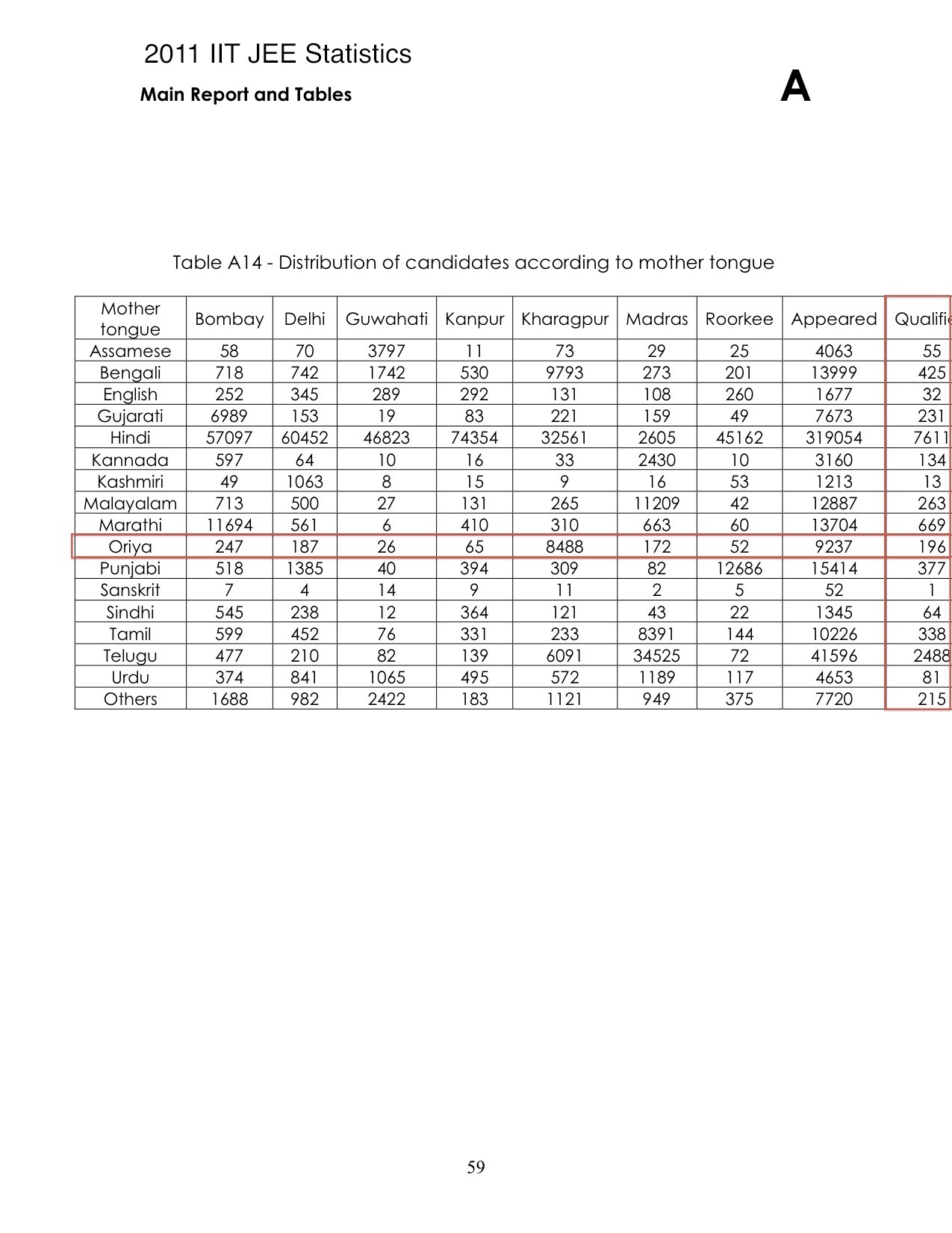
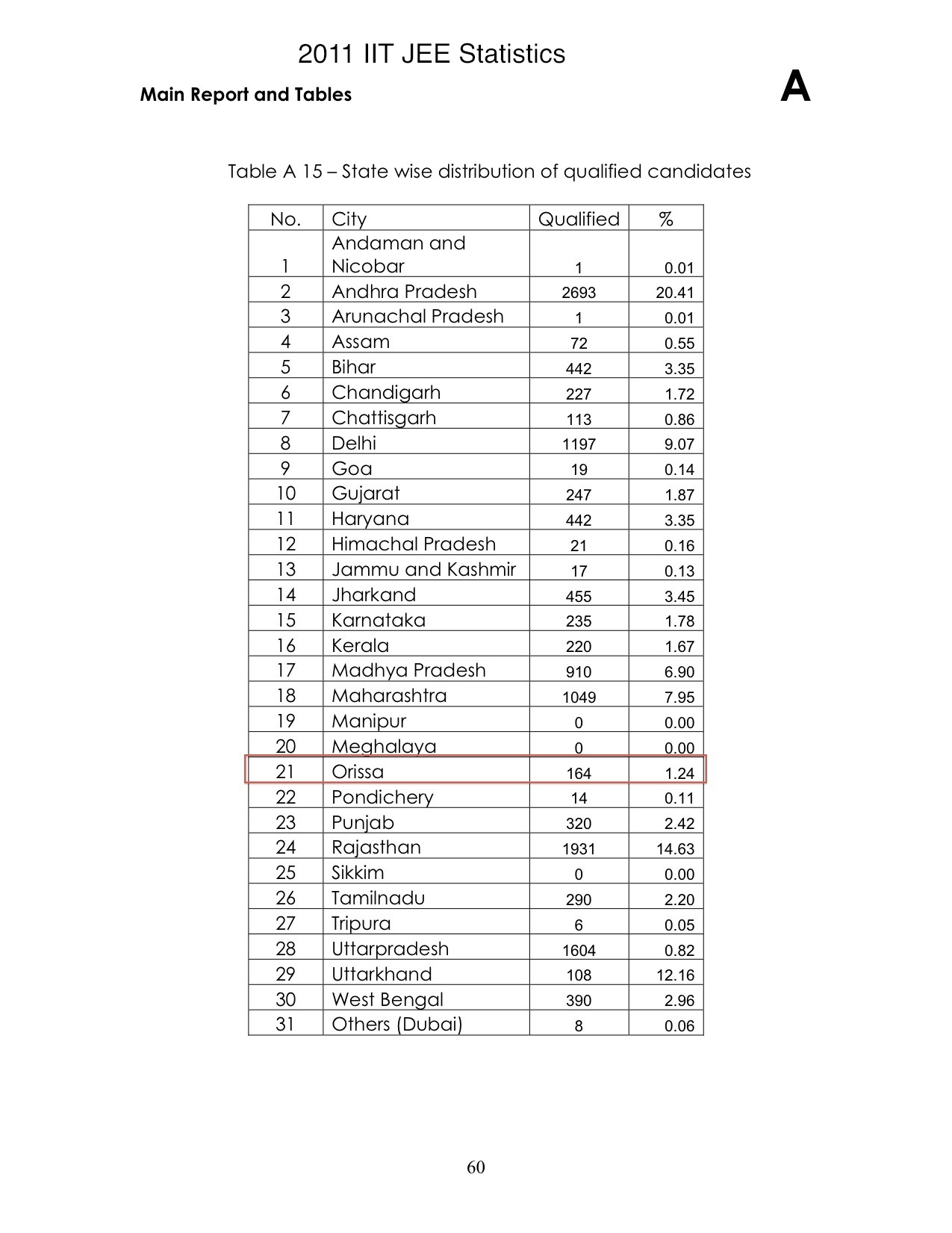
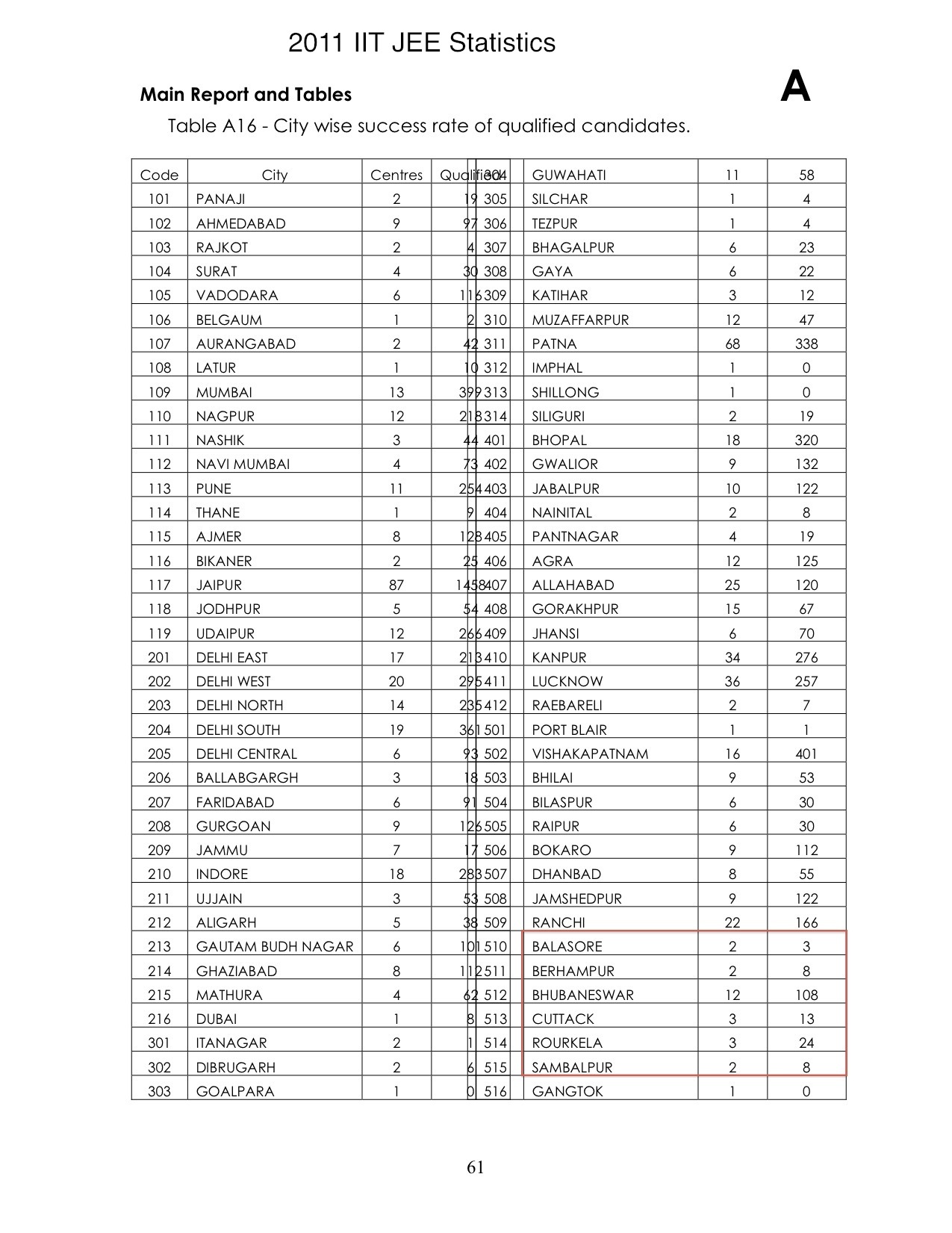
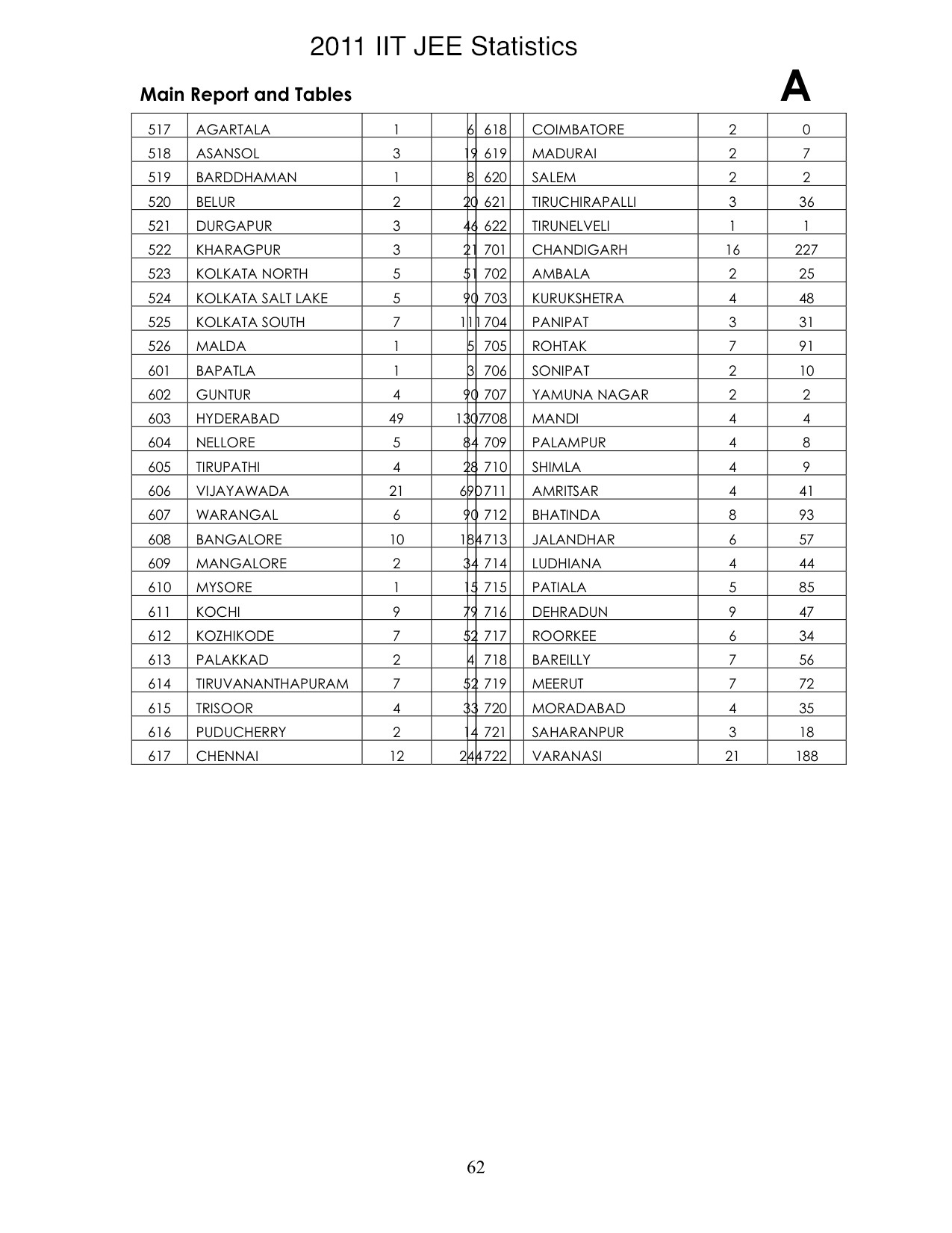
Some statistics based on the students entering various IITs in 2010 and 2011
(Thanks to Abi for the pointer.) The following tables are from documents at http://www.iitsystem.ac.in/academics/admmission.jsp.
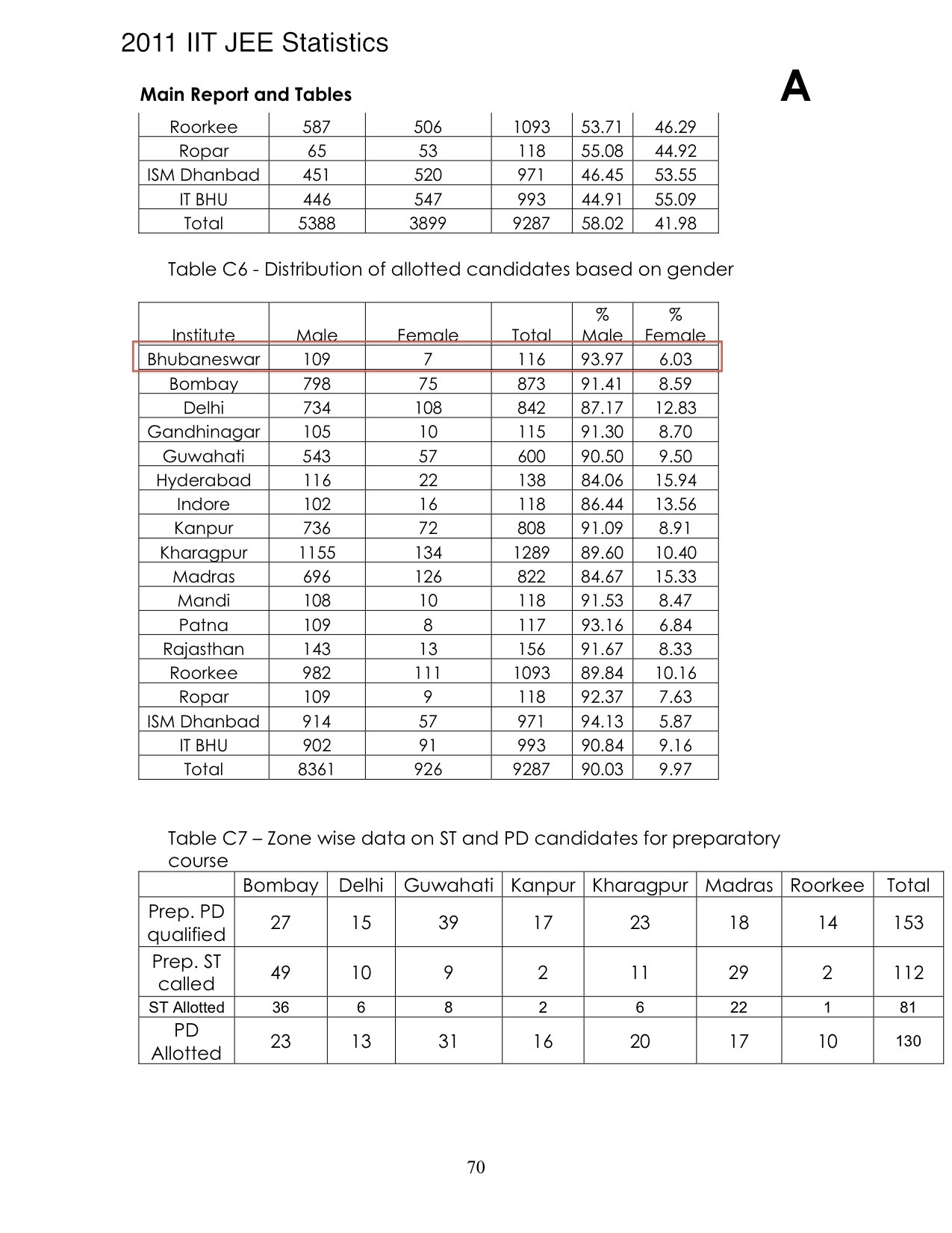
November 22nd, 2011
(Thanks to Abi for the pointer.) The following tables are from documents at http://www.iitsystem.ac.in/academics/admmission.jsp.
November 22nd, 2011
(Thanks to Abi for the pointer.) The following tables are from documents at http://www.iitsystem.ac.in/academics/admmission.jsp..jpg)
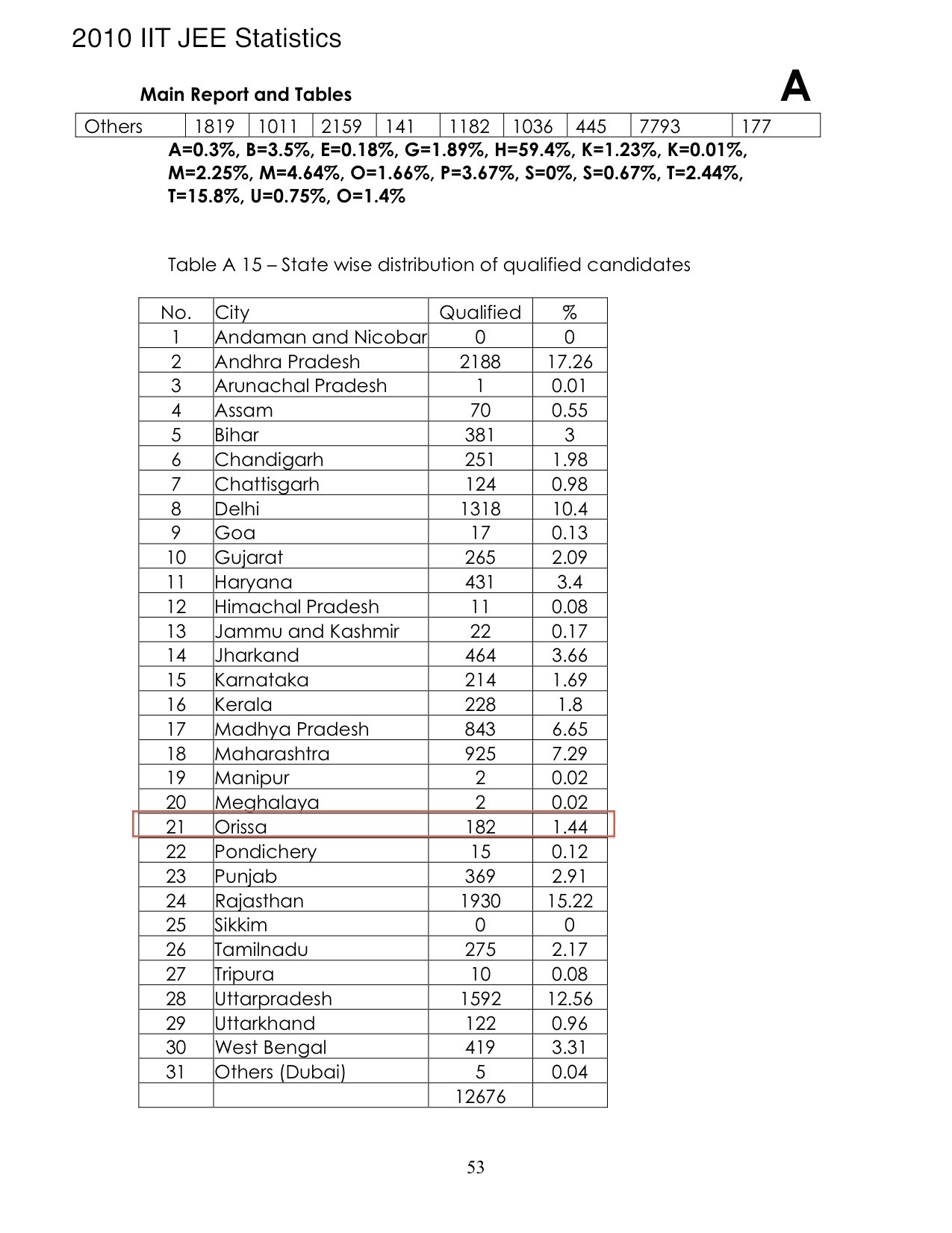
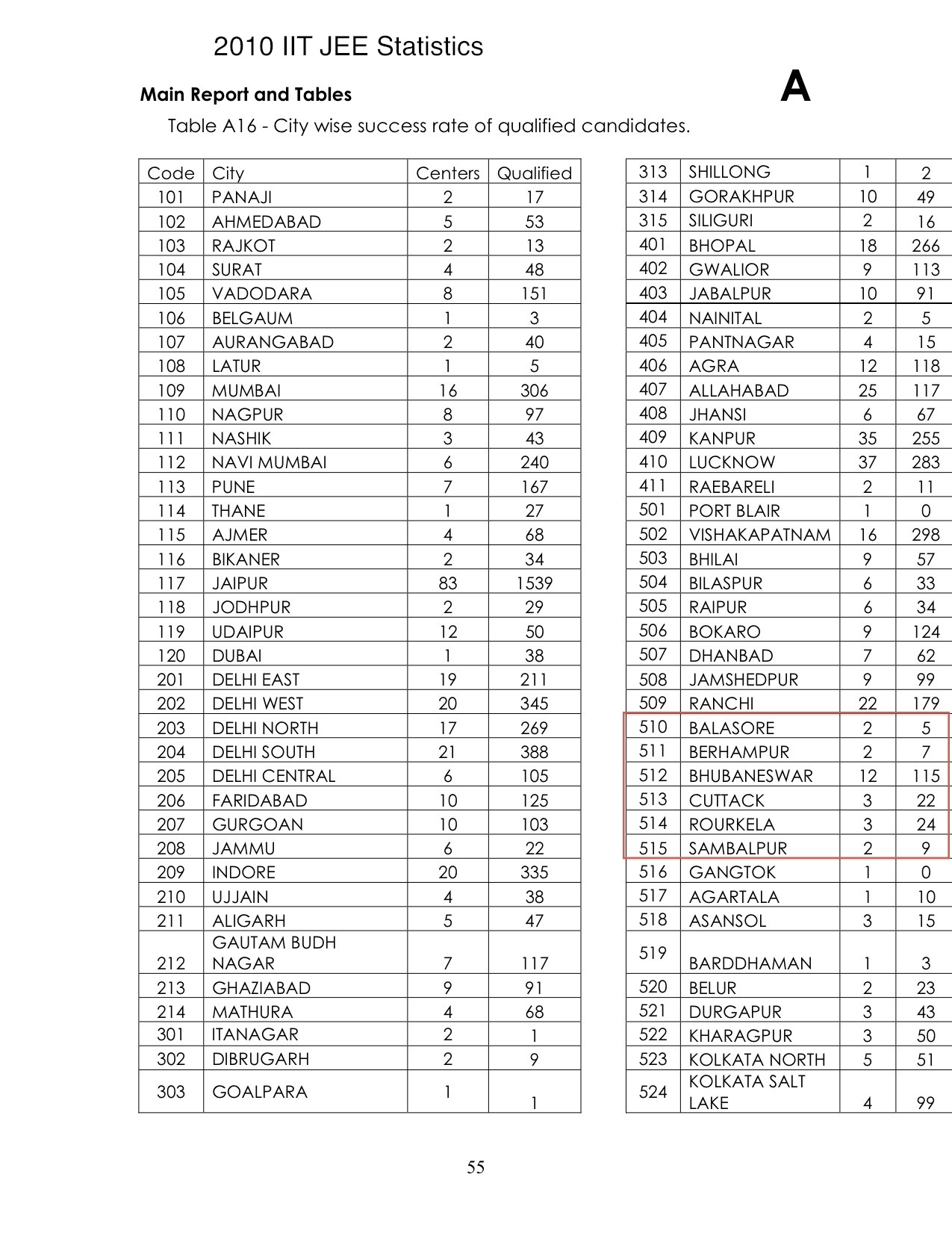
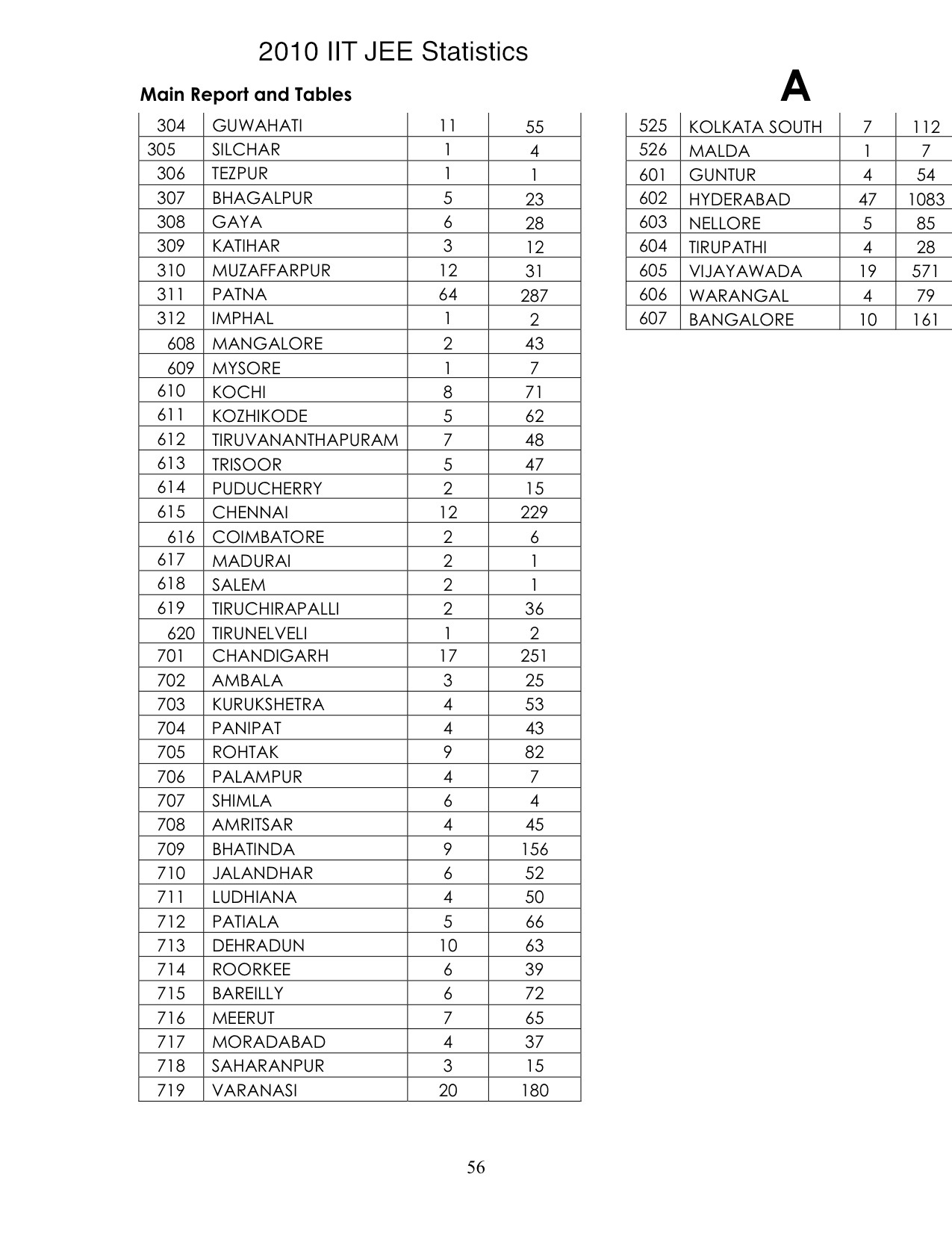
November 22nd, 2011
Although Vedanta University has not taken off yet, several other industrialists and billionaires have made efforts to establish quality higher education institutions in India. Using the links in http://prayatna.typepad.com/education/2011/11/ashoka-university-at-sonepat-and-the-young-india-fellowship.html we give a short list of the other efforts.
1. Ashoka University: Following is an excerpt from a report in http://www.businessworld.in/businessworld/content/Focus-Art-Learning.html.
To recreate their own experience of learning at US universities, a group of professionals have come together to set up a new university of liberal arts in India. Well known names in Delhi and Mumbai circles — Ashish Dhawan (ChrysCapital), Sanjeev Bikhchandani (Naukri.com), Pramath Sinha (9.9 Mediaworx), NV “Tiger” Tyagarajan and Vineet Gupta (Jamboree), among others, are part of the International Foundation for Research and Education.
To be located in the Rajiv Gandhi Education City in Kundli, Sonepat, across 25 acres, Ashoka University has sought “private university” status from the Haryana government and will be not-for-profit. A total of Rs 50 crore has been paid for the land, and the first phase is expected to cost about Rs 200 crore. The seed capital has been put up by the trustees, apart from donations from individuals.
Dhawan, senior managing director, ChrysCapital — who recently announced he was stepping down — plans to get into school education in a big way. However, with Ashoka University, the “idea is to offer a greater focus on languages, humanities and social sciences and to offer breadth rather than just depth as in the British system. Instead of studying one subject in depth for 3-4 years, the idea is to study many subjects across disciplines,” says Dhawan. He says it will offer courses and areas of study on the lines of universities such as Yale, Princeton and Amherst.
… Pramath Sinha, founder of 9.9 Mediaworx, brings his experience of the Indian School of Business (ISB), Hyderabad, to the new venture. Some of the IFRE founders were keen to set up a quality engineering institute, while others wanted “more holistic” liberal arts courses. “We decided to marry the two and brought everyone together to set up a more ambitious project,” Sinha says.
Says an advisor in the Planning Commission: “Given the paucity of public funds, we need many such initiatives to bridge the demand between quantity and quality in higher education.” The founders, he says, can raise funds through various means. Given the founders’ past experience, raising capital should be the least of their problems.
2. Azim Premji University: The Azim Premji University is up and running in Bangalore. See http://azimpremjiuniversity.edu.in/.
3. Shiv Nadar University: The Shiv Nadar University is up and running in Delhi area. See http://snu.edu.in/.
4. Reliance University: There have been several news item regarding Nita Ambani heading the establishment of a Reliance University through the Reliance Foundation. See the announcement here.
Following is an excerpt from a report in Economic Times.
The Reliance Group is setting up a ‘world-class’ university as it seeks to promote education and research in sectors ranging from liberal arts to technology .
Reliance Foundation, which will spearhead the project, is expected to start the university either in Mumbai or Delhi. Nita Ambani, the wife of RIL chairman Mukesh Ambani, will head the new project.
India’s largest business conglomerate has started the process of identifying land for the proposed university , according to persons familiar with the development.
The university, modelled on the lines of American universities such as The University of Pennsylvania, will tie up with foreign universities. "It will be international in scale and in best practices, but with an Indian soul," said Mukesh Ambani, chairman, Reliance Group.
Nita Ambani told ET that the proposed university would be located either outside Mumbai or Delhi. "We are looking for sufficient land to set up a world-class university," she said.
Mr Ambani made this announcement while making the acceptance speech at Mumbai’s Tident Hotel after receiving the Dean’s medal from the University of Pennsylvania’s engineering school. His father Dhirubhai Ambani was earlier conferred Dean’s medal from Wharton School of Management.
The university will initially offer undergraduate courses. It will later offer postgraduate and doctoral courses, Ms Ambani said. India’s big business houses are strengthening their focus on education as it is poised to become a $80-billion opportunity by 2012. Indian spend $50 billion on private education annually, according to a research report by IDFC. It is expected to grow at a CAGR of 16%, said a CLSA Pacific study.
5. Proposed Bharati University: Following are excerpts from an article in http://prayatna.typepad.com/education/2010/07/mittals-speak-about-the-proposed-bharti-university.html that quotes from a CNBC interview.
Q: So could we possibly see a Bharti University being setup anytime soon? And now you can also bring in foreign partners and collaborate with them.
Mittal: For us education will never be a business and therefore whatever we do will have to be done through grants and contribution from the group and friends. And I don’t know whether foreign universities would want to come in for the philanthropy part of it. But we will bring them in at our cost and price but they will not be a foreign university, it should be a Bharti University funded endowed by the contributions that we have made.
November 21st, 2011
Following is an excerpt from a report in Times of India.
Bokaro Steel Ltd (BSL) has expedited the process of turning the 910-bed Bokaro General Hospital (BGH) into a state-of-the-art medical college.
Without setting a fixed deadline as of now, BSL a unit of SAIL wants to set up the college on public-private-partnership (PPP) basis. The state government is also providing its best possible support to BSL in setting up the college.
According to a senior BSL official, the company has initiated the process to enter into collaboration with private medical colleges for setting up the college. Talks between BSL management and premier medical colleges like Manipal Medical College, Karnataka, D Y Patil, Mumbai, Bhartiya Vidyapeeth, Pune, and Sri Ram Chandra Medical College, Chennai, are now in its final stages. A deal will soon be finalized with any one of the institutions, said the official.
The medical college for doctoral aspirants from the state is a dream project of BSL managing director S S Mohanty. However, BSL had earlier also initiated the process of setting up the medical college under the banner of Bokaro Ispat Education Trust but it was turned down for not fulfilling certain criteria as required by Medical Council of India.
However, BSL management has again formed a committee, which is working on preparing terms and conditions of the MoU that is to be signed with the institution. The committee members have already negotiated verbally with several medical institutions in this regard. The committee has received letters of interest from Manipal and D Y Patil Medical colleges while others have sent their assurance verbally.
Under the joint venture, the official said, BSL will provide its infrastructure (hospital) and other arrangements for bedside teaching facility to the institution, which will come up with its own building for classrooms, manpower and other essential facilities. BSL will provide the land on 99-year lease to the institution.
BGH has a huge potential to be developed as a medical college in this region. Around 11 lakh patients have undergone treatment in BGH in the last financial year alone.
Contrast this with SAIL Rourkela and Odisha. In https://www.orissalinks.com/archives/4625 we reported that the Odisha government was pushing for a medical college at SAIL Rourkela. But so far nothing has come out of it. See also the news item at http://www.telegraphindia.com/1110108/jsp/orissa/story_13406872.jsp.
Considering that IGH already is a 685 bed hospital it can easily accommodate a medical college. SAIL Rourkela and IGH need to learn from the efforts at SAIL Bokaro and pursue establishing a medical college.
November 21st, 2011
Following is the ad.
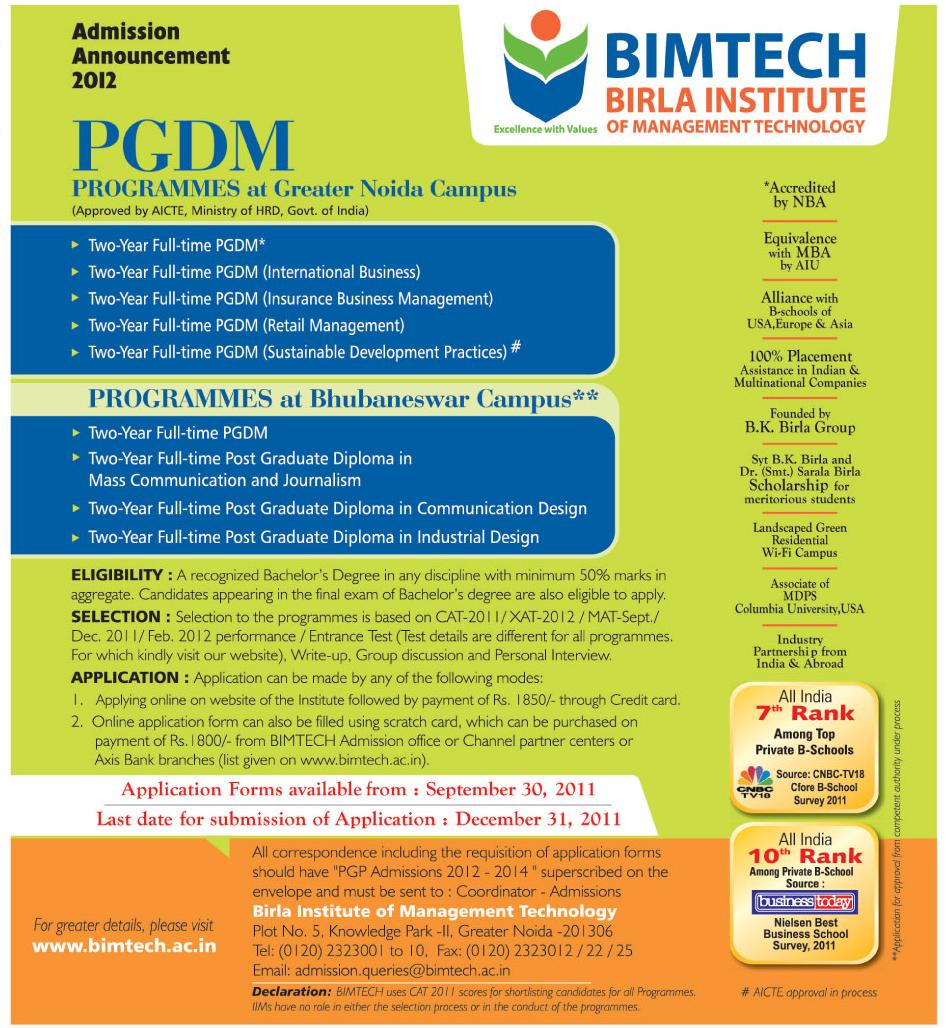
It seems, besides PGDM, BIMTECH Bhubaneswar will be offering programs such as PGD in Mass Communication & Journalism, PGD in Communication Design and PGD in Industrial Design; all subject to AICTE approval.
1 comment November 20th, 2011
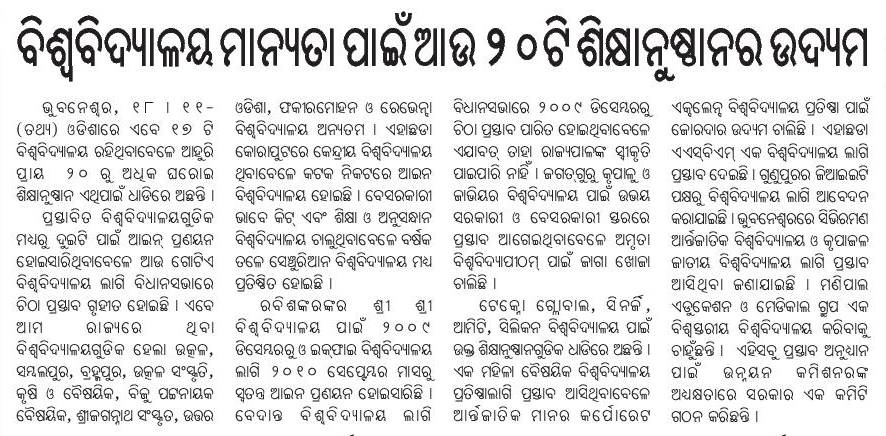
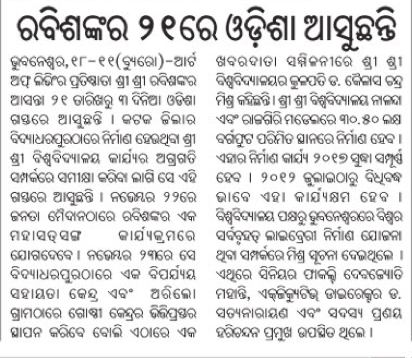
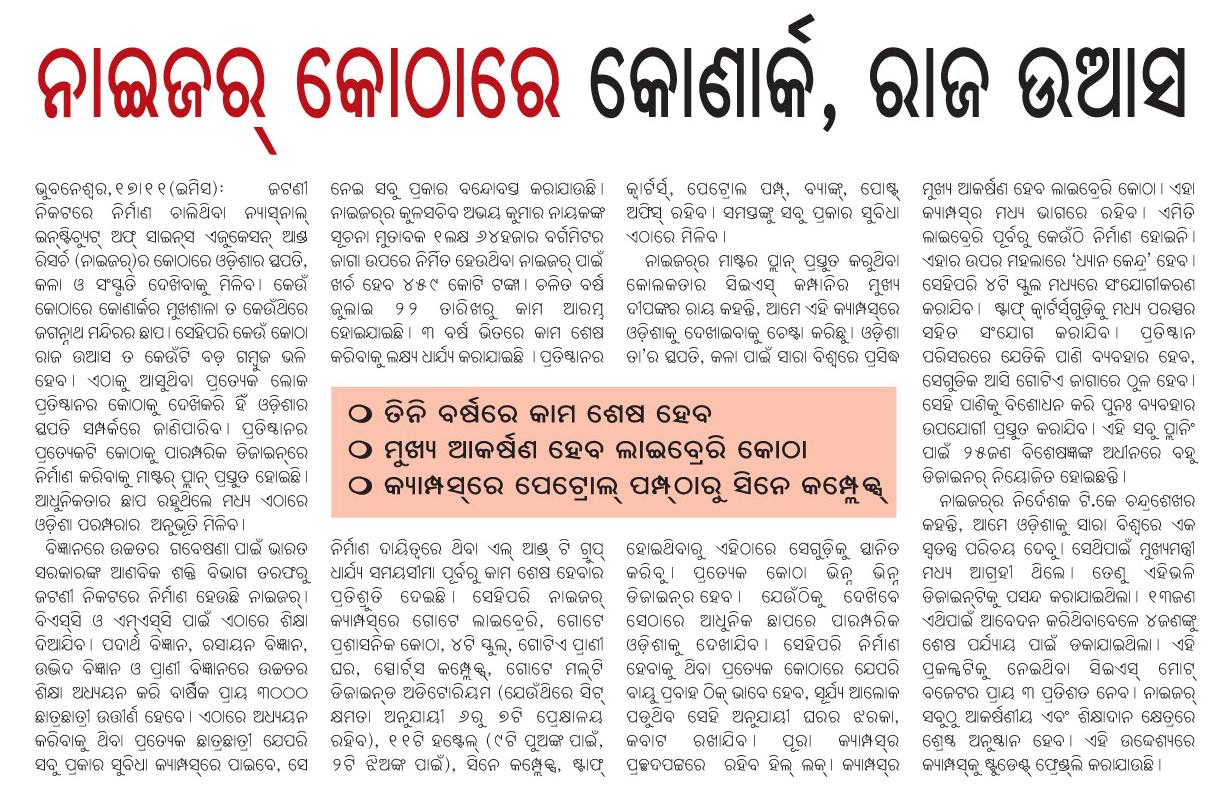
The 30.5 lakh sq feet is equivalent to 2,83,355.4066 sq meters and is equivalent to 70.0158 acres. As a comparison:
November 20th, 2011
The newsletter is at http://www.iitbbs.ac.in/pdf/Newsletter_Rhythm_4-9-2011.pdf.Following are some excerpts from it.
Ground Breaking Ceremony
The foundation stone of the permanent campus of the Institute was laid on 12th February, 2009. On the eve of the 65th Independence Day, on 14th August 2011, Sri Naveen Patnaik, Hon’ble Chief Minister, Odisha formally launched the construction of the Phase-1 of the permanent campus of the Institute near Aragul (Jatni) in the presence of Director Professor M. Chakraborty, Deputy Director, Deans, Registrar, Faculty Members, Officers, members of the Staff and students of the Institute and other dignitaries including Hon’ble Member of Parliament Dr P. K. Patsani, and Hon’ble MLAs of Jatni and Khurda. This was preceded by a Bhumi Pujan Ceremony at the site by the Registrar. The Government of Odisha has allotted 936 acres of land for the purpose and 16 acres of private land is being acquired by the Government for making the land contiguous. The Master Plan of the Campus has been designed for 10,000 students, 1000 teachers, and 1100 non-teaching employees besides 1000 plus outsourced support staff including security personnel. The Institute has also a plan for a Research Park. However, the initial construction in the first phase (Phase-1) would cater to 2500 students, 250 faculty members and about 300 other employees. The total investment for the phase-1 has been estimated to be about 800 crores. The construction would cover 2, 21,000 m2 (63000 m2 for academic complex and 1, 58,000 m2 for residential complex) which would include Main Administrative Building, Lecture Hall and Class Room Complexes, Laboratory Complex, Four Academic Schools, Central Workshop and Students’ Activity Centre in the Academic Complex whereas the Residential Complex shall consist of 800 capacity single seater boys’ hostel, 200 capacity girls’ hostel, 80 numbers of Grade A quarters for faculty members and officers and 40 numbers of Grade C quarters for supporting staff, Shopping and Community Centre, Guest House, service centre etc. The Main Building shall be a structure of 6 storeys and that of the other Academic Schools shall be of 4-storey construction. The hostels as well as the residential quarters shall be of G + 7 storey constructions. The Institute plans to start operating from its permanent campus by 2013-14.
Prof. P C Pandey Joins IITBBS
A doctorate in Physics (Microwaves) from Allahabad University, he is credited with the initiation of the satellite borne microwave remote sensing of Ocean Atmosphere and Cryosphere research in India. Professor Pandey was the Founder Director of National Centre for Antarctic and Ocean Research, Goa from 1997 to 2005. He has spent a major part of his career at Space Application Centre (ISRO), Ahmedabad, and has worked for about five years at the NASA’s world famous Jet Propulsion Laboratory, USA. Professor Pandey has carried out extensive research in the areas of satellite oceanography, atmospheric science, climate change and polar science. He has published more than 100 papers in reputed national and international peer reviewed journals and also written and edited many books. He has guided eleven Ph.D. students. Professor Pandey is a Fellow of the Indian Academy of Sciences (Bangalore) The National Academy of Sciences (Allahabad), Indian Society of Remote Sensing, Indian Geophysical Union, Geological Society of India and a host other societies. Besides, Professor Pandey has been Member/Chairman of various Committees of Govt. of India from ISRO, DSTM CSIR and has led or participated as member of delegation to various international Forums, notably the International Polar Year (2007- 09). He was also a member of the delegation led by Hon’ble Kapil Sibal to Antarctic, the first ever ministerial delegation to visit Antarctica. Professor Pandey has represented India in various International symposia related to Polar Science and Logistics such as Scientific Committee on Antarctic Research (SCAR), Antarctic Treaty Consultative Meeting (ATCM) etc. Professor Pandey is the recipient of the prestigious Shanti Swarup Bhatnagar Award (1989), Professor Vikram Sarabhai Award and Gold Medal, Om Prakash Bhasin Award and Vigyan Ratna Samman Award of U.P. Council of Science and Technology as well as the NASA award.
New Faculty Members joined
Dr. Arun Ghosh joined the School of Electrical Sciences in the month of April 2011. His research areas include Robust Control, Periodic feedback Control.
Dr. Subhransu Ranjan Samantaray joined the School of Electrical Sciences in the month of April, 2011. His research areas include Intelligent protection to transmission systems including FACTs, Microgrids with Distributed Generation and Dynamic security assessment in large power network.
Dr. Neti V. L. N. Murty joined the School of Electrical Sciences in the month of May 2011. His research areas include Semiconductor material & Device characterization, Wide Bandgap Semiconductor Devices, MMICs.
November 19th, 2011
Following is an excerpt from a report in Telegraph by Priya Abraham.
Utkal University is set to establish an engineering college in the capital.
… “The proposal to set up a new technical college has already been discussed by the syndicate and will be taken up by the academic council. The target is to start the new institute by the next academic session. A committee of experts will be set up to finalise the project,” Utkal University vice-chancellor P.K. Sahoo told The Telegraph.
“The team would discuss technical and academic aspects of the institute. Based on its recommendations, the institute will be set up,” said Sahoo.
The college will be located on the varsity campus and will have modern facilities and equipment. “We are trying to bring in diversification. For the staff salary, pension and modernising the varsity, there is a need for adequate funds. The UGC and state government have already asked state universities to try and raise their own funds. Only then can the varsity be self sustainable,” said the vice-chancellor.
Officials said a special budget would be sanctioned to make various provisions for the proposed institute.
However, this initiative by the university has surprised many people because technical education in the state is passing through a grim phase. About 22,000 of the 38,000-odd engineering seats are lying vacant. This number is around 5,000 more than last year.
… “There is definitely a lot of scope. Utkal University is a premier university and has earned a good name at the national level. Like all other self-financing courses that we have launched, this would also be a successful one,” said PG council chairman Pradip Kumar Sarkar.
Although there is a glut of engineering seats in Odisha with more than half the available seats unfulfilled, this is still a good move. This is along the lines of the recommendation by the Yashpal committee which recommended more well rounded universities. Having an engineering college as part of the university will make Utkal a more well-rounded university. In particular, being part of a university, the engineering program can take advantage of the existing university faculty in many disciplines (especially, English, Business, Economics, Psychology, Sciences, and Mathematics) and foster many cross disciplinary programs and research projects.
This action also shows that the new Utkal VC is a man of action and is willing to take risks. This bodes well for Utkal.
ps — We thank Prof. Arun Pujari, the immediate past VC of Sambalpur University, for having led the way in this direction by establishing SUIIT with several engineering programs and several other innovative programs. It is unfortunate that several locals and some activists could not understand his groundbreaking contributions and lobbied to deny him a second term. We hope that the new Sambalpur VC will continue the progress than Prof. Pujari made in Sambalpur.
November 19th, 2011
(Appeal to readers: I would appreciate any additional pointers to literature where the knowledge center aspects of the Odisha buddhist monuments have been discussed and/or they have been compared with the well-known buddhist sites in India such as Nalanda, Bodhgaya, Sanchi, etc.)
We all have read about Nalanda and Taxila as ancient learning centers and they are often referred to the as precursor of the present day universities. In Odisha the yet to be identified Puspagiri mahavihara as well as the Lalitgiri-Ratnagiri-Udaygiri have been compared with Nalanda in the art history and Buddhist literature. Following are some slides (in facebook) which compiles that information. In these slides we quote extensively from Mrs. Debala Mitra’s two books. 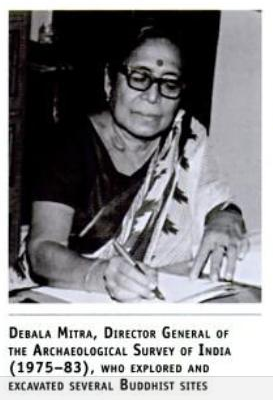 Mrs. Mitra was the Director General of the Archaeological Survey of India (1975-1983) [Page 448 of this book] and has written extensively on various Monuments of India.
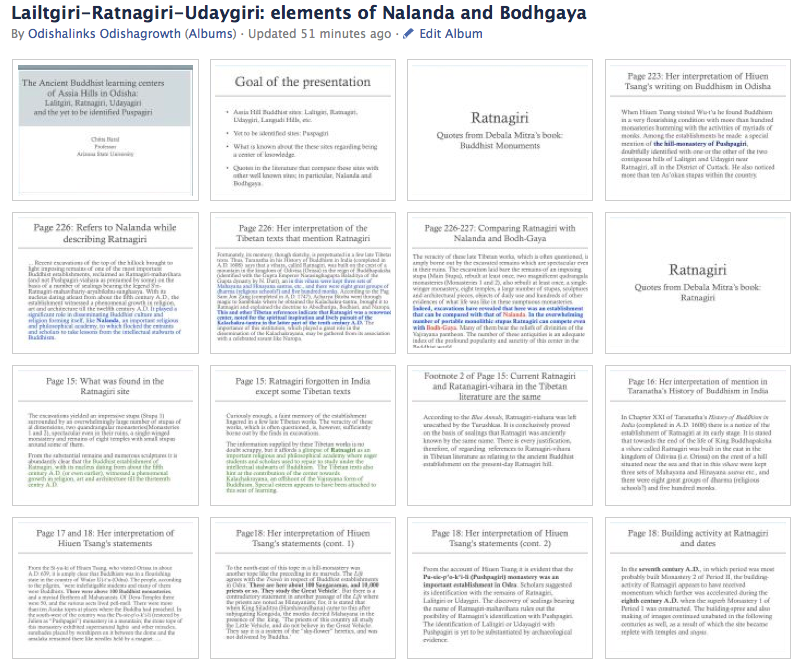
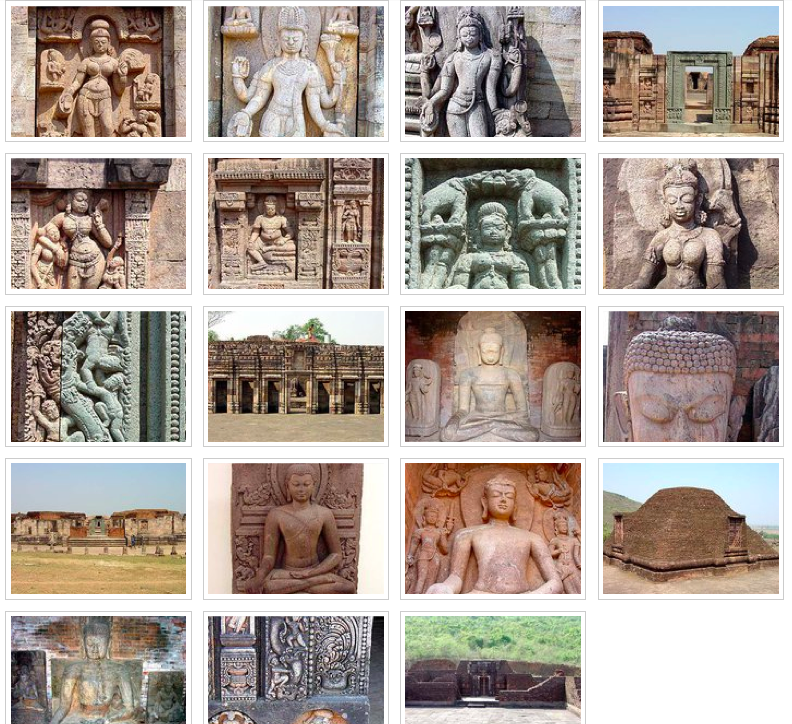
The above slides do not have any pictures. As is mentioned in some of the slides, the Lalitgiri-Ratnagiri-Udaygiri Mahaviharas are also comparable to Bodhgaya in certain respects and one slide mentioned how none of the monasteries in Nalanda can compare with the embellishment in one of the monastery found in Ratnagiri. The following pictures, again from facebook, gives one the idea of what has been found in Lalitgiri-Ratnagiri-Udaygiri and the beauty and significance of them.
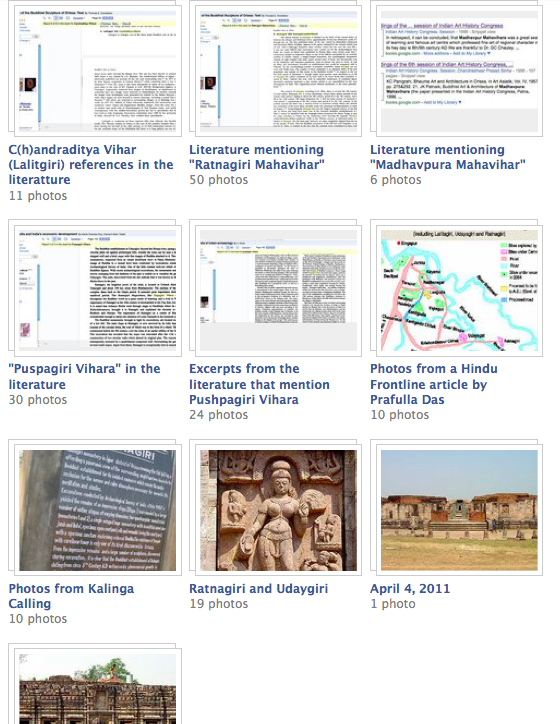
In 2010 the Indian Parliament passed the Nalanda International University Bill. This university is in the making now and this wikipedia page has information on it. We hope that some day more people in Odisha and India will know about Lalitgiri-Ratnagiri-Udaygiri and a similar university (perhaps called Puspagiri University, the yet to be identified Mahavihara about which Hiuen Tsang wrote glowingly) will be established in Odisha. Towards that effort some background information has been compiled in a facebook page and a facebook account. Following is a glimpse of the information that has been collected.

November 18th, 2011
The various reports are at http://www.innovationcouncil.gov.in/index.php?option=com_content&view=category&layout=blog&id=8&Itemid=10. The following excerpts are from the report at http://www.innovationcouncil.gov.in/images/stories/reportpeople/report%20to%20the%20people-full-report.pdf.
NInC is focused on encouraging and facilitating the creation of an Indian Model of Innovation by looking at five key parameters: Platform, Inclusion, Eco-system, Drivers and Discourse. The aim is to re-define innovations to go beyond formal R&D parameters and look at innovation as a broader concept that breaks sectoral silos and moves beyond a high-tech, product-based approach to include organisational, process and service innovation. The core idea is to innovate to produce affordable and qualitative solutions that address the needs of people at the Bottom of the Pyramid, eliminate disparity and focus on an inclusive growth model.
… Some key initiatives that NInC has focused on in the past year include: (a) Developing a framework to finance innovation for the Bottom of the Pyramid through the creation of an India Inclusive Innovation Fund; (b) Creating an eco-system for seeding innovations in regional industry with a focus on MSMEs, by facilitating the creation of Industry Innovation Clusters to drive job creation and productivity; (c) Leveraging our demographic dividend for innovation by creating a connected India through the spread of rural broadband in two years time to all 250,000 panchayats; (d) Nurturing innovation in the education system through action in schools and colleges by intervening in curriculum, talent-spotting of innovators among students and award of Innovation Fellowships, creation of a Meta University, as a global first, that rides on the National Knowledge Network to promote multi-disciplinary learning, facilitating the creation of innovation ecosystems at Universities through University Innovation Clusters; (e) Promoting an innovation culture through action in areas of communication and advocacy through an Innovation Portal and working through mass media organisations; (f) Creating an institutional framework for innovations in Government by facilitating the setting up of State Innovation Councils in each State, and Sectoral Innovation Councils aligned to Union Government Ministries; (g) Promotion of projects that create an innovation dividend like the setting up of a Rabindranath Tagore Knowledge City in Kolkata, setting up twenty Innovation Design Centres co-located in existing institutes; (h) Setting challenges for the Indian imagination to come up with solutions, especially those that relate to inclusive innovation; (i) Promoting co-creation and sharing of knowledge through Global Knowledge Partnerships, beginning with a Global Roundtable on Innovations for sharing ideas.
…
Developing an India Inclusive Innovation Fund
To promote inclusive innovation and entrepreneurship focusing on the needs of people in the lower echelons of society, an India Inclusive Innovation Fund (IIIF) was conceptualised, detailed and is currently under discussion with the Ministry of Finance and leaders of industry. The Fund seeks to promote enterprises engaged in developing solutions in key areas such as health, education, agriculture, handloom, handicrafts and other small business enterprises. The Fund will combine commercial and social returns. The Fund will be capitalised to an eventual target size of Rs 5000 crores to be achieved in phases. It will be kick-started with seed investment from the Government and bilateral/ multilateral institutions and go to scale with private capital. The Fund will be an autonomous, professionally managed entity with a social investment focus.
PROGRESS
The idea of the IIIF has been proposed to the Ministry of Finance and its initial contribution will kick start the Fund in the fiscal year 2012-13.
…
Nurturing Innovation through Education
To promote creativity and nurture innovations NInC has so far made six proposals to the Ministry of Human Resource Development (MHRD). These include five proposals made in May 2011 and one in September 2011.
(a) Creation of a separate scholarship stream of National Innovation Scholarships analogous to the National Talent Search Scheme. This will help identify talented children at the school level who think creatively, laterally and innovatively on issues that they perceive as important in their local environment. It is expected to have a multiplier effect of valuing creativity and innovation by parents, teachers and the learning system.
(b) Setting up an Innovation Centre in each DIET (District Institute of Education and Training) to enhance teacher training and enable them to become facilitators of creativity and innovative thinking. This could be done by tapping local creative talent on part-time basis into DIETs.
(c) Mapping of Local History, Ecology and Cultural Heritage by each High School in the country to create critical thinking on their local environment by students.
(d) Creation of a National Innovation Promotion Service to replace/add to National Service Scheme in Colleges to use college students to identify local innovations. This is a scheme of the Ministry of Youth Affairs and Sports which along with Ministry of HRD has been requested to examine its feasibility.
(e) Setting up a Meta University, as a redefinition of the university model in the 21st century by leveraging India’s National Knowledge Network to enable multi-disciplinary learning and collaborative knowledge creation.
(f) Setting up twenty Design Innovation Centres co-located in Institutes of National Importance. It has been proposed to set up these Design Innovation Centres in twenty select institutions and included in the 12th Plan for consideration by the Ministry of Human Resource Development. Co-location in campuses of national repute like IITs/NITs will help leveraging of academic and industry resources and give a boost to design capacity in the country.
(g) Setting up a pilot University Innovation Cluster. NInC proposes to identify and facilitate the development of 20 University Innovation Clusters across the country where innovation would be seeded through Cluster Innovation Centres.The CIC will provide a platform for the university and its partners to forge linkages between various stakeholders from industry and academia, initiate and assist innovation activities, encourage innovations in curricula and act as a catalyst and facilitator. It will also work closely with other industry clusters in its region. An initial pilot with University of Delhi has commenced and received overwhelming response from the student community.
PROGRESS
Ministry of Human Resource Development has green—lighted the following three proposals:
(a) Award of 1000 Innovation Fellowships at the School Level (Classes 9-12)
(b) Introducing the Mapping of Local History, Local Ecology and Local Culture and Heritage by all High Schools
(c) Setting up the first Meta University of the world for multi-disciplinary learning and collaborative learning All these three proposals will roll out in academic year 2012-13. Other proposals are also under consultation with Ministry of HRD.
(d) University of Delhi has set up a University Innovation Cluster as a pilot which has been widely welcomed
The 12th Five Year Plan will include all approved proposals. Most, except the proposal on Design Innovation Centres, can be done under existing policies and schemes by appropriate modifications.
…
Some of the key initiatives taken up by the National Innovation Council in its first year to nurture innovations through education are given below.
(a) Creation of a separate scholarship stream for National Innovation Scholarships analogous to the National Talent Search Scheme To complement the government’s National Talent Search Scheme, the NInC has proposed the introduction of a parallel stream of National Innovation Scholarships to be administered by NCERT and conducted through the decentralised management system it has put in place.This will help identify talented children at the High School and Secondary School level (Classes 9-12) who think creatively, laterally and innovatively on issues that they perceive as important. It will have a multiplier effect of valuing creativity and innovation by parents and teachers and will gradually evolve into a culture of valuing innovation in the schooling system. It is proposed that 1000 scholarships be considered for awarding each year under this scheme with 50% earmarked for innovations by students in schools located in non-urban areas and at least 33% earmarked for children from the field of liberal arts.
…
(e) Setting up a Meta University as a Global First to promote collaborative and multi-disciplinary learning using the National Knowledge Network
India pioneered the idea of the university with Nalanda and Taxila to explore a life of the mind and undertake an exploration of ideas.Today India is poised to reinvent the university of the 21st century as a new adventure of cross-cutting ideas facilitated by technology. In doing so it seeks to position the university as a cradle of innovation.The National Knowledge Network connecting India’s major knowledge institutions is already in place and provides a platform to facilitate this endeavour, further the fact that most of these major knowledge institutions in India are part of a public system, makes collaborative effort easier. Technology offers unprecedented opportunities to “disrupt the classroom” as traditionally understood, provide for individualised and customised learning and radically alter pedagogic systems to move towards collaborative and multi-disciplinary learning.
Seizing these new opportunities and leveraging the platform of the National Knowledge Network, the National Innovation Council has put forward a proposal to create the first global Meta University. The idea of a Meta University was first conceptualised by Charles Vest and later developed by Don Tapscott and Anthony Williams as a Global Network of Higher Learning to be realised in several stages.The basic idea of a Meta University as a collaborative platform where a network of Universities offers students a customised learning experience is eminently applicable in the Indian context.
The National Knowledge Network (NKN) initiated by the National Knowledge Commission, is already being implemented to connect all our universities, research institutions, libraries, laboratories, hospitals and agricultural institutions across the country with a high speed (multi gigabit) fibre based, broadband network. The NKN by networking all knowledge institutions and providing them with high speed connectivity aims to facilitate flow of information and create a platform for collaboration between researchers, academic faculty and students from diverse backgrounds and geographies. In addition, the Ministry of HRD aims to eventually provide connectivity to colleges and schools as well as support content creation through its initiatives. Further, the proposed Universities for Innovation Bill recognises flexibility as its DNA to facilitate innovation.Thus India provides unique opportunities for innovating with this idea of a ‘Meta University’ given the enormous unmet demand for high quality education in an environment of limited resources and the availability of a dedicated national network. It will enable the breaking down of silos of academic disciplines and help students to gain multi-disciplinary understanding to be able to create more “rounded” intellectuals for society.
The Meta University riding on the NKN envisages a collaborative and multi-disciplinary learning platform, where students enrolled in a primary college/university will be able to take courses available in other universities and colleges. With the help of Mentors, students will therefore be allowed to customise their learning experience and select options from a wide menu of choices, leveraging the specialisation of individual institutions. So it will be possible for an engineering student from, say IIT Kanpur to also enrol for a course in ancient history from the Jawaharlal Nehru University or a mathematics student from Indian Institute of Science pursue a course in comparative literature from the Jadavpur University.
The Meta University will reinterpret the concept of a University as not just a traditional, physical space of learning, but as a repository of knowledge and information that can be delivered in multiple ways, and can be accessed from anywhere and anytime. It will seek to enhance the learning experience through new and innovative delivery models of education that allow students and institutions to collaborate in unprecedented ways.
This model is low-cost, requires no brick-and-mortar, leapfrogs over conventional bottlenecks of non-availability of a talented faculty pool, and works within existing legal systems. It innovates on both the content and form of the twenty-first Century University and offers a unique model for the proposed fourteen Universities of Innovation mooted in India. It is hoped that this would become a model for the world to emulate to move towards collaborative and multi-disciplinary learning that redefines knowledge-creation and knowledge-sharing in the twenty-first century.
Though the internet and technology are fundamental to this conception of the Meta University, at the crux is not a new technology but a ‘new pedagogy’ that is more in tune with the requirements of the knowledge society of the twenty-first century. In such an environment there is a greater focus on moving from the chalk and talk model with the teacher at the centre, to a learner-centric, collaborative model that allows continuous learning from the environment.The web/internet therefore provides both a platform for communication and collaborations as well as a source of content.
The learning platform of the Meta University will incorporate these principles of collaborative and multi-disciplinary knowledge sharing, knowledge creation, openness and flexibility in its design. It will in effect be a test bed for experimenting with a new model of teaching and learning that may show the way for a new education model for the future.The detailed design of the Meta University will be undertaken by a core group of academics, heads of institutions and experts who would constitute the Board of Governors of this new Meta University. The National Innovation Council is working closely with government departments concerned and other stakeholders to implement these initiatives at the earliest.
(f) Setting up of 20 Design Innovation Centres by co-locating them with Institutes of National Importance Design is a key element of the innovation process and will be critical for driving innovation in the new knowledge economy. Design-driven innovations can ensure sustainable competitive edge, enhance industrial productivity and also address crucial challenges by harnessing design thinking for needs-based solutions. Design thinking is especially important for solving key problems because it works with a different set of processes: repeatedly reframing the problem, engaging with stakeholders, prototyping and testing solutions, exploring alternatives, visioning scenarios and so on.
In the last fifty years the world has seen dramatic changes and design has also transformed significantly along the way. Design and Design thinking are increasingly about building in capabilities that empower and enable people to use these resources, with quality of life and environment as the guiding principles, not just economic factors which are also important. However, we as a nation do not have enough state-of-the-art design institutes to enhance our innovation capabilities.The major bottleneck in clearance of setting up of Design Institutes across the country is availability of land, as well as access with an ambience conducive to professional education and trained and talented faculty. One such campus needs a minimum of 30 acres of land for construction of about 20,000 sq meter area of class rooms, studios, hostels, offices, faculty residences etc.
In this context, NInC has suggested a model of setting up Design Innovation Centres in twenty select locations to be included in the 12th Plan for consideration by the Ministry of Human Resource Development.These could be through co-location in campuses of national repute to ensure maximum convergence, optimum utilisation of existing resources and infrastructure, and to leverage a context of academia-industry interaction. These centres could be located in IITs, new IITs where there is industry presence, the NITs, and select Technical and Liberal Arts Universities. Co-location will address issues of availability of land and faculty, save costs, enable horizontal transfer of knowledge, as well as offer a ready talent pool to enable timely execution of this initiative. Also, co-locating these schools in institutes beyond IITs would also ensure that emphasis of design education is not on engineering and technology oriented product design alone, but could extend to other faculties/disciplines related to eco-friendly and green design for products and services, service design, communication design, systems design etc. broadly integrating design intervention in different sectors supporting economic growth and increasing employment opportunities. Further, existing National Institutes of Design could play a mentoring role to these centres given their expertise in the field.The aim is to make these Innovation Design Centres/Schools state-of-the-art institutions to enhance the innovation quotient in the country and foster a design culture.
Out of the above, the Ministry of Human Resource Development has green-lighted the following proposals: Award of 1000 innovation fellowships at the school level; Mapping of local history, local ecology and local culture and heritage by high school students; Setting up the first Meta University of the world for multi-disciplinary learning.
(g) Creation of Cluster Innovation Centres (CICs) at Universities
Over the years universities in India have become increasingly focused on their teaching function, imparting and disseminating knowledge and training to a large number of students.With a few notable exceptions research by and large has moved out of academic institutions to stand alone research centres and laboratories. Further, university linkages with industry and society have at best been weak and under developed. As a result, our Universities have not been at the vanguard of innovations that solve real world problems and result in creation of products and processes that boost the economy and help the common man. While far reaching systemic reforms in higher education are required and the government is committed to them, one significant way to revitalise the university system in the context of innovation is to strengthen its linkages with industry and society.
Recognising that educational institutions must be at the centre of the innovation process, in the last decade or so renewed efforts have been made by various stakeholders to promote innovations and entrepreneurship in our educational institutions. The Government has taken up various initiatives like setting up Innovation and Entrepreneurship Development Centres (IEDC) in educational institutions, Science & Technology Entrepreneur Parks, and Technology Business Incubators, in order to promote knowledge based and innovation driven enterprises. Other initiatives include creating better incentive structures to reward innovations, encouraging young talent through scholarships, making available risk/venture capital and other necessary ingredients to strengthen the institutional capacity for innovation in the country.
In order to strengthen these efforts and to make Universities hubs of innovation the National Innovation Council seeks to create Cluster Innovation Centres (CIC) at Universities with an aim to foster an ecosystem of innovation, and connect research with application for the benefit of society. The CIC will provide a platform for the university and its partners to forge linkages between various stakeholders from industry and academia, initiate and assist innovation activities, encourage innovations in curricula and act as a catalyst and facilitator. It will also work closely with other industry clusters in its region. The CIC will provide a range of services and facilities, starting from evaluating an idea for its innovation potential, advice on technical and commercial viability, advice on IPR issues, guidance on relevant schemes and grants, helping innovators find partners and collaborators including funding, business development and finally taking the products and processes to end users.The CIC will have an appropriate institutional structure to enable it to undertake a range of functions, and a lean management team with expertise in guiding stakeholders in innovation management.
The NInC aims to catalyse the creation of at least 20 such Cluster Innovation Centres at Universities and provide support for the clusters to bear fruit and sustain.The NInC is currently working with a few select academic institutions to showcase the potential of Cluster Innovation Centres and will scale up this activity to a larger number of educational institutions in the coming year.
November 18th, 2011
The website of this summit is http://www.ficci.com/past-Events-page.asp?evid=20665. Following are excerpts from the press release on Dr. Montek Ahluwalia’s speech.
Inaugurating FICCI Higher Education Summit 2011: Strategies for Expansion in Higher Education in India’, Mr. Ahluwalia said, “The challenge before planners, policy makers and educationists, both in the public and private sector, was of producing world class Indian universities that could be counted in the top 200 rating list.” In the next 20 years we must see a significant number of educational institutions in that category, he declared.
Mr. Ahulwalia also underlined the need to lend an international flavour to Indian universities by inducting international faculty. This would not happen unless the government removes the restriction on employment of international faculty, he said.
For higher education, the 12th Plan objective was expansion, equality of access and excellence. The aim was to raise the gross enrolment ration from the current level of 15 per cent to 30 per cent over the next 15 years. “Expansion of higher education has to be balanced with equality of access, especially for those living in areas where educational institutes did not exist,” he said.
Following are excerpts from the press release on Sam Pitroda’s speech.
Addressing the FICCI Higher Education Summit 2011, Mr. Pitroda said, “Higher education reforms are essential if the nation is to meet the serious challenge of skill shortage that will not allow the economy to grow at 8-10 per cent annually. While many of the recommendations of the National Knowledge Commission are in the process of being implemented, we are waiting for the government to act on the recommendations retailing to reform of higher education.”
“The debate on what needs to be done ought to be over, the time now is to focus on action,” he said and added that “the Bills have already been drafted but none of them have been tabled in or passed by Parliament.”
Mr. Pitroda’s concern found an echo in FICCI President, Mr. Harsh Mariwala’s suggestion that although education continues to be a priority sector during the Twelfth Plan, unless the reform agenda initiated by the Ministry of Human Resource Development in the 11th Plan is carried forward within a stringent timeframe, the demographic dividend of a young population could become a demographic disaster for India as well as the world.
Mr. Mariwala hoped that the Foreign Education Providers’ Bill; Unfair Practices Bill; Tribunal Bill and the Accreditation Bill will be passed in the coming winter session of the Parliament and the National Commission for Higher Education and Research (NCHER) Bill 2010 and Innovation University Bill will be introduced in the winter session of the Parliament. The delay in implementation of the reforms is a serious impediment for the economic development of the country, he said and added that FICCI earnestly urges the political leadership to take cognizance of this fact.
Mr. Pitroda said that the government was creating a US$ 5 billion National Knowledge Network (NKN) which is expected to be ready in about nine months. The network would be a state-of-the-art multi- gigabit pan-India network for providing a unified high speed network backbone for all knowledge related institutions in the country. It would facilitate the building of quality institutions with requisite research facilities and creating a pool of highly trained professionals. The NKN will enable scientists, researchers and students from different backgrounds and diverse geographies to work closely for advancing human development in critical and emerging areas.
Following are excerpts from a report in Chronicle of Higher Education.
Mr. Sibal has said that private participation in higher education must be encouraged, and conference attendees agreed that if the government hopes to reach its goal of sending 30 percent of young people to college, both private and public participation are needed. The challenge, as always, is in weeding out the low-quality operators.
"The public perception of private higher education is in a range," said Montek Singh Ahluwalia, head of India’s Planning Commission, a top government policy-making body. "Many are good, but there is a problem of those not-very-good ones."
Mr. Ahluwalia argued that supply and demand will eventually eliminate the bad actors, but others disagreed.
"It will be difficult to weed them out," said M. Anandakrishnan, head of the Indian Institute of Technology’s Kanpur branch. Because there is more demand than supply, he said, it will take time for stakeholders to make discerning choices.
Another delegate, Sachi Hatakenaka, a British-based education researcher, argued that "private sector growth is good for quantity but not for quality."
… Still, said Mr. Agarwal, the next round of government higher-education planning will focus more on expanding capacity at existing institutions rather than adding new universities.
Some private players were hopeful that the government will look to the private sector more as an ally than an adversary in coming years.
November 16th, 2011
Following is an excerpt from a report in Times of India.
… Bottlenecks continue to hamper the progress of the prestigious Indian Institute of Technology, Bhubaneswar (IITBBS).
The IIT authorities in a meeting with Khurda collector Roopa Mishra earlier this week (on November 8 ) raised concern over several issues stalling the work. Mishra, when contacted, said "There are certain issues, which the government has been resolving. It is a continuous process. All matters are being addressed. We hope all problems will be solved."
… the institute is far from its December 2013 deadline to complete first phase work to create facility for 2,500 students, 250 faculty members and 275 support staff.
The institute is yet to get approval from Bhubaneswar Development Authority (BDA) for its building. Sources said the IIT had applied for the approval over one month ago. The Central Public Works Department (CPWD) is in the process of floating tenders for construction of hostels. "The tender would be advertised by this month- end," said a CPWD official.
The master plan of the campus has been designed to accommodate 10,000 students, 1,000 faculty, 1,100 non-teaching employees besides 1,000 out sourced support staff. Odisha had allotted 936 acres of land for IIT for the purpose. The Union government has approved construction of 221,000 sq m of covered area (63,000 sq m for academic complex and 158,000 sq m for residential complex) in the first phase for which an outlay of Rs 388 crores has already been provided.
November 14th, 2011
(Thanks to Situn’s post in Rourkelacity.com for pointing us in this direction.)
Following is an excerpt from a report in dnaindia.com.
Patnaik presided over a review of NTPC’s progress on two proposed two projects at Darlipali in Sundergarh district and Gajamara in Dhenkanal district.
… The NTPC has committed to set up a medical college hospital in Sundergarh district and upgrade the existing district headquarters hospital to 100 beds with ICU.
The location of Sundergarh is a judicious one, as Talcher (where NTPC has its current operations) area will have two medical colleges (one by MCL and another by JSPL) and Dhenkanal (the other location of NTPC’s two new UMPPs) is close to Cuttack-Bhubaneswar which have several medical colleges. In addition, it is time something is given back to Sundergarh, whose Ib valley is a major source of coal.
November 4th, 2011
November 1st, 2011
Following is from their ad at http://www.niser.ac.in/notices/2011/FACULTY%20RECRUITMENT-Oct-2011.pdf.
NISER invites application for faculty positions in specific areas of Physics, Chemistry, Biology and Mathematics at the level of Assistant Professor. Candidates who possess requisite qualification (Ph.D and at least 2-3 years of postdoctoral experience in the relevant area) are requested to send their detailed CV on or before 30th November 2011 to director@niser.ac.in.
Age: 35 years or less as on 30th November 2011
Physics
1. Experimental High Energy Physics (Higgs and SUSY Search beyond standard model of LHC).
2. Theoretical condensed matter physics (Many body theory, strongly correlated systems, Topological Insulators related areas).
3. Cosmology (Early Universe, Inflation, CMB related topics, Gravity waves).
* Persons with outstanding track records may be considered for Reader-F level provided they are below 40 years of age on 30th November 2011.
Chemistry
1. Spectroscopy with hands on experience with building of equipments for electronic absorption, fluorescence spectroscopy.
Biology
1. Ecology and Structural Biology
Mathematics
1. All areas of Mathematics
DIRECTOR
October 28th, 2011
| M | T | W | T | F | S | S |
|---|---|---|---|---|---|---|
| 1 | 2 | 3 | 4 | 5 | 6 | 7 |
| 8 | 9 | 10 | 11 | 12 | 13 | 14 |
| 15 | 16 | 17 | 18 | 19 | 20 | 21 |
| 22 | 23 | 24 | 25 | 26 | 27 | 28 |
| 29 | 30 | |||||