… The master plan is ready and the Department of Atomic Energy (DAE) has selected Larsen and Toubro (L&T) to execute the job. They are expected to start the work next month. The project has to be completed within 36 months … We hope that the Phase-I work comprising four major schools and the administrative block will be over by the end of 2013,’’ said the institute’s registrar, AK Naik.
The campus is coming up on 298 acres near Jatni.
While the forest department has already marked 285 trees for felling top facilitate work, steps to ensure enough greenery are being taken by planting 2,500 saplings along its fenced boundary. “We are planning more afforestation programmes in future,” added Naik.
The project envisages an expenditure of Rs 457 crore in the first phase including Rs 160 core on residential township and Rs 130 crore on academic buildings and a sports complex. The Centre has sanctioned Rs 823.19 core for the entire campus project in Bhubaneswar.
After fencing the authorities have deployed a 25-member security team with a supervising officer to keep watch. … the NISER campus site is safe. A transformer has been installed at the site to ensure uninterrupted power supply. Two corrugated tin sheds have also been put up at the site for the engineers to work out of.
The Registrar added that the construction work was getting delayed as the approval of the one of a senior officials of the Ministry of Finance was still awaited. Once it was available the executing agency would go ahead with the work. Earlier there was some delay on account of the time taken by the department of atomic energy (DAE) to grant certain approvals.
“The DAE technical panel inspected, checked and approved each and every aspect of the engineering drawing which took one year,” said a senior professor, who is an advisor and member on the NISER Board.
Currently operating from a transit campus of 5,000 square metres within the Institute of Physics (IoP), Bhubaneswar premises, NISER has lab, teaching and research facilities. While Rs 12.5 crore has been spent on these facilities for the school of chemistry Rs 13.5 crore for the school of physics, Rs 25 crore for the school of biology and Rs 5 crore for the school of mathematics.
… “We have been promised a three-acre plot by the state government for setting up a city campus in future. This will include a 1,500 seated conference hall,” said the registrar.
As per the latest statistics, the community colleges of the Indira Gandhi National Open University (IGNOU) have become a rage in the country. "In just three years, IGNOU has over two lakh students in about 600 community colleges pursuing vocational education, skill development and work integrated learning," announced Vice-Chancellor Prof. V.N. Rajasekharan Pillai,.
… In the early 1990s, the University Grants Commission had sent a committee of Vice-Chancellors and Principals to the USA to study the well-established community college system there. Following the recommendations, the Pondicherry Central University had started the first community college in the publicly funded university system. Pondicherry University is now augmenting the community colleges by appointing faculty and creating other facilities.
In Tamil Nadu, state universities like Manonmaniam Sundanar University, Tirunelveli and very recently, all the state universities in Tamil Nadu have decided to start 10 community colleges each. The Tamil Nadu Open University (TNOU) has started Community College programmes at the Certificate and Diploma levels and the state has also a large number of community colleges supported by charity organisations, particularly by the missionary institutions. …
"The Community College System the world over is the most open and flexible pattern of post-secondary education, life-long learning and skill development. It provides a supplementary route to higher education through an appropriate mix of skills and academic knowledge. In the US, according to the latest statistics, 46 percent of the students go to the Universities through the two-year community colleges. Several of these Community Colleges are much bigger than some of the premier universities over there. Open education practices, flexi-time approach, technology-enabled teaching and learning, On-line and distance learning, work-integrated learning, and very recently use of Open Education Resources (OER) are the most salient features of these community colleges," said the VC.
Open University of China (OUC) offers full-time, part-time and spare-time two-year and three-year degree programmes in addition to various modular, certificate and diploma programmes. The two-year degrees (Associate Degrees) are analogous to the community colleges in the US, Canada and Australia, and to the advanced diploma programmes in the UK and European post-secondary education system.
The 2010 Statistical Bulletin of the Open University of China indicates that the Associate Degree, which is in between the Certificate and the Bachelor Degree, is the largest qualification base in China. In 2010, 4,12,400 students from OUC received Associate Degrees in contrast to 6,914 Bachelor Degrees and 38,000 Certificates. More than 50 percent of the students enter into higher learning in the Universities through these two-year degree colleges in China.
Open and Distance Learning (ODL), On-line Learning and Open Educational Resources (OER) constitute major delivery strategies as of today in the Community College System. The two-year Associate Degree Community Colleges have more than 50 percent of their enrollment through Distance Education.
Looking at these global trends in Open University and Distance Education Systems and considering the challenges of the National Skills Mission, chaired by the Prime Minister of India, IGNOU initiated the Community College Movement in the country in 2008, after countrywide consultations and drawing inputs from the National Knowledge Commission and the Planning Commission. In just three years, IGNOU has over two lakh students in about 600 community colleges pursuing vocational education, skill development and work-integrated learning, full-time, part-time and spare-time. …
… The Ministry of Human Resource Development held a meeting with the representatives of IITs, including the eight new ones, in Delhi on Thursday.
… Like its counterparts, the Bhubaneswar institute too is behind the schedule and unlikely to meet its 2013 deadline given the existing pace of work. With problems of land acquisition and transfer, the IIT Bhubaneswar has been able to construct only boundary walls measuring about six km. …
Sources said that IIT Bhubaneswar would submit a report to the Ministry detailing its bottlenecks about land transfer, forest land conversion, acquisition of private land and infrastructure like road, power and water.
With the slow progress raising hackles, the IIT has decided to hasten establishment of its campus at Arugul, about 25 km from here. Works estimated at 30 crore will soon be taken up with two-phase tenders.
The first tender will be scheduled in July and include works such as roads inside the 935-acre campus, sewerage and site development. The second tender will be floated around December for construction of buildings.
… Most of the new IITs, sources said, sought that new project proposals be chalked out since the 12th Plan is only three quarters away and the project costs will stand revised at the current prices. The IIT Bhubaneswar was earmarked 760 crore, half of which is towards infrastructure.
The sources further said that each of the new institutions is likely to cost close to 1,400 crore for which funding proposals will have to be placed in the 12th Plan.
The IITs have completed 50 years and have helped build India. They were set up for producing high quality technical human capital for India and have met their objectives. But, as is the character with such institutions, they have not changed with the times and are not providing India with what she now needs.
… The IIT boards and the directors are unable to take any financial decision which they deem fit without the approval of the government . Even for an overseas travel of the director or the faculty, permission is needed. They are subject to austerity measures of the government, a perfect situation to emasculate an educational institution.
The demand for an IIT seat is enormous and has spawned a tutorial industry that earns more revenues than the IITs themselves. This has resulted in large number of students spending up to two years of their youth going to cramming schools learning pattern recognition, forgetting the art of thinking and problem solving knowing that their lives are made once they get entry into the hallowed portals. Today about 60% or more of the intake is from the coaching mandis. This has also resulted in many bright young Indians deciding not to undergo the ordeal and go overseas for higher education. 250,000 of them study overseas, over 110,000 in the United States, about 45,000 in the UK spending about $ 6bn on fees and costs annually …
Overall , the 15 IITs graduate 7000 undergraduates, 6000 post graduates and about 1700 PhDs annually . Sadly only about 2% of the undergraduates go on to their masters and PhD in the IIT system. The IITs hold fast to the idea that by squeezing input they can get a quality output, an idea that has been consigned to the dustbin of history. Increasing the scale and size can give them the diversity of talent, the resources, the ability to have more quality faculty and the depth and width needed for an elite educational institution.
… the IITs will live in their ivory tower and possibly become less and less relevant to India’s need as neither are they meeting India’s need for more human capital nor producing the kind of PhDs India needs.
… The best solution is to open up the education system and allow competition, the dreaded word in academics, to come forth. India should revise her educational policies and allow the private sector to set up "innovation universities" granting them all that they need. Full autonomy, academic, administrative and financial to chart their own future. Some safeguards are needed, as this is a public good. A large corpus of say Rs 100 crore, an open merit based admission policy, a faculty compensation policy based on minimum UGC scales and an assurance that they will aim to be amongst the top 100 in the world over the next 25 years. To ensure access to the merited we need a national scholarship scheme which will fund students. India needs to trust the genius of her citizens to create institutions that are world class and not look at them through myopic eyes with suspicion.
… Today there is a flight to quality. The bad colleges are dying since students have a choice, they are voting with their feet. The good ones are expanding and seeing greater demand. The market mechanism has worked, not by design but by serendipity. So there is hope. Look at various other sectors today. Bharti has made BSNL redundant and has given us a choice, Jet has overtaken Air India and given us a choice, the power system in Mumbai is still the best, and in education the Indian School of Business has turned our IIMs inside out. The IIMs actually want reform, expansion and are concerned about their future .
Competition and an open liberal environment for higher education will work .
I agree with most of the points made in the article and its arguments buttress the need for early approval of universities like the proposed Vedanta University.
One point where I disagree is the suggestion that 100 crores is a large corpus. If the goal is to be in the top 100 in the world, a corpus of 100 crores is very little. That is only 20-25 million USD. In comparison the corpus of Harvard and Stanford are of the order of 25+ Billion USD.
Community Colleges are an alternative system of education which aims to empower individuals through appropriate skill development leading to gainful employment in collaboration with the local industry and community.They offer the advantage of tailoring programmes to local needs and state-based requirements by using approaches that will be most acceptable to workers in the given community. Community Colleges generally have a 2-year curriculum that either leads to an Associate Degree for transfer to an undergraduate college or to the students direct entry into any occupation or trade.These colleges are a source of economic growth because they provide an educated and skilled workforce that improves the quality of life for individuals students, communities, and the nation.
Q: After doing Associate Degree Programme from Community College will the third year be done from IGNOU or any other University?
Ans. We are targeting for IGNOU only.
… Q: How to get an approval of a proposal regarding Community College?
Ans: Please go to IGNOU website and visit the link "Community College‟.
… Q: Who will be eligible to enroll in Community Colleges?
Ans: Anyone who has completed 10+2 or its equivalent is eligible to enroll for the Associate Degree Programme. Similarly students who have completed the BPP Programe of IGNOU may also enroll for the Associate Degree Programme. Eligibility for Certificate Programmes vary from 8th pass and above and that for Diploma Programme vary from 10th pass and above.
… Q: What is the suggested structure of Certificate and Diploma Programme?
Ans: Certificate programmes should be of 6 months‟ duration and equivalent to 16-20 credits. A Diploma programme is of one year duration with 32-36 credits.
The pattern of credits is as follows:
Full-time programmes – one credit is equivalent to 15 contact hours. Part-time / Distance learning programmes – one credit is equivalent to 30 hours of study by a student which includes self-study, assignments, library work, etc. All Community Colleges must conduct theory/practical/in-service/apprenticeship in appropriate proportions commensurate with the teaching methodology.
… Q: How will students transfer from an Associate Degree to the third year of graduation?
Ans: For students who complete an Associate Degree and wish to register for the third year in IGNOU, a credit transfer policy will be worked out between the Community College and IGNOU. The international pattern is to accept about 80% of the credits earned during Associate Degree Programme.
Q: What is the structure of Bachelor’s Preparatory Programme (BPP)?
Ans: Bachelor’s Preparatory Programme has the following three courses.
i) Preparatory Course in General Mathematics ii) Preparatory Course in Social Sciences iii) Preparatory Course in Commerce
A student has to select any two from the above courses.
… Q: Which are the Associate Degree Programmes that can be run through a Community College?
Ans: A Community College is supposed to identify the programmes as per the need of the community. The Master List given on the IGNOU website carries the names of all programmes on offer by the Community Colleges. This would definitely give you an idea.
… Q: What is the minimum educational qualification and age of formal students in Associate
Degree Programmes?
Ans: 10+2. No age bar.
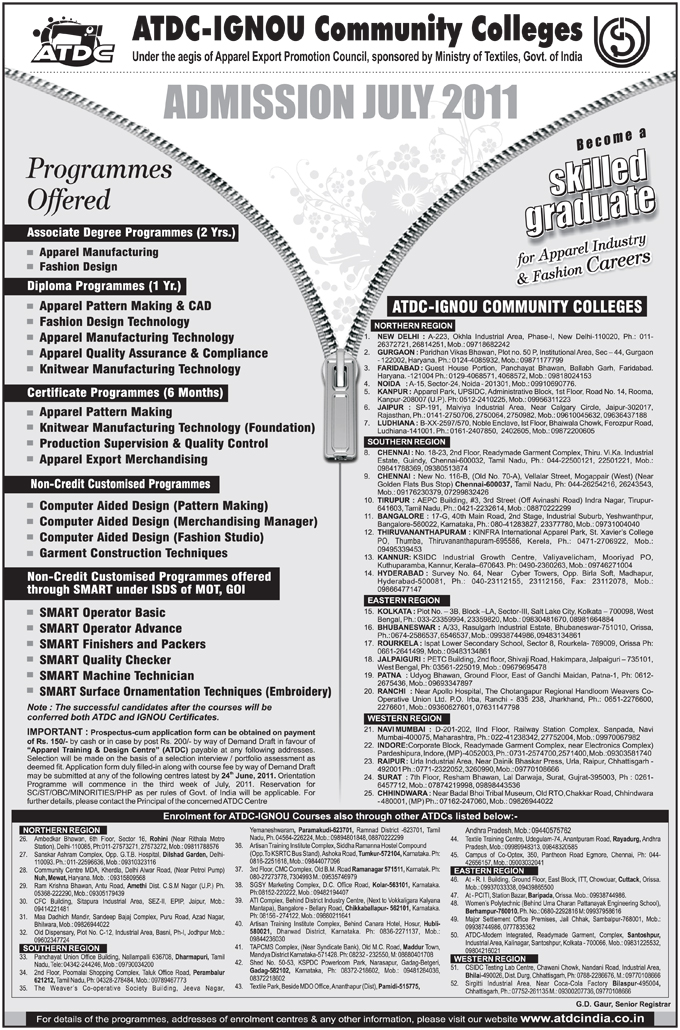
My thoughts: This seems like a good start with some details yet to be formulated. The community colleges will formalize various trade oriented courses and will allow people doing those courses to do a bit more work towards a Bachelor’s degree. At present, there are only a few of these in Odisha. As the awareness increases, it should pick-up. At present most of the current community colleges seem to be run by private entities (the ATDC ones are exceptions). I hope Odisha starts district community colleges in each of its districts and creates a mechanism so that it is funded by district funds and the locals have a say in what is taught.
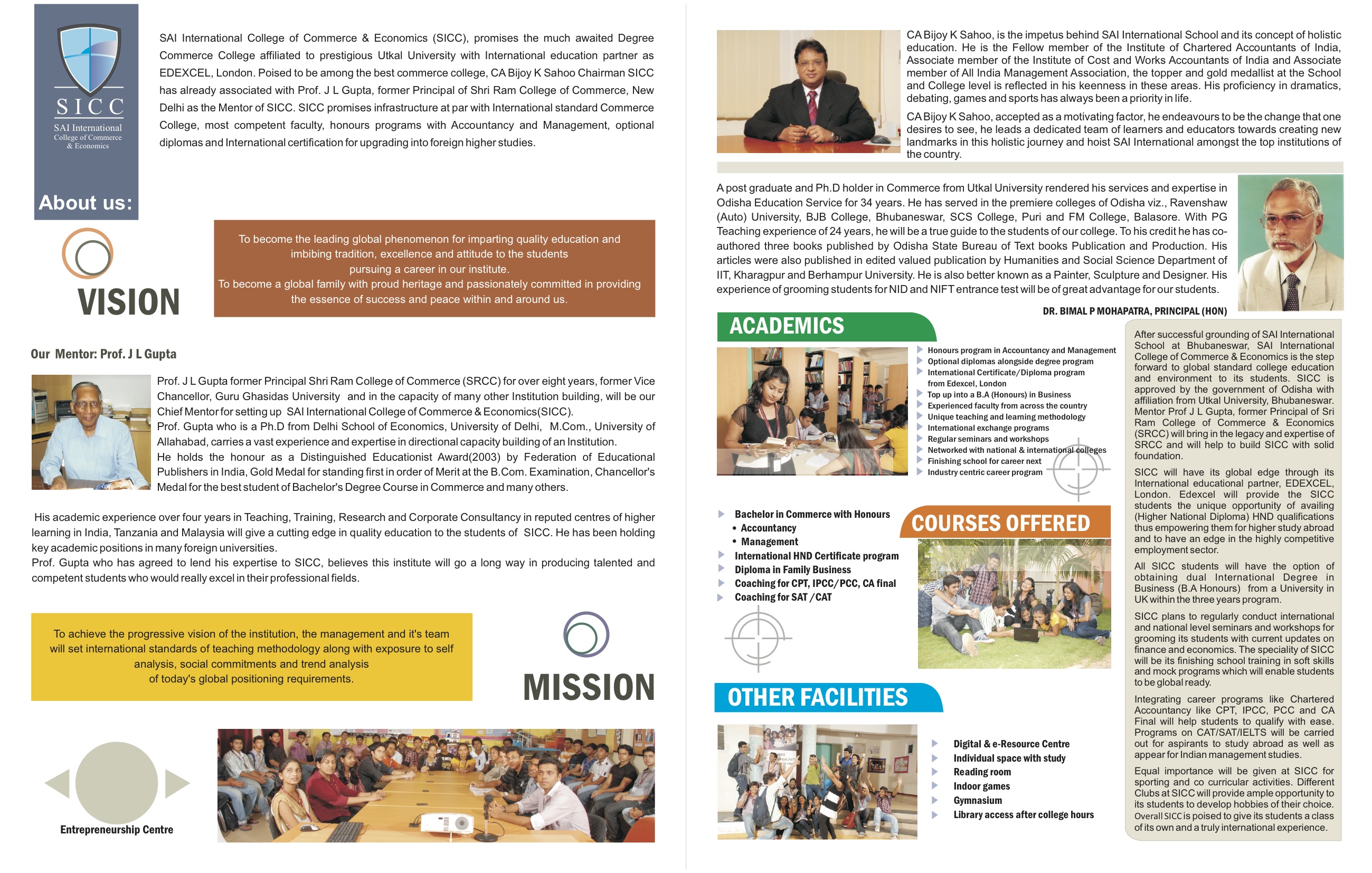
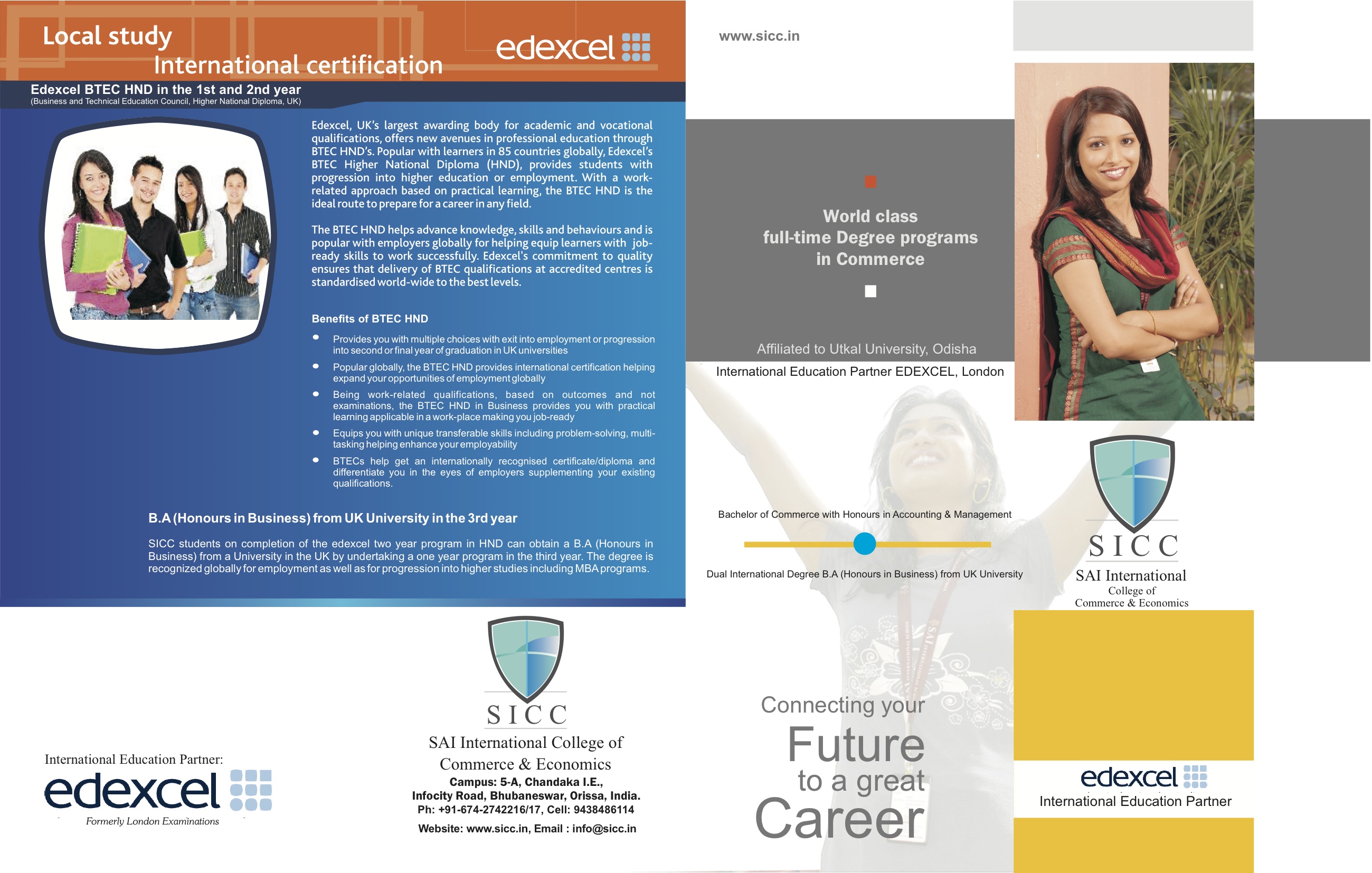
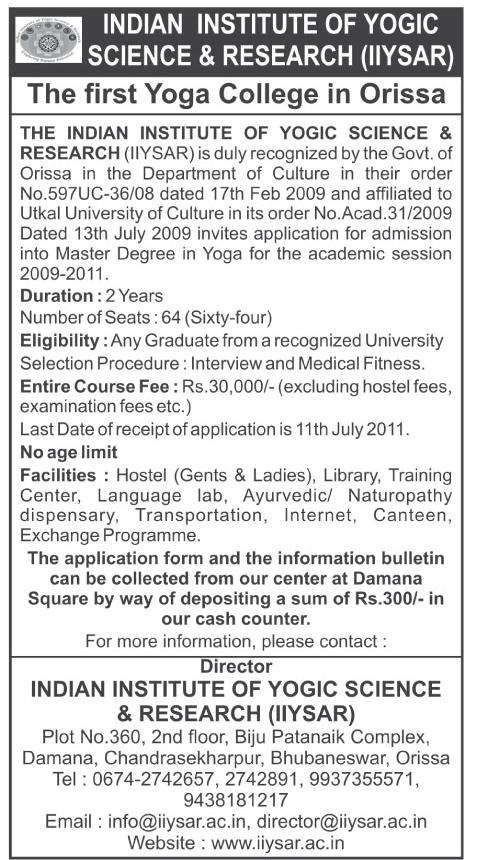
The web page of this college is at http://sicc.in/. Its founder is the person who established the well regarded Sai International School in Bhubaneswar. Based on that, I am hoping that this will be a good college and will fill the lacunae of a good commerce college in Odisha, especially in the Bhubaneswar-Cuttack area. At one time the commerce program at Ravenshaw was ranked, but that was a long time back. I hope the commerce program in this college gets national ranking and other institutions in Odisha (especially the private ones like KIIT and SOA) get inspired by this to start their own quality commerce programs. While there is a plethora of colleges (several of them quite good) in the Bhubaneswar area for pursuing an MBA, there has not been any top-notch (i.e., nationally ranked) colleges for B.Com.
Following is an ad for this college and pages from its brochure.
… the State Government on Monday decided to set up a Construction Skills Training Institute (CSTI) in Bhubaneswar under the Odisha State Employment Mission scheme.
The L&T group has evinced interest for the mega training institute to be set up in the PPP mode in the infrastructure development sector and the negotiation is in an advanced state, said Chief Secretary Bijay Patnaik, adding that the Government would provide the infrastructure support to the L&T.
He said that besides the main campus to be located in Bhubaneswar, the institute would have three sub-centers in the tribal areas, one each at the district headquarters of Koraput, Kandhamal and Mayurbhanj. The sub-centers would act as feeder units for the main CSTI, Bhubaneswar. The concerned district Collectors have already been directed to identify suitable sites for the sub-centers.
The Bhubaneswar institute will be located at the Industries Department premises in the Sailashri Vihar area. Training will be imparted in construction-related trades like masonry, bar bending and carpentry. Training will be meant for school dropouts and the training period will be three months. The training and lodging will be free of cost and L&T will extend stipend of `2,000 per month. According to sources, since the training programme is placement-linked, L&T will offer placement in its own construction sites both within the State and outside.
The Chief Secretary also said after a high-level meeting on the activities of the State Employment Mission held under the chairmanship of Chief Minister Naveen Patnaik that it was decided to provide skill development training to an estimated 10 lakh unemployed youth during the next three years under the Employment Mission.
He said a number of sectors like retails, housekeeping, food and beverage, customer relations, front office management, telecom sales, driving, computer and photo shops, nursing and debt recovery agents would be taken up for skill development.
Meanwhile, on the request of the State Government, the National Skill Development Corporation has agreed to undertake skill mapping in order to identify the demand-driven sectors with special emphasis on an in-depth study in tribal areas.
A committee under the chairmanship of Dr. Anil Kakodkar has circulated a report (see also here and here) with the above name. Following is an input that I hope to send to the committee.
My suggestion is that the IITs combine the idea of free seats and paid seats that is used in many state engineering colleges with (some aspects of) the idea of honors colleges used in many universities in the US.
This means, for any discipline or program, there would be some number of seats (say between 20-40) for a "Research-Honours" program. The students in this program will be required to be involved in research all through their 4 years. Starting from second year they would be part of the research lab of a faculty and each semester they would have to sign up for research credits (and do research) whose grade will be based on research done by the students. Each class from the 4th semester onwards would have research component where students would have to go beyond textbooks and read latest papers on that topic. The students would be required to publish in a good international conference or journal before they graduate. During the summers they will be required to spend time in research labs. In general these students would be motivated and prepared for research careers as is being done in the IISERs and NISER. For these students the fees will be minimal and they may be even given scholarships like the INSPIRE scholarship. To remain in the "honors-research" program the students would have to maintain a required grade point average.
The rest of the students would be in regular programs (as they exist now) and would be required to pay more substantial fees, similar in amount to what the Kakodkar committee recommends. (Based on their academic performance some of these students may be allowed to change over to the "honors-research" program after the end of first year or perhaps even later.)
The above idea may be implemented at NITs too, may be with lesser number of seats in the "honors-research" program.
This will address several issues mentioned in the Kakodkar committee report.
It will result in more IIT (and NIT) graduate pursuing research.
It will result in more funds for the institutes.
The students will have a clear expectations. The ones going to the "research-honors" program will know that research is expected of them and they are supposed to study hard.
The rationale behind the fees difference is fairly obvious. The "research-honors" students have a high chance of pursuing research in their chosen fields and that is the current need of the nation. On the other had the other students, as evident from the current trend, are less likely to pursue careers in their own disciplines (except the ones in electrical/cs/it/electronics areas) and many are likely to go for management and other careers. Since that is not the core goal of the IITs, these students need not be subsidized. Loans and other mechanisms need to be in place so that everyone who can get admitted to a program is able to find the money for the fees.
The above is a bare-bone idea and needs to be flushed out with more details. One may look at how honors programs are administered in many US universities to flush out some of the details. See for example Barrett Honors College (ASU).
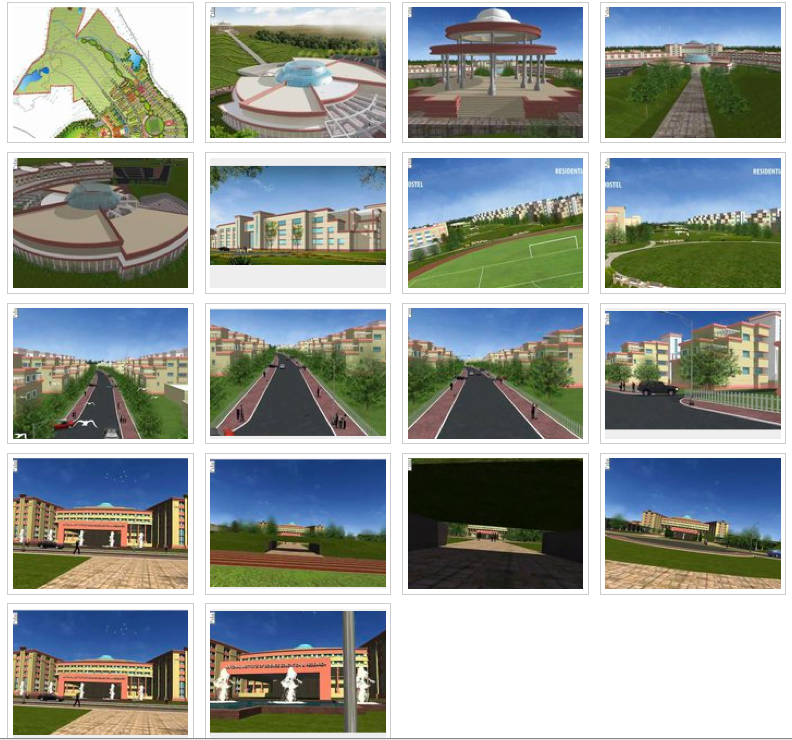
(i) The academic part where the various school are connected through a common corridor curving around the auditorium complex and then jut out in some what of a radial manner. This allows faculty of different schools to run into each other and foster inter school collaboration while still giving unique identity to each school. The path from the hill top to the auditorium to the academic complex is very pretty,
(ii) The green between the hostels and residential places is also a very nice feature. I assume those hostel would be for doctoral and post-doctoral scholars, some with families. (The hostels closer to the academic complex will probably be for the undergraduates and masters students.) Those greens will create a very collegial campus and off-hour interaction between the faculty-staff families and families of doctoral/post-doctoral scholars.
On the other hand, the colors (yellow and light brick) and the paucity of big trees make part of the campus look very hot. The walk through of the residential area make it look like a typical government colony. While the academic buildings are made 6-7 stories tall, the residential buildings seem to be only 3 stories. Highrises would have saved more land for the future. I hope they use a more pleasing color combination and have more fast growing and colorful plants such as various palm trees and bougainvillea. If funding is a concern, with the help of the Odisha government, they should rope in some corporate houses to make the campus look even prettier.
After all this background study, and a lot of discussions, IIIT-Delhi finally decided to take the lead and shift to requiring only Maths as a necessary pre-requisite for applying for admission to BTech(IT). Of course, the Institute still will have an aptitude test for selection.
However, this seems to be only useful for students from Delhi. (Please double-check at the IIIT Delhi website.) I.e., Delhi Plus 2 arts students with Maths will be eligible to the BTech(IT) program of IIIT Delhi.
Although there are 15% seats for out-side Delhi students, these students have to take AIEEE.
The page at http://mohfw.nic.in/showlink.php?id=698 documents the progress of the various AIIMS-like institutes across the country and as one can find out the progress is the least with respect to AIIMS-like institute in Bhubaneswar. That is a shame.
A bigger shame is that many other states have managed to get approval for additional AIIMS level institutions while Odisha, despite our many emails to the CMO, has not tried that. Odisha should push hard to get both MKCG and VSS Medical colleges upgraded to the AIIMS level.

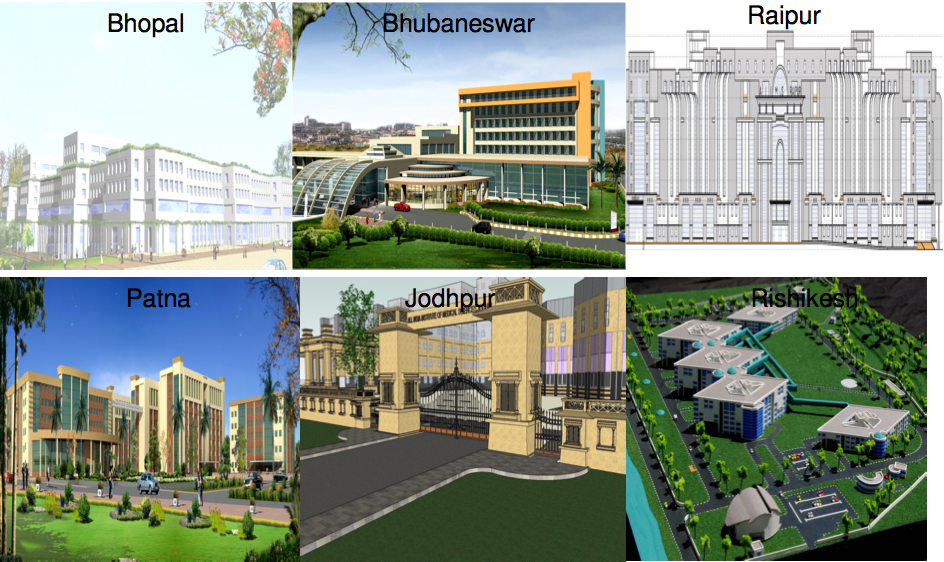 The page at