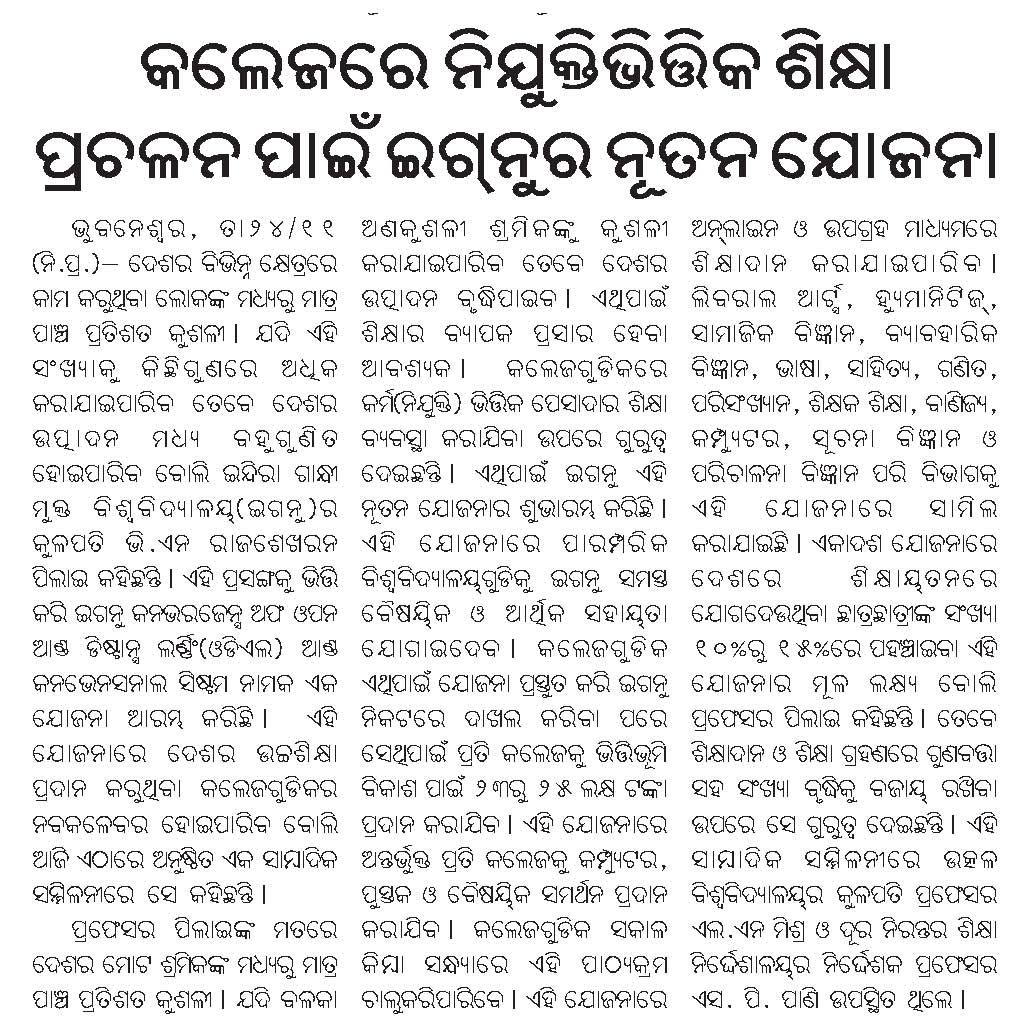
Indira Gandhi National Open University (IGNOU) has introduced a student developmental program – "Convergence of Conventional Education and Distance Learning".
The program was inaugurated by Union Human Resource Development Minister Mr. Arjun Singh on the foundation day of the varsity.
As per the scheme, students pursuing courses in colleges through the conventional system can simultaneously enroll for the same level degrees at IGNOU. For this purpose, a student needs to complete the first year of the course through the conventional system.
However, the second year can be pursued via the distance mode.
The credit transfer will be made possible through a Memorandum of Understanding (MoU) between IGNOU and the concerned university.
Furthermore, IGNOU would identify some new programs in collaboration with the interested university to offer degrees jointly to students.
Both universities can also offer under-graduate and post-graduate courses of IGNOU.
Hundreds of engineering graduates are either unemployed or engaged for a paltry sum.
… That is why the Secretary Industry of the Government of Orissa has mooted a program for skill development of the engineering graduates belonging to economically weaker section of the society.
Accordingly a program has been chalked out in consultation with the ST SC Development department, which will be work out in details by the College of Engineering & Technology (CET), Bhubaneswar.
Software Major, Infosys has agreed to fund the program partly and the gap will be covered by the Orissa Employment Mission, said an official here on 24 November.
Infosys has agreed to pay Rs.50 lakh for the program.
Giving out details the sources said that the program will be for 6 months and at least 100 engineering graduates will be included in the first batch.
All of them will receive stipends to pursue the courses.
During the program they will be provided with a laptop and necessary gadgets for their skill development, said Mr.Dalwai.
He said other companies are also interested to fund the program as with rising attrition and scarcity of talent, companies have no choice but to tap rural India for their growing workforce needs.
So TCS, Satyam and Wipro has also shown their inclination for the program, Mr.Dalwai told tathya.in.
The long-standing demand of the alumni and students of University College of Engineering (UCE), Burla, has been met with the varsity being registered under Societies Act on Tuesday. This would pave way for the engineering college to stake for Deemed University status.
It has been registered as Orissa Institute of Technology (OIT) at Sambalpur. The change in the statute of Biju Pattnaik University of Technology BPUT) in the Assembly bifurcating OIT from under its ambit will follow. Only after ratification by the State Assembly, the OIT will move UGC for Deemed University status.
The Deemed University status would enable the Engineering College get more funds besides help in giving their existing infrastructure a facelift. The College is already bestowed with 200 acres of land and can acquire another 300 acres adjacent to the present campus if needed.
Infosys has donated Rs.1 crore to IIIT-Bhubaneswar.
… It is worthwhile to mention that the State Government decided to set up the “International Institute of Information Technology” (IIIT) at Bhubaneswar.
It has been established as a state initiative project, similar to the ones at Bangalore and Hyderabad.
IIIT-Bh, primarily has been set up to meet the urgent need for appropriate Human Resource, which is the most critical input for the sustained growth of IT and ITES industries.
IIIT-Bh aims to be a World Class institute with an objective to impart higher education and undertake advanced research in the field of Information and Communication Technology.
The State Government has allotted Ac 23.24 of prime land at Gothapatna, Bhubaneswar, free of cost.
The government has committed a financial grant of Rs.10 crore towards start up capital expenses and a recurring annual grant of Rs.2 crores for the first three years.
During the period the institute will have to develop enough strength to stand on its own.
This would be a completely autonomous institute with sustained support from industries.
IIIT shall function at OCAC building for the initial two years till the construction of its own permanent infrastructure at Gothapatna is completed.
The institute shall offer M.Tech and Doctoral Programme in Computer Science.
AICTE has already issued Letter of Intent and shall visit IIIT Bhubaneswar on 22 November for inspection of the necessary academic infrastructure.
It is planned to enroll students during January 2008 after getting the final approval of AICTE.
Other software majors like TCS, Wipro, MindTree etc. have also shown interest in instituting Chair Professors in IIIT-Bh.
The Ambedkar National Merit Scholarship is given to three students scoring highest marks in the regular Class X-level-examination conducted by the State Education Board/All India Board. Students securing highest, second highest and third highest marks are given Rs. 60,000/-, Rs. 50,000/- and Rs. 40,000/- respectively. Girl student securing highest marks in case she is not in the above three categories, is given a cash award of Rs. 40,000/-. The scheme provides for separate provisions both for scheduled castes and scheduled tribes.
Despite India’s "political triumph of democracy", deprived sections of the society continue to remain marginalised. One of the major reasons has been wide spread illiteracy among these sections. Literacy is an important indicator of human development index. The literacy rate for Scheduled Castes (SC) in 1991 was 37.4 per cent as compared to 57.7 per cent for others. Expressing concern over the plight of those living on the fringes of social spectrum, the Prime Minister, Shri Atal Bihari Vajpayee said, "Independence is incomplete without social justice". It may not be out of place to mention that these marginalised sections constitute a sizable portion of our population. According to the 1991 census, the Scheduled Castes comprise 16.73 per cent. The Other Backward Castes (OBCs) constitute 52 per cent and the Minorities 18 per cent of the country’s total population.
Dr.Bhim Rao Ambedkar believed that education is everybody’s birthright and should be available to the poorest of the poor. Education is the stepping stone towards social, economic and political empowerment. In pursuance of this, the Ministry of Social Justice & Empowerment has accorded top priority to radical improvement in literacy rates among the weaker sections. It has taken several major initiatives during the last five years in this direction. Lauding these efforts the Prime Minister said at the National Convention of Minorities , "It is good that you are focusing on education. Education is an investment for development, for progress and for a better future".
Towards Self-Reliance
To meet the emerging challenges, the Ministry of Social Justice & Empowerment has embarked upon schemes to promote merit among the SC/ST students right from the beginning. One of them is the Dr. Ambedkar National Merit Scholarship Scheme for the Scheduled Caste and Scheduled Tribe students launched early this year to encourage merit and excellence among them from the school level. Under this scheme more then Rs.1.25 crore would be distributed as scholarship to 458 Scheduled Caste and Scheduled Tribe students having secured highest marks in 26 Education Boards/ Councils in the country each year. The Social Justice & Empowerment Minister, Dr. Satyanarayan Jatiya, described it as a historic initiative for generating self-confidence and self-reliance among SC/ST students.
The other scheme provides for upgradation of Merit of SC/ST students through cent per cent Central Assistance to the States/UTs for arranging remedial and special coaching for Scheduled Caste and Scheduled Tribe students studying in class IX to XII. While remedial coaching aims at removing deficiencies in school subjects, special coaching is provided with a view to preparing students for competitive examinations for entry into professional courses like engineering and medical.
To enable them to pursue higher studies abroad, the National Overseas Scholarship Scheme to seventeen meritorious SC and ST students has also been improved. The rate of maintenance allowance has been enhanced to US $ 7,700 per annum or Pound Sterling 5,000 per annum per candidate. The scheme also provides for US $ 500 per annum for meeting various contingency expenses besides air passage, visa fee, equipment allowance and incidental expenses charged by the institution and insurance premium.
Many students belonging to the weaker sections find it difficult to compete for entry into institutions of higher learning or for employment. Consequently, the reserved quotas for them in technical and professional courses remain under-utilized. Therefore, NGOs, universities and institutions of repute are provided 90 per cent central assistance in running coaching and allied assistance programmes to prepare such students for competitive examinations.
Initiative
For their higher education, the Central Government is running a post-matric scholarship scheme for the SC students. They are also provided financial assistance. The amount varies from Rs. 90 to Rs. 425 per month for pursuing studies beyond matriculation in recognised institutions. There are other incentives also like reimbursement of compulsory non-refundable fees and study tour charges. The coverage under this scheme has grown at a much faster rate than that of the growth rate in the SC population. More than 93 per cent of SC students in the country are now covered under this scheme. An estimated number of over 46 lakh students have benefited from this scheme since 1999-2000.
The Central assistance under the scheme is normally provided to State /UT governments on 50:50 basis over and above the committed liability. The annual committed liability of the States during the Ninth Plan under the scheme was Rs. 231 crore. It would be Rs.390 crore per annum during the Tenth Plan as per existing pattern. The Centre is actively considering to revise the rates of maintenance allowance and other norms of the Scheme in view of the rising cost of books, school fees and food.
Yet another scholarship scheme at the pre-matric level has become popular with the children of the families engaged in occupations like scavenging and leather tanning. The number of beneficiaries increased by nearly 42 per cent during the first three years of the Ninth Plan.
The implementation of the scheme of hostels for SC boys and girls has been stepped up since 1998-1999. During the last 4 years 285 hostels were sanctioned for the boys and 183 for girls. These hostels are meant to enable the SC students pursue their studies in a congenial atmosphere. To encourage mixing among students, these hostels are allowed to accommodate non-SC students upto 10 per cent.
Two new schemes are on the anvil to boost quality education among the Scheduled Castes. These include provision of assistance to the SC students for pursuing studies in residential public schools. Under it meritorious students with family incomes of less than Rs. 1 lakh per annum would be financially assisted in getting quality education. The assistance would help them in fully meeting boarding, lodging fees and cost of study material charged by the management. It would be subject to a ceiling of Rs. 80 thousand per annum per student from Class VI to XII.
Another scheme in the pipeline envisages setting up of residential schools for SC/ST students studying between Class VI and XII. One residential school would be set up in districts where the literacy rate of the SCs is much lower than the general category. Such residential schools numbering 125 would be set up in the country with the establishment of 25 schools in each year under the Tenth Plan. The enrollment target in these schools stipulates admission to at least 30 per cent SC/ST girl students and 3 per cent disabled SC/ST students.
Yet another scheme on the anvil is to provide Bridge Education for Children living in city slum or street children. Under the scheme children between the age group of 6-10 years would be provided educational material and nutrition in the shape of one glass of milk and 2 biscuits per child per day.
Schemes for Disabled
There are about 10 million children with disabilities in the country according to the National Sample Survey Organisation Report, 1991. Reportedly being considered less productive even by their own families, they often require special learning aids and financial support besides encouragement from the scommunity to get proper education.
The Ministry of Social Justice & Empowerment has started the Scheme of National Scholarship for Persons with Disabilities since the last financial year. The objective of the scheme is to provide financial assistance to students with disabilities for pursuing higher and technical education. To begin with 500 scholarships have been made available under the scheme. The amount of award varies from Rs.1000 per month for post-graduate courses to Rs.400 for graduate level professional courses. The awardees are also reimbursed the course fee upto Rs.10,000 per year. They are supported with financially for acquiring special aids and appliances for pursuing their studies.
The Ministry has also been providing a new thrust to not only encouraging new enrolments in schools and preventing drop-outs among the weaker and deprived sections but also imparting them with quality education. It is a new approach to tackle the problem rooted in history.
With the Sarva Shiksha Abhiyan, a time-bound programme for imparting elementary education to all children in the age group of 6-14 years by 2010, it is expected that all gender and social gaps would be bridged. Coupled with the provision of facilities for quality education the deprived people would be able to compete with the rest of the country’s population on a level platform. It would also create an urge among them for achieving excellence and make themselves equal partners in the country’s march towards a better future. (PIB Features)
*Contributed by Shri M.L.Dhar, Information Officer, PIB, New Delhi
State-wise list of medical colleges, which have been permitted by the Central Government for being, set up during the last three years i.e. 2005-06, 2006-07 and 2007-08
AIIMS like institutions are to be set up at six places in different parts of the country.For the construction of medical college and hospital complex, the Design Detailed Project Report (DPR) consultants have been selected for all the six sites.DPR would be available by May-June, 2008.
In so far as construction of housing complex is concerned, the bid process for selecting the turnkey developer was carried out for all sites.However, only 2 bids were received, of which one was found responsive.The work has been awarded to developer (M/s. Rajasthan State Road Development Corporation) for Jodhpur.The work relating to construction of housing complex at Rishikesh and Patna has been entrusted to HLL and for Bhubaneswar and Raipur to HSCC, on nomination basis.For Bhopal site, housing complex work would be awarded alongside with the hospital-medical college work.
The state-wise progress regarding construction of AIIMS like institutions can be seen at Annexure.
This information was given by the Minister for Health & Family Welfare, Dr. Anbumani Ramadoss in a reply to a question in the Lok Sabha.
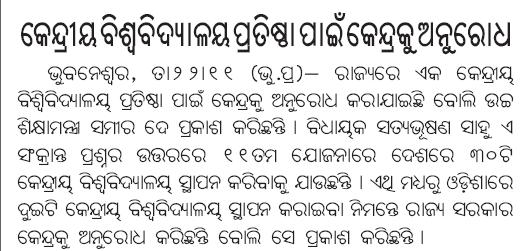
Requests have been received from the State Governments of Kerala and Gujarat for setting up of satellite campuses of IIT-Madras and IIT-Bombay respectively in their States. However, the Government has taken a decision that establishment of large satellite campuses with regular Bachelor and Master Programmes amount to setting up of new IITs should be avoided. The Government, however, has no objection to the setting up of small extension centres of existing IITs outside their main campuses, devoted to continuing education, diploma courses, finishing schools, incubation programmes, etc.
This information was given by the Minister of State for Human Resource Development, Smt. D. Purandeswari in a written reply to a question by Smt. N.P. Durga in the Rajya Sabha today.
In this regard, one may note that, IIT Kharagpur has an extension center in Bhubaneswar and had earlier signed an MOU with Govt. of Orissa to make a branch campus in Bhubaneswar. It had submitted a proposal to MHRD on this. But with the above clarification, IIT Kharagpur’s branch campus proposal in Bhubaneswar goes to cold storage for now.
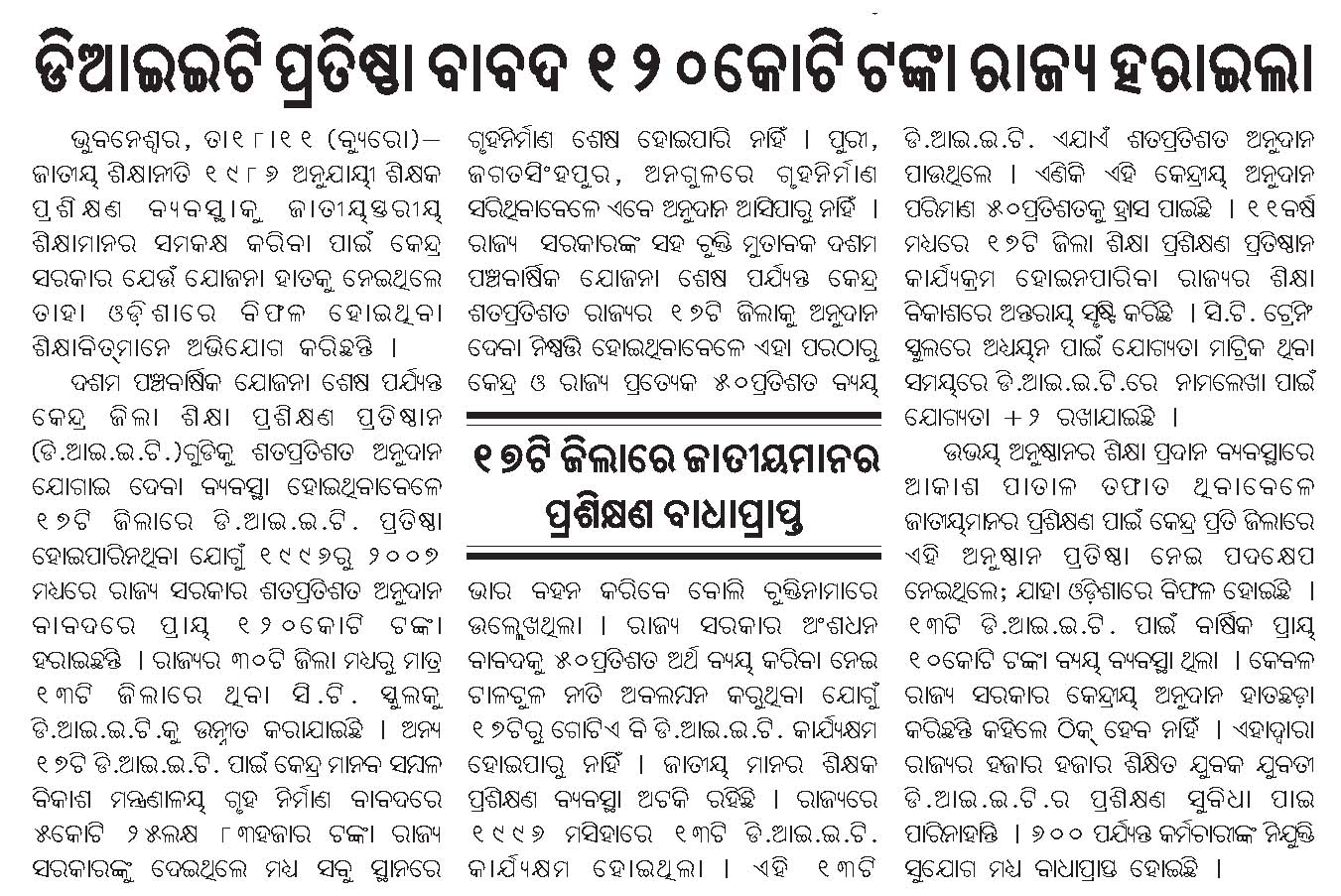
Following is from Samaja and it suggests that Orissa missed out on funding for DIETs by not establishing one DIET in each district. However, it does not mention that there are many CT trained people still looking for a teacher’s job (see http://orissagov.nic.in/e-magazine/Orissareview/sept-oct2006/engpdf/51-55.pdf) and perhaps because of that the state government did not establish additional DIETs.