Institutions offering CT in Orissa

Following is from http://www.ncte-in.org/inst/instlist.asp?statecode=ORISSA&cour=CT. (CT certification is needed to become teacher in lower primary schools. B.Ed is needed for becoming teachers in middle and high schools.)

  NAME OF INSTITUTION AND ADDRESS CITY
 
Ph #
 
1 GOVT. SECONDARY TRAINING SCHOOL,CHENDIPADA
CHHENDIPADA,
ANGUL-759124
ANGUL   50
2 GOVT. SECONDARY TRAINING SCHOOL,KISHORENAGAR
KISHORE NAGAR,
RAJ KISHORENAGAR,
ANGUL-759126
ANGUL   50
3 D.I.E.T. BALANGIR
BALANGIR,
BALANGIR-767001
BALANGIR

(06652)-

232009

50
4 GOVT. SECONDARY TRAINING SCHOOL, BALANGIR
BALANGIR,
BALANGIR-767001
BALANGIR

06652-

230861

50
5 D.I.E.T. REMUNA,BALASORE
REMUNA,
KHIRACHORA,
GOPINATH,
BALASORE-756018
BALASORE

(06782)-

224309

50
6 GOVT. SECONDARY TRAINING SCHOOL,LANGALESWAR
LANGALESWAR,
BALASORE-756024
BALASORE

(06781)-

257011

50
7 GOVT. SECONDARY TRAINING SCHOOL,RAGADI
RAGADI,
CUTTACK,
BANKI-754008
BANKI

956723-

240807

50
8 GOVT. SECONDARY TRAINING SCHOOL, BARGARH
BARGARH,
BARGARH-768028
BARGARH

06646-

233063

50
9 D.I.E.T. MAYURBHANJ,BARIPADA
BARIPADA,
BARIPADA-757002
BARIPADA

(06742)-

260283

50
10 GOVT. SECONDARY TRAINING SCHOOL,BARIPADA
BAGHRA ROAD,
MAYURBHANJ,
BARIPADA-757001
BARIPADA

(06792)-

252443

50
11 GOVT. SECONDARY TRAINING SCHOOL(WOMEN),BERHAMPUR
GANJAM,
GANJAM,
BERHAMPUR-760001
BERHAMPUR   50
12 GOVT. SECONDARY TRAINING SCHOOL,AGARPARA
AGARPADA,
B.T.PUR,
BHADRAK-756115
BHADRAK   50
13 GOVT. SECONDARY TRAINING SCHOOL,BAGUDI
BAGUDI,
SORO,
BHADRAK-756045
BHADRAK

06788-

242217

50
14 GOVT. SECONDARY TRAINING SCHOOL,PAHIMAHURA
PAHIMAHURA,
BARIKPUR BAZAR,
BHADRAK-756112
BHADRAK   50
15 GOVT. SECONDARY TRAINING SCHOOL,BHANJANAGAR
GANJAM,
BHANJANAGAR-761126
BHANJANAGAR

06281-

240770

50
16 D.I.E.T. KALAHANDI
KALAHANDI,
BHAWANIPATNA-766001
BHAWANIPATNA

(06670)-

320230

50
17 DISTANCE EDUCATION UNIT, DIRECTORATE OF TE&SCERT
BHUBANESHWAR,
BHUBANESHWAR-0
BHUBANESHWAR   2250
18 GOVT. SECONDARY TRAINING SCHOOL(WOMEN),BHUBANESWAR
UNIT-6,
KHURDA,
BHUBANESWAR-751003
BHUBANESWAR

0674-

2419673

50
19 GOVT. SECONDARY TRAINING SCHOOL,TITILAGARH,
TITILAGARH,
BOLANGIR
BOLANGIR

(06655)-

20837

50
20 GOVT.SECONDARY TRAINING SCHOOL,PATNAGARH
PATNAGARH,
BOLANGIR-767025
BOLANGIR

06658-

222181

50
21 GOVT. SECONDARY TRAINING SCHOOL,BOUDH
DIST-PHULBANI,
BOUDH(NEW),
BOUDH-762014
BOUDH

(06841)-

222210

50
22 GOVT. SECONDARY TRAINING SCHOOL, ATHAGARH
ATHAGARH,
CUTTACK-754002
CUTTACK

06723-

20438

50
23 GOVT. SECONDARY TRAINNIG SCHOOL
NARASINGHPUR,
CUTTACK-0
CUTTACK   50
24 RADHANATH SECONDARY TRAINING SCHOOL
CHANDINCHOWK,
CUTTACK-753002
CUTTACK

0671-

2621258

50
25 THOMSON WOMEN’S SECONDARY TRAINING INSTITUTE,
MADHUSUDAN ROAD, G.P.O.,
BUXI BAZAR,
CUTTACK-753001
CUTTACK

(0671)-

23651

50
26 URDU SECONDARY TRAINING SCHOOL, CUTTACK
SHAIKH BAZAR,
TULASHIPUR,
CUTTACK-753008
CUTTACK

0674-

2607149

50
27 GOVT. SECONDARY TRAINING SCHOOL,DEOGARH
PURUNAGARH,
PURUNAGARH,
DEOGARH-768119
DEOGARH

06641-

226165

50
28 D.I.E.T.DHENKANAL
DHENKANAL,
DHENKANAL-759001
DHENKANAL

(06762)-

224725

50
29 GOVT. SECONDARY TRAINING SCHOOL,PARALAKHEMUNDI
PARALAKHEMUNDI,
GAJAPATI-761200
GAJAPATI

(06815)-

222382

50
30 D.I.E.T. KHALIKOTE
KHALIKOTE,
GANJAM-761030
GANJAM

(0681)-

256420

50
31 GOVT. SECONDARY TRAINING SCHOOL,POLASARA
POLASARA,
GANJAM-761105
GANJAM

(06810)-

282272

50
32 GOVT. SECONDARY TRAINING SCHOOL,JAGATSINGHPUR
JAGATSINGHPUR,
JAGATSINGHPUR-754032
JAGATSINGHPUR   50
33 D.I.E.T. CUTTACK
DOLIPUR,
NAGUA,
JAJPUR ROAD,
JAJPUR-755019
JAJPUR

(06726)-

220761

50
34 D.I.E.T. JAYPORE
KORAPUT,
JAYPORE-764001
JAYPORE

(06854)-

232400

50
35 GOVT. SECONDARY TRAINING SCHOOL,PANCHAPARA
PANCHAPARA,
NUAPARA,
JHARSUGUDA-768204
JHARSUGUDA   50
36 GOVT. SECONDARY TRAINING SCHOOL,DHARMAGARH
DHARAMGARH,
KALAHANDI-766015
KALAHANDI

0674-

2414873

50
37 GOVT. SECONDARY TRAINING SCHOOL,BALIA
BALIA,
BHAGABATPUR,
KENDRAPARA-754234
KENDRAPARA   50
38 GOVT. SECONDARY TRAINING SCHOOL,KENDRAPADA
P.O. & DIST – KENDRAPARA,
KENDRAPARA-754211
KENDRAPARA   50
39 D.I.E.T. KEONJHAR
OLD TOWN,
KEONJHAR-758002
KEONJHAR

(06766)-

253076

50
40 GOVT. SECONDARY TRAINING SCHOOL,FAKIRPUR
FAKIRPUR,
KEONJHAR-758022
KEONJHAR

956731-

20753

50
41 D.I.E.T. KHURDA
KHURDA,
KHURDA-752055
KHURDA

(06755)-

220219

50
42 PAN SCHOOL OF EDUCATION, BANKOI, KHURDA
BANKOI,
HATABASTA,
KHURDA,
KHURDA-752066
KHURDA

06755-

234749

50
43 GOVT. SECONDARY TRAINING SCHOOL, CHITRAKONDA
CHITRAKONDA,
MALKANAGIR-764052
MALKANAGIR   50
44 GOVT. SECONDARY TRAINING SCHOOL, GORUMAHISANI
GORUMAHISANI,
MAYURBHANJ-757042
MAYURBHANJ

(06794)-

274205

50
45 GOVT. SECONDARY TRAINING SCHOOL,KUSHALDA
KUSHALDA,
MAYURBHANJ-757055
MAYURBHANJ

06795-

236064

50
46 GOVT. SECONDARY TRAINING SCHOOL,NABARANGAPUR
MIRGANGUDA,
NABARANGAPUR-751001
NABARANGAPUR   50
47 GOVT. SECONDARY TRAINING SCHOOL,UMERKOTE
UMERKOTE,
NABARANGPUR-764073
NABARANGPUR

06866-

270115

50
48 GOVT. SECONDARY TRAINING SCHOOL,NUWAPARA
NAWAPARA,
NAWAPARA-766105
NAWAPARA

06628-

223620

50
49 GOVT. SECONDARY TRAINING SCHOOL,RAJSUNAKHALA
RAJSUNAKHALA,
NAYAGARH-752065
NAYAGARH

0675-

234089

50
50 GOVT. SECONDARY TRAINING SCHOOL,NIMAPARA
PURI,
PURI,
NIMAPARA-752106
NIMAPARA   50
51 D.I.E.T. TIKABALI
UNDIVIDED PHULBANI,
TIKABALI,
KANDHAMAL,
PHULBANI-762010
PHULBANI

(06847)-

263720

50
52 GOVT. SECONDARY TRAINING SCHOOL, SAKHIGOPAL
SAKHIGOPAL,
PURI-752014
PURI

06752-

272029

50
53 GOVT. SECONDARY TRAINING SCHOOL,PIPLI
PIPILI,
PURI-752104
PURI

06758-

240594

50
54 GOVT. SECONDARY TRAINING SCHOOL,PURI
DIST – PURI,
PURI-752001
PURI

06752-

232756

50
55 GOVT. SECONDARY TRAINING SCHOOL,BISSAM CUTTACK
BISSAM CUTTACK,
RAYAGADA-765019
RAYAGADA

06863-

247637

50
56 GOVT. SECONDARY TRAINING SCHOOL,GUNUPUR
GUNUPUR,
RAYAGADA-765022
RAYAGADA

(06857)-

20261
(06857)-

20367(Fax)

50
57 D.I.E.T. SAMBALPUR
BUDHARAYA,
SAMBALPUR-768004
SAMBALPUR

(0663)-

2540789

50
58 GOVT. SECONDARY TRAINING SCHOOL,TUDIGADIA
TUDIGADIA,
BALASORE,
SORO-756047
SORO   50
59 GOVT. SECONDARY TRAINING SCHOOL,SONEPUR
SONEPUR,
SUBARNAPUR-767017
SUBARNAPUR

(06722)-

220642

50
60 DISTRICT INSTITUTE OF EDUCATION & TRAINING
SANKARA,
SUNDARGARH-770020
SUNDARGARH

(06622)-

273636

50
61 GOVT SECONDARY TRAINING SCHOOL, BHALULATA
BHALULATA,
BISRA,
SUNDARGARH,
SUNDARGARH-770036
SUNDARGARH

95661-

2612527

40
62 GOVT. SECONDARY TRAINING SCHOOL,KUARMUNDA
KUARMUNDA,
SUNDARGARH-770039
SUNDARGARH   50
63 GOVT.SECONDARY TRAINING SCHOOL,KUNDUKELA
KUNDUKELA,
SUNDARGARH-770019
SUNDARGARH   50
64 GOVT. SECONDARY TRAINING SCHOOL,TANGI
KHURDA,
TANGI-752023
TANGI   50

150 comments November 19th, 2007 Author : Chitta Baral

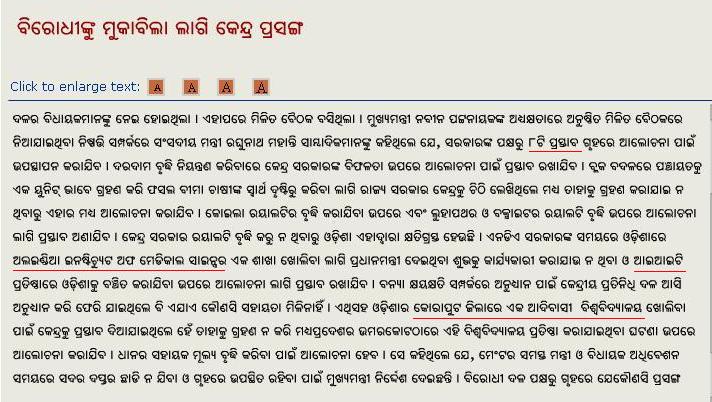
Three HRD issues (AIIMS, IIT, KBK University) to be raised by the ruling coalition in the current assembly (from Dharitri)

November 19th, 2007 Author : Chitta Baral

Not much progress on establishing a medical college in Rourkela

Following is an excerpt from a report in New Indian Express.

The proposed medical college on PPP (public private participation) mode at Rourkela continues to be an election promise. In 2004, Chief Minister Naveen Patnaik announced about it at a pre-poll rally.

Still there is no headway in the project as the government allegedly continues with its dillydallying attitude under the plea that the proposed site is disputed.

In the face of intense public pressure, while Rourkela BJD MLA S P Nayak assured to expedite the issue, a demand has gained ground that the proposed medical college and hospital be attached to the Rourkela Government Hospital (RGH).

Reliable sources said earlier the project got delayed for two years as a clause made it mandatory for the private partner to accept the proposals for Rourkela and Balangir simultaneously.

After much persuasion one GSL Trust came forward to be the partner but later made a quiet exit. The 650-bed medical college and hospital envisages to have 150 medical seats in the initial year.

The project requires a minimum capital investment of Rs 100 crore. While the Western Orissa Development Council (WODC) will arrange 25 acre cost-free land and Rs 10 crore, the rest fund would be raised through private participation.

Wasting much time in locating land, the WODC finally decided to use the surplus land of RGH. But, the local displaced persons staked claims on proposed site in court. A high-power committee is now looking into the project.

1 comment November 19th, 2007 Author : Chitta Baral

Plans for increasing capacity of Orissa govt. engineering colleges

Following is an excerpt from a news report in New Indian Express.

… If sources are to be believed, the varsity is seriously planning to raise the intake capacity of the government institutions.

The technical university’s four constituent colleges – University College of Engineering (UCE), Burla, College of Engineering and Technology (CET), Bhubaneswar, Indira Gandhi Institute of Technology (IGIT), Saranga, and Orissa School of Mining Engineering (OSME), Keonjhar – impart different courses in engineering streams.

While UCE has seven disciplines with an intake capacity of about 270, annual approved strength of CET is 340 in as many as nine streams. Similarly, IGIT admits 150 students in five programmes, while OSME’s degree streams intake is about 90.

However, the BPUT management appears to believe that the government colleges are in need of increasing their intake capacity which will strengthen them financially.

While UCE, Burla and CET, Bhubaneswar, are primarily dependent on government, it is OSME (degree stream) which is self-sufficient.

In the last board of management meeting of the varsity, it was strongly felt that the private colleges have a much larger student strength compared to their government counterparts that contribute significantly to their solvency.

It has agreed that an increased intake in government constituent colleges is the need of the hour where the number of qualified teachers and overall infrastructure is better compared to those available in the private colleges.

A way out is to introduce self-financing models for the programmes. In fact, two engineering streams in UCE, Burla and four subjects in CET here are self-financing but the funds are not sufficient to support the increasing needs.

1 comment November 19th, 2007 Author : Chitta Baral

GOI to partner with MIT for a health science and tech institute

Following is an excerpt from a MIT News item on this.

MIT and the government of India’s Department of Biotechnology today launched a partnership that will result in the creation of a new Translational Health Science and Technology Institute (THSTI) in India.

This new institute, which will be modeled after the Harvard-MIT Division of Health Sciences and Technology (HST), will include faculty from multiple disciplines and professions, offer degrees through multidisciplinary programs and develop strong ties with other institutions. Funded by the Indian government, the Indian HST will be a multidisciplinary, multiprofessional research and training center that is highly interconnected with regional centers of excellence.

The institute will increase India’s capacity for translating scientific and technological advancements into medical innovations that have the potential to improve healthcare both in India and around the world.

HST Director Martha Gray and Dr. M. K. Bhan, Secretary, Department of Biotechnology, Ministry of Science & Technology, Government of India, signed a letter of intent for this partnership today at a symposium in New Delhi titled "India and MIT: A Conversation about the Future."

"Launching this new partnership with India’s Department of Biotechnology will build on HST’s pioneering model of medical education that integrates science, medicine and engineering to solve problems of human health," said Susan Hockfield, president of MIT. "We look forward to a future of significant collaboration across disciplines, across institutions and around the world."

To foster a culture of innovation in THSTI, HST will help recruit and train new THSTI faculty members. Each year starting in September 2008 and continuing until 2011, four recruited THSTI faculty fellows will join the HST faculty. These faculty fellows will train at HST for two years. During their stay they will develop translational research programs, design courses and curricula for THSTI, and develop close relationships with HST faculty and students.

These fellows will benefit from HST’s nearly 40 years of experience bringing together science, engineering and medicine in education and translational medical research. HST’s success stories include medical innovations such as functional magnetic resonance imaging, a low-cost AIDS detection kit and novel implantable drug delivery mechanisms.

HST and MIT will also benefit from having these fellows on campus. "We will have people immersed in our program who actually know about the unmet medical needs in India and who will expose our students and faculty to those needs," said Gray.

November 19th, 2007 Author : Chitta Baral

MM Joshi: Center neglecting Orissa

Following is an excerpt from a report in Pioneer.

BJP leader and former Union Minister Murli Manohar Joshi on Sunday met Chief Minister Naveen Patnaik at his residence, Naveen Niwas, and had breakfast with him. Sources said that both leaders discussed many issues pertaining to the interests of the State’s coalition Government and the interests of the State. “Yes, we are good friends,” he later told reporters.

Addressing a Press conference, he said the Congress-led Governments at the Centre have constantly neglected Orissa’s interests.

During the NDA regime, the foundation stone of the AIIMS was laid. But no work has yet been taken up to give it a formal shape, he said.

Though the NDA gave its nod for establishment of an international standard educational institute like National Institute of Sciences in Bhubaneswar, the UPA shifted it to Kolkata,” he pointed out.

November 19th, 2007 Author : Chitta Baral

14 World class universities in India: Guidelines being formulated, States to compete

Following is an excerpt from a report on this in Economic Times.

NEW DELHI: With a thrust on improving the standard of higher education, government is working on a proposal to set up 14 ‘World Class Universities’ across the country at an early date.

A blueprint is being prepared by the Human Resources Development (HRD) Ministry and Planning Commission to set out the criteria for such universities, which will have a business management school, an engineering college, a medical college, a law college in a single campus.

The proposal is being pursued by the Prime Minister’s office which has asked the HRD Ministry and Planning Commission to expedite formulation of guidelines for such universities and give the final picture by the third week of this month.

… The HRD Ministry and Planning Commission have started working on these guidelines acting on the proposal of full Planning Commission meeting on education sector that held on September 13.

"We are working at a very fast pace on the guidelines because we have already been told once by the PMO that we are behind the schedule. So soon we will have the guidelines in place," said Mungekar, former Vice Chancellor of Mumbai University.

… Proposals for setting up the ‘World Class Universities’ will be invited from all the states and those meeting the criteria will benefit. This will, in effect, do away with allegations of discrimination by states.

"The rules are going to be very stringent. The states have to compete to get the world class university," Mungekar said while giving an outline of the regulations.

Besides reasonable rules like a big plot of a land for free in prime location, there would be other demanding criteria that the states will have to meet while competing for having such universities.

In the allotment of such centrally-funded universities, priority will be given to states which do not have central varsities at present.

Orissa must get ready to prepare and send a good proposal on this. After the criteria is announced there may not be much time to do this. So preparing for this beforehand is important.

1 comment November 18th, 2007 Author : Chitta Baral

A campus for India, shaped like a mandala: New Urban News article on Vedanta University

From the SEPTEMBER 2007 issue of New Urban News

A campus for India, shaped like a mandala

Courtesy of Ayers Saint Gross

Vedanta, the largest new university in the world, will have a plan that draws from Indian spiritual traditions.

On an expanse of flat rural land near the Bay of Bengal, earth-moving is to get under way this fall for an extraordinary institution. Vedanta University — to be built with a billion dollars donated by Indian industrialist Anil Agarwal — will have a shape like no other university on the planet (see plan, above, and on home page).

Dhiru Thadani, lead architect-planner at Ayers Saint Gross (ASG), has been spending about one week per month in India, spearheading the master-planning of the approximately 10,000-acre project. Thadani and his team have produced a remarkable, complex layout, one that suggests an elaborate mandala.

A mandala — a symbol associated with Hinduism, Buddhism, and other religions as well — is sometimes defined as a geometric pattern that represents the cosmos. The mandala that Thadani’s team has created in the state of Orissa consists of two large, overlapping circles, each half a mile in diameter. They sit within a larger oval that stretches about 1.4 miles from east to west.

Within the two circles and the 780-acre oval, there may eventually be as many as 280 university buildings, predominantly three to five stories high. Thanks to their disciplined arrangement, tight spacing, and consistent heights, the buildings will form dozens of well-defined outdoor spaces, ranging from small private courtyards to quadrangles and parks.

The patterns made by the buildings’ curved, angled, or straight walls will be intricate. Weaving through them will eventually be 100,000 students, plus tens of thousands of teachers, administrators, and others.

Thadani, who was born in Bombay (Mumbai) and educated at Catholic University in Washington, DC, is based in Washington, but has previously worked on large planning projects in his native country. He and Adam Gross, principals at Baltimore-based ASG, say they set out to make the campus “Indian in spirit.”

The western circle, containing humanities programs, has an oval open space at its center and “is organized by a series of radiating spokes representing the Indian flag and the spokes on Gandhi’s spinning wheel,” a master plan document explains. “The eastern circle — science — is organized orthogonally around a central square, representing practice and research that is grounded in the earth.”

Unlike many universities, where the arts and humanities occupy the well-loved, walkable core of the campus, while the science, engineering, and professional schools sit in less lovely, more disconnected settings, Vedanta is striving for an intertwining of disciplines — with all of them enjoying a pleasing ambience.

FITTING THE LOCAL CLIMATE
For protection from the sun and from the 79 inches of rain that fall annually on this section of India, the planners called for continuous arcades, which can also keep the buildings cooler. They encountered some resistance — arcades in India are sometimes associated with housing occupied by the poor — but the logic of the arcades seems to have won out.

Prior to starting Vedanta’s planning, some of the principal figures — from India and the US — toured several campuses. The three- to five-story height of most of the buildings is consistent with precedents the team examined, including the University of Virginia, Stanford University, and the city of Bologna, Italy.

Among their practical advantages, those heights reduce the need for elevators and mechanical equipment. A key element of circulation inside the buildings will be grand staircases placed within atriums. Big rooms, such as auditoriums, will be mostly at first-floor level, to keep most traffic at the lower level. Academic buildings will be constructed mainly of concrete, with stone cladding. “There’s a lot of granite in this area,” Thadani points out, so it’s affordable. Residential buildings may have stone on the ground floor and stucco above.

The goal is for 40 percent of the buildings to do without air conditioning, relying on stone screens, cross-ventilation, and other tactics to ameliorate the hot climate. “That will not be possible in laboratory buildings,” Thadani acknowledges.

In Indian educational circles, one tendency today is for people to want buildings that look very modern, with an abundance of glass — ostensibly forward-looking structures. But across much of Asia, this mindset is producing many buildings that consume power heavily, ignore human scale, inadequately define public spaces, and seem at odds with traditional places. “From the start, we have been emphatically talking about sustainability,” Thadani notes. Emphasizing sustainability can win people over to an architecture that is generally not so flashy but is more economical, more urbane, and presumably of more lasting value.
Besides planning the campus and the surrounding township, which may ultimately have a population of 400,000, ASG is designing three of Vedanta’s first buildings — a library, a science building, and a humanities building. These structures divide a diamond-shaped open space where the campus’s two circles overlap. The firm is also programming three other buildings.

Thadani and Gross are encouraging the client to retain other architects for other buildings. However, the US-based designers hope to continue in a design review capacity once the master plan is in place. As of mid-August, the plan was nearly complete.


This article is available in the September 2007 issue of New Urban News, along with images and many more articles not available online. Subscribe or order the individual issue.

November 18th, 2007 Author : Chitta Baral

Vedanta University project reaches out

Following is an excerpt from a report in Statesman.

Vedanta University project and Anil Agrawal Foundation launched a mobile healthcare unit at Chhaitana Kabirajpur village under Gop block in Puri district yesterday.

It was launched by Mr Trilochan Baral, chief district medical officer (CDMO), Puri.

Mr Prashant Hota, general manager (CSR), Vedanta Orissa projects was present on this occasion.

The ambulance van of this mobile healthcare unit will pay weekly visits to the areas to be affected by the Vedanta University project and the nearby villages under Puri Sadar, Gop and Satyabadi blocks in a phased manner accompanied by doctors, pharmacists, nurses and other health workers.

1 comment November 18th, 2007 Author : Chitta Baral

Co-operative university in Pune

Following is an excerpt from a news item in Hindustan Times. (After reading it I am not very clear what a co-operative university is.)

India will soon have its first co-operative university and the first of its kind in the entire South-East Asia. The Jawaharlal Nehru Co-operative University will set up in Pune.

The idea to have a full-fledged co-operative university has germinated to counter intense challenges posed by the private players to the co-operative sector institutions, which suffer due to lack of trained professionals in the area.

The Centre has agreed in principle to the proposal, which at present is under the University Grants Commission’s (UGC’s) consideration, the National Co-operative Union of India president Ghanshyam Amin said.

The proposed university will have courses such as BA (Co-operatives), MBA, law and MCE with special focus on the co-operative sector. To begin with, it will start with five courses that would be increased with the addition of new streams in future. Amin said that the existing national level co-operative institution in Pune will be upgraded to a university.

With the infrastructure readily available, the five new courses will be started as soon as the proposal is cleared by the UGC, he added. Significantly, a major source of funding for the university project would be the proposed corps fund of Rs 200 crore to be raised by the NCUI, an umbrella outfit of co-operative institutions and the Centre with both having 50 per cent stake.

November 17th, 2007 Author : Chitta Baral

NISER course structure for Years 1-3 is in their web site

NISER course structure for Years 1-3 is in their web site at http://www.iopb.res.in/niser/NISER-Course_Structure.pdf. One thing that is missing in  the course structure is Computer Science and programming courses; it does have numerical analysis and Bioinformatics though. If I were making the course structure I would at least add the following Computer Science courses, each with a programming lab.

  • Data Structures and programming
  • Theory of automata and languages
  • Design and analysis of algorithms

2 comments November 16th, 2007 Author : Chitta Baral

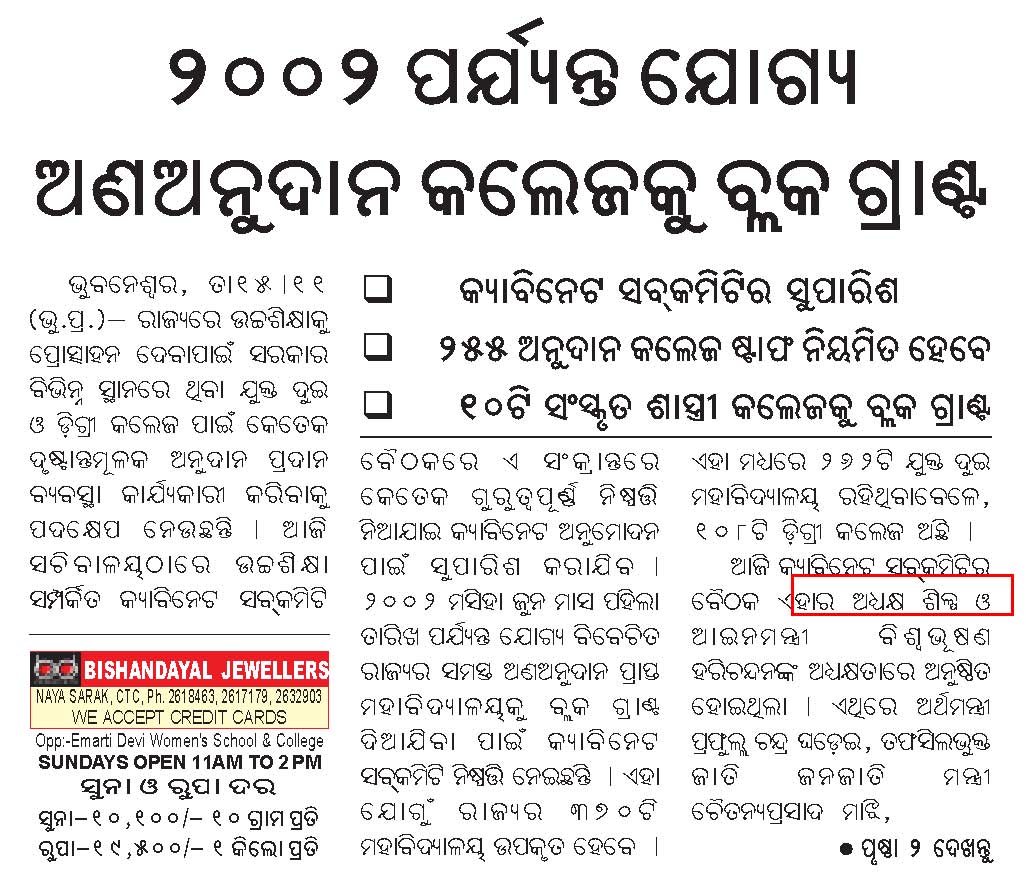
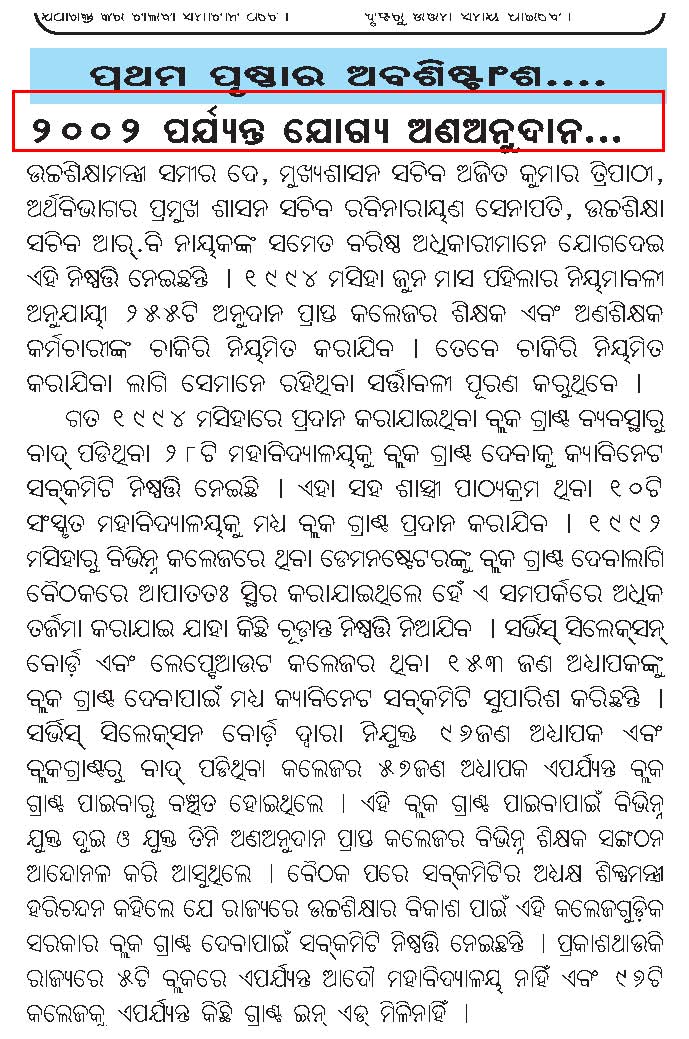
More colleges to be given block grants by the state : Samaja

November 16th, 2007 Author : Chitta Baral

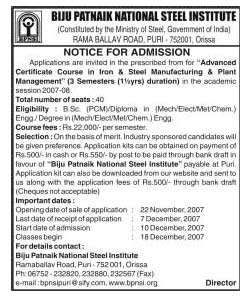
BPNSI (Biju Patnaik National Steel Institute) admission ad in Samaja

November 16th, 2007 Author : Chitta Baral

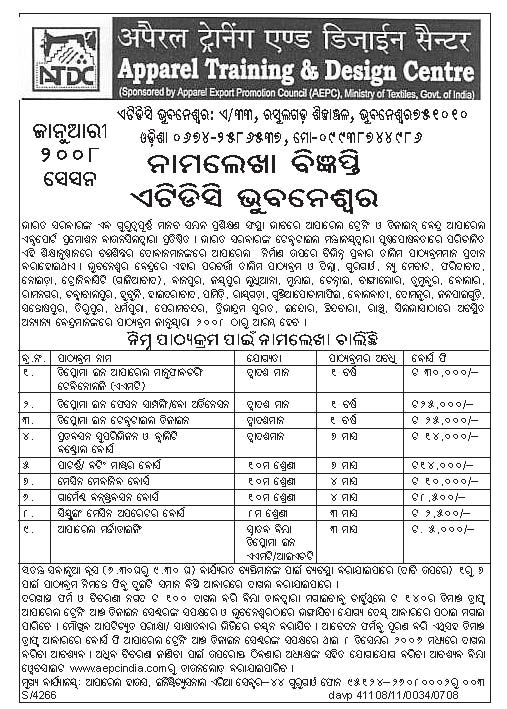
ATDC (Apparel Training & Design Center) admission ad in Samaja

2 comments November 16th, 2007 Author : Chitta Baral

Ravenshaw extension campus to start soon

Following is an excerpt from a report in Pioneer.

Works of the extension campus of the Ravenshaw Unitary University would be started soon and the university would also be made one of the best study destinations in the country, said senior BJD leader and Rajya Sabha member Pyari Mohan Mohapatra .

He was addressing the concluding day of the annual function of the University Students’ Union on Tuesday.

Recollecting the past glory of the historic educational institution of the State, he further added that funds would not be a major problem for growth of the Ravenshaw University. The institution has produced so many scholars in various fields and it would continue its magic in the future too, he hoped.

November 16th, 2007 Author : Chitta Baral

150 more Bal Bhavans next year. Will some of them be outside Delhi?

Following is an excerpt from the PIB http://pib.nic.in/release/release.asp?relid=32645.

There will be 150 more Bal Bhavans next year, said Shri Arjun Singh here today. Inaugurating the International Children’s Assembly and Integration Camp on the occasion of Children’s Day, Human Resource Development Minister Shri Arjun Singh said “there are only 74 Bal Bhavans within the country that do not suffice the need of children. Therefore, our aim should be to bring up 150 more Bal Bhavans next year and one Bal Bhavan in each village in the future”.

 As per http://www.nationalbalbhavan.nic.in/about_us.htm there are currently 52 Bal Bhavan Kendras in Delhi, 73 affiliated state Bal Bhavans and 11 state Bal Bhavan Kendras. Following is an excerpt from the Bal Bhavan pages describing what they are.

With the objective of reaching out to maximum number of children who cannot avail the facilities provided by the National Bal Bhavan Head Quarters, Bal Bhawan Kendras were opened in different localities of Delhi. At present there are 52 Bal Bhawan Kendras which are mostly located in Municipal Corporation of Delhi’s schools or Govt. Schools. These Kendras cater to the under privileged children living in slum areas, rural areas and re-settlement colonies. Part-time Instructors man these Kendras. The activities provided in these Kendras are usually Art & Craft, Dance, Vocal Music, Painting, Batik etc. These Kendras are attended to by school going, non-school going and drop-out children. 92% of the children enrolled with these Kendras belong to the lower income group categories.

Lets hope some of the new Bal Bhavans, which are funded by MHRD, are opened in others states, including in Orissa.


1 comment November 15th, 2007 Author : Chitta Baral

Next Posts Previous Posts


We And oDishA

Current Focus

Categories

Links

Feeds