Archive for the 'Key Center-State issues' Category

Rs 716 crore of central fund for PCPIR to go towards 6-laning of NH 5A, new Bhubaneswar-Paradeep Road and a greenfield coastal road

Business Standard, Coastal highway, Coastal highway - beach preservation, IOC, Jagatsinghpur, Kendrapada, Land acquisition, NH 5A, National Waterway 5, PCPIR, Paradip - Jatadhari - Kujanga, Petrochemicals No Comments »

Following is an excerpt from a report in Business Standard.

The Centre would provide Rs716 crore under ‘Viability Gap Funding’ for infrastructure development of the PCPIR (Petroleum, Chemicals and Petrochemicals Investment Region) hub to be set up at Paradip in Orissa.

“The Centre would provide this money in two phases. While Rs388 crore would come in the first phase of the project, the balance Rs328 crore would be provided by the Government of India in the second phase”, an official source told Business Standard.

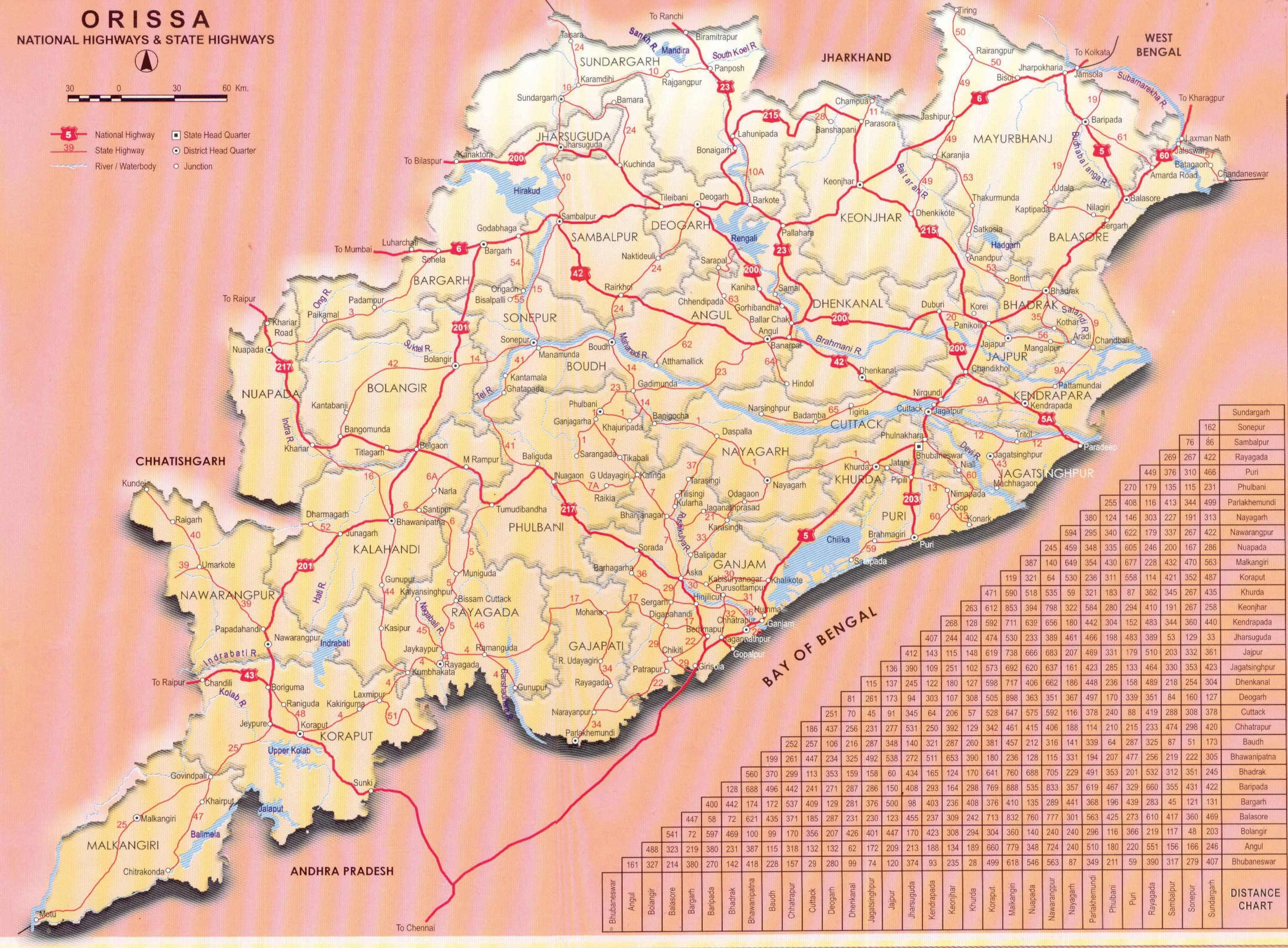
The funds to be provided by the Centre under ‘Viability Gap Funding’, will be utilized for various infrastructure projects of the PCPI hub like six-laning of NH-5 (A), building a greenfield coastal corridor, construction of all-new greenfield road from Bhubaneswar to Paradip \and upgradation of port infrastructure.

The six-laning of the NH-5 (A) will be taken up in the second phase of the PCPIR project at a cost of Rs76 crore. The greenfield coastal corridor will involve an expenditure of Rs410 crore out of which Rs 264 will be invested in the first phase while the remaining expenditure of Rs146 crore will be incurred in Phase-II.

The construction of all-new greenfield road from Bhubaneswar to Paradip will be taken up at a cost of Rs190 crore while Rs40 crore would be provided by the Centre for upgradation of port infrastructure.

Meanwhile, the Orissa government has committed an expenditure of Rs1796 crore on infrastructure development for the PCPIR hub. Out of the envisaged expenditure of Rs1796 crore, Rs 754 crore will be spent on development of arterial roads, Rs 465 crore on water supply, Rs 410 crore on power distribution and Rs136 crore on canal upgradation.

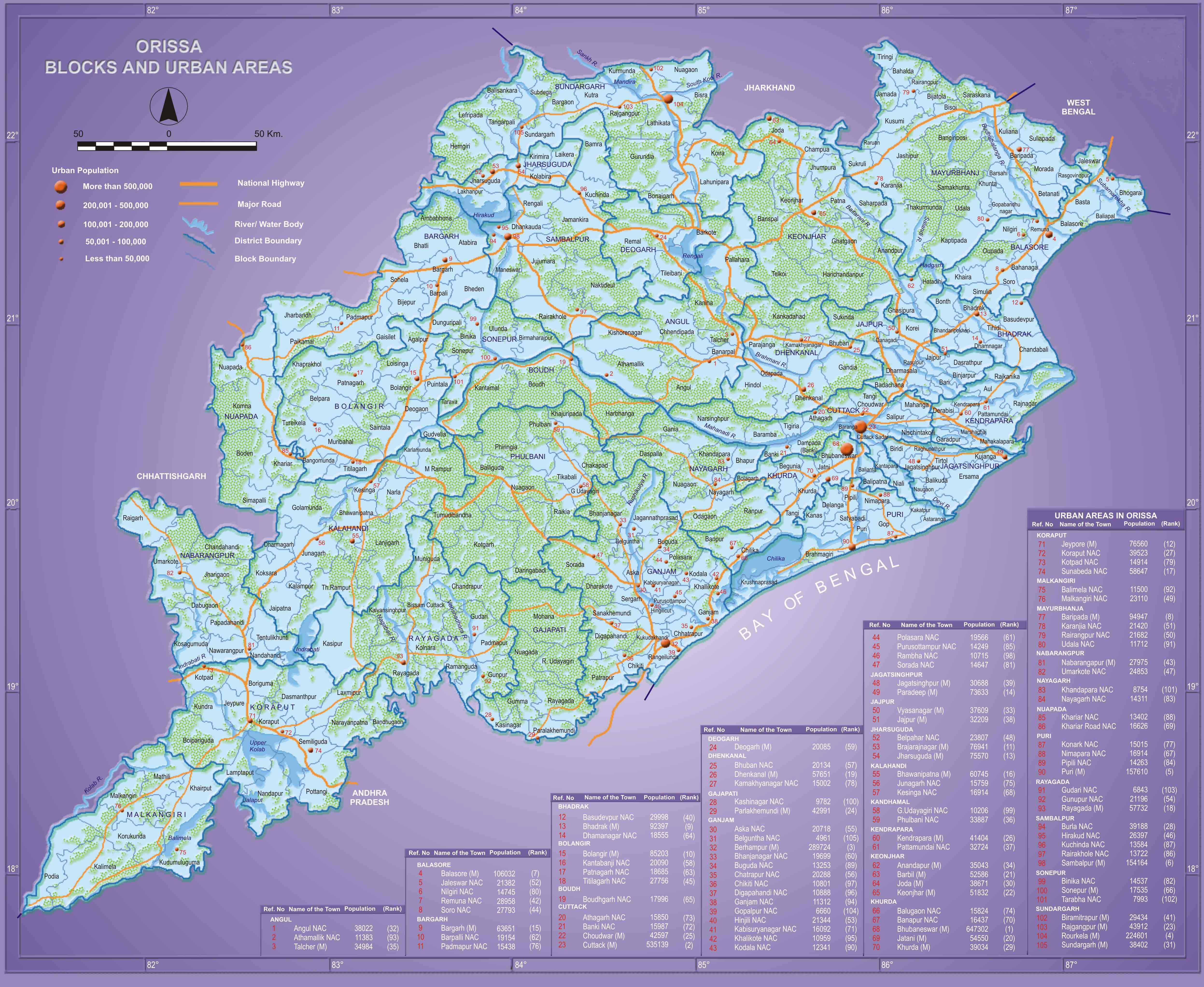
The PCPIR project in the state would be set up on 284.15 sq km (70,214 acres) of land spread over Jagatsnghpur and Kendrapara districts. The PCPIR hub is expected to attract investments to the tune of Rs2.74 lakh crore.

Phase-I work of the project is expected to be completed by 2015 while the entire project is scheduled for commissioning by 2030.

Of the expected overall investment figure of Rs2.74 lakh crore, the lion’s share would come from the petroleum and petrochemicals sectors at Rs2.3 lakh crore followed by housing and allied infrastructure at Rs23,500 crore, external infrastructure at Rs13,634 crore and Rs3,500 crore each for chemicals & fertilizers and ancillary sectors.

The mega project is set to create employment for 6.48 lakh people which includes direct employment for 2.27 lakh people and indirect employment for 4.41 lakh others.

The turnover of this PCPIR hub is estimated at Rs4.23 lakh crore with an export potential of Rs 43,000 crore. The PCPIR hub is expected to generate taxes to the tune of Rs 42,000 crore and contribute six per cent to Orissa’s Gross Domestic Product (GDP).

… This refinery cum petrochemical complex which needs 3300 acres of land, is scheduled for commissioning by March 2012.

The land acquisition process for PCPIR is on the fast track with the state owned Industrial Infrastructure Development Corporation of Orissa (Idco), the nodal agency for the project having filed requisition for 90 per cent of the total land requirement in .

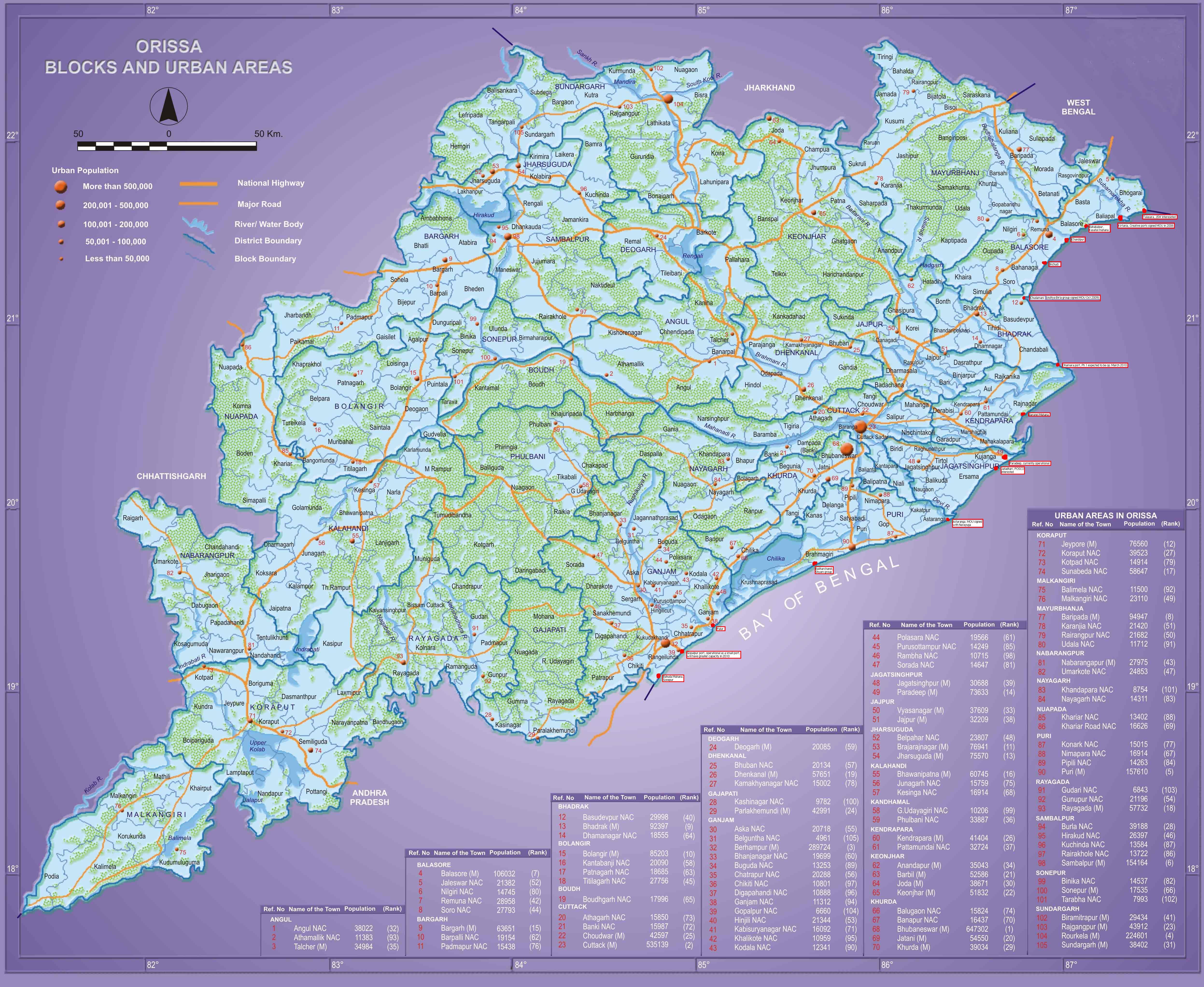
This is really great. Especially, the part about a greenfield coastal road.  Odisha has been demanding such a road for a long time. I think eventually it will run all the way from Dhamara-Paradeep-Astaranga-Konark-Puri-Baliharchandi-across Chilika to Gopalpur. From Dhamara to the North they can put this road together with the National Waterway.

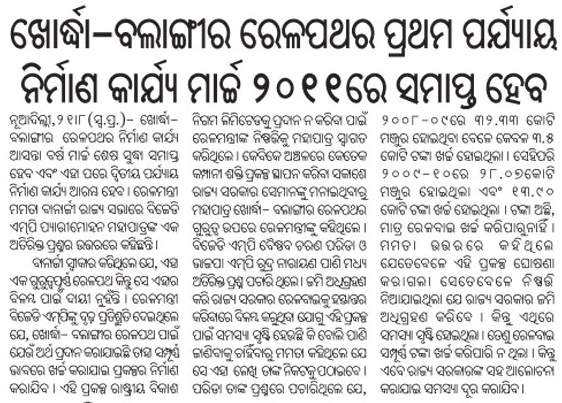
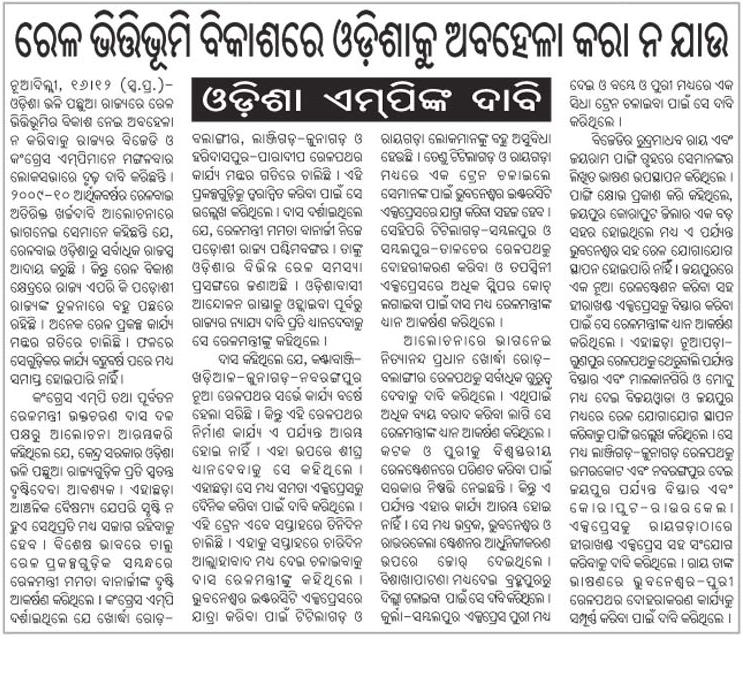
Mamata assures that the first phase of Khurda Rd-Balangir rail will be finished in March 2011: Dharitri

Balangir, Bouda, Khordha, Khurda Rd - Balangir (under constr.), Orissa MPs, Railway network in Orissa 3 Comments »

Odisha government responds to the Saxena Committee report on Vedanta’s operations in Kalahandi

Anil Agarwal, Bauxite, ENVIRONMENT, Forestization, Key Center-State issues, Mine related pollution, Supreme Court, Vedanta 1 Comment »

I don’t have the letter that the Odisha government wrote. But the following excerpts from a report in tathya.in gives some idea.

… However responding to the report, in a letter to the Ministry of Environment & Forest (MOEF), the State Government has said that “it is shocking to note that the Saxena Committee has preferred to discuss in a derogatory manner the issues, which have been considered and adjudicated by the Supreme Court of India.” 

Upendra Nath Behera, Principal Secretary of the Department of Forest & Environment (DOEF) in his letter to the Secretary, MOEF has said that a preliminary study of the report shows that it has raised serious allegations against the State Government. 

It has cast aspersions on the intention of the State Government about implementing the Forest Rights Act (FRA), when the Government of Odisha is credited to be the second best performing state in the country in implementation of FRA. 

The report has asked the MOEF to reject the application of the State Government for diversion of forest land for the above purpose as mining in Niyamgiri will destroy wildlife habitat and it will cause hydrological disaster. 

It has also said that mining will destroy the cultural, religious and economic habitat of the Dongaria Kondhs, who reside in the forest area proposed for diversion. 

The State Government has pointed out that the issues raised by the Saxena Committee were the subject matter of different PILs filed by various activists before the Central Empowered Committee (CEC), which ultimately came up before the Supreme Court. 

In view of the technical issues raised in the applications, the Apex Court had directed MOEF to appoint expert bodies for examining various issues. 

The Wildlife Institute of India, Dehradun had conducted studies on the impact of the mining project on biodiversity and wildlife including its habitat. 

The Central Mine Planning & Design Institute (CMPDI), Ranchi conducted studies on the impact of the mining project on soil erosion, impact of ground vibration on hydrological regime including ground porosity and permeability. 

All these issues were discussed in the Forest Advisory Committee (FAC) on 30 August, 2006, when the project was placed before the Committee for scrutiny. 

Similarly the project was challenged in the Supreme Court on the grounds of violation of FRA. 

After elaborate discussion of the reports of the expert bodies, views of the State Government and MOEF covering all issues relating to ecology, wildlife, hydrology, soil erosion, tribal life and implementation of different environmental laws, the Supreme Court on 23 November, 2007 cleared the project with certain directions. 

On compliance of all the directions of the Apex court, the project was cleared by the Supreme Court on 8 August, 2008. 

The State Government has said that “it is of course, understood that the MOEF has not taken a view on the recommendation of the Committee."

The Government of Odisha in its’ letter has said that “it believe that if a judicious view is taken by the MOEF, most of the findings of the Saxena Committee will not hold water." 

Under this backdrop, the State Government has urged the MOEF to provide an opportunity to present its’ views before taking a final decision in this matter.

Jairam Ramesh, environment, Vedanta and Odisha

Alleged rogues, Anil Agarwal, Bauxite, Bhubaneswar- Cuttack- Puri, ENVIRONMENT, EXPOSING ANTI-ORISSA-GROWTH SCHEMES, Forestization, Kalahandi, Key Center-State issues, Koraput, Malkangiri, Mine related pollution, Nabarangpur, Puri, Vedanta 11 Comments »

People reading this blog must must have seen the news about the Saxena committee (which was empowered by Jairam Ramesh and the environment ministry) report on Vedanta’s operations in Lanjigarh, Odisha.

Although the report reads like an activist team’s report, the fact remains that the laws of the country are sacred and needs to be followed.

It is a different matter that laws are broken with impunity at all levels ranging from the laws reported to be broken by Vedanta to normal people extending their houses and gardens into government land, groups building temples as a ruse to capture government land where ever they feel like, people blocking roads, trains, doing bandhs whenever they feel like, etc. etc. In India laws are broken with impunity and are broken more often than they are adhered to. But this does not excuse what Vedanta is reported to have done. The committee report also rebukes the Odisha government for its hand in the whole affair.

However, one needs to put this report in perspective with what the environment ministry and Jairam Ramesh have found in rest of India. Following are excerpts from a report in rediff.in that gives us some added perspective.

… several industrialists are also upset about what they call Environment Minister Jairam Ramesh’s activist-like positions. "He is taking positions, which are normally associated with unreasonable activists and their organisations," says one leading industrialist whose project is stuck. …

… Data from the ministry’s website show that of the 58 projects that have come up for Coastal Regulation Zone clearance since April 2009, it gave only half a dozen of them the green signal.

Over 1,800 projects are awaiting clearances as of the first week of this month.

…"There are people who consciously instigate and organise people in coastal Andhra against projects coming up in the region," says a spokesperson of a power company,  which is promoting a project in coastal Andhra Pradesh.

"Land availability is a big issue in India. Developers can approach the ministry only after either acquiring the land or have assurances to get the land, to request for the terms of reference to carry out an Environmental Impact Assessment study. By that stage, a lot of investment and time may have gone into execution of the projects, and still you are not sure of getting the clearance," says Sanjay Sethi, executive director (infrastructure) at Kotak Investment Banking.

"It is necessary to have more transparent and clear guidelines and checklists for land available for various commercial and industrial uses, with clear maps of sensitive zones, which should be easily available to project developers," he adds.

… To be fair to the environment ministry, there are issues like misrepresentation of facts by project developers and the state, or conflicting reports on issues by expert panels.

In a recent development, the environmental clearances for at least four projects in an around Srikakulam in Andhra Pradesh were suspended by the ministry.

On July 15, the ministry cancelled the clearance given to Nagarjuna Construction Company’s 2,640 megawatt (Mw) coal-based super critical thermal power plant at Gollagandi and Baruva villages in Srikakulam.

An expert panel said most of the project land allocated by the state government might be regarded as wetland, contrary to an earlier panel report that the 750 acres of grasslands were barren and not fit for agriculture.

The same expert panel, which visited East Coast Energy’s 2,640 Mw thermal project near Kakarapalli village in Srikakulam during the same time, found the state government had ignored reports on the ecological value of low lying areas of the well recognised Naupada swamps wetland and migratory bird breeding in nearby Telineelapuram of Srikakulam.

"This amounts to suppression/distortion of facts," the panel said.

A nearby project – that of JSW’s 1.4 million tonnes per annum (MTPA) alumina refinery and a co-generation plant – is also being reviewed by the ministry.

… On June 28, the ministry directed the formation of a supervisory committee to monitor the influence of toxic effluents from JSW Energy’s 1,200 Mw thermal power plant at Jaigad in Maharashtra, following apprehensions that effluents could affect the quality of Alphonso mangoes and cashew orchards in the region.

… Ten days before that, Jindal Power Limited drew the wrath of the ministry for commencing construction of a 2,400 Mw power project at Tamnar in Chhattisgarh,  without obtaining prior environment clearance.

The ministry has directed the state government to stop work and initiate action against the Naveen Jindal-promoted company.

Some of the other high-profile projects that have been halted include the Maheshwar Hydroelectric project on the Narmada river in Madhya Pradesh on grounds that the conditions of the statutory environmental clearance were not complied with and the resettlement and rehabilitation of the project-affected families was less than satisfactory – charges denied by the state chief minister and the company.

… Also, many say the minister has involved himself in much-publicised wars of words with Civil Aviation Minister Praful Patel over the environment ministry’s reluctance to clear the Navi Mumbai international airport, citing destruction of mangroves, razing of a hill and diversion of two rivers; with Road Transport Minister Kamal Nath, who openly accused him of blocking projects;

… But, even his sharpest critics agree on one thing: Ramesh has made sure that no one can treat the environment ministry lightly any longer.

… "This is probably the first time that an environmentalist has become a minister. He is almost single-handedly bringing about a paradigm shift within the government about how to view progress and development," says Pandey.

I agree with the sentence in the red. Earlier companies and state governments were not taking the environment ministry that seriously. Ramesh’s actions will make sure that everyone take the environment ministry seriously. That is a good thing and kudos to Mr. Ramesh for that.

However, as far as Odisha is concerned Jairam Ramesh seems to have something against it. We say that for the following reasons.

  • When Odisha was trying for an IIT Jairam Ramesh insulted Odisha with his comments. See http://www.orissalinks.com/archives/286.
  • Recently, Hindustan Times (see http://www.hindustantimes.com/Environment-Ministry-puts-on-hold-Vedanta-University-in-Orissa/Article1-542363.aspx) reported the following: "The Union Environment Ministry on Tuesday put on hold the controversial Rs.150 billion Vedanta University project in Orissa following complaints of alleged irregularities by its promoter Anil Agarwal Foundation. The direction to keep the project in abeyance has come within a month of the Ministry granting conditional environmental clearance to the Foundation which is building the university." Now stopping a mine or a factory or an airport for environmental reasons may make sense, but a university?? That too, just because some one complained. No investigation! Just people complained and he stopped the project, when the project was about to construct a medical college!!
  • Jairam Ramesh and his ministry recently granted environmental permission to construct the Polavurum dam in Andhra Pradesh against the objections of the Orissa and Chhatisgrah government. See http://timesofindia.indiatimes.com/india/Environment-ministry-clears-Andhra-project/articleshow/6233874.cms . Times of India was surprised with this. It wrote: "Oddly, while the ministry had set up separate committees to investigate the settlement of rights under the Forest Rights Act in other high profile cases such as Vedanta and Posco which propose to displace far lesser people, in the Polavaram case the ministry has decided to accept the state government’s compliance report on face value.  The mega-project is expected to submerge 276 villages displacing upwards of two lakh people by some estimates. "   

In summary, while Jairam Ramesh deserves kudos for putting his foot down on environment laws and making sure everyone takes them seriously, people of Odisha need to be very careful of him as he seems to be against Odisha; he has stopped projects clearly beneficial to Odisha (namely, Vedanta University) by using his environment stick, and at the same time has allowed projects clearly harmful to Odisha  (namely, the polavurum dam) even after the Odisha government and Odisha chief minister have vehemently objected to it. This does not at all gel with the actions they took against Vedanta University. There the project was ordered to stop because some people complained. Here the project was given green signal despite the state of Odisha and its chief minister complaining and that too reportedly without any enquiry. 

Central government on the right track to give tribals their fair share

Central govt. schemes, Corporate Social Responsibility (CSR), INVESTMENTS and INVESTMENT PLANS, MINES and MINERALS, Mine royalty and cess, Mining royalty, TRIBAL WELFARE, Thermal No Comments »

Following is an excerpt from a report in Telegraph.

… According to the draft bill, a mining company has to “allot free shares equal to twenty six per cent in the company… in case the holder of the lease (the land being taken over) is a company”. If the holder of the lease is a person, “an annuity equal to 26% of the profit after tax” has to be given as “annual compensation”.

The draft Mines and Minerals (Development & Regulation) Act, 2010, also proposes that the mining company has to provide employment and/or other assistance in accordance with the rehabilitation and resettlement policy of the state government concerned.

Government sources said they hoped the draft bill would address these issues through the “partnership” plan. “Their (tribals’) home is being taken away so how will they feel. The point is being driven home,” said an official with the mines ministry.

… The sources said the bill could come up before the cabinet for clearance in a few weeks.

The bill envisages the involvement of gram sabhas or district councils or panchayats — as the case may be — who would identify the families to be affected by mining projects, directly or indirectly, before the commencement of operations to “ensure appropriate benefits”.

“A mining welfare fund will be set up, funds from which will be only for tribal land,” sources in the government said. The plan is to create “model villages”, added an official.

The bill also proposes a mandatory Corporate Social Responsibility document to be attached to the mining plan. The document envisages a scheme for annual expenditure by the mining company on socio-economic activities in and around the mine area to facilitate self-employment opportunities.

P. Chidambaram’s home ministry, too, has come up with a plan to assuage tribal sentiments. It has proposed free power for villages within a certain radius of power plants. “People should not feel that the power generated from their land is benefiting only the rich in cities,” said a home ministry official.

…  Home ministry officials said the focus was now on “micro-management” to understand the problems of tribals. On April 30, MPs from 34 districts most affected by Maoist violence will be briefed by home ministry officials. “We can put things right in the bureaucracy, but it is the duty of MPs to go and talk to affected people,” said a source.

On policing, the ministry wants to deploy police personnel “sympathetic” to tribals.  …

Manmohan Singh has been generous to Patnaik’s demands of late?

CENTER & ORISSA, Demanding equitable treatment, Elections 2009, Key Center-State issues, Orissa MPs, Orissa govt. action 2 Comments »

Following are excerpts from an article in Telegraph.

Congress managers have launched an operation to manage the numbers in the Lok Sabha after the political flux caused by the women’s reservation bill.

The government is working on two tiers to build a cushion in case the BJP tries to push the UPA to the wall with the support of the Samajwadi Party, the BSP, the RJD and the Left. …

… The Congress is also in touch with the Biju Janata Dal for a “limited understanding” in parliamentary proceedings even as the two parties oppose each other in Orissa. There is a unity of purpose — fighting Maoists and clearing development projects — and Manmohan Singh has been generous to Patnaik’s demands of late.

As the current term of the government progresses the UPA will be needing BJD’s help. The Orissa CM and BJD MPs must be ready to forcefully ask the fulfillment of some of Odisha’s important or longstanding demands. But no demand for a "special category state" please.

Budgetary Provision for railway network in Odisha since 1992-1993

Railway Budgets, Railway network in Orissa 5 Comments »

The following table (except the last two rows) is from an Odisha government source.  All the amounts are in crores of rupees.


Year

New Rail lines

Gauge Conv.

Doubl.

Elect- rificat- ion

ECOR

Total


1992-93


42.00


-


26.48


-


-


68.48


1993-94


83.61


-


24.00


-


-


107.61


1994-95


78.11


-


15.51


-


-


93.62


1995-96


64.00


3.00


42.24


40.00


-


149.24


1996-97


52.62


0.50


15.67


10.00


1.50


80.29


1997-98


98.13


3.01


18.35


35.19


4.05


158.73


1998-99


82.91


2.01


71.40


95.50


2.93


254.74


1999-2000


50.00


     14.00


82.14


97.00


0.60


243.74


2000-2001


58.00


6.10


94.10


80.69


0.30


239.19


2001-2002


67.00


4.10


67.60


39.91


0.05


178.66


2002-2003


53.00


     15.00


70.18


51.57


4.00


194.00

2003-2004


117.00

25.00

104.1

55.00

5.8

 306.9

2004-2005

119.38

43.19

127.41

71.00

Open line

360.98

2005-2006

171.71

8.00

170.30

24.50

Open line

374.51

2006-2007

271.85

49.89

293.16

39.00

Open line

653.90

2007-2008

94.00

60.00

449.51

3.00

Open line

606.51

2008-2009

242.43

50.41

618.20

38.30

Open line

949.34

2009-2010 275.07 36.14 389 14.1   714.31
2010-2011 448.7 6 396.2 **   851

The last two rows are filled by me. The rest is from an Odisha government document.

Where Odisha lost out in the Railway budget?

Railway Budget 2010, Railway network in Orissa 1 Comment »

Following is from Dharitri.


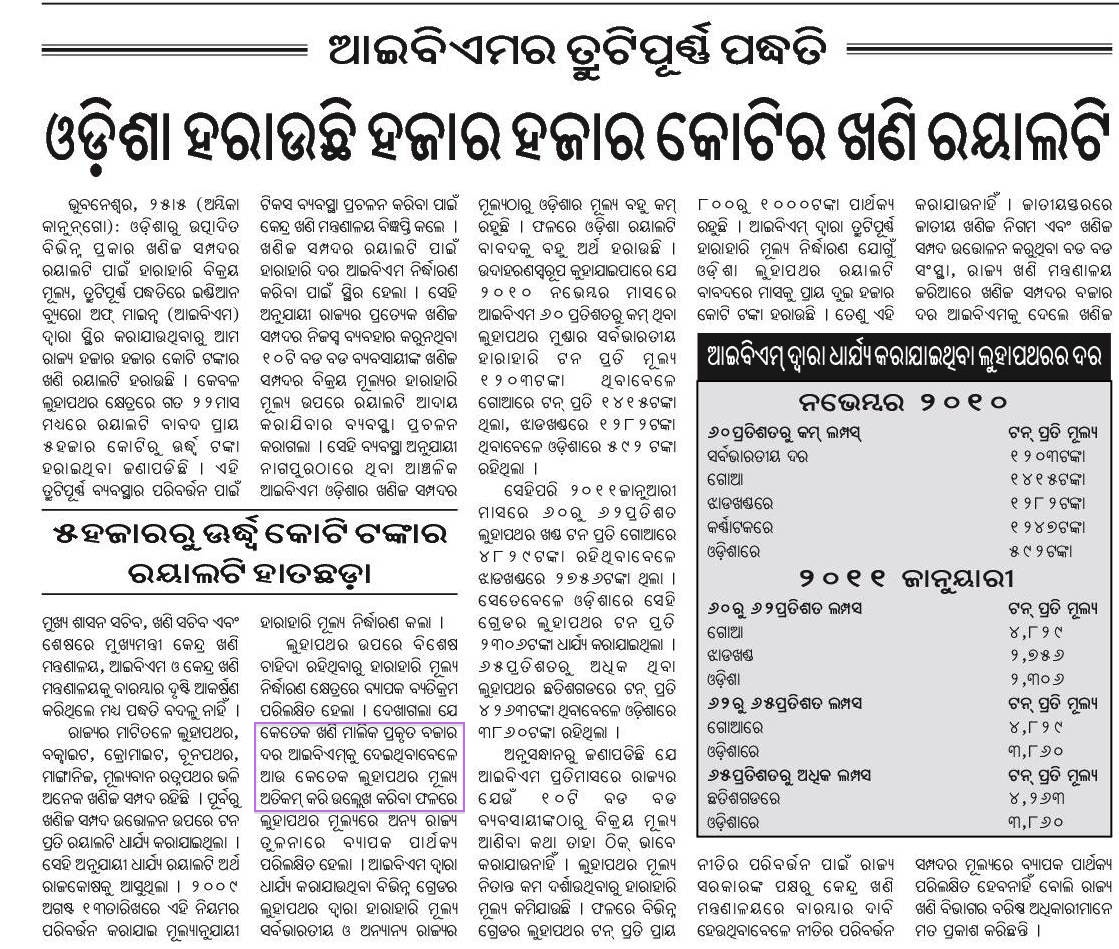
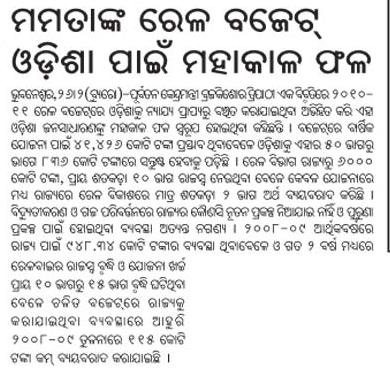
The above article writes about the analysis of ex-MP Braja Tripathy. His main complaint is that Indian Railways makes 10% of its revenue (about 6000 crores) from Odisha but has spent only 2% of the budget in Odisha; 836 crores out of 41,426 crores. He also says that in 2008-09 the Rail budget had 948.34 crores for Odisha and since then while the revenue and planned expenses have increased 10-15%, Odisha’s rail budget has decreased by 115 crores. 

Mr. Tripathy has a very good point. We made similar points in our page http://kbkrail.orissalinks.com/ and in the article http://www.orissalinks.com/orissagrowth/archives/1550.

However, I partly agree with the comment made by Mr. Prasanna Mishra; this year’s allotment of 120 crores for the Khurda-Balangir line is pretty good. The Odisha government must facilitate land acquisition so that the full 120 crores is spent this year. That way it can ask for more in the next budget and possibly get it. Otherwise next year Khurda-Balangir will get a smaller allocation and we will be back to square one.

Orissa MPs raise various issues in the parliament

Demanding equitable treatment, Kalahandi, Orissa MPs, Orissa issues in the Parliament, Railway network in Orissa, Railways No Comments »

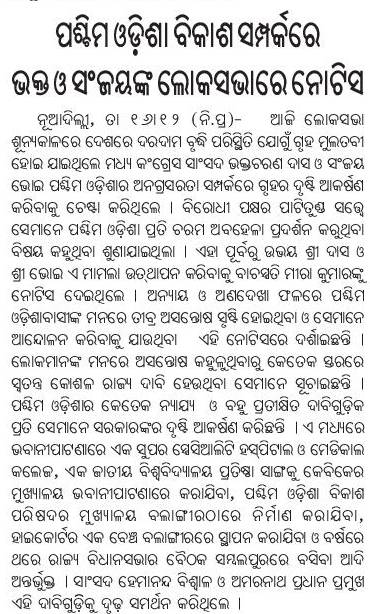
Many of them raised various Railways related issue. MPs Bhakta Das and Sanjay Bhoi raised the issue about a medical college and a national university in Bhawanipatna. Following are news items from Dharitri and Samaja on this.

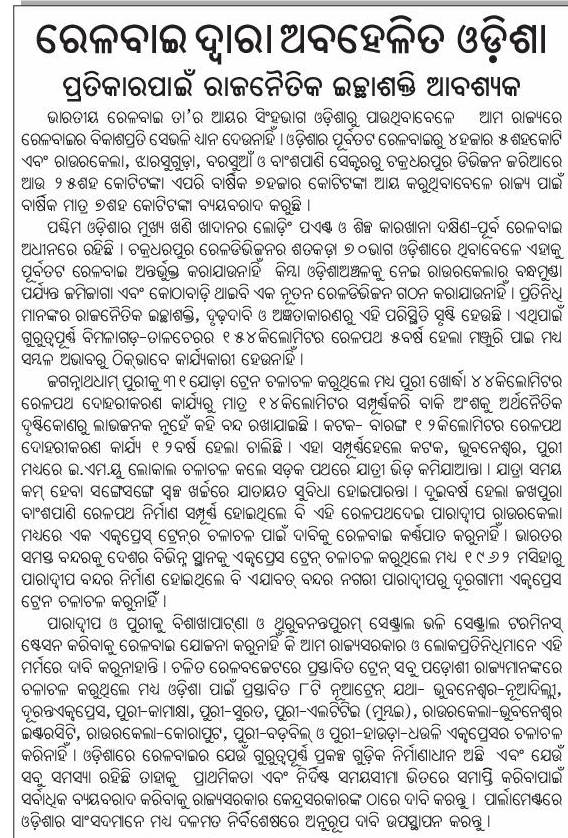
Following is an op-ed piece from Samaja on the Railways issue.

Orissa’s peeve with the center

CENTER & ORISSA, Demanding equitable treatment, Mine royalty and cess, Orissa Assembly, Orissa govt. action, Railway network in Orissa No Comments »

Following is an excerpt from a report in Pioneer.

the BJD has decided to bring four resolutions against the Centre. “We will move resolution against the Centre for neglecting the cause of Odisha in the field of railway, for not increasing mine royalty in a regular manner and not giving its due share to the State, Centre’s negligence in providing help to the State to face the Maoist menace and Government’s failure to provide flood assistance to the State,” Mohanty added.

I agree with the above.


History of Parlakhemundi light railway: Indian Express

Gajapati, Naupada - Gunupur (Gauge conversion), Orissa history, Railway network in Orissa, Rayagada No Comments »

Indian Express has a nice article on the history of Parlakhemundi light railway. Following are some excerpts.

Paralakhemedi Light Railway (PLR) was two feet six inches gauge railway. It was the brainchild of the erstwhile Raja of Paralakhemedi. The Kimedi country, consisting of Paralakhemedi, Paddakimedi and Chinna Kimedi, was under a single ruler till 1607. Paralakhemedi came under the British influence in 1768.

East Coast Railway came into existence in the year 1893 with the construction of the Cuttack-Khurda Road-Puri line, covering a distance of 96 kms and its subsequent link along the East Coast up to Vijayawada — junction point of Southern Maratha Railway and Nizam’s Guaranteed State Railway. As a result, a stretch of 1280 kms of East Coast Railway, covering the entire coastal stretch of Cuttack, Khurda Road, Puri, Palasa, Vizianagaram, Visakhapatnam, Kakinada, Rajahmundry, Vijayawada, was opened for traffic between 1893 to 1896. East Coast Railway brought rail line to Naupada in 1894. The Raja of Paralakhemedi decided to connect his capital with Naupada, which was only 40 kms away. With the government giving sanction in 1898, work began in full earnest. The line was opened to traffic in 1900. This railway line was built at a cost of Rs 7 lakh.

Due to a change in the policy of the British Government, the Bengal Nagpur Railway, popularly known as the B.N.R, took over the northern section of East Coast Railway from Vizianagaram to Cuttack, including the Branch Line of Puri, by 23-01-1902. Accordingly, the working of the PLR was taken over by the Bengal-Nagpur Railway in 1902. In the first few years, the PLR had incurred losses but after 1910, it started making marginal profits and after 1924-25, the profits increased. This motivated the Raja to extend the line to Gunupur in two phases in 1929 and 1931. There were now a total of ten stations between Naupada and Gunupur. Tekkali, Paddasan, Temburu, Ganguvada, Patapatnam, Paralakhemedi, Kashinagar, Lihuri, Bansidhara and Palasingi.

The management of BNR was taken over by the Government of India in October 1944. On 14-04-1952, at the time of the re-grouping of the Indian Railways it became part of the Eastern Railway. The merger of B.N.R. into Eastern Railway, however, did not last long and on 01-08-1955 it was merged with newly constituted South Eastern Railway. During the SER centenary celebrations in 1987, set of four postage stamps were released. One of the stamps featured the PL 691 locomotive.

The standard type of locomotive on PLR was the 20 ton 0-6-4 tank locomotive with small (27 inch diameter) coupled wheels and an axle load of only 4.75 tons. …

The foundation-stone was finally laid for the Naupada-Gunupur gauge conversion work at Naupada on September 27, 2002. With effect from April 1, 2003, PLR became a part of the newly formed East Coast Railway. The line was finally closed for gauge conversion on June 9, 2004.

— VIKAS SINGH, RAIL ENTHUSIAST
Courtesy National Rail Museum

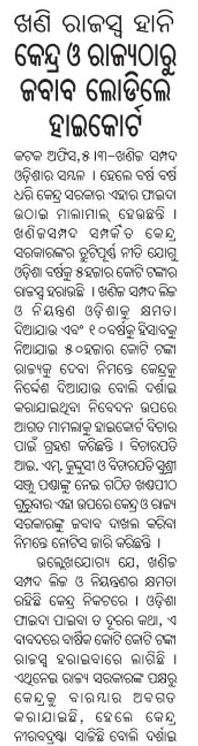
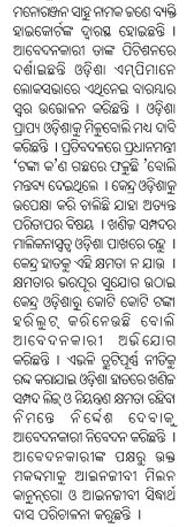
High court asks center and state on loss to Orissa on faulty mine policies

Demanding equitable treatment, Mine royalty and cess, Orissa issues in the Parliament No Comments »

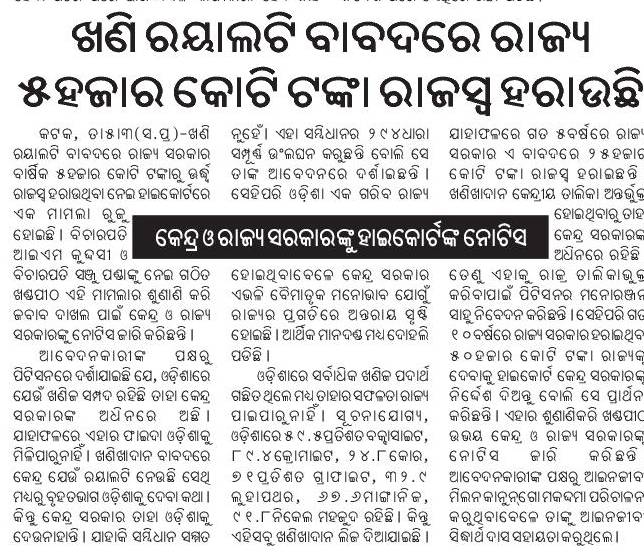
From Samaja:

From Dharitri:

GFT Technology to be used to arrest sea erosin

Coastal highway - beach preservation, Orissa govt. action No Comments »

Following is excerpted from a story in The Week.

The Orissa government for the first time would use the Geo Filter Tube (GFT) technology in construction of sea wall to save the Satbhaya village from constant threat of sea erosion.

Chief Minister Naveen Patnaik is scheduled to lay foundation stone of the much ambitious project, estimated to cost Rs 15 crore to the state exchequer, Aul Saline division executive engineer Rajkishore Ghadei said.

Official sources said a high-level scientist team from Chennai-based Indian Institute of Technology (IIT), which earlier visited the sea erosion prone Petha village under Rajnagar, had asked the district administration and the state government to erect a sea wall by using the Geo-Filter Tube technology.

Mr Ghadei … The erosion control measures, he said, would be easily solved by installation of the Geo-Filter Tube erosion barrier. Shoreline restoration is also easily achieved by the installation of the Geo- Filter Tube which acts as a natural sand filter to reduce the insecticides.

It is a low cost shoreline restoration system easy and fast to install with little or no impact on existing landscape at 25 per cent of the cost of the conventional bulkheads or sea walls.

According to Ghadei, the Geo-Filter Tube is constructed of a spun-bond polyester fabric sewn together to form a custom diameter tube. The tube is interconnected along the water-edge, then a small sand pump is used to fill the tube with the same sand and organic material that has been eroding into the lake or canal.

The final result is a long lasting fully contained sand filter barrier that would stabilise the bank from erosion and filter rainwater and irrigation run off.

The Geo-Filter Tube erosion barrier could be installed on any shoreline contour or stacked pyramid fashion to create a more substantial barrier to protect against soil erosion during heavy rains.

The Tubes are geo-textile encapsulated soils used to replace rock as conventional building blocks in marine Geo-tube wall to prevent sea erosion and hydraulic engineering structures,Ghadei.
 

Kharabela Swain, MP from Orissa, has the guts to point out Lalu Yadav’s partiality

Orissa MPs, Railway network in Orissa, Railways 1 Comment »

Following is an excerpt from a the Lok Sabha transcript of 20th October 2008.

SHRI KHARABELA SWAIN (BALASORE): What he has done? He has taken one railway factory to his constituency, another factory to his wife’s constituency, and the third one to the UPA Chairperson’s constituency. … (Interruptions) We are nowhere.  Shall we be eligible to get any rail factory any time in life? … (Interruptions) People say that now-a-days jobs are being given in the Railways by taking land from them. … (Interruptions)

MR. CHAIRMAN: Please go to your seat. Let the Minister reply. I will give him time.

… (Interruptions)

SHRI KHARABELA SWAIN (BALASORE): Even now the Ministers in the Government are becoming Ministers by giving land in this country. … (Interruptions)

1707 hours

(At this stage, Shri Ram Kripal Yadav and some other hon. Members

 came and stood near the Table.)

… (Interruptions)

MR. CHAIRMAN: If you do not go, I have no other way but to adjourn the House. If you want me to adjourn the House, then I will adjourn it.

… (Interruptions)

SHRI KHARABELA SWAIN (BALASORE): It is because of this only. … (Interruptions) This is happening and nothing else. I strongly object to what is being done by the Railways. … (Interruptions)

MR. CHAIRMAN: Please go to your seats. If you do not go, I have no other way but to adjourn the House.

          The House stands adjourned to meet tomorrow, the 21st October, 2008 at 11 a.m.

One wonder if Lalu Yadav is the Minister of Railways for India or the Minister of Railways for UPA or the Minister of Railways for Bihar?

Calculating Indian Railways’ estimated profit from Orissa in 2008-09

APPEAL to readers, Railway network in Orissa, SECR, SER 1 Comment »
  Total Route kms Route Kms in Orissa

Total estimated Profit in 08-09 (in crores)

Orissa’s portion of the profit (in crores)
ECOR 2430 1607 3077.15 2034.97
SECR 1599 51 2529.89 80.69
SER 2577 589 2467.88 564.06
    2247   2679.72


Indian Railways exploitation of backward and tribal areas of Orissa: confronting Railway Board Chair with the facts in Toronto

Balasore - Niligiri (defunct?), Baripada - Bangiriposi (under constr.), EXPOSING ANTI-ORISSA-GROWTH SCHEMES, FINANCE & BANKING, Gajapati, Ganjam, Interstate disputes on Water and rivers, Jaroli - Deojhar .. Chaibasa, KBK Plus district cluster, Kandhamala, Keonjhar, Koraput - Rayagada, Mayurbhanj, Nayagarha, Orissa Consumer Welfare Foundation, Paradip - Jatadhari - Kujanga, Railway maps, Rajathagara - Nergundi, Rayagada, Samaja (in Oriya), Sambalpur, Sonepur, Sundergarh, Talcher - Barang, Titlagarh - Jharsugurha Jn, Tomka - Jaroli, Uncategorized 3 Comments »

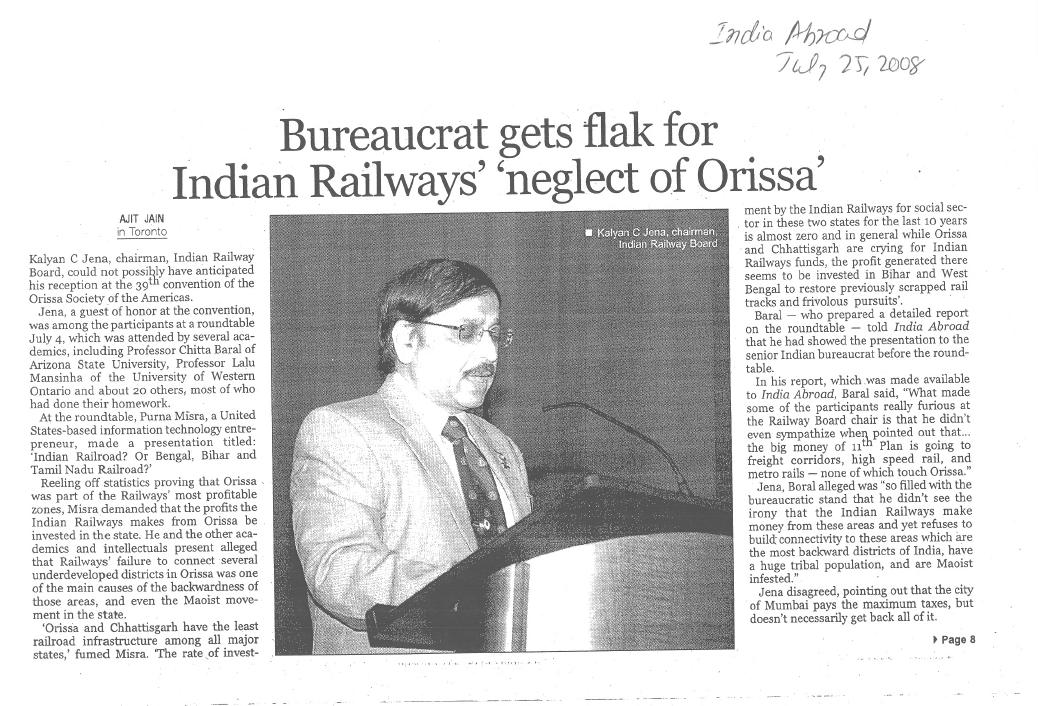
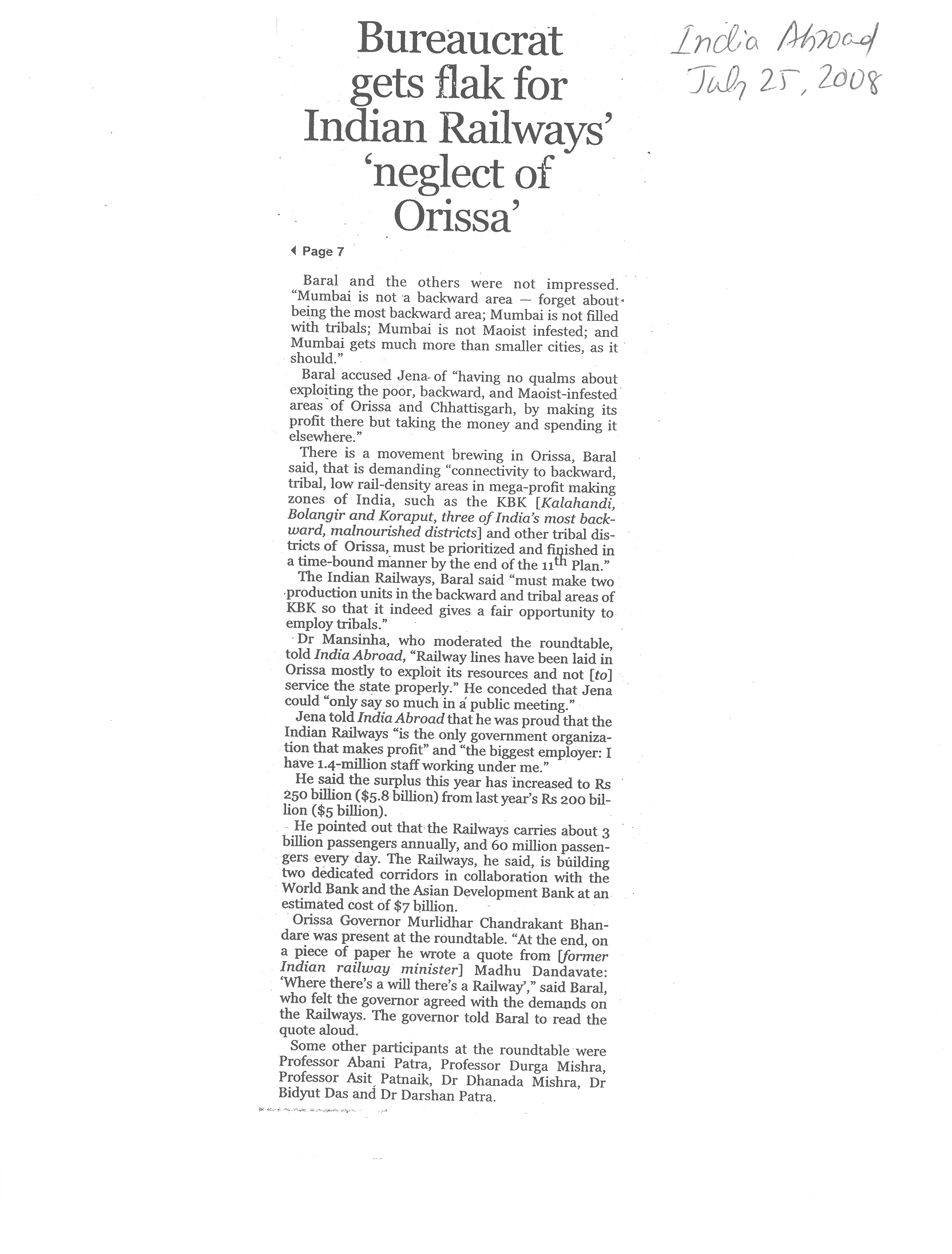
Following is the news report on the discussion (almost a confrontation) with the Railway Board Chair, as reported in India Abroad. The basic premise behind our grievances against Indian Railways and our demands is simple.

  • Indian railways is scheduled to make 2500-3000 crores/year from Orissa, but spends only 1000 crores/year on Orissa in terms of new lines, doubling and gauge conversion.
  • Its current plan for major spending includes freight corridors, metro rails, and high speed rails, none of which touch Orissa. It plans to do gauge conversion of 12000 kms, most of which is unprofitable (this proves that Indian Railway lies when it says it only does profitable lines), very little (less than 100 km) of which is in Orissa.
  • Orissa is already behind the national average in terms of rail density and way behind its neighbors such as West Bengal and Bihar. If no changes are made to the 11th plan IR allocations Orissa will further fall behind.
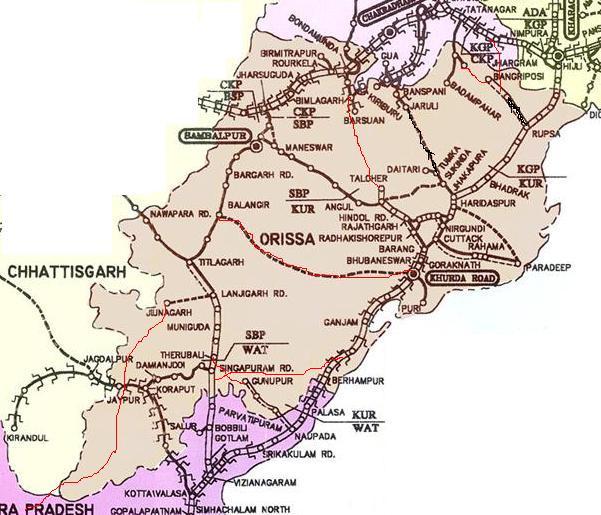
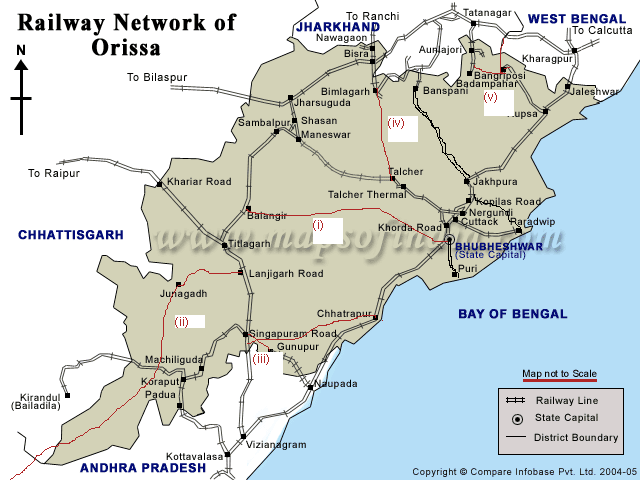
  • Indian Railways must not take money from its profit in Orissa, and spend it else where, until it takes care of proper connectivity to Orissa’s tribal, backward and maoist infested areas. The 2500-3000 times 5 = 12,500 -15,000 crore that Indian Railways will profit from Orissa during the 11th plan must be spend in new lines in Orissa until the (i)-(v) lines below and other port and mine connectivity lines are completed during the 11th plan.
  • To Mr. Jena’s retort that Mumbai earns so much in taxes and not all of it is spent in Mumbai; we reply that it is often acceptable to take from rich and give to poor; But when did it become acceptable to take from poor (Orissa) and give to rich (freight corridors etc. in other states)?

The lines in Orissa connecting to the tribal and backward areas that we demand to be finished during the 11th plan are:

  • (i) Khurda Rd – Nayagarh – Balangir: Lack of connectivity was one of the reasons a recent Maoist mayhem happened in Nayagarh. It seems after recent events, including the confrontation with the Railway Board Chair and various dharanas in Bhubaneswar, IR has started responding to this demand, but not to the extent to promise its completion during the 11th plan. Note that Balangir is the B in the KBK districts that are the most backward in India.
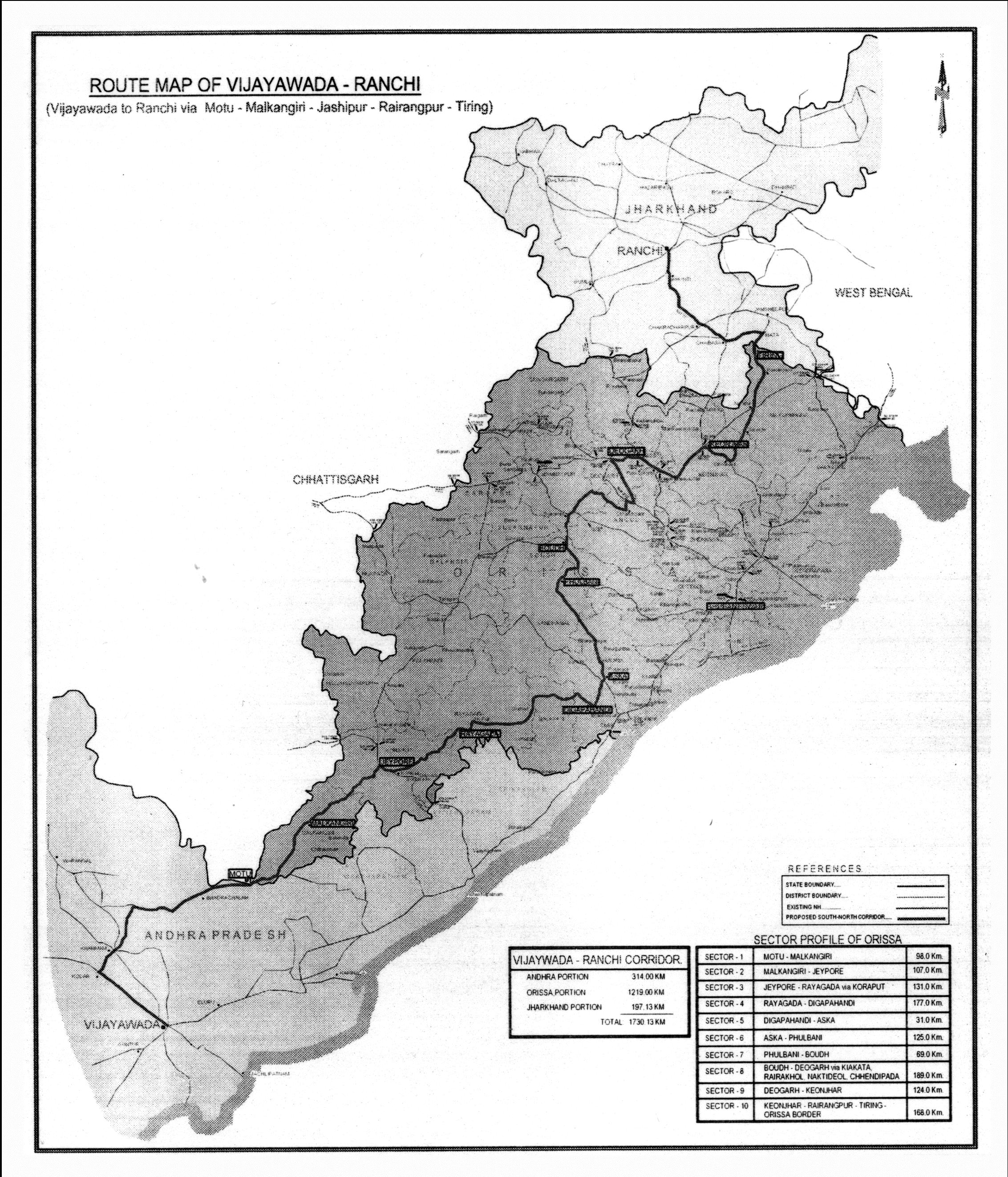
  • (ii) Lanjigarh Rd – Junagarh – Nabarangpur – Jeypore – Malkangiri – Bhadrachalam Rd in Andhra Pradesh: Only small part of this is approved. Most of it is not even surveyed. In the long run this will really bring those parts of Orissa closer to the rest of Orissa. This is the most important connection and has to be take care of at the earliest. Like the approved Vijaywada-Ranchi highway, this line will create an alternative Hyderabad – Ranchi path passing through backward and tribal areas of Andhra Pradesh, Orissa and Jharkhand. This line will connect the Kalahandi and Koraput districts, the two K’s in KBK. The recent Maoist attack and killing of the Greyhound forces in Malkangiri might have been prevented if this line existed as then the forces would have used the train rather than being seating ducks taking a boat across a lake in Malkangiri.
  • (iii a) Rayagada – Gopalpur: This has been surveyed and but work on it has not started. Note that Rayagada is part of the undivided Koraput district, one of the K’s of KBK. This line could come under port connectivity and will be a viable line connecting the industries near Rayagada with the upcoming port in Gopalpur.
  • (iii b) Gunupur – Theruvali: This will add to the Naupada-Gunupur line and make it an economically viable line. (IR and Mr. Jena agree about its importance.) This line will be completely inside the Raygada district, part of the undivided Koraput district, one of the K’s of KBK.
  • (iv) Talcher – Bimlagarh (connectivity to the tribal district of Sundergarh): This line has been approved but is only being given a few crores each year, which is less than the inflation. This line will reduce the distance between Sundergarh district and teh coastal areas significantly. For example, it will make Rourkela only 4-5 hrs from Bhubaneswar.
  • (v) Baripada/Buramara – Chakulia: This line will connect the tribal district of Mayurbhanj to tribal areas of Jharkhand. It will add to the Rupsa-Baripada-Bangiriposi line and make it an economically viable line. (IR and Mr. Jena agree about its importance.)

All these lines can be completed if Indian railways just suspends its practice of taking from poor (Orissa) and giving to the rich for only a few years (may be just 3-4 years). The following maps show the above mentioned lines.

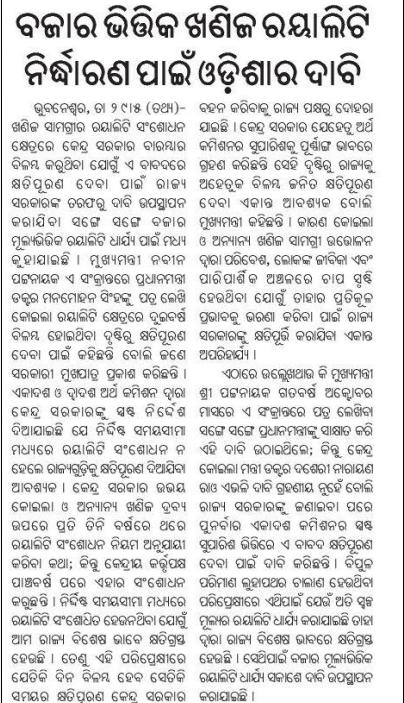
CM writes to PM for Ad Valorem rates on minerals: Samaja

Ad Valorem, Chief Minister's actions, MINES and MINERALS, Mine royalty and cess, Samaja (in Oriya) No Comments »

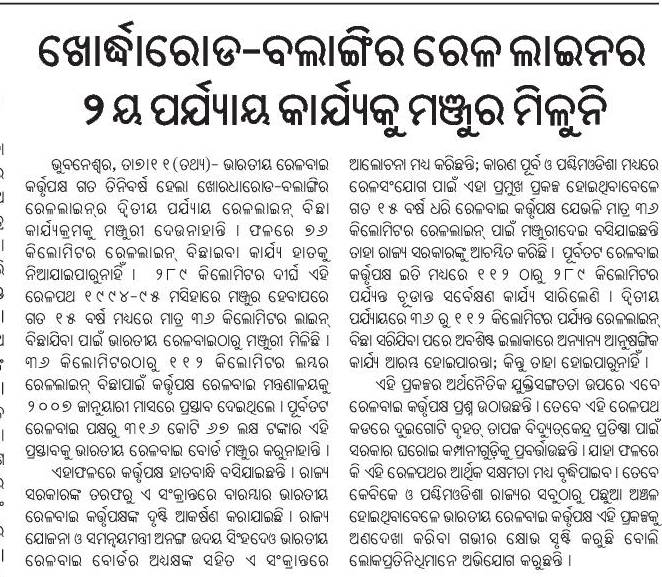
Khurda-Balangir work stopped for now?

Khurda Rd - Balangir (under constr.), Railway network in Orissa No Comments »

Following is from Sambada:


Following is from Samaja:


Orissa to rework its coastal highway plan

Balasore, Bhadrakh, Coastal highway, Coastal highway - beach preservation, Ganjam, Jagatsinghpur, Kendrapada, Khordha, Orissa govt. action, Puri 1 Comment »

Following is from a report in New Indian Express.

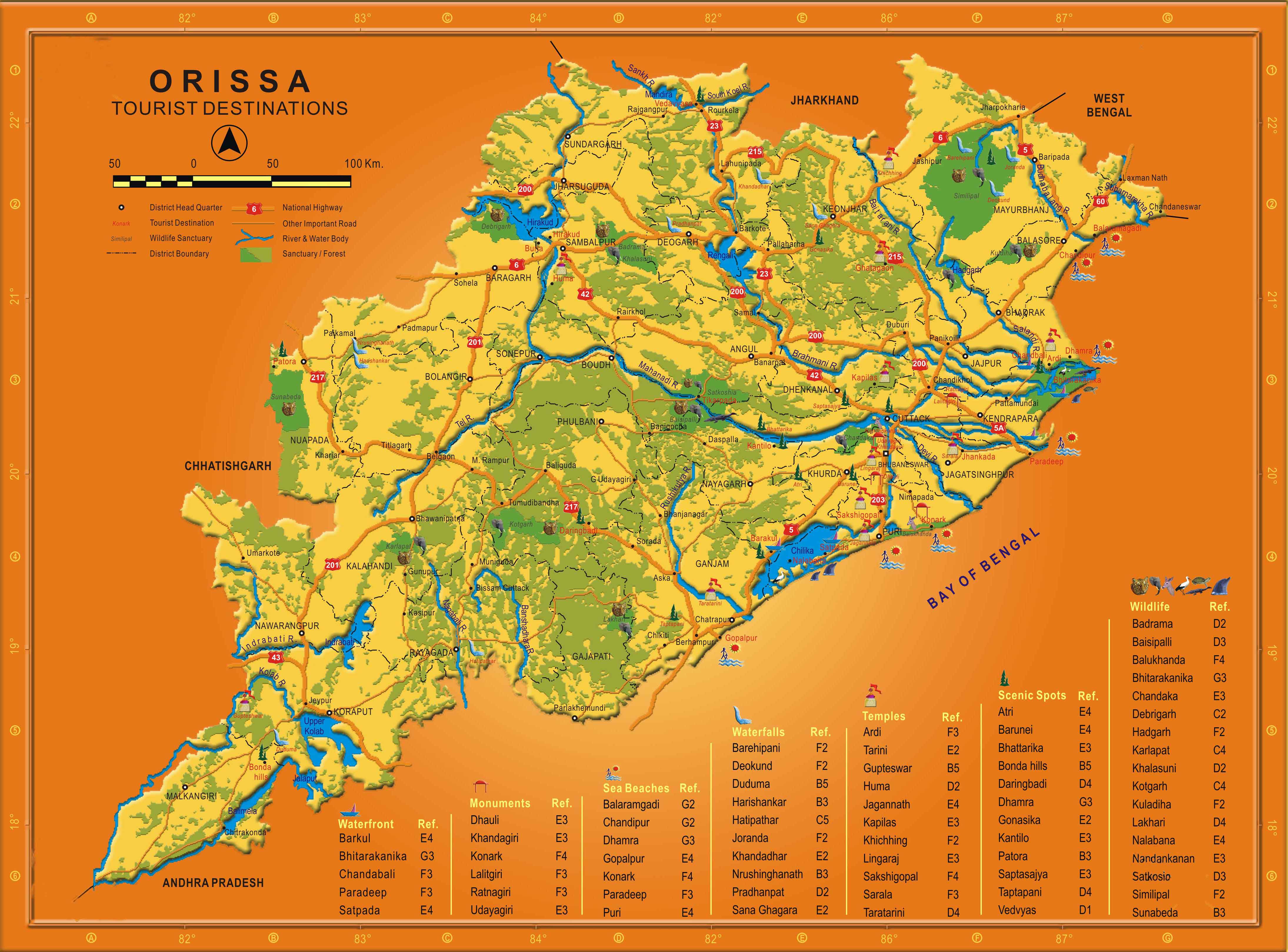
The State Government has decided to revive the Gopalpur-Digha coastal highway proposal. Announcing this on Monday during question hour, Parliamentary Affairs Minister Raghunath Mohanty said the proposal would be submitted to the Centre for approval after completion of the feasibility report.

Mohanty, who was replying on behalf of Chief Minister Naveen Patnaik, said that the length of the highway will be 573 km. Of this, the Astaranga-Dhamra patch will be 245 km while the length of Astaranga-Gopalpur will be 180 km. The patch of highway from Dhamra to Subarnarekha will be 148 km.

The State Government had earlier submitted a proposal to the Centre and requested that it should be included in a Central scheme. However, the proposal was rejected as it did not confirm to the guidelines of the Planning Commission.

Chinese to help in the making of a world class station in Bhubaneswar?

Bhubaneswar- Cuttack- Puri, ECOR, Khordha, Railway network in Orissa, TOI, Economic Times No Comments »

Following is an excerpt from a report in the Economic Times.

Railways may seek Chinese help in developing railway stations at Bhubaneswar and Bypanahalli in Bangalore.

A high-level Chinese delegation is visiting India from tomorrow to understand the Indian Railway system in a better way as part of the memorandum of understanding (MoU) signed between both the countries.

The 13-member delegation headed by Wu Wei, Director of Sino-India Railway Cooperation Working Group will visit Agra, Bhubaneswar, Mumbai and Bangalore during their 12-day visit.

… The two countries’ cooperation in rail sector is envisaged in the MoU signed on January 14 during Prime Minister Manmohan Singh’s visit to Beijing. The agreement, valid for three years, envisages development of rail-related programmes of mutual interest.

… The team would visit railway station at Bhubaneswar and Bypanahalli to explore the possibility of developing these stations at the international level. "After visiting these places, the team would share their views with us about the way to go ahead with the project, said the official.

National Waterway 5 bill to come up in Lok Sabha today

Key Center-State issues, National Waterway 5 No Comments »

Update: It could n’t come up on the 26th (item 17) as the Lok Sabha was adjourned after the Railway budget. It was scheduled to come up on the 27th (page 4), but  the Lok Sabha was again adjourned following protests by NDA and others raising the issue of the farmer’s plight.  Its scheduled to come up again on the 28th. But again the house was adjourned till the next day just about when this item was supposed to come.

The following is from http://164.100.24.207/lobtext/14/XIII/RLOB26.2.2008.pdf. (Our earlier coverage of this was in http://www.orissalinks.com/orissagrowth/?p=445)


Excerpts from TOI editorial: “After Nayagarh”

CENTER & ORISSA, Higher Education neglect, KBK Plus district cluster, Orissa govt. action, Railway network in Orissa No Comments »

From Today’s TOI Editorial:

Along with policing, however, other arms of the state machinery need to act and reach out to India’s tribal areas where Maoist insurgents are based. That means schools, roads, health care, easy credit, market access and other social welfare measures needed to mainstream India’s tribals and poor.

There’s a misguided belief that a hands-off policy is best when it comes to tribals. It becomes a handy excuse for not undertaking concerted efforts to bring them within the ambit of modernity and an Indian common market. The problem is that if government institutions don’t make serious efforts to get to India’s 84 million tribals then others will: Christian missionaries, Hindu activists, Maoist proselytisers. And that will end up strengthening the forces of both ideological extremism and regional chauvinism. Instead of ad hoc, panicky responses whenever incidents like Nayagarh happen, a long-term strategy comprising both security and welfare elements needs to be put in place to tackle the Naxalites and tone up governance in the areas that are their strongholds.