Archive for 2009

Comparing 2009 and 2004 election results; Orissa’s position

Elections 2009 Comments Off on Comparing 2009 and 2004 election results; Orissa’s position
   BJD   Congress   BJP   Others
2004 Assembly  61  38  32  IND 8, JMM 4, OGP 2, CPI 1, CPM 1
 2009 Assembly  103  27  6  NCP 4, CPM 2, CPI 1, Others 4
2004 Lok Sabha  11  2  7  JMM 1
 2009 Lok Sabha  14  6  0

 CPI 1

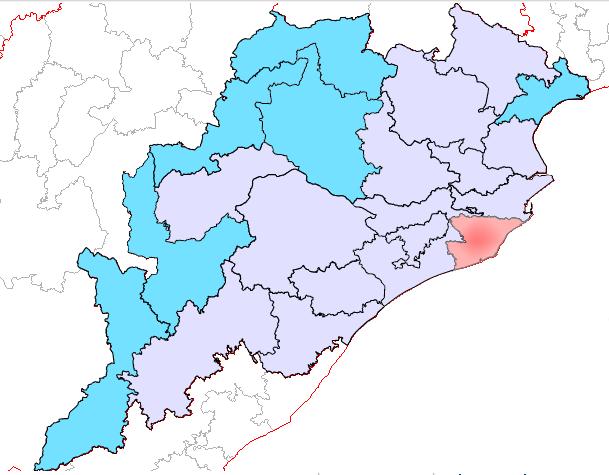
The following map shows which part won which Lok Sabha constituency in Orissa. (It is from http://164.100.9.52/ge2009/Final.html.) The blue is where Congress won, the grey is where BJD won and the red is where CPI won.

Compared to 2004, Orissa is better of in 2009 with respect to its leverage with the center. 

  • In 2004 it had only 2 MPs from the ruling party, this time it has 6. I hope that leads to more ministers from Orissa, including one cabinet minister and one state minister. 
  • In 2004 BJD with its 11 MPs was part of NDA  and BJD was dependent on BJP support in the state to get majority; so the ruling party in the center could just ignore BJD MPs of Orissa as it had no hope of getting their support. In 2009 BJD has 14 MPs. Although BJD has said it will not support UPA, the UPA may still harbor hope that in a crunch it may need BJD and so it would not completely ignore BJD.
  • However, the fact that UPA has very good numbers in 2009, and NDA and Left have done bad, UPA does not desperately need BJD support or abstention. Thus BJD does not have that much bargaining power to demand some special goodies for Orissa in return for its support or abstention.
  • This win increases the stature of Naveen Patnaik further and he will be taken more seriously in Delhi.
  • Jay Panda, having become a Lok Sabha MP, will also have a higher stature now.

Early results look good for Orissa’s interest

Elections 2009 Comments Off on Early results look good for Orissa’s interest

May 16 2009 12:54 AM Arizona Time (1:24 PM India):

Earlier in http://www.orissalinks.com/orissagrowth/archives/2036 I had suggested that a BJD MP contingent of 15+ MPs will be the best for Orissa. Later in http://www.orissalinks.com/orissagrowth/archives/2196 taking into account Naveen Patnaik’s statement that he would not support Congress, I revised my opinion and sugested that 12-13 BJD MPs and 8-9 Congress MPs would be good for Orissa.  


4:26 AM AZ/4:56 PM India: From http://www.eciresults.nic.in/StateWiseTrends.htm. (Leading- BJD: 14, CPI:1, Congress:6)


Orissa

1

Bargarh

Sanjay Bhoi

Indian National Congress

Dr. Hamid Hussain

Biju Janata Dal

65555

NO

Orissa

2

Sundargarh

Hemanand Biswal

Indian National Congress

Jual Oram

Bharatiya Janata Party

874

NO

Orissa

3

Sambalpur

Amarnath Pradhan

Indian National Congress

Rohit Pujari

Biju Janata Dal

26167

NO

Orissa

4

Keonjhar

Yashbant Narayan Singh Laguri

Biju Janata Dal

Dhanurjaya Sidu

Indian National Congress

90756

NO

Orissa

5

Mayurbhanj

Laxman Tudu

Biju Janata Dal

Sudam Marndi

Jharkhand Mukti Morcha

40188

NO

Orissa

6

Balasore

Srikant Kumar Jena

Indian National Congress

Arun Dey

Nationalist Congress Party

23101

NO

Orissa

7

Bhadrak

Arjun Charan Sethi

Biju Janata Dal

Ananta Prasad Sethi

Indian National Congress

47839

NO

Orissa

8

Jajpur

Mohan Jena

Biju Janata Dal

Amiya Kanta Mallik

Indian National Congress

72645

NO

Orissa

9

Dhenkanal

Tathagata Satpathy

Biju Janata Dal

Chandra Sekhar Tripathi

Indian National Congress

174224

NO

Orissa

10

Bolangir

Kalikesh Narayan Singh Deo

Biju Janata Dal

Narasingha Mishra

Indian National Congress

56159

NO

Orissa

11

Kalahandi

Bhakta Charan Das

Indian National Congress

Subash Chandra Nayak

Biju Janata Dal

104528

NO

Orissa

12

Nabarangpur

Pradeep Kumar Majhi

Indian National Congress

Domburu Majhi

Biju Janata Dal

28479

NO

Orissa

13

Kandhamal

Rudramadhab Ray

Biju Janata Dal

Suzit Kumar Padhi

Indian National Congress

124183

NO

Orissa

14

Cuttack

Bhartruhari Mahtab

Biju Janata Dal

Bibhuti Bhusan Mishra

Indian National Congress

187505

NO

Orissa

15

Kendrapara

Baijayant Panda

Biju Janata Dal

Ranjib Biswal

Indian National Congress

45581

NO

Orissa

16

Jagatsinghpur

Bibhu Prasad Tarai

Communist Party of India

Rabindra Kumar Sethy

Indian National Congress

74469

NO

Orissa

17

Puri

Pinaki Misra

Biju Janata Dal

Braja Kishore Tripathy

Bharatiya Janata Party

178674

NO

Orissa

18

Bhubaneswar

Prasanna Kumar Patasani

Biju Janata Dal

Santosh Mohanty

Indian National Congress

198294

NO

Orissa

19

Aska

Nityananda Pradhan

Biju Janata Dal

Ramachandra Rath

Indian National Congress

147206

NO

Orissa

20

Berhampur

Sidhant Mohapatra

Biju Janata Dal

Chandra Sekhar Sahu

Indian National Congress

44360

NO

Orissa

21

Koraput

Jayaram Pangi

Biju Janata Dal

Giridhar Gamang

Indian National Congress

82915

NO


More exit polls; Dharitri says that BJD would be in a good bargaining position for Orissa

Elections 2009 1 Comment »

I kind of agree with the above analysis that BJD can put Orissa in a good bargaining position. In addition if there is a UPA government in center with 7+ Congress MPs there could be a cabinet minister and a state minister from Orissa; hopefully in ministries where they can be of help.

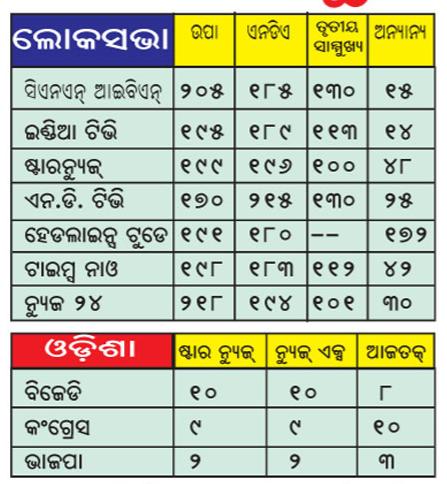
Times Now Exit Poll Lok Sabha projections for Orissa: Congress 9, BJD 8, BJP 4

Elections 2009 2 Comments »


My prediction: Congress 7, BJD 12, BJP 2.

The Times Now projection for the rest of the country is as follows:

  Congress BJP Other UPA Other NDA Others
India 154 142 44 41

Left – 38

Others – 124

Orissa 9 4     BJD – 8
Kerala 12   3   Left – 5
Tamil Nadu 4   DMK 7  

Left – 4

AIADMK – 24

West Bengal 5   TM Congress – 12   Left – 24
Uttar Pradesh 13 17    

BSP – 28

SP – 23

Maharashtra 12 13 NCP – 11 Shiv Sena – 12  
Karnataka 9 16     JDS – 3
Rajasthan 13 10     2
Gujarat 7 19      
Madhya Pradesh 6 23      
Andhra Pradesh 15       TDP 15, TRS 5, PRP 4, Left 2, Others 5
Assam 5 4   AGP – 3 BPF –  1, AUDF – 1
Bihar 3 10 RJD LJP – 6 JDU – 19 Left – 1, Others – 1
Chhatisgarh          
Jharkhand          
Punjab          
Haryana          
Himachal Pradesh          
J & K          
Delhi          
Goa          


IOC ties up funding for its Rs 29,777 crores refinery in Paradeep

IOC, Jagatsinghpur, Paradip - Jatadhari - Kujanga, Petrochemicals, Refinery Comments Off on IOC ties up funding for its Rs 29,777 crores refinery in Paradeep

Following is from a report in Hindu.

Indian Oil Corporation has tied up finances for its Rs 29,777 crore Paradip refinery project in Orissa that would be commissioned by March 2012.

"We have received commitments from a consortia of banks," IOC Chairman Sarthak Behuria said.

SBI Caps, which was mandated to arrange Rs 14,700 crore debt for the project, has managed Rs 14,900 crore from 21 banks. State Bank of India (SBI) will be the largest lender with Rs 4,200 crore exposure.

IOC was likely to sign loan agreements with the consortia of banks on May 14.

"We will draw (from these loans) as and when we need them," he said but did not give details.

IOC is targeting commissioning of the refinery in first quarter of 2012. The board had recently split the refinery cum petrochemical complex into two, deciding to do the refinery first and the chemical unit will follow later.

Paradip refinery is being configured to process the toughest, heaviest and the most dirtiest crudes which are cheaper than the cleaner and easier varieties. The refinery will have a Nelson Complexity Index of 15.

Rs 13,381 crore investment proposals for Orissa in January

Investment ranking, INVESTMENTS and INVESTMENT PLANS Comments Off on Rs 13,381 crore investment proposals for Orissa in January

Following is an excerpt from a report in Times of India.

…  According to government data, steel and electrical equipment makers lead the pack of corporates in drawing up investments in new capacities and expansion projects. The department of industrial policy and promotion has received investment proposals totalling around Rs 99,958 crore in January. This marks a 65% increase over proposals filed in December.

The government reckons that if the projects fructify, they could create about 65,000 new jobs. Among the January proposals, Rs 15,654 crore worth plans are for West Bengal, followed by Rs 15,088 crore for Chhattisgarh and Rs 13,381 crore for Orissa. Andhra Pradesh, Maharashtra, Karnataka and Gujarat are the other states where investments have been planned.

With focus on infrastructure development, especially in the power sector, investment of Rs 39,157 crore has been announced for electrical equipment and Rs 38,798 crore in metallurgical industries.

Among the industries, electrical equipment, metallurgical industries, cement and gypsum products are the areas attracting the maximum investment plans.

Though these are mere investment plans, the figures are yet another pointer that the worst may be over and the economy looks set for a rebound. This may sound contra-intuitive after dire predictions of a long and deep slowdown, but economists and investment bankers indeed see an uptick as early as September, or latest by December.

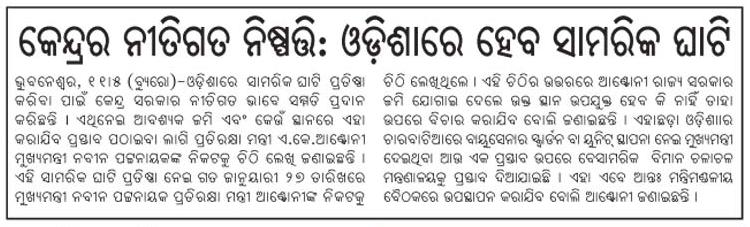
Center agrees in principle to set up an army base in Orissa and is considering an Air Force squadron or unit in Charbatia: Dharitri

Defence establishments, Odisha govt. action Comments Off on Center agrees in principle to set up an army base in Orissa and is considering an Air Force squadron or unit in Charbatia: Dharitri

Following up on an earlier posting http://www.orissalinks.com/orissagrowth/archives/1842 Dharitri reports that the center has agreed in principle to set up an army base in Orissa.

Greenroofing towns and cities in Orissa and India: collection in progress

Greenroofing Comments Off on Greenroofing towns and cities in Orissa and India: collection in progress

Most building roofs in India are flat, and this is ideal for having green roofs. Green roofing the buildings has many advantages:

  • Decreases the temperature of the building, and the surroundings
  • Puts less pressure in the drainage system; especially useful in towns like Cuttack which do not have proper drainage systems.
  • More space for planting

Overall, it is good for the environment.

Here I will collect links on Greenroofing and use it to encourage my friends and family to have green roofs in their homes and buildings in Orissa. I hope the Government of Orissa and some of the city authorities will aso encourage this in Orissa and its cities and towns.

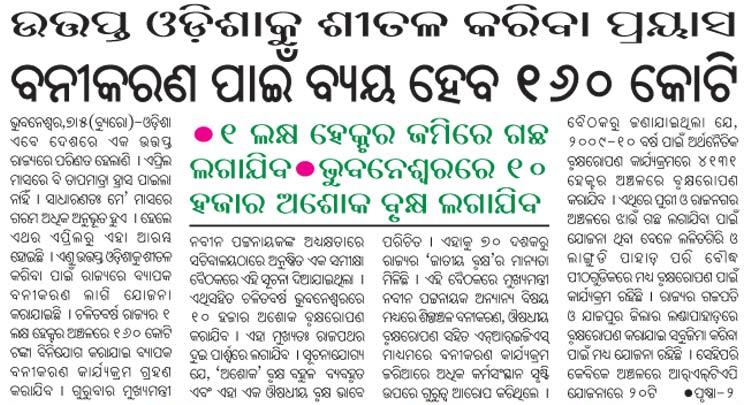
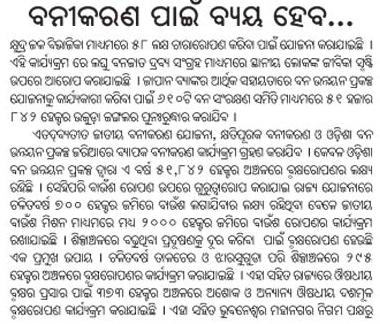
Large scale forestization planned in Orissa and planting of 10,000 Ashoka trees planned for Bhubaneswar: Samaja

Bhubaneswar- Cuttack- Puri, Forestization Comments Off on Large scale forestization planned in Orissa and planting of 10,000 Ashoka trees planned for Bhubaneswar: Samaja

Orchid brand hotel coming up in Konark

Bhubaneswar- Cuttack- Puri, Hotels and resorts, Konark, Puri Comments Off on Orchid brand hotel coming up in Konark

Following is an excerpt from a report in hospitalitybizindia.com.

Kamat Hotels India Ltd (KHIL) is in the process of developing 600 additional rooms under ‘The Orchid’ brand across India. Presently, properties are under development in Nagpur, Coimbatore, Raipur and Konark. Upcoming properties will be set up at greenfield locations and will be entirely managed and operated under the KHIL banner.

“The Orchid brand will continue to grow through tier I and II locations across India. For KHIL’s premium brand, we plan to tap emerging markets for potential locations,” says Vishal Kamat, Director, KHIL to Hospitality Biz. KHIL will develop a 30 room all-suite hotel in Konark, Orissa and a 100 room hotel in Nagpur. The Coimbatore and Raipur properties are expected to come up with about 200 and 120 rooms, respectively. “KHIL has always positioned The Orchid as a business hotel and we are keen that we develop and manage hotels under this brand to maintain its exclusivity in the market. Unlike Concept Hospitality Ltd (CHL), which presently manages a few Orchid hotels in New Delhi, Kollam and Jalandhar, KHIL will not operate simply as a hotel management entity in the market,” clarifies Kamat.

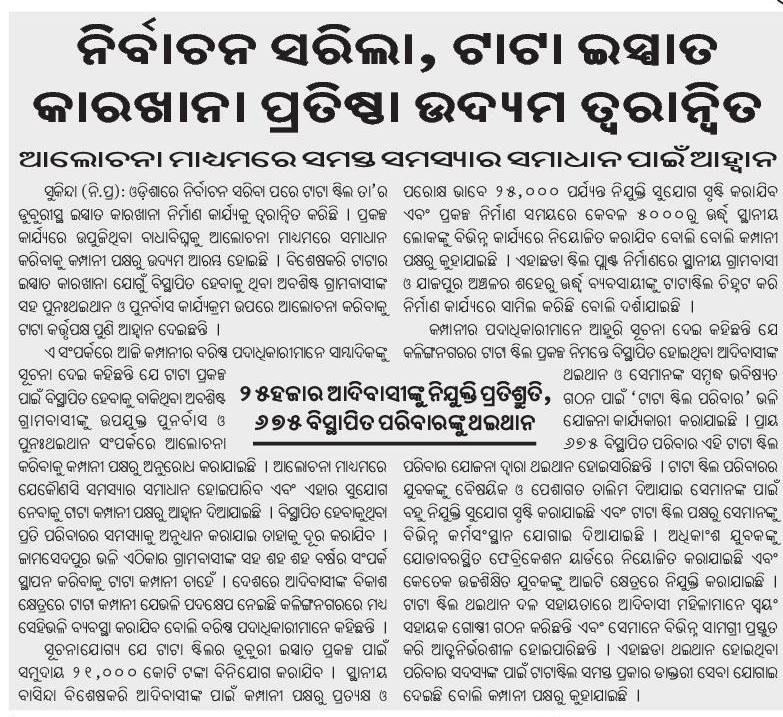
Status of Tata Steel in Kalinganagar: Samaja

Jajpur, Jajpur Rd- Vyasanagar- Duburi- Kalinganagar, Samaja (in Odia), Steel, Tatas Comments Off on Status of Tata Steel in Kalinganagar: Samaja

IED to establish three food processing centers in Orissa: Hospitality Biz

Cuttack, Food processing, Jagatsinghpur, Kandhamala 1 Comment »

Following is from a report in Hospitality Biz India.

The Institute of Entrepreneurship Development (IED) is likely to set up three food processing centres (FPCs) in Orissa to provide infrastructural facilities for farmers to directly process their products. These FPCs are expected to be developed in PPP mode.

While, the required infrastructure will be created by the Orissa government, the day to day operations, including the centres’ maintenance will be managed by a private agency. Currently, the details of the FPCs are being worked out by the IED and the proposal will be sent to the Union Ministry of Food Processing Industries for assistance after the plan is finalised.

The state government has identified three locations, namely Cuttack, Jagatsinghpur and Phulbani, for setting up of these Centres. However, a final decision regarding the locations for these FPCs is yet to be taken.

The importance of the third front in getting rid of the communal party of India

Elections 2009 20 Comments »

Update: Expressbuzz.com has a related op-ed piece.

The communal political party of India which still is not apologetic about its role in Gujarat in 2002 and in Kandhamala in 2008 can be made to drastically lose its importance (or forced to abandon its communal elements) if in more and more states the main contenders are among Congress and regional parties. I have a feeling that come May 16th this communal party will become irrelevant in Orissa.  If more and more people see the third front as a viable alternative then it will automatically become the main competitor to Congress nationally and in the states many regional parties will choose the third front instead of the communal party for their partnership. This would then force the communal party to either become irrelevant or reinvent itself. This communal party has some very good people. Perhaps these people will come to senses and push to throw out the communal elements; otherwise the party will sink.

Some Oriya delicacies and their regional origins

Bhubaneswar- Cuttack- Puri, Circuit: Bhubaneswar-Chilika-Puri, Food joints, Odia/Odisha cuisine Comments Off on Some Oriya delicacies and their regional origins
  • Chungri Masala
  • Baripada Mudhi
  • Mansa Machchar Besar
  • Dahi Machha
  • Poi-Kosala Saag
  • Dhenkanal Ghuguni
  • Santula
  • Janhi Masala
  • Katak Dahibara
  • Manik Raita
  • Pitha
  • Salepuri Rasagola
  • Kendrapara Rasabali
  • Chenapoda
  • Chhena Payesh

The above Oriya delicacies are being  currently offered at the Hotel Kalinga Ashok Bhubaneswar in their family restaurant ‘Phulbani’. Non- vegetarian thali meal is Rs 120 and vegetarian thali meal is Rs 100.

Dhinikia Gram Panchayat has spoken; POSCO should stay away from Dhinikia; Both pro and anti POSCO people should shun violence

Against Bandhs, Against Road Blockades, EXPOSING ANTI-ODISHA-GROWTH SCHEMES, Jagatsinghpur, Paradip - Jatadhari - Kujanga, POSCO Comments Off on Dhinikia Gram Panchayat has spoken; POSCO should stay away from Dhinikia; Both pro and anti POSCO people should shun violence

The Anti-POSCO candidates for the gram panchayat elections have won. The details are below. I hope POSCO removes Dhinikia from its plan and both anti and pro POSCO people shun violence and illegal activities sich as blocking roads. Let POSCO be established in those areas where people want it and stay away from places where they are not wanted. Following is an excerpt from a report in orissadiary about the gram panchayat election results.

Posco Pratirodha Sangram Samiti … PPSS fielded its sarpanch candidate Mr Sisir Mohapatra and PS member candidate Mr Prakash Jena in this panchyat election. Mr Mohapatra is working as secretary of PPSS while Mr Jena has been languishing in Kujang jail since seven months after his arrest on Posco violence issue. PPSS candidate Mr Mohapatra has defeated his rival candidate Mrs Salila Nayak, wife of former sarpanch late Basant Nayak by margin 73 votes .Mr Mohapatra has got 2005 votes while Nayak has got 1932 votes.

Similarly, PS member candidate Mr Jena has also defeated his rivalry candidate Mr Nrusingh Das by 282 votes in which Jena has got 1672 votes while Mr Das has got 1390 votes. Sarpanch candidate Mr Nayak and PS member Mr Das who were defeated from this seat was backed by Posco supporters.

On the other hand, Zilla Parishad candidate Mr Saubhagaya Behera who was contesting as independent candidate has defeated his rival congress candidate Mr Rupakar Sethy by 995 votes. Mr Behera has got 6742 votes while Mr Sethi has got 5767 votes.

Orissa needs to avoid going the West Bengal way

EXPOSING ANTI-ODISHA-GROWTH SCHEMES 1 Comment »

An article in the Statesman  gives the dismal state of affairs in West Bengal. Orissa must resist the communist party’s indiscriminate opposition to industries and industrialists to avoid going the West Bengal way. People of Orissa must also learn to avoid listening to leaders from West Bengal who are routinely invited by Orissa communist leaders. These people have already destroyed West Bengal. Listening to their ideas and acting on them will take Orissa on the wrong path. Following are excerpts from that article.

Bengal’s dismal economy

…  HIGH INDEBTEDNESS
According to the latest estimates of the RBI, West Bengal has a total debt of Rs 1.47 lakh crore, including small savings loan of Rs 61,000 crore and market loan of Rs 31,579 crore. It means, 8.5 crore of the state’s people have a per capita debt of more than Rs 17,000. Among the states, only Uttar Pradesh and Maharashtra have larger indebtedness, although both have larger areas and population than West Bengal.

In order to reduce the states’ indebtedness and their fiscal imbalance, the Central government introduced the FRBM Act three years back. It provided opportunity to the states to be relieved of Central loan to the extent they would reduce their fiscal deficit. But unlike other states, West Bengal could not utilise this benefit. On the other hand, the state has indulged in gradual rise in its non-developmental expenditure, particularly in escalating its salary and pension bills.
Around 2001, the state government’s expenditure on this account was 155 per cent of its own tax collection. It has, however, managed to bring it down to 90 per cent, first by ceasing and then minimising government recruitment. In the comparable other states, this ratio varies between 55 and 70 per cent. Such a massive unproductive expenditure naturally leaves a paltry sum for the state’s economic development.

Dr Dasgupta, in his budget speeches, never mentions such huge indebtedness of the state nor ways to reduce it. Rather he always speaks high of the state’s economic growth, which, according to him, is more than that achieved by the country as a whole. The question then arises, what benefit has it brought to the state. A state’s high rate of economic progression should be reflected in its growing tax effort. But this is only 4.5 per cent in West Bengal, when the same is 8 to 10 per cent in other big states. Even in Orissa, it is 6.67 per cent.

This lowly mobilisation of its own tax resources not only points out its backwardness in industrial and commercial activities, but also makes the state dependent on external sources of finance, creating uncertainties in its economic planning.

LOW INDUSTRIALISATION
In the election time, Dr Dasgupta and his party comrades are lamenting the shifting of the Tata Motors’ Nano car plant from Singur to Sanand in Gujarat, pulling up the Opposition for its “irresponsible” protests.

But what about the 2,126 big and medium industrial units which have been shut down in the state during resistance and opposition less 32-year rule of the Left Front government? The number of closed small-scale industrial units is about 55,000. Is not the irresponsible and destructive trade unionism of Citu responsible for most of these closures? Besides, why are 80 collieries and 32 tea gardens closed?

Presently, West Bengal contributes only 4 per cent of the total industrial output of the country, which was 18 per cent in 1965 when the state achieved industrial supremacy. Since then, even in its own income, contribution of industry fell drastically from 36 per cent to only 11 per cent.

Moreover, whatever industrialisation the state has achieved, it is mostly concentrated in and around Kolkata. To be specific, 87 per cent of the industrial units in the state are localised in the five districts of Howrah, Hooghly, Burdwan and North and South 24-Parganas, apart from Kolkata. As commercial activities evolve around industries, most of the districts have poor growth of business and commerce as of industries.

It has resulted in a low rate of urbanisation in the districts away from Kolkata. In fact, in nine such districts, rural people constitute 90 per cent or more of the total population. This could be described as some sort of “ruralisation” that the state has achieved instead of urbanisation over time. It has created enormous pressure on agriculture for livelihood making it almost a subsistence work to many farm dependent people. Non-viable agriculture has compelled many to leave farming and become wage labourers.

Failure of the state to provide public irrigation and rural electrification, the two vital ingredients of Dr Dasgupta’s “alternative way” of development, keeps village people jobless over a larger part of the year.

UNEMPLOYMENT
The state government has failed to consolidate the gains from land reform measures of its initial years through setting up industries, particularly of the small scale type, by ensuring infrastructural development.

As compared to similar other states, West Bengal lags behind in road and electricity. Its per capita use of electricity, 380 kwh, is only above Bihar while the national average in this respect is 81 times higher. Similarly, Gujarat and Karnataka, with population being less than 39 per cent and 34 per cent, respectively, have more than 49 per cent and 135 per cent surfaced road, respectively, than West Bengal. Likewise, Maharashtra, with only 16 per cent more population, has 544 per cent more surfaced road than West Bengal. Thirty-two per cent of its villages still do not have all-weather roads.

The infrastructural deficiency has constrained economic development in West Bengal only to generate huge unemployment, the official estimate being 70 lakh. In relative sense, it has 26.6 per cent of rural unemployment and 24.0 per cent of urban unemployment. These are the second and the fifth highest among the comparable sixteen states when the respective national average is 11 per cent and 15.4 per cent.

It is surprising that rural unemployment of 31.27 lakh in West Bengal, unlike most of the other states, is higher than its urban unemployment. Moreover, its educated unemployment, amounting to 33.50 lakh and comprising 11 per cent of the total of the country, is also relatively high among the states. Among all the states, West Bengal, with an average unemployment rate of 4.93 per cent a year, is only behind Kerala which has 5.56 per cent of such rate.

Dr Dasgupta has the only option of self-help groups to provide jobs. He speaks of lakhs of such jobs each year, but never mentions how many of such groups can repay bank loans or stay viable for long. Joblessness brings in poverty which is almost one-third in the rural and one-fourth in the urban areas of the state with the proportion of population remaining starved or half-starved in a year reaching the maximum of 13 per cent among the states.

In fact, one important reason of closing down of so many of small scale industrial units in the state could be lack of demand in the villages plagued by a high rate of poverty and unemployment.

…  (The writer is Reader of Economics, Durgapur Government College)
 

Paramount Airways plans to connect Bhubaneswar in 2009-10

Bhubaneswar- Cuttack- Puri, Khordha 1 Comment »

Following is an excerpt about Paramount Airways plans for Bhubaneswar from a report in Economic Times:

Paramount forayed into eastern India last month, with flights to Kolkata, Guwahati and Agartala. It plans to add Shillong, Silchar, Imphal, Bhubaneswar, Ranchi and Cooch Behar to its network over the next year.

Following is an excerpt from a report in Business Standard.

Ahead of its plans to fly to international locales, Paramount Airways, the Chennai-based premium service carrier, is launching services to various other destinations in the country. The fully business-class airline is to commence services to 35 more cities, increasing its domestic routes to 50 by the end of 2010. It is to launch services to the northern region, including Delhi, and to the western and eastern parts, too.

“We are looking at having a strong domestic network, prior to starting our international operations. We are looking at connecting to every major airport in the country in a phased manner,” Paramount’s managing director, M Thiagarajan, told Business Standard here today.

Delhi is one of the new planned destinations and so are Imphal, Bhubaneswar, Ranchi, Bhopal, Nagpur, Porbander and other places in Gujarat. This is in addition to the earlier announced plans of launching services to Kolkata, Guwahati and Agartala, connecting these the south Indian cities of Chennai, Coimbatore and Kochi.


Orissa farmers buy tractors, power tillers and combine harvesters in record numbers

Farm mechanization 30 Comments »

Following is an excerpt from a report in expressbuzz.com.

… A record number of 2,170 tractors were sold under farm subsidy scheme in the last financial year as against Government target of 1,500. Never before in the agriculture history of the State such a large number of tractors were sold in spite of Government subsidy. However, this was possible due to significant increase in the rate of subsidy, said Director of Agriculture and Food Production Arabinda Padhee.

Prior to the last kharif, the subsidy on the purchase of tractor was limited to Rs 45,000. The subsidy amount was doubled last year to Rs 90,000 and this is definitely the major motivating factor for the farmers.

Similarly, the sale of power tiller has gone up. Under farm subsidy, 7,762 power tillers were sold in the last fiscal as against a target of 5,529. The other mechanised implements sold last year include 292 reapers, 45 self-propelled rice transplanters, 65 tractor drawn rotavators, 831 power thrashers and 396 tractor drawn axial flow power thrashers.

… Earlier, farmers were not very keen on combine harvester because of its prohibitive cost. Cost of a combine harvester ranges from Rs 6 lakh to Rs 16 lakh. However, 49 combined harvesters were sold last year because of enhanced subsidy. Subsidy on a combined harvester is Rs 3 lakh for base model and Rs 4 lakh for top-end model, Padhee said.

Mechanisation of various agricultural operations has made significant impact on the productivity and cost of cultivation. While the reduction of cost varies from 16 to 26 per cent, productivity has gone up from 7 to 25 per cent, he said adding, this also reduced drudgery to a great extent.

The machineries have also provided additional income to its owners through custom hiring. Apart from self-employment, these machineries are also generating direct and indirect employment for the local youth, he said.

Opposition parties of Orissa must change their stratgeies

Elections 2009, EXPOSING ANTI-ODISHA-GROWTH SCHEMES, Land acquisition 4 Comments »

It is my impression that the opposition parties in Orissa over the years have focused more on finding fault with Government schemes and actions and often agitated to stop them completely. Although opposition should find fault with government actions, their approach of doing it indiscriminately, focusing on stopping the action altogether and only doing that, is a flawed approach and it has not only hampered the development of Orissa but has hampered the opposition parties themselves, especially when they are pitted against Naveen Patniak’s government.

Their appraoch would work if the government is seen by people to be corrupt and if other developments were not happening. However, that is not the case with Naveen Patnaik’s government. Naveen has distanced himself from corruption taints by taking swift action in removing his ministers and officers accused of corruption. So he and his government are not seen by the people as a corrupt government. Also there is no visible accumulation of wealth by Naveen Patnaik and neither does he have relatives dependent on him or relatives that he is trying to groom. So most people see that he does not have a reason to be corrupt. (Contesting in elections does require money. But most people  often do not question where that money comes from. Moreover, every party needs that money and spends that money. ) On the other hand they do see progress happening around, be it NREGS, or gram-sadaks or establishment of IIT. They also see Naveen Patnaik frequently dueling with the central government on getting more resources for Orisssa.

The opposition’s approach of fighting such a government by opposiing development programs indisciminately, and demanding that they be stopped, does not help them – may actually harm them, and also harms Orissa. It may harm them because because many people see them has blocking Orissa’s progress.

The opposition party should change their strategy and beat Naveen at his own game.

They should change their premise that Naveen is doing wrong things that need to be stopped to:

  • In addition to what Naveen is doing, he must do XYZ to protect interests of UVW people,
  • Naveen is not doing enough good things, and
  • Naveen is missing opportunities.

They should take the development mantra down to towns districts and blocks.

They should agitate and ask the state government to do XYZ in UVW district. They should compare regions/towns/districts/blocks across Orissa and agitate that XYZ region/town/district/block does not have UVW or is being discriminated against PQR. Now when they succeed in convincing or forcing the government to take action many people will give them the credit; the same way Naveen Patnaik’s government gets credit for getting IIT and NISER to Orissa even though they were central government decisions and PM Manmohan Snigh paid personal attention to this. Alternatively, if the state government does not give in to their demand they can make that their election plank.

Let us take some specific examples.

People in Balasore have been demanding a medical college. A smart opposition could have made a big issue out of it. If it had succeeded after some agitation then the people would have remembered that when casting their vote.

Similarly, the Rourkela area, the second largest metropolitan area of Orissa, does not have a general university. In fact, I would go out on a limb and say that it is the largest metropolitan area in the country to not have a general university where one can puruse graduate (Masters and PhD) degrees in fields like Economics, Psychology, Physics, Business, etc. A smart opposition party could have taken advantage of that and created a movement in Rourkela for that and would have benefited by that. 

A smart opposition should have taken up the issue of the Central University of Orissa in Koraput starting in Bhubaneswar instead of in Koraput.

These are some glaring examples. Every region, every block, every district, every town needs development related things that the state government may have neglected. A smart opposition advocating those needs would get the attention of people there.

Such a strategy is a win-win and no-loss strategy. No one locally will oppose the demand of a medical college or a university. Thus there is no loss. It is a win-win because if they succeed in getting XYZ they can claim that their efforts led to getting XYZ and if they don’t they can blame the state government for neglecting the region/district/town/block and promise that if they come to power they would make XYZ  happen.

Instead, Orissa’s opposition often follows a very risky strategy which often goes against them. What they do is they oppose the establishment of UVW, say because it displaces X number of families. While some of those families (Y < X) may not want to be displaced many others are happy with the compensation package. But a large number of people who live nearby and are not displaced would really like UVW established. In agitating againts the establishment of UVW the opposition parties usually create a lot of drama, get a lot of lefties – many from outside state – involved, sometime pursue violence, many times block roads (causing a lot trouble to the locals) and get a lot of press.  By reading the press, which usually jumps on reporting events (bandhs, violence, road closure, etc.), they wrongly assume that they are getting a lot of popularity.

But actually while they do get the support of the Y families who do not want to displaced, they have lost support of X-Y families who want to move and the neighboring people who think they would have been benefitted by the project. So the opposition parties, by  doing this, basically harm themesleves as well as Orissa.

If they were smarter they would be more discriminating in their  targets and in their approach. Ofcourse, if the govt is violating laws (including displacement laws) they should oppose that; If the compensation is not fair they should pursue getting higher compensation; etc. Such a constructive approach would not only get them the votes of X (all of whom would get a better deal because of the opposition) but also of many people locally and across the state who would be impressed by the constructive approach.

(The opposition parties will say that they do indeed point out laws that are broken and even go to court. That is true. They do. But often they make many frivolous cases which take time but ultiamtely goes against the opposition. All that results is the delay of the project, lost opportunity, and a lot of people annoyed at the opposition for their negative impact.) 

So I will advise the opposition to at least pursue the three examples I mentioned above (Medical College in Balasore, University in Rourkela and starting of Central University of Orissa in Koraput), change their game plan in regards to Vedanta University, Posco, and Tata’s Kalinganagar project, and in general pursue the alternate strategy suggested above. Let me now be more specific on some of these.

  • On Vedanta University, the opposition should create a database of all the people that are being displaced and make sure the promises made to them are kept. The opposition can make sure all other promises are being kept such as regarding to where water comes from, how the environment is not harmed, etc.
  • On POSCO, they can again make sure that the promises made to the displaced people are kept. They can push for better compensation. They can team up with the state government in pushing the center for better lease rates. etc.

Post ballot predictions on the elections: collection in progress; make your own prediction

Elections 2009 3 Comments »

(Note to readers: Please make your own prediction. Also, if you see any other newspaper making a prediction, please give us a link. Thanks.)

Sarat Pattanayak in his Capital notes in Pioneer:

The BJD, they predict, will emerge as the single largest party with 60 to 65 seats. The Congress will get 50 to 55 seats and the BJP will have 15 to 20 seats.

Sanjeev Patro in his article in expressbuzz.com:

The final tally could be somewhat like this. The INC might muster 50, BJD slip to 56-58 seats and BJP get around 25 seats and others including JMM, Independents and Left parties between 13-16 seats.

NDTV’s prediction  about the MPs after the second phase of elections, which it calls as trends emerging:

NDA – 3, Congress – 10 and Third Front (including BJD) – 8

NDTV’s Gfk Mode opinion Poll:

NDA : 2-4, Congress: 7-9 and Third Front (including BJD) – 9-11

Times of India reports on BJD strategist and Rajya Sabha MP Pyari babu’s estimates for BJD. Following are some excerpts:

"We are getting a minimum of 85 Assembly and 12 Lok Sabha seats. There cannot be any dispute on this figure," BJD Rajya Sabha MP and party’s chief poll strategist Pyari Mohan Mohapatra told TOI. …

The numbers refuse to go below 85. This includes 38 from constituencies that went to polls in the first phase and 47 from those in the second phase," he asserted.

Mohapatra even predicted the "possibility of the number of seats going up further". "In at least 33 Assembly constituencies, BJD has a 50 per cent chance. Anything can happen," he said.

Mohapatra has all bad news for his "enemy" Bijay Mohapatra, who fought from his traditional Patkura Assembly constituency on BJP ticket. "He is losing. The margin could be 7,000 to 8,000 votes this time," he said emphatically. "Had Bijay Mohapatra contested as an Independent, we would have been in trouble. But things became easier for us after he joined BJP," he observed. He had the similar prediction for BJP’s Puri LS candidate Braja Kishore Tripathy, who quit BJD after Naveen Patnaik gave the ticket to Pinaki Mishra, who left Congress. "Tripathy would be defeated," he claimed. "We will bag 12 LS seats. This could also go up because in Berhampur, Koraput and Jajpur anything may happen," he added.

Mohapatra did not sound very optimistic about BJP‘s performance and said the saffron brigade might have to content with less than 15 Assembly seats. "My reading is that if the BJP is reduced to single digit the Congress tally could go up to 45," pointed out.

Mohapatra had his reasons behind the likely victory of his party. "The BJP fought the elections on a negative note of constantly criticizing BJD as a traitor. It might work for a few days, but not always. The party had also no chief ministerial candidate to project before the voters. The Congress had the same problem and it remained embroiled in its own problems wasting much of its time. But we were far ahead in making preparations. Naveen Patnaik is our sole star attraction whom the voters see as transparent and clean. And there was the Rs two rice and concrete roads to villages made us invincible," he maintained, adding "The body language of people attending our meetings gave firm indications that we are going to turn the table on others." 

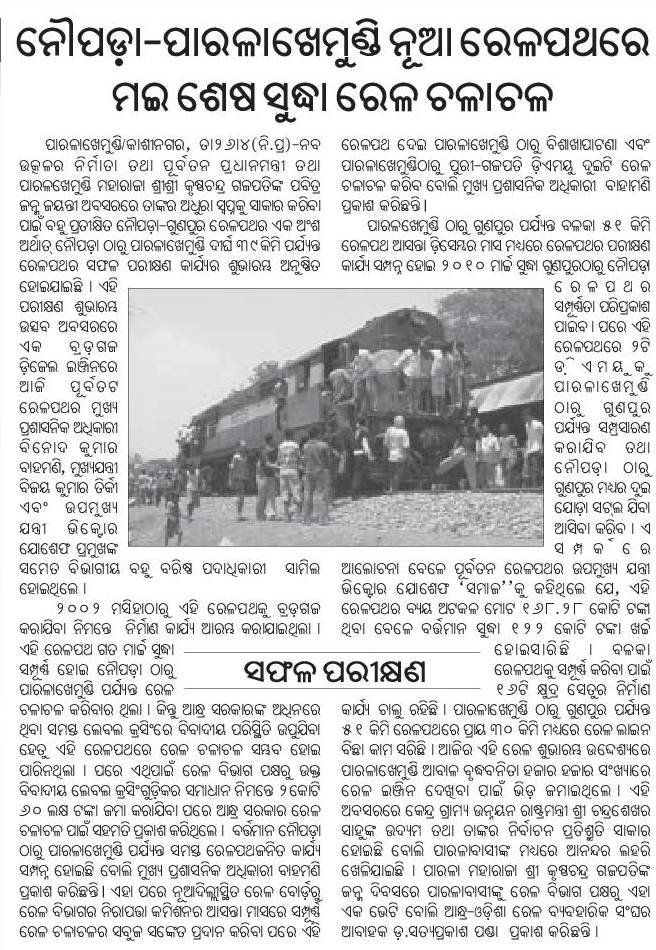
Naupada-Parlakhemundi broad gauge trial run is successful: Samaja

Gajapati, Naupada - Gunupur (Gauge conversion) Comments Off on Naupada-Parlakhemundi broad gauge trial run is successful: Samaja

New poultry operation in South Orissa; Three Sub-ordinating offices of the Department of Animal Husbandry and Diarying are in Orissa

Bhubaneswar- Cuttack- Puri, Central govt. schemes, Khordha, Koraput, Koraput- Jeypore- Sunabedha- Damanjodi, Poultry farming, Sambalpur, Sambaplur- Burla- Bargarh- Chipilima Comments Off on New poultry operation in South Orissa; Three Sub-ordinating offices of the Department of Animal Husbandry and Diarying are in Orissa

Following is from a report in farminguk.com.

The large poultry farm meant for research and promotion of poultry farming in south Orissa had been closed down due to management problems. It was revived and modernised with Central aid. It would serve as a major breeding farm in south Orissa. The chicks produced in this poultry farm would be sold to poultry farmers of Ganjam, Gajapati, Kandhamal and Nayagarh districts.

The Regional Poultry Farm is ready to start its sale of newly-hatched chicks from 29 April. … The farm has decided to specialize in breeding ’Banraj’ breed of poultry. The head of the farm, G.Naresh Kumar informed that at present the animal husbandry department is promoting this breed among rural poultry farmers.

The Banraj breed is being promoted to cash on the market of organic chickens of traditional breeds, which are still grown in large numbers in rural areas in an unorganised manner. The traditional breeds are slow growing yet they have a good market and fetch good price in market. It may be noted that similar poultry farms of the State government at Chiplima, Angul, Cuttack, Bhubaneswar, Sundergarh, Bolangir, Semiliguda and Koraput are also being modernised to meet the increasing need of poultry products in Orissa.

The Government of India has a Department of Animal Husbandry and Diarying under its ministry of Agriculture. That Department has the following sub-ordinating offices, of which three are in Orissa. Orissa should try to get a Fisheries division office.

I. Animal Husbandry Division

  1. # Central Cattle Breeding Farm, P.O. Dhamrod, District Surat, Gujarat.
  2. # Central Cattle Breeding Farm, Andesh Nagar, District Lakhimpur, (UP).
  3. # Central Cattle Breeding Farm, Similiguda, P.O. Sunabada (Koraput) Orissa.
  4. # Central Cattle Breeding Farm, Suratgarh (Rajasthan).
  5. # Central Cattle Breeding Farm, Chiplima, P.O. Basantpur, District Samalpur, (Orissa).
  6. # Central Cattle Breeding Farm, Avadi, Alamadhi (Madras).
  7. # Central Cattle Breeding Farm,P.O. Hessarghatta, Bangalore North.
  8. # Central Frozen Semen Production and Training Institute, Hessarghatta, Bangalore North.
  9. # Central Herd Registration Unit, W-15, Jagdish Colony, Rohtak (Haryana).
  10. # Central Herd Registration Unit, W-34, G.N.M. Colony, Christian Ganj, Ajmer – 305 001.
  11. # Central Herd Registration Unit, 10, Gautam Vihar, Cooperative Society Building, Usmanpura, Ahmedabad.
  12. # Central Herd Registration Unit, Santhapat, Ongole 523 001, District Prakasam (A.P.)
  13. # Regional Station for Forage Production & Demonstration, P.O. Netaji Subhash Sanitorium, Kalyani, Distt Nadia (W Bengal).
  14. # Regional Station for Forage Production & Demonstration, 48, Rajbagh (Extension) Srinagar (J&K).
  15. # Regional Station for Forage Production & Demonstration, Suratgarh (Rajasthan).
  16. # Regional Station for Forage Production & Demonstration, P.O. Textile Mill Hissar (Ha ryana)_.
  17. # Regional Station for Forage Production & Demonstration, GA 128/2, Sector No. 30, Gandhinagar, (Gujarat).
  18. # Regional Station For Forage Production & Demonstration, Avadi, Alamadhi, (Madras)-600052.
  19. # Regional Station for Forage Production & Demonstration, Mamidipally, Via Keshavagiri, Hyderabad – 500005.
  20. # Central Fodder Seed Production Farm, Hessarghatta, Bangalore North.
  21. # Animal Quarantine & Certification Service Station, Delhi -Gurgaon Road, Kapashera Village, New Delhi.
  22. # Animal Quarantine & Certification Service Station, Velachary Main Road, P.O. Pallikarni Village, Madras – 601 302.
  23. # Animal Quarantine & Certification Service Station, Village Gopalpur, P.O. Gopalpur, Distt Choubis parganas (W Bengal).
  24. # Animal Quarantine & Certification Service Station, Bombay – 400 065.
  25. # Central Sheep Breeding Farm, P.O. Box No. 10, Hissar – 125 001 (Haryana).
  26. # Central Poultry Development Organization, Southern Region, Hessarghatta, Bangalore North.
  27. # Central Poultry Development Organization, Eastern Region, Bhubaneshwar.
  28. # Central Poultry Development Organization, Western Region, Aarey Milk Colony, Mumbai.
  29. # Central Poultry Development Organization, Northern Region, Industial Area Chandigarh.
  30. # Random Sample Poultry Performance Testing Centre, 69/4, Urban Estate, Gurgaon (Haryana).

II Dairy Development Division

  1. # Delhi Milk Scheme, West Patel Nagar, New Delhi.

III Fisheries Division

  1. # Central Institute of Coastal Engineering For Fishery, Bangalore
  2. # Central Institute of Fisheries Nautical and Engineering Training, Cochin.
  3. # Integrated Fisheries Project, Cochin.
  4. # Fisheries Survey of India, Mumbai.
  5. # Aquaculture Authority, Chennai.

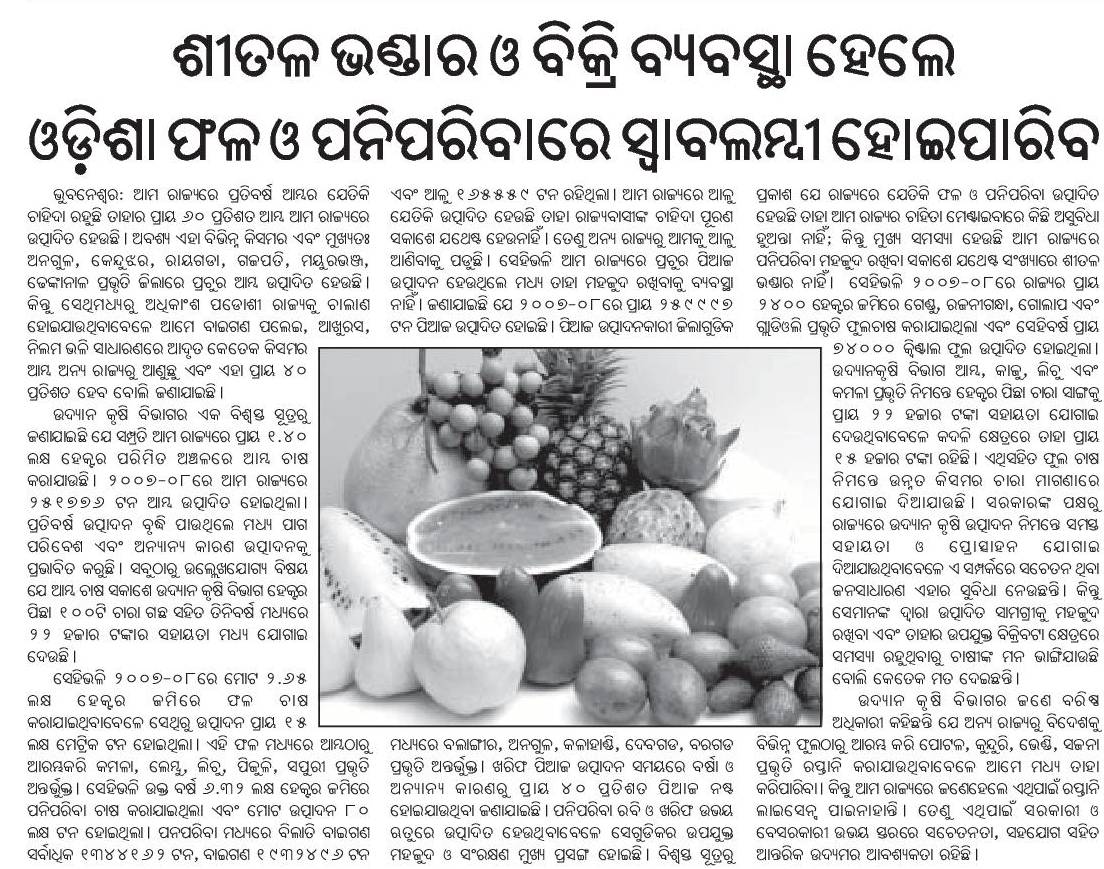
Cold storage and distribution channel can make Orissa self-sufficient in fruits and vegetables: Samaja

Cold storage, Horticulture, Vegetables 1 Comment »