Archive for 2011

Early steps for a new airport in Bhubaneswar

Bhubaneswar, Bhubaneswar- Cuttack- Puri, Khordha 5 Comments »

Following are excerpts from a report in Times of India.

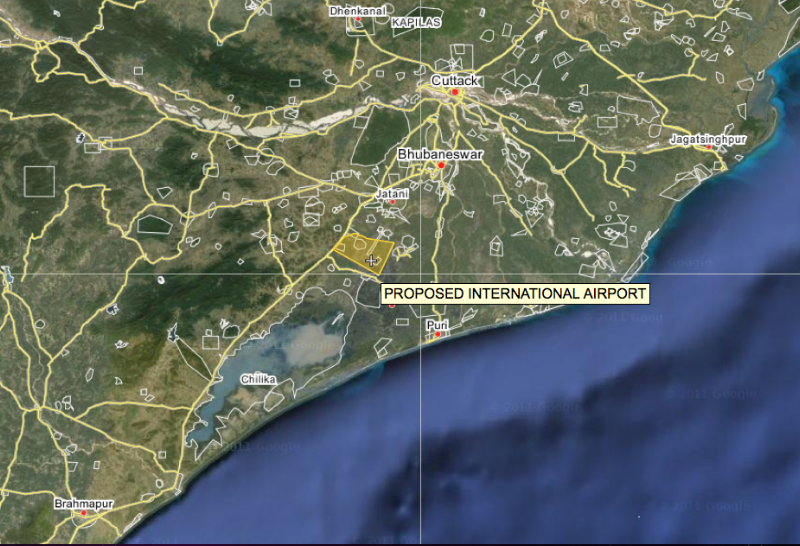
The city has moved a step closer to its dream of an international airport with the state government identifying over 2,000 acres of land, around 40 km south of the capital, on National Highway 5 for it. "We have identified over 2,000 acre near Jankia and Malipada villages. The survey work is on," Khurda collector Hrusikesh Tripathy said.

Sources said land of around 20 villages, including Gayabandha, Malipada, Dalaka, Pota and Godipada, a large tract of cashew plantation belonging to the Orissa State Cashew Development Corporation, are being considered for the proposed international airport.

Official sources said the area was considered for three main reasons. One, the government has a big patch of land available in the area. So the proposed airport would require minimum land acquisition and displacement. Secondly, the NH will provide good connectivity to the airport from the city. Thirdly, it will be a strategically located for Cuttack-Bhubaneswar urban complex as well as Puri and Berhampur.

…"The airport plan is futuristic keeping in mind the city’s need for 2030 and beyond. The location has to keep in mind the city’s needs then.

… Officials said the airport plan is still at a nascent stage. A committee under the revenue divisional commissioner (central range) has tentatively identified the land. After it finalises actual details of the land, the government would send the same for a feasibility study to the Airports Authority of India. If AAI gives it a go-ahead, the government would go for land acquisition. After that the government and AAI would involve private parties to develop the airport, they said. "The current airport almost divides the city into two. It is high time to consider shifting it to a new location," said BDA planning member Prashant Patnaik.

IDCO hands over 972 acres to OTDC for the Shamuka beach project

Bhubaneswar- Cuttack- Puri, Puri, Puri, Shamuka Beach project, Sites in and around Bhubaneswar Comments Off on IDCO hands over 972 acres to OTDC for the Shamuka beach project

Following is an excerpt from a report in Business Standard.

The Industrial Infrastructure Development Corporation of Orissa (Idco) has handed over 972 acres of land to the Orissa Tourism Development Corporation (OTDC) for the Rs 3,500-crore Shamuka tourism project.

This was the land acquisition for the big-ticket project, to be set up over 3,000 acres near Sipasarubali, about 10 km south of Puri district.

… Till now, 11 professional consultancies have applied for the job. After the study report is prepared, the mode of implementation of the project will be decided. The options to implement the project are either through PPP (public-private participation) or joint venture, or forming a special purpose vehicle, sources said.

… The model plan for the project is ready. It has been prepared by the Centre for Environmental Planning and Technology.

The state government had lined up an investment of Rs 120 crore for developing external infrastructure facilities like water supply, electricity and roads for the project.

Integrated Coastal Zone Management Project (ICZMP) to cover renovation of heritage sites in Odisha; this includes upgradation of the state museum in Bhubaneswar

Berhampur- Gopalpur- Chhatrapur, Bhubaneswar- Cuttack- Puri, Central govt. schemes, Ganjam, Heritage sites, INTERNATIONAL RELATIONSHIPS, Kendrapada, Khordha, Museums, Puri 2 Comments »

Following are excerpts from a report in Orissadiary.com.

… the Government of Orissa planned to renovate and conserve eight heritage properties currently in different stages of ruin, along the coast. This special initiative is a part of the Integrated Coastal Zone Management Project, which is being implemented in Orissa along with Gujrat and West Bengal with support from the World Bank. 

… A special consultancy with funding support from with help from “Italian Trust Fund for Culture and Sustainable Development”, was undertaken to identify opportunities to promote local economic development connected to conservation of the built heritage and to promote linkages with conservation of traditional stone craft and enhancement of the State Museum at Bhubaneswar by LASA – INTACH consortium being facilitated by The World Bank.

… The eight significant heritage sites earmarked for restoration and tourism promotion are Bhaba Kundaleswar Temple of Manikpatna and Baliharchandi Temple in Puri district, Harihardeva Temple of Nairi in Khurda district, Potagada Fort, British Cemetry of Ganjam and Bateswar Temple of Kantiagada in Ganjam district, Jagannath Temple of Pentha and Jamboo Colonial Building in Kedrapara district.

… The preservation and restoration work would be implemented in next five years and Rs.7.41cr will be spent on this component as per the ICZMP plan. Preservation of cultural heritage and monuments along coastal stretch will be undertaken through the involvement of experts like LASA-INTACH. The work will undertake the structural conservation, chemical conservation, environmental up-gradation and illumination of the monuments. Primarily, the aesthetic and grand classic look of the monuments and the cultural sites will be maintained. Any contemporary work and intervention will be avoided to preserve the historical and physical integrity of the cultural property. The monuments are selected on the basis of their architectural, sculptural, historical and religious importance among the 160km coastal zone of the ICZMP pilot project area. …

BHABA KUNDELASHWAR TEMPLE at Manikpatna, Puri

The Shaivite temple is situated in Manikpatna village close to the new sea mouth of the Chilika Lake. The temple is a State protected monument and covered under Orissa Monuments Preservation Act, 1956. The temple is a part of a larger piligrimage route linked with the Jagannath temple at Puri. The temple marks the site of the blessing to the Gajpati Purushottamadeva on his famous Kanchi-Kaberi expedition. The legendary Manika, a milkmaid from the village, believed to offer curds to Lord Jagannatha and Balabhadra at the temple sites. The folk-lore suggests Lords are part of the royal army to bless the Gajpati.  

HARIHARADEVA  TEMPLE at Sanannairi, Khorda

This twin temple of Shiva and Vishnu is a State protected monument and covered under Orissa Monuments Preservation Act 1956. As the legend goes during the campaign of Kalapahar, the invader, when the Jagannatha temple at Puri was desecrated, the images are believed to have been brought here and hidden on an island, which is about 10minute boat ride away. They were also kept in the Harihar temple for some time.

POTAGADA FORT AND CEMETRY at Potagada, Ganjam

The construction of the unique star shaped fort was commenced in 1768 by Cotsword. The adjoining Cemetery contains interesting monuments in form of tomb stones. The French were the earlier settlers in this place who were later driven away by the British. The local folklore is that the site was under a curse and therefore an epidemic broke. The fort was surrounded by a moat.

The cemetery is one of the earliest one of British Administrators and comprise tombstones with spire like monuments in masonry.

HARCHANDI TEMPLE AT BALIHARICHANDI, Puri

The Shakti temple, 800meter away from the sea coast is under the State Preservation Act of 1956. The Bakiharichandi temple is 27km from Puri and linked through ritual and patronage, to the Jagannatha Temple complex at Puri. There are multiple stories about inception of this temple. The Goddess is believed to have killed Kalapahar at the temple spot. The temple also marks the spot where Indra’s Vajra, Shiva’s Trishul and his anger, in the form of the fire (Agni), as well as the wind and the sea come together. 

OLD BUILDING at Jamboo, Kendrapara

The structure is a nineteenth century building that had been used for administrative purposes and cyclone shelter by the British.

STATE MUSEUM, Bhubaneswar

LASA –INTACH consortium; have developed the master plan of the State Museum with the inputs from the experts including the Italian experts. The inputs from Italy would certainly help to make our State museum world class.  

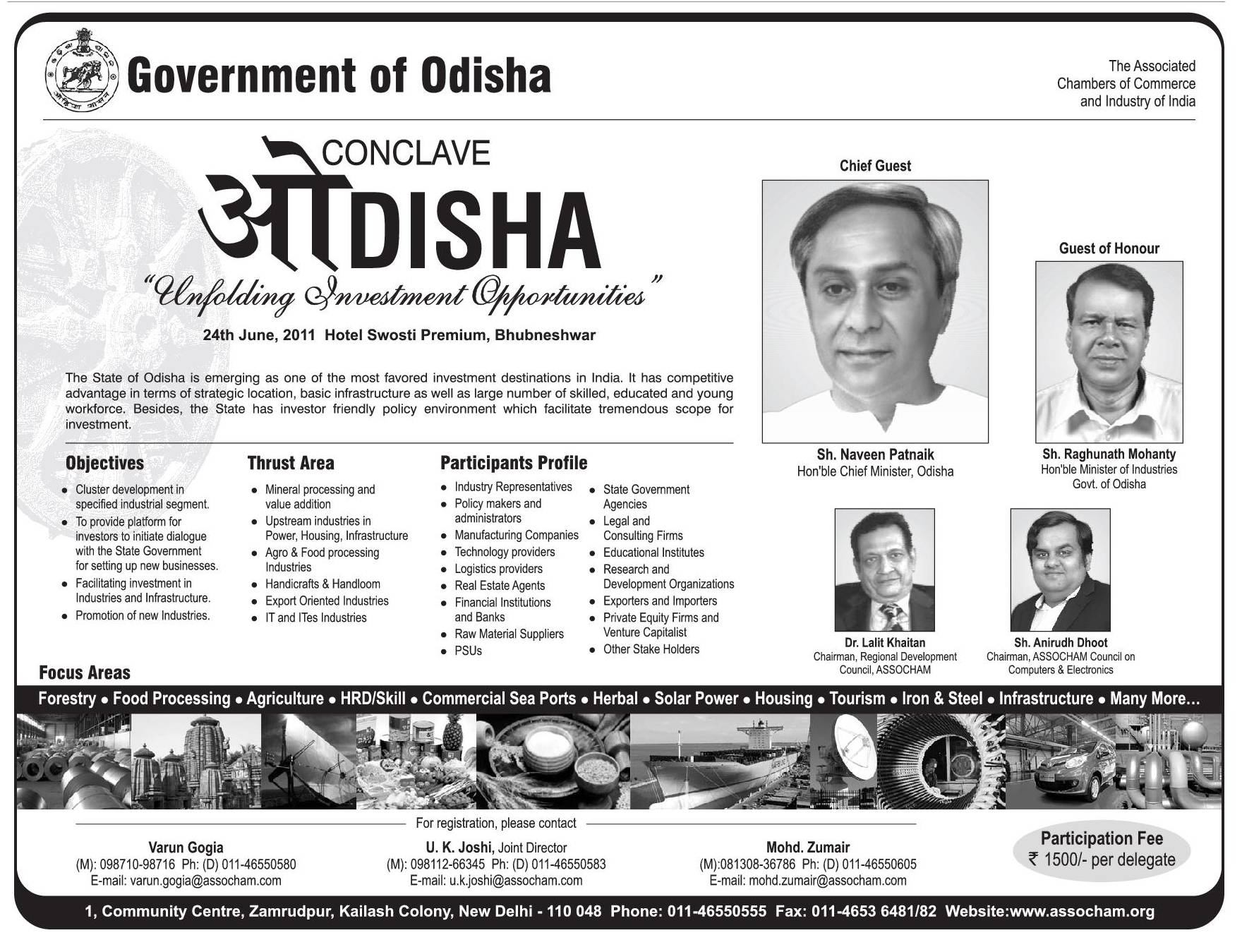
Conclave Odisha: Unfolding Investment Opportunities

INVESTMENTS and INVESTMENT PLANS 3 Comments »

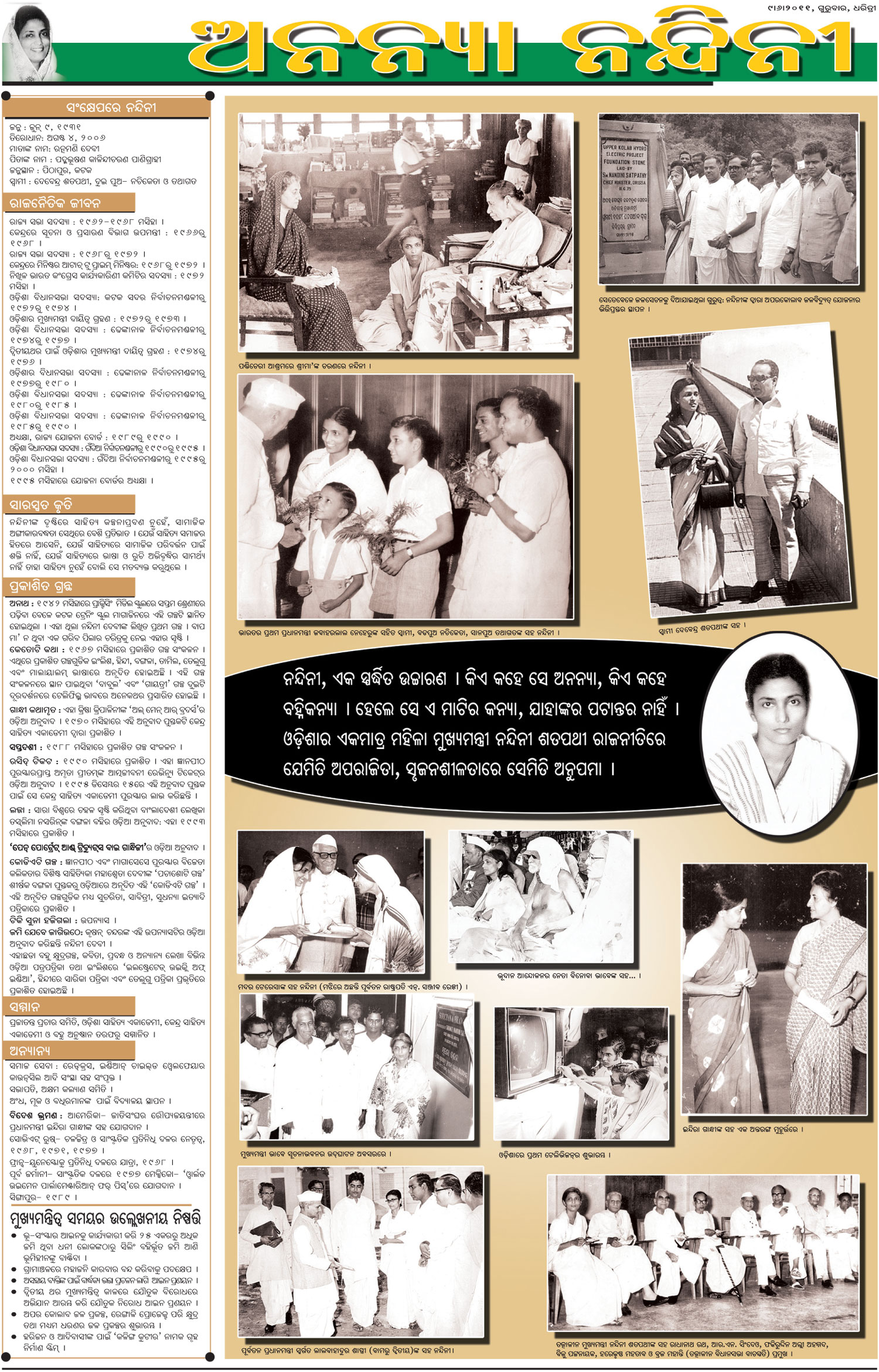
Life and times of Nandini Satpathy: From Dharitri

Odisha personalities 3 Comments »

ASSOCHAM proposes 16 new PPP based clusters in Odisha

Balasore, Bhadrakh, Clusters, Dhenkanal, Mayurbhanj, MSE - medium and small enterprises, MSMEs, Puri Comments Off on ASSOCHAM proposes 16 new PPP based clusters in Odisha

Following is from a report in Economic Times by Nageshwar Patnaik.

The Associated Chambers of Commerce and Industry of India (ASSOCHAM) on Wednesday proposed setting up of 16 new clusters on public-private partnership [PPP] in Orissa each accommodating about 1000 units and providing direct and indirect employment close to 4 lakh people.

Releasing the ASSOCHAM study on "Cluster Development for Inclusive Growth in Orissa" National Secretary General, D. S. Rawat said, "The total funds required for basic and essential infrastructure to these clusters will be about Rs. 480 crores. Once functional, it will contribute additional 10% revenues per annum to the exchequer, help in inclusive growth and simultaneously lead to upgradation of existing clusters.

…  In the state, there are only 26 clusters in the state recognized by the Central government as against 6500 clusters in the country out of which 450 are assisted by the government. The 16 new clusters suggested by ASSOCHAM are: Palasa (Cashew), Buditi (Brass & Bell Metal), Baripada (Sabai Grass), Dhenkanal (Powerloom), Puri (Rice Mills), Bhadrak (Rice Mill Cluster), Dhamara (Ice Plant), Basudevpur (Ice Plant), Chandbali (Chuda Cluster), Tihdi (Chuda Cluster), Basudevpur (Chuda Cluster), Bhandaripokhari (Honey), Dhamara (Honey), Betaligaon (Wood Carving), Olaga (Wood Carving) and Dhusuri (Wood Carving).

The MSME sector contributes around 40% to GDP with an estimated value of goods and services around Rs. 20 lakh crore in 2009-10. The sector is estimated to employ about 5.9 crore people in over 2.6 crore units in the country and has consistently registered a higher growth rate than the rest of the industrial sector. There are over 6000 products ranging from traditional to high-tech items, which are being manufactured by the MSMEs in India.

Odisha government plans to turn its three medical college hospitals to super-speciality hospitals

Cuttack, Ganjam, HEALTHCARE and HOSPITALS, Medical, nursing and pharmacy colleges, Odisha govt. action, Sambalpur Comments Off on Odisha government plans to turn its three medical college hospitals to super-speciality hospitals

Following is an excerpt from a report in ibnlive.com.

The State Government on Tuesday announced creation of 669 new doctor and para-medical staff posts along with an addition of 869 beds in its three medical college and hospitals.

Four new departments have been notified for the SCB Medical, Cuttack, and two each for MKCG, Berhampur, and VSS, Burla.

The move marks the beginning of efforts by the Government to increase the MBBS seat strength in the three medical colleges from the present 150 to 250.

The process of assessing infrastructure, faculty and other capacities along with identifying the areas that need attention in the medicals so as to get the approval of the Medical Council of India (MCI) has started. A detailed proposal would be sent to the MCI soon, sources said.

Health Minister Prasanna Acharya on Tuesday said 478 beds would be added to 1,200-bed SCB along with 40 doctors and 126 para-medics, including nurses.

Four new departments in Transfusion Medicine, Emergency Medicine, Rheumatology and Hepatology have been announced.

Three professor, 11 associate professor and 34 senior resident posts have been created.

The MKCG would have 181 more beds with two new departments in Transfusion Medicine and Emergency Medicine.

The new posts include two professors, four associate professors, 12 assistant professors, 39 senior residents, 105 staff nurses, 10 nursing sisters, one assistant matron and 15 attendants.

The VSS has been infused with 210 new beds and two departments on Transfusion Medicine and Emergency Medicine. New posts include two professors, five associate professors, 22 assistant professors and 37 senior residents.

Shimla, Jamnagar and Bhubaneswar have been selected to participate in the Asian Cities Climate Change Resilience Network – Dissemination & Replication (ACCCRN-D&R) project

Bhubaneswar- Cuttack- Puri, ENVIRONMENT, Khordha 1 Comment »

ICLEI stands for ‘International Council for Local Environmental Initiatives’. Following is from a recent announcement.

Three Indian Members selected for Dissemination & Replication stage of ACCCRN project

May 02, 2011

ICLEI South Asia is pleased to announce that three Indian cities, Shimla, Jamnagar and Bhubaneswar, all ICLEI Members, have been selected to participate in the Asian Cities Climate Change Resilience Network – Dissemination & Replication (ACCCRN-D&R) project on the basis of an Expression of Interest that was circulated to over 35 Indian cities.

The ACCCRN is made up of ten cities in India, Indonesia, Thailand and Vietnam, currently experimenting with various adaptation activities that together aim to improve the ability of these cities to withstand and prepare for the projected impacts of climate change. The ultimate objective of ACCCRN is to provide poor and vulnerable people with the ability to respond to these impacts in an appropriate way.

In order to achieve this, the program partners have developed a diverse range of effective approaches, processes, and practices to build urban climate change resilience which incorporate the priorities of poor and vulnerable communities in the network’s cities.The approaches taken are determined by the local needs and priorities of each city.

Initiated in early 2009, with support from the Rockefeller Foundation, the first two phases of the project have been completed. The third phase has now been launched with a focus on disseminating and replicating the lessons learnt and the approaches developed in the previous phases.

In this third phase, the learning, models, approaches and best practices developed across the 10 pilot cities of the previous phases will be supplemented with best practices from other approaches which build urban climate resilience. This will all be developed into a tool that can be adopted by other cities to develop Climate Resilience Strategy Plans. ICLEI’s South Asia and Oceania offices have been commissioned to implement the third phase of ACCCRN in the three Indian cities.

Read more about the project on the ICLEI South Asia website.

Following is from http://www.iclei.org/index.php?id=12113 about the project.

As part of the Dissemination & Replication phase, a total of 3 Indian cities have be selected for the dissemination of this tool. The selected cities would receive training in the process of formulating Climate Resilience Strategy Plans, which would broadly include:

1.       Undertaking vulnerability assessments
2.       Undertaking climate projection assessments
3.       Engaging stakeholders in the entire process to ensure social relevance and acceptance
4.       Developing a Climate Resilience Strategy Plan document
5.       Integrating the resilience strategy into urban planning and implementation processes

ICLEI SA along with ICLEI Oceania and ISET will replicate the learnings from the previous phases of ACCCRN initiative in 3 other cities. The various interventions are expected to target sectors like health, infrastructure, water, disaster, urban planning/development issues, services, disaster management and preparedness strategies.

The approach followed in the cities will be driven by local needs and requirements with the focus on developing resilience for the vulnerable communities from climate change impacts. ICLEI SA has been engaged to assist develop the methodology in a form suitable for the Indian context and to select and support the Indian cities during the trial period.

MOEF to develop a bio-culture park in Bhubaneswar; MOEF to get a digital copy of the early 18th century book Jardin de Lorixa by a Frenchman about plants of Odisha

Bhubaneswar- Cuttack- Puri, CENTER & ODISHA, ENVIRONMENT, Khordha, Parks, Sites in and around Bhubaneswar Comments Off on MOEF to develop a bio-culture park in Bhubaneswar; MOEF to get a digital copy of the early 18th century book Jardin de Lorixa by a Frenchman about plants of Odisha

Update: Jairam Ramesh has written to the the French ambassador regarding getting a digital copy of Jardine de Lorixa. Following is an excerpt from a report in inewsone.com.

Union Environment Minister Jairam Ramesh Thursday asked for help from the French envoy in India to get a digitised copy of a manuscript on plants in Orissa written by a Frenchman in 1725.

‘I have been told that the oldest document based on a scientific survey of plants in Orissa was written in the year 1725 by a Frenchman called Nikolas L. Empereur,’ said the letter to French Ambassador to India Jerome Bonnafont.

The document is currently available at the Natural History Museum in Paris.

‘I wonder whether we could get a digitized copy of this manuscript. Any expenses incurred in this regards will be borne by us,’ Ramesh said in the letter …


Following is an excerpt from a report in Hindu.

The Ministry of Environment and Forests (MoEF) proposes to develop a “bio-cultural park” on 10 acres here. It will be the first of its kind in the country.

… Environment and Forests Minister Jairam Ramesh said flowers associated with all religions and traditions of the country would find a place in the park.

Mr. Ramesh said: “Chief Minister Naveen Patnaik has responded positively to make land available for the purpose. Within the next two-and-half years, you will have India’s first bio-cultural park. Cultural traditions are not Hindu tradition only. Cultural traditions such as tribal, Buddhist, Jain, Sikh, Islamic, and Christian would be followed while choosing species. The bio-cultural park will not just be a monument of flowers, but also will be reflective of our divergent cultural traditions.”

Thje MoEF would develop the park and then hand over it over to the State government. The idea was to draw strength from Indian culture for the cause of conservation of bio-resources. Traditionally, biological sources were being conserved in the form of sacred grooves, ‘nakshatravanams,’ ‘navagraha vatika,’ concept of panchvati and use of timber from ecologically important species for religious purposes.

… the park would be developed on the lines of ‘nakshatravanam …

Following is from http://www.orissalinks.com/archives/6592.

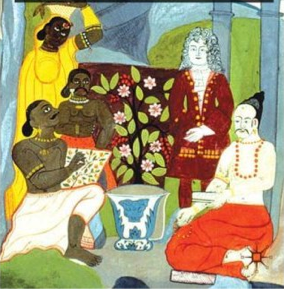
the Ministry would make efforts to get a digital copy of Jardin de Lorixa, considered to be the earliest scientific documentation of traditional/ indigenous knowledge about plants of Orissa, of which only one manuscript is available in Natural History Museum Paris (France).

Following are excerpts on the Jardin de Lorixa.

Following is from the cover of Jardine De Lorixa.

Full Text of Speech of Chief Minister Naveen Patnaik at Regional Consultations for Finalizing Approach to the Twelfth Five Year Plan at Patna on, 30th May, 2011

12th plan (2012-2017), Chief Minister's actions, Odisha govt. action, Planning Commission and Odisha Comments Off on Full Text of Speech of Chief Minister Naveen Patnaik at Regional Consultations for Finalizing Approach to the Twelfth Five Year Plan at Patna on, 30th May, 2011

(Thanks to http://orissadiary.com/CurrentNews.asp?id=26974.)

Hon’ble Deputy Chairman, esteemed Members of the Planning Commission, Hon’ble Chief Ministers of the eastern region, senior officers of the Planning Commission and State Governments. 

2. Let me convey my appreciation to the Planning Commission for initiating the regional consultation process with State Governments and other stakeholders for finalizing the Approach to the 12th Five Year Plan.  The Planning Commission has identified twelve strategy challenges for the Twelfth Plan.  These strategy challenges need to be carefully analyzed at the State level.   While it may not be possible to discuss in detail all strategic issues, I would like to highlight a few major aspects concerning the development needs of States like Odisha. 

3. The first challenge of the 12th Plan is to enhance the economy’s capacity for growth and to mobilize adequate resources from various sources.  It may be worth mentioning that the economy of Odisha has historically grown and diversified at a very slow pace except in the last decade when it has achieved a real average growth rate of more than 9 percent per annum at 1999-2000 prices.  The per capita income of Odisha is much lower than the national average and the poverty and other human development indicators for the State are very adverse.  The State has a limited capacity to raise its own resources.  Though the State has been making all possible efforts to raise resources needed for public investment to maintain the growth momentum, there would still be a substantial gap between investible funds that can be mobilized by the State and the level of investment required.  To meet this gap, there has to be a national framework by which larger resources can flow to Odisha and similarly placed states.  Any national growth strategy has to give special attention to states having special development needs.  Odisha, with about 40 percent population of Scheduled Tribes and Scheduled Castes, has a special need to accelerate their development and improve their human development indicators.     

4. Odisha favours a development approach that encourages less developed states to grow faster than the national average over a long period of time in order to bridge the widening income gap between poor and rich states and to reduce poverty at a faster pace.   The development approach should also focus on: (a) scaling up investments in agriculture and allied sectors that need to perform above the national average over a long period of time, (b) mitigating adverse impacts of natural calamities and other shocks including climate change, (c) accelerating the development of depressed regions and marginalized classes including Scheduled Tribes, Scheduled Castes and women to substantially reduce regional, social and gender disparities and ensuring inclusive growth, (d) building and substantially improving rural and urban productive infrastructure such as roads, bridges, irrigation projects and ports, (e) strengthening social security system by way of allocating higher resources to primary education, health services and nutrition programmes, (f) addressing the problem of unemployment and under-employment, particularly among young persons and improving their employable skills, education and soft skills to harness opportunities that the growing economy may create, (g) improving the delivery of public services for the poor, (h) increasing convergence of resources from various sources and development programmes for faster poverty reduction and (i) continuing vigorously Public Sector Reforms Programmes, enabling policy framework and improving investment climate.      

5. In Odisha and other eastern states, large populations still live in villages and majority of them subsist on agriculture and allied sectors.   We, therefore, endorse the view of the Planning Commission that transforming rural areas and achieving high sustainable growth in agriculture and allied sectors is a crucial challenge for the 12th Plan.  There is an urgent need to take appropriate measures to raise productivity of the agriculture and allied sectors so that the income and employment opportunities in these sectors are enhanced in a sustained manner.  A vibrant rural economy is needed to ensure increased rural incomes and employment which would be a strong contributor for poverty reduction.  The strategy paper should focus on expansion of irrigation, watershed development and saturation of watersheds, diversification of crops, rural marketing, strengthening of agricultural extension and technology transfer, crop insurance and rural infrastructure.  The plan strategy should also look at ways in which farmers can get remunerative prices for their produce and ensure that the terms of trade do not move adversely against the farm sector.  Availability of credit is also critical for increasing farm output.  We, therefore, urge Government of India to put in place an appropriate macro policy framework to make the farm sector productive and profitable and to liberally fund development activities of agriculture and allied sectors, particularly in less developed states.  

6. Increasing irrigation potential and drought proofing are critical pre-requisites to enhance agricultural productivity.  In Odisha, substantial areas need to be brought under assured irrigation.  Out of about 59 lakh hectare irrigable area, we have been able to tap the potential only of about 30 lakh hectare by now.  We, therefore, urge that the funding under AIBP be stepped up adequately.  I would like to add that there is a need to extend AIBP funding to lift irrigation projects and innovative community based irrigation programmes such as our Biju Krushak Vikas Yojana (BKVY).  It is worth mentioning that the BKVY has been lauded and promoted by NABARD.

7. A major concern, however, is that though the share of agriculture and allied sectors has been declining in Gross State Domestic Product, the proportion of people dependent on agriculture and allied sectors has not been declining in the same proportion.  Major benefits of the economic growth, which has occurred mainly in the service and industrial sectors, flow largely to educated and skilled manpower.  There is, therefore, an urgent need to raise the skill levels of large sections of the population, particularly youth, so that they may find remunerative employment and livelihood opportunities.  A growth strategy that promotes desired skills and skill-based employment opportunities to youth and others has to be given prominence in the approach paper for the 12th Plan. 

8. Development of small scale industries in clusters, ancillarisation, linking industries to supply chains would have to be accorded due attention in the 12th plan strategy.  Employment potential, income generation and export potential of micro enterprises, handicrafts, handlooms and other traditional sectors have not been tapped fully.  Promotion of tourism and other service sector activities are to be given greater importance in the plan strategy.  The efforts of the States in these areas will have to be strengthened by appropriate resource flow and policy inputs by Government of India and this has to be emphasized.  

9. For Odisha and other mineral bearing states, mining and related industrial activities are very important.  Achieving strong growth in these sectors is critical in increasing incomes and poverty reduction.  However, these activities impose significant economic, environmental and social costs in terms of displacement of people on account of land acquisition, loss of their livelihoods and mounting pollution problems.  There is a need for a national policy framework to address these problems in an efficient, equitable and sustainable manner.

10. We have taken several initiatives including the single window clearance mechanism, transparent procedures and well thought out R&R policy, which have been put in place for facilitating setting up of industries.  As a result, there has been a surge in the private sector investments in mining and related industries. We would like to consolidate and strengthen this with due regard to sustainable development and environmental protection as a part of the growth strategy for next plan.  However, in order to attract private sector investment, there is immediate need for high levels of investment in infrastructure like roads, ports, railways, power generation and power transmission and distribution.  My state has already initiated PPP mechanism for infrastructure development in the field of port and road development.  But PPP alone cannot be the answer to infrastructure development in most eastern states including Odisha.  In fact, poor states like Odisha need greater investments in the non-PPP mode than more advanced states where returns on investment in infrastructure will be much higher.  Mobilizing adequate resources for high quality infrastructure in poor states is a greater challenge and the 12th Plan should have appropriate central schemes for liberal funding of infrastructure projects in poor states.

11. Macro policy distortions are proving to be a hindrance to Odisha and possibly other States, which are rich in minerals, in proper husbanding of those resources.  Royalty structures are such that the States are losing out substantially in resource generation potential due to very low royalty rates and delayed revisions of royalties on coal, iron and other minerals.  We urge the Government of India to revise the rates of royalty on coal and other minerals in a timely manner and to compensate the mineral bearing states for revenue losses sustained by them due to late revision of mineral royalties and other causes, as recommended by the 13th Finance Commission.  We reiterate our earlier demand for increasing mineral royalties on ad valorem basis from 10 percent to 20 percent of market prices of coal and other minerals.

12. With a view to contributing to the national efforts for augmenting power production, the State has planned production of 50,000 MW of power.  The establishment of new power plants, however, imposes significant economic, environmental and social costs on Odisha and other mineral bearing states in terms of displacement of people on account of land acquisition and loss of their livelihoods and mounting pollution problems.  Whereas power and coal consuming states benefit because of low costs of coal and power, revenues from electricity duty on consumption and revenue from sales of surplus power, the host states like Odisha bear most of economic, environmental and social costs.  This scenario leads to an inequitable sharing of costs and benefits from the coal mining and thermal power generation.  We have been repeatedly requesting the Government of India to put in place, by way of suitable amendments to the Electricity Act 2003 and the National Thermal Power Policy, appropriate institutional arrangements which would result in fair sharing of costs and benefits of coal mining and thermal power generation.  It is our long standing demand that the host states should get 25% free power from Independent Power Producers and 33% free power from coal reject based power plants on the lines of the National Hydro Power Policy.  We also urge  Government of India that the funds collected under the National Clean Energy Fund should be given back to the States from where coal has been mined to help them take up environment remediation measures.  

13. The 12th Plan should also focus on substantially improving human development indicators and stepping up investments in social sectors, particularly health, education, poverty eradication and other social safety nets.  There is also need to make adequate provisions for gender equality, child and women welfare and welfare of other disadvantaged sections.  Special efforts are needed to arrest fast declining sex ratio among children in 0-6 year age group and to improve the welfare of girl children. 

14. Correction of intra-state imbalances has been receiving special attention in the plan strategy of my State.  Heavy incidence and persistence of poverty in KBK region of the State has been a cause of concern for the State Government.  Though the region has improved through implementation of the Revised Long Term Action Plan, it still lags behind many other regions of the State.  In order to bring this region at par with other areas, the RLTAP has to be extended for at least ten years beyond the 11th Plan with increased funding.  We would also suggest that backward district initiative may be extended to more districts of my State which are equally backward.  

15. We have taken a number of steps to promote decentralized planning at district and sub-district level.  District Planning Committees have been constituted and are functional in all 30 districts in Odisha.  We have also constituted District Planning & Monitoring Units in all 30 districts to assist District Planning Committees for consolidating district plans and monitoring the implementation of various development programmes.  I may add that Odisha has been preparing annual district plans since 2008-09 in a consultative and participatory manner.  Summaries of district plans have been incorporated in the State Annual Plans since 2010-11.  Increasing efficiency and expenditure has been a thrust of our reform initiatives.  Outlays are being increasingly linked to outputs and outcomes both on Plan and Non-Plan side.

16. We support this consultative process for preparing the approach paper for the 12th Plan.  We may also like to add that a uniform policy and uniform programmes for the country as a whole have produced distorted growth, and created inequalities, within different parts of the country.  As a result, regional imbalances have cropped up.  The objective of the 12th Plan should be to correct these distortions by region-specific interventions.  I hope the regional consultations will prove the right beginning for such an approach for the 12th Plan.

17. Orissa should be declared a special category state.
  
Thanking you. 


I think it is time the tone of Odisha’s request change.  We should not ask to be declared a special category state.

We should forcefully demand that Odisha gets properly compensated for its minerals; years of neglect on some of its infrastructure aspects (such as railways) be corrected; environmental impact due to mining (especially coal mining) and power production be suitably addressed; the tribal areas (of Odisha as well as other states) be declared as special regions and special funding (to the tune of J & K and North East) be allocated to address them; and various central ministries must be ordered to treat each state fairly instead of channelling bulk of their funds to the states from where the ministers come from.
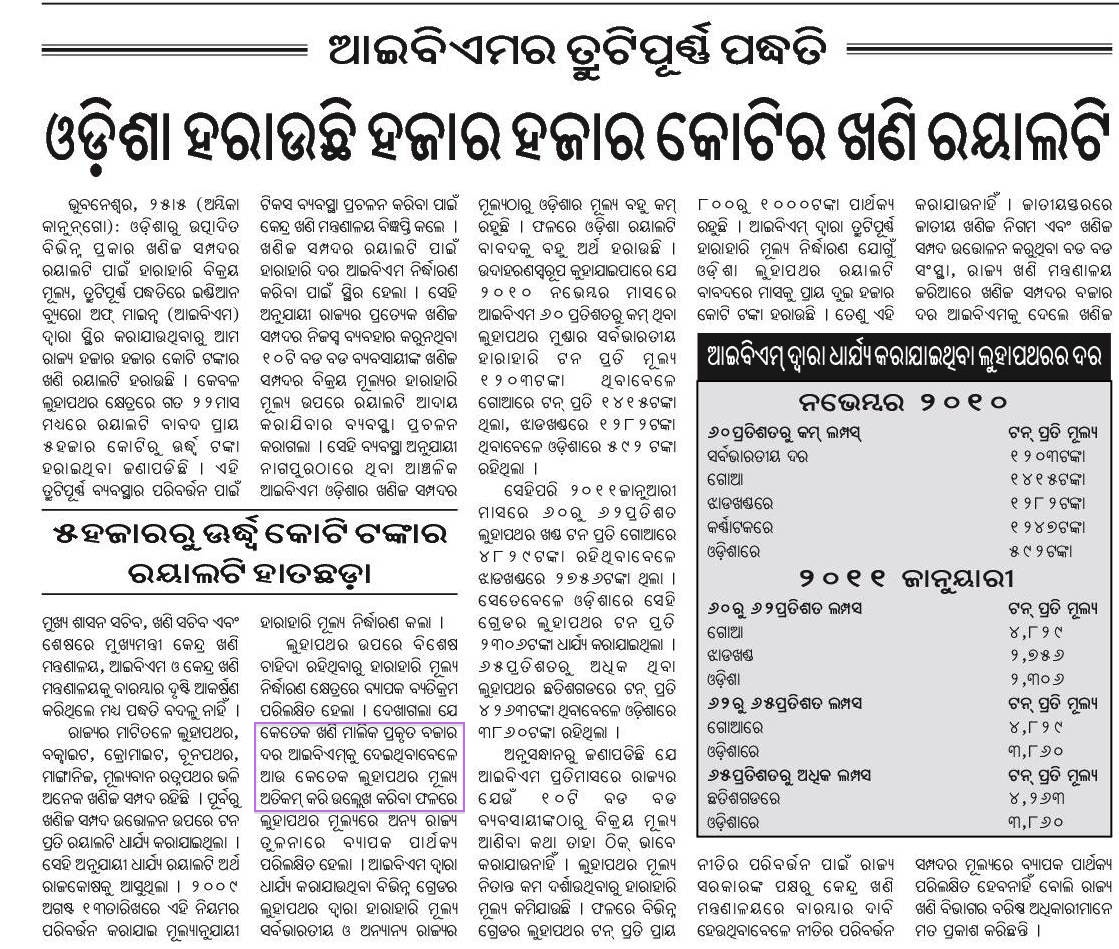
Odisha should cancel the lease of the mine owners who are giving wrong data to Indian Bureau of Mines causing great loss to Odisha; it should aslo sue them to recover the lost revenue

Mine royalty and cess, Odisha govt. action, Odisha govt. Inaction Comments Off on Odisha should cancel the lease of the mine owners who are giving wrong data to Indian Bureau of Mines causing great loss to Odisha; it should aslo sue them to recover the lost revenue

Following is from Samaja.

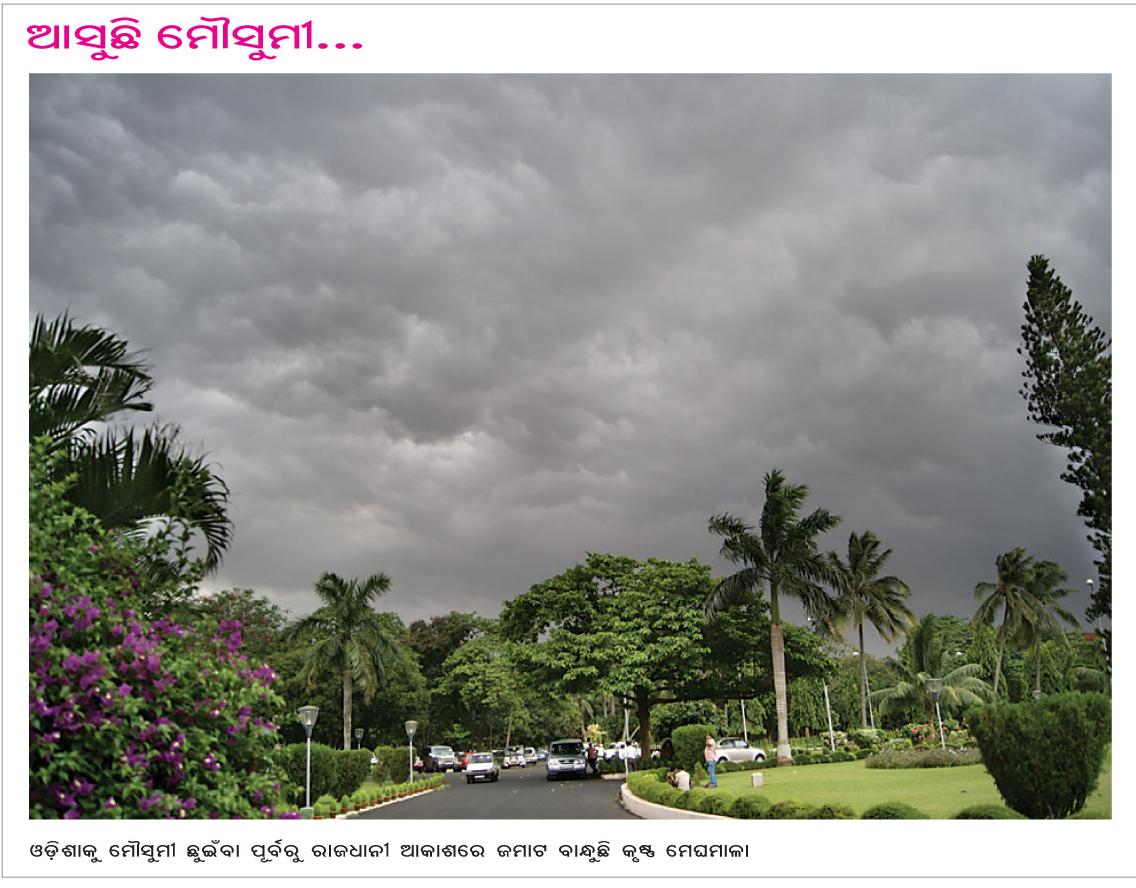
Sambada picture of Bhubaneswar sky with dark clouds

Bhubaneswar- Cuttack- Puri 1 Comment »

Readers: Guess which location is depicted by the following picture.

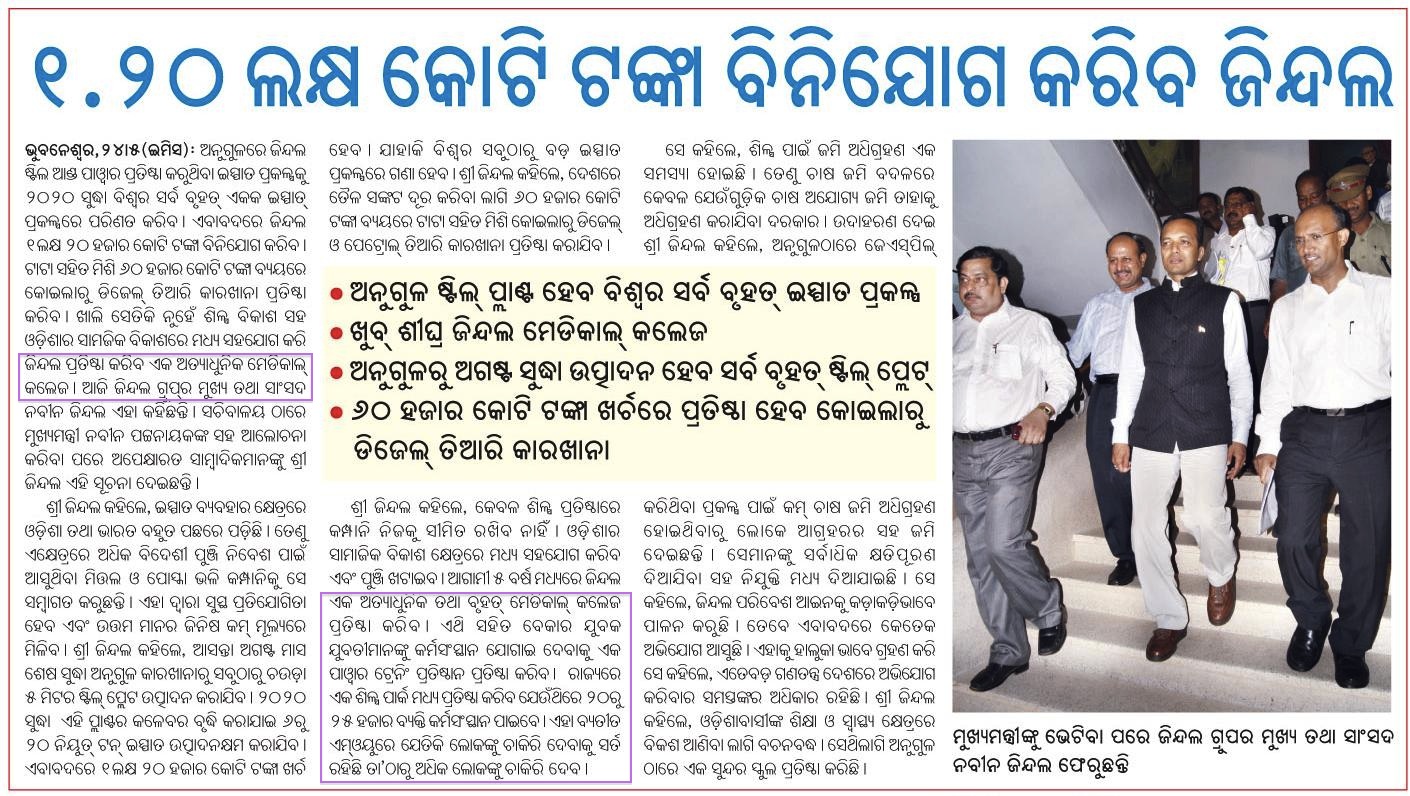
Jindal groups plan for Odisha; seeks iron ore mines; dangles medical college

Angul, Anugul- Talcher - Saranga- Nalconagar, Coal, Coal to diesel, Dhenkanal, Iron Ore, Jajpur, Jajpur Rd- Vyasanagar- Duburi- Kalinganagar, Jindal, Medical, nursing and pharmacy colleges, Steel, Steel ancilaries Comments Off on Jindal groups plan for Odisha; seeks iron ore mines; dangles medical college

Following is from Sambada.

The various news reports that initially came after Mr. Jindal met the CM, such as the above, did not mention anything regarding Mr. Jindal wanting iron ore linkage for his steel plants. But reports on the next day mentioned that. Following is an excerpt from a report in Financial Express.

The Jindal Steel & Power Ltd (JSPL), which is all set to commission its 2 million tonne steel plant next month, is desperately looking for iron ore linkage.

JSPL vice-president and managing director Naveen Jindal urged Orissa chief minister Naveen Patnaik for allotment of a captive iron ore mine for the plant.

Jindal met the Orissa CM on Tuesday and discussed the steel project and the captive power plant.

Sources in the government told FE that the JSPL managing director has requested the chief minister Naveen Patnaik to ensure raw material security for the plant through suitable iron ore concession.

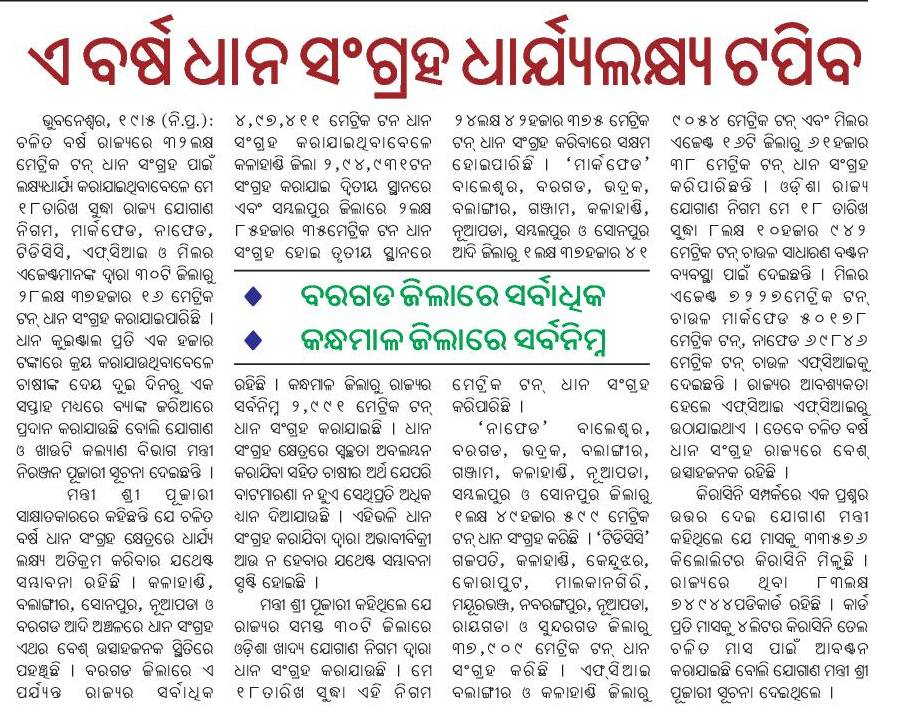
Baragarh, Kalahandi and Sambalpur districts are the top districts with respect to rice procurement: Samaja

Bargarh, Kalahandi, Rice-n-Paddy, Sambalpur, Sambaplur- Burla- Bargarh- Chipilima Comments Off on Baragarh, Kalahandi and Sambalpur districts are the top districts with respect to rice procurement: Samaja

Daya West Canal would soon be converted into a two-way road network with a water body at the centre: Telegraph

Bhubaneswar- Cuttack- Puri, Capital Region Ring Road (CRRR), Khordha 1 Comment »

Following is from a report in Telegraph.

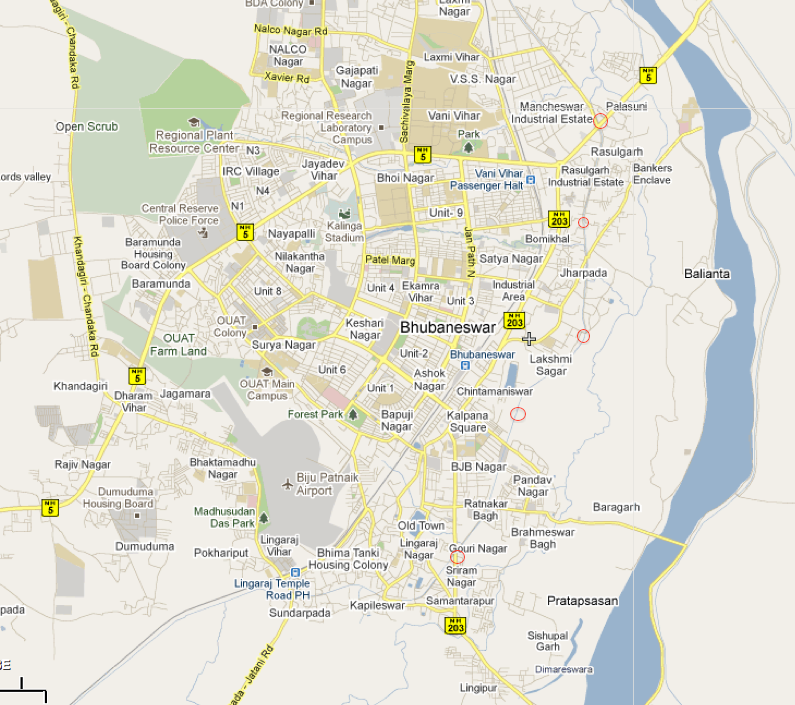
The polluted Daya West Canal would soon be converted into a two-way road network with a water body at the centre at an estimated cost of Rs 30 crore. The integrated Daya West Canal road project would entail a 7.8-km structure from Palasuni to Garage Chhak connecting NH-5 with NH-203.

The work began today with chief minister Naveen Patnaik laying foundation stone for the integrated project, which would have roads of 30-feet width on both sides of the canal. The 60-feet wide canal would be squeezed to half its width. The roads on both the sides of the water channel would also have barricade for safe plying of vehicles.

… the project would be completed within two years. However, keeping in view the traffic problem on the Rasulgarh-Samantarapur stretch on NH-203, it has been decided to speed up work for the road project so that it could help in diverting traffic from NH-5 from Palasuni to Puri.

… The 7.8-km-long structure would include strengthening of the existing road crossings so that people residing on both sides of the Daya West Canal can easily cross the road. In case of necessity, new road crossings will also be added,’’ said Gantayat.

… To facilitate better traffic flow on the road, there would be provisions like bus bay, autorickshaw stand and common parking lots. There is enough land on both the sides of the canal. In future, therefore, the roads on both sides can be expanded to a six-lane or eight-lane structure as per the demand of the growing traffic.

… In future, the road project with the water body can also become a spot to promote water sports or fun activities such as boating. “We have also included possible space to include such activities, in case the civic authorities or the tourism department wishes to take it up,” he added.

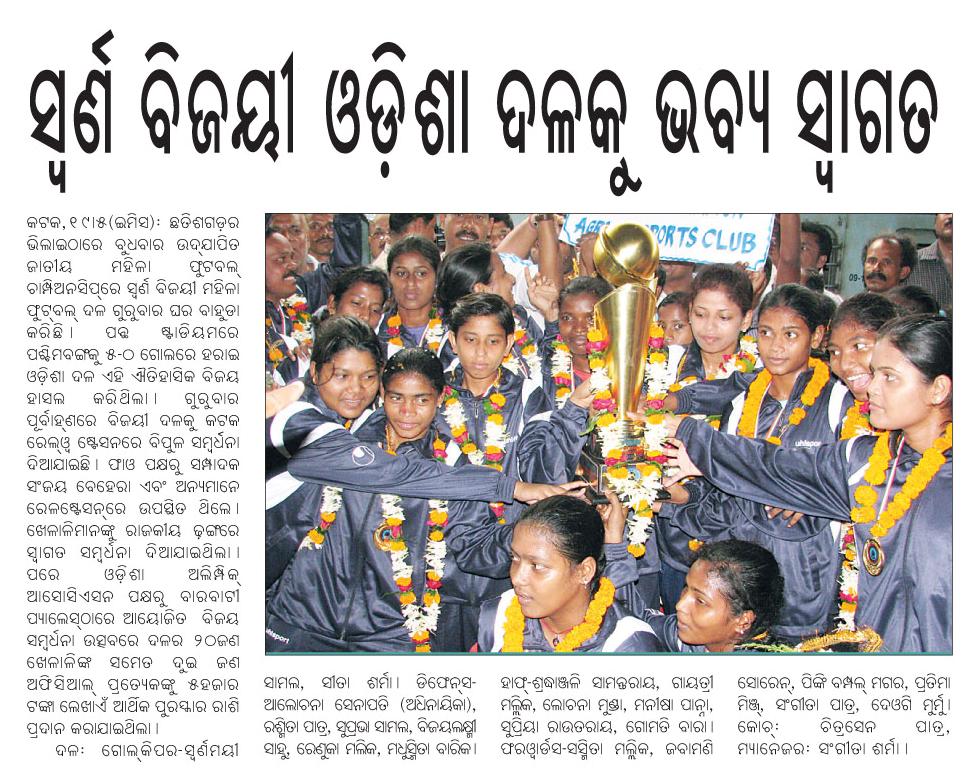
Odisha women win the National Football Championship; earlier this year they were also the national games champion in football

Kendrapada, Women's footbal Comments Off on Odisha women win the National Football Championship; earlier this year they were also the national games champion in football

Following is from a report in ibnlive.com.

Orissa blanked three-time champions Bengal 5-0 to clinch their maiden title in the 19th edition of the Senior National women’s football championship at Pant Stadium here today. Orissa’s leading goal scorer Sasmita Mallick struck a brace (5th and 80th), while Jabamoni Soren (50th), Pinky Magar (60th) and Shradhanjali Samantaray (71st) fired in one each to complete the rout. With five minutes remaining, Orissa had an unassailable 5-0 lead when heavy showers stopped play yesterday. Orissa completed the formalities when the play resumed this morning. Incidentally, this was the biggest margin defeat suffered by any team in the championship’s final, surpassing Bengal’s 0-4 loss to Manipur in the second edition of the tournament in 1992-93. The reigning National Games champions, Orissa, thus erased the bitter memories in the final of the last edition of the tournament in Imphal where they lost to Manipur who won their record 14th title. "We had beaten Bengal 4-0 in the quarterfinal league…So we were confident of winning against the same team in the final. Had it been Manipur, the girls would have been a little apprehensive. It’s really a proud moment for us," an ecstatic Orissa coach Chitrasen Patra told PTI. Orissa routed former runners-up Kerala 13-0, blanked Haryana and Bengal by identical scorelines of 4-0 to top group B in their quarterfinal league.

The winning team received a rousing welcome when they returned to Odisha. Following is from Sambada.

An interesting fact to note is that several of the top Odisha players (including the captain and the top scorer), some of whom play for India, are from a particular district in Odisha; the Kendrapada district. This district has sent so many womens football players to play for Odisha and India that it is sometimes referred to as the women’s football cradle of India. Following are some old links about this.

  • http://www.odishatoday.com/sports/World_Cup_soccer_mania_grips_Kendrapara_120610-976987648465356423563734586.html Excerpts: … backward villages in Aul and Rajkanika region here. The villages shot to fame for contributing a number of emerging women footballers of both State and national repute in the past few years. At least 15 of them are now playing for the country in various age groups while the State women’s football team mostly includes players from this region. Five international players, Sashmita Mallick, Suprava Samal, Sangita Patra, Alochana Senapati and Gayatri Mallik are all from Aul-Rajkanika region of this district while Alochana and Sashmita have emerged as idols in the country.
  • http://expressbuzz.com/States/Orissa/two-kendrapara-girls-bend-it-like-beckham/147378.html
  • http://www.telegraphindia.com/1100916/jsp/orissa/story_12940399.jsp : A cluster of backward villages in Aul teshil region of Kendrapara district continues to dribble past all odds to reach the goal of churning out the best women footballers for the state.

    This success story began about eight years ago when the mini stadium of Aul block hosted a series of exhibition of women’s football matches. Since then, many women footballers from Aul have donned the national jersey.

    “It’s an amazing story. Although the girls are mostly from poor economic background, patronage of the Aul Athletics Association has resulted in many of them entering the soccer arena,” said Raj Kamal Mandal, a former coach of women’s football and district sports officer of Kendrapara.

    At present, nine girls from Aul are international players representing the country at various levels.

    “While three local girls are part of senior national team, the junior (under-19) squad includes two players from the Aul belt. Five footballers from this area represent the country in the sub-junior (under-16) team,” Mandal said.

    The state women’s football team is virtually packed with girls from Aul. Thirty-six girls have found their place in Orissa’s senior, junior and sub-junior women’s football teams. It is a matter of pride that they have overcome poverty and social stigma to achieve success.

    Most of these emerging stars are from far-flung and unknown villages such as Malapatana, Giribandha, Goudpatana, Mulasahi, Niala, Kanteipur, Telepatana, Dhanamandal and Adheikana.

    … “After a few exhibition matches in 2008, we invited the girls of Aul to take part in a training camp. The response was amazing. Over 40 girls eagerly waited for the training session to commence. Since then, they never looked back. At present, we have a reserve pool of around 50 girls who undergo training at the Aul stadium,” Sharma said.

NHAI plans in and around Bhubaneswar; lots of new flyovers

Cuttack, Khordha, NH 5 (488 kms: NH No.6 in Jharkhand - Baripada - Baleshwar - Bhadrakh - Cuttack - Bhubaneswar - Khordha - Brahmapur - upto Andhra Pradesh Border) 1 Comment »

Following are excerpts from a report in Times of India.

… NHAI state project director Aditya Kumar Ray said work has started on the flyovers at Rasulgarh and Fire Station and the construction similar projects at CRPF Square, Acharya Vihar and Vani Vihar will commence soon.

Except for the Rasulgarh project, the other flyovers will be similar to the one at Jaydev Vihar. The Rasulgarh flyover will have extra slopes to facilitate seamless traffic flow from Cuttack to Puri as well as on NH-5. It will be aesthetically designed as an entrance point to Bhubaneswar, he said.

… Sources said NHAI needed to acquire more land at Rasulgarh to execute the project. "We are in the process of acquiring some more land at Rasulgarh. Everywhere else in Bhubaneswar, the expansion will happen with the land already acquired," Ray said.

NHAI plans to construct vehicular underpasses at VSS Nagar, Vani Vihar railway overbridge (ROB), Pahal, Press Chowk. The pedestrian underpasses will be built at Kali temple, CRPF Chowk, Iskon temple, OCAC building, RTO office, University Law College and Rasulgarh.

Just outside Bhubaneswar, NHAI will construct flyovers at Phulnakhara, Khapuria, Jagatpur and Manguli in Cuttack. Work for three-lane bridges over the rivers Hansapal, Kathajodi, Mahanadi and Birupa has already started. "The bridges will be hopefully ready by 2014," Ray said.

The existing two-way bridges on these rivers will be made one way and the new bridges will be used for traffic going the other way. The NHAI had signed an agreement with Sri Jagannath Expressway Pvt Ltd, a concessionaire of three private firms (SREI, Simplex and GALFAR), on August 6, 2010, for widening and redevelopment of the 67-km-long Bhubaneswar-Chandikhol section of the Kolkata-Chennai highway. The road will be constructed to sustain vehicular traffic at a speed of 100 km per hour. However, the actual speed limit will be decided by the civic administration, the NHAI official said.

The project will cost Rs 1,047 crore and NHAI will provide Rs 205 crore. The developer will generate the rest of the funds through design, build, finance, operate and transfer (DBFOT) basis. "The developer will maintain the road for 26 years,” Ray said.

Once the construction is over, the developer will collect toll from the road users. According to initial estimates, heavy vehicles will have to pay something over Rs 100 and light vehicles would be charged an amount between Rs 80 to Rs 100.

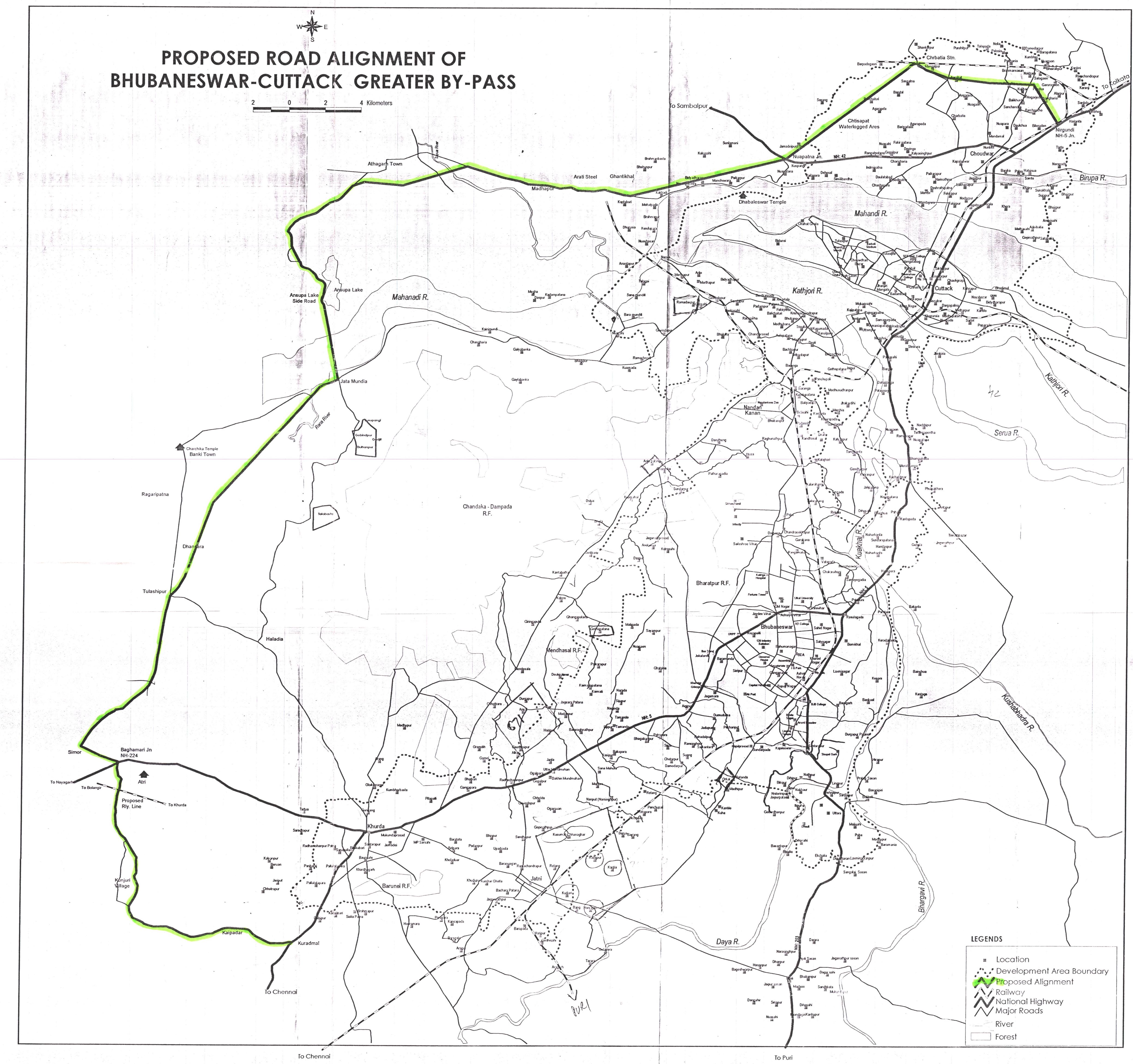
… At present, over 5,000 heavy vehicles pass through the national highway in the city every day. To reduce the traffic load within Bhubaneswar, police divert the vehicles towards Cuttack from Pitapalli via Chandaka. Sources said NHAI has plans to make a bypass road from Khurda to Tangi bypassing Cuttack and Bhubaneswar.

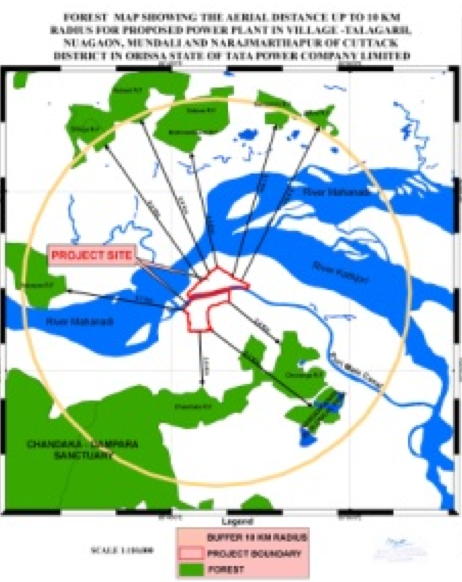
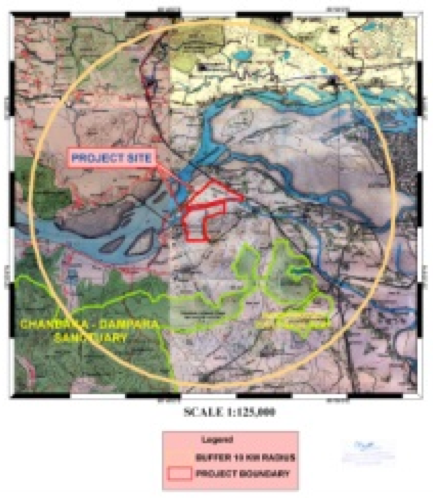
Tata’s power plant plan in Naraj-Marthapur marches ahead

Bhubaneswar- Cuttack- Puri, Cuttack, Tatas, Thermal 3 Comments »

Although I personally would prefer that the location is used for an IT or Knowledge park, it seems  the power-plant project is making stead progress. Following is from the page http://www.tatapower.com/services/power-projects.aspx#naraj.

All major clearances for the 660 MW Naraj Marthapur project have been obtained. The environmental clearance from the Ministry of Environment and Forests is obtained. The plant is expected to be commissioned within three years of the completion of the land acquisition, which is expected to be completed during the year. Tata Power has been allotted the Mandakini coal block located in the Angul district of Orissa, along with Monnet Ispat and Energy Limited, and Jindal Photo Limited.

Wlid life Conservation Plan

Consent to Establish- Naraj Marthapur

Approval of Wildlife Conservation Plan

List of Activities for wild life Conservation

Click here for the Environmental Clearance from the Ministry of Environment and Forests

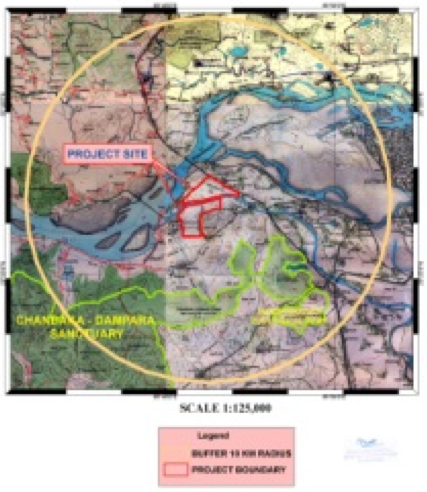
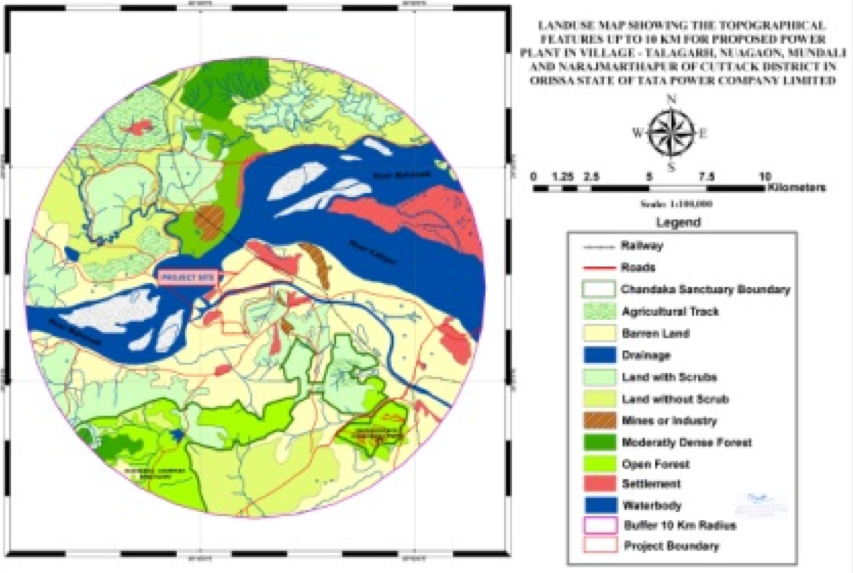
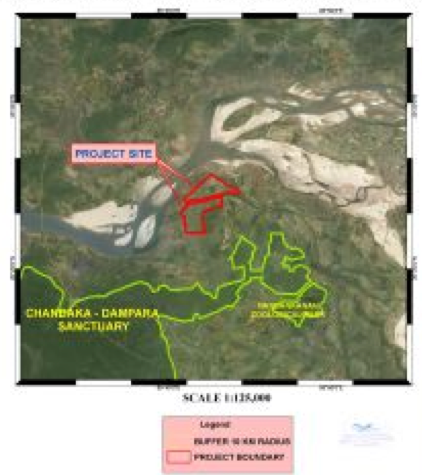
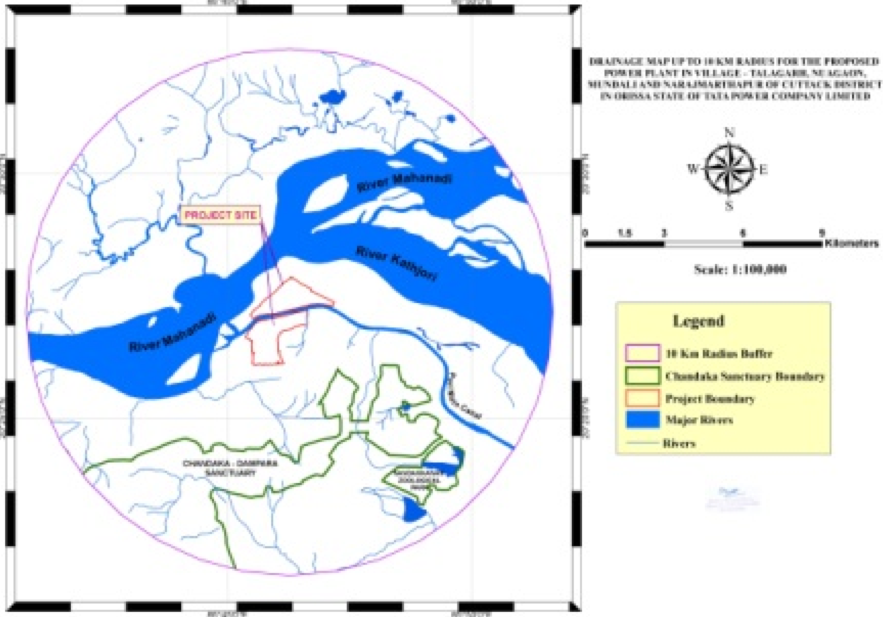
I hope it is not too late to change this plan. Following are maps from the Wlid life Conservation Plan document.

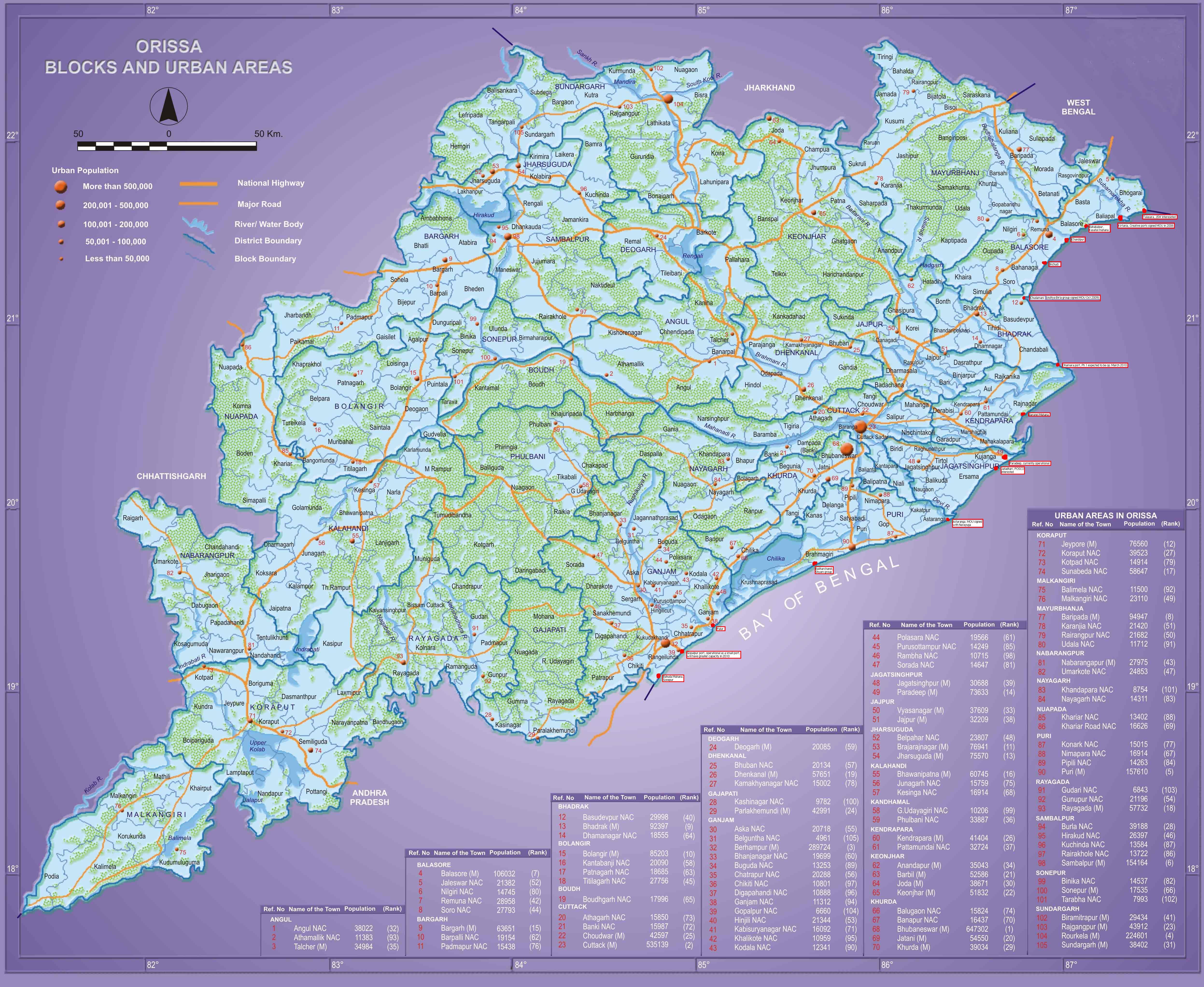
The above maps do not show the location of Bhubaneswar and Cuttack. Following is a map that shows it.

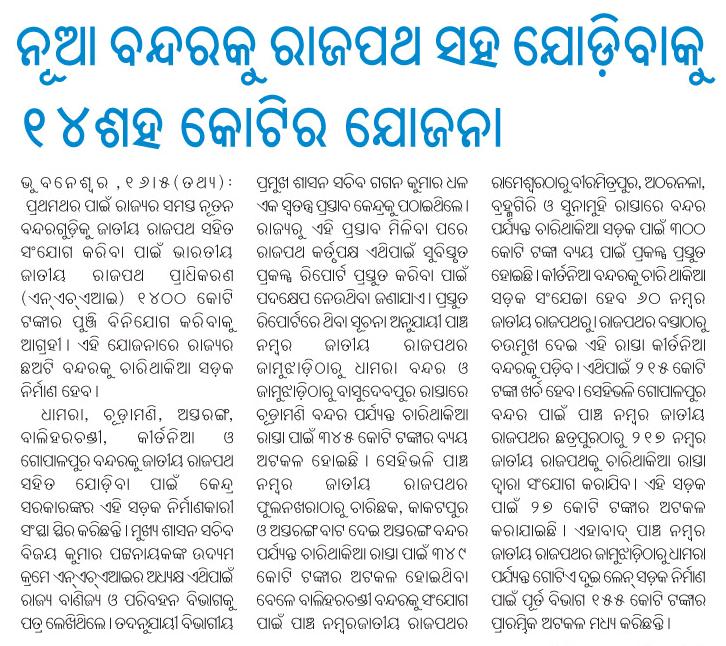
1400 crore plan to connect six new ports to the National Highways

Astaranga, Puri (Navayuga interested), Balasore, Baliharchandi, Puri (many interested), Bhadrakh, Choumukha-Kirtania, Balasore (Creative ports, Chennai interested), Chudamani, Bhadrakh (Birlas interested), Dhamara port (under constr.), Ganjam, Gopalpur port (under constr.), Puri, Roads, highways and Bus stands, Sambada (in Odia) 2 Comments »

The six new ports are Kirtania (Balasore district), Chudamani (Bhadrak district), Dhamara (Bhadrak district), Astaranga (Puri district), Baliharchandi (Puri district) and Gopalpur (Ganjam district).

Following is a report from Sambada.

Lessons that Odisha can learn from Punjab

Odisha govt. action 2 Comments »

Following are excerpts from an article in Wall Street Journal.

India’s northern state of Punjab was once a symbol of the nation’s economic progress, its advances in agriculture lauded worldwide as a spectacular feat that made India self-sufficient in food production.

But Punjab today faces a grave economic crisis, the result of years of shoddy governance that have stunted growth and created such a mound of public debt that the state is now seeking a multi-billion dollar bailout from the central government. It also is facing high unemployment, an anomaly in a nation that has the highest economic growth rate of any major nation after China.

Once India’s fastest growing state, Punjab is now one of its slowest, with about 6% economic expansion annually in recent years, compared with a national average of 8.5% and top-performing regions that are clocking 11% growth. With few good industry jobs being created, urban unemployment is a staggering 15.2%.

Many of the problems behind Punjab’s decline – an overreliance on agriculture, the under-development of manufacturing, lack of infrastructure development and overspending on populist welfare subsidies – are major issues for the government in New Delhi.

… Amid the turmoil in Punjab, the state’s ex-finance minister, Manpreet Singh Badal, has emerged as a leading advocate of reforms. …

Mr. Badal says Punjab needs to reduce spending on populist programs such as free power for farmers and cash handouts to lower caste women who get married; make long-term investments in education and infrastructure; and provide more incentives for industrial development.

"We have to think about not just the next general election, but the next generation," Mr. Badal said in a recent interview.

… With little spending restraint and paltry tax collections, Punjab has amassed $15.5 billion in debt. To pay annual debt servicing costs of about $1.8 billion, salaries for government workers and maintain all basic public services, the government is borrowing about $1 billion more per year, Mr. Badal says.

The debt crisis has been a humiliating blow to the proud Punjabi culture and economic history. Punjab’s agriculture sector in the late 1960s and 1970s was largely responsible for India achieving food security. Using new hybrid seeds imported from Mexico and taking advantage of extensive canal networks, farmers saw spectacular yields of wheat and rice. From 1966 to 1969, Punjab grew at an average of 8.4%, twice the national rate.

But by the 1990s, farmers’ yields had begun to stagnate. They began over-using fertilizers, which ultimately damaged the soil. …

Mr. Badal says there’s nothing wrong with agriculture but the state is too reliant on the sector, which makes up 30% of output but has grown only at an average of 3.1% a year for the past five years.

Successive governments since the mid-1990s have pursued populist policies that have left the exchequer in the red. The most sweeping move came in 1997 when the state gave free electricity to farmers to help cope with the costs of running water pumps. Mr. Badal estimates Punjab spends $1 billion per year on such subsidy programs.

… Though Punjab has small-scale industries that produce items like woolen garments, bicycle parts, and sporting goods, the state hasn’t attracted large-scale industrial investment – from foreign or domestic firms – and consequently has relatively few factories employing more than 15 or 20 workers, economists say.

Punjab’s infrastructure woes, including electricity demand that outstrips supply by 24% at peak usage hours, are one reason big manufacturers don’t want to set up shop.

Kaushik Basu, economic advisor to India’s finance ministry, says Punjab is still too focused on spurring growth in agriculture at the expense of other sectors. "It is tilting the incentives away from services and industry, which if it is unleashed, the growth potential of Punjab is huge," he said.

The above has a lot of lessons for Odisha in terms of what it should not do and what it should continue to do.

  • Odisha is a power surplus state and with many new power companies in the pipeline, it will continue to remain power surplus. It should tout this to get more diverse and employment-reach industries to Odisha. On the other hand it needs to address the environmental concerns and be smart in locating the power plants.
  • Odisha got out of negative budgets that depended on loans a few years back. It needs to keep a close eye on not getting into that situation again.
  • More …

Odisha’s plan outlay almost triples in four years; second best in the country after Haryana

Odisha govt. action, Planning Commission and Odisha 3 Comments »

Following is from a PIB report.

The size of the annual plan for 2011-12 for the State of Orissa was finalized here today at a meeting between the Deputy Chairman Planning Commission, Shri Montek Singh Ahluwalia and the Chief Minister, Shri Naveen Patnaik. The State will have a plan size of Rs.15200 crores.

Deputy Chairman, Planning Commission, Shri Montek Singh Ahluwalia complimented the State Government for the progress achieved in many areas. He said Odisha was figuring amongst the State doing well in poverty eradication and human development. Satisfactory progress has been recorded in social sectors including education and health.

Planning Commission appreciated the State Government for achieving a real average growth rate of 9.57 per cent during the first three years of the eleventh Plan. He said in the agriculture and allied sector growth rate of 4.8 per cent has been achieved during the same period. The State Government was advised to focus on making progress more inclusive and on reducing regional disparities. The State Government was also advised to better utilize science and technology in addressing the development related problems of the State. Attention was drawn to the condition of tribal and women and children in the State. It was pointed out that the State has done a good work in reforms and port sector was doing exceptionally well.

The Planning Commission has offered expertise in handling the problems which the State was facing following reforms in the power distributing sector. A team from the Commission will be visiting State with a purpose to find solution.

Mr. Naveen Patnaik said that the State has been assiduously pursuing the development agenda to achieve a sustainable and inclusive higher economic growth, accelerated overall development and a faster rate of poverty reduction. The development strategies include: strengthening human development sectors such as education, health services, food and nutritional security; improving welfare of marginalized groups such as Scheduled Castes. Scheduled Tribes and women; reducing regional, social and gender disparities; and scaling up investment in agriculture, allied sectors and infrastructure sectors.

He said removal of disparities is one of the important development strategies adopted by the Government. Several Key initiatives have been taken to address severe problems of underdevelopment and regional disparities. To expedite development of KBK districts an Eight Year Perspective Plan for KBK districts from the year 2009-10 to 2016-17 for a projected outlay of Rs.4,550 crore has been developed.

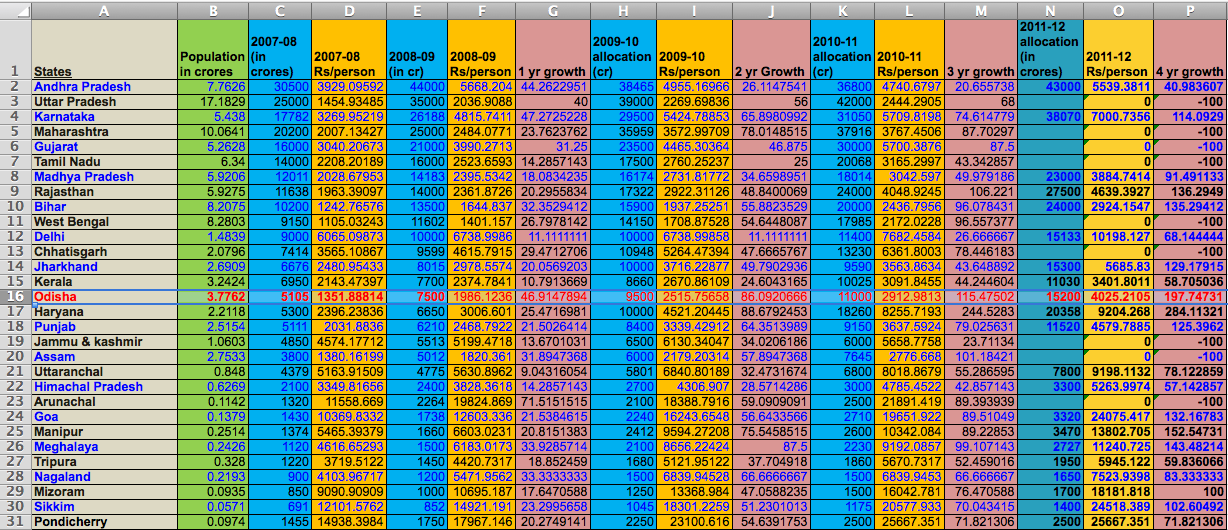
To get a better idea on how Odisha is doing, I created the following spreadsheet for the various states of India. State by state data is available at http://planningcommission.nic.in/plans/stateplan/index.php?state=b_outbody.htm.


The spreadsheet shows how Odisha’s plan outlay has grown from 5100 crores for 2007-08 to 15200 crores for 2011-12. While we don’t yet have the plan outlays for all states for 2011-12, it is expected that the only state doing better than Odisha in terms of the growth in plan outlay is Haryana. Following are a few comparative observations from the spreadsheet.

  • For 2007-08 Odisha’s plan outlay was 5105 crores and Kerala’s was 6950 crores. This translated to Rs 1352 per person for Odisha and Rs 2144 for Kerala. For 2011-12 Odisha’s plan outlay is 15200 crores and Kerala’s is 11030 crores which translates to Rs 4025 per person for Odisha and Rs 3402 per person for Kerala.
  • For 2007-08 Punjab’s plan outlay was 5111 crores which translated to Rs 2032 per person. For 2011-12 Punjab’s plan outlay is 11520 crores which translates to Rs 4580 per person. Odisha seems to be fast catching up.
  • The 2011-12 numbers for Maharashtra is not out yet, but based on the 2010-11 numbers, Odisha is fast catching up with Maharashtra in terms of per person outlay.
  • The 2011-12 numbers for West Bengal is not out yet, but based on the 2010-11 numbers Odisha’s per person outlay may be close to twice the number for West Bengal.

The planning commission web site shows where the plan outlays are to be spent and most of the spending is more beneficial to the poor. This explains the popularity of the current BJD government among the people. But many do not see the forest for the tree and there are more brickbats than bouquets for the current Odisha governemnt  and bureaucrats.

Non-ideologues and open-minded people need to look at the above spreadsheet and make fair assessment of the government and need to stop following the communist leaders from Kerala and West Bengal who have demonstratably dragged down their state and their people. In that regard it is ridiculous that many leaders from Odisha invite communist leaders from these states to Odisha and give them a platform to talk about how Odisha should follow their negative path.

Road between Khandagiri and Udaygiri to be diverted; many improvements planned for this 2nd century BC site

Bhubaneswar- Cuttack- Puri, Circuit: Bhubaneswar-Chilika-Puri, Historical places, Khordha, Sites in and around Bhubaneswar, Telegraph Comments Off on Road between Khandagiri and Udaygiri to be diverted; many improvements planned for this 2nd century BC site

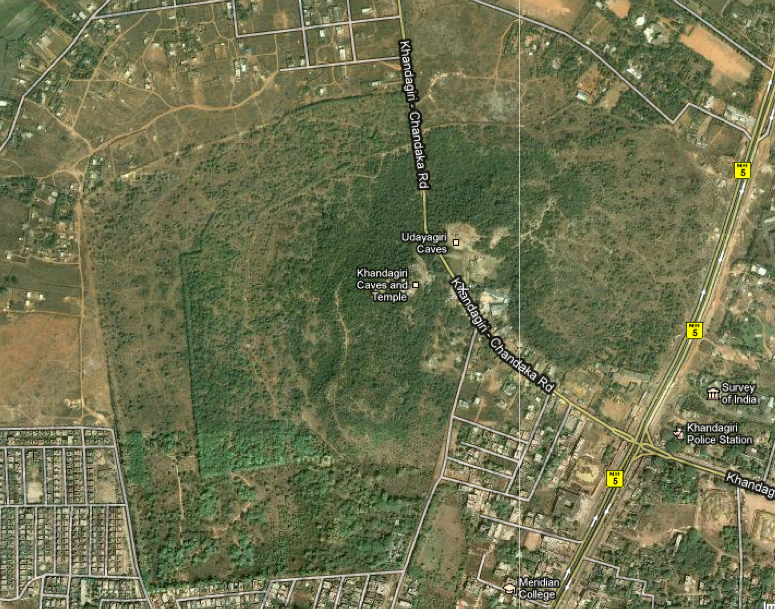
For all these years a major road passed between Khanadagiri and Udaygiri sites with various shops along the road. See picture below.

Finally the government has a plan to close this road and create the right ambiance for such a historic site. Following are excerpts from a report in Telegraph.

The state government has decided to close a road that passes through the historic Khandagiri and Udaygiri caves to vehicular traffic in a bid to bolster tourism and beautify the environs of the twin hills.

The Bhubaneswar Municipal Corporation (BMC) took the first step in this regard by identifying 24 shops near the hills.

These have been asked to shift behind the Udayagiri hills where a vending zone is coming up.

Priyadarshi Mohapatra, deputy municipal commissioner, said: “The state government plans to give a distinct touch to the historic monuments in the 2nd Century BC Khandagiri-Udayagiri caves. For that, the historic sites is expected to be visible from a distance and not get hidden under an unplanned growth of shops and vendors.”

There is a ‘panthanivas’ and a public convenience centre, but the other areas are either used for unplanned parking of heavy vehicles or have been encroached upon by vendors and shop owners.

“Today we initiated the process to find out the genuine shop owners so that they can be relocated behind the Udayagiri hills in front of the proposed tourism information centre, which is being developed by the Orissa Tourism Development Corporation,” Mohapatra added.

…“Once the space in front of Khandagiri-Udayagiri with 33 caves is clear of the congestion, tourists will enjoy their stay in the caves.

“They would have more recreation facilities once the beautification drive takes place in sync with the architecture of the hills,” said a tourism official of the state government.

… The tourism complex near Khandagiri-Udayagiri caves will house a quality interpretation centre with a food court serving an array of Oriya cuisine, public convenience, souvenir centre, audio-visual facility and entertainment and independent parking space.

This will serve as a cultural hub so that tourists coming to the city, especially to the cave sites and Jayadev Vatika, will have a detailed knowledge about the cultural tradition of the state.

Besides the interpretation centre, a common facilitation centre for handicrafts development will also be included in the compound to promote artisans in stone, brass and bell metals, fibre art, applique, terracotta and pattachitra work.


Ethnologue report for Odia

Odia language resources, Odia literature Comments Off on Ethnologue report for Odia

The following is from http://www.ethnologue.com/show_family.asp?subid=1299-16.

Indo-European  (439)

Indo-Iranian  (310)

Indo-Aryan  (221)

Eastern zone  (45)

Oriya (8)

Bhatri  [bgw] (India)

Bhunjia  [bhu] (India)

Bodo Parja  [bdv] (India)

Desiya  [dso] (India)

Kupia  [key] (India)

Oriya  [ori] (India)

Oriya, Adivasi  [ort] (India)

Reli  [rei] (India)