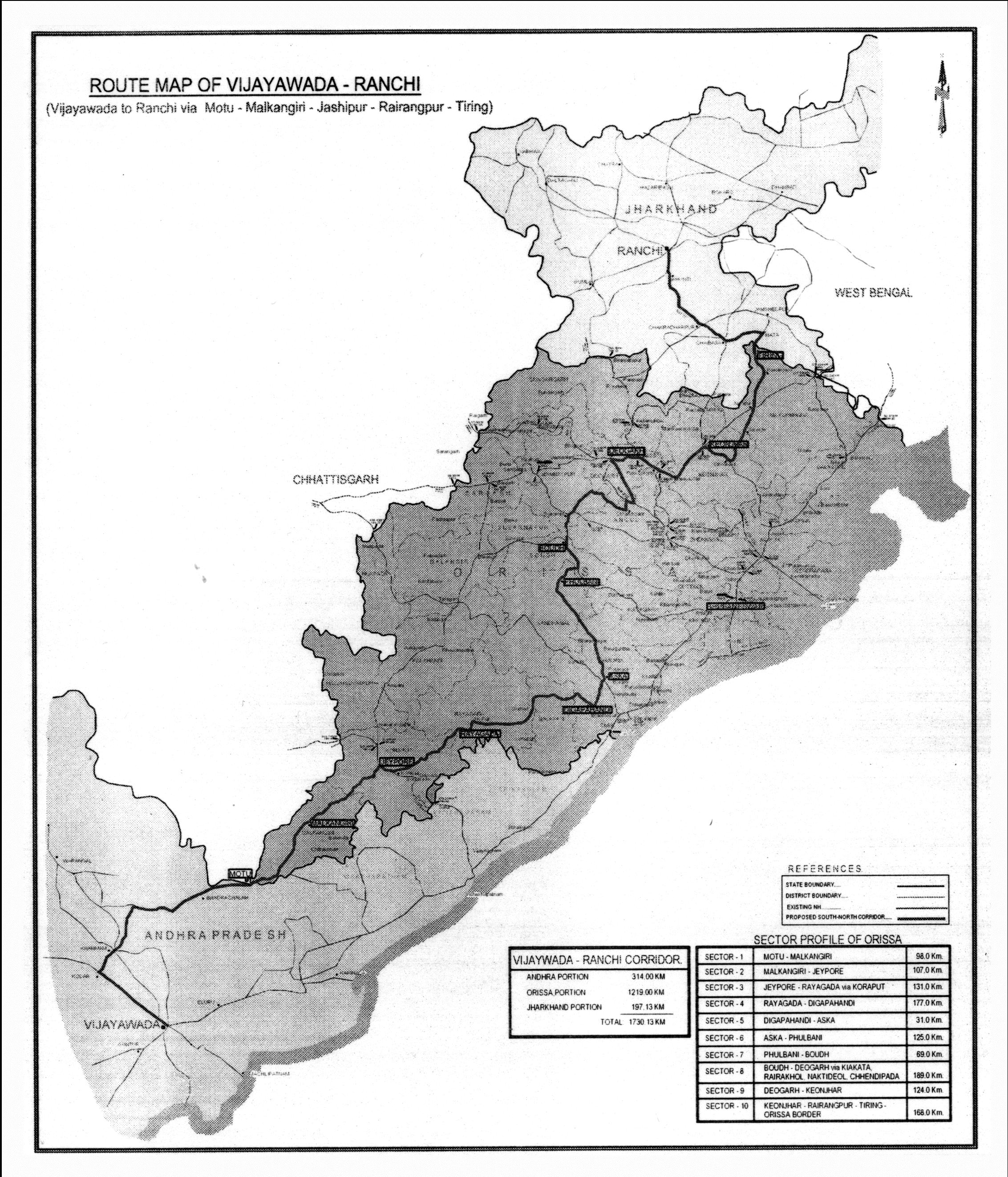
Forest resource of Orissa
The following is from http://envfor.nic.in/fsi/sfr99/sfr.html. The maps below are also copied from there. Both talk about the status in 1999. More info on Orissa forests is at http://www.orissafdc.com/.
India:
The recorded forest area of the country, as reported by the state forest departments, is 76.52 million ha which constitutes 23.28 per cent of the total geographical area of the country.
Orissa:
The recorded forest area is 5.72 million ha, which constitutes 36.73% of the geographic area of the state. The forests are uniformly distributed in the state except in coastal districts where they are scarce. By legal status, the Reserved Forest constitutes 47.37%, Protected Forest 52.60% and Unclassed Forest 0.03%. About 0.503 million ha, constituting 8.8% of total forest area, is affected by shifting cultivation.
There are four forest types namely Tropical Semi Evergreen, Tropical Moist Deciduous, Tropical Dry Deciduous, and Littoral and Swamp Forests.
Air India reintroduces Kolkata-Bhubaneswar-Chennai-Bangalore flight
Following is an excerpt from a report in New Indian Express.
The public carrier has decided to reintroduce the Kolkata-Bangalore flight via Bhubaneswar and Chennai on February 18. A brand new Airbus 319 would be introduced on this lucrative sector.
… The new flight will boast of business class. It will operate on all the days of the week and would leave Bangalore at 9.30 in the morning and arrive here at 1 pm and in Kolkata at 2.35 pm. It will reach Chennai at 10.15 and take off at 11.05 am.
In the return direction, the flight will take off from Kolkata at 3.25 pm and arrive here at 4.20 pm. It will leave at 5 pm and arrive in Chennai at 6.55 pm and depart at 7.45 pm. The plane will touch down in Bangalore at 8.30 pm.
Second Rural Technology Park of the country in Bhubaneswar: Sambada
The first RTP is in Hyderabad. Both RTPs will have a relationship with the National Institute of Rural Development (NIRD) in Hyderabad. (New indian Express also reports on this.)
Tiger presence in Orissa
Following is an excerpt from a report in Kalinga Times.
The details of the latest report titled `Status of the Tigers, Co-predators, and Prey in India ‘ (2008), published jointly by the National Tiger Conservation Authority and WII, were made public in New Delhi on Tuesday.
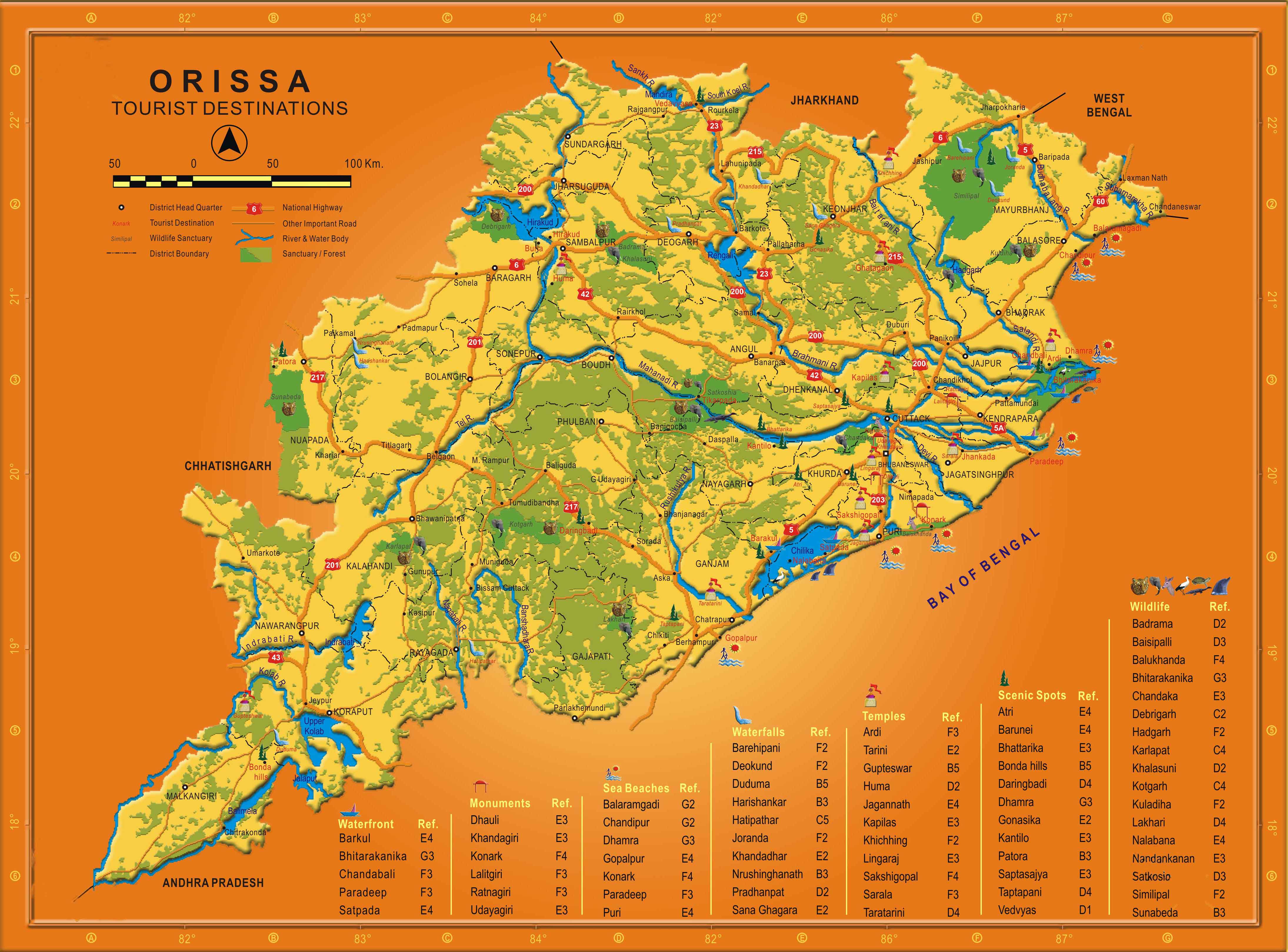
According to the report, Orissa has a total forest cover of 27,427 sq km with mapable tiger occupancy reported in 9,144 sq km. Orissa reported mapable leopard presence in 25,516 sq km, dhole presence in 8,215 sq km and Sloth bear presence in 43,236 sq km of forested habitat.
Amongst prey species wild pig were reported from 21,525 sq km, nilgai 711 sq km, chital from 6,040 sq km, Gaur from 2,772 sq km and sambar from 6,112 sq km of forested habitat.
“Tigers were distributed in four larger occupied units, three smaller units and sporadic occurrences largely in Southern and Central part of the State.
“The larger occupied units comprise of:
a) Simlipal Landscape comprising of 3824 sq km patch of forest has recorded tiger presence in 2 units having a total tiger occupancy of 2297 sq km with an estimated tiger population of 20 (17-34) tigers.b) Sunabeda-Udanti-Indravati Landscape is part of a contiguous forest patch of 34,000 sq km having a tiger occupancy of 570 sq km of about 9 (7-11) tigers.
c) Tiger population in the tehsil of Malakangiri in the district of Koraput comprising the sanctuary of Balimela and Kondakamberu comprises a part of the forested patch of 6254 sq km that extends from East Godavari , Khammam and Vishakapatnam of Andhra Pradesh.
Tiger occupancy in this forest patch in Orissa was reported in 879 sq km. Sporadic tiger presence is recorded in several places within Koraput district.
d) Satkosia Landscape is part of a forest patch of 13,459 sq km and has tiger occupancy in 787 sq km with several smaller pockets reporting tiger presence. The low density population was estimated to about 6 tigers. The area covers the districts of Phulbani, Gangam, and Kalahandi,” the report said.
“The smaller tiger occupied units having between 6-8 tigers were:
a) In the forested area of Raigarha tehsil in Koraput district with a tiger occupancy of 97 sq km.b) The tiger occupancy of 221 sq km was recorded in Sundergarh tehsil.
c) The Bargarh tehsil having an occupancy of 142 sq km.
“The total tiger population in Orissa was estimated to be 45 (37 to 53) tigers,” according to the report.
According to the recommendations made in the report, the major source population of tigers in Orissa is in Simlipal. Due to its large size and good habitat it can potentially sustain a viable population for long term conservation. It also has the potential to connect with the forests of Saranda in Jharkhand.
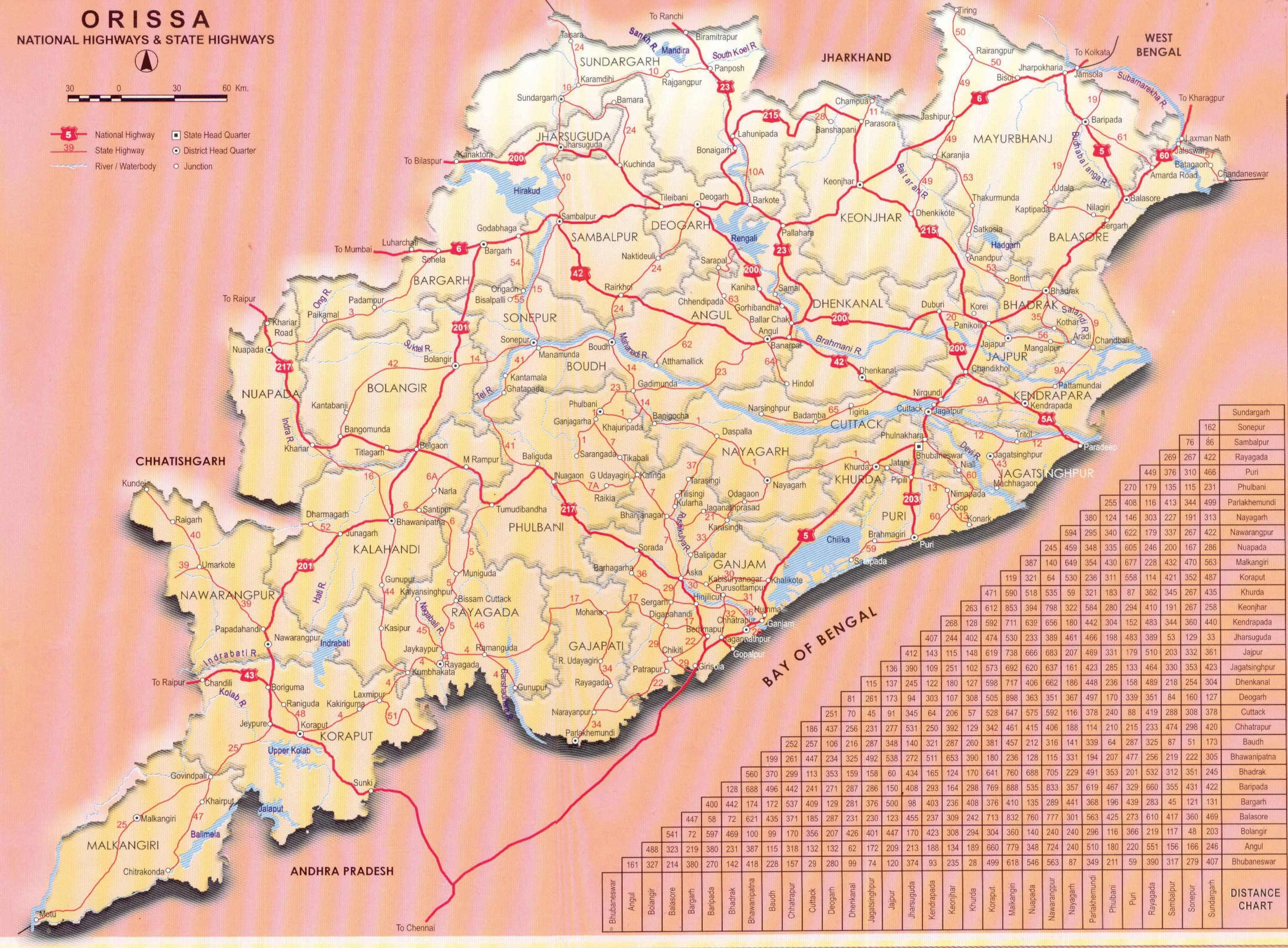
Demand to include the Northern part of Railway lines in Orissa into ECOR – Samaja
This is a tricky issue. If these parts are taken out of SER and put in ECOR then SER will become very small. Also, ECOR then has to give up part of the Vizag division as people in that area of Andhra Pradesh have similar complaints with respect to ECOR.
ECOR map dated April 1 2007
Gopalpur port may be ready ahead of schedule in 2009: Samaja
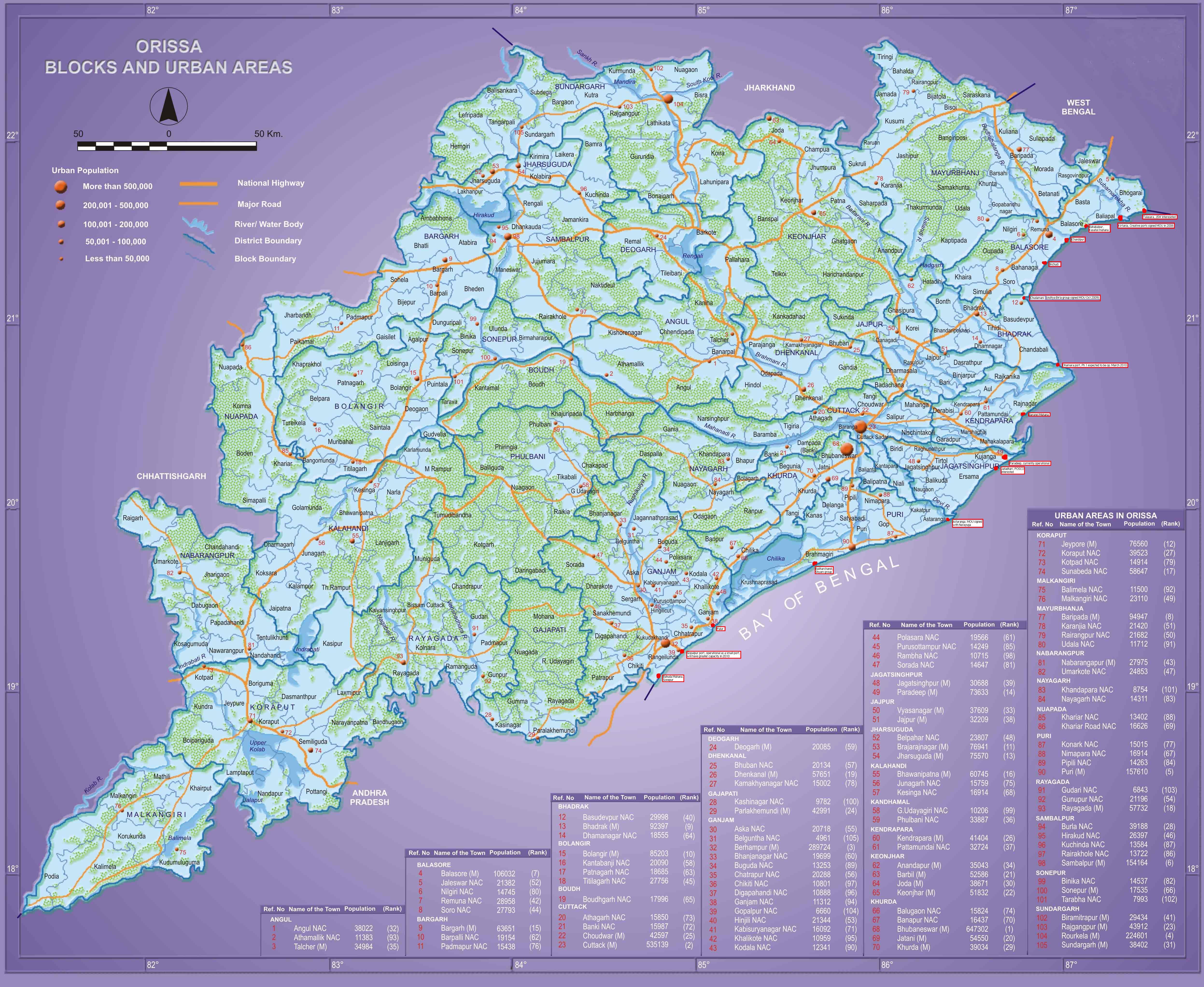
The above article mentions a list of other places where new ports may come up and the companies that have shown interest in them. They are:
- Barunei muhana, Kendrapada: Interest shown by Mittal Steel, Adhunik Metallic and SPI infrastructure.
- Inchudi, Balasore: Interest shown by IL&FS and SSL energy.
- Palur, Ganjam: Interest shown by Future metals.
- Bahuda Muhana, Ganjam: Interest shown by Mehta and Company
It says that among the shortlisted 13 locations for ports the chances are not good for Chandipur, Bahabalpur and Chudamani and if ports come up in the remaining 10 then Orissa will have the second largest number of ports.
Excavation at Sishupalgarh
Update: Times of India also writes about it with headlines "2,500 years ago, a city bigger than Athens in Orissa" and "Lost city had all urban amenities." See also this Telegraph report.
Following is an excerpt from a report in Hindu.
Researchers involved in excavation at the ancient city of Sisupalgarh on the outskirts of Bhubaneswar have come across a number of artefacts and structures that throw light on the existence of a flourishing urban life during the pre-historic period.
The geophysical research showed large-scale patterns of subsurface architecture such as streets, which were visible linking the gateways in the interior of the site, and a large ancient perimeter area around the pillar zone, said R.K. Mohanty of the Pune-based Deccan College and Monica L. Smith of the University of California here on Thursday.
These researchers, with the help of students from different universities and the Archaeological Survey of India (ASI), began their work in 2000, about 50 years after the first excavation.
After several deep trenches, they have now exposed 18 previously unknown pillars and several associated structures on a mound within the fortification wall.
Sisupalgarh was absolutely visible through naked eyes as well as from the space and this could be one of its kinds of cultural heritage in the whole of eastern India, the researchers claimed.
“It seemed to be a large city, which could have been governed under one ruler. The ancient population inhabiting the place was estimated to be 25,000,” said Mr. Mohanty, an archaeologist.
“The civilisation could have lasted for more than 1,000 years between 3rd BC and 3rd AD,” he said.
Researchers worked on the place adjacent to a “majestic gate” excavated by Prof B.B. Lal in 1950. They found house foundations of laterite block architecture. The habitation areas also contained very large quantities of household pottery such as bowls and jars along with other household artefacts such as iron nails and terracotta ornaments including bangles, finger rings, pendants and ear spools.
Pointing out that the latest debris deposits and pillars indicated that it was meant for public use, Ms. Smith said the ancient artisans at Sisupalgarh were manufacturing potteries massively and those were in rapid use.
“It suggested that the people, animals and trash were closely integrated in the crowded space of the city. …
Planned IT Park
Following is an excerpt from a report in Business Standard. (See also the report in Financial Express.)
Mumbai-based realty major Raheja group will be investing around Rs
30001000 crore for the development of the first information technology (IT) park in Orissa.Alongside, a 50 Mw power plant, cold storage in the public-private-partnership (PPP) mode and a hotel would also be set up by the group. The group also plans to enter the retail space and set up an IT development centre after surveying the potential.
The park would be christened Mindspace cum Techno-campus Park. The group already has such Mindspace cum techno-campus parks in Hyderabad, Mumbai and Ahmedabad.
… As per the presentation, in the first phase an incubation centre on 30-40 acres would be developed. The entire IT park would come up over 100 acres.
The plan envisages development of the park within the next 8-10 months, provided land is made available by the Orissa government in the next couple of months.
Following is from Samaja.
Progress on Paradip PCPIR proposal
Following is an excerpt from a report in Financial Express.
The Paradip Petrochemicals & Petroleum Investment Region (PCPIR), which has raced ahead to become one of the five fast track projects, is expected to attract a total investment to the tune of Rs 2.75 lakh crore.
The IL&FS, the consultant for the Orissa project, Monday gave a presentation to the senior officials of the state government about the development of the project. The presentation was witnessed by chief secretary, Ajit Kumar Tripathy, development commissioner RN Bohidar, industries secretary Ashok Dalwai, commerce & transport principal secretary Priyabrata Patnaik, special secretary Guru Ray, IDCO managing director Vishal Dev, among other senior officials.
The IL&FS vice-president, Anil Goel, said that the Orissa project, which was lagging behind, has made good progress during the last two months. According to him, the project is now at par with the projects proposed at Visakhapatnam in Andhra Pradesh, Dahej in Gujarat and Mangalore in Karnataka. He said that the project has been highly appreciated by the Centre.
Goel, who was accompanied by his Orissa head Manoj Panda, said that the project, which will come up over an area of 28,500 hectare at Paradip, will have Indian Oil Corp’s (IOC) Rs 26,000 crore petrochemical complex as anchor tenant. Besides the IOC investments, the project will attract investment to the tune of Rs 23,000 crore in township, housing and allied sectors, Rs 15,275 crore in external infrastructures like port, airport, cargo complex, road, while Rs 2.30 lakh crore will come in the hardcore industries of the petrochemical sectors. He said the investments would be by the private corporate houses, public sector undertakings, and in the mode of BOOST and PPP.
Following is Samaja’s take on it.
Coal belt in Angul district
Following is from a report in New Indian Express.
Raijharan area of Chhendipada near here where power grade coal is available just eight feet below would soon become a major coal producing area of the state. The coal rich area called "Utkal block" has attracted both private and public sector companies to open up open cast coalmines. The block has been divided into seven parts named Utkal-A, B1, B2, C, D, E and F.
According to district official sources there are about 900 million tonne deposit in the area. This is for the first time that private coal producers are going to open up mines in the area which come under Talcher coalfield.
As per the latest in formations available, Utkal-B1 block has been allotted to Jindal Steel and Power Limited in the year 2003 as a captive coal mine while B2 block went for Monnet Ispat &Power limited in 1998. The block C has been allocated to IMFA group may 1998 while Block F came under Tata Spong Iron Limited of keonjhar in 2006.
Orisa Mining Corporation got block D while block E has been given to Nalco for captive mining in August 2004. AS regards to Utkal block A the union Coal ministry has allotted it to public sector Mahanadi Coalfield Limited and four other companies including Jindal stainless limited. The block A was earlier allotted to Kalinga Power Corporation in 1996 which was to set up a power plant at kalinga nagar.
But when the company moved away from setting up the plant there the allotment was cancelled and given to MCL and four companies . All the coal blocks except Utkal D are captive coal mines for power plants. .Utkal D though is owned by OMC will be developed and mined by a private company called Kalinga Coal mining private Limited.( KCMPL).
It is in an advanced stage other than these companies to begin production by December if all goes well. It has successfully acquired all the required land by now without any trouble.As per the records of the district office here 4 (1) notifications for all the coal producers except Nalco and Utkal have been done. Monnet Ispat and Energy which is setting up a steel and power plant along with the coal mine is acquiring private lands on direct purchase basis.
Jindal Steel and Power Limited (JSPL) which opening a captive mine is also progressing well on the acquisition matters after the meeting of its chief Navin Jindal with state chief minister Section 7(1) of its land acquisition in under progress.
As regards to the environmental clearance all but Nalco got the clearance from the union ministry of Forest and Environment. TATA also did not have the clearance but its case is different as it got the block in last year while Nalco got in 2004.
Satkosia Gorge: second largest sanctuary of Orissa and a tiger reserve
Following is an excerpt from a report in New Indian Express.
Satkosia gorge sanctuary located in the heart of the State is unique in more than one way. River Mahanadi has cut right across the Eastern ghats endowing the gorge with all its beauty.
The 22 km long gorge divides the area into two distinct parts accessible from Angul and Nayagarh or Boudh. It covers four districts of Angul, Cuttack, Nayagarh and Boudh and is the second largest sanctuary of Orissa.
The areas support moist deciduous forest, dry deciduous forests and moist peninsular sal forests and a largely bamboo species.
Wild animals like the Royal Bengal Tiger, Leopard, elephant, four horned antelope, giant squirrel, wild dogs, nilgai, sloth bear, mouse deer, spotted deer etc are the pride of the sanctury.
A huge variety of resident and migratory birds and reptile species (gharial, mugger, crocodile, fresh water turtle, poisonous and non poisonous snakes etc) are also a part of the sanctuary.
The sanctuary is home to 400 plant species, 38 mammals, 31 reptiles in the sanctuary. Satkosia gorge was declared a sanctuary in 1976 AD by the State Government under Section 18 of Wildlife (protection) Act 1972. Its area is 795.52 sq km.
The sanctuary is managed by two wildlife divisions, south part by Mahanadi Wildlife Division at Nayagarh and north by Satkosia Wildlife Division at Angul. Both Satkosia Gorge and Baisipalli sanctuary area of 1038 sq.km were declared elephant reserves in 2002 by the State Government. Satkosia also enjoys the status of a Tiger Reserve after being the title in December 2007 after an approval of the Central Tiger Conservation Authority as per Wildlife Protection Act (amendment 2006).
Now, request would also be put forth to declare it a bio-sphere reserve for its biodiversity and abundant natural resources. Former Central Environment amd Forest Minister Kamalnath initiated to declare as Bio-sphere reserve.
About 133 villages in the sanctuary, including three forest villages and 10 hamlets. In The buffer zone as many as 128 villages are located.
The village people mostly depended on forest for their livelihood but the ban enforced by the Government on forest work and collection of NTFP and forest produces as per direction of Supreme Court and Wildlife Protection Act.
No developmental work is being done inside the sanctuary for a long time. The recent declaration of Satkosia as the second tiger reserve was long over due. It would not only go a long way in protecting the tiger population but also take care of other rare animals on the verge of extinction.
State government should spare no time in implementation of the reserve process by making an action plan and constituting an authority as required. Now in the Tiger Reserve 18 Royal Bengal Tiger, 34 Leopard and 194 elephants.
Power plants in and around Angul
Following is an excerpt from a report in New Indian Express.
… The coal rich Angul district alone shared 8050 mw out of these projected power generation. The figure may go up if Reliance Power Limited and Lanco Power who have also evinced interest to set up power plants, go for it.
Besides, there would be another 1900 mw power generation in the district for captive purposes. The district, virtually, is slated to be the power house not only of State but also of the nation as hardly any district in India would have so much of power generation capacity when these projects would go on stream.
The independent power producers are Jindal photo (2000 mw), Mahanadi Aban Power Limited (1050 mw), Bhusan Power Limited (2000), ESSSAR Power (2000 mw), Tata Sponge (1000 mw). All these are in very infant stages.
While Mahanadi Aban and Jindal photo would get their power plants set up at Talcher, the remaining producers will have their ventures at Angul area.
Besides these, steel producers like Jindal Steel and Power Limited would set up its 900 mw of captive power plant while Monnet Ispat will go for 1000 mw of power plant at Angul.
This would be the additional capacity generation of power in the district in addition to the existing generation capacity of 4500 mw of two NTPC and one Nalco captive power plant.
While at Kaniha, NTPC has 3000 mw super thermal power plant, it has another 460 mw plant at Talcher also. Nalco also has a power plant of installed capacity of 840 mw while another 220 mw addition is under way under the expansion.
Taking into account this current capacity, the total capacity of the district in coming years would be around 14000 mw. If Reliance and Lanco come, this figure will go up further.
Most of these upcoming power producers will have their own captive coal mines. Some of them got allotment while others are waiting.
Angul district unlike others is conducive for power plants because of availabity two key infrastructural bases. These are coal and water.
… but how far the area, already extremely polluted, could sustain such power generation on such a massive scale. Environmentalists fear the Talcher and Angul area which is experiencing 50 degree Celsius in summer could be led to catastrophe unless massive forestations and anti-heating measures are not taken right now on a long term basis.
A concrete environmental management plan should and must be in place along side of these power plants, environmentalists asserted.
MESCO expansion in Kalinganagar
Following is an excerpt from a PTI report in Hindu.
Kalinganagar: MESCO Steel Group plans to invest $2.8 billion (over Rs 1,000 crore) to expand its existing steel making capacity and set up a greenfield project that would together take its total capacity to 6.5 million tonnes per annum. MESCO, which owns Mideast Integrated Steel Ltd (MISL), would enhance its existing pig iron plant here into a 3.5 million tonnes steel plant with an investment of $1.2 billion, company’s Managing Director Rita Singh told reporters here.
Ms Singh said that the company would pump in $1.5-1.6 billion through joint venture route in setting up a greenfield steel plant here. The project is likely to be finalised within 2-3 months.
"We have already acquired 800 acres of land for this greenfield steel plant,” she said, adding that this project would be set up by MESCO Kalinga Steel. Both these projects would be completed by 2010-11, she said. The funds for these projects would be arranged through suppliers credit and cash equity.
… MESCO, which has become debt free recently, is also planning to ramp up its pig iron production from the current 4 lakh tonnes to 7 lakh tonnes by 2008-09. The products would be utilised by its steel plants, she said. – PTI





.jpg)