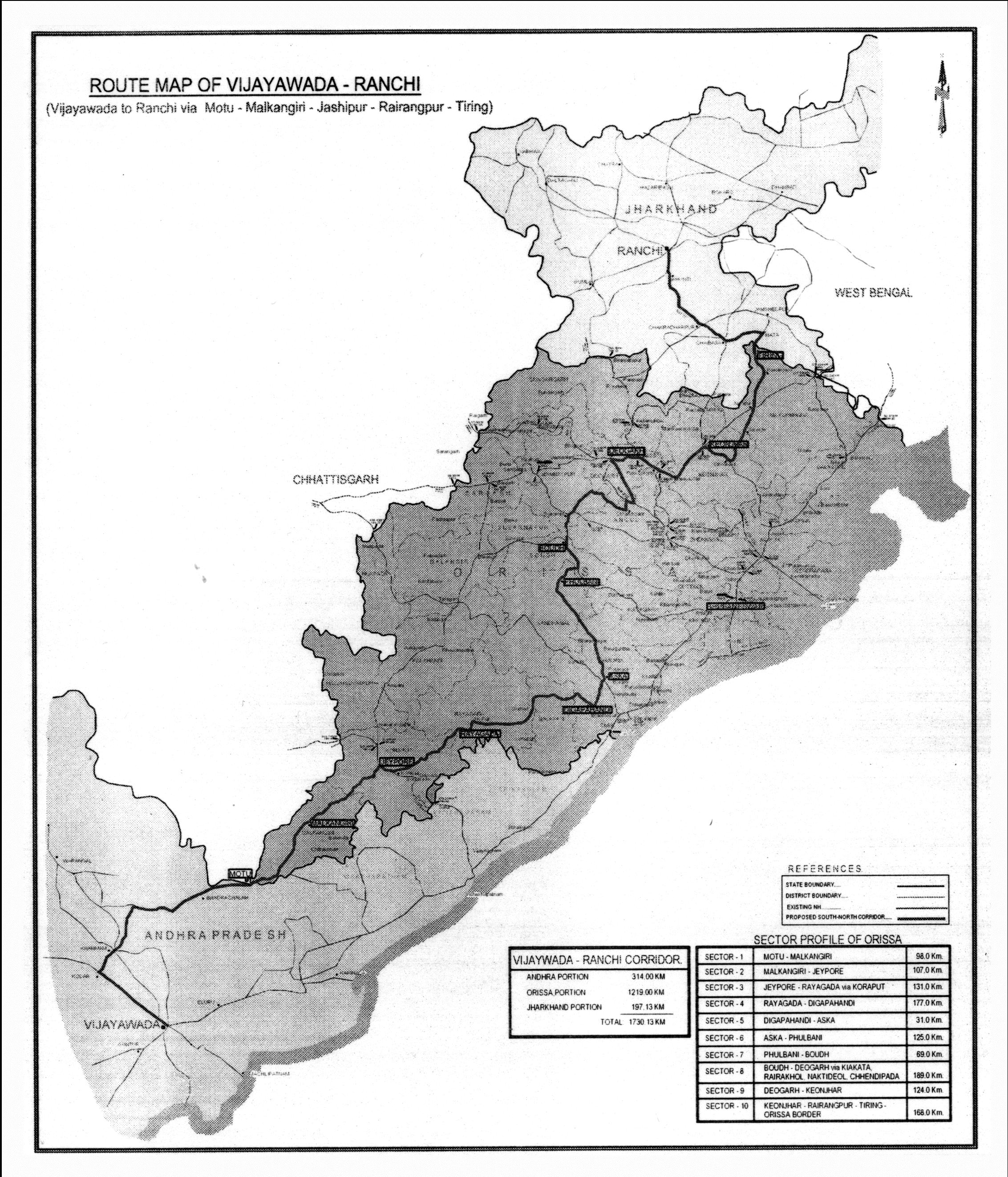

Dept. of IT GOI plans its eastern region data center in Bhubaneswar
A Business standard-Rediff article mentions this. Following are some excerpts.
The government of India is working on a structured Business Continuity Planning model to ensure that critical services like the functioning of government websites and servers go on unhindered even when disasters — man-made or natural.
The model has been devised to recover and restore partially or completely interrupted critical function(s) within a given time period after a disaster or disruption. The government hopes to have this implemented in a year.
Thursday’s flooding of the National Informatics Centre rendered most of the Indian government websites with the domain address ‘nic.in’ — including the Prime Minister’s and President’s websites — inaccessible till about 6 pm.
However, there was no reported data loss because of there being a backup tapes mechanism and its storage area network in the NIC’s Delhi unit. …
Besides Delhi, the NIC has data centres in Pune and Hyderabad, meant to house mainly Central government data.
The department of information technology intends to set up another data centre in Bhubaneswar to serve the eastern region.
These data centres are connected by high-speed networks to support data/application back-up security.
WIPRO in Orissa: 2nd center in Infocity II; global training center; 15,000 employees in Bhubaneswar
Following is Pioneer’s short report on this.
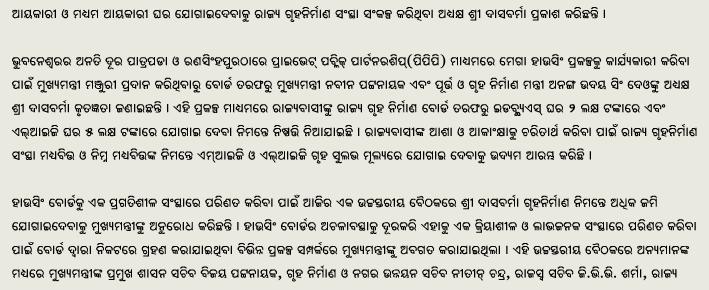
Wipro will give employment to 15,000 in its Bhubanewar centre. In this connection, CIO of Wipro met the Chief Minister Naveen Patnaik at the State Secretariat.
Wipro also agreed to set up a Global Training Centre here. Wipro will set up its second campus in Infocity II.
New Indian Express has a slightly more elaborate report. Following are excerpts from that.
… Wipro has decided to open a global training centre in Orissa.
The issue was discussed at a meeting between Chief Minister Naveen Patnaik and Chief Information Officer (CIO) Laxman Badiga …
Badiga informed that about 15,000 IT specialists would be recruited in the development centre of Wipro to be set up here.
Besides, the company would also open its second campus in Infocity II near Janla.
Smart city concept of Infocity II was also discussed. Principal Secretary to the Chief Minister Bijay Kumar Patnaik, Secretary in the Information and Technology Department Surendranath Tripathy, Director, Information and Technology Vishal Dev, Chief Technology Officer of Wipro Rajesh Ram Mishra and Bhubaneswar chief of Wipro Surjya Mohanty also attended.
Telegraph’s report on this has some more information. Following are some excerpts.
Information and technology giant Wipro will soon set up the state’s biggest software development centre, where 15,000 IT engineers would be employed.
Chief information officer of Wipro … said the company would open a global training centre, too, in Orissa.
… The proposed hub, to be constructed on the Puri-Konark Marine Drive, would have facilities to train about 3,000 persons, said the state’s information and technology director Vishal Dev.
Wipro, listed on the New York Stock Exchange, had signed a MoU with the state government in 2004 to set up its software development centre with a proposed investment of about Rs 200 crore. It was allotted 27 acres of land in Infocity, opposite to the Infosys centre. The construction work has begun and the work is expected to be complete by 2008.
Wipro is among the four major IT firms for whom a 130-acre special economic zone is being carved out of the 350-acre Infocity-I. The other three companies are Hexaware, MindTree and TCS.
Significantly, Orissa has witnessed a spurt in its export earnings from the information technology sector in 2006-07. In 2005-06, the earnings were Rs 465 crore but it shot up to Rs 732 crore in the next fiscal.
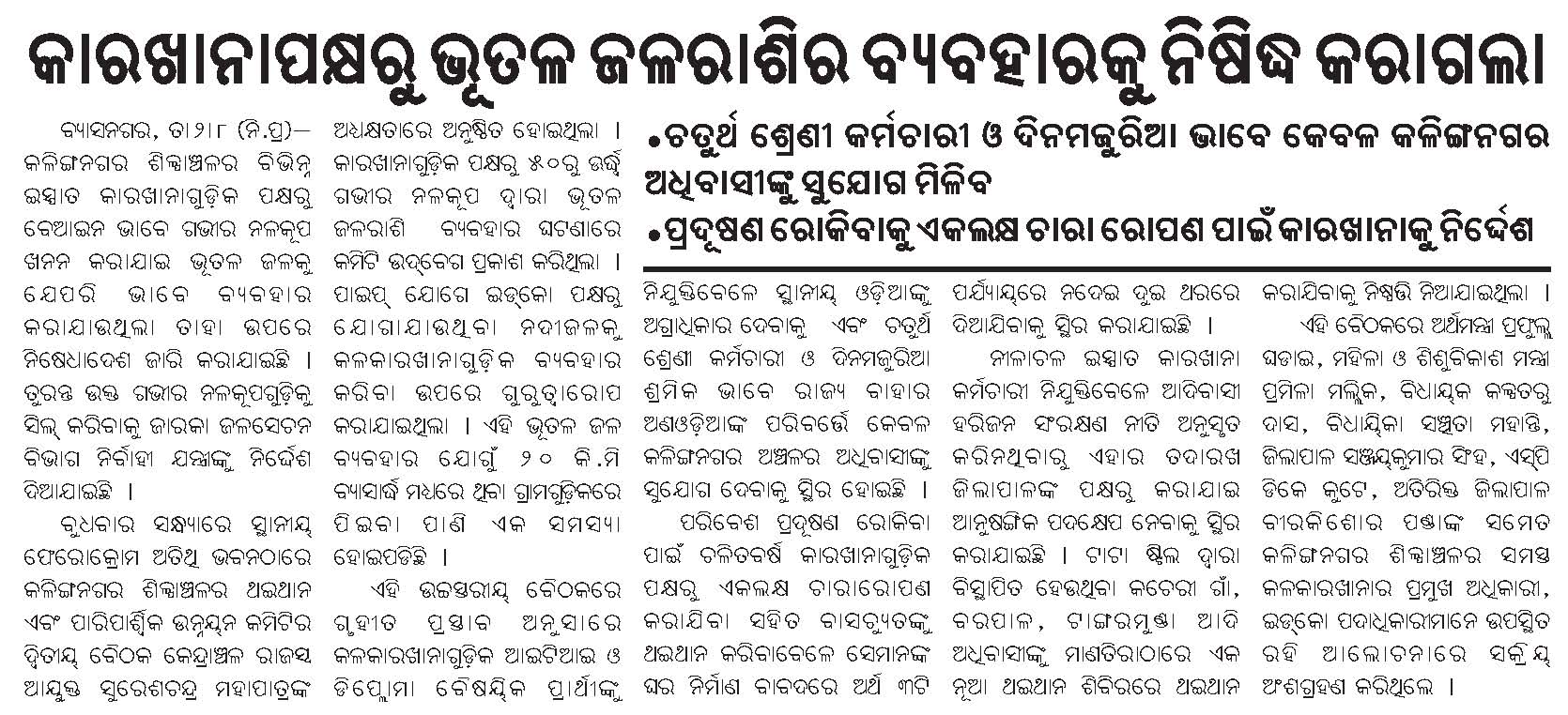
Some rules set for the Kalinganagar area industries
Samaja reports on several rules that have been set with respect to the various Kalinganagar industries.
- Industries can not use underground water; they must use the river water supplied by IDCO through pipes.
- While recruiting ITI and Diploma holders they must give preference to local Oriyas.
- For fourth class employees and daily laborers they must hire local Kalinganagar people.
- This year they must plant 100,000 trees.
- For rehabilitation, they must pay the housing cost in two installments instead of three.
Following is Samaja’s report.
Orissa Govt. Plans IT-enabling of Govt. services
New Indian express reports that Orissa Govt has started The Orissa Modernising Government Initiative (OMGI) . This will be utilising IT in a more effective way. The Whole project is funded by DFID. Excerpts:
The Orissa Modernising Government Initiative (OMGI) seeks to address these and much more effectively. A State Government initiative, the project is being funded by DFID and would be completed by December 2008. It envisages rationalisation of the role of the State Government to focus on the most critical goods and services and reach out to the poor in a way that benefits them from its policies.
Besides, it aims to enhance the effectiveness, transparency and accountability with which the government performs its role.
The contours of the project was presented to Chief Secretary Ajit Kumar Tripathy by OMGI officials here on Wednesday. Its uniqueness lies in the fact that it exploits the benefits of IT to speed up delivery of public services and make them more transparent.
It also empowers the common men and gives them enough scope to ventilate their grievances to mandarins. Reengineering of the tools and procedures of the government departments would be one of its prime concerns.
Government officials can equally benefit from it. They would have access to service book, keep track of their career growth, leave sanction, transfer and posting. Each staff right down the ladder would be provided with a password.
Dissemination of government rule and procedure, citizen charter and performance data would be in vogue. Disclosure of information in a transparent manner to public on various procurements, allocations and awarding of tender would also be a reality.
Even candidates can review job posting, apply online and have access to employment news, views and service rules.
The reform measures would not be confined to the Secretariat alone. Revamping of the administration at the district-level would also be taken up. Human resource management would form a key component of the programme. Further, OMGI would intervene in other sectors like housing and urban development, health, education, industries and take up district modernisation and litigation management among others.
Jaldhara drinking water scheme for 1000 villages
Following are excerpts from the New Indian Express report on this.
… The new scheme ‘Jaldhara’ would provide drinking water to 1000 villages next year. It will be funded by the State Government.
… it will be implemented through the panchayats. At least one village in each panchayat and three to five villages in each block will be covered under the scheme.
Naveen directed the Health Department to take steps to ensure drinking water provided to the villages through pipe water scheme is free from flouride and other chemicals which create health problems.
Official sources said that the State Government had taken up 1486 pipe water schemes under the swajaldhara programme funded by the Centre, of which, 963 projects have been completed. The Chief Minister directed that incomplete schemes should be completed by March next year.
… Earlier in the year, Naveen had launched the Biju KBK and the Gopabandhu Grameen Yojana to be implemented for a period of five years with a budget provision of Rs 600 crore each.
These were followed by an announcement to provide pattas to six lakh landless people. Besides, the Biju Grameen Jyoti Yojana was launched recently to supply power to habitations with a population of less than 300 people. During this financial year 1000 villages will be electrified for which a provision of Rs 100 crore has been made.
Grangu Kuti: nature spot in Kandhamala
Following are excerpts from a Pioneer report by Pradipta Mishra.
Orissa is a real treasure hunt for nature lovers and off-beat tourists. ..
One such hidden spot is Grangu Kuti or Ganga Kuti in tribals-dominated Kandhamal district. Thirteen km from Raikia, a small town above Kalinga Ghat in Kandhamal district, Grangu Kuti is about 260 km from Bhubaneswar. Along the way one comes across beautiful tribal villages and dense forests along with ancient townships like Bhanjanagar, famous for its enchanting lake, and Ghumusar Udayagiri. A drive to Grangu Kuti is like a good appetiser before a lavish lunch.
In local Kui language, Grangu means dangerous and Kuti connotes gorge. Wordsworth, however, would have called it a heavenly gorge. Such is the beauty of the place that it would turn a hardcore criminal a poet!
Grangu Kuti is a deep gorge surrounded by cloud-capped tall and densely-forested mountains. Local tourists and picnickers go down to the bottom of the gorge to listen to the breathing of nature goddess. Sound of the waterfall nearby and that of the small fountain flowing close to your leg with its crystal clear water is a lifetime experience.
The gorge is about one and a half km long and its width nearly one km. One can go either side of it and go deep as well. The whole area is a lavish feast to one’s eyes. But for one’s belly, he has to travel three km, even for a packet of biscuits. Lunch is 13 km away at Raikia. And accommodation! Forget about a hotel; the only nearest place to stay is a PWD bungalow at Raikia. Here too, one has to do a three-km walk for his morning tea.
… Moreover, the place is only about 50 km from a better-known tourist destination, Daringibadi. …
In fact, Gangru Kutis and Daringibadis have all the potential to emerge as international tourism hubs as they possess tall hills, virgin forests, perennial fountains and charming flora and fauna.
BILT plans a power plant in Choudwar, Orissa
Business standard reports on this. Following are some excerpts.
The Thapar-owned Ballarpur Industries Ltd (Bilt) power outfit BILT Power proposes to set up a 1,200-Mw independent power plant (IPP) in Orissa at an investment of around Rs 6,000 crore.
… BILT Power is expected to sign a Memorandum of Understanding (MoU) with the state government soon.
Funds for the project would be sourced through loans from banks and financial institutions (FIs), of which 70 per cent would be debt and 30 per cent would come in as promoters’ equity.
BILT Power Chief Executive Officer (CEO) Anil Bhargava told Business Standard, “The detailed project report and feasibility study reports have already been submitted to the government. We are just awaiting the government nod to go ahead with the project.”
Bilt Power has already cleared the screening committee process for setting up the plant. Requirements for setting up the IPP has been forwarded to the state government.
The IPP is proposed to be set up in Choudwar on 950 acres. The Thapars already have paper production facilities in the state. They also have a captive power plant (CPP) at Sewa in Koraput district of the state.
Currently, BILT Power aggregates 100 Mw of CPP capacity at Sewa, Yamunanagar in Haryana and two plants each at Pune and Ballarshah in Maharashtra.
These plants have capacities between 25 Mw and 30 Mw each. Bilt Power has applied for allotment of coal blocks at Mandakini in the Talcher Coalfields of Orissa.
S Jagdev, head, corporate affairs, (eastern region), Bilt, said, “About 6 million tonne (MT) of coal would be required annually to feed the power plant.”
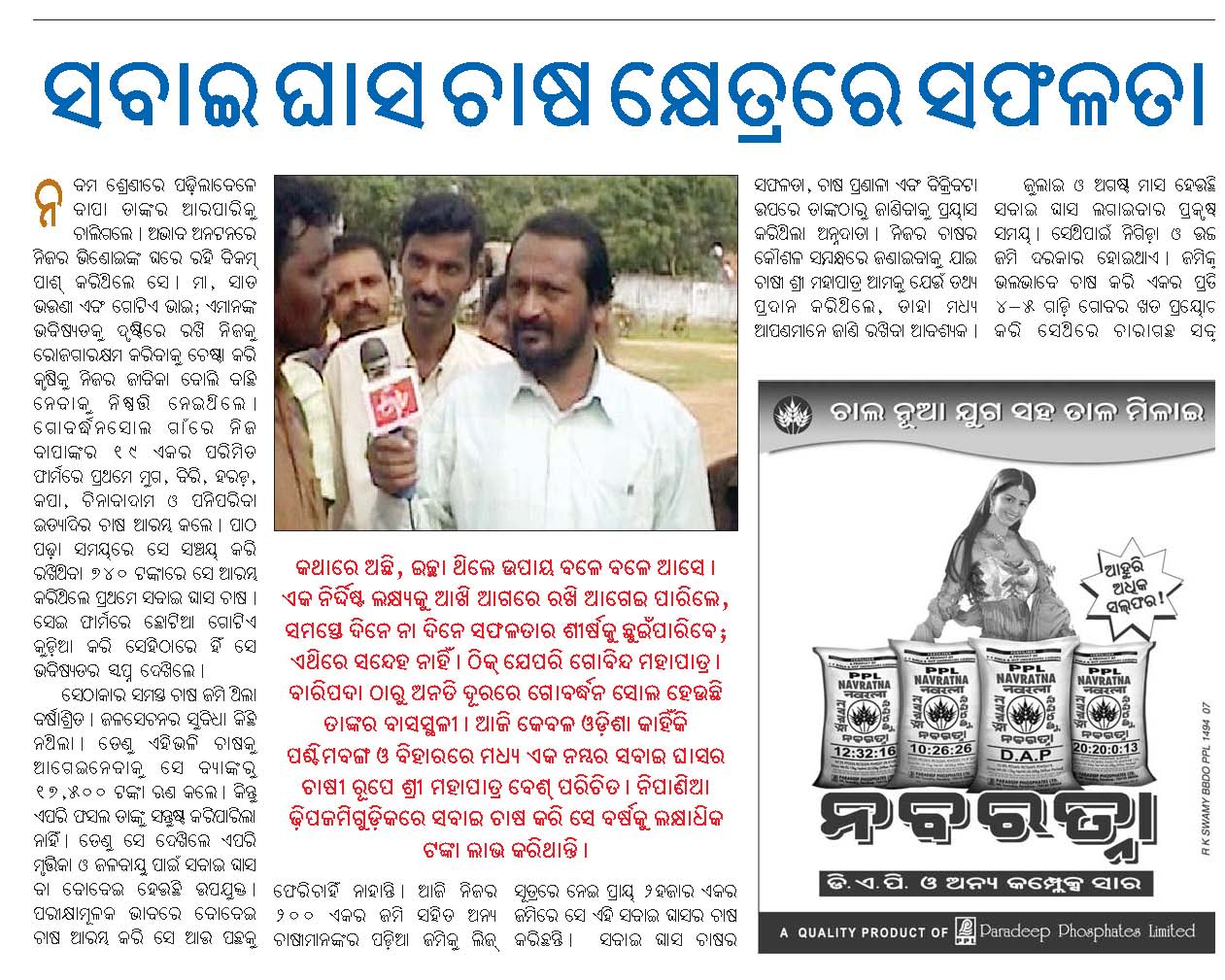
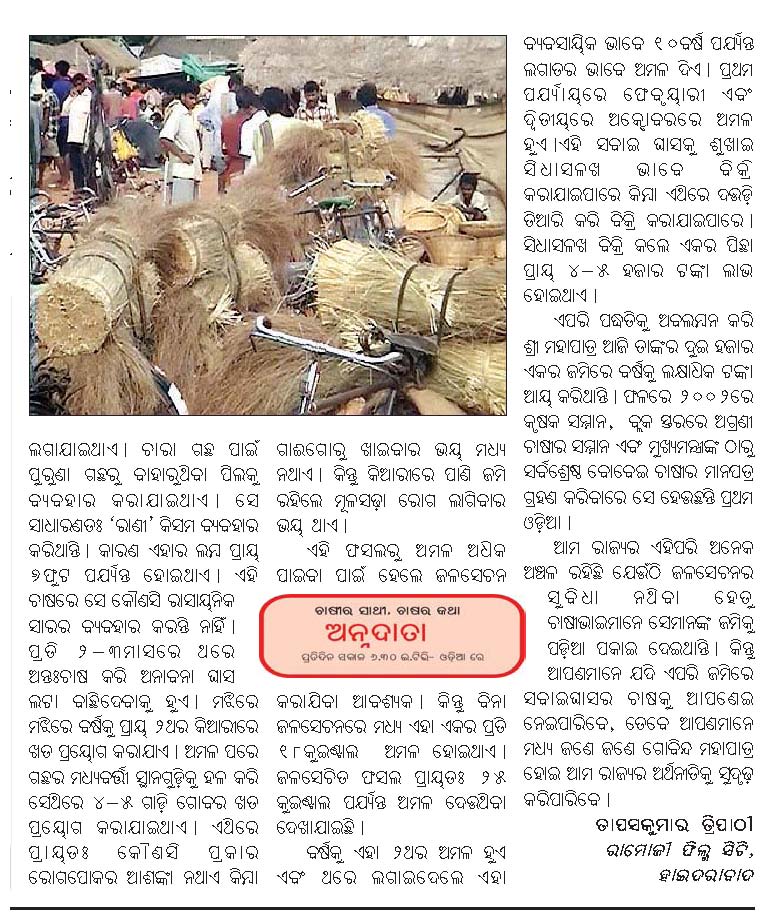
Samaja: Cultivating “Sabai” grass – a success story
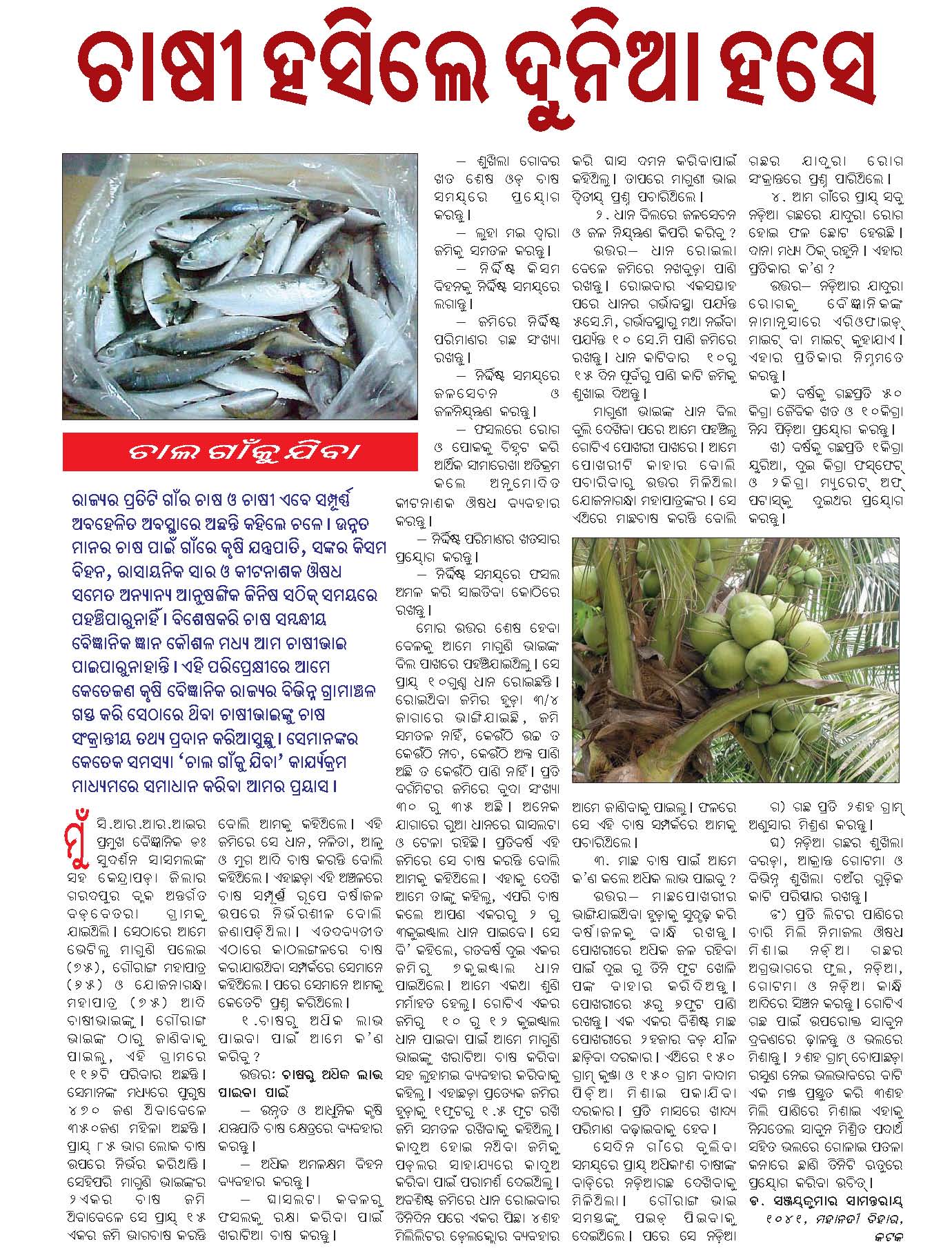
Samaja: Q & A on agriculture (a scientist visits a village and answers their questions)
Samaja on pulse cultivation in high lands

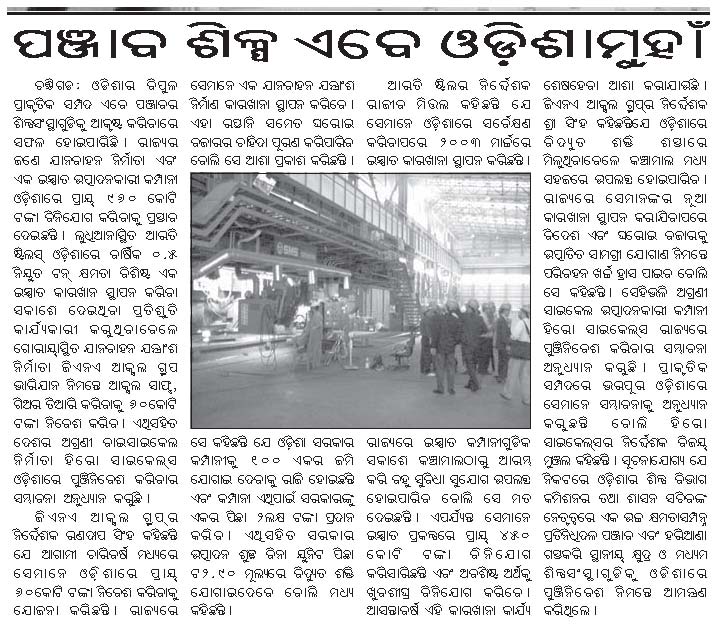
Samaja’s take on Punjab industrialists setting shop in Orissa
Earlier we reported on a news item on this in an English media. Following is Samaja’s take on this.
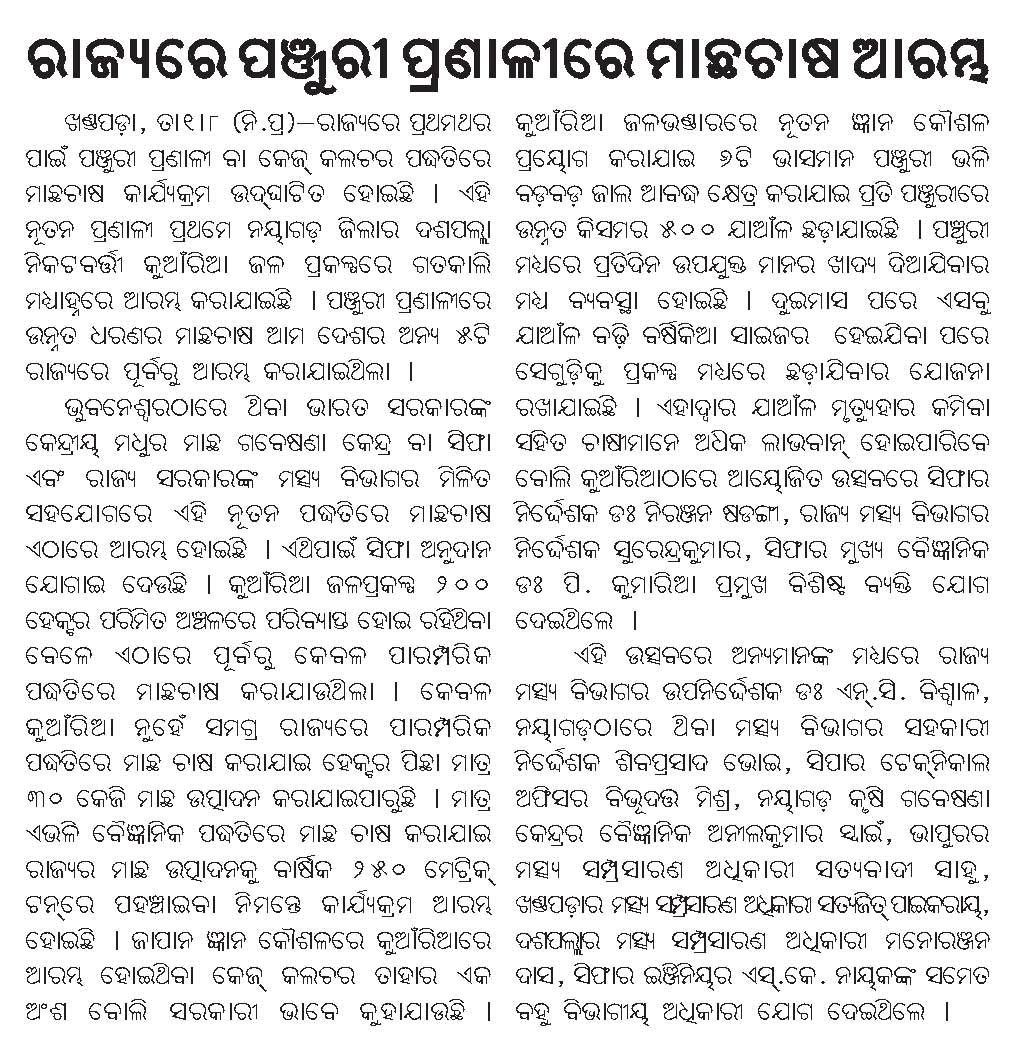
Fishery using “caged” approach in Orissa
Following is Samaja’s article on this.
Center willing to discuss and resolve differences so as to get consent of Orissa and Jharkhand on the new mining rules
If they indeed listen to Orissa’s concerns, take them into account and get a consent on the new mining policy that would be really wonderful and a break from the past. If the UPA government continues like this (need to approve the more IIT and IIM plan and make railways more equitable) then it will be one of the most equitable government of India ever. The following excerpts from a Reuters report really gives hope.
India’s new mining policy is likely to approved by the cabinet within the next two months, the junior mines minister said on Thursday.
T. Subbirami Reddy said the head of a ministerial panel set up to examine the policy would meet the chief ministers of mineral-rich Jharkhand and Orissa to resolve differences before sending the policy for cabinet approval.
“Once they give their consent, we will take it to the cabinet. It will take between one to two months,” Reddy said.
The new policy is expected to help foreign and domestic firms invest in the exploration and mining of gold, diamonds and metals like copper and zinc.
Two crores to modernize Berhampur station
Hindu reports on this. Following are some excerpts.
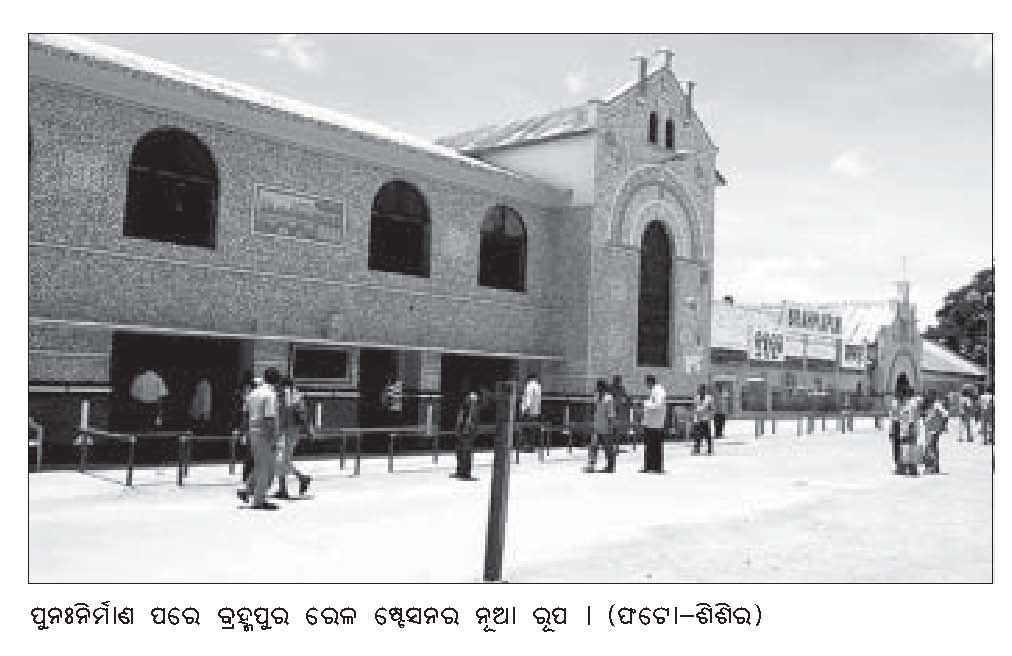
A sum of Rs. 2 crores has been sanctioned for the development and modernisation of the Berhampur railway station, Divisional Manager of the East Coast Railways P.K. Srivastav has said. Keeping its colonial architecture intact, work is on to add structures
to the existing station and to beautify it.Speaking to newsmen, Mr. Srivastav said to expand the station premises, the goods shed by the side of platform number three was shifted to Jagannathpur. A fourth platform would be added in place of the goods shed. The new platform and the continuing work on the second foot overbridge at the railway station were expected to be completed by2008. As per the new plans, the Berhampur railway station would have two entry gates in a bid to reduce rush at the main gate.
Following is a picture of the station that appeared in Today’s Samaja.
Tourism in the 11th Five year plan
Following are excerpts from a Telegraph report on this.
The government will develop 100 heritage circuits for tourists by the end of the Eleventh Five-Year Plan. Of these, 25 are expected to be of international standard.
The government plans to build world-class infrastructure at Hampi, Agra, Konark, Khajuraho, Orccha and Datia along with the Buddhist and Jain circuit tourist centres. Moreover, 10 new heritage circuits are expected to be identified every year. To develop cultural tourism, the government has identified six museums — one each in Calcutta, Delhi, Mumbai, Chennai, Bangalore and Cochin. These will be upgraded so that they can compete with global rivals.
Important religious pilgrimage sites will also be developed. The tourism ministry has identified 11 sites. These are the four dhams of Uttaranchal — Kedarnath, Badrinath, Yamunotri and Gangotri — Sabrimala in Kerala, Kamakhya temple in Guwahati, Dwarakadhish in Gujarat, Puri in Orissa, Ujjain in Madhya Pradesh, Kanchi Kamkioti and Rameshwaram in Tamil Nadu. …
Rakesh Mathur, president of ITC Welcome Heritage, said, “Heritage sites in India need to be looked after well. A combination of dining, storytelling and live entertainment can do wonders and create a lot of interest in travellers.”
Railway Reservation Facility introduced in Phulbani and Sundargarh District Post Offices
Reader R. P. Tripathy sent us the following item. Thanks.
Railway Reservation Facility has been introduced in Phulbani and Sundargarh District Post Offices. Earlier a person from Phulbani used to travel to Berhampur or BBSR for railway reservation and it will be a big respite for those people as the travelling expenses were much higher than the railway ticket itself. http://www.odisha.com/20070801
/fullstory/train%20ticket.html
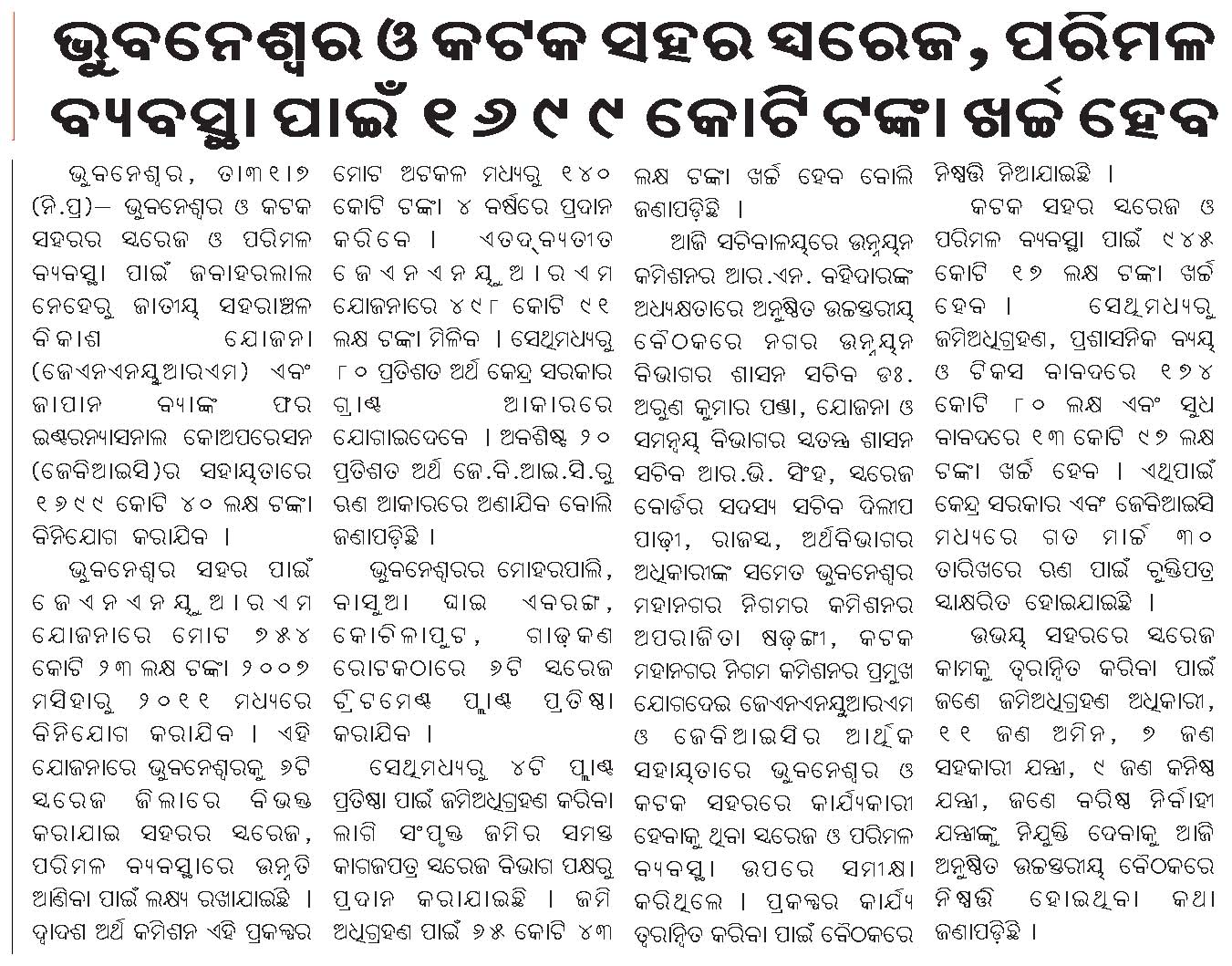
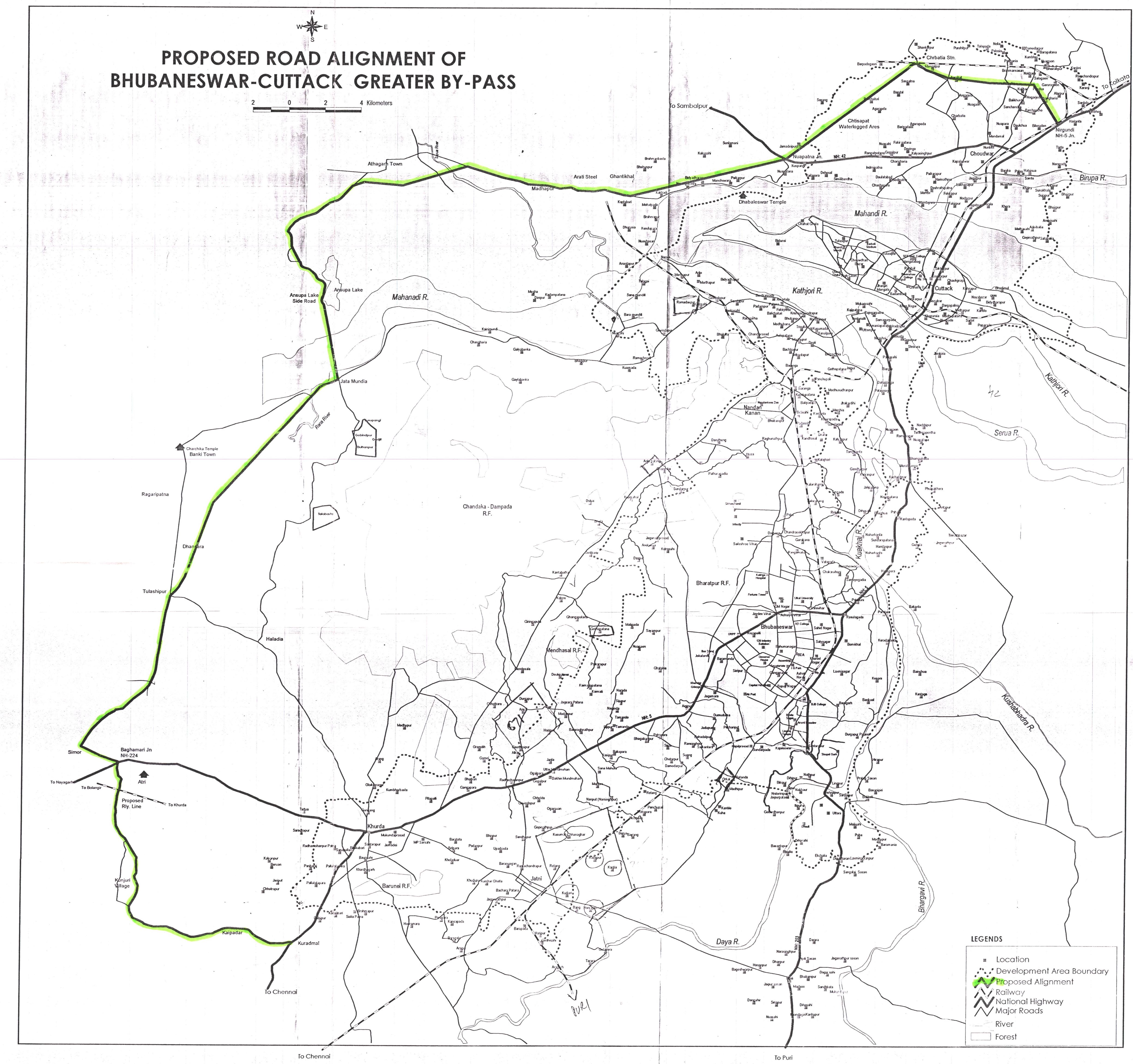
Sewerage and drainage improvement in Bhubaneswar-Cuttack
This is part of Bhubaneswar’s proposal for JNNURM. Following is Samaja’s report on it.
Govt grants environmental clearance to Posco steel plant
The Hindu reports that environmental clearance has been granted to POSCO steel plant. POSCO has earmarked 1,525 crores for environmental pollution control as per the Ministry of Environment and Forests (MOEF) as well as the state government conditions. Excerpts:
“The Ministry of Environment and Forests has given the environmental clearance for Posco’s mega steel project at Kujang near Paradip in Jagatsinghpur district of Orissa,” highly-placed official sources said.The Korean steel giant had signed a Memorandum of Understanding with the Orissa government in June 2005 pledging an investment of Rs 52,000 crore for setting up the plant.
“The project authorities shall utilise Rs 1,525 crore earmarked for environmental pollution control measures judiciously to implement the conditions stipulated by the Ministry of Environment and Forests (MOEF) as well as the state government. The funds so provided shall not be diverted for any other purpose,” a source quoted the Environment and Forests Ministry as saying, while granting clearance.
The clearance has been granted to the world’s third largest steel manufacturer for installing furnaces using FINEX technology only and on the condition that gaseous emissions from its various units should strictly conform to load/mass based standards notified by the government.
Earlier in April, the MOEF had granted its approval under Coastal Regulation Zone to the Korean steel giant’s proposal to set up a captive port at Jatadhari at a cost of Rs 17,113 crore.”
Arcelor-Mittal plans to speed-up its plan in Orissa
Hindustan Times and others report on this. Following are some excerpts from the Hindustan Times report.
Steel baron Lakshmi Mittal’s global giant Arcelor Mittal is planning to advance the construction at its 10 million tonnes (MT) Orissa plant and hopes to begin initial construction by mid-2008, as against the earlier date of 2009. …
The first phase of Arcelor Mittal’s plant in Orissa, with a capacity of six million tonnes, is likely to be commissioned by 2011.
The company has appointed Dastur & Co to carry out a detailed project report and environment management plan for the two sites, which are currently underway. Chief Executive Officer of Mittal Steel India Ltd, Sanak Mishra, said that major construction work in the site will be taken up in 2009 and the company has finalised the product mix of the proposed plant for both long and flat products.
Dalmia Cement’s subsidiary Orissa cement to double capacity
In a report Hindu says the following:
In an interaction with The Hindu, T. Venkatesan, Chief Executive Officer (Cement) of Dalmia Cement, said Orissa Cement, a subsidiary of the company, would also be expanding by doubling its capacity from the current 2.5 million tonnes.
Orissa MOU signees focus: Money Ispat
Moneycontrol reports on Money Ispat’s performance and its interest in Orissa. Following are some excerpts.
Net profit of Monnet Ispat & Energy Limited jumped by 82% at Rs. 48.55 crores in its 1st quarter of 2007-2008, vis-?-vis Rs. 26.64 crores in the corresponding quarter of last financial year. The company recorded total turnover at Rs. 234.53 crores as compared to Rs. 137.12 crores achieved in the corresponding quarter of last fiscal ?an increase of 71%. …
Emphasising its shift to energy from steel making, Delhi based Monnet Ispat & Energy Ltd. (MIEL) has signed an MoU with the Government of Orissa for setting up a 1,000 MW power plant at an estimated cost of Rs.4200 Crores. The pithead power plant will come up in the Angul district of Orissa. MIEL plans to put up the 1000 MW power project in two phases of 600 MW and 400 MW. The 1st phase will be set up at an estimated cost of Rs.2850 Crores and the 2nd Phase at a cost of Rs.1350 Crores.
“In the coming years, the company will be focused more on the energy business rather than steel. Within a year, 55% of the revenues will come from the energy business and the rest from steel.,” said Mr. Sandeep Jajodia, Managing Director, Monnet Ispat & Energy Ltd.
Whatever happened to “Remote Area Rail Sampark Yojana”
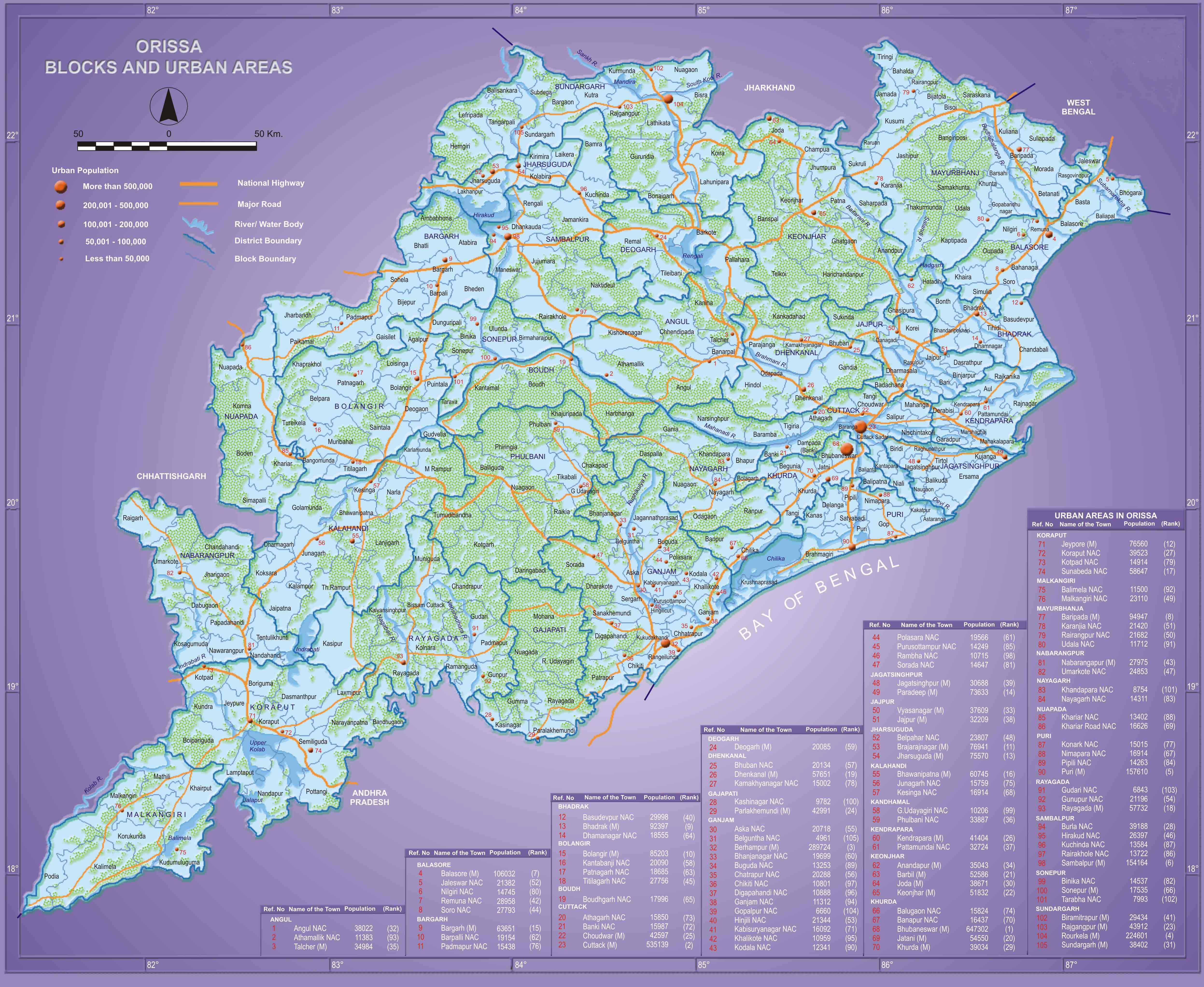
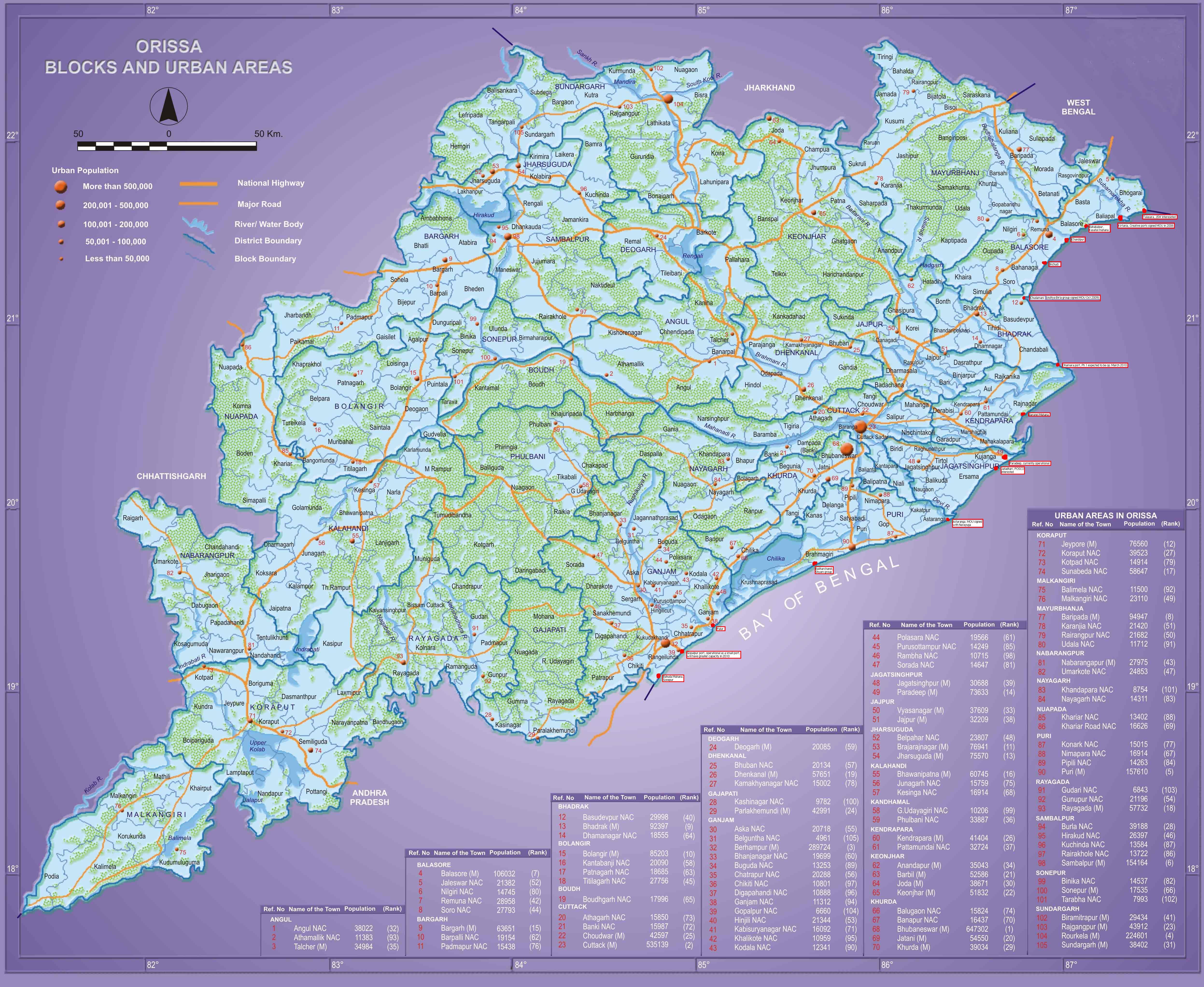
The 2004 Railway budget talked about “Remote Area Rail Sampark Yojana” which would have finished projects like Khurda Rd – Balangir in 5 years. However, it seems to have been forgotton by the UPA govt. and Lalu Yadav. Today, Rediff has a small report on it. I think Orissa should get together with the other states that are part of it (West Bengal, Chattisgarh, Jharkhand, Orissa, Rajasthan, and Madhya Pradesh) and demand that this program be revived. Following are excerpts from the 2004 Rail budget that talks about this program.
Remote Area Rail Sampark Yojana
- 35. Railways have a large shelf of over 230 projects worth about Rs. 43,000 cr, for construction of New Lines, Gauge Conversion, Doubling, Electrification and Metropolitan Transport Projects. Even with the enhanced budgetary support, non-budgetary initiatives under National Rail Vikas Yojana and other cost sharing mechanisms apart from Defence funding of some projects of strategic importance, there will still be projects valuing Rs. 20,000 cr which would remain unfinished even after the next five years. A large number of these have been sanctioned on socio economic considerations with the intention of connecting remote and backward areas with the rail network. However their progress is very slow on account of inadequate funding, which causes dissatisfaction. Connecting these areas with the rail network will facilitate the economic and social development of these areas and will provide major employment opportunities during construction and thereafter. Keeping these factors in mind, it has been decided to speed up the execution and completion of these projects also in the next five years. I am happy to inform the House that this would be done through an ambitious ‘Remote Area Rail Sampark Yojana’, with an additional outlay of Rs. 20,000 crore.
- 37. This decision to accelerate the completion of all projects in five years is expected, on a broad estimate, to provide yearly employment to about 3 lakh persons during the construction period. Once opened for traffic, these lines would also require about 18000 persons per year for normal maintenance and operations, on incremental basis. Apart from this, it is expected that there will be scope for indirect employment of nearly 55000 persons per year. The ‘Remote Area Rail Sampark Yojana’ will go a long way in changing the economic and social scenario of the remote and backward regions of the country and bringing the people of these areas into the mainstream. Further, the demand for steel, cement, rolling stock, fittings, components, plant and machinery will also be generated, boosting the economic growth of the entire country.





.jpg)