Archive for 2011

IMMT scientists are now planning to set up a demonstration plant at Orissa Sands Complex of IREL at Chhatrapur for processing ilmenite

Bhubaneswar-Berhampur, Ganjam, Research institutions, Titanium 1 Comment »

Following is from a report in Telegraph by Bibhuti Barik.

The Institute of Minerals and Materials Technology (IMMT) here has perfected the technology of processing ilmenite, a compound of iron and titanium, which is iron-black or steel-gray, found abundantly in the sands of Orissa’s beaches.

IMMT scientists are now planning to set up a demonstration plant at Orissa Sands Complex, a division of Indian Rare Earths Limited (IREL) at Chatrapur, for processing ilmenite as the ore is found in the beach sand of Chhatrapur and is being processed by IREL. The cost-effective technology will work wonders for extracting titanium dioxide and high-value iron from low-grade ilmenite.

Ilmenite is non-toxic and its use in biomedical substances does not create any physiological problem. On the other hand, titanium, in its pure metallic and alloy forms, finds applications in aerospace, defence applications, chemical and related metallurgical industries.

“The ilmenite processing technology developed by IMMT scientists will help the nation as the prime raw material for titanium production — rulite — is now in short supply. So, ilmenite is the best alternative raw material for fulfilling the demand of titanium,” said P.S. Mukherjee, chief scientist and head, advanced materials and technology department, IMMT.

“The new technology serves two benefits — it does not produce toxic by-products and it produces high value iron as a value-added by-product for the automobile industry,” said the chief scientist.

… “But this new process is an environment-friendly one. This is for the first time such a technology is being planned in the country. With proper industry support and more and more R&D support, it can be developed further,” the scientist said.

The world’s reserve of ilmenite ore is estimated at around 1.8 to 2 billion tonnes and India has the largest and richest reserve. The commercial deposits are found in the beach sands of Orissa, Tamil Nadu and Kerala. However, only 0.4 million tonnes are processed by IREL. Majority of the deposits are exported as pure ilmenite without any value addition.

IMMT director Baradakanta Mishra said: “Processing technologies of two metals — nickel and ilmenite — perhaps is the best contribution of IMMT to the country. However, more financial help should be extended to the laboratory by the industry and the government. Even with a limited reserve, China is supplying 70 per cent of the Earth’s rare materials whereas we are exporting valuable sand-rich ores to foreign countries without any value addition. The pilot plant should be scaled up and more fund flow to IMMT can result in innovative research in mineral processing.”

Naveen makes demand on new NH designations and more mine royalty; points out super-normal profit by miners and Australia’s steps to levy higher taxes on iron ore

Chief Minister's actions, Iron Ore, National Highways 8 Comments »

Following is an excerpt from a report in ibnlive.com.

Naveen demanded that five State Highways — Berhampur-Koraput, Madhapur-Rayagada, Phulnakhara-Konark, Kuakhia-Aradi-Bhadrak and Palasa-Khariar — be upgraded to NHs.

Following are excerpts from a report in Hindu.

The Orissa Chief Minister, Mr Naveen Patnaik, has sought 50 per cent share in “super normal profit” earned by private mine owners and said he would raise the issue of imposition of a mineral resource tax on iron ore during the National Development Council (NDC) meeting on Saturday.

“Mining companies are making super normal profits in Orissa. People of Orissa deserve 50 per cent of this…a quarter of our population is of tribals and we will put this profit to developing our areas,” Mr Patnaik said.

He said this was essential as most of the mining companies were operating on tribal land without doing justice to the people. Despite the State being the owner of the resources, the mine owners are benefiting beyond any measure of reasonable returns, he said.

“I have already written to the Prime Minister about it. I will be speaking about it in the NDC meeting. Rent-resource tax from the mining companies should be levied on Australia’s pattern,” he said.

In a July 30 letter to the Prime Minister, Mr Patnaik said, “The insatiable demand for iron ore in the export market has resulted in iron ore becoming highly profitable commodity, with returns from mining being far in excess of economically acceptable rates.”

The letter mentioned that the super-normal profits being made are evident from the audited operational profits of 80 per cent by miners, which is unheard of in other industries.

The Chief Minister had sought imposing a 50 per cent mineral resource tax, taking cue from Australia which has decided to levy higher taxes on iron ore from July 2012.

Odia movies in the Internet: work in progress.

Odia movies 1 Comment »

Following are some of the Odia movies that I found in the Internet (mostly in youtube).  As I see them, I will add some comments.

  1. Agnishikha.
  2. Allo mo kandhei.
  3. Bhukha.
  4. Chaka chaka bhaunri.
  5. Dhanre rakhibu sapatha mora.
  6. Dhire dhire prema hela. (Barsha and Sabyasachi. So so. First half is tolerable. Second half is atrocious.)
  7. Dil tote deichhi. (another link)
  8. I love you. (another link) (Remake of a 1999 Tamil movie) [Highest grossing Odia film in Box office]
  9. Jajabara
  10. Kandhei akhire luha.
  11. Kau duniyaru asila bandhu.
  12. Lakhye siba puji paichi pua.
  13. Laksmana Rekha
  14. Laxmi Pratima.
  15. Love Dot Com.
  16. Manini
  17. Mate anidela lakhya faguna.
  18. Megha sabarire asiba pheri.
  19. Mita re mita. (another link)
  20. Mu Sapanara soudagara.
  21. Nandini I love you.
  22. Neijare megha mote. (Barsha and Anubhav.)( Loved it.)
  23. Pagala karichhi paunji tora.
  24. Pagala Premi.
  25. Prem rogi. (another link)
  26. Priya mo priya.
  27. Sahara Jaluchi. (another link)
  28. Samaya hatare dori.
  29. Sanju aou Sanjana. (Babusan.) (Just saw a few minutes. Looks like a remake of the Telugu film Parugu.)
  30. Sasura ghara zindabad.
  31. Sathi re.
  32. Satru Sanghar.
  33. Subha bibaha. (Barsha, Akash, et al. Did not like it. Badly edited.)
  34. Suna chadhei mo rupa chadhei, 2009. (another link) (Watched this. It is a remake of a  2005 Telugu hit. The actress Barsha has done well, even when compared to Trisha in the Telugu original. Anubhav is not impressive, especially when one compares to Siddharth in the Telugu one. Siddhant has done ok, but Srihari in the Telugu one is better. Finally, Prakash Raj in the Telugu one is unmatchable.)
  35. Tate mo rana. (another link)
  36. To akhire mo akase ki ranga lagile.
  37. To bina bhala lagena. (another link)
  38. Topae sindura ditopa luha.
  39. To paeen.
  40. Tora mora jodi sundara.
  41. Tu eka ama saha bharasha.
  42. Tu mo akhira tara.
  43. Tu mo girlfriend.

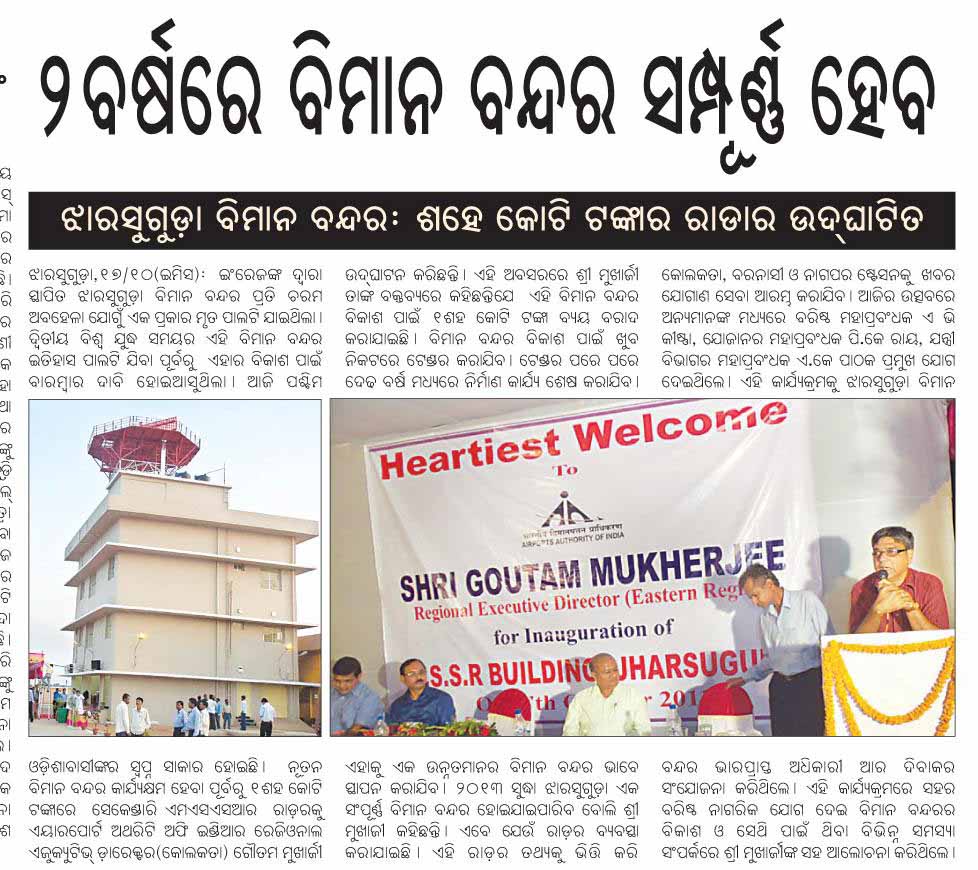
New radar inaugurated at Jharsuguda airport; Airport expected to be functional in two years (in 2013)

Jharsuguda, Jharsugurha, Sambalpur-Burla-Jharsuguda 8 Comments »

Thanks to Saket Sahu @ Orissatoday google group for the pointer.

A park to be built in Bhubaneswar especially for differently-abled kids

Bhubaneswar- Cuttack- Puri, Khordha, Parks Comments Off on A park to be built in Bhubaneswar especially for differently-abled kids

Following is from a report in Pioneer.

The Indian Academy of Paediatrics, Bhubaneswar Municipal Corporation and sahidnagar Socio-Cultural Society have planned a unique park for the differently-abled children of the city to be built up approximately at a cost of Rs 3 crore on PPP mode.

As per national coordinator of IAP Disability Chapter Dr Arabinda Mohanty, the park is planned over an area of 17,000 sqf near the ESI Hospital and will provide an entertaining and amusing centre to over 700 spastic children in the city.

The proposed park will be far ahead of the parks in Mysore and Bilaspur (Chhatisgarh) in many aspects including it being 100 per cent disabled-friendly with merry-go-round provisions for children in wheel chairs and modern gadgets for amusement , besides physiotherapists, supporting staff and a standby ambulance.

Dr Mohanty said though the park will be meant for the wheelchair-bound children, normal children would also be allowed but only after they are sensitised to related issues. “Entry of normal children will help in mainstreaming of the spastics and in increasing the understanding of the normal children about spasticity,” he said.

Odisha to expand areas under coffee cultivation to 22,700 hectare by 2021-22 with an investment of Rs 400 crore

Aluminium, Bauxite, Birlas, Coffee development, Ganjam, Kalahandi, Kandhamala, Keonjhar, Koraput, NALCO, New Indian Express, Indian Express, Financial express 4 Comments »

Following are excerpts from a report in ibnlive.com.

The coffee plantation would be taken up in the undivided Koraput district where currently about 1,300 hectares are under cultivation. …

It has been decided to invest the ` 400 crore over a period of 10 years from 2011-12. The ICB would fund ` 35 crore for a programme on organic coffee production in the State. Rest of the funds will be pooled from MGNREGS, Revised Long Term Action Plan (RLTAP) for KBK districts and other schemes.

As per the survey conducted by the Coffee Board, an area of 11,650 hectare in the Koraput, Kalahandi, Ganjam, Phulbani and Keonjhar districts has been found suitable for coffee cultivation.

Public sector industries like Nalco, Hindustan Aluminium Company and a host of private sector enterprises have evinced interest to take up coffee cultivation in about 1,000 acres which is mined for bauxite ore extraction.

 … For Orissa, the Board is implementing a Special Area Programme with the objective of checking ‘Podu’ cultivation, rejuvenating small coffee holdings and expanding coffee plantation in the tribal sector by providing a subsidy of ` l5,000 per hectare.

Besides, the Board is also providing financial assistance for installation of coffee processing units and imparting training to coffee growers on latest coffee husbandry practices and scientific methods of cultivation.

Six hulling units were also supplied under the scheme to the State during 1999- 2000 to process coffee at farm level.

At present, there are about 122 private coffee growers in the Koraput who have taken to commercial cultivation. …

Air India introduces Delhi-Portblair flight with stopover in Bhubaneswar;

Air India/Indian, Bhubaneswar, Bringing International Connectivity, Uncategorized 12 Comments »

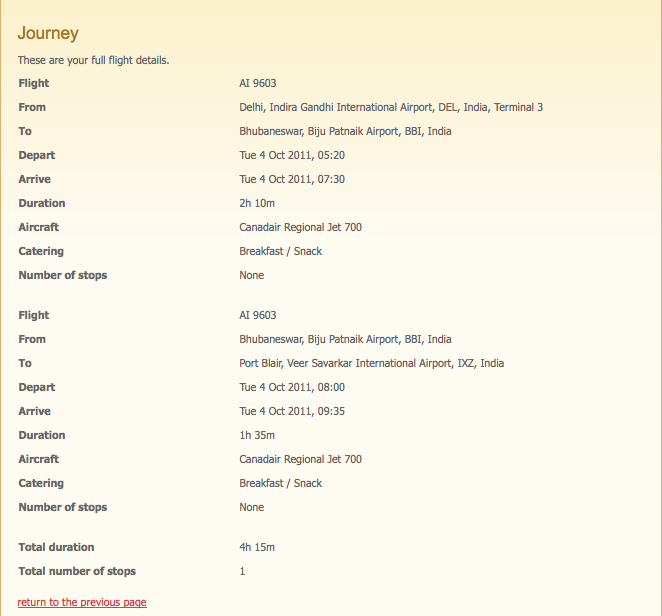
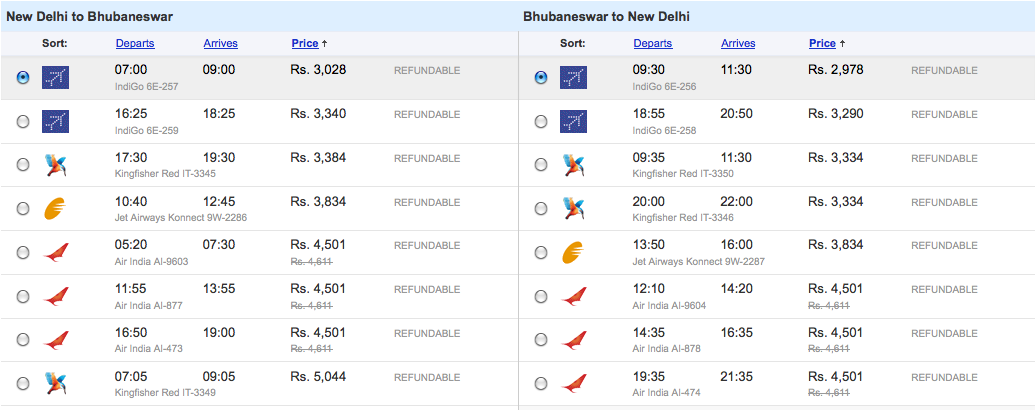
Update on 10th October 2011: The Delhi – Bhubaneswar – Port Blair Air India (6 days a week) flight will allow boarding and deplaning of passengers at Bhubaneswar. This will not only provide Bhubaneswar – Port Blair connectivity; it will also incraese connectivity between Bhubaneswar and Delhi. Air India also plans to have another daily Bhubaneswar – Delhi flight taking the total number of daily AI flights between these cities to (almost) three   and taking the total number of daily Bhubaneswar – Delhi flights to almost eight – 7 dailies and one 6 days a week. Following is a screen copy from http://www.cleartrip.com/ on the dates Nov 2 2011 and Nov 3 2011.


Following is an excerpt from a report in Deccan Herald.

Keeping in mind the high tourist potential, Air India subsidiary Alliance Air has introduced a direct flight to Port Blair from here via Bhubaneswar and would operate a new 70-seater jet plane.

Giving holiday makers another reason to cheer, Air India’s direct flight AI 9603/9604 would be operated with Bombardier’s CRJ-700 on all days of the week, except Saturday, a spokesperson said.

The above news item is confirmed from the Air India web site. See the screen capture below.

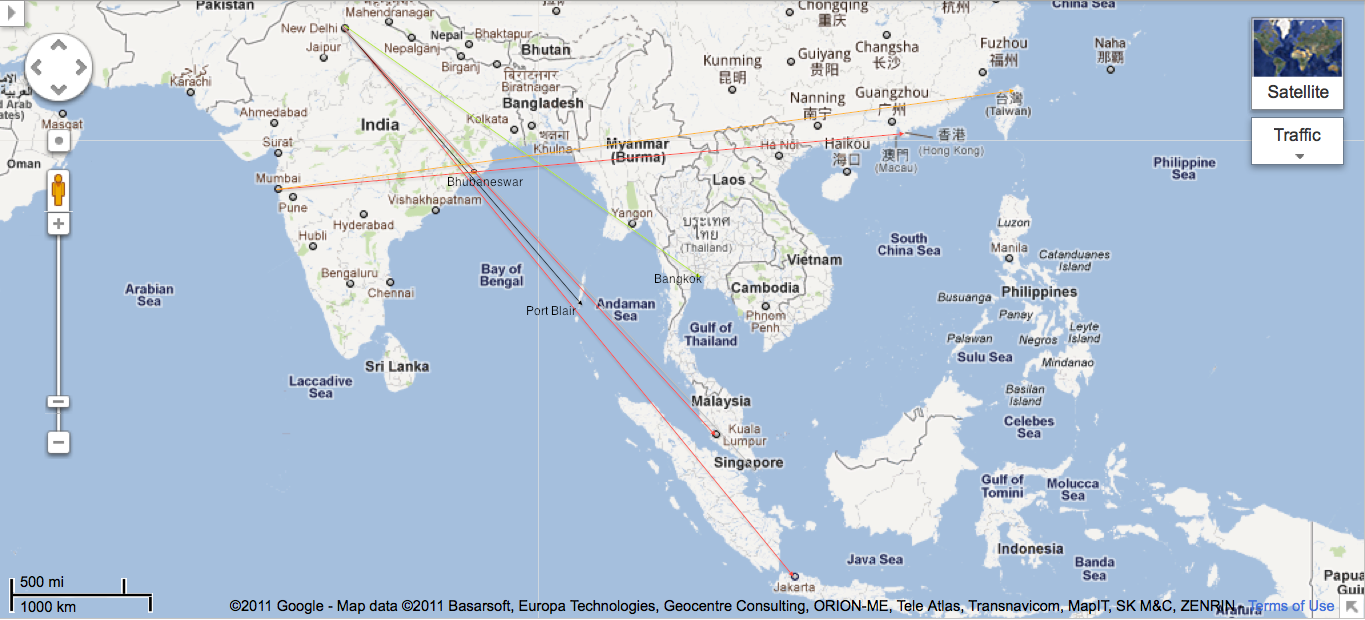
As the following map shows Bhubaneswar is very close to the straight line between Delhi and Port Blair. The stop-over in Bhubaneswar allows Air India to use a smaller aircraft that can be refueled in Bhubaneswar. I hope Air India will allow people to get on and off at Bhubaneswar.

As the map above shows Bhubaneswar is also very close to the straight line connecting Delhi to Jakarta, Delhi to Singapore and Delhi to Kwalalumpur. I hope  some of the airlines take note of that and introduce flights between those places with a stopover in Bhubaneswar.

Update: Mumbai to Hongkong and Mumbai to Taipei also passes very close to Bhubaneswar. Updated the map above to illustrate that.

Multiple funding sources to help further develop various tourist attractions and infrastructure in the coastal areas

Berhampur- Gopalpur- Chhatrapur, Bhadrakh, Bhubaneswar- Cuttack- Puri, Bhubaneswar-Pipli- Konark, Bhubaneswar-Puri, Business Standard, Central govt. schemes, Chandaka, Circuit: Bhubaneswar-Chilika-Puri, Dhamara- Chandbali- Bhitarakanika, Ganjam, Gopalpur-on-Sea, Heritage sites, Historical places, Jagatsinghpur, Kendrapada, Khordha, Konark, Lord Jagannath, Nandan Kanan, Odisha govt. action, Paradip - Jatadhari - Kujanga, Puri, Puri, Puri - Konark, Raghurajpur, Shamuka Beach project, Sites in and around Bhubaneswar, Telegraph, Temples, Tourist promotion Comments Off on Multiple funding sources to help further develop various tourist attractions and infrastructure in the coastal areas

Following is from a report in Telegraph.

The capital will soon have a mega-tourist circuit for which the Centre has sanctioned Rs 8.14 crore.

The proposed tourist circuit envisages, among others things, renovation of two major roads in Old Town area, construction of a ‘parikrama’ around Lingaraj temple, soft-lighting for eight protected monuments and two tourism interpretation centres.

While the tourism department is trying to revive Ekamreswar, the miniature temple of Lord Lingaraj near Lingaraj police station, a dedicated road corridor will be constructed to link Puri, the Old Town area and Khandagiri via Dhauli.

Moreover, a 3,000-seater amphitheatre will be constructed opposite Madhusudan Park at Pokhariput.

… Samal spoke to reporters after the heritage walk, which was held today as part of World Tourism Day function.

The circuit will aim at facilitating various cultures as the city is perhaps the only one place in the region where three major religions — Hinduism, Jainism and Buddhism — have their presence and the Daya riverbed is linked to the transformation of Emperor Ashok from Chandashok to Dharmashok.

… While the mega circuit will be part of the development of the ambitious Bhubaneswar-Puri-Chilika tourism sector, the Old Town area of the city will have a 40-feet road near the temple connecting Kotitirtheswar Lane and a proposed three-acre parking site.

Later, the same road will be extended up to Kedar Gouri temple. These two roads, in turn, will provide a better corridor so that tourist vehicles can pass through the areas smoothly. Similarly, a ‘parikrama’ or circular road will be planned around the Lingaraj temple.

“Apart from providing better connectivity to the Old Town area, the side walls of various buildings and structures will be decorated with tiles of red laterite stones. The concept has already been adopted in various western cities and states such as Rajasthan. …

The mega circuit will also emphasise on infrastructure development to connect various sites of Buddhist and Jain religious interests. Other than central assistance, there is also a plan to develop a road connecting Gangua nullah (through its right embankment) to the historical Kapileswar village. Another road will link Ganesh Ghat near Dhauli Peace Pagoda with the Jatni Kapilaprasad Road.

According to the pre-feasibility report, the state government will spend more than Rs 30 crore on the two proposed roads.

“These two roads will connect Dhauli with Khandagiri and the travellers and tour operators need not take the longer Cuttack-Puri Road via Rasulgarh to reach the historical Jain sites. Even nature lovers visiting places such as Deras in Chandaka or Nandankanan Zoological Park can take this road in future,’’ said the MLA.

“The state government has also asked the Bhubaneswar Development Authority to construct an amphitheatre opposite Madhusudan Park in Pokhariput. This will resemble the amphitheatre at the Utkal Sangeet Mahavidyalaya near Rabindra Mandap,’’ he said.

Sources at the public works department said: “There is a plan to construct a flyover over the railway level crossing at Pokhariput for Rs 42 crore. While the state government will share Rs 22 crore, the rest will come from the railways. Once the flyover is commissioned, the road from Dhauli to Khandagiri will become a vital link to various religious centre.’’

Under the mega tourism circuit, temples such as Lingaraj, Rajarani, Mukteswar, Rameswar, Parsurameswar, Lakshmaneswar, Bharateswar and Satrughneswar will be illuminated with light emitting diode based ‘dynamic lighting system’ for which Rs 3.98 crore will be utilised. The project will be executed by the Orissa Tourism Development Corporation.

Hinting at the development of two interpretation centres near the Lingaraj temple, Samal said: “While one will be constructed on the premises of Sibatirtha Mutt, the other one will come up near the employees’ colony.’’

On the proposed tourist interpretation centre near Khandagiri-Udaygiri caves, he said the project would be completed within two or three months time.

Following is from a report in Business Standard.

The Orissa government has decided to promote heritage tourism at eight locations along the coast line with an investment of Rs 7.41 crore in the next five years.

Based on archeological, architectural, sculptural and historical importance, the selected structures, identified by the state archeology department, would be taken up under the World Bank funded Rs 227.64-crore Integrated Coastal Zone Management Project.

… The structures identified to get a face lift under the scheme included Potagarh (Buried Fort), located on the bank of river Rushikulya in Ganjam town which stands as a mute witness to the vicissitudes of history in Orissa.

Apart from historic Potagarh, the British Cemetery near Ganjam town, Bhaba Kundaleswar temple of Manikapatna, Baliharichandi temple near Puri, Hariharadeva temple, Nairi, Bateswara temple, Kantiagada (Ganjam), Jagannath temple, Pentha and Jamboo Colonial Building, Kendrapara will be refurbished under the scheme.

Preservation of ancient monuments under the project will include their protection, structural conservation, chemical conservation, landscaping and maintainance from time to time.

… The officials of the Gujarat and West Bengal projects along with a World Bank team visited various places including Ganjam and Kendrapada districts in the state recently to review the implementation of the project. Project Director of ICZM (Orissa) AK Pattnaik briefed the team about various steps taken under the project and their progress. The scheme, whose tenure spans from 2010 to 2015, is being implemented in two coastal stretches: Paradeep to Dhamara and Gopalpur to Chilika.

Plans for a port-based cluster of wood-based industries in Paradip

Clusters, IDCO, Jagatsinghpur, Odisha govt. action, Paradip - Jatadhari - Kujanga Comments Off on Plans for a port-based cluster of wood-based industries in Paradip

Following is an excerpt from a report in Telegraph.

The state government is planning to set up a port-based cluster of wood-based industries in Paradip on the Kandla model. The hub will manufacture wooden products with imported timber and market them within and outside the country.

“The entrepreneurs will set up their units with their own funds. We will facilitate the project by providing land and other infrastructure. The state run Industrial Development Corporation has earmarked 100 acres of land for the purpose,” said industries minister Raghunath Mohanty.

“The beauty of the project is that the wood-based units will use timber imported from South Africa, New Zealand and West Indies. The proposal is on the lines of Kandla project in Gujarat where several wood-based industries are operating. The entire raw material is imported from outside,” said forest and environment minister Debi Prasad Mishra.

Infrastructure hurdles getting noticed; Some Odisha projects in focus

Aluminium, Anil Agarwal, Bauxite, Business Standard, CENTER & ODISHA, Haridaspur - Paradeep (under constr.), Kalahandi, Talcher - Bimlagarh (under constr.), Vedanta 6 Comments »

In the following excerpts from a report in Business Standard Haridaspur-Paradip and Talcher-Bimlagarh are listed as strategic projects. I hope they are fast tracked.

… Delays in land acquisition and forest clearances continue to stand in the way of completing strategic projects like the 82-km Haridaspur-Paradip line and the 154-km link between Talcher and Bimlagarh, both in Orissa. While the first project is to give good port access to units in the steel hub of Kalinganagar, the second is designed to step up evacuation of coal from mines at Angul and Talcher.

…This is why India, endowed with the world’s fifth largest bauxite deposits and the fourth largest coal reserves, has emerged as a preferred place for making aluminium. Within the country, Orissa is where every aluminium maker wants a presence. That is why the Vedanta group, in spite of being solidly anchored in Chhattisgarh, thanks to its 50 per cent ownership of Balco, with capacity of 345,000 tonnes and then giving shape to a 650,000-tonne smelter there, wants to create alumina capacity of five mt and smelting capacity of 1.6 mt in Orissa, with adequate upstream integration in bauxite mining and coal-based power.

NAY SAYERS
Unfortunately, Vedanta is not able to realise what it has set out to do in Orissa, as it fell foul of pressure groups such as Amnesty International and Survival International and also of the ministry of environment and forests. The Niyamgiri Hills, from where Vedanta’s refinery is to draw bauxite, is considered sacred by Dongria Kondh tribesmen. But why should the company be stopped to take out bauxite from there if it is ready to resettle the displaced people and practise environment-friendly mining?

As a result of the impasse, Vedanta is required to source bauxite from outside, totally upsetting the considerations for hosting a refinery at nearby Lanjigarh. The denial of mining at Niyamgiri is setting a bad precedent for the mining sector. Redemption for Vedanta would hopefully come, with the Orissa government committed to offering alternative bauxite deposits.

There are some recent news on Vedanta’s expansion in Lanjigarh. But the news are confusing. Following is an excerpt from a September 17th report in Times of India.

Vedanta has suffered another setback in its fight-back to expand the aluminium refinery in Orissa after the Union environment ministry had struck down its environment clearance for violations.

The Cuttack bench of the Orissa High Court backed the environment ministry and ordered that Vedanta would have to apply afresh for a clearance for expansion if it wants to.

Following is an excerpt from a September 19th report in ndtv.com.

The ministry of environment and forests has cleared Vedanta Aluminium’s project in Lanjigarh, Orissa. 

The expansion of Anil Agarwal-led Vedanta Aluminium’s four million tonne Lanjigarh refinery plant in Kalahandi had been put on hold by the Union Environment Ministry  on October 21, 2010.

… Environment ministry’s expert appraisal committee (EAC) has cleared the project with 70 conditions, sources told NDTV. Major conditions among them are:  Five per cent of the total project cost would be spent on social welfare projects.The company will maintain air, water quality & develop 164 hectare of plant area as green belt.

Others conditions say that the company will also submit rehabilitation and resettlement policy covering tribals, which should be in line with government policies. The company will also be required to submit corporate environment policy approved by its board.

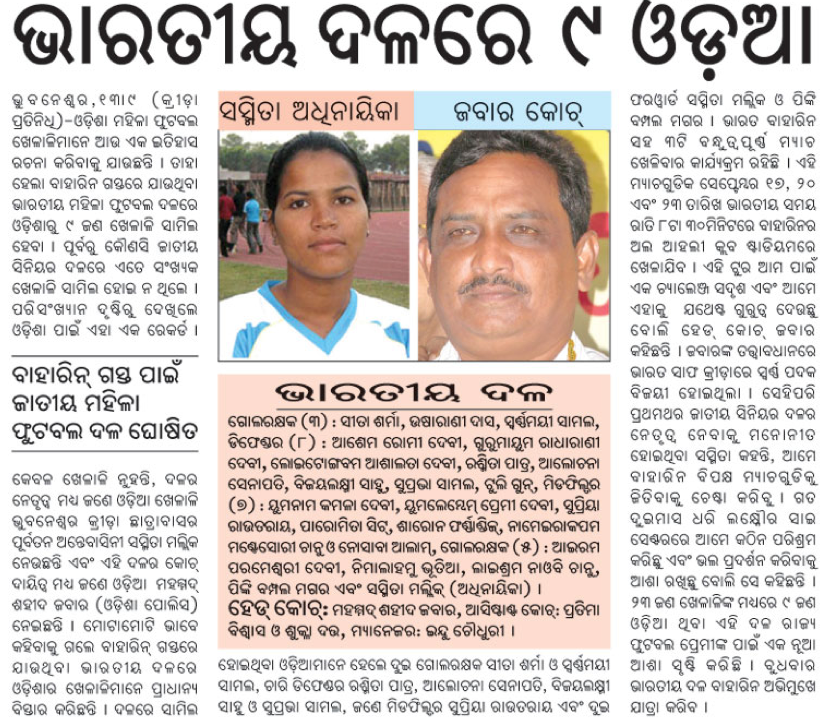
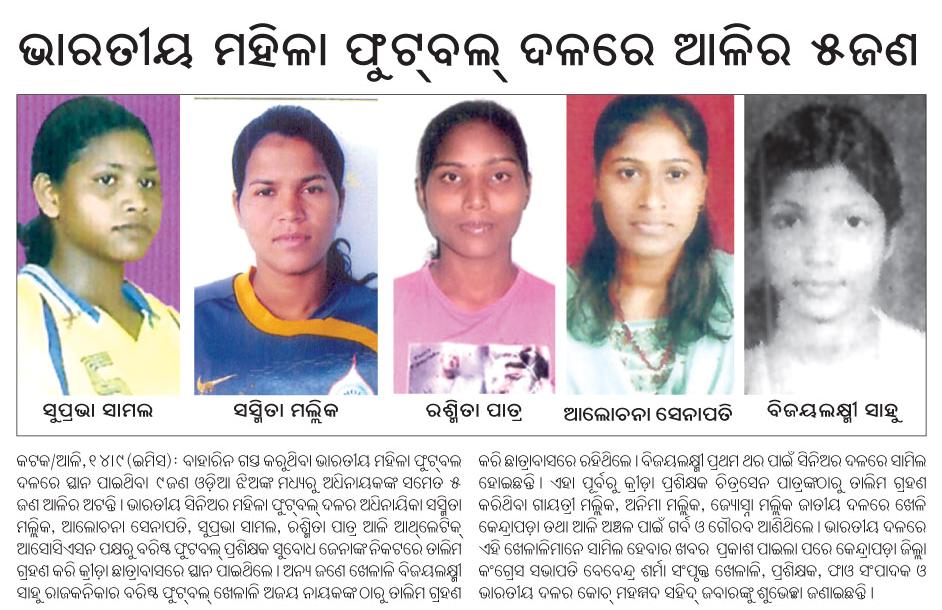
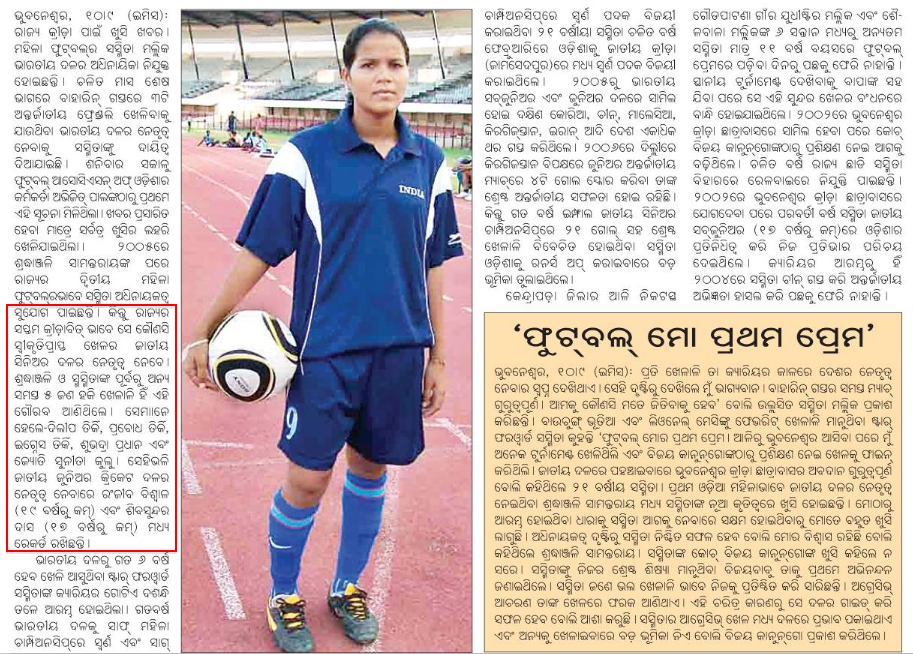
Nine of the 23 players of the Indian national women’s soccer team are from Odisha: Dharitri; Update: 5 of them are from Aali in Kendrapada district

Women's footbal Comments Off on Nine of the 23 players of the Indian national women’s soccer team are from Odisha: Dharitri; Update: 5 of them are from Aali in Kendrapada district

Following is from Dharitri.

Following is from Sambada.

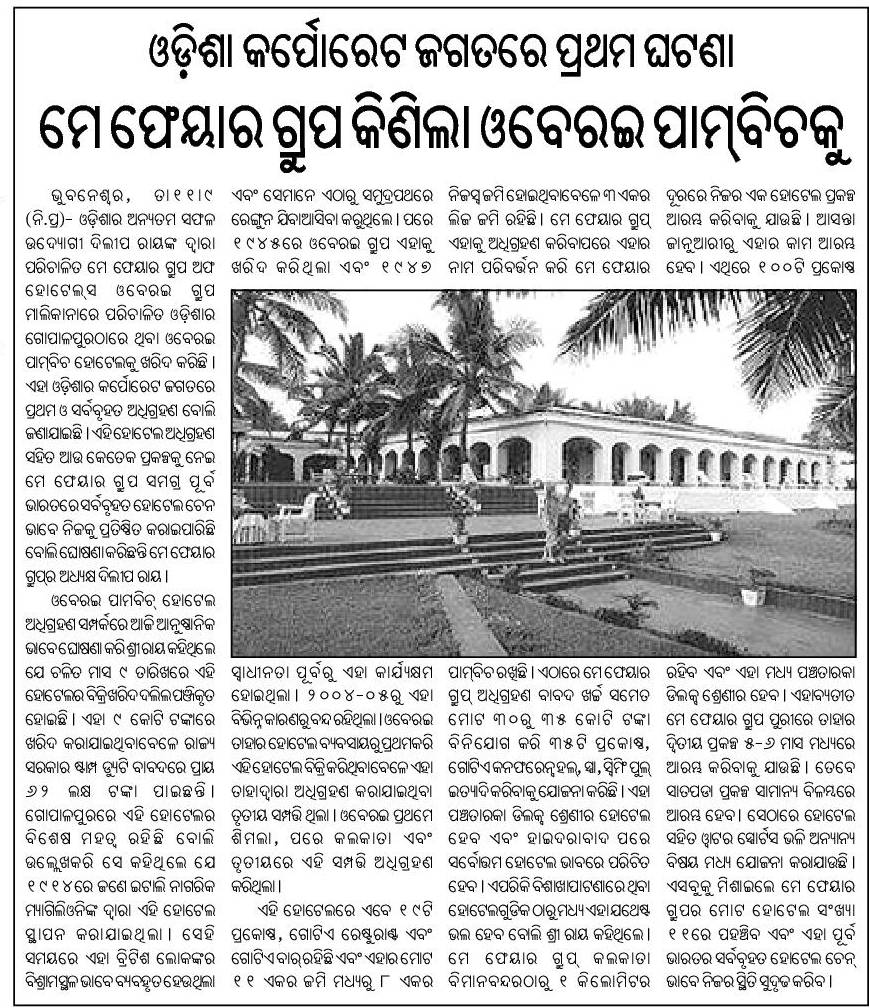
Mayfair group buys Oberoi palm resort in Gopalpur: Samaja

Berhampur- Gopalpur- Chhatrapur, Ganjam, Gopalpur-on-Sea, Hotels and resorts, REAL ESTATE 1 Comment »

Sasmita Mallick, captain of the national Women’s soccer team, is the seventh Odia player to lead a national team: Sambada

Kendrapada, Men's hockey, Women's footbal, Women's hockey Comments Off on Sasmita Mallick, captain of the national Women’s soccer team, is the seventh Odia player to lead a national team: Sambada

The others are:

  1. Dilip Tirkey (Men’s Hockey)
  2. Prabodh Tirkey (Men’s Hockey)
  3. Ignace Tirkey (Men’s Hockey)
  4. Subhadra Pradhan (Women’s Hockey)
  5. Jyoti Sunita Kullu (Women’s Hockey)
  6. Shradhanjali Samantaray (Women’s Soccer)

Odisha single window committee (SWC) approves investment of Rs 1,286.61 crore

Bargarh, Bhubaneswar- Cuttack- Puri, Cement, Electronics, Food processing, Jagatsinghpur, Jharsugurha, Jharsugurha- Brajarajnagar- Belpahar, Khordha, Paradip - Jatadhari - Kujanga, Sambaplur- Burla- Bargarh- Chipilima, Single Window Clearance (SLSWCA), Thermal Comments Off on Odisha single window committee (SWC) approves investment of Rs 1,286.61 crore

Following is an excerpt from a report in ibnlive.com.

The single window committee (SWC) on Friday approved proposals for four industrial units, two of them power plants, with an investment of Rs 1,286.61 crore.

… The proposal of M/S Beverages Private Limited to set up a soft drink beverages unit with capacity of one lakh crates per annum at Atabira in Bargarh district with an investment of Rs 59.61 crore was approved in the meeting.
Similarly, the proposal of M/S Essar Power Orissa Limited to set up 4×30 MW captive power plant in two phases at Paradip with an investment of ` 683 crore was also given the green signal.

It is expected that the project will provide employment opportunity to 200persons.

The proposal submitted by Investa Ventures Limited for setting up a LED manufacturing plant and incubation park at Chandaka near Bhubaneswar with an estimated investment of Rs 190 crore was also approved.

The plant will produce energy saving LED electric bulbs and tubes and is expected to open employment opportunities for 470 persons.

Besides, the proposal of M/S Ultra Tech Cement Ltd for expansion of the existing cement grinding capacity from 1MTPA to 3 MTPA at Jharsuguda Cement Works and bulk terminal in Cuttack district with an investment of ` 354 crore has also got the approval of the committee.

India plans new major ports in each of its 9 coastal states. Why? Why not let the private sector, which is very much interested in setting up ports, take care of it?

Central govt. schemes, Ports and waterways 3 Comments »

Following is an excerpt from a report in Business Standard. (Thanks to Abhishek for the pointer.)

The government has envisaged an investment of more than Rs 22,000 crore for setting up nine new major ports in the country over the next five years.

The Ministry of Shipping has asked nine coastal states — West Bengal, Orissa, Andhra Pradesh, Tamil Nadu, Kerala, Karnataka, Goa, Maharashtra and Gujarat — to select sites for setting up a major port each. It is awaiting a response from all nine states.

"We have written to all the nine (maritime) states and have asked them to select site for the major port," a Shipping Ministry official said, adding that construction of each port would cost about Rs 2,500 crore.

The 12 existing major ports are Mumbai, the Jawaharlal Nehru Port Trust, Kolkata (with Haldia), Chennai, Visakhapatanam, Kochi, Paradip, New Mangalore, Marmagao, Ennore, Tuticorin and Kandla.

… Any port with two or more berths with facilities and equipment capable of handling 100,000 tonne per month of cargo from ocean-going ships is categorised as a major port.

The Shipping Ministry plans to create port capacity of around 3,200 million tonne to handle the expected traffic of about 2,500 million tonne by 2020.

… About 90 per cent by volume and 70% by value of the country’s international trade is carried through maritime transport.

For some reason I feel there is a catch somewhere.

To start with with private parties willing to spend their own money in setting up ports, why does the central government needs to spend its tax earnings on this. It should focus on elements for which private funding is lacking.

Other arms of the central government are trying to sell-off equity in public sector units to get money for other developmental things. With that background it does not make sense for India to spend money on things (new ports) that the private sector can do.

Perhaps some of the readers can suggest some perspectives where the above makes sense.

What is corruption? Is not fulfilling (in spirit) the bond you sign corruption or not?

CENTER & ODISHA 3 Comments »

Following are some excerpts from a report in Business Standard. (Among all the news report that I have seen this seems to have the most numbers. Hope they are accurate.)

… on November 1, 2000, when he opted for a study leave for of years till October 31, 2002. A senior Central Board of Direct Taxes (CBDT) official told Business Standard that according to the study leave conditions, Kejriwal had signed a bond which required him to mandatorily serve the government for three years after coming back.

Kejriwal joined back on November 1, 2002. The CBDT official said that in 2003, Kejriwal was promoted as joint commissioner and was transferred from Delhi to Chandigarh but he never joined there. The official said he went on Extra Ordinary Leave (EOL) for two years thereafter from November 1, 2003 to October 31, 2005 and resigned in February 2006.

This meant that, effectively, he worked with the income tax department for one year after coming back from the study leave, against the bond condition of three years.

The CBDT official said the bond condition outlined that if he quits within three years after joining back, he would have to pay back the leave salary with interest, as determined by the government. “Kejriwal is deficient by two year,” added the official.

Kejriwal’s argues that he resigned after working for three-and-a-half years and has not violated the bond condition. In fact, Kejriwal requested CBDT for a waiver of the bond condition after resigning from service on the submission that he had been working for a public cause — the Right to Information (RTI) — which helped the government.

The CBDT official said since then the department had sent a number of letters to Kejriwal for the payment of dues, which is a must for accepting his resignation, but he had ignored.

The latest notice was sent by CBDT on August 5. This was the time when the battle between the Anna Hazare team and the government was brewing on the Lokpal Bill, raising apprehensions of a political motive behind the move.

Kejriwal has pointed out that it was not specified that he cannot go on leave during the three year period he had to serve after coming back from his study leave. The government’s contention, on the other hand, is that he is two-years’ deficient in service as per the bond conditions and will have to pay the dues.

Following are some of my observations:

  1. The letters sent on August 5, 2011 ( 11 days before the fast) does seem vindictive.
  2. But the report above says a number of letters were sent. This contradicts the claim in many other reports that the government did  not send anything for a number of years and suddenly send this just before the fast.
  3. The Time line mentioned above:
    • Paid study leave period: November 1, 2000 till October 31, 2002.
    • Bond requirement (as mentioned above): Serve three years after coming back.
    • Served after coming back: November 1, 2002 – November 1, 2003
    • Did not join after was transferred to Chandigarh.
    • Extra-ordinary leave: November 1, 2003 to October 31, 2005
    • Resigned: February 2006.
  4. Government’s contention: Worked with the income tax department for one year after coming back from the study leave, against the bond condition of three years.
  5. Kejriwal’s contention: Resigned after working for three-and-a-half years and has not violated the bond condition

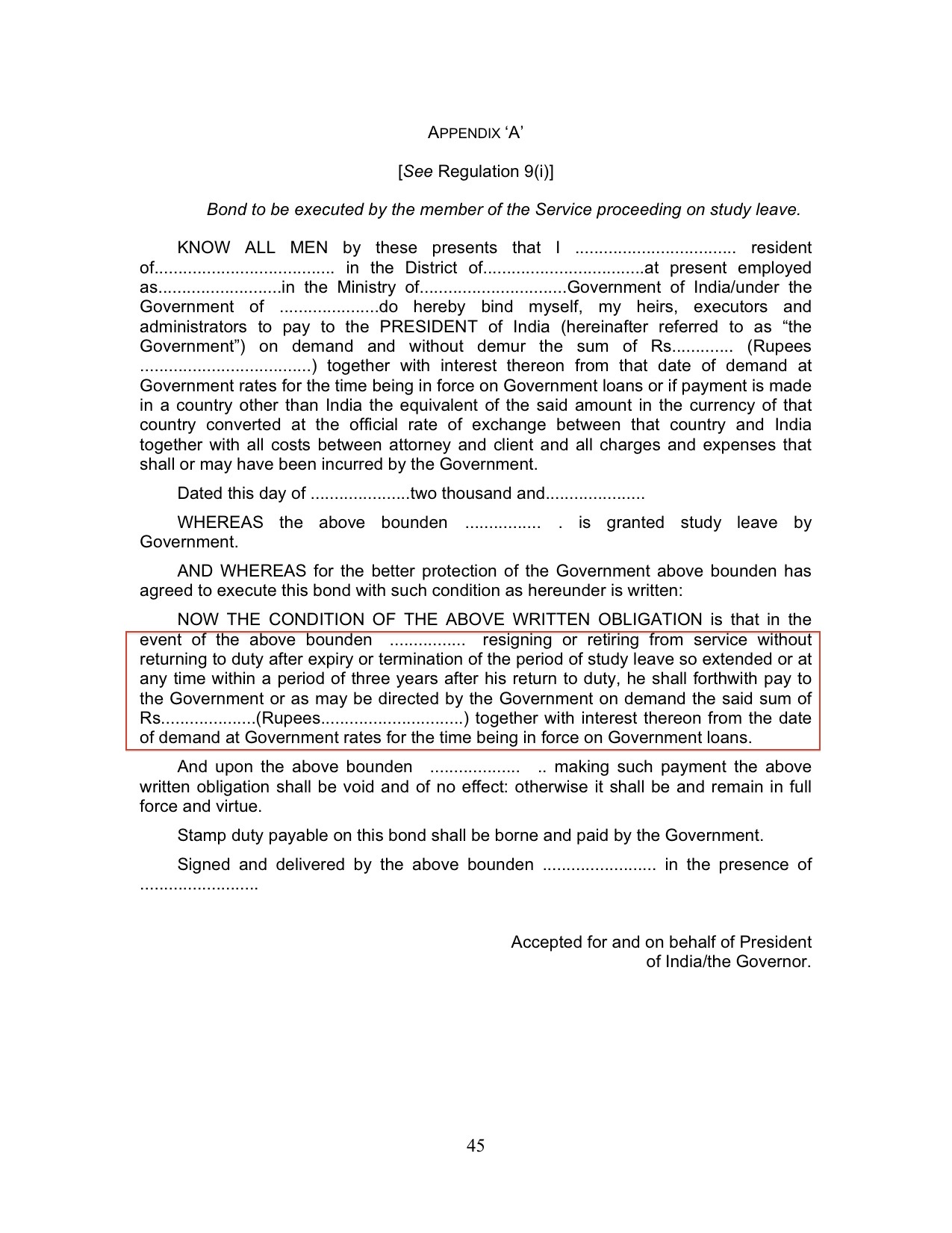
To sort this out I looked up the All India Services (Study Leave Regulations) in the web. Assuming that that is the right document, it contains the following bond one has to sign before going on a study leave.

So Kejriwal is right in that he resigned more than three years after his joining back date. 

But if one tries to understand the intent of the bond, which is that after going on a paid study leave, one needs to work for three years (this is not spelled out accurately in the bond), Kejriwal did not satisfy the intent.

I am no lawyer and there may be previous cases in the courts that can be used to decide what is written in the bond and what its intent is.

But even if Kejriwal is legally right, what he is doing is finding a loophole in the clumsily written bond statement. Many people who are considered corrupt by the aam janata do exactly that; hide behind loop holes.

Considering that Kejriwal is leading the anti-corruption movement and many consider him as an icon of the country (so much so that if India had a Presidential form of government, and there was a presidential election in the next few months, he would have had a very good chance of winning it) he should not hide behind a loophole; he should pay his dues immediately and move on.

The Bhubaneswar-Cuttack-Puri city bus routes

Bhubaneswar- Cuttack- Puri, Bhubaneswar-Cuttack, BMC action 2 Comments »

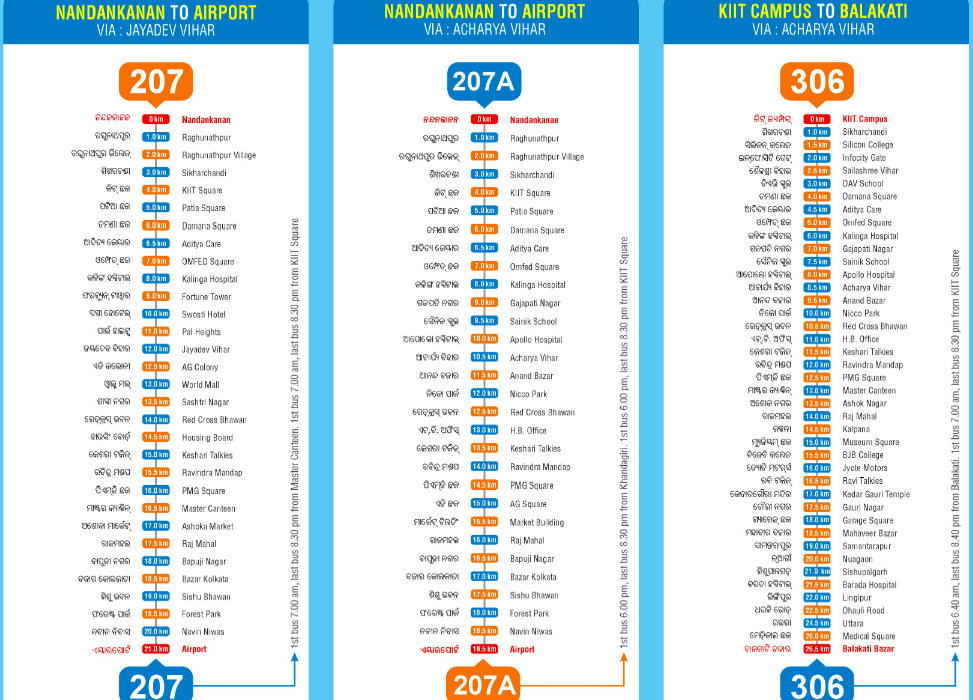
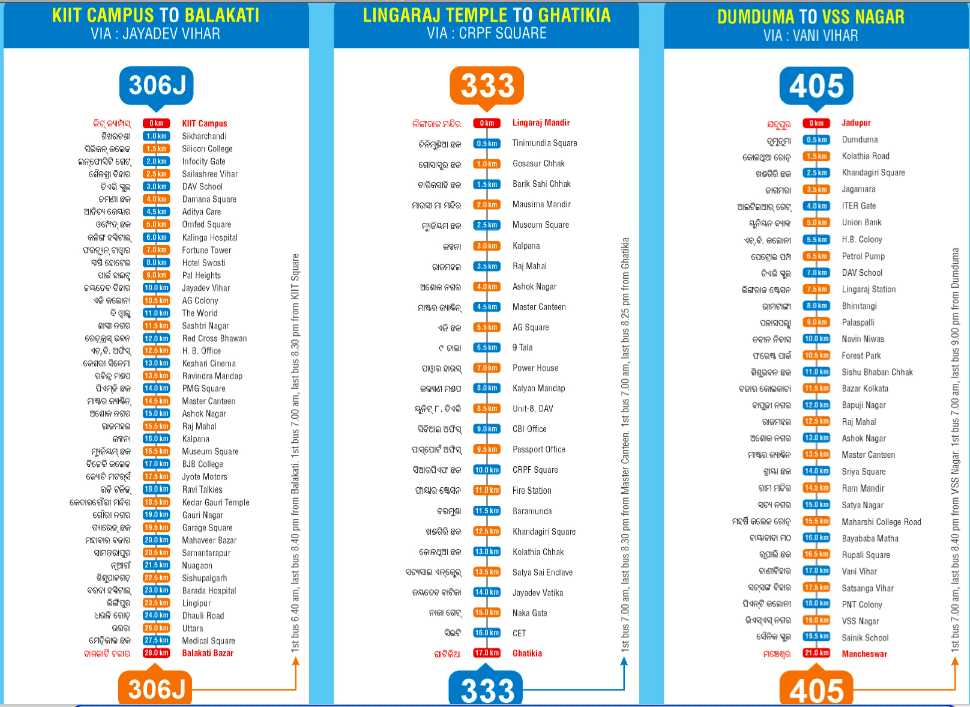
As per recent news, the latest route to be added is KIIT-Niladri Vihar – Kalpana with stops at Infocity, Niladri Vihar, Sailashree Vihar, Damana, Chandrasekharpur-Omfed Square, Kalinga Hospital Square, Sainik School, Institute of Physics, National Institute of Science Education and Research, Utkal University, Regional Museum of Natural History, Planetarium, Acharya Vihar, Master Canteen, and Kalpana Square.

For an overall status following is an excerpt from a Telegraph report.

Dream Team Sahara will deploy five buses for the new route. Therefore, a total of 90 buses will ply in the city bus service network in 12 routes, including those to Cuttack and Puri.

“At present, we are running 15 buses in Cuttack. But as Orissa High Court has given a directive to introduce more buses for the historic city, we are planning to add five more buses for Cuttack. Similarly, five buses are running between Bhubaneswar and Puri. By the end of this month, the number is, however, expected to go up to 15. Therefore, we will ultimately run all the 125 buses as per the plan for the city bus service under Jawaharlal Nehru National Urban Renewal Mission (JNNURM). With 90 buses pressed into service, bus companies will have to provide 35 more buses to make the fleet fully equipped,” said chief operating officer of Dream Team Sahara, Sudhanshu Jena.

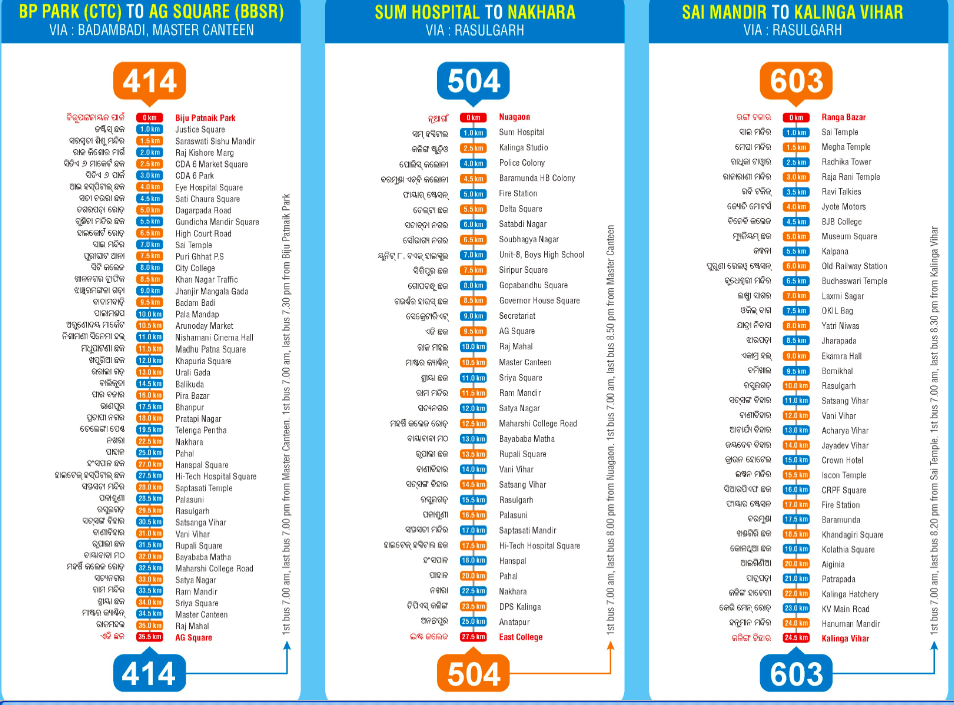
The detailed stoppages and distances of the older routes are given in the following brochure obtained from a BMC site.


Some excerpts from the draft approach paper to the Twelfth plan

12th plan (2012-2017), KBK Plus district cluster, Medical, nursing and pharmacy colleges, Research institutions Comments Off on Some excerpts from the draft approach paper to the Twelfth plan

The draft approach paper to the Twelfth plan is at http://planningcommission.gov.in/plans/planrel/12appdrft/appraoch_12plan.pdf.

Following are some excerpts.

Page 6: 1.12 One critical parameter to examine the degree of inclusiveness is to see what has happened to the real farm wages in the rural areas. This is because the largest number of poor, primarily landless workers, is in rural areas and the majority of them still rely on farm work for their livelihood. It is comforting to see that during the period 2007 to 2010 (calendar years), the average real wage rates have increased by 16 percent at an all India level. The growth was the fastest in Andhra Pradesh (42%) and Orissa (33%). Even in states like Bihar and Uttar Pradesh, real farm wages went up by 19 and 20 percent respectively, over the three year period.

Page 50: 3.33 Access to power has been particularly poor in rural habitations and the Rajiv Gandhi Grameen Vidyutikaran Yojana RGGVY was devised to remedy this problem by providing connections to all villages and free connections to BPL families. There are, however, still a large number of habitations left uncovered and a very large population that has no connectivity. It is desirable to try and universalize access of power during the Twelfth Plan and this requires dealing with the large backlog in the States of Uttar Pradesh, Bihar, Orissa and Assam and some of the other North East States. However for effective universal access the RGGVY programme has to be restructured. Connectivity by itself is only part of the problem, since in many States there is also a real shortage of power. Besides RGGVY focuses only on household supply and does not address the need for providing electricity for agriculture, which needs three phase supply. This in turn requires strengthening of the rural network, and not just last mile connectivity to households, which is what RGGVY covers.

Page 56: 4.7 A master plan for 18,637 kilometres of expressways, with new alignments for both passenger and freight movements in high traffic density corridors based on “access control toll” needs to be taken up. These roads will be either 4 or 6 lane. The proposed National Expressway Authority of India is expected to take the initiatives for both land acquisition and to get the work executed under BOT mode.

Page 120: 9.19 District Hospitals need to be greatly strengthened in terms of both equipment and staffing for a wide range of secondary care services and also some tertiary level services. They should actually be viewed as District Knowledge Centres for training a broad array of health workers including nurses, mid‐level health workers (e.g. Bachelor of Rural Health Care or Bachelor of Primary Health Practice) Paramedics and other public health and health management professionals. New medical and nursing colleges should preferably be linked to district hospitals in underserved states and districts, ensuring that districts with a population of 25 lakhs and above are prioritized for establishment of such colleges if they presently lack them. New programmes for developing mid‐level health workers (such as Bachelor of Rural Health Care/Bachelor of Primary Health Practice) and nurse‐practitioners which have been ntroduced in some States must be similarly linked to District Hospitals and their attached District Knowledge Centres.

Page 120: 9.25 Lack of human resources is as responsible for inadequate provision of health services as lack of physical infrastructure, especially in rural areas. According to Rural Health Statistics (RHS), 2,010, there is shortage of 2,433 doctors at PHCs (10.27 per cent of the required number); 11,361 specialists at CHCs (62.6 per cent of the required number); and 13,683 nurses at PHCs and CHCs combined (i.e., 24.69 per cent of the required number). In addition 7,655 Pharmacists and 14,225 Laboratory Technicians are needed at PHCs &CHCs (27.13 per cent and 50.42 per cent of the required number) in the country. These numbers are based on the 2001 Census.

9.26 The status of Human Resources for Health (HRH) has improved during the 11th Five year plan period, however much more needs to be done. The density of doctors in India is 0.6 per 1,000 and that of nurses and midwives is 1.30 per 1,000, representing jointly 1.9 health workers per 1,000. While no norms for Health Human Resource have been set for the country, if one takes a threshold of 2.5 health workers (including midwives, nurses, and doctors) per 1,000 population, there is shortage of health workers. Furthermore, because of a skewed distribution of all cadres of health workers, the vulnerable populations in rural, tribal and hilly areas continue to be extremely underserved.

9.27 The Twelfth Plan must therefore ensure a sizeable expansion in teaching institutions for doctors, nurses and paramedics. Only 193 districts of a total of 640 have a medical college – the remaining 447 districts do not have any medical colleges. Further, the existing teaching capacity for creating paramedical professionals is grossly inadequate. Against 335 medical colleges, there are 319 ANM training schools, 49 Health and Family Welfare Training Schools and only 34 LHV training schools. To fill the gap in training needs of paramedical professionals, the Twelfth Plan proposes to develop each of the District Hospitals (635) into knowledge centres, and CHCs (4535) into training institutions.

Page 131: 10.20 There must be a strategic shift from mere expansion to improvement in quality higher education. For this, the focus should be not only on larger enrolment, but also on the quality of the expansion. During the Twelfth‐Plan period, an additional enrolment of 10 million could be targeted in higher education equivalent to 3 million additional seats for each age cohort entering the higher education system. This would significantly increase the GER bringing it broadly in line with the global average.

10.21 A holistic and balanced expansion approach is needed to target under‐represented sections of society. Thrust should be on consolidating and improving the capacity and quality of the existing institutions. New institutions may be set up to bridge regional imbalances and disparities across disciplines and to address special economic, social and technological needs of the country. Further, traditional education should be supplemented with skill‐based studies and institutional differentiation should be encouraged so that institutions grow along their own growth trajectories without being clones of each other. Open and distance education methods could be deployed to augment capacity optimally. In addition, the concept of Meta University aimed at collaborative and multi‐disciplinary learning that redefines knowledge‐creation and knowledge‐sharing in the twenty‐first century, could also be explored.

10.22 There is an urgent need to step up both public and private investment in higher education (including technical), and increase in the efficiency of its utilization. About 18 per cent of all government education spending or about 1.12 percentage of GDP is spent on higher education today. This should be raised to 25 percent and 1.5 per cent respectively. An increase of 0.38 per cent of GDP means an additional allocation of about Rs.25, 000 crore to higher education for the Centre and the States taken together.

10.23 State universities and their affiliated colleges that account for more than 90 percent of the enrolment suffer from severe fund constraints and poor governance leading to poor quality. Strategic Central‐funding based on State higher education plans should be leveraged to stimulate more state funding linked to academic and governance reforms which may include norm‐based funding for State universities and colleges. Allocation of operating budget should be based on objective norms and new investments based on competitive grants and performance contracts. Institutions should be encouraged to raise their own funds through various legitimate means. Reasonable tuition fees in higher education need to be supplemented with appropriate publicly‐funded financial aid. The scale and reach of scholarship schemes and student loans need to be enhanced. Government guarantees for student loans could be considered. The central principle should be that no student who is eligible to be admitted should be deprived of higher education for financial reasons.

Encouraging Private Participation

10.26 Private sector growth in higher education (including technical) should be facilitated and innovative Public‐Private Partnerships (PPP) should be explored and developed in the Twelfth‐ Plan. Private higher education accounts for about four‐fifths of enrolment in professional higher education and one‐third overall. This growth trend is likely to continue in the Twelfth Plan. Currently, this growth is restricted to specific areas and there are concerns about quality and use of unfair practices. A clear policy is therefore required to manage private education and a statutory and transparent framework needs to be established for its operation for driving private growth further in a legitimate and balanced manner. The “not‐for‐profit” tag in higher education sector should, perhaps, be re‐examined in a more pragmatic manner so as to ensure quality without losing focus on expansion and equity. Deserving private institutions could benefit with access to public funds in the form of loans, financial aid for students and competitive funding for research.

Research Culture and Faculty Issues

10.27 We must bring back the ‘lost’ research culture of Indian Universities so as to create new knowledge and improve teaching standards. This would require more funding for university‐ based research and funding policies that create right incentives for quality research and promote collaboration among institutions. Related to this is the issue of faculty shortages which can be tackled through innovative ways such as technology‐enabled learning and collaborative information and communication technologies (ICT). A complete overhaul of the Academic Staff Colleges that are used to provide refresher courses for teachers is also necessary. Initiatives to improve the quality and availability of teachers in higher education need to be launched in a mission mode. With improvements in life expectancy, a growing pool of retired and elderly people is now available in the country. They have potential to enrich teaching‐learning experience and act as social capital for the society. It is possible to tap and convert their valuable acquired expertise into useful codified knowledge through a special Ph.D. programme for senior citizens facilitated by liberal entry requirements.

Page 134: 10.30 While most of our universities and colleges are required to build human resources to reach desired levels of competence, we also need to go beyond this to ensure that the country has several institutions of higher education that strive to achieve excellence in both teaching and research. The latter needs significantly large resources and, also much greater institutional autonomy and approval incentive structures. Realistically, India should aim to have at least a few universities in the global top‐league. To achieve this as quickly as possible, the country should act on two fronts. It should create new top‐end universities and also upgrade very good ones. A few new Innovation Universities could be established urgently, and several universities and institutions could be converted or upgraded by creating centres of excellence within the University, building on their existing strength. At the core of achieving excellence, is ability of institutions to attract and retain high quality faculty from across the world. This not only requires providing them with competitive salaries but also ensuring a challenging work environment and a lot of flexibility. The Twelfth Plan should attempt to operationalize these objectives.

10.31 In addition, the idea of creating large education hubs on fallow lands at four or five locations in the country, anchored by large public sector enterprises (possibly with participation by the private sector) and funded through their allocations for corporate social responsibility needs to be explored. These could be models for industry‐institute interface and would ensure local and regional development of areas where these are located.

10.32 Higher education is an increasingly global enterprise; hence Indian institutions should embrace internationalization that could provide them with new opportunities. Country’s rationale for internationalization would be to enhance its soft power, improve standards of domestic provision and produce graduates with international competencies and skills. This can best be achieved by having more and innovative partnerships. Given the historical advantage in higher education (particularly among emerging market economies) the wide spread use of English language and low cost living, India can potently become a global hub for higher education. We need to provide greater autonomy to our Centres of excellence to enter into collaborative partnership with the best universities abroad.

Page 138: Backward, Border and Remote Areas

11.11 Special emphasis must be given in the XIIth Plan for connecting to areas where connectivity is poor, which is one of several reasons why they are unable to become active participants in the growth process. These areas include the mountainous Himalayan region, the under‐developed pockets in Central and Eastern India, the islands territories and some regions in the North East. A large number of districts (often characterised by forested areas with tribal population) in the States of Andhra Pradesh, Orissa, Chattisgarh, Maharashtra, Jharkhand, Bihar, Madhya Pradesh and Uttar Pradesh have experienced much less development than the overall development of the States within which they are located. They are also affected by Left Wing Extremism. Some of these less developed regions are spread across state boundaries, such as Bundelkand, which extends across Uttar Pradesh and Madhya Pradesh. In other instances these are pockets within a state that are historically fraught with difficult conditions. Notable amongst them are the Vidharbha region of Maharashtra; the Kalahandi, Bolangir and Koraput (KBK) region in Orissa and most of the tribal belt in Central and Eastern India.

11.12 To deal with the legitimate aspirations of the people of these neglected regions the overall growth strategy must have a component of regional development. This will require inter‐state cooperation and strengthening the pace of development of inter‐state and intra‐ state connectivity of tribal and other isolated communities through forests and difficult terrain. It will need better governance and deeper involvement of local people in the development process. Skill development and employment opportunities must be an important component of this strategy. The XIIth Plan will identify such areas for continued and enhanced development.

11.13 The development of physical infrastructure coupled with opportunities for education and skill development can generate significant improvements in livelihood and incomes and result in better sharing of the fruits of economic growth with these remote areas.

Plan within a Plan

11.14 A special effort is needed in the Twelfth Plan to create a Plan within a Plan. There are already programmes such as the Backward Regions Grant Fund (BRGF), Border Area Development Programme (BADP), Hill Area Development Programme (HADP), the Kalahandi, Bolangir and Koraput (KBK) Plan, the Bihar Special Plan, the Bundelkhand Special Package, and most recently, the Integrated Action Plan (IAP) for Left Wing Extremism (LWE) affected districts. The XIIth Plan should create a greater coherence among all these Special Plans.

Page 154: 13.16 Finally, the institutional concepts which were initiated in earlier Five Year Plans, like the Inter University Centres and Inter‐Institutional Centres for enhancing research and educational linkages for Universities, are to be expanded further to cover many other inter‐disciplinary research areas such as Earth System Science, life sciences, Computational Science, Cognitive Science etc., during the Twelfth Plan to bring about functional connectivity across universities and domain institutions. This would also overcome regional disparities in the quality of education/research.
Proposed Electoral reforms for India and its states

CENTER & ODISHA 12 Comments »

As per this report in Times of India Anna and his team have further plans. One of those plans is "Electoral Reforms." Following is an excerpt from that report: 

"We have to change the election system of the country… we have the right to reject," he said, adding that people should be allowed to use the option not to vote if they don’t like any candidate.

I completely agree that "Electoral Reforms" is an important issue. I have thought about it for some time. Following are some of my thoughts.

1. Holding Primaries: In the current system the party bosses have the ultimate say in terms of their candidates. So Sonia Gandhi, Nitin Gadkari, Sharad Pawar, Naveen Patnaik etc. have the ultimate say of their candidates in some faraway place in Odisha. How much sense does that make? Since it is extremely difficult to win as an independent, create a new party and run, or have a chance to convince existing parties and their boses to field you as a candidate,  it creates a huge barrier for someone to enter politics and get elected and as a result a very huge percentage of elected representatives are family members of past or current representatives. Also, often the situations arise when none of the candidates chosen by the party bosses are "good". To address these the best way is to introduce "primaries" or "preliminary elections" for all recognized parties. These preliminary election would then determine who the candidate of a particular party will be. Laws can be made to decide who can vote in these primaries. In US, in some states only party members can vote for the primary elections of that party and in other states there are open primaries. Open primaries is much easier to implement. So basically what will happen is before the election there will be another election where there can be multiple candidates of each party. As before everyone can only vote for one candidate total. After the primary elections the top voted candidate from each party goes on to the main election.

2. Removal of the anti-defection law: The anti-defection law passed in 1985 as the 52nd amendment to the Indian constitution is a bad piece of legislation. Because of it MPs do not have the freedom to vote their conscience or vote as per the will of their constituents. They have to vote as dictated by their party leader.  This is extremely dangerous. The following illustrates it. Currently, if their is a single party with majority in Delhi it can pass whatever bill its boss wants. Now imagine someone is able to blackmail this boss. (Say the blackmailer possesses some document that can greatly harm the party boss.) This blackmailer can now pass whatever bill it wants. But abolishing the anti-defection law and allowing MPs to vote their conscience would mean government motions may fail resulting in the government being forced to resign under the collective responsibility principle. This is not desirable. So additional changes would be necessary to avoid this. See (5) below.

3. Provide mechanisms to recall an elected representative: If an elected representative is out-of-synch with the voters of his/her constituency there should be a mechanism to recall that representative and have a new election. That way elected representatives can not forget their voters between elections and only show up around the election time. (Team Anna has mentioned this as one of their goals.)

4. Government funding of election: Currently a big reason the elected representatives are corrupt is that they have to find funds for their election expenses. Many of them, though not personally corrupt, participate and if not participate then allow (and turn a blind eye) someone to raise funds (mostly in an illegal manner) for their elections. This can be avoided if government funds elections. Such a system is in place in the US; it allows a candidate to refuse this funding and use his/her own funding.

5. Direct election of CM and PM but with term limits of maximum of two terms: Came across the following suggestion of a  clever way to directly elect CMs and PM. To that I will add that our CMs and PMs should have a term limit of maximum of two terms. This will allow for young leadership to emerge more easily.

… consider the idea of adding a single non-voting seat to every State Assembly and to the Lok Sabha. This single non-voting seat could have for its constituency all eligible voters within that State in the case of a State Assembly and similarly it could have all of the eligible voters in India in the case of the Lok Sabha. During elections this all-State or all-India constituency could go to polls along with the other legislative and parliamentary constituencies. The person who gets elected to this non-voting Lok Sabha or Assembly seat could be automatically considered to be the Leader of the House as he or she would be reflecting the collective will of all the voters of that Legislative Assembly or Parliament. Since the seat is a non-voting addition to the strength of the House this seat will not change the balance of power in the legislature which continues to be same as before.

By virtue of being the leader of the House the person elected to the all-State or all-India constituency will have to be invited by the Governor or the President to form the next Government as the Chief Minister or Prime Minister. Irrespective of whether a party or a combination of parties has a legislative majority the Chief Minister or Prime Minister will have a fixed term which will be the same as the term of the legislature. Removal of the Chief Minister of Prime Minister would now require a higher legislative bar similar to a Presidential impeachment. The anti-defection law becomes redundant and irrelevant since the Government no longer depends on a simple majority in the legislature.

In the absence of anti-defection laws, a cultural shift could be effected wherein legislators across party lines can think independently and come together to propose bi-partisan Bills in a manner similar to what we see in the United States. The Chief Minister or Prime Minister could then also have the additional freedom to appoint members to his Cabinet from outside the legislature thus eliminating another source of instability and dissidence.

6. Instead of "Right to Reject" allow "Write-in" candidates: The idea behind "right to reject" is that during voting there should be a option of "No One." This was suggested in a movie. In light of implementing 1-5 I don’t see any usefulness of this idea by itself. However, a better idea is to have a write-in option where people can write the name of the person (who is not in the ballot) who they want to vote for. So people can write "No one" if they desire so. Or they can write someone’s name. This is a good back-up if at last moment one of the candidate passes-away or if there is some major change (say a major movement like the current movement) and people want to vote for someone who is not in the ballot.

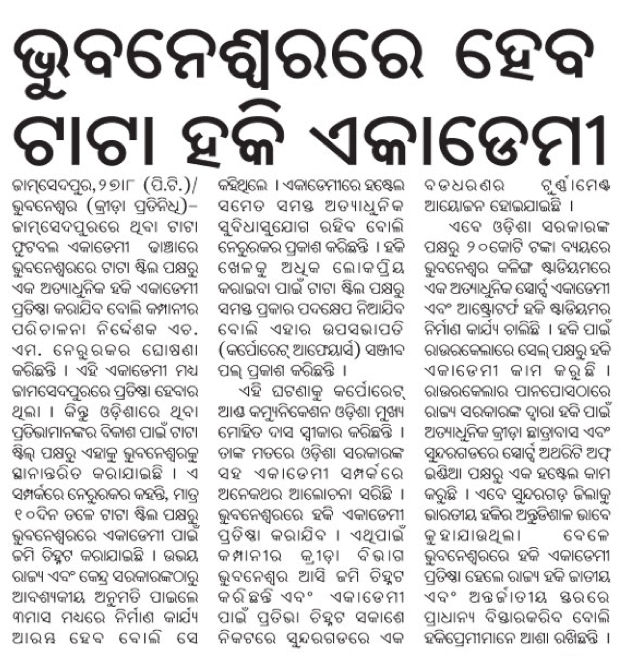
Tata Steel to establish a Hockey Academy in Odisha: Dharitri

Bhubaneswar- Cuttack- Puri, Khordha, Men's hockey, Odisha sports, Tatas, Women's footbal, Women's hockey 1 Comment »

A few points and recap of similar news:

  1. TATA Steel has a football academy in Jamshedpur.
  2. Hockey: SAIL has a hockey academy in Rourkela which serves the tribal belt around Sundergarh well.  The proposed Hockey academy in Bhubaneswar will be a good plus. I think KISS with its large tribal students could and would be one of the top recruiting ground for the proposed hockey academy.
  3. Women’s footbal (soccer): As per the news item at http://www.dailypioneer.com/321111/FAO-glad-to-host-SAFF-Championship-in-December.html the Football Academy of Odisha (FAO) is setting up a woman football academy in Cuttack or Kendrapada.
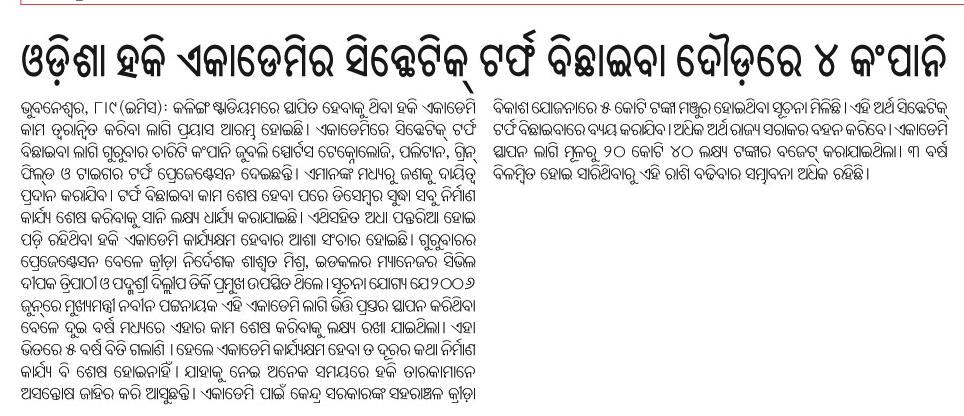
  4. Sports, Hockey: The above article also mentions that the State government is spending 20 crores for an Odisha Hockey Academy and astroturf hockey stadium in the Kalinga stadium complex. (See news item below.)
     
  5. American Football: Bhubaneswar to be one of the eight teams in the Elite Football League that will start in 2012.
  6. Indoor games: ECOR making an indoor stadium in Bhubaneswar.
  7. Tennis Academy: Being established in Bhubaneswar.
  8. Cricket Academy: Odisha Cricket academy has been established in Cuttack.
  9. Cricket: ECOR has made a cricket stadium in Bhubaneswar and aims to make it of international standards.

ECOR updates on various project in Odisha and the land-acqusition related stumbling blocks

Angul - Talcher - Sukinda (under constr.), Haridaspur - Paradeep (under constr.), Khurda Rd - Balangir (under constr.), Lanjigarh Rd - Junagarh 1 Comment »

Following is from a report in Telegraph:

  1. Khurda – Balangir line: "… the process of separating the government land has been hampered because of the demand of premium for it by the concerned tehsildars. This, when the state government had exempted it.

    Between the 32km and the 112km marks of the line, 1,020 acres are required and out of this, 802 acres have been handed over by the state government.

    However, processing of papers for the land acquisition from the 80km to the 112km mark is held up for verification. This patch of land is crucial for the project."

  2. Haridaspur-Paradip broad gauge line: " the progress of land acquisition has been hampered by the demand for higher compensation against acquired land by the local people. Interestingly, payment of ex gratia to the landlosers has already been made by Haridaspur- Paradip Rail Corporation Limited."
  3. Talcher-Bimalagarh new broad gauge line: "… a total of 68.56 acres of government land and 58.865 acres of forestland is yet to be demarkated by the state government in favour of railways."
  4. Angul-Sukinda new broad gauge line:  "has also not been taken up because of the state government’s non-cooperation. The project would involve 69 villages, but formalities have been completed only for 38 villages. Preliminary estimates regarding the remaining 31 villages are pending with the commerce and transport department for sanction."
  5. Rajaathagarh-Barang doubling project: "… 11 acres were required. The total private land required for the project has been acquired and the alienation proposal is under process by the district administration."
  6. Jharsuguda-Rengal doubling rail project: "119 acres are involved. Land measuring 14.570 acres in two villages is to be handed over to railways by the state government. The acquisition of another 4.310 acres is pending with the state government’s transport and commerce department."
  7. Lanjigarh-Junagarh new broad gauge line: " work has been stalled because of non-acquisition of land. With the possession of 2.8km forestland yet to be reported by the divisional forest officer, Bhawanipatna, the construction has been held up.


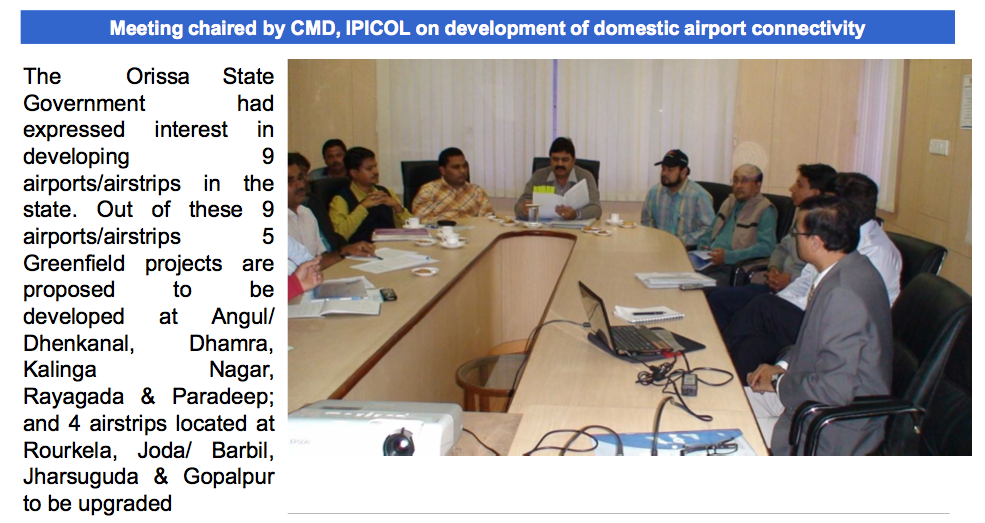
Team Odisha steps in the last months on airports and air services

Angul, Bhadrakh, Bhubaneswar, Bringing International Connectivity, Dhenkanal, Ganjam, Jagatsinghpur, Jharsuguda, Jharsugurha, Keonjhar, Khordha, Others, Rangeilunda Berhampur, Rayagada, Rourkela, Sundergarh, Team Odisha 8 Comments »

Following is from the Team Orissa newsletter of AprilJune’2011.

In regards to the airport in Paradeep, there has been news that it will be an important aspect of the proposed PCPIR in Paradeep.

In the past, two other airport locations have been mentioned: Koraput/Jeypore/Sunabeda area and Balasore/Baripada/Rasgovindpur area. In fact, after Rourkela, Jharsuguda and Gopalpur, these two will be the important locations as they have the potential to be regional airports.

DTDS to start scheduled air-taxi service between Kolkata and Rourkela from September 1, 2011

Rourkela, Rourkela- Kansbahal, Sundergarh 9 Comments »

(Thanks to Situn and Rourkelacity.com for the pointer.)

Following is an excerpt from a report in Telegraph.

Air taxi services between Rourkela and Calcutta will be launched from September 1. As a promotional fare, a one way trip per person (inclusive of all charges) would cost Rs 4,189 for Rourkela-Calcutta sector from September 1 till 11. Thereafter, the full fare of Rs 6,494 (inclusive of all charges) will be levied on the sector. The bookings on the Calcutta-Rourkela-Calcutta route is already on and available on the website www.dtdsindia.com.

We explored the DTDS webiste at http://www.dtdsindia.com/.  Following are some excerpts.


Between Kolkata airport and all the neighboring Steel City Bokaro, Jamshedpur, Burnpur, Durgapur (Panagarh), Rourkela airport at a fixed and convenient schedule.  …

As soon as you arrive at airport, our staff will greet you with your boarding ticket and escort you till the aircraft where you board and take off.

Following are the flight timings.

Flight Code Place of Departure/Dep.Time Place of Arrival/Arrival Time Duration Baggage Limit Total Trip Cost
FL004 Rourkela
15:30 hrs
Kolkata (SAIL)
17: 0 hrs
2Hr 30 min 10kg. Rs.4,189.00**
FL003 Kolkata
10:30 hrs
Rourkela (SAIL)
13: 0 hrs
2Hr 30 min 10kg. Rs.4,189.00**


Now the people of Rourkela need to patronize this flight so that other careers get interested in scheduling regular flights to Rourkela.