Archive for 2011

T. N. Ninan: “… non-agricultural incomes are typically five times agricultural incomes. The way to even out the imbalance is to get people off the land, and into non-agricultural occupations.”

AGRICULTURE & FARMING Comments Off on T. N. Ninan: “… non-agricultural incomes are typically five times agricultural incomes. The way to even out the imbalance is to get people off the land, and into non-agricultural occupations.”

Following are excerpts from T. N. Ninan’s Business Standard lecture reported here.

… productivity growth in Indian agriculture had been poor, so rural incomes were not growing fast enough. In its effort to deal with this, the government was pumping subsidies and income transfers into the countrywide, to put money in people’s pockets — which the recipients were spending. Since this expenditure was not matched by productivity growth, it was causing inflation. …

If you look for the root cause of the power sector’s problems (high losses, disincentive for investors), it boils down to the virtually free electricity provided to farmers. That can’t be corrected because farmers don’t earn enough to be able to pay a higher electricity tariff. And there is a limit beyond which it becomes impossible for other users to cross-subsidise power to farmers; high electricity tariffs are already a burden for exporters who compete against rivals in countries that enjoy lower power tariffs. So you can’t fix the power sector’s problems without fixing agriculture. …

The bald truth is that half of India’s workforce toils in the fields to generate one-sixth of GDP. Since the other half produces the remaining five-sixths, non-agricultural incomes are typically five times agricultural incomes. The way to even out the imbalance is to get people off the land, and into non-agricultural occupations. But urbanisation and the growth of non-agricultural employment have been slow in India, an important reason being the stifling of industries that can provide entry-level, low-value work. China showed the way by promoting Township and Village Enterprises (TVEs), and encouraging through them the manufacture and export of simple products like toys and shoes. Rajiv Gandhi, on his path-breaking visit to China in 1988, visited one such TVE outside Shanghai which was making and exporting tricycles of a basic kind. India missed the bus that China caught, but it can still catch some others — like travel and tourism. …
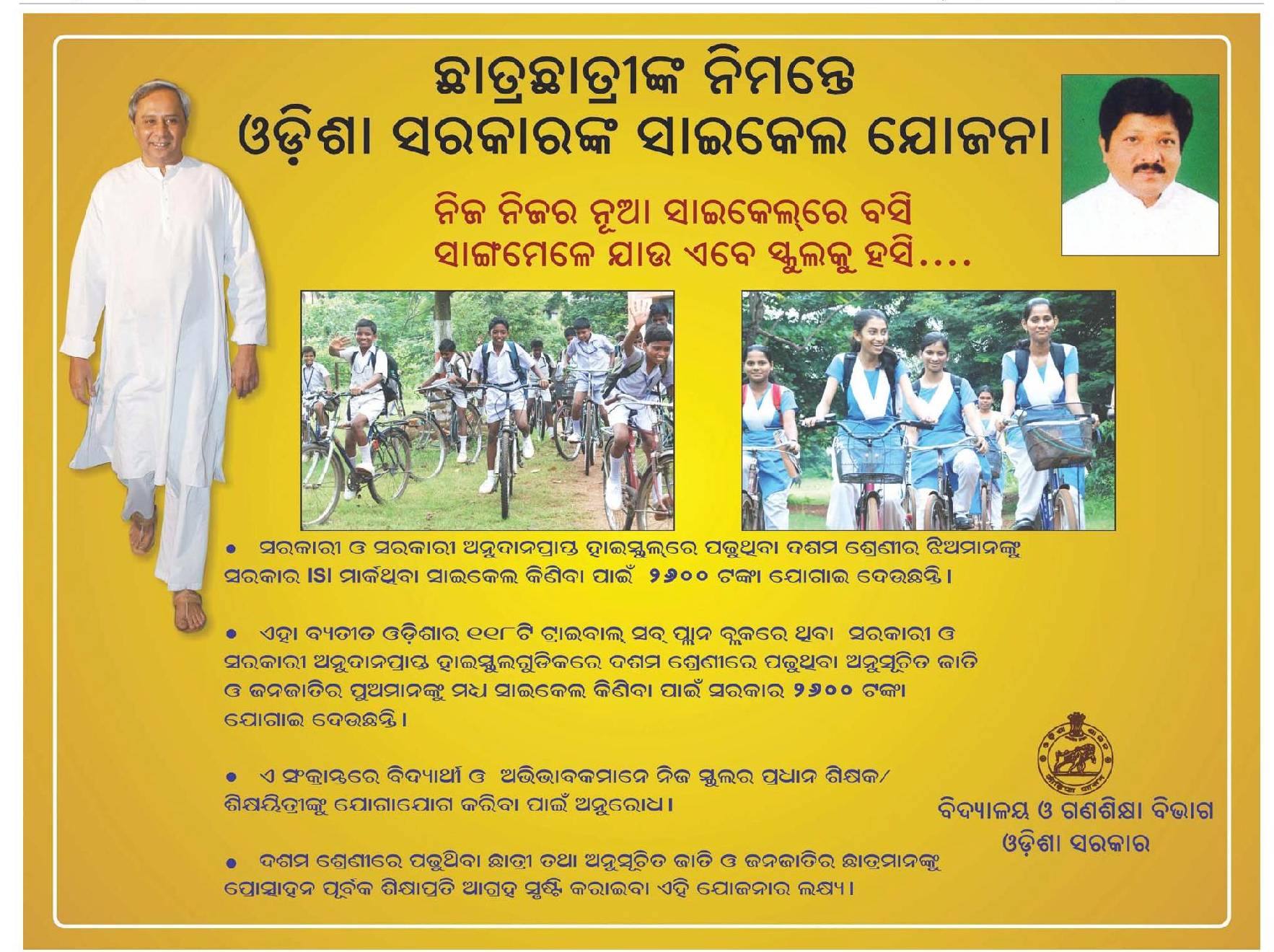
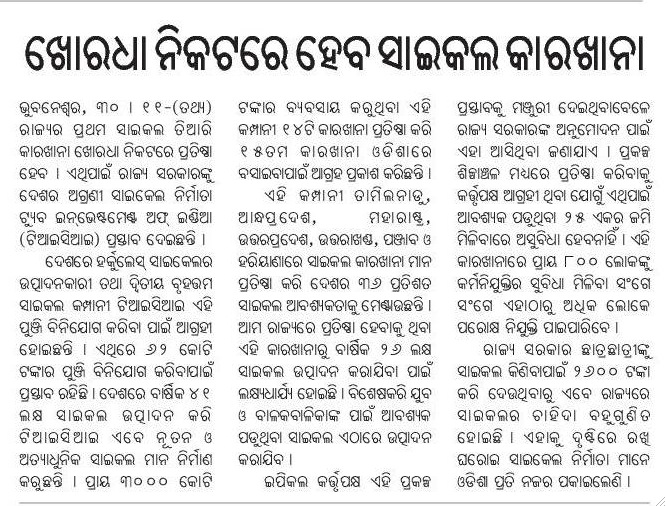
Odisha’s bicycle scheme for girls and the upcoming bicycle factory near Khurda

Khordha, Odisha govt. action 1 Comment »

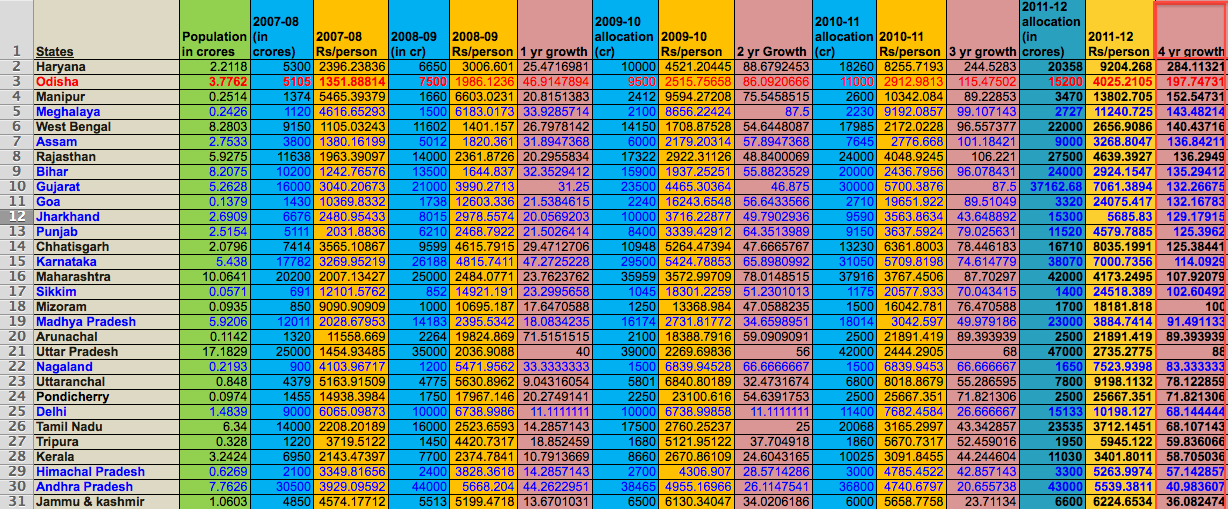
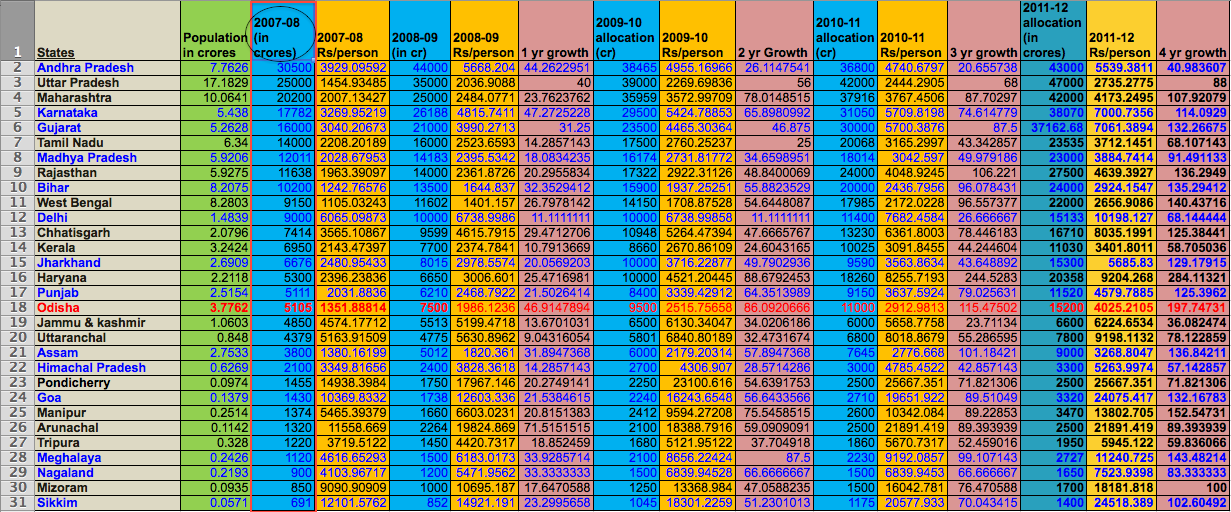
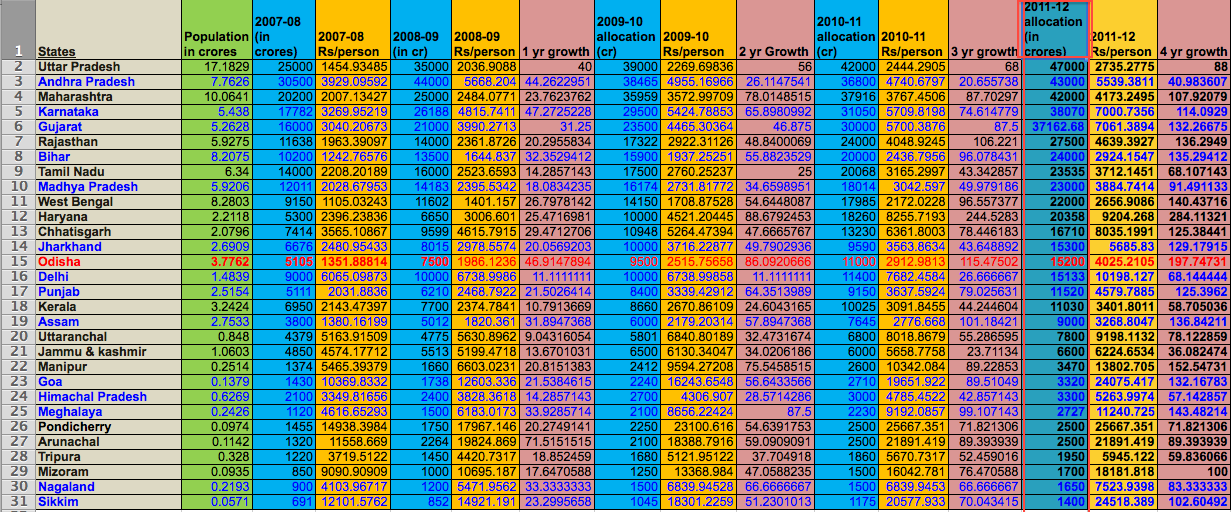
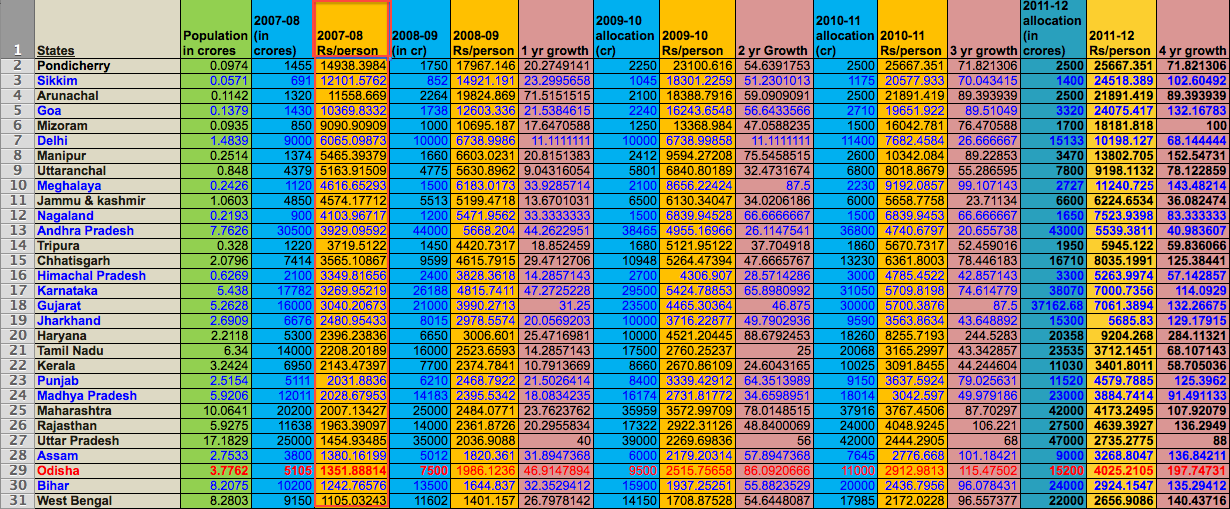
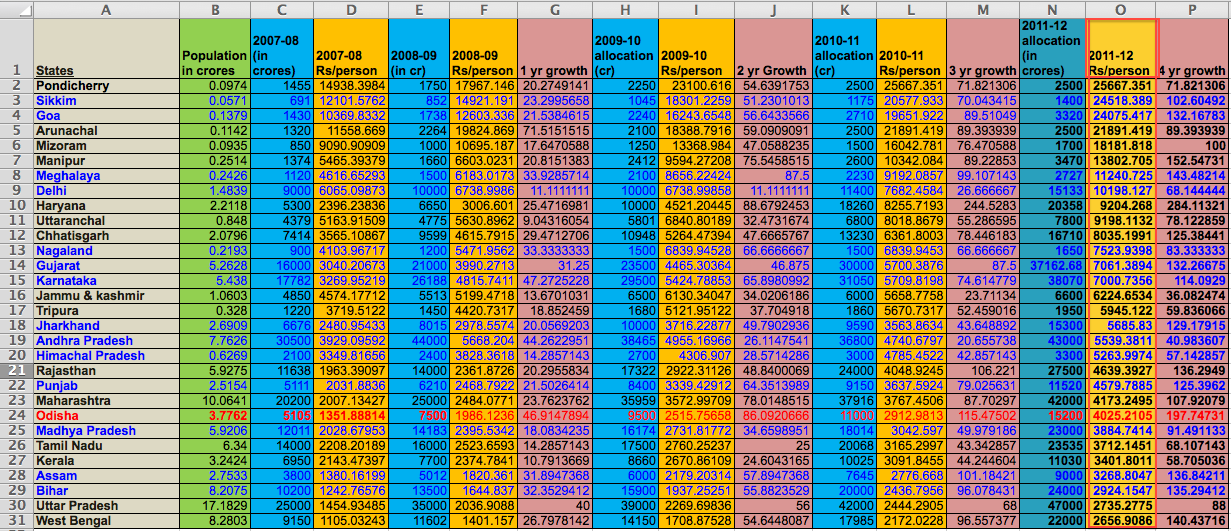
Increase in plan allocation over the years from 2007-08 to 2011-12: Odisha second after Haryana

Planning Commission and Odisha Comments Off on Increase in plan allocation over the years from 2007-08 to 2011-12: Odisha second after Haryana

The following is obtained from the planning commission’s web page on approved plan outlays.

In terms of total plan allocation Odisha’ position has inched from being the 17th state to being the 14th state. In the process it has overtaken Delhi, Punjab and Kerala.

In terms of per capita plan allocation (using the 2001 population numbers) Odisha has inched from 28th to 23rd. But in the process it has overtaken UP, Assam, Kerala, Tamil Nadu and MP. It was ahead of Bihar and West Bengal and continues to be ahead of them.

Odisha has a good chance of overtaking Maharashtra, Punjab and Rajasthan in the next 1-2 years. Note that based on the 2011 census it is already closer to them.

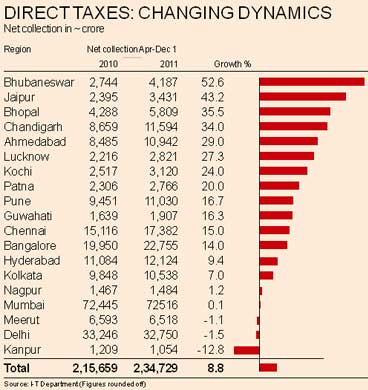
Bhubaneswar sends much more direct tax than much more populous cities such as Jaipur, Patna, Nagpur, Lucknow and Kanpur and has had the highest growth in direct taxes from 2010 to 2011

Bhubaneswar- Cuttack- Puri, CENTER & ODISHA, Khordha, Taxes 1 Comment »

(Thanks to Devasis Sarangi for the pointer to this in facebook.)

Following is from a report in Business Standard.

Number one in growth over last year’s net direct tax collection during April 1-December 1 is Bhubaneswar, with a 52.6 per cent increase at Rs 4,187 crore (Rs 2,744 crore in last year’s corresponding period). Of the collection this year, Rs 2,959 crore has come from corporate tax and Rs 1,226 crore from personal income tax.

A senior department official said the better growth in direct tax realisation in smaller regions clearly indicated an increase in business activities in these. And, that this had come despite overall sluggish performance.

I am tempted to draw more conclusions but am not sure of jurisdictions of each of the locations in the left. For example, for the number corresponding to Bhubaneswar, is the data just about collection from Bhubaneswar city (as defined by what?) or about the collection from Bhubaneswar tax circle (what are the areas it covers?). Although not knowing this makes it difficult to draw more conclusions, one thing is for sure; Bhubaneswar tops in the growth of direct tax collections.

Odisha’s growth will be steady; albeit slower than what some desire

EXPOSING ANTI-ODISHA-GROWTH SCHEMES, Odisha govt. action, Odisha govt. Inaction, POSCO, Universities: existing and upcoming, Vedanta 9 Comments »

In the recently held by-elections in Umerkote in Nabarangpur district the BJD candidate won handily. The winning candidate from BJD had 54,713 votes while the candidate from BJP had 33,652 votes and from Congress had 32,877 votes.

In the 2009 elections the numbers were: BJD candidate – 44326, BJP candidate – 30,155, Congress candidate – 25,512.

Although this is just a single point data, but based on such data, my informal survey of people, my observations, and some other reasons I give below I predict the following:

  • BJD will win the next assembly and parliament elections handily in Odisha and it may even have more parliament seats than it got in 2009.

I now give some reasons for my prediction.

  • In the 2009 election BJD jettisoned BJP at the last moment; so it was not as prepared in some of the constituencies which had BJP representatives.
  • For the same reason, during the 2009 elections, in many people’s mind BJD and BJP were aligned together, while Congress was the opposition. So with the vote split between BJD and BJP, Congress was able to sneak through in some places.  Good examples of this situation are the Balasore and Sundergarh parliamentary constituents. In both places the BJP had strong candidates (in Kharabela Swain and Jual Oram, respectively) and thus the anti-Congress votes got split resulting in Congress wins in both places. The situation will be different in the next election. In the next election the anti-government votes will get split between Congress and BJP and both will do worse than they did in the 2009 elections.

Now let me list some of the attributes of the BJD party and its government and some points regarding the situation in Odisha.

  • BJD’s supremo is a gentleman and closely guards his party members at all levels to follow some basic principles. There are aberrations, but he sorts them out expeditiously. Following is what I mean.
    • The state ministers have very little authority or power. That way they don’t have much of an opportunity to engage in corruption; they can not do any corruption on behalf of the MLAs; the MLAs themselves or party workers at lower level  can not indulge in any big corruption. So in general, there is no (or very little) visible corruption among BJD MLAs and ministers, especially towards personal gain. (Note: All parties in India get their party funds from various sources. There is some corruption involved in that.)
    • The state functions via the bureaucrats and the important departments are headed by bureaucrats that have more or less spotless reputations. So the corruption by higher bureaucracy is not there.
    • With a long running government BJD has a lot of party workers, but they are not like cadres of other parties. They are restrained from indulging in violence or similar activities that would antagonize the people. The BJD party and the Odisha government’s way of dealing with Kalinganagar and POSCO situation and its comparison with Singur is illuminating. In both Kalinganagar and POSCO, although the opposition parties have indulged in unlawful and sometimes violent methods, the BJD party has not countered with its cadres. The government has followed the strategy of wearing people out with time and leaving matters to law and order authorities but with strict instructions to be soft. Thus, even though some newspapers published by opposition parties have used the term "BJD goondas", the public does not have such a view of BJD having a goonda cadre.
  • BJD has given SOPs to the poor people (2 Kg rice), have indulged in populist people pleasing policies (bicycle for girls), and has sincerely helped people during calamities. So its popularity among common people is growing.
  • In essence, the government and the BJD party is not heavy handed and not arrogant and is perceived as people friendly. Ofcourse pockets of people are unhappy in places (e.g. Dhinikia) where promotion of industry clashes with people wanting to be left alone or people agitated by others; but by the government and its party not being heavy handed, arrogant or violent, such unhappyness is localized and as in Kalinganagar, it decreases with time. 
  • The *local* media–especially the top news papers–in Odisha keep a sharp eye on the government. They scrutinize every action and inaction of the government and are mostly critical of the government. They rarely praise any government initiatives. If one is not careful, one solely reading the local media may start having a distorted image of Odisha. But, although, I often feel bad by the negative portrayal of  many things in the local media I realize that in the big picture view, this is good for Odisha. It keeps the government on its toes, keeps it in check, and prevents it from being arrogant. Once one takes the perspective that the job of the opposition and the local medial is to "oppose", "criticize" and "scrutinize" every government actions, and they are able to do that well and freely, then it is easier to get a better picture. Reading some comparative articles in the national media, such as this, also helps.

So how does BJD winning another term after this term reflect on Odisha’s future.

  • It means that the current policies will continue and some of the big projects will happen. In particular, POSCO will go the Kalinagnagar way with the resistance slowly decreasing and development creeping in. Already a good chunk of the land has been acquired and basic efforts for construction (such as access roads) have started. The opposition can stop some of the land being acquired but they can not lawfully stop construction to happen in land that has already been acquired. They are trying, but I don’t see such unlawful efforts being sustainable. Similarly, if the Supreme Court gives ok to the Vedanta University land acquisition so far, then that will happen too. For both these big projects one can look back at Kalinganagar and Dhamara as models. In both Kalinagnagar and Dhamara, it took much longer than originally projected, but they happened. My prediction is same with respect to POSCO and Vedanta University.
  • Although by various measures (of investment) Odisha is among the leading states in the country there is the perception that things move very slow here. The perception is true, but perhaps moving slow is necessary. Running roughshod over the people backfires in many ways. Again, Singur, West Bengal is a good example of that. Also, Chandrababu Naidu’s fast moving steps did not help him win the next election. So Odisha will move forward in a slow and steady manner slowly modifying some of the people’s anti-industry attitude and taking them along.

The above are broad stroke observations. There would be exceptions at individual levels. Similarly, the predictions are based on assuming that no abnormal events happen; the future is unpredictable and small events can change everything.

Now what can Odisha and BJD do better.

  • Rope in good technocrats and have more people with decision making authority: I think BJD and Odisha would do better if BJD ropes in some good technocrats who have spotless reputations. There is so much one CM and a few trusted officers can do. The party needs to find a few more people within its ranks and increase its ranks with people it can trust (to be effective and not corrupt) and have more people with real decision making  authority.
  • Find ways to listen to local and regional voices: Currently, most in BJD are winning elections because of the party supremo’s image. Plus the tight control from above results in that they do not have much of a voice in government decisions. As a result they are not able to forcefully state regional aspirations and demands. This results in regional aspirations and demands being sidelined. For example, in this site we have highlighted many demands of Rourkela people. Because the local representatives (MLAs and one of them happen to be a minister) do not have much of a voice, for little things (like a new train) they have to hit the streets. This is not healthy and could ultimately result in BJD’s downfall and/or more vocal demands to split the state. If the MLAs and ministers can not be fully trusted and the trusted officers rule the roost in the government, may be a few more senior officers (besides the RDCs) can be each entrusted with a cluster of districts to look after. In particular, their job would be to bring to the higher level of the government demands and aspirations of people of those districts.

Odisha to have a national investment and manufacturing zone (NIMZ)

National Investment and Manufacturing Zone (NIMZ) Comments Off on Odisha to have a national investment and manufacturing zone (NIMZ)

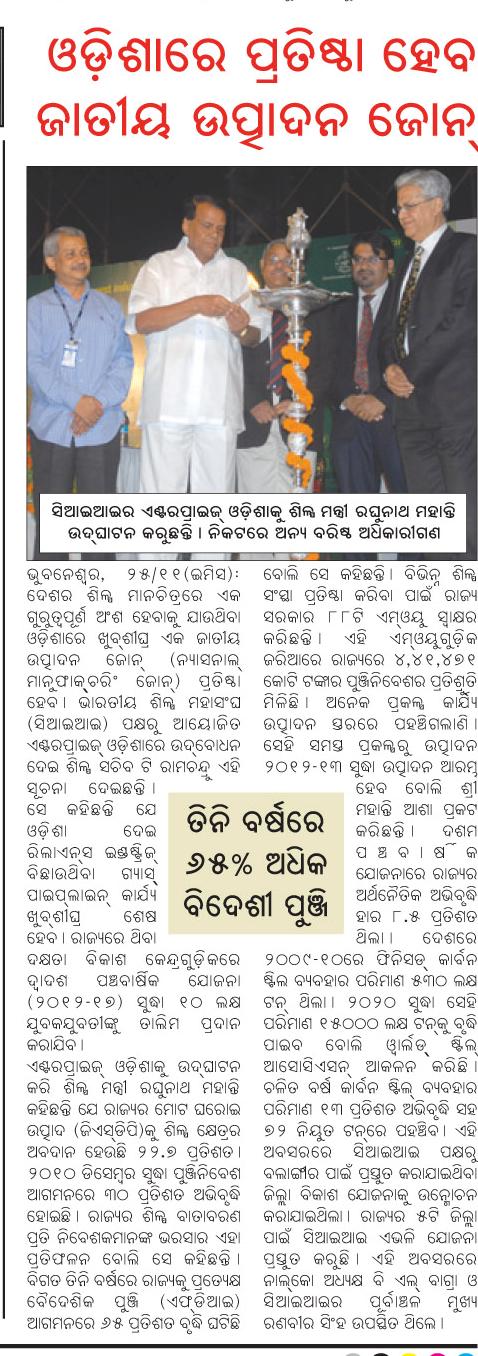
The NIMZs are part of a new national manufacturing policy. The following excerpt from a report in WSJ explains the goal of this policy.

India’s federal cabinet Tuesday approved a national manufacturing policy, the first of its kind in the country, to increase manufacturing’s share of national output as it aims to create millions of jobs and add capacity to sustain brisk economic growth through the next decade.

The policy targets raising the share of manufacturing to 25% of gross domestic product by 2022 from the current 16% — a level that has remained stagnant since 1980.

The new policy proposes developing National Investment and Manufacturing Zones, or mega-industrial parks, that will reduce the compliance burden on industry, the government said in a statement.

Following is information on the establishment of such an NIMZ in Odisha.


List of museums in and around Bhubaneswar

Arts village, Bhubaneswar- Cuttack- Puri, Cuttack, Dhenkanal, Heritage sites, Khordha, Lalitgiri-Ratnagiri-Udaygiri, Monuments, Museums, Puri 1 Comment »

Following is a list of museums and ASI ticketed monuments in and around Bhubaneswar:

  1. Odisha State Museum, Bhubaneswar. (branch museums at: Puri, Dhenkanal, Salipur, Khiching, Baripada, Balasore, Nuapara, Bhawanipatna, Balangir, Jeypore, Baragarh and Koraput)
  2. Museum of Tribal Arts and Artifacts, Bhubaneswar.
  3. Regional Museum of Natural History (RMNH), Bhubaneswar.
  4. Regional Science Center, Bhubaneswar
  5. Handloom and Handicrafts museum, Bhubaneswar (being set up)
  6. ASI Museum in Konark.
  7. ASI Museum in Ratnagiri.
  8. ASI Museum in Lalitgiri (being constructed)
  9. ASI Ticketed Monuments (Konark, Udaygiri and Khandagiri caves, Rajarani temple, Lalitgiri, Ratnagiri)
  10. Srikhetra Culture Museum, Puri (being constructed)
  11. Dhenkanal Science Center. (Kapilas Science Park.)

Following is a list of live museums in and around Bhubaneswar:

  1. Nandan Kanan, Barang
  2. State Botanical Garden, Barang
  3. Regional Plant Resource Center (Ekamra Kanan), Bhubaneswar (with a cactus garden, arboretum, orchidarium, bamboosetum, wild fruit garden and palmetum)
  4. Medicinal plant garden, Patrapada, Bhubaneswar
  5. Jayadev Vatika, Kenduvila (30 kms from Bhubaneswar)
  6. Jayadev batika at Khandagiri.
  7. Ekamra Vana (Medicinal plant garden), around Bindu sagar lake, Bhubaenswar
  8. Various parks in Bhubaneswar.
  9. Aquarium at Nandan Kanan.
  10. Aquarium at CIFA, Bhubaneswar
  11. Aquarium, Puri (planned)

Others:

  1. Sudarshan Sand art institute, Puri.
  2. Raghurajpur artisan village.

A new gallery on primitive tribal groups (PTGs) to be added to the tribal museum in Bhubaneswar

Bhubaneswar- Cuttack- Puri, Khordha, Museums Comments Off on A new gallery on primitive tribal groups (PTGs) to be added to the tribal museum in Bhubaneswar

Following is from a report in Indian Express.


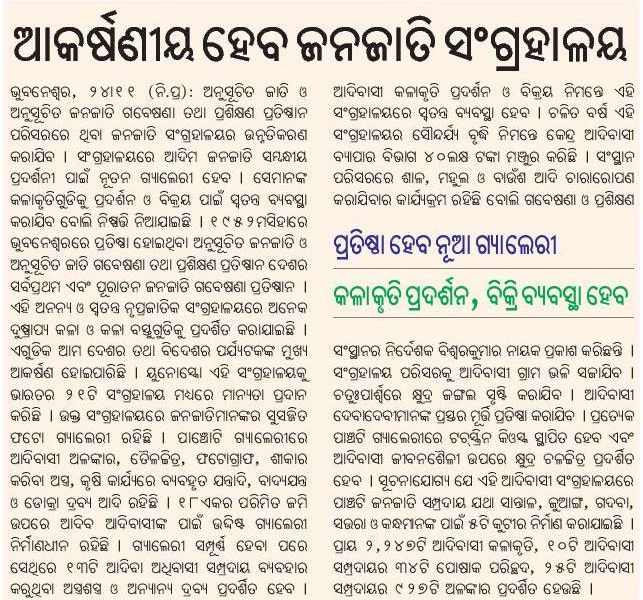
The Tribal Museum here is up for a makeover. Located on the premises of Scheduled Caste and Scheduled Tribe Research and Training Institute (SCSTRTI), the archives displays objects from almost every tribe. The institute is the only government-run tribal museum in the State and  attracts hundreds of visitors from abroad each year. A few years back, it was identified as the best among the 21 tribal museums in India by Unesco.

 Apart from the existing five galleries in the Museum that houses ornaments, paintings, photographs, hunting tools, agriculture implements, musical instruments and Dokra items,  the authorities are setting up another Primitive Tribal Group (PTG) gallery on the institute’s 18 acre campus. Construction of this gallery is underway and after completion, it would adorn artefacts related to 13 PTGs in the State.  Plans have also been drawn up to rope in tribal artisans and use the institute premises as a live museum-cum-platform where tribal artisans would get the chance to display and sell their products. This apart, the Ministry of Tribal Affairs has sanctioned ` 40 lakh for beautification of the Museum this year that would entail landscaping, construction of pathways and plantation of trees like Sal, Mohul, Bamboo … "… The land behind the five hutments within the Museum will be used for setting up small forests that are typical to a tribal habitation,” said Museum in-charge Trilochan Sahoo, adding stone statues of tribal deities will also be installed. Besides, touchscreen kiosks will be set up in each of the existing five galleries where short films on tribal livelihood will be screened for interested tourists. The Tribal Museum has around 2,247 tribal artefacts, 34 items of textiles of 10 tribes and 927 ornaments of 25 tribes. The five huts within the premises are of Santal, Juang, Gadaba, Saora and Kondh tribes.

Tribal Dance Festival

The three-day Tribal Dance Festival will  be organised this year by the SC & ST Development Department from December 12. … every day during the festival, five tribal dances will be showcased and this time, tribals from Chhattisgarh, West Bengal, Jharkhand and Andhra Pradesh have been invited to perform besides the those from the State.

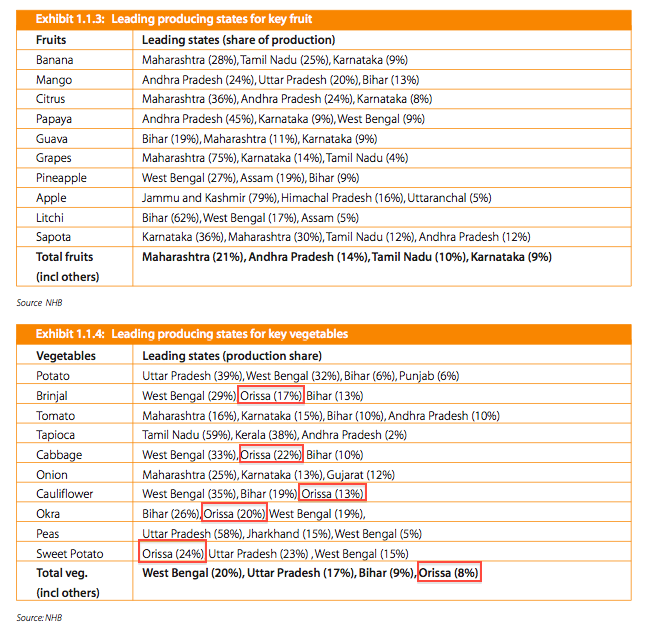
Odisha is among the top 4 vegetable producers of India (from a 2005 document)

Organic fruits and vegetables, Potatoes, Vegetables Comments Off on Odisha is among the top 4 vegetable producers of India (from a 2005 document)

The following is from Page 3 of the document at http://mofpi.nic.in/images/File/volume2.pdf. Thanks to Devasis Sarangi for the pointer.

Investment status of four new ports in Odisha: Dhamara, Gopalpur, Subarnarekha river mouth (Choumukha-Kirtania), Astaranga

Astaranga, Puri (Navayuga interested), Balasore, Bhadrakh, Choumukha-Kirtania, Balasore (Creative ports, Chennai interested), Dhamara port (under constr.), Ganjam, Gopalpur port (under constr.), Puri Comments Off on Investment status of four new ports in Odisha: Dhamara, Gopalpur, Subarnarekha river mouth (Choumukha-Kirtania), Astaranga

Update: Following is from a report in Business Standard.

… "The Ministry of shipping and highways has more or less agreed to bear 50 per cent of the cost of road and rail connectivity for the minor ports proposed in the state. The ministry had asked us to submit cost estimates for the same and accordingly, we had submitted Rs 1200-crore plan for offering road and rail connectivity for the upcoming minor ports", an official source told Business Standard.

According to the proposal, the cost of rail and road connectivity for the minor ports would be shared equally between the Centre and the port developers.

… Among the 14 locations identified by the state government for the development of ports are Dhamara, Jatadhari Muhan, Barunei Muhan, Astaranga, Bichitrapur, Chudamani and Kirtania to name a few.

The state government had already inked concession agreements with the developers for the development of ports at Dhamara, Gopalpur and Kirtania.

The Orissa government has also signed MoUs (Memorandum of Understanding) with the Hyderabad-based Navayuga Engineering Private Ltd and Aditya Birla Group for setting up of ports at Astaranga and Chudamani respectively.


Following is from a report in Business Standard.

Orissa has witnessed grounding of investment of Rs 4,262.44 crore from non-major ports in the past 10 years.

The investments have made four minor port developers- Dhamara Port Company Ltd (DPCL), Gopalpur Port Ltd (GPL), Creative Port Development Ltd and Navayug Engineering Ltd from 2002-03 up to the end of September this year. …

DPCL, a 50:50 joint venture between Tata Steel and L&T, is the biggest investor, with its investment till the second quarter of 2011-12 standing at Rs 3,570.35 crore.

The port developer, who has already begun operations, has invested Rs 762.79 crore, Rs 1,088.26 crore and Rs 1,059.40 crore in 2008-09, 2009-10 and 2010-11 respectively. In 2011-12, DPCL has invested Rs 60.45 crore till the end of September.

Gopalpur Port Ltd (GPL), a special purpose vehicle promoted jointly by Orissa Stevedores Ltd and Sara International Limited (SIL) has invested Rs 421.09 crore during 2007-08 to September-end of 2011-12. The port developer which is developing the seasonal port at Gopalpur into an all-weather port, has invested Rs 51.09 crore in 2007-08, Rs 30 crore in 2008-09, Rs 50 crore in 2009-10, Rs 40 crore in 2010-11 and Rs 250 crore in this fiscal (till September-end).

The state government has asked the port promoters to commission second phase of the port operations by March 2013. GPL has already claimed to have achieved financial closure of Rs 1,400 crore for the first stage of Phase-II of the deep sea port with the signing of loan agreement with a consortium of 11 banks.

The port at Subarnarekha river mouth, proposed by Chennai-based Creative Port Development, has seen investment of Rs 221 crore.

Creative Port Development had inked an MoU (Memorandum of Understanding) with the state government on December 18, 2006 for setting up a port with an initial capacity of 10 million tonnes per annum (mtpa) which was to be scaled up to 40 mtpa in 10 years.

The port developer had also entered into a concession agreement with the state government on January 11, 2008. As per this agreement, the port developer would share revenue with the state government at the rate of five per cent from first to fifth year, eight per cent from sixth to 10th year, 10 per cent from 11th to 15th year and 12 per cent for the remaining 15 years.

The port at Astaranga in Puri district has witnessed an investment of Rs 50 crore over the past four years.

The port project is being taken up at a cost of Rs 6,500 crore. The initial capacity of the port will be 25 mtpa which will be eventually scaled up to 70 mtpa. The state government had entered into an MoU with Hyderabad-based Navyug Engineering Ltd on December 22, 2008.

The project proponent had signed a concession agreement with the state government in November 2010.

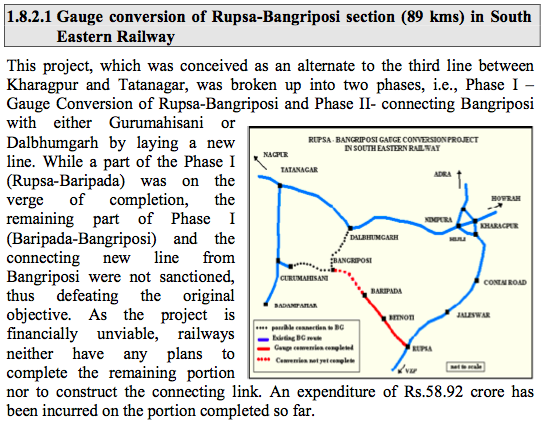
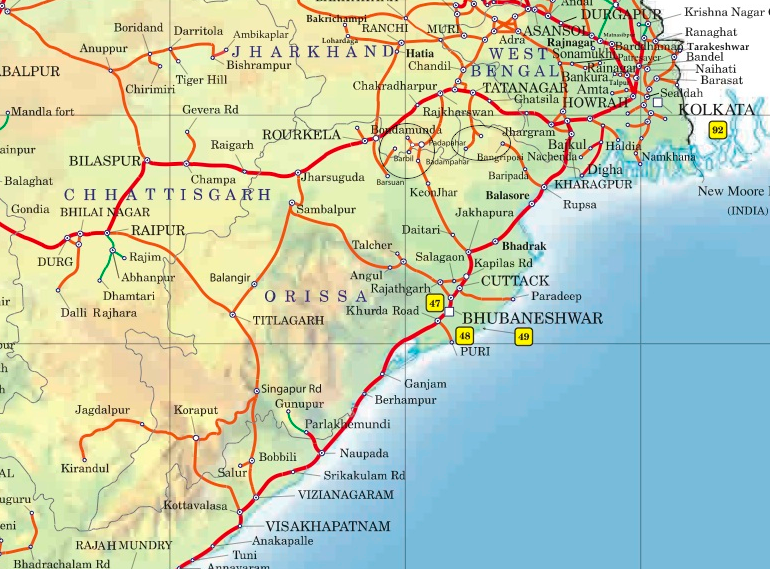
SER needs to have a division HQ in Odisha (possibly in Rourkela) as more than 22% (and growing) of its route kms lie in Odisha; and without a proper voice from Odisha SER has been neglecting and making blunders in Odisha (work in progress)

APPEAL to readers, Balasore, Balasore-Baripada-Rasgovindpur, Baripada - Bangiriposi (under constr.), Keonjhar, Mayurbhanj, Rourkela- Kansbahal, Rupsa Jn - Baripada, SER, Sundergarh 38 Comments »

Please help me fill the missing data in the table below. (The important data we need is the route kms for the red states in Column 2 as those states do not have a division HQ of that zone.)

Zones, Zone HQ (Route kms from page 13 of 2009-10 yearbook) States where the zones lie (Route km break up) Division HQs and states they lie in
Central, Mumbai (3905) [wiki,home,map] Maharashtra, Karnataka, MP. Bhusawal, Mumbai, Nagpur, Pune, Solapur (all Maharashtra)
Eastern, Kolkata (2414) [wiki,home,No map] West Bengal, Bihar Asansol, Howrah, Malda, Sealdah (all West Bengal)
East Central, Hazipur (3628) [wiki,home, No map] Bihar, Jharkhand, UP Danapur (Bihar), Dhanbad (Jharkhand), Mughalsarai (UP), Samastipur (Bihar), Sonpur (Bihar)
ECOR, Bhubaneswar (2572) [wiki,home,map] Odisha (1807.25), Chhatisgarh (268.50), AP (570.64)=2646.39 [from map] Khurda Rd (Odisha), Sambalpur (Odisha), Visakhapatnam (AP)
Northern, New Delhi (6968) [wiki,home,map] Punjab, Delhi, UP, J & K, Haryana, Himachal Pradesh, Uttaranchal, Rajasthan, Chandigarh Ambala (Haryana), Delhi, Firozpur (Punjab), Lucknow (UP), Moradabad (UP)
North Central, Allahabad (3151) [wiki,home,map]  UP, MP, Rajasthan, Haryana Agra, Allahabad, Jhanshi (all UP)
North Eastern, Gorakhpur (3667) [wiki,home]  UP, Uttaranchal, Bihar Izzatnagar (UP), Lucknow (UP), Varanasi (UP)
Northern Frontier, Guwahati (3907) [wiki,home,India map] WB, Bihar, Assam, Tripura, Manipur, Nagaland, Mizoram, Arunachal Pradesh Alipurdar (WB), Katihar (Bihar), Lumdig (Assam), Rangiya (Assam), Tinsukia (Assam)
North Western, Jaipur (5459) [wiki,home,map] Rajasthan, Punjab, Haryana, Gujarat, MP. Ajmer, Bikaner, Jaipur, Jodhpur (all Rajasthan)
Southern, Chennai (5098) [wiki,home] Tamil Nadu, Kerala, Pondicherry Chennai (TN), Madurai (TN), Palghat (Kerala) Trichi (TN), Trivendrum (Kerala)
South Central, Secunderabad (5803) [wiki,home,map]

AP (4348.4), Maharashtra (1115.8), MP (70.2), Tamil Nadu (6.9),  Karnataka (268.7) = 5810
[from map]

Guntakal (AP), Guntur (AP), Hyderabad (AP), Nanded (Maha), Secunderabad (AP), Vijaywada (AP)
SER, Kolkata (2631) [wiki,home]

West Bengal, Jharkhand, Odisha (589+)

2004 data: West Bengal (894), Jharkhand (954), Odisha (574.6) = 2422.6

Adra (WB), Charadharpur (Jharkhand), Kharagpur (WB), Ranchi (Jharkhand)
SE Central, Bilaspur (2447) [wiki,home,no map]

Chhatisgrh (891.3), Maharashtra (662.3), Odisha (51.1), MP (792.5) = 2397.3 Total [From a 2005 map]

But BG distribution is as follows:
Chhatisgrh (802.3), Maharashtra (482.1), Odisha (51.1), MP (263.6) = 1599.3 [From a 2005 map]

Bilaspur (Chhatisgarh), Raipur (Chhatisgarh), Nagpur (Maharashtra)
South Western, Hubli (3177) [wiki,home,map] Karnataka (2702.6), Andhra Pradesh (224.2), Tamil Nadu (174.3), Maharashtra (27.9), Goa (69.3) = 3198.3 [from map] Bangalore, Hubli, Mysore  (all Karnataka)
Western, Mumbai (6182) [wiki,home,map] Gujarat, Maharashtra, MP, Rajasthan. Ahmedabad (Gujarat), Bhavnagar (Gujarat), Mumbai (Maha), Ratlam (MP), Rajkot (Gujarat), Vadodara (Gujarat)
West Central, Jabalpur (2965) [wiki,home,map] MP, Rajasthan Bhopal (MP), Jabalpur (MP), Kota (Rajasthan)


Why it is important that SER have a division in Odisha?

  • As we will show below SER, without a proper representation in Odisha, has badly messed up in Odisha.
  • SER has neglected stations in Odisha. In particular, it has neglected Rourkela, the second largest metropolitan area of Odisha in many ways. For example, Rourkela is not in the list of world-class stations.

How has SER messed up in Odisha?

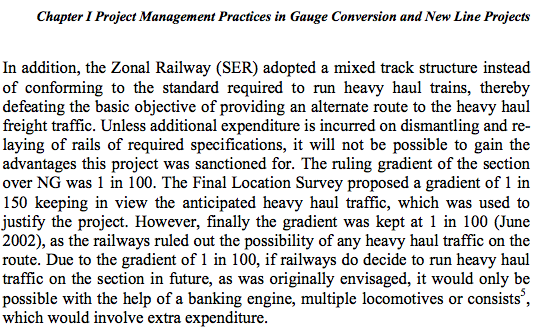
  • The Rupsa-Bangiriposi conversion to broad gauge has been messed up badly. See page 8-9 of 2006-may-CAG report.
  • Alignment of Jaleswar – Digha line.
  • The dangling lines
  • etc.


Having made the point that SER needs to have a division HQ in Odisha, the best location for such a division HQ would be Rourkela. It would of course need a reorganization of the current division break-up. Below we will give some suggestions on a possible reorganization.


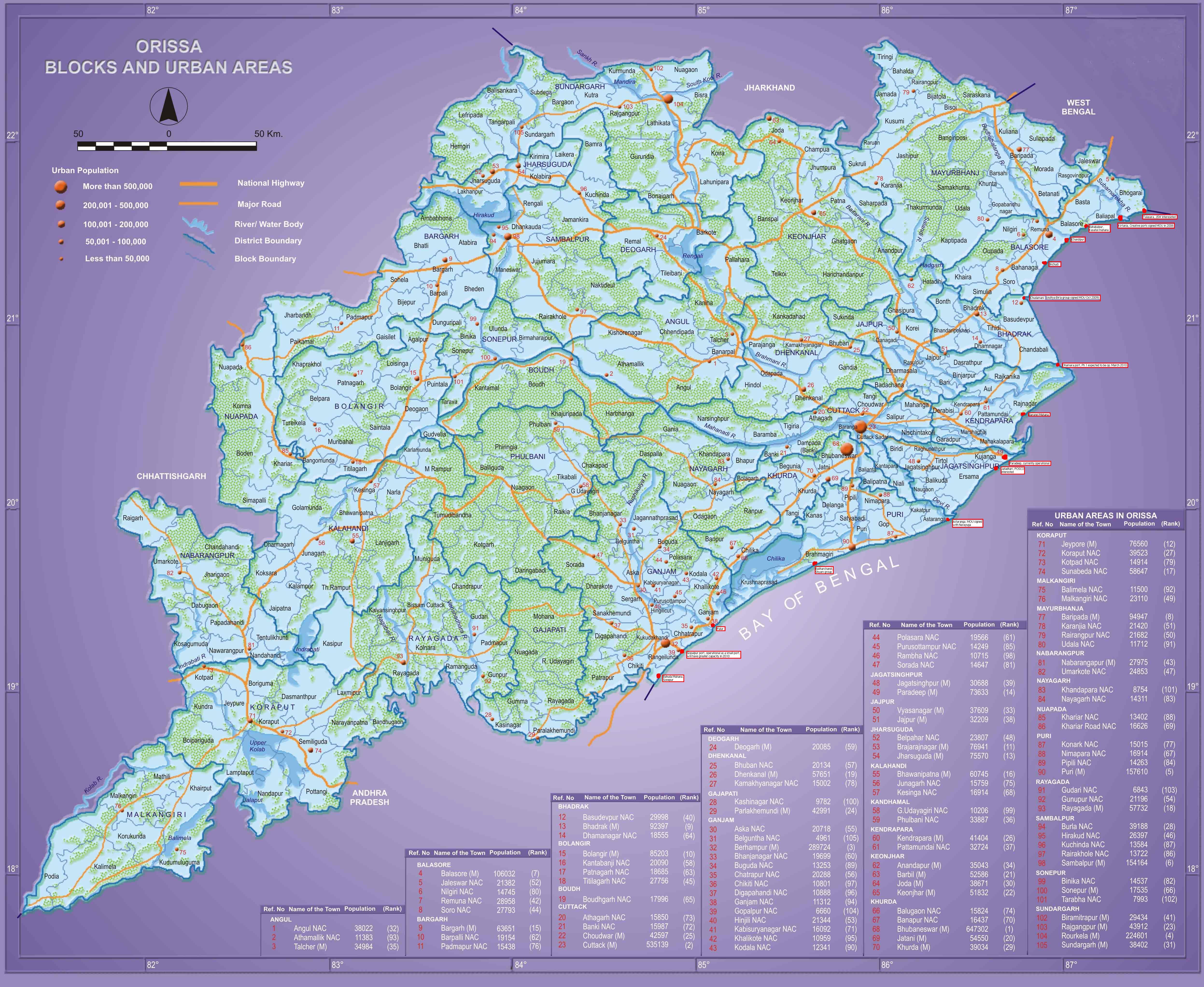
Work starts on Paradeep-Choudwar-Rourkela Industrial Corridor

Angul, Anugul- Talcher - Saranga- Nalconagar, Bhubaneswar- Cuttack- Puri, Bhubaneswar-Dhenkanal- Anugul, CKP ... Bhalulata - Rourkela - Jharsuguda Jn - Daghora , Cuttack, Cuttack - Paradeep, Cuttack-Paradip, Dhenkanal, IDCO, Jajpur, Jharsuguda-Sambalpur- Bargarh, Jharsugurha, Jharsugurha- Brajarajnagar- Belpahar, Kendrapada, Khordha, Paradeep port, Paradip - Jatadhari - Kujanga, Rourkela- Kansbahal, Rourkela-Jharsuguda, Sambalpur, Sambalpur - Talcher, Sambalpur-Burla-Jharsuguda, Sambaplur- Burla- Bargarh- Chipilima, Sundergarh, Talcher - Barang, Talcher - Bimlagarh (under constr.) 1 Comment »

Following is an excerpt from a report in ibnlive.com.

The state government has started work on development of a railway corridor through Choudwar to Rourkela to allow ease of inward and outward transportation of goods from the industrial hubs and mining belts along the region.

Land acquisition for the project, the first of its kind initiative by a state government, has already been initiated by the Industrial Infrastructure Development Corporation (Idco). The project would go on ground after the land acquisition and is targeted to be completed by 2015, said Idco CMD Priyabrata Patnaik on Friday.

The corridor involves development of extensive rail and road connectivity, along with provisioning of water supply and other infrastructural facilities. The corridor would encompass two track railway lines and six-lane road passing through the industrial hubs and the coal mining belts. New industrial areas and downstream units would be developed along the corridor.

Common infrastructure facilities under the corridor would solve the problems of inward and outward transportation of goods and minerals. The stretch would pass through the heart of coal mining operations in the state, which harbours about 65 billion tonne of reserves. The coal reserves in the Talcher belt only is around 43 billion tonne.

The corridor would cover 17 large and mega-industries, along with 57 other units, through the stretch from Choudwar to Rourkela. Traffic projection on the route is given out as 8.7 million tonne.

The route would have 163 km of railway track length and 465 km on road. As many as 308 minor bridges and 77 major bridges would have to be constructed on it, said Patnaik.

Note 1: The 163 km of railway track probably refers to the Talcher-Bimlagarh segment.

Note 2: Although the above report only mentions the Choudwar-Rourkela part, in earlier documents there is mention of Paradeep-Choudwar-Rourkela industrial corridor. See for example this 2009 Business Standard report. Following are some excerpts from that.

The Orissa government plans to develop an industrial corridor running from Paradeep to Rourkela through industrial hubs like Choudwar, Talcher and Sambalpur.

Though the initial proposal was to have an industrial corridor originating from Choudwar to Rourkela, the proposal was modified to extend the corridor till Paradeep to allow inward and outward transport of goods through the Paradeep port, sources said.

… The proposed industrial corridor will be in line with the Delhi-Mumbai Industrial Corridor and is designed to pass through national highway no.42 and national highway no 5 (A).

Under the project, both road and rail corridor will be developed, which will be the backbone of the proposed project. The industrial estates and down stream units would be developed over 25 km area on both sides of the corridor.

IL&FS has been appointed as the consultant for the project and it has already submitted the pre-feasibility study report to the industry department on the project. However, the detail cost of the project is yet to be worked out yet, sources added.

The latest initiative of the state government follows a similar initiative to develop a common ‘rail-road-water pipeline and infrastructure corridor’ in Meramundali-Angul-Talcher-Chhendipada belt, to facilitate movement of coal in the Talcher coalfield area.

The project is estimated to cost about Rs 5000 crore including Rs 2000 crore for 2-line rail corridor and Rs 1100 crore for 4 lane road alongside it. The land width of the proposed corridor will be 300 metre which includes 60 metre for road and 20 metre for water pipeline.

The total length of the corridor is 137 kilometre which includes length of 43 number of major bridges to be constructed on this stretch. RITES Ltd has already submitted a pre-feasibility report to the state owned Industrial Infrastructure Development Corporation of Orissa Ltd. (Idco) on the project.

The project is designed to have multi-point centralised loading stations conceived along the corridor rather than individual bulb connections with a view to avoid interference or wastage of coal bearing areas. Road and water pipe alignment will run parallel to rail alignment, sources said.

It will be connected to rail line at three locations- Jharpada, Angul and Budhapanka. The common corridor will have multiple entry and exit points and no surface crossing. Besides, flyovers are proposed to avoid cross movements at junction stations.

This ‘rail-road-water pipeline and infrastructure corridor’ in Meramundali-Angul-Talcher-Chhendipada belt is projected to handle 113 million tonne coal by 2014-15. It includes 55 million tonne coal movement required by the power companies, 40.76 million tonne by steel companies and 17.22 million tonne by other industries.

The Lalitgiri-Ratnagiri-Udaygiri ancient Buddhist knowledge center in Odisha; has been compared with Nalanda in the art history and archaeology literature

APPEAL to readers, CENTER & ODISHA, Historical places, Jajpur, Kalinganagar- Chandikhol- Paradip, Lalitgiri-Ratnagiri-Udaygiri, Odisha history, Universities: existing and upcoming Comments Off on The Lalitgiri-Ratnagiri-Udaygiri ancient Buddhist knowledge center in Odisha; has been compared with Nalanda in the art history and archaeology literature

(Appeal to readers: I would appreciate any additional pointers to literature where the knowledge center aspects of the Odisha buddhist monuments have been discussed and/or they have been compared with the well-known buddhist sites in India such as Nalanda, Bodhgaya, Sanchi, etc.)

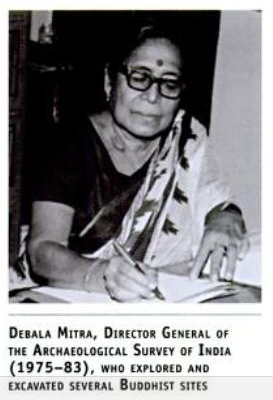
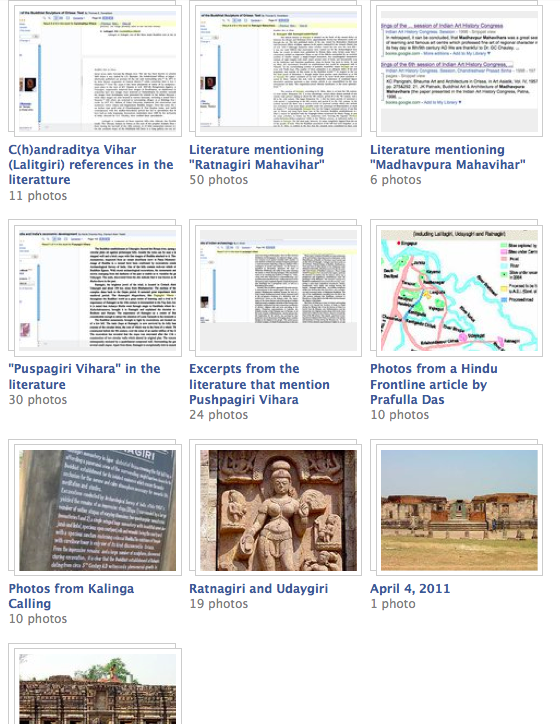
We all have read about Nalanda and Taxila as ancient learning centers and they are often referred to the as precursor of the present day universities. In Odisha the yet to be identified Puspagiri mahavihara as well as the Lalitgiri-Ratnagiri-Udaygiri  have been compared with Nalanda in the art history and Buddhist literature. Following are some slides (in facebook) which compiles that information. In these slides we quote extensively from Mrs. Debala Mitra’s two books. Mrs. Mitra was the Director General of the Archaeological Survey of India (1975-1983) [Page 448 of this book] and has written extensively on various Monuments of India.
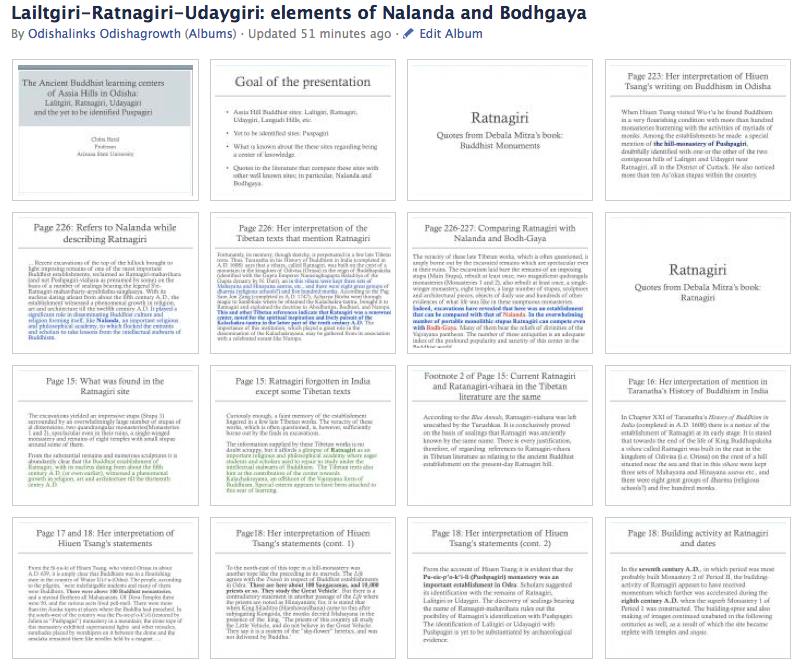
 

The above slides do not have any pictures. As is mentioned in some of the slides, the Lalitgiri-Ratnagiri-Udaygiri Mahaviharas are also comparable to Bodhgaya in certain respects and one slide mentioned how none of the monasteries in Nalanda can compare with the embellishment in one of the monastery found in Ratnagiri. The following pictures, again from facebook, gives one the idea of what has been found in Lalitgiri-Ratnagiri-Udaygiri and the beauty and significance of them.

In 2010 the Indian Parliament passed the Nalanda International University Bill. This university is in the making now and this wikipedia page has information on it. We hope that some day more people in Odisha and India will know about Lalitgiri-Ratnagiri-Udaygiri and a similar university (perhaps called Puspagiri University, the yet to be identified Mahavihara about which Hiuen Tsang wrote glowingly) will be established in Odisha. Towards that effort some background information has been compiled in a facebook page and a facebook account. Following is a glimpse of the information that has been collected.

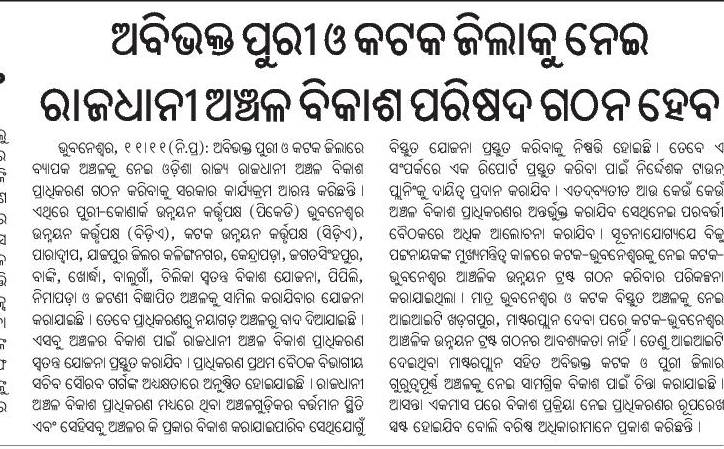
Odisha initiates plans for a Capital Area Development Region

Bhubaneswar, Bhubaneswar- Cuttack- Puri, Bhubaneswar-Berhampur, Bhubaneswar-Cuttack- Kalinganagar, Bhubaneswar-Dhenkanal- Anugul, Bhubaneswar-Nayagarh, Bhubaneswar-Paradip, Bhubaneswar-Pipli- Astaranga, Bhubaneswar-Pipli- Konark, Bhubaneswar-Puri, Choudwar-Kendrapara - Dhamara, Cuttack, Cuttack, Cuttack-Paradip, Dhenkanal, Jagatsinghpur, Jajpur, Jajpur Rd- Vyasanagar- Duburi- Kalinganagar, Kalinganagar - Panikoili - Jajpur - Kendrapara, Kalinganagar- Chandikhol- Paradip, Kendrapada, Khordha, Odisha govt. action, Paradip - Jatadhari - Kujanga, Puri, Puri, Puri - Konark, URBAN DEV. & RENEWAL 1 Comment »

The above is a good idea.


  • A plan over a larger area will avoid congestion and slums that are typical of densly packed areas.
  • Another big benefit will be that the term "Capital Area" will make it easier for institutions, companies and other entities to come to the gretaer area rather than coming to "Bhubaneswar". For example, many institutions that are looking for land in Bhubaneswar are hesitant to locate in Kendrapada or Jagatsinghpur; even though the political leadership is very welcoming.  But once the term "Capital Area" encompasses Kendrapada and Jagatsinghpur, these institutions will be less hesitant to come there.

So while the current Bhubaneswar and Cuttack planned areas will sever as the core urban area, the larger Capital Area development region will morph to a sub-urban area which down the road will touch the metropolitan areas around Angul in the west and Berhampur in the south.

We wrote about this in http://www.orissalinks.com/orissagrowth/archives/3637.

A similar term needs to be coined for the greater Sambalpur-Jharsuguda-Rourkela area. See http://www.orissalinks.com/orissagrowth/archives/3660 , http://www.orissalinks.com/orissagrowth/archives/3672 and http://www.orissalinks.com/orissagrowth/archives/3668.

Perhaps it can be called the "Western Odisha Development Region".

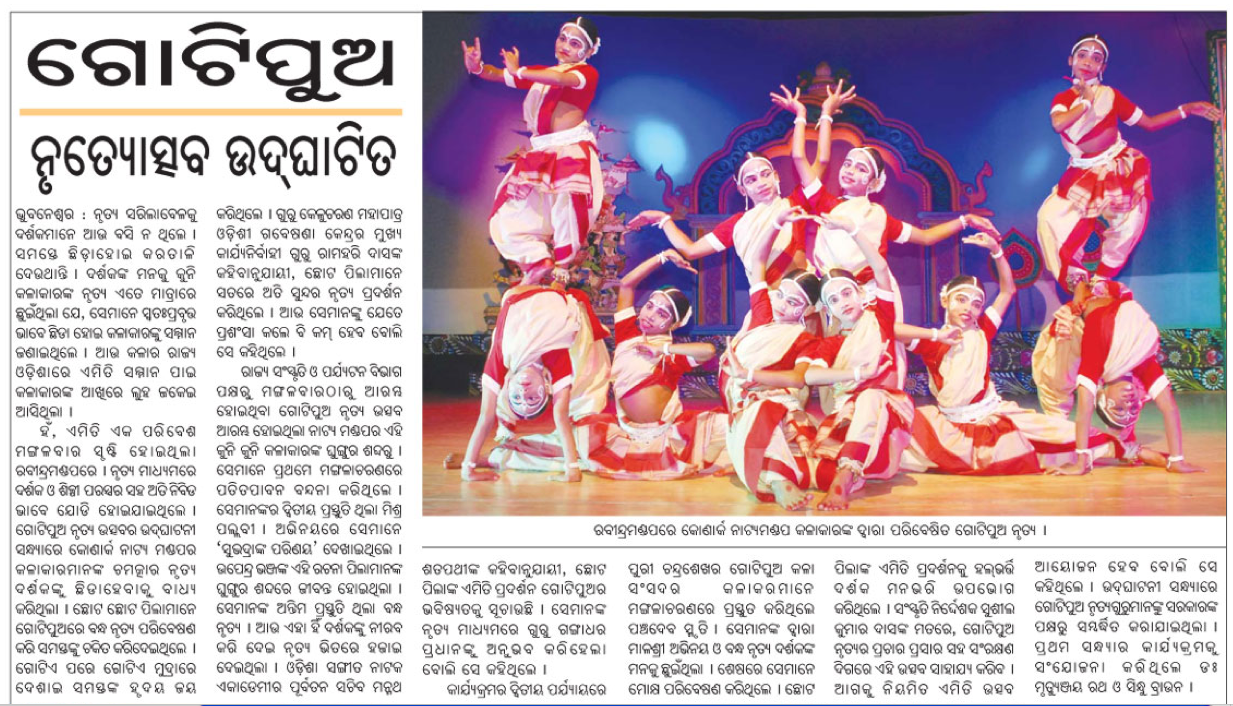
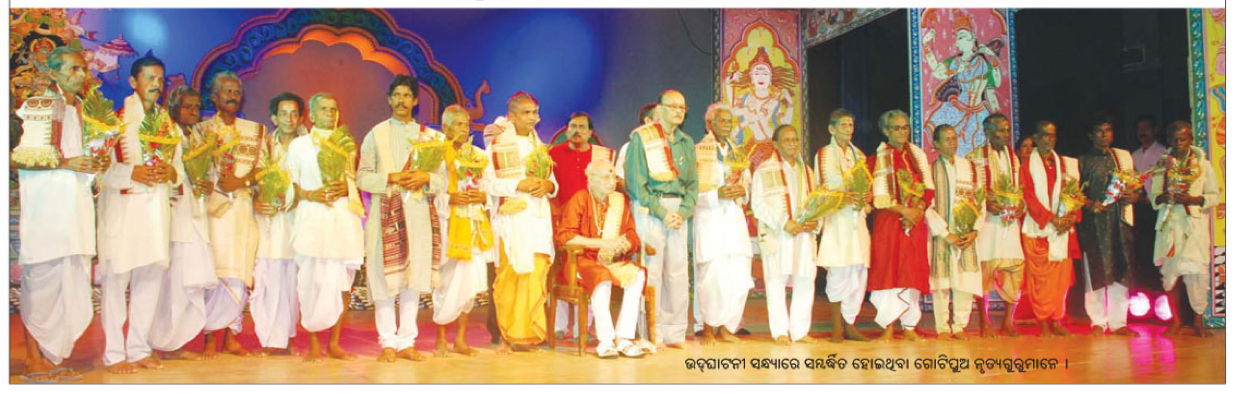
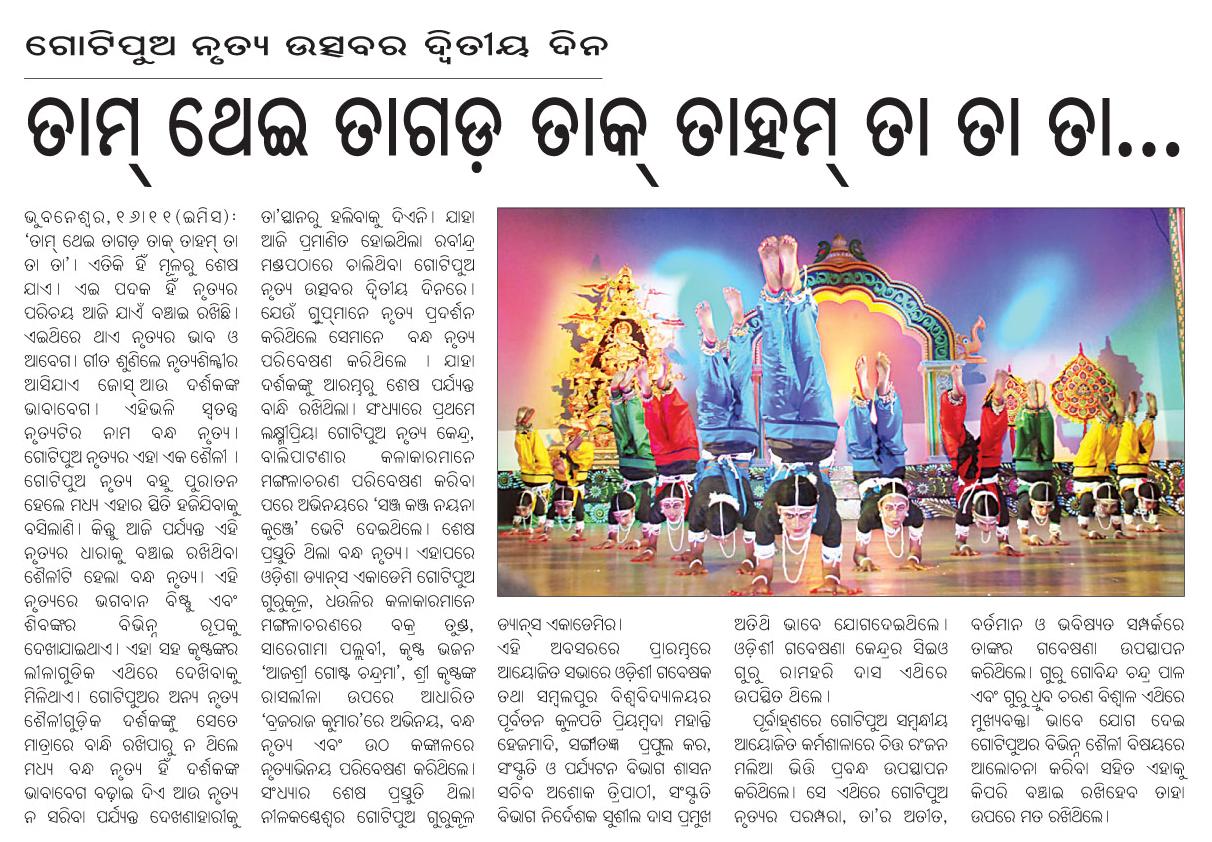
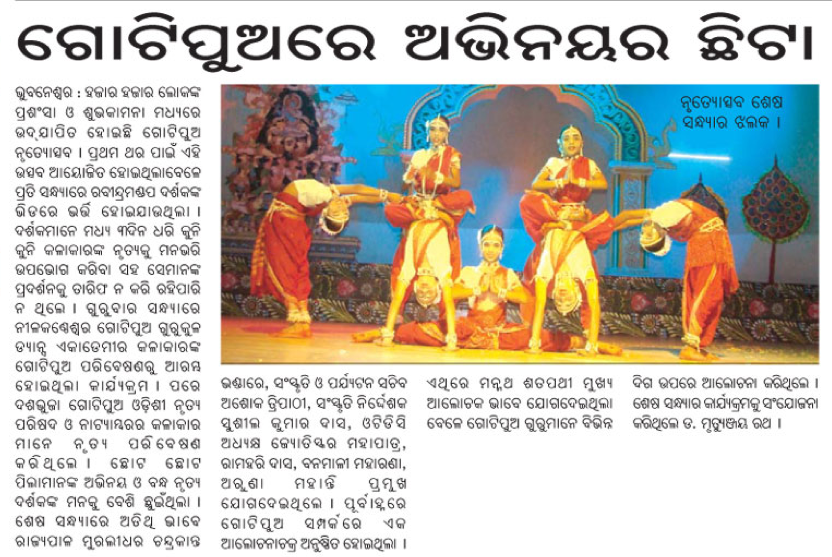
Newspaper reports and pictures on the 2011 Gotipua festival

Gotipua, Gotipua Festival, Odisha govt. action Comments Off on Newspaper reports and pictures on the 2011 Gotipua festival


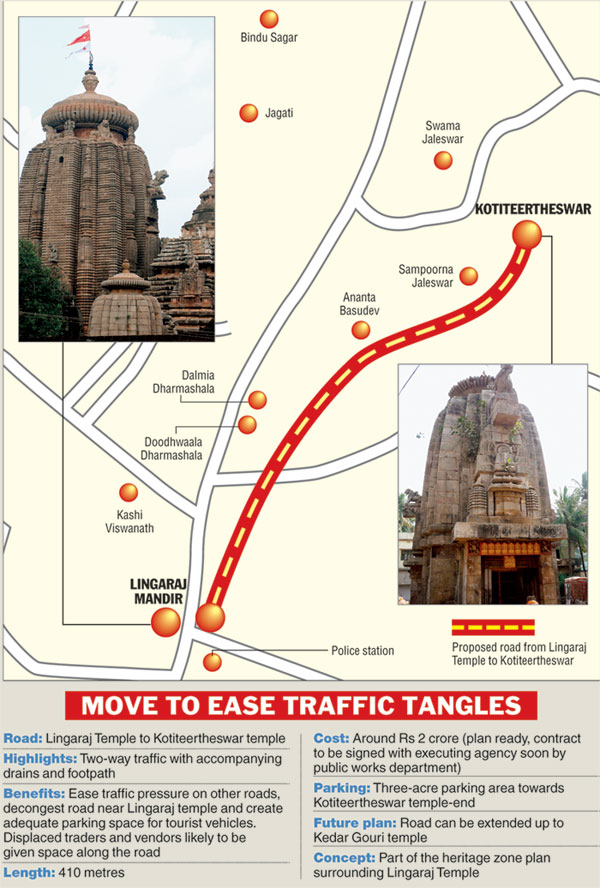
Some tourism infrastructure involving Lingaraj temple and vicinity in Bhubaneswar

Bhubaneswar, Bhubaneswar- Cuttack- Puri, Circuit: Bhubaneswar-Chilika-Puri, Khordha, NURM, JNNURM, Odisha govt. action, Roads, highways and Bus stands, Telegraph, Temples Comments Off on Some tourism infrastructure involving Lingaraj temple and vicinity in Bhubaneswar

Following is from a report by Bibhuti Barik in Telegraph.

The state government is planning to build a new road from Lingaraj Temple to Kotiteertheswar Temple at a cost of around Rs 2 crore, to ease traffic pressure in the area. The 410-metre two-lane road will come with a three-acre parking area.

The project, which is to be taken up jointly by the tourism department and the roads and building division of the public works department (PWD), will also help provide a clearer view of the 11th century Lingaraj temple as shops and roadside vendors in front of the shrine will be relocated along the new road.

… the dilapidated Lingaraj Market Complex … will be demolished to clear the area for the laying of the road which will run along the Devi Padahara pond, behind Ananta Vasudev Temple and the farm lands on the side of natural drainage channel No. 7 near Kotiteertheswar Lane. The private land near the temple, which is owned by businessmen and the Lingaraj Temple Trust, will also be acquired to speed up the road project.

… “The state tourism department has already given Rs 30 lakh to the PWD and the rest — Rs 1.69 crore — will be provided by them from their plan budget. All the displaced traders and vendors will be rehabilitated.”

… the two-lane road would have facilities such as footpath and accompanying drains. However, the parking lot would be built by the tourism department, as it is not included in the road project.

The road would later be extended up to Taleswar Mahadev to improve the communication between Kedar Gouri and Lingaraj Temple.

Tourism department sources added that Old Town would soon have a mega tourist circuit, for which the Centre has sanctioned Rs 8.14 crore. The proposed circuit envisages, among others things, renovation of two major roads, construction of a “parikrama” around Lingaraj Temple, soft lighting for eight protected monuments and two tourism interpretation centres.

While the tourism department is trying to revive Ekamreswar, the miniature temple of Lord Lingaraj near Lingaraj police station, a dedicated road corridor will be constructed to link Puri, Old Town and Khandagiri via Dhauli. An amphitheatre will also be built opposite Madhusudan Park at Pokhariput with a capacity to accommodate 3,000 people.

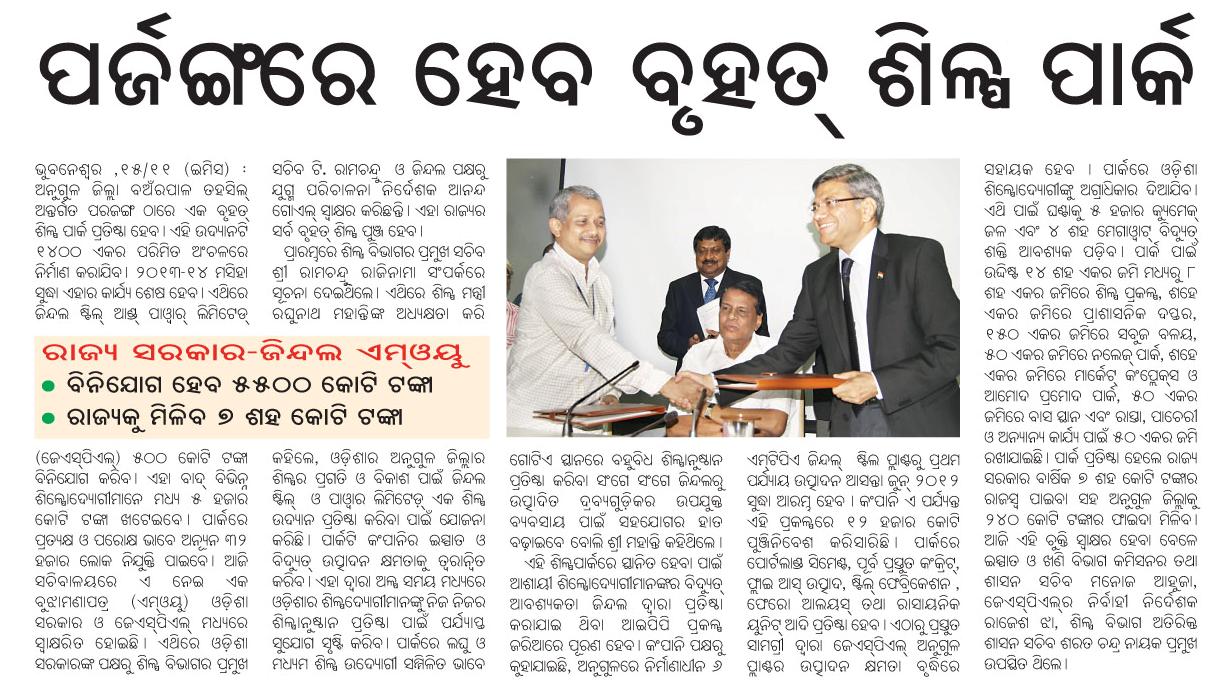
JSPL signs MOU with Odisha government on the proposed industrial park at Parjang, Angul

Angul, Anugul- Talcher - Saranga- Nalconagar, Cold rolling mills, Industrial Parks, Jindal, Steel, Steel ancilaries 1 Comment »

Update:

Following is from a report in Business Standard.

Jindal Steel & Power Ltd (JSPL) has committed an investment of Rs 500 crore for a downstream industrial park in Orissa.

This is the latest in a string of investment plans announced by the company in the state which includes a greenfield steel plant, a coal to liquid project and a proposed deep sea port.

The steel company on Tuesday signed a Memorandum of Understanding (MoU) with the state government for setting up the park at Parang in Angul district. The downstream industrial park is expected to attract investments of Rs 5,000 crore besides generating employment opportunities for 32,000 people, both direct and indirect.

The park is also set to generate tax revenue worth Rs 700 crore per annum for the state government.

The pact was signed between T Ramachandru, principal secretary (industries), Orissa government and Anand Goel, joint managing director of JSPL.

The park, to come up over 1,400 acres of land, is expected to be operational by the end of 2014. It will focus on medium and small scale downstream units that would both add value and result in increased industrial activity.

The industries targeted for the park include steel rolling and other mills for downstream steel products, forging units, beam welding plants, ferro alloy units, pipe manufacturing units, galvanizing and colour coating units, foundries as well as food processing and coal storage units.

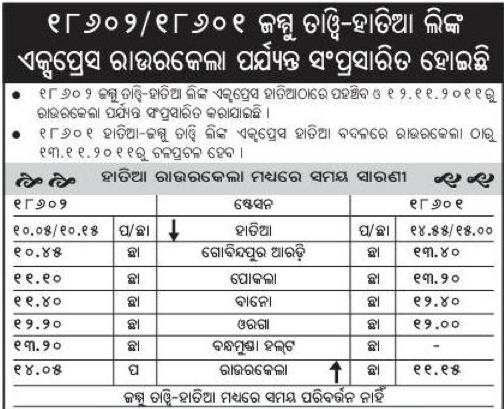
Jammu Tawi-Hatia Express to be extended till Rourkela from November 12

Railway Budget 2011, Rourkela - Biramitrapur, Rourkela- Kansbahal, Sundergarh, Time table and websites 62 Comments »

Update: The updated train timings of this extended train is as follows. It is slower than expected and takes 4 hours between Rourkela and Hatia. But those extra stops, many in Jharkhand, makes it easy for the Jharkhand people to accept this extension. That may be the reason it has these many stops in between.


(Thanks to rourkelacity.com for the pointer to this topic.)

Following is from a report in Telegraph.

… the Jammu Tawi-Hatia Express will be extended till Rourkela from November 12. Hitherto, Rourkela could enjoy the services of only Hatia-Puri Tapaswini Express, Hatia-Bhubaneswar Garib Rath Express and Hatia-Jharsuguda Passenger.

The above report is from the Jharkhand edition of Telegraph. It is nice to hear that they are taking this news positively, unlike many places which complain when a train originating/terminating from their city is extended.

Although this is a slow train with many stops, this will be the first direct connection between a city in Odisha and Jammu Tawi. The major en-route stops of this train are: Muri, Allahabad, Kanpur, Tundla, Aligarh, Delhi, Sonipat, Panipat, Kurukshetra, Ambala, Ludhiana, Jalandhar, Amritsar and Pathankot Jn. From Ranchi it currently takes 30:25 hrs to Delhi. It takes about 2:30-3 hrs from Rourkela to Ranchi. So from Rourkela it will take about 33 hrs to Delhi. In comparison Utkal Express plus the 08177 Tata-JSG special takes 26:25 + 2:20 = 28:45hrs. So although it is not that good an alternative to travel to Delhi, it provides new connectivity between Rourkela to many other cities such as: Allahabad, Kanpur, Tundla, Aligarh, Sonipat, Panipat, Kurukshetra, Ambala, Ludhiana, Jalandhar, Amritsar, Pathankot Jn and Jammu Tawi.

This extension is the result of the efforts of the people of Rourkela. Their movement to provide better connectivity and facilities at Rourkela should be energized by this initial result.


From an initial look, Rourkela has good connectivity to places in the west (Mumbai, Pune, Ahmedabad, etc.) and Kolkata.

With the above mentioned train the connectivity to Delhi will be decent and as mentioned their will be new connectivity to many new cities in the North. (Earlier there was only a biweekly train to/from Varanasi.)

In terms of connectivity to Southern cities the main trains are: the daily Allepey train with stoppages at Vizianagaram, Vizag, Vijaywada, Chennai, Coimbatore, Palghat, and Kochi (Ernakulum); thrice a week to/from Bangalore via Vijaywada and Tirupati; and weekly to Hyderabad. So the connectivity to Bangalore and Hyderabad needs to be improved urgently. Connectivity to/from Hyderabad could be easily improved by extending the biweekly Sambalpur-Nizamabad express to Rourkela. (One needs to check the current rake-sharing arrangements for it.)


The site http://rourkelarail.wetpaint.com/page/DEMANDS lists a bunch of demands from some railfans from Rourkela. It would help if they make a prioritized list of their demands for trains (new, extensions, frequency increases): Top, Top 3, Top 5. Note that diversions and rerouting of trains is extremely rare as the people in the current routes (who will lose that train) will oppose it. So such demands undermine the effort.

Paradeep PCPIR gets legal sanction via a signed memorandom of agreement between Odisha and the center

Fertilizers, IOC, Jagatsinghpur, Paradip - Jatadhari - Kujanga, PCPIR, Petrochemicals, Refinery Comments Off on Paradeep PCPIR gets legal sanction via a signed memorandom of agreement between Odisha and the center

(Thanks to a reader for the pointer.)

Following is from a report in Telegraph.

The Memorandum of Agreement (MoA) for setting up the Rs 2.7 lakh crore petroleum, chemicals and petrochemicals investment region (PCPIR) near Paradip was signed between the state and the Centre today.

The PCPIR will come up over 284.15sqkm in Jagatsinghpur and Kendrapara districts with a proposed investment of Rs 2,77,734 crore.

While Orissa Industrial Infrastructure Development Corporation (Idco) chairman-cum managing director Priyabrata Patnaik represented the state, additional secretary of the department of chemical and petrochemicals Geeta Menon signed on behalf of the Union government. Patnaik said, “The MoA was signed and the project has got legal sanction. All the work for the project will now proceed according to the plan.”

… Sources said the state government has requested the Centre to take up the project work in the 12th five year plan. Under the plan, an airport will come up at Paradip and two direct roads from Bhubaneswar to Puri Paradeep will be built. One of these will begin from Uttara Square on the outskirts of Bhubaneswar.

Idco will act as a nodal department to help the government develop the PCPIR. “A meeting chaired by CM Naveen Patnaik is likely to be held this week to finalise the detailed project report.”

An apex body under the chairmanship of the chief minister has already been constituted to look into the implementation of the project. Under the proposed plan, a regional development authority (RDA) will be set up. The RDA will have autonomous power and other authorities will not be able to intervene in the work of the RDA.

… Officials hope that land acquisition for the project would not be a problem. “Instead of taking lands directly from people, we will go for swapping of land. If the government takes one acre of land, the same area of land will be allotted to the owner in another place,” said an official associated with the project.

Sources said the government had asked the Centre to build a coastal corridor that would connect Paradip to Chennai. “Andhra Pradesh has also supported Orissa. The Centre has taken the demand seriously,” said the official.

The Indian Oil Corporation (IOCL) will be the anchor tenant for the project. The PCPIR will also include the IOCL’s refinery at Paradip, which in the first phase, will have an investment of Rs 29,777 crore. The refinery will have a crude and vacuum distillation unit, a hydro-cracking unit and a delayed coker unit. It will also have an integrated gasification combined cycle plant for production of steam, power and hydrogen from petroleum coke for captive use in the refinery.

Another leading player, Deepak Fertilizers, will set up a greenfield ammonium nitrate plant in the PCPIR. Tata Steel and the South Africa-based Sasol have expressed interest in setting up a coal to liquid project under the PCPIR. The project is likely to come up by 2018 in an area of 3,000 acres. The plant will produce 80,000 barrels of liquid fuel from coal per day.

According to the plan, Rs 13,634 crore will be invested for infrastructure development in the PCPIR. Of this, the Centre will provide Rs 716 crore under Viability Gap Funding (VGF) to ensure infrastructure linkages such as rail, road (national highways), ports, airports and telecom through public-private partnership. The state’s share will be Rs 1,796 crore while the remaining Rs 11,122 crore will be generated through private participation.

Shekhar Gupta on the Jan Lokpal bill (April 23, 2011)

Uncategorized 9 Comments »

I somehow missed this article where Shekhar Gupta has thoroughly analyzed and listed all that is wrong with the then Jan Lokpal Bill. (I think the Jan Lokpal Bill has since been modified. The version at http://www.indiaagainstcorruption.org/downloads.html is dated June 21, 2011. So some of the issues pointed out by Shekhar Gupta may no longer hold. Nevertheless, it gives an idea of the mindset of and (dis)ability of the Jan Lokpal bill drafters in drafting such an important bill.) Following are some excerpts:

… The Musharraf reference is also tempting because the standard answer from this group of civil society leaders to the question if their bill violates the basic spirit of the Constitution is, so what, the Constitution can be amended as it has been so many times. But the kind, and number of Constitutional amendments this draft will require, will need a Musharraf.

… Where will the rest come from? Your guess is as good as mine. All of these will have to be people of “unimpeachable integrity” and also “should have demonstrated their resolve to fight corruption in the past.” From where will you find these people, particularly as you are working on the presumption that a large number of judges of the Supreme Court and high courts do not pass that test of unimpeachable integrity. And who will choose them? A committee headed by the prime minister who, in turn, will be under the jurisdiction of the Lokpal he chooses. But, wait, it is more complicated than that. This committee shall include the two youngest judges of our high courts and Supreme Court respectively, the presumption being that the young are cleaner (Clause 6, 5 c and d). But, if a Lokpal has to be fired for misdemeanour, the case will be heard by a bench consisting of the five seniormost judges of the Supreme Court? Confused? Why are the youngest virtuous while hiring, and the seniormost equally so while firing?

… If this is not sounding impossible already, this search committee has to recommend at least “three times the names as there are vacancies” (Clause 6, 10 f). So if you thought it is hard enough to find so many perfect men and women, you now know that you have to find thrice as many. And, of course, when the selection committee’s choice is finally forwarded to the president, she “shall” sign it within a month.

… If the idea of this bill is to take away all discretion, and strike terror in the hearts of the bad guys, it does that very effectively.

Except, so many of the rest, generally innocent Indians, may live in that terror as well. The bill, for example, entitles the Lokpal to collect 10 per cent of all the fines collected, stolen wealth recovered, or even national wealth saved from being stolen, in its own corpus for its own use, thereby creating extortionist incentive: the more you value, the more you collect.

… If you report on another citizen and he is caught and convicted, you would similarly earn 10 per cent of the money recovered, and/ or the money saved from being swindled as your reward. We will, therefore, be incentivised by law to become a nation of cops and spies, sneaking on neighbours and family for pecuniary gain. Such things happen in North Korea and if it is your argument that its people are happier than us Indians, we will need some convincing.

… the Lokpal members will be deemed police officers, have the powers of seizure and search without going to a magistrate — precisely the question with Armed Forces (Special Powers) Act) — have protection of contempt of court law, will function as civil courts, be investigators and prosecutors, throwing out the very principle of separation of powers, checks and balances (Clauses 8-19, 21, 24, 25, 27, 32).

… This bill, in this form, is designed to match the dictum of “absolute power corrupts absolutely.” It also presumes all Indians are thieves, unless proven otherwise, and can only be governed in a police state. Further, that a society of a billion-plus thieves can be cleansed by barely a dozen individuals armed with the most undemocratic law drafted in a democracy outside its Parliament. That is why this needs greater, cooler discussion.

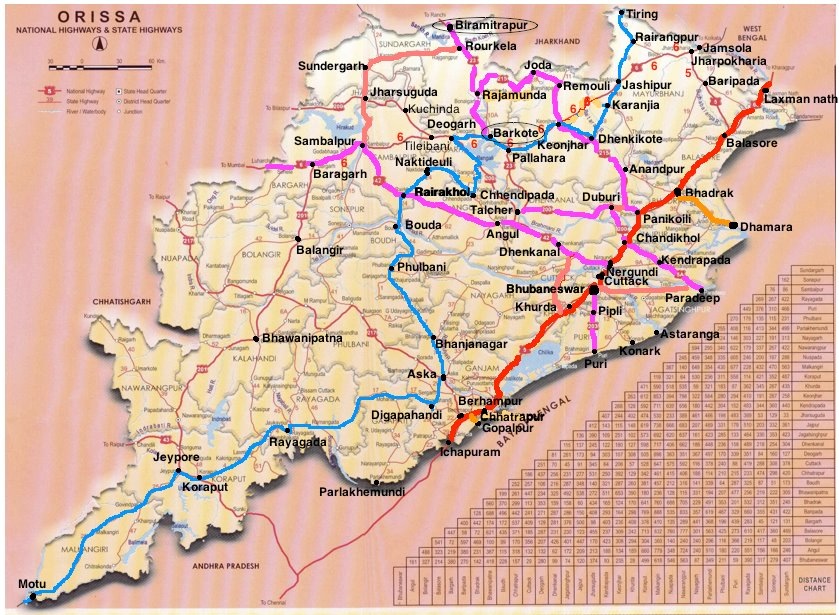
Four/two laning of Birmitrapur-Barkote section on NH 23 in Odisha under National Highways Development Project (NHDP) phase IV-A approved

CENTER & ODISHA, NH 23 (209 Kms: Jharkhand Border - Rourkela - Rajamundra - Pala Laharha - Talcher - NH-42) 3 Comments »

Following is from a PTI report in zeenews.

The Cabinet Committee of Infrastructure (CCI) on tuesday approved projects … four/two laning of Birmitrapur-Barkote section on NH 23 in Orissa under National Highways Development Project (NHDP) phase IV-A, an official release said.

"… The total estimated cost of the project (Orissa) is Rs 1,098.90 crore," the release said.

On land acquisition, resettlement, rehabilitation and pre-construction, … Rs 320.75 crore will be spent on  Orissa projects.

Both the projects will be built on design, build, finance, operate and transfer (DBFOT) basis in BOT (Toll) mode of delivery.

… On the Orissa project, which is based in Sundargah and Deogarh districts, it said the concession period is 23 years including construction period of 30 months for 125.61 km scheme.

"The project will reduce the time and cost of travel for traffic, particularly heavy traffic, plying between Birmitrapur-Barkote. It will also increase the employment potential for the local labourers for the project activities," it said.

Odisha districts under the IAP, SRE and KBK BRGF plans (Update: SADP plans)

Balangir, Bargarh, BRGF: Backward districts program, Central govt. schemes, Deogarh, Dhenkanal, Extremist infested districts program, Gajapati, Ganjam, Jajpur, Kalahandi, Kandhamala, KBK Plus district cluster, Keonjhar, Koraput, Malkangiri, Mayurbhanj, Nabarangpur, Nayagarha, Nuapada, Programs for special districts, Rayagada, Sambalpur, Sonepur, Sundergarh Comments Off on Odisha districts under the IAP, SRE and KBK BRGF plans (Update: SADP plans)

Update on May6th 2012: 300 crores for Malkangiri and Sukma (Chhatisgarh) under the Special Area Development plan (SADP).


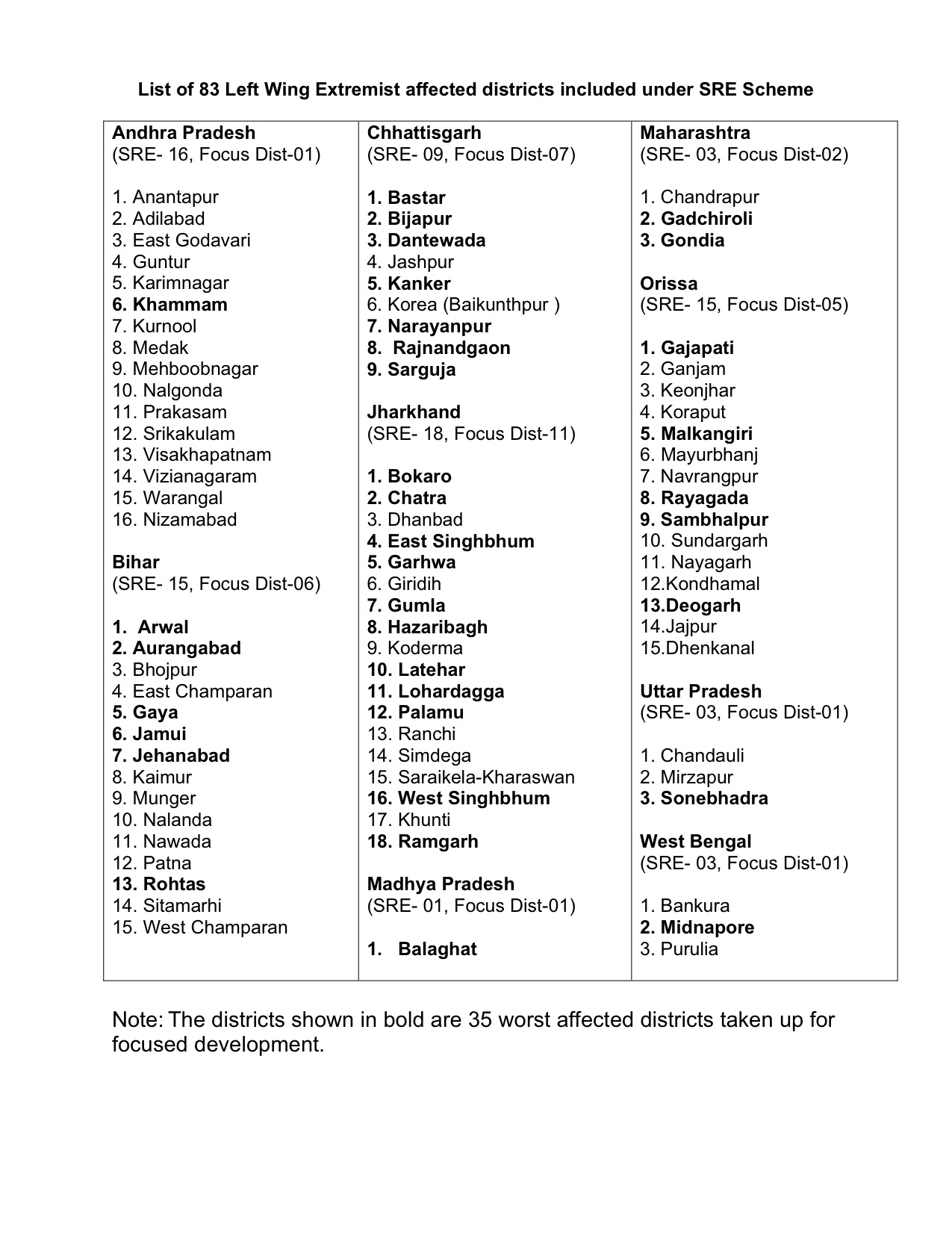
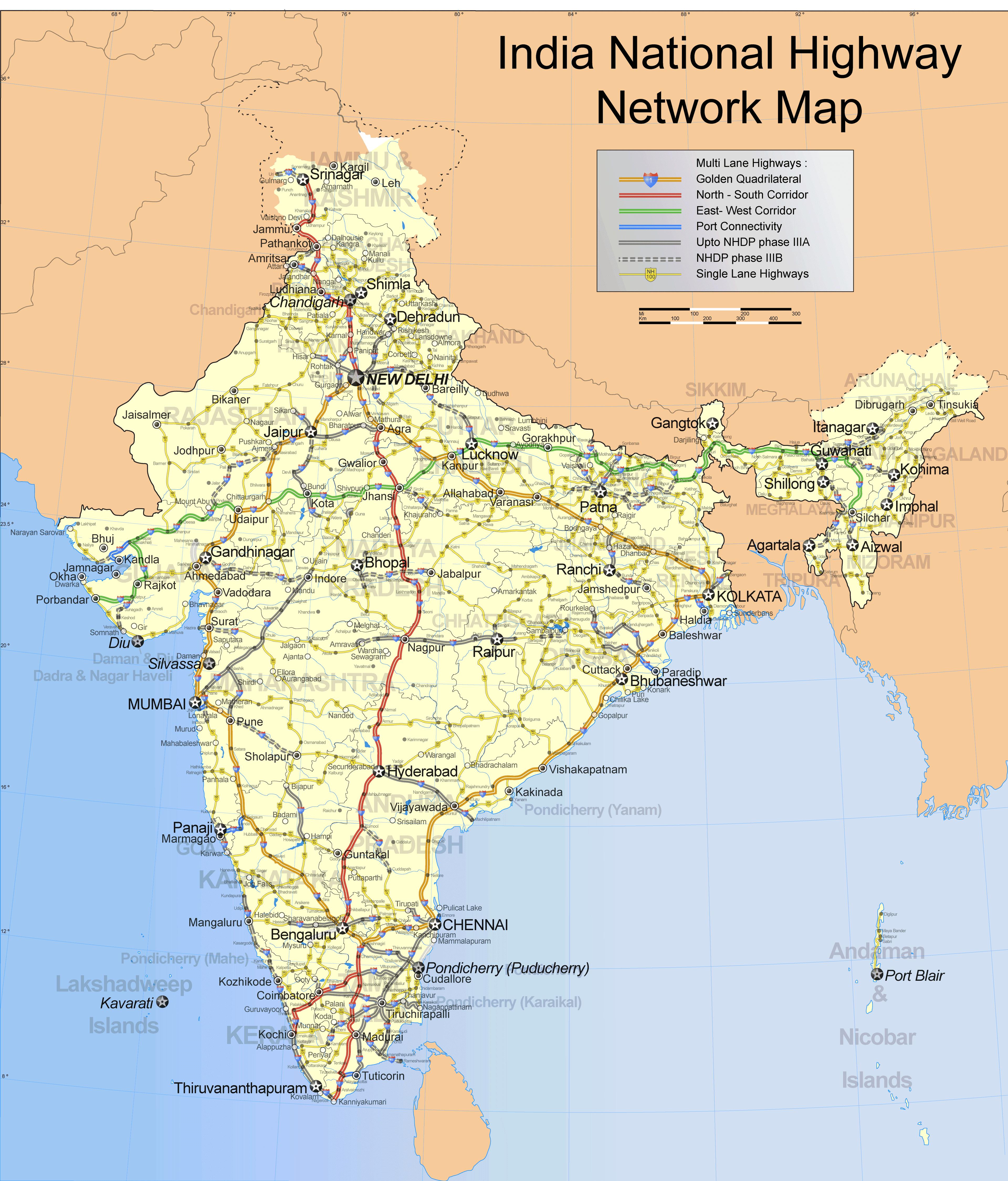
The initial list of 83 Left Wing Extremism (LWE) affected districts under Security Related Expenditure (SRE) scheme is at http://mha.nic.in/pdfs/LWE-aftdDist-131210.pdf. A jpg copy is given below.

In the 83 SRE districts all the expenses incurred on security in these districts are reimbursed by the MHA. These districts were identified after a survey where Maoist violence incidents are more than 20 percent of all the incidents in that district.

As per a recent news item in Pioneer, four more districts from Odisha have been included in this list. They are: Nuapada, Bargarh, Bolangir and Kalahandi.


Besides the LWE SRE scheme, there is an Integrated Action Plan for Backward and Tribal districts. Originally there were sixty such districts out of which:

(a) Five are in Odisha. They are: Deogarh, Gajapati, Malkangiri, Rayagada and Sambalpur. Each of these districts get a block grant of 30 crores.

(b) The eight KBK districts are also included in the IAP and they get the 30 crores each plus 130 crores for all 8 as part of the BRGF (Backward Regions Grant Fund). The eight KBK districts are:  Kalahandi, Nabarangpur, Nuapada, Koraput, Rayagada, Malkangiri, Balangir and Sonepur.

(c) As per a recent news item in Pioneer, three more districts from Odisha have been included in this list. They are: Ganjam, Nayagarh and Jajpur.

In total there are 14 districts from Odisha that are covered under the IAP. They are: Balangir, Deogarh, Gajapati, Ganjam, Jajpur, Kalahandi, Koraput, Malkangiri,  Nabarangpur, Nayagarh, Nuapada, Rayagada, Sambalpur and Sonepur.


In total, 20 of Odisha’s 30 districts are now covered under these schemes. Following is the list.


  • Balangir (IAP, KBK, LWE SRE)
  • Baragarh (LWE SRE)
  • Deogarh (IAP, LWE SRE)
  • Dhenkanal (LWE SRE)
  • Gajapati (IAP, LWE SRE)
  • Ganjam (IAP, LWE SRE)
  • Jajpur (IAP, LWE SRE)
  • Kalahandi (IAP, KBK, LWE SRE)
  • Kandhamal (LWE SRE)
  • Keonjhar (LWE SRE, LWE SRE)
  • Koraput (IAP, KBK, LWE SRE)
  • Malkangiri (IAP, KBK, LWE SRE) (Update: SADP)
  • Mayurbhanj (LWE SRE)
  • Nabarangpur (IAP, KBK, LWE SRE)
  • Nayagarh (IAP, LWE SRE)
  • Nuapada (IAP, KBK, LWE SRE)
  • Rayagada (IAP, KBK, LWE SRE)
  • Sambalpur (IAP, LWE SRE)
  • Sonepur (IAP, KBK)
  • Sundergarh (LWE SRE)

The ten districts that are not covered above are: Angul, Balasore, Bhadrak, Bauda, Cuttack, Jagatsinghpur, Jharsuguda, Kendrapada, Khurda and Puri.

Special programs for naxal hit districts

Central govt. schemes, Extremist infested districts program, IAY, NRLM, PMGSY Comments Off on Special programs for naxal hit districts

Following is an excerpt from a PTI report in zeenews.

In a bid to tackle the Naxal menace in 60 most affected districts, the Centre has decided to start major initiatives there which includes IAY housing for people whose homes have been destroyed and construction of concrete roads.

The Rural Development Ministry has also planned to start a PPP initiative with private companies for value addition in non-timber forest produce in six districts of Orissa, Madhya Pradesh, Jharkhand, Chhattisgarh, Maharashtra and Andhra Pradesh as a pilot project.

… "We are actually going to them for four major decisions. First is Pradhan Mantri Gram Sadak Yojana. We are going to allow concrete roads to be built in the highly affected blocks in the 60 districts. Normally, we build black top roads. But on security point of view, cement concrete roads will be done," Ramesh said.

He said 90 per cent of amount for the construction of the roads will be borne by the Centre and 10 per cent will be borne by the state. At present, the ratio stands at 50-50.

The government also decided to make all sections of people whose houses were destroyed in Naxal violence eligible for housing under the Indira Awas Yojana in these districts.

… "For disabled, widows and old age beneficiaries, the district administration will construct the IAY houses. Right now, what happens is, we give the money, yet these people are unable to construct houses," the Minister added.

All the 60 IAP districts would be covered under the National Rural Livelihood Mission by March 31, 2013, he said.

"We will start a programme for placement linked jobs for 3,00,000 unemployed youths in these 60 districts over the next five years. These youths will be trained and provided jobs," Ramesh said.