Rural electrification programs

New Indian Express reports on the energy minister’s statement on this in the assembly. Following are some excerpts.

Energy Minister Surya Narayan Patro … announced in the Assembly the Government’s commitment to provide electricity to all villages and hamlets in the State by the end of Eleventh Five Year Plan.

The State Government would formulate a captive power policy (CPP) for the captive power plants, he said. … the Minister said rural electrification is being carried out by the State Government under three schemes – Minimum Needs Programme (MNP), Pradhan Mantri Gramodaya Yojana (PMGY) and Rajiv Gandhi Gramin Vidyutkaran Yojana (RGGVY).

Stating that the Government has submitted the detailed project reports (DPRs) to the Rural Electrification Corporation (REC) for 30 districts, the Minister said the DPRs of Angul, Nayagarh, Ganjam, Gajapati and Jajpur districts have been approved. Besides, the DPRs of three more districts – Balasore, Bhadrak and Puri – have received in-principle approval.

The Minister said the Centre has released Rs 92.85 crore in the first phase to the NTPC and NHPC to take up rural electrification work in Angul, Nayagarh and Ganjam districts.

Referring to the Biju Gramjyoti Yojana (BGY) announced by Chief Minister Naveen Patnaik recently, the Patro said under the programme hamlets with less than 300 population will be electrified. He said the Centre rejected the State Government’s request to include hamlets with less than 300 population in the RGGVY.

The State Government has set a target to provide Rs 1000 crore for the programme in the Eleventh Five Year Plan and provided Rs 50 crore in the 2007-08 financial year. Besides, the State Government has also made a provision of Rs 120 crore under the Biju KBK Yojana for providing electricity, road and drinking water to villages.

The Minister informed the House that the Government has undertaken electrification of 4,499 villages under the MNP for which the Centre has provided Rs 120 crore so far. He said by May-end, 3,736 villages have been electrified under the programme.

Stating that five special police stations have been set up to check theft of power and related crimes, the Minister said special courts have been opened to try these cases.

Patro announced that police stations and courts would be set up in the rest of the districts during the year.

Following is Samaja’s coverage on this.
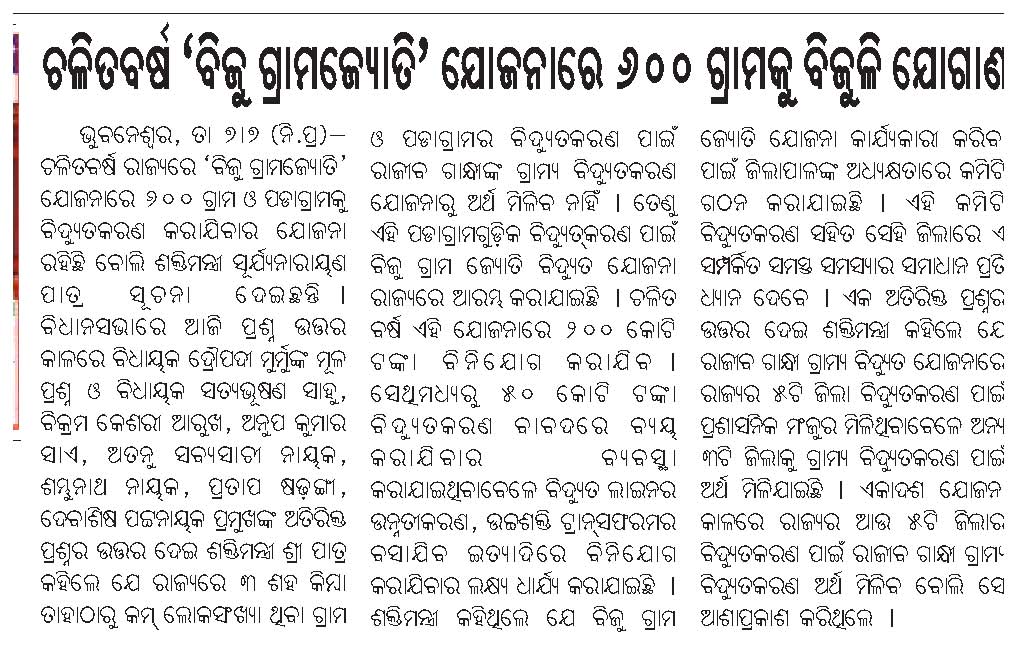
20070708a_003101012electricity.jpg

20070708a_011101003assembly-electricity.jpg

July 8th, 2007 | Chitta Baral | Comments Off on Rural electrification programs

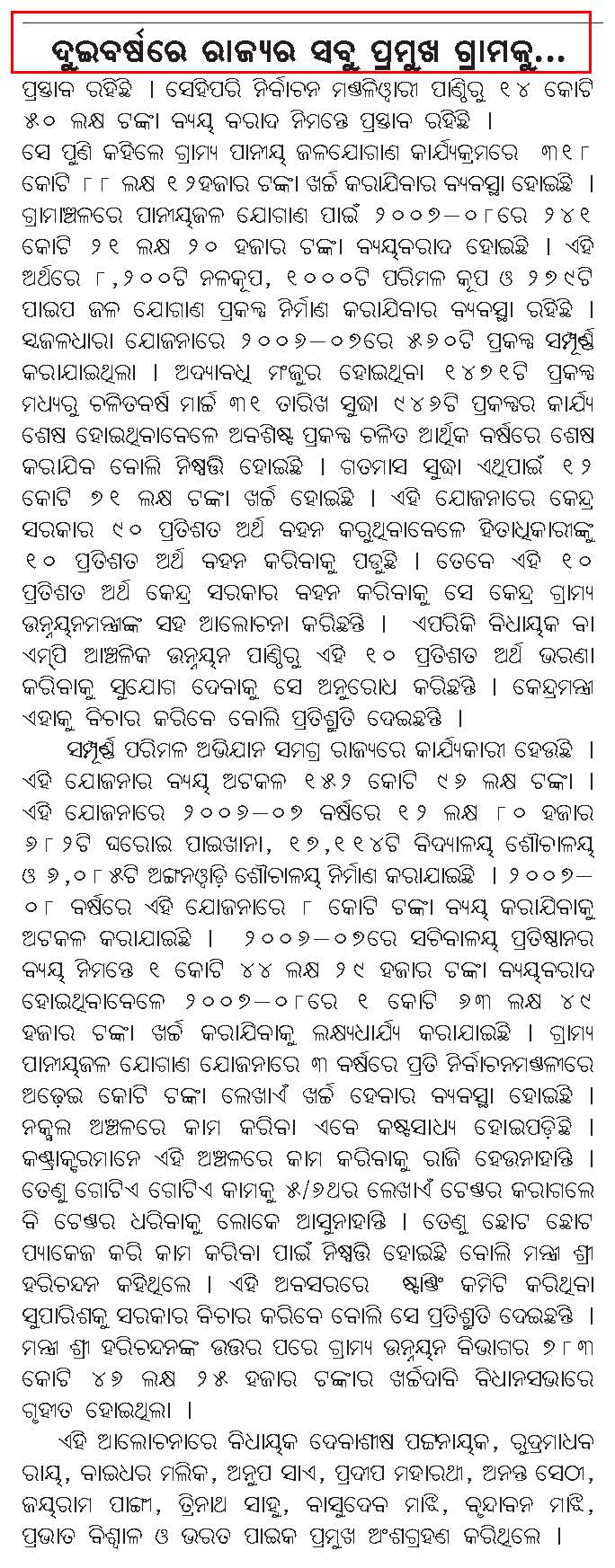
Rural development and drinking water

New Indian Express reports on the minister’s statement on this topic in the assembly. Following are some excerpts:

Rural Development Minister Biswabhusan Harichandan announced in the Assembly on Saturday that 1,722 drinking water projects would be taken up in the State during the current financial year.

… the minister said the State Government has written to the Centre to waive the 10 percent contribution of the beneficiaries under the Swajaldhara scheme. …

Observing that the Prime Minister’s Gram Sadak Yojana (PMGSY) has been a huge success in Orissa, the minister said the State has secured the fifth position in the country in the implementation of the programme.

The Centre had sanctioned Rs 3,342.54 crore between 2000-01 and 2006-07 for construction of 3,723 roads having a length of 12,545.22 km, he said.

Harichandan announced that a target has been fixed for construction of 3,124- km road and upgradation of 2,798-km road under the PMGSY during the 2007-08 financial year.

Expenditure under the schemes funded by the awards of the Twelfth Finance Commission has also been satisfactory, Observing that the total sanitation programme is also a focus area of the government, the minister said Rs 8 crore has been provided in the budget for the programme in 2007-08.

He announced that 12 more divisions of the Rural Development department in addition to the present eight would be opened.

July 8th, 2007 | Chitta Baral | Comments Off on Rural development and drinking water

Irrigation and flood control plans

New Indian Express reports the Orissa minister’s statement on this regard in the assembly. Following are some excerpts:

Refuting Opposition charges that the State Government has paid no attention to flood control measures, Planning and Coordination Minister Padmanabha Behera said a master plan is being prepared in this regard for Tel river basin.

The State Government has also decided to construct a barrage at Barmul on river Mahanadi as a part of flood control measure. Only seven villages would be submerged because of the project, he said.

He reiterated the State Government’s commitment to irrigate 35 percent agriculture land in all the blocks in the State. … the minister said out of the 314 blocks, 194 blocks have less than 35 percent irrigated agriculture land.

More than 60 percent of these blocks are in KBK and backward areas, … and … steps have been initiated under different programmes to increase the land under irrigation in these blocks.

Stating that the project to link Bansadhara with Rushikulya river would not be economically viable, the Minister said the State Government was contemplating to implement Lower Bansadhara project which can irrigate 31,000 hectares.

… Leader of Opposition J B Patnaik said 40,000 hectare agriculture land can be brought under irrigation if a dam is constructed on the upper basin of Mahendra Tanaya river.

…, JB said 30 lakh acres could be brought under irrigation within the next five years by spending Rs 8,000 crore. He said pani panchayats should be scrapped.

July 8th, 2007 | Chitta Baral | Comments Off on Irrigation and flood control plans

The report by the high level committee on National Mineral Policy (Hoda committee report)

The report by the high level committee on National Mineral Policy (Hoda committee report) is available in the planning commission’s web page. The “Conclusions and Recommendations” of the initial Hoda committee report is available here. Orissa government’s response to the initial Hoda committee report is here and further lobbying the PM on this issue is here. To understand the various nuances this old Business world article is very useful.

(Note: Earlier we compiled several mining related links here.)

July 7th, 2007 | Chitta Baral | 1 Comment »

Nuclear power plant in Orissa under consideration

Hindu has reported on the energy minister Mr. S. N. Patro’s statement regarding the location identified by the central government for a nuclear plant in Orissa. Following are excerpts.

The Centre has identified a site in Orissa’s Ganjam district for setting up of a 6000 MW nuclear power plant, …

The Nuclear Power Corporation of India Ltd (NPCIL) has identified Pati Sonapur under Chikiti block where the plant can be established, …

Official sources said if the NPCIL’s proposal of setting up the nuclear power plant materialised, it would be the largest such generation unit in the country.

Though there are 17 nuclear power plants operating in the country, none matches the capacity of the proposed project.

While a total of 4120 mw of power is being generated by all units, the proposed plant alone would produce 6000 mw of power.

Sources said the 17 nuclear power stations are located in six states. While four units each are located in Maharastra and Rajasthan, three are in Karnataka. Two units each are in Tamil Nadu, Uttar Pradesh and Gujarat.

The minister said the NPCIL has already proposed drilling six borewells to reconfirm suitability for the project.

July 7th, 2007 | Chitta Baral | Comments Off on Nuclear power plant in Orissa under consideration

Salient points of the recommended new mineral policy

The economic times reports that the new mineral policy has been announced. Excerpts are mentioned in another post. Here, we list it’s salient features.

  • The GoM has accepted the views of the mining industry while recommending no changes in the guidelines for exports.[This decision supports POSCO’s case for captive mines]
  • More powers provided to state government. The state governments will be able to give preference to companies undertaking value addition within the state while allotting iron ore mines. This will reduce standalone mines.
  • The policy will provide captive mines to all steel units in operation up to July 2006.[I’m not sure about it’s implications for POSCO]
  • The policy will now aim towards procedural simplification for attracting investments in the sector.
  • It will also benefit the states as under the new policy, the present system of specific rate royalty will shift to ad valorem rate of 7.5%.[This will have great benefits for Orissa and other mineral rich states]. Once notified, the proposal will increase royalty earnings by almost six times.
  • The states sitting over mining applications of companies will be penalised as delays will transfer their powers to the Centre.
  • Another important aspect of the new policy is that a process of competitive bidding can be initiated for allocation of captive coal blocks. This is presently done by a screening committee within the coal ministry. The bidding process will also be started for all other major minerals.
  • Besides, the government will auction mining areas where full prospecting has to be done.
  • Companies will have to earmark 3% of turnover for undertaking rehabilitation and resettlement of displaced people under a sustainable development model. However, the ministry of environment and forests will work out fresh guidelines separately to introduce environment-friendly mining practices in the industry.

The economic times states that mining areas will be auctioned for prospecting but the Telegraph says that Auctions mean global giants such as Posco and ArcelorMittal will not be allowed to negotiate for leases with Jharkhand and Orissa on the basis of plans for units in these states. Of course, this statement is speculative. But the states need to be careful before agreeing to this proposal.

Perhaps, We will have to wait and watch for the final notification on the policy.

July 7th, 2007 | Umashankar Das | Comments Off on Salient points of the recommended new mineral policy

BHP Biliton’s proposal rejected

Various news reports mention that BHP Biliton’s proposal has been rejected by the Orissa government as it did not have an appropriate value addition component. Following are excerpts from the Financial Express report.

The Orissa government has rejected BHP Billiton’s proposal to set up a 3-million tonne alumina refinery special economic zone (SEZ) in Gopalpur with an investemnt of $3.3 billion (Rs 14,000 crore). …

The government reportedly refused to accept the offer on the ground that the project did not have any proposal for aluminium smelter. The state government, which is insisting on value addition to at least 50% of the alumina in the state as part of its bauxite mineral policy, has asked the company to submit a fresh proposal with facilities for production of aluminium.

BHP Billiton has sought bauxite mines with proven reserve of 300 million tonne and 5500 acre in Gopalpur for the project.

July 6th, 2007 | Chitta Baral | Comments Off on BHP Biliton’s proposal rejected

GOM’s receommendation on the National Mineral Policy

Following are excerpts from the Economic Times report on this:

A GROUP of ministers (GoM) on Friday cleared the National Mineral Policy that retains the freedom of mining companies to export iron ore without restrictions on quantity or quality. …

The decision also clears the cloud over Posco’s proposed steel project in Orissa that has proposed to export some portion of ore from its captive mines. The company has proposed the exports to enable it to import high-grade ore required for mixing.

However, in order to facilitate value addition within the country and boost steel production, the new policy has given more powers to the state. The state governments will be able to give preference to companies undertaking value addition within the state while allotting iron ore mines. This will mean standalone mining activities will be disincentivised. However, the entire country will be treated as one economic region and states will have to permit transfer of ore outside the state if no one is willing to put up a plant there.

Moreover, the GoM has decided that a balanced policy will be followed while granting captive iron ore mines to steel companies. The policy will, therefore, provide captive mines to all steel units in operation up to July 2006 . It will also benefit the states as under the new policy, the present system of specific rate royalty will shift to ad valorem rate of 7.5%. Once notified, the proposal will increase royalty earnings by almost six times. For example, royalty earnings from iron ore of five ore producing states work out to Rs 250 crore. This will increase to Rs 1,250 crore under the new regime.

However, the new policy will also clip some of the powers of the states. The states sitting over mining applications of companies will be penalised as delays will transfer their powers to the Centre.

Another important aspect of the new policy is that a process of competitive bidding can be initiated for allocation of captive coal blocks. This is presently done by a screening committee within the coal ministry. The bidding process will also be started for all other major minerals.

Besides, the government will auction mining areas where full prospecting has to be done. This will require amendments to the Mines and Mineral (Development & Regulation) Act, 1957, that is likely to be introduced during the monsoon session of Parliament.

Under the new policy, companies will have to earmark 3% of turnover for undertaking rehabilitation and resettlement of displaced people under a sustainable development model. However, the ministry of environment and forests will work out fresh guidelines separately to introduce environment-friendly mining practices in the industry.

July 6th, 2007 | Chitta Baral | Comments Off on GOM’s receommendation on the National Mineral Policy

Some suggestive projects of VISION 2030 plan for BBSR

This is from a document regarding the vision 2030 plan for Bhubaneswar that has been prepared by IIT Kharagpur.

  • Zones for multiplex, Retail-malls and theme parks for outdoor recreation
  • Film city development with ample natural resources and back up from Orissa film industry with necessary infrastructure
  • Logistic Hub for the prime urban centers
  • Textile parks with cottages and medium scale industries for local specialized weaving art.
  • Development of another major Railway Station, to cater to the trains for Western Orissa
  • Circular Trains for cheaper mass transportation within urban areas
  • Upgrading the existing Airport for tourists and higher officials for government and private sectors in the capital city
  • Multi level Freeways for better accessibility with all roadside modern facilities ( Private Sector participation)
  • World Class Club-towns
  • Flood management plan for Cuttack with innovative technology (Venice Model)
  • Garland Lake System to develop and protect the water bodies in the region
  • Major organized open spaces like, urban squares, ceremonial / recreational grounds, and permanent fair grounds as image developers
  • Health city/ Education city/ Software parks etc (new urban districts)
  • Waterfront development with landscape conservation
  • Travel Circuit (Architecture/Archeology/Religious) with facilities like “Palace on Wheels” for international and national tourists
  • “Utkal Sanskriti Prangan” – A representational centre of traditional art and culture, craft,cuisine, living style, fair and facilities of Orissa at Bhubaneswar.
  • Development of Traditional Art Village (Paper/Cloth/Silver/Pottery) in the line of “Arts Acre” in the peri-urban areas of Bhubaneswar
  • Adventure tourism for Reserve forest/ Nature Study camp areas for rare natural species zone
  • Development of Nature Corridors –to provide a feel of flora and fauna in the urban setup
  • Area development of Lingaraj temple and Bindu Sagar with new allied activities
July 6th, 2007 | Umashankar Das | 2 Comments »

Paradip port floats tenders for new berths

Livemint reports that Paradip port has floated tenders for coal and iron ore berths. Following are some excerpts:

Paradip port plans to build a Rs387 crore 10mt capacity berth for handling imported coking coal used for firing steel plants and another Rs505 crore 10mt capacity berth for handling iron ore export from India. When fully operational, the two berths will have deep drafts of 16 metres capable of handling ships of 125,000 tonnes initially and later 185,000 tonnes. …

Paradip port currently operates a 4mt capacity iron ore berth that handled 6.5mt of iron ore in the 12 months to March 2007. “Customers who take coal through Paradip port are allotted only 10mt by the coal ministry. Unless, we are given more, we cannot handle more,” says Raghuramaiah. The coal linkages for each customer are allocated by the coal ministry. Coal is shipped from Paradip to Ennore and Tuticorin ports for customers such as Tam.

July 6th, 2007 | Chitta Baral | Comments Off on Paradip port floats tenders for new berths

A cable alternative to OTV in Orissa

Tathya.in reports that OTV will now have competition to its cable business. Following are excerpts of that report.

Wire and Wireless India Limited (WWIL and Ushodaya Enterprises Private Limited (UEPL), which controls popular ETV joined hands to float Variety Entertainment Private Limited (VEPL) …

VEPL, which has set up the state of the art control rooms in Bhubaneswar and Rourkela promises to provide better cable services in the cities of Orissa.

Announcing the launching of the services Deepak Chandnani, CEO WWIL, said that it will provide 87 channels of national and regional interest to the viewers in Orissa.

He said the services will be expanded in near future to provide digital services including triple play – voice, video and data under the aegis of “GalaxZee” by digitalization of signals.

Chandnani said GalaxZee will provide crystal clear picture, digital audio and video quality.

More number of channels will be added with multilingual facility, said he.

Provision for e-education, e-commerce gamming and video on demand facilities will be given in near future, said Chandnani.

Arvinda Mohan, Executive Director, WWIL said that the cable network service in Orissa depends on the court’s verdict.

July 5th, 2007 | Chitta Baral | 12 Comments »

One more SBI regional business unit in Bhubaneswar

Business standard reports that SBI has started one more regional business unit in Bhubaneswar. Following are some excerpts.

As a part of the decentralisation process and to provide prompt and qualitative service to the customer, the State Bank of India (SBI) has set up one more regional business office in Orissa. With this the total regional business office of the bank has reached five in the state.

The new regional office will function under the Bhubaneswar zonal office of the bank. …

The new regional office will cover 6 branches in the Khurda district and eight branches of Nayagarh district along with 16 branches of the Bhubaneswar city.

Though to start with the bank will have 30 branches and 24 ATMs under its jurisdiction , two more branches are likely to be opened in that area taking the total to 32. While 16 branches are located in urban areas, 5 branches are located in semi-urban areas. Besides, 9 branches are located in rural areas.

Significantly, 23 branches out of these 30 branches have Core Banking Solutions (CBS) facility.

The new region has a deposit of Rs.748.55 crore and advance of Rs.569.39 crore as on May 2007. The decision to set up the fifth regional office is significant as SBI is the lead bank in both Khurda and Nayagarh districts.

Besides, the bank has initiated measures to implement financial inclusion in Nayagarh district. SBI has a presence at every nook and corner of the state and its branches are financial bigbazars, selling all the products under one roof.

The bank has 502 branches at present and 60 percent of the branches are located in rural areas. Subject to Reserve Banks permission, the bank intended to open 40 more branches this fiscal. SBI has taken several measures to improve customer care through business process re-engineering.

Besides, it is involved in various social activities of the state. …

SBI is the lead bank in 19 districts of the state.

July 5th, 2007 | Umashankar Das | Comments Off on One more SBI regional business unit in Bhubaneswar

Writings in oDiA script

The Orissa government web site currently has the following classics in oDiA script.

The site http://www.odia.org/ also has several books and pages in oDiA script.

Various Oriya poem sites:

July 4th, 2007 | Chitta Baral | Comments Off on Writings in oDiA script

Orissa tourism related links from the Orissa government site

July 4th, 2007 | Chitta Baral | Comments Off on Orissa tourism related links from the Orissa government site

PPP pages in the orissa.gov.in site

The orissa.gov.in site is revamped and now has a lot of information. It has a page on PPP (private-public partnership) which contains the Orissa draft PPP policy and a list of projects in Orissa planned to be funded through PPP.

July 4th, 2007 | Chitta Baral | Comments Off on PPP pages in the orissa.gov.in site

Odisha.com reports on hotel groups interested in Orissa

Odisha.com reports about various hotel groups that have expressed interest in building hotels and resorts in Orissa. The list of such hotel groups include:

July 4th, 2007 | Chitta Baral | Comments Off on Odisha.com reports on hotel groups interested in Orissa

Railway track to Dhamara port

A Hindustan Times news report on Dhamara port mentions the following:

A new railway track to Dhamra will be built for movement of cargo to the port. “Out of 62-km of railway track, land acquisition for 52-km of track has already been completed. After the monsoon, construction will gather pace”

July 3rd, 2007 | Chitta Baral | Comments Off on Railway track to Dhamara port

Centre releases Rs 1346 crore to Orissa under various programmes

Following is from a Zee News report.

With the aim to accelerate development in rural areas, the Centre has released Rs 1346 crore to Orissa under various programmes in 2006-07, out of which Rs 762 crore has been allocated under the National Rural Employment Guarantee Act covering 19 districts.

During the current fiscal, the Government has so far released Rs 445 crore to Orissa against the central allocation of Rs 614 crore under major allocation based schemes, official sources said.

Under the NREGA, a total 799.34 lakh person days employment were generated, of which 198.06 lakh person days were for SCs, 393.87 for STs, 284.58 for women and 216.41 lakh persons days for others.

A total of 51,521 works were taken up in the state under the programmes, out of which 18,803 works have been completed and 32,718 are ongoing.

During 2007-08, five additional districts have been included under NREGA. Central release is Rs 94.20 crore and total available funds as on April 1, was Rs 263.28 crore, out of which expenditure of Rs 16.52 crore has been reported.

Under Pradhan Mantri Gram Sadak Yojana (PMGSY), the entitlement of Orissa from 2000-01 till 2006-07 was Rs 1,411 crore against which Rs 1804 crore has already been released and Rs 1638.29 crore has been spent by the state government.

Under Bharat Nirman programme, 2312 habitations of 1000 plus population and 2135 habitations of 500 plus population are proposed to be covered and 9993.36 km road is proposed to be constructed under it in Orissa, they said.

July 3rd, 2007 | Chitta Baral | Comments Off on Centre releases Rs 1346 crore to Orissa under various programmes

Copper snakes made in Bouda district used all over India

DailyIndia.com reports about a village in Bouda district where artisans make copper snakes that are used in temples all over India. Following are excerpts from that report.

Gudbhelipadar Village in Orissa’s Bouda District is today known for its dozens of coppersmith families who have gained popularity for their copper snakes used in different parts of the country.

Each of these over forty families takes pride in the fact that it has been successful at carrying forward a legacy despite all odds. …

These coppersmith families belong to Maharana caste and locally known as “Meher”. They have been involved in this work of making copper snakes since ages. All these years, these families have cherished a dream to keep the ancestral art alive. …

Praful Kumar, another artisan, said: “First, we cut the copper sheet in different body parts of snake, we heat them up. After that, we bend the copper from where we want to and at that time we need lead. We bend it using lead and give it final look.” 

Snakes prepared in this village have been placed in various famous temples. Besides various parts of Orissa, these snakes are sent to various places like Mumbai, Kolkata, Delhi and various places in Madhya Pradesh, Chattisgarh and Andhra Pradesh.

July 3rd, 2007 | Chitta Baral | Comments Off on Copper snakes made in Bouda district used all over India

POSCO Status: a Financial express interview

Financial express carried a short interview of POSCO India Chairman and MD with journalist Dilip Bisoi. This interview gives a good idea of the status of the POSCO India project. Following are some excerpts:

  • How you are going to accelerate the project’s implementation? We have chalked out a strategy to implement the project. We are preparing to start the ground preparation work by October 2007. Out of the 4,004 acre of land, 3,566 acre is government land and 438 acre is private land. Out of the private land, only 30 acre is fertile land as it yields double crops. We are willing to exclude the 30-acre fertile land from the project site. We are also willing to differ use of the 438 acre private land until the villagers were willing to sell.
  • Anti-Posco activists have set up checkpoints and are not allowing anybody to enter the site. How do you plan to enter the area and start work? It is not true that we don’t have access to the site. We do have some access to the site. Villagers in Gadakujanga grampanchayat are supporting the project, while people in Nuagoan area are starting to change their mind in favour of the project. Only a small area of Dhinkia grampanchayat is not accessible. We will shed that portion from the project site for the time being. Access to the site and starting civil work will not be difficult.
  • Have you prepared your R&R package?  We are preparing a special R&R package for the displaced people. The Xavier Institute of Management, Bhubaneswar, has been engaged in conducting a survey to understand the needs of the people. The package will be announced once it gets the approval of the Rehabilitation & Peripheral Development Authority. I promise, I will make their lives better than before. Rehabilitating 450 displaced families is not a big job. We want to provide them with a sustainable livelihood.
  • How confident you are that the project work will start by October 2007? The next two to three months are very crucial. The prospecting licence for the Khandahar iron ore mines and forest clearance for the project site are expected in the next few months. Once these issues are settled, we will go ahead with the land preparation. If everything goes according to plan, we will procure equipment for the steel plant by the second half of next year. We will shop in the Indian market before going to Asian countries like China and Vietnam. The main plant, however, will be imported from Posco in South Korea. However, starting of the peripheral work at the site by October is very essential.
July 3rd, 2007 | Chitta Baral | Comments Off on POSCO Status: a Financial express interview

Tatasteel, Dhamara port and Greenpeace

Recently there were some reports on Greenpeace’s opposition to the Dhamara port. Following are some excerpts of a news report that talks about Tata Steel’s response.

India’s Tata Steel Ltd said it will go ahead with its 24.6 bln rupee joint venture with Larsen & Toubro to set up an all-weather port at Dhamra, in the eastern Indian state of Orissa.

Tata Steel spokesperson Yogesh Joshi said the company had no intention of abandoning the project and said work will continue as usual. …

Dhamra port is crucial for India as traffic is projected to grow to 2 bln tonnes by the year 2016, and all the ports of the country put together are presently handling only 760 mln tonnes.

Sheltered between the mainland and the Kanika Sands Island on the eastern coast, Dhamra port will be the deepest all-weather port of its kind in India, with a draught of 18.5 metres. It will be able to accommodate super cape-size vessels of up to 180,000 dead weight tonnes.

July 3rd, 2007 | Chitta Baral | Comments Off on Tatasteel, Dhamara port and Greenpeace

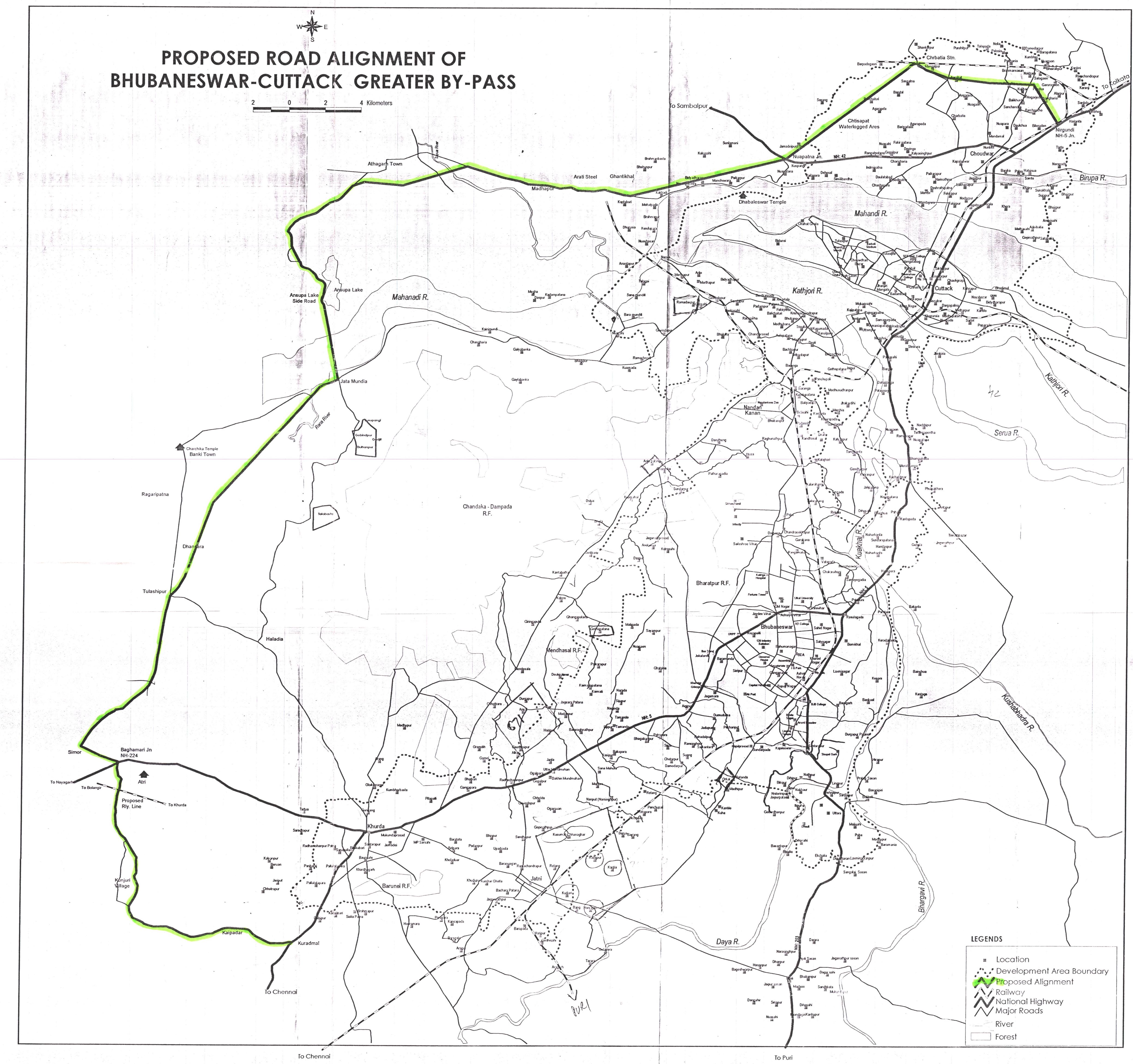
Proposal to connect Bimlagarh and Nayagarh (near Keonjhar) for a shorter Bhubaneswar-Rourkela route

The following article from Sambada suggests connecting Bimlagarh with Nayagarh (near Keonjhar) for a shorter Bhubaneswar-Rourkela route. It talks about the delay in constructing the Talcher – Bimlagarh line and proposes this alternative.

If Bimlagarh is connected to Nayagarh then the route between Bhubaneswar and Rourkela will consist of the following segments: Bhubaneswar – Jakhapura (92kms), Jakhapura – Tomka (24kms), Tomka – Nayagarh (130kms), Nayagarh – Bimlagarh (30?kms), Bimlagarh – Bondamunda HLT (46.5kms), Bondamunda HLT – Rourkela Jn (12 kms).

July 3rd, 2007 | Chitta Baral | Comments Off on Proposal to connect Bimlagarh and Nayagarh (near Keonjhar) for a shorter Bhubaneswar-Rourkela route

Samaja: Kalinganagar is becoming the Steel capital of India

The following article from Samaja lists the various steel plants in operation and under construction in the Kalinganagar area. They are: Nilachal Ispat Nigam Limited, Jindal, MESCO, VISA, JK Steel, Rohit, Dinabandhu and Maithan which have started production; and Tata Steel which is in preparation.

July 3rd, 2007 | Chitta Baral | Comments Off on Samaja: Kalinganagar is becoming the Steel capital of India